Tag Archives: poetry

Eunice Andrada’s Flood Damages

Eunice Andrada, Flood Damages (Giramondo 2018)

damages.jpg

There’s a lot of pain in these poems: the pain of migration and living in diaspora, of miscarriage and sickness, of  domestic violence, racism and internalised racism, and – shockingly topical just now – of family separation at the hands of officaldom. There are also poems that celebrate the body and family relationships, especially of a young woman with her grandmother.

There’s a wonderful variety in the forms of the poems. There are ‘novenas’, which echo the cadences of the Catholicism of Andrada’s native Philippines. There are prose poems – such as the one that would be a straightforward account of an allergy test except that the doctor is Ferdinand Marcos. There’s ‘photo album’, made up of captions to photographs, some of which probably actually exist. There’s a narrative element: no dates, times and places, but a cast of characters that we come to recognise, and when in ‘alibi’ the speaker refers to ‘the muscle memory of dancing / to the gospel / of my father’s temper’ the reader knows what she is talking about.  There are elusive epigrams, of which the best example is ‘forms’:

It is no sacrifice
when he collapses over his own altar
then asks for your body.

Eunice Andrada is also a Spoken Word practitioner – a poet of the stage as well as the page. She recently appeared at the fabulous Bankstown Poetry Slam. Here, for my readers who might hesitate to read an actual book of poetry, is a video of her performing her climate change poem ‘Pacific Salt’ at Sydney’s 2015 Youth Eco Summit, preceded by a short and charmingly awkward interview:

Flood Damages is the tenth book I’ve read for the 2018 Australian Women Writers Challenge. I am grateful to Giramondo for my copy.

Michael Farrell Loves Poetry

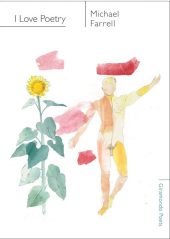
Michael Farrell, I Love Poetry (Giramondo 2017)

ilovepoetry.jpgSomeone said (on Twitter) that if a reviewer doesn’t get the thing they are reviewing, then no matter how long the review is, it will just be a whole lot of different ways of saying ‘I don’t get it.’ So, though I think of myself as a reader with a keyboard rather than a reviewer, I’ll make this brief.

I don’t get a lot of Michael Farrell’s poetry. That is to say, in some of his poems I really can’t tell what’s happening, apart from random phrases appearing on the page. It’s not like it’s a foreign language – I can’t tell if it’s a language at all. For instance, here’s the start of one poem (punctuated as in the book):

K In The Castle

I

Like a food documentary from 2013
Know something of your life
———and character. giraffes cry

Australian giraffes – third generation. everyone has
coconut in their tears, saliva and blood

Apart from recognising the reference to Kafka’s The Castle in the title, I draw a blank. I’m not even puzzled. My guess is that this is doing something that’s discernible to readers who are versed in contemporary poetics, but certainly not to me, and a fair amount of this book is as inaccessible (to me) as that.

Then there are poems that work for me in a tantalising way that makes me think of the fan dancers who performed in sideshow tents at the Innisfail Annual Show in my 1950s childhood. As a nine or ten year old I wasn’t oblivious to the performances’ salacious dimension, but I was mainly enthralled by the dancers’ amazing skill at waving ostrich feathers around while keep their presumably naked rude bits hidden. I don’t mean (obviously) that the poems are salacious, but that the frequent brilliant phrase and the pervasive, if sometimes annoying, playfulness are what keep me going, along with a feeling that often just out of sight there’s something coherent and beautiful.

There are some enticing opening lines:

Blue Poles and INXS shuffle into a bar. ‘What’ll you have?’
(‘Into A Bar’)


In Newcastle a businessman half-disappeared into another life.
(‘Death Of A Poet’)


The boxer has great hair, a great beard, great ink
jobs down both arms. He likes to pull up his
shirt when he’s with his friends: just above the nipples
(‘The Boxer’)


Bending over in shorts forever, Australianything
can remind us more of a country and western
song than a rap
(‘When Arse Is Class, Or Australianything’)

The poems then reliably take off in reliably unpredictable directions.

Sometimes I think I catch a glimpse of what lies behind the fan-dancing. ‘Cate Blanchett And The Difficult Poem’, perhaps the most straightforward of the book’s narrative poems, is a case. In it Cate Blanchett chats ‘laconically, fragmentedly’ with Waleed Aly while preparing to go on stage to read a difficult poem. Partly I feel relatively confident with it because I get most of its references.I know who Cate Blanchett and Waleed Aly are, and also Judith Wright and Patrick White who are both mentioned. The reference to ‘Jackie Weaver’s eye manoeuvres in Animal Sconedom / as they scorched their moving targets’ would be lost on anyone who hadn’t seen David Michôd’s Animal Kingdom, but it a great description of that performance in that film. I’ve even seen Julian Rosefeldt’s multi-screen video work Manifesto, in which a protean Blanchett performs a multitude of artistic manifestoes, and which may lurk in the background of the poem.

But those are all part of the ostrich feathers. The thing that I have glimpsed is possibly an account of a poetic method. After Cate has read the text silently then aloud, trying out different tones and accents, an actor preparing, the ground shifts beneath our feet and she starts inserting lines from Judith wright’s ‘Woman to Man‘:

Blanchett’s jaw connects to a signal tower in her brain
that produces a pas de deux between the difficult
poem – but does it exist? – and the Wright poem, which
she gradually replaces with – not exactly quotations from
she’s not a complete freak – paraphrases of scenes from
Patrick White novels

A couple of lines later, Cate says to Waleed:

You have to fake it with a difficult poem: be like
I ain’t easy either, me. Treat it like a camera or
call it to the stage for an award and trapdoor it.

I like to think that’s a description of Farrell’s method: there’s a text (in the sense that everything we experience is text of one sort or another) that he has some difficulty with (for values of difficulty that include interest in a complexity), or maybe there’s nothing there at all (‘but does it exist?’); you make a poem from it by faking it, being like ‘I ain’t easy either, me’, that is tosay, by assuming you’re on equal terms with it – perhaps inserting bits of other texts (childhood memories, bits of pop culture, literary allusions), improvising a performance around it. By this method, of course, the original text / idea/ emotion will be hard if not impossible for the reader to see: what we are reading is a pas de deux between it and the poet, or perhaps only the poet’s side of the pas de deux. And maybe it’s a danse des éventails  de deux.

There’s also an implicit invitation to readers to do their own pas de deux with Farrell’s poetry. This has been an attempt to do just that.

Once again, I’m happy to acknowledge that my copy of the book is a generous gift from Giramondo.

Maryam Azam’s Hijab Files

Maryam Azam, The Hijab Files (Giramondo 2018)

img_2516.jpg

In ‘Hotel Golf’ in the current issue of The Monthly, Erik Jensen writes that Helen Garner doubts if many people who attend church actually believe – she thinks that’s a myth maintained by non-religious people.

As a non-believer, I understand how Garner herself can participate in religious services without subscribing to the underpinning beliefs, but surely it’s just a failure of imagination to project that lack of belief onto the other participants. To put that another way, Helen Garner doesn’t seem to have met ‘many people’ like my Catholic  mother, or me in my teenage years, or – to get to the point – Maryam Azam, the author of The Hijab Files.

The 29 poems in this small book aren’t religious poems, but they are infused with a religious understanding of the world. Many of them focus on the hijab, and it’s hugely refreshing to hear a clear, nuanced, non-Orientalist voice on the subject, sometimes cheerfully practical (‘A Brief Guide to Hijab Fashion’, ‘Places I’ve Prayed’), sometimes satirical from an unexpected viewpoint (‘Modestique’), sometimes touching on friendly or hostile reactions from non-Muslims (‘The Hobbling Bogan’, ‘Praying at School’), sometimes addressing difficulties with other Muslims (‘Fashion Police’).

To single out one poem, here’s ‘Fajr Inertia’ (the Arabic fajr is explained in the epigraph):

Come to prayer! Come to success! Prayer is better than sleep!
FROM THE FAJR ADHAN (DAWN CALL TO PRAYER)

I lie in the knowledge of my failure
the way I lie through my chance at success,
hip sunk into the mattress
blanket over my chin
staring at a yellow flower clock
with a missing plastic cover
that reads six minutes past seven;
twenty-five minutes too late.
The broken gas canister of sleep
slowly clears from my head.
I hide under the covers from
the light invading my room
but I can't hide the fact
I'll have to live today outside
of Allah's protection.

You don’t have to be a devout Muslim to understand this: the emotion isn’t a million miles from how I feel when I missed my pre-breakfast visit to the swimming pool, and realise I’ll have to live the day without that half hour of self-care. Who hasn’t woken up befuddled by a ‘broken gas canister of sleep’? With a gorgeous lack of portentousness, the poem places Allah’s protection in the middle of this commonplace experience.

Helen Garner’s scepticism about other people’s religious belief is probably typical of non-believers in these secular times. The Hijab Files speak back quietly but definitely to challenge that scepticism.

If you’re interested in getting more of a sense of this poet, you could have a look at a short, 5-question interview with her on Liminal magazine, here.

The Hijab Files is the seventh book I’ve read for the 2018 Australian Women Writers Challenge. I am grateful to Giramondo for my review copy.

John Mateer’s João

John Mateer, João (Giramondo 2018)

joão.jpgJoão is a man’s name, the Portuguese equivalent of John. So it was serendipitous that a copy of this book was in the mail waiting for me when we got back from the trip that included a memorable couple of weeks in Portugal.

The Book is made up of two unequal parts. The first, ‘Twelve Years of Travel’, consists of 58 sonnets – 58 fourteen-line moments in which the character João travels the world, seeing the sights, attending poetry events, partying, having sometimes embarrassing sexual encounters (mind you, I tend to find all writing about sex embarrassing), spending time with friends and inlaws, occasionally hobnobbing with the famous, and ruminating self-consciously. The sonnets make up a kind of discontinuous narrative, which is a term I first met in the context of Frank Moorhouse‘s short stories. The comic self-deprecation of many of the sonnets also reminds me of Moorhouse’s early stories. One of the famous writers who appear is Vikram Seth, author of The Golden Gate, a fabulous novel made up of sonnet-like stanzas, but even though it might be possible to discern a narrative through-line in João, it is not a verse novel in that way, and nor are his sonnets as formally strict as Seth’s stanzas.

These sonnets read as if they were written during John Mateer’s own travels, João being a semi-transparent mask that allows for a playful distance between character and poet, while gesturing to Mateer’s complex relationship to national identity: for example, he was born in South Africa, spent part of his childhood in Canada, is an Australian citizen, and has strong connections to Portugal and the Portuguese diaspora (hence João rather than, say, Giovanni or Johan). I imagine Mateer walking back his hotel room in Macau or Colombo or Prague, finding the words to squeeze something from his day into fourteen lines about João, partly as discipline, partly as play.

The second section, still featuring João, is just four sonnets grouped under the heading ‘Remembering Cape Town’. As far as I can tell, the only reason they are in a separate section is that Cape Town is in a sense home for both John and João, so involve encounters with family and childhood memories.

Here’s a sample. It’s the 50th sonnet from ‘Twelve Years of Travel’:

Vomiting as critique, João thought bent
over in the millionaire’s dark Balinese garden,
while in the marquee the other writers went
through the motions of being gracious. Forgotten
was introspection; they were just acting true
to their personae. Then he wiped his face,
went back to the table where he and others, too,
watched those more famous. ‘My disgrace,’
he quipped, ‘is that affluence makes me sick!’
His mind loved the tropical opulence, his body,
though, was still political. No laughter. Restricting
himself to French, the Egyptian writer, now less moody,
was again bragging to a younger Australian woman.
João, like the watching servants, was alone, forgotten.

This probably needs to be read aloud. The rhyming is important (as it is in the whole book, though not always consistently as here). It avoids the feeling of glibness that can be created by perfect rhyme (rotten/forgotten, say, is more obtrusive to modern ears than garden/forgotten or woman/forgotten), but its regularity makes the reader aware that there’s a verse structure at work. Though I don’t think there’s a regular metre, there are five conversational beats a line. True to the sonnet form, there’s a turn at the halfway point: up to then João is vomiting in the dark garden looking back into the marquee. In line 7 he becomes one of the group again.

The story is relatively trivial. A less than famous writer has a reaction to the food at a writerly party (presumably at the Ubud Writers and Readers Festival). He vomits in the garden. On his return he makes a joke about his sickness which falls flat, and then is left feeling alone and socially awkward as the conversation near him, possibly sexually charged, is in a language that he’s not proficient in.

But it’s interesting how much happens in these fourteen lines. Wordsworth’s notion that ‘poetry takes its origin from emotion recollected in tranquility’ comes to mind, only the origin of this poem is a bit more physical than that. The emotion, and the thinking – the ‘critique’ – stem from the intense experience of regurgitation. If you’re out in the garden vomiting, you’re very likely to feel alienated from the people who are still happily chatting inside, so from the start there are invisible //irony// markers around João’s ‘critique’: yes, it’s a millionaire’s garden in a country where most people live in poverty; yes, people at parties tend to put on their party faces (their ‘personae’) rather than go in for ‘introspection’ (which I read as shorthand for serious thought). But what do these reflections amount to other than another form of self-indulgence? When João returns to the party, he tries to mould his observation into a quip. The fact that he fails – ‘No laughter’ – doesn’t take away from the fact that he wants to maintain his status as a partier.

Then, primed as we are from Shakespeare to expect things to be wrapped up neatly in the final couplet of a sonnet, we come to the lovely twist in the final line:

João, like the watching servants, was alone, forgotten.

Well, no, João isn’t like the servants, and the poem doesn’t expect us to think so. João is on the outer because he got sick, because he’s not one of ‘those more famous’, and because the French-speaking Egyptian writer and the Australian woman aren’t interested in him. People who work as servants in Bali are excluded by much harsher factors. And it’s in the nature of a party that they are more or less ignored by the partiers. João thinking of himself as ‘like’ them is self-pity, not solidarity. By putting them in the picture, though, the poem takes a mocking step back, suggesting a wider perspective. And I don’t think it’s stretching the point to read the repetition of ‘forgotten’ as a rhyme word as talking to us over João’s head, suggesting that whereas the vomiting João thought that forgetting ‘introspection’ was something to be criticised, actually forgetting a whole class of people is o a whole other level. We’re still fond of João, but a lot happens in the space between him and ‘John’ the poet.

I’m grateful to Giramondo for my copy of João.

Jacqueline Woodson’s Brown Girl Dreaming

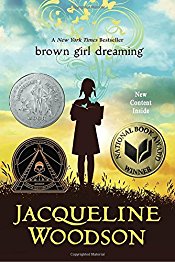
Jacqueline Woodson, Brown Girl Dreaming (2014)

browngirl.jpgThis is a memoir in verse written for a mainly YA readership. ‘YA’ stands for ‘Young Adult’, publishing jargon for teenagers, but don’t let that put you off: teenagers get some of the best stuff.

It’s a portrait of the writer as a young woman who is Africa-American. She was born in Ohio in the early 1960s, and the Civil Rights movement features in this narrative as significant backdrop.

___________ we can’t turn on the radio
without hearing about the marching.

After her parents split up she and her two siblings move to Greenville, South Carolina, to live with their grandmother who imposes strict Jehovah’s Witness discipline, then at about the age of seven they rejoin their mother in Bushwick, Brooklyn, where the Witness discipline is relaxed somewhat, and among other things young Jacqueline discovers her vocation as a writer.

There’s something almost miraculous in the way the narrative swings along, one short, self-contained poem at a time. The little girl’s relationships with her mother and grandparents, and even with the father they leave very early in the piece, are finely drawn. Likewise her position in the family: in the shadow of her smarter older sister, concerned for their vulnerable youngest brother, born in Brooklyn, and proud of their quietly achieving middle brother. There’s a lot about the Witnesses and the Civil Rights Movement, and the joys and pressures on children’s inter-racial friendships. When a beloved uncle comes home from gaol as a convert to Islam, the telling provides a tender contradiction to the way such a story would be treated in the mainstream press.

This is from near the end of the book, but I don’t think it’s a spoiler:

the promise land

When my uncle gets out of jail
he isn’t just my uncle anymore, he is
Robert the Muslim and wears
a small black kufi on his head.

And even though we know
we Witnesses are the chosen ones, we listen
to the stories he tells about
a man named Muhammad
and a holy place called Mecca
and the strength of all Black people.

We sit in a circle around him, his hands
moving slow through the air, his voice
calmer and quieter than it was before
he went away.

When he pulls out a small rug to pray on
I kneel beside him, wanting to see
his Mecca
wanting to know the place
he calls the Promise Land.

Look with your heart and your head, he tells me
his own head bowed.
It’s out there in front of you.
You’ll know when you get there.

It’s a terrific book, and the reader falls in love with young Jackie and her family, so it’s a real pleasure to discover the pages of photos of them all up the back.

I feel obliged to mention, though, a shock I had when I read the poem ‘bushwick history lesson’. The first four stanzas begin: ‘Before German mothers wrapped scarves around their heads’, ‘Before the Italian fathers sailed across the ocean’, ‘Before Dominican daughters donned quinceañera/ dresses’, and ‘Before young brown boys in cutoff shorts spun their / first tops’. We are reaching back into the beginnings of this part of the world. But where we get to is: ‘Before any of that, this place was called Boswijk.‘ In the beginning were the Dutch and ‘Franciscus the Negro, a former slave / who bought his freedom.’ For young Jacqueline, this meant that African heritage people had been in Bushwick from the beginning. But for the reader it’s a painful shock all the same to have the pre-colonial past, and the dispossession of Native Americans so thoroughly erased.

To quote Joe E Brown’s character says at the end of Some Like it Hot, ‘Well, nobody’s perfect!’

Simon Armitage’s Flit

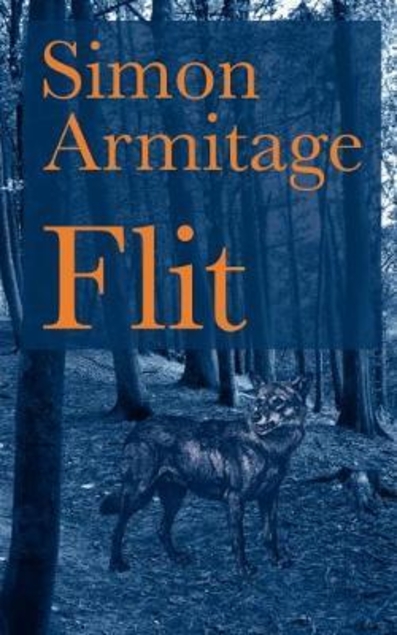
Simon Armitage, Flit (Yorkshire Sculpture Park 2018)

FLIT.jpg

This handsomely produced book of poems and photographs (mainly taken by the poet) was published to coincide with a small exhibition at the Yorkshire Sculpture Park featuring a selection of the photos and a video of Simon Armitage reading some of the poems.

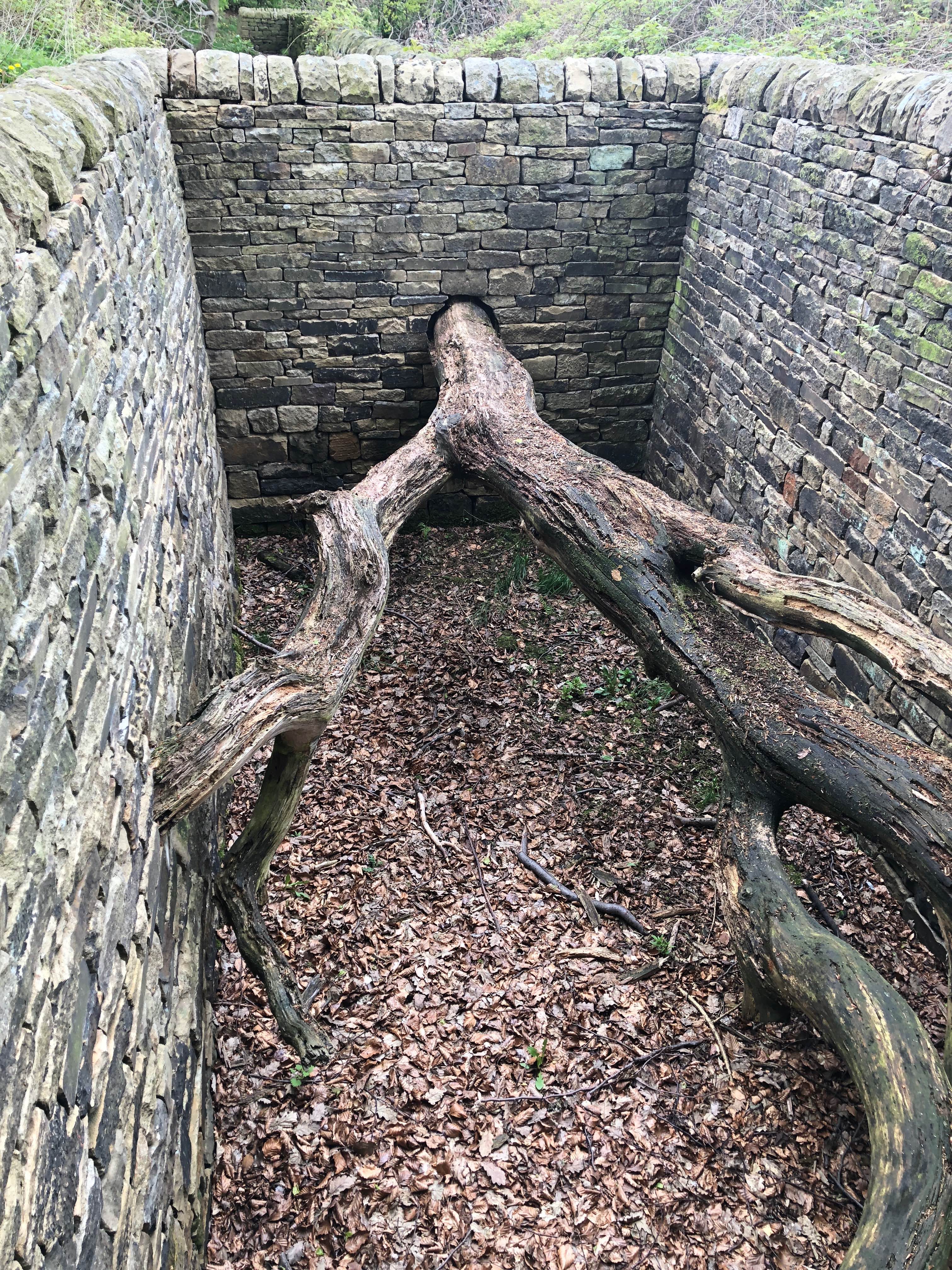
The Yorkshire Sculpture Park is brilliant: Henry Moore sculptures and sheep happily coexist in the fields, in wooded areas you stumble on Andy Goldsworthy’s extraordinary land art, an Ai Wei Wei Iron Tree stands outside a chapel, and there are any number of special exhibitions, including, when we visited in early May, the Simon Armitage room and Chihara Shiota’s Beyond Time, which fills a small building with floating memories of its past identity as a chapel.

hangingtree

Part of Andy Goldsworthy’s Hanging Trees. Photo by Penny Ryan

IMG_6897

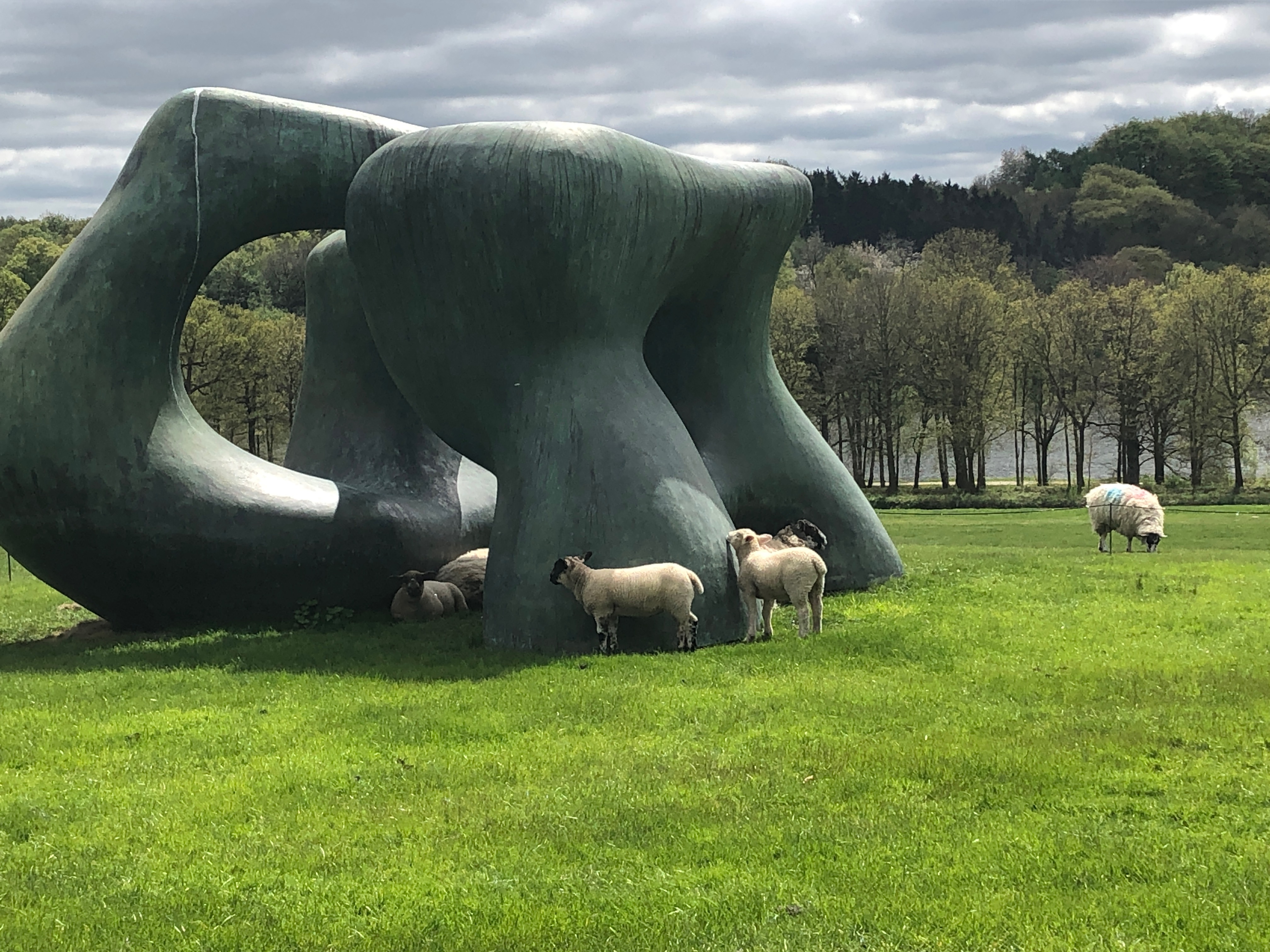
Henry Moore, Two Large Forms and sheep. Photo by Penny Ryan

Back to the book. The YSP website describes it like this:

The fully illustrated publication comprises 40 poems by Armitage, who was poet in residence at YSP throughout 2017, its 40th anniversary year. […] Rather than writing a direct commentary on the Park, he has redefined it as its own country, the little known Ysp (pronounced eesp). Letting his imagination run wild, Armitage has mapped an elaborate, alternative reality that melds fact and fiction, creating a fanciful existence for both YSP and the poet himself.

The key word of that is ‘fanciful’. At least for this reader, the book hardly relates at all to the experience of the Park. Less than a quarter of its photos show any of the sculpture – most are of the park’s buildings old and new or of its woods and water, some with odd images collaged into them: a Vietnamese fisherman sitting on the roof of a shed; a paddle-steamer on one of the streams. The photographs are beautiful, and so are the poems, but for me the conceit falls flat – my main response to the Ysp poems (a queue that lasts for months, the legend of a great drought …) is impatience. I guess what I wanted, to use the words of the website, was ‘direct commentary on the Park’.

All the same the individual poems are a good read. I’ve heard Simon Armitage read on the radio, and am glad to have got to read some of his work on the page.

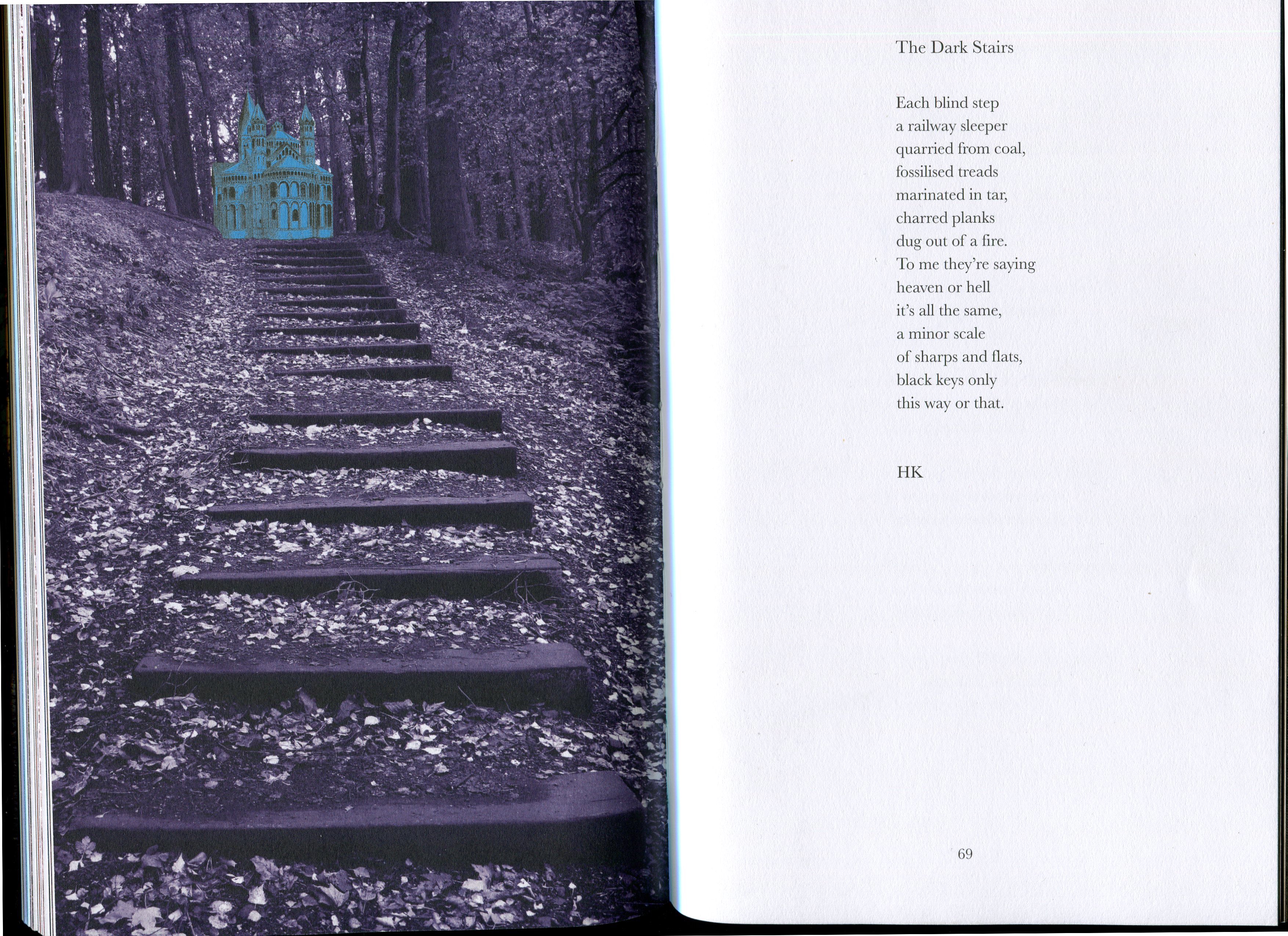
Here’s a spread that includes ‘direct commentary’ on a sculpture (an ekphrastic poem, to use the technical term):

steps.jpg

On the left is a photograph of David Nash’s ‘Seventy-One Steps’, with the image of an odd temple-like building fancifully, and to my mind awkwardly, inserted. In real life you encounter this sculpture as you walk through the woods, and if you weren’t on the alert you might just walk on the steps without realising they were a work of art, though you would probably register that they are a lovely piece of work.* What you can’t see in the photo is that the dark, hefty oak steps rest on 30 tonnes of coal which will gradually erode. (The work was originally called The Black Steps, but it has already changed enough that it has been renamed.)

On the right is ‘The Dark Stairs’, presented as a translation of a poem by Armitage’s invention, ‘Ysp’s most famous poet, HK’. It’s a 14 line response to the sculpture, the short lines themselves a bit like steps.

[Inserted later: I realised that the text is hard to read in that image, so here’s the poem in full:

The Dark Stairs

Each blind step
a railway sleeper
quarried from coal,
fossilised treads
marinated in tar,
charred planks
dug out of a fire.
To me they’re saying
heaven or hell
it’s all the same,
a minor scale
of sharps and flats,
black keys only
this way or that.

The more I look at this poem, the stronger it feels. Where Seamus Heaney’s poem ‘Polish Sleepers’ spells out the dark associations of railway sleepers by invoking the Holocaust, Armitage (ventriloquising HK) invokes elemental forces of fire and fossilisation, and perhaps the spectre of global warming, and does exactly the thing that I had hoped for from the book as a whole, finding words that help name the feelings evoked by the work.


*One of the joys of the Park is that this is true of a number of the sculptures: you could easily miss the Andy Goldsworthy piece above if you didn’t happen to look over a low stone wall, and there’s a brass sculpture that looks for all the world like the exposed roots of trees.

Carol Ann Duffy’s Feminine Gospels

Carol Ann Duffy, Feminine Gospels (2002, Picador 2017)

gospels.jpgThis book is on the curriculum in UK schools, and that is definitely a good thing: its wholehearted focus on female experience is a welcome corrective to the existing gender imbalance. The surreal, shaggy-dog story form of most of the poems – a shopping woman accumulates huge quantities of stuff, goes broke and eventually metamorphoses into a shop; a character named Beauty becomes a series of celebrated women, from Helen of Troy to Diana Spencer; one girl’s unstoppable giggling in class infects the whole school, leading eventually to the school closing its doors as all its teachers leave to follow their dreams – provides plenty of scope for classroom dissection and discussion. And there’s much joy to be had in the way the words sound and work on the page.

I’d better give a warning to any students who stumble on my blog looking for help with an assignment. I’m a seventy-something man from Australia who likes to read and to write something about everything I read. I would probably fail the A Levels.

I’ll stick to my rules and single out just one poem. There is handful of wonderful, memorable and readily memorisable lyrics at the end of the book, of which I especially liked the love poem ‘White Writing’ and the elegiac ‘Death and the Moon’. But the poem that struck me most forcefully on second reading is ‘History’, not actually a tall-story poem, but a close relative. You can read the whole thing here – it’s not long.

The poem begins with a picture of an old woman ‘not a tooth / in her head, half dead … smelling of pee’. who is a personification of History. There follows a list of events she has witnessed, and from a particular Eurocentric/Christian sample of world history:

She’d seen them ease him down
from the Cross, his mother gasping
for breath, as though his death
was a difficult birth, the soldiers spitting,
spears in the earth;

——————————been there
when the fisherman swore he was back
from the dead; seen the basilicas rise
in Jerusalem, Constantinople, Sicily; watched
for a hundred years as the air of Rome
turned into stone;

——————————witnessed the wars,
the bloody crusades, knew them by date
and by name

I love ‘the air of Rome / turned into stone’ as a way of capturing the transformation of the fluid, liberatory Jesus movement into a hard, authoritarian institution, and then the way that transformation segues to the wars and crusades.

There’s a bit of a leap in the next bit:

Bannockburn, Passchendaele,
Babi Yar, Vietnam.

These are not crusades, three of them aren’t even wars. Bannockburn (1314) was an important victory against the English for Duffy’s native Scotland, and the rest are emblematic moments of violence in the 20th century: the battle of Passchendaele (1917) of the First World War (and incidentally the subject of Paul Ham’s book that won the Douglas Stewart Prize for Non-Fiction this year); the massacre of Babi Yar (1941), the Second World War and the Holocaust; and the Vietnam War (1955–1975), known in Vietnam as the American War, a dominating feature of the first 20 years of Duffy’s life. If the poem had been written a few years later, it might well have included George W Bush’s invasion of Iraq and the rise of Isis.

The slide from religion to mass violence is then repeated in the next section, this time in relation to the suffering of individuals: the old woman has witnessed the deaths of martyrs and of murderers, and then ‘the dictator strutting on stuttering film’. Finally, in a heartbreaking return to the Holocaust, she has seen

——————————how the children waved
their little hands from the trains.

 So far, so rich in possibilities for classroom explication and discussion! (Not that there’s anything wrong with that.) Then the poem ends like this, and it’s the ending that makes me love it:

—————————————————-She woke again,
cold, in the dark,

——————————in the empty house.
Bricks through the window now, thieves
in the night. When they rang on her bell
there was nobody there; fresh graffiti sprayed
on her door, shit wrapped in a newspaper posted
onto the floor.

So far, History has been imagined as a feeble, weary old woman, worn down by the burden of witnessing the horrors of the Christian era, and especially of the twentieth century. The reader thinks he (in my case) gets it. But now it turns out it’s more than that: she is being actively harassed and humiliated. It’s hard to pin these final lines down to a specific allegorical meaning. The old woman is a personification of History, but who are the thugs who are attacking her, and what is signified by the bell, the graffiti and the shit through the letterbox? In a way it doesn’t matter: the sudden, visceral power of the final image takes the poem to a whole different level.* It’s no longer asking for polite applause, but doing what we always hope poetry will do, changing the way we see and feel about the world, or at least helping us to see and feel with more clarity and precision. It makes me want to leap up and shout, ‘That’s what the Trumps and Duttons and Bolts and Devines and Kennys are doing with their lies and half-truths: they ring History’s doorbell and run away before she can answer. And they shove shit through her letterbox!’

Thanks, Carol Ann.
———
* This could be an idiosyncratic response on my part, due to my mother-in-law having dog shit pushed into her letterbox during the American/Vietnam war. But it is my response.

Kathleen Jamie’s Bonniest Companie

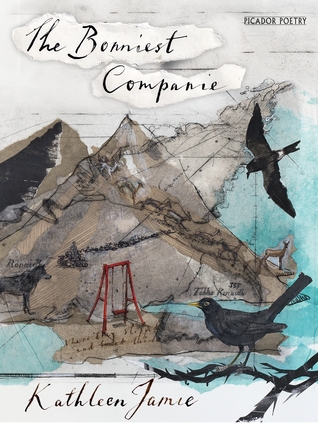
Kathleen Jamie, The Bonniest Companie (Pan Macmillan 2016)

companie.jpg

This book was a Christmas present from a friend who may have thought of me when she read that the book resulted from Kathleen Jamie’s project of writing a poem every week in 2014. I had a similar project, maybe even that same year.

My resulting rhymes went up on the fridge for a time and then mostly were seen no more, for which the world should be glad. Conversely, the world can be glad that Kathleen Jamie’s results are collected here – though there are slightly fewer than 52, so maybe, unlikely as it seems, there were a couple of duds.

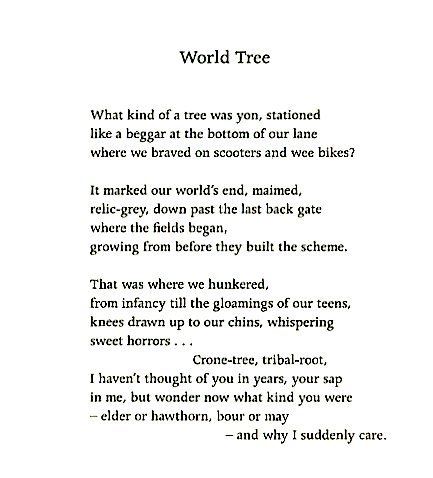
Kathleen Jamie is a Scottish poet. You can read her Wikipedia entry here, and a 2012 article by Sarah Crown in the Guardian here. 2014 was the year of the Scottish independence referendum, and at least one of these poems refers to that explicitly. All the poems have to do with Scotland one way or another: the language moves back and forth between standard English and Scottish; the wild creatures and landscape are always present. But I’ll stick to my policy of picking just one poem:

world tree002

I love the sound of this, as of these poems in general. In its sense, I recognise that experience of something remembered from childhood looming large in your mind in the present moment, with a new question about it. Here the speaker asks what kind of tree, as in what species, but she conjures up childhood memories that are full of a different kind of kind: tree as boundary, as relic, as something damaged, as a place for scary stories, magic and lore, as something not completely separate from herself (‘your sap in me’).

The bits of Scottish language – ‘yon’, ‘wee’, ‘gloaming’, ‘bour’ – link the adult speaker back to her childhood language. At least that’s how it reads to me: I imagine the speaker has had a more emphatic version of my experience of losing the accent and linguistic tics of my North Queensland childhood as I was educated into standard Australian in southern climes.

Anyhow, the last line performs a nice twist. The expected question is something like, ‘why this charged memory comes back so vividly after years of not being thought about’. But childhood memories just do that when one is of a certain age, and really to ask why would be futile. But the poem opens with a different question, and the last line brings us back to it: why do I ‘suddenly care’ about the kind of tree? Why does the mind, having gone back to a childhood experience, ask a question that was of no interest during all the years of the experience (‘from infancy to the gloaming of the teens’)? The tone is ambiguous: it could be like, ‘Why should I care about such an irrelevancy?’ or ‘What strange ways of the mind have made this interesting after all this time?’ Or, actually, both.

The title, ‘World Tree’, suggests a generalisation from the experience, that the poem is about the difference between a child’s immersive relationship to the world, and an adult’s more analytic one. The resonances then run deep.

But I’m out of time. It’s a terrific book.


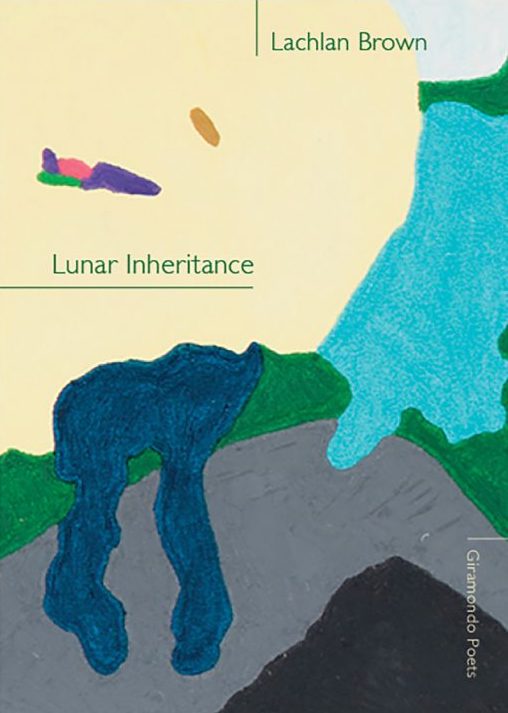
Lachlan Brown’s Lunar Inheritance

Lachlan Brown, Lunar Inheritance (Giramondo 2017)

Lunar-Inheritance At the beginning of 2013, the Carriageworks in Sydney hosted Song Dong’s extraordinary art installation, Waste Not, in which we were invited to walk about in the skeleton of a small house, along narrow pathways among the neatly arranged items that were found in the artist’s mother’s house when she died. The hundreds of duplicate humble household items – cakes of soap, hairbrushes, spectacles, shoes, plastic bowls, eggbeaters – had an uncanny power, like mute witnesses of a life lived with scrupulous thrift. As Song Dong says in the video below, the installation struck a chord with Chinese viewers: ‘This is not just your home. It is our home too.’

Lachlan Brown invokes that work in an epigraph to Lunar Inheritance*, and as we read on we realise it is a literal reminder of his own Chinese grandmother’s hoarding, as well as a rich metaphor for his own complex diasporic cultural heritage.

The book is neatly structured: two poems each consisting of eight eight-line stanzas (or call them sub-poems, because they don’t have the continuity of narrative or argument suggested by ‘stanza’), followed by a tightly rhyming sonnet; repeat four times; then one more 8×8 poem, and a final 7×8. Each of the sub-poems has a title in parenthesis.

As the structure suggests, the book has an over-all unity, which is woven from several strands: memories of growing up Chinese in rural New South Wales, memories of the poet’s grandmother, notes from a visit to China where, as the cover blurb puts it, ‘amidst the incessant construction and consumption of twenty-first century China, a shadowy heritage reveals and withholds itself.’

The book is exhilarating . There are so many beautifully crafted phrases, moments captured with brilliant clarity, sharp observations, surprising connections and juxtapositions – so much mind at play!

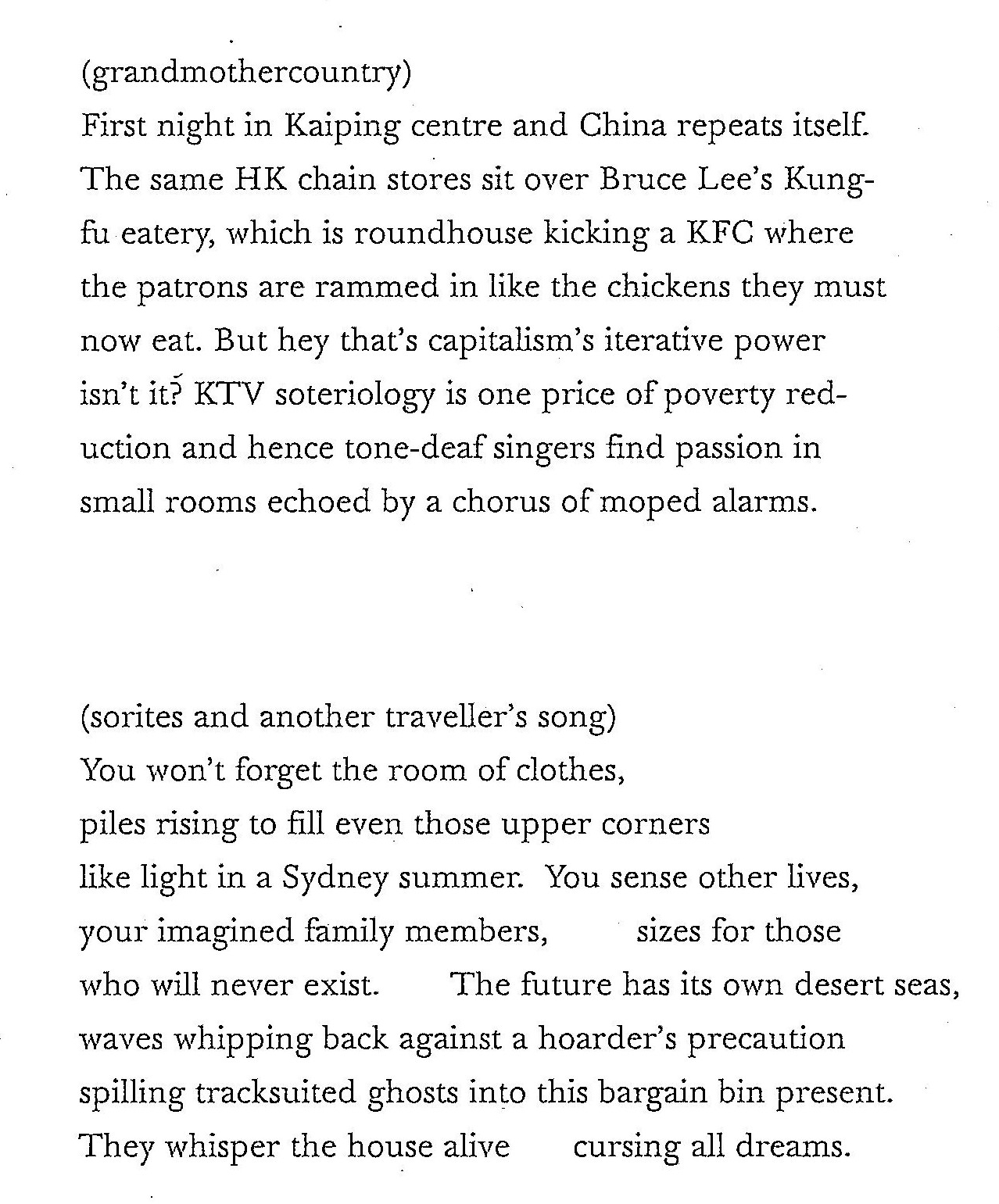
But I’m sticking to my policy of talking about just one poem, here’s the second page – the third and fourth ‘sub-poems’ – from the book’s third 8×8 poem, ‘Self Storage’:

brown

(I had to look up a couple of words. KTV is Chinese Karaoke. Sorites is a term used in philosophy, but as far as I can tell that’s a red herring: it’s Greek for ‘heap’. Soteriology is the branch of theology that deals with salvation [I knew that]. I don’t expect many of my readers will have trouble with ‘HK’ or ‘KFC’.)

The first of these looks at first glance like a pure tourist poem, an outsider’s satirical observations with a bit of intellectual showing off in the reflection on ‘capitalism’s iterative power’ and a hint of traveller’s condescension in the description of the karaoke singers. Even the complex observation about the connection between poverty reduction and KTV as a kind of salvation is made from an outsider’s viewpoint. (Incidentally, the pun created by the line break ‘red-/uction’ is one of the sweet, sharp moments that make me love this book,) But the title, ‘(grandmothercountry)’, sets up a counter-current: even without reference to other poems in the book, it lets us know that the speaker is on some kind of quest to explore his heritage wit the result that the touristic commentary is tinged with deep melancholy. I doubt if Lachlan Brown had A D Hope’s 1962 poem ‘A Letter from Rome‘ in mind,  but the final reference to moped alarms reminds me of Hope’s final lament about motor scooters in Rome:

A song the Sybil’s murmur taught to grow
From age to age, until the centuries
Heard the high trumpets in their passion blow,
Now lost in mindless roar from the abyss.
The parables of history can show
Surely no sadder irony than this
Which brings that noble, intellectual voice
To drown in trivial and distracting noise.

The second poem doesn’t obviously follow on from the first, but the title does suggest links: ‘another traveller’s song’ locates the poem as sung by a traveller (remembering home, as it turns out), and ‘sorites’, a hi-falutin word for ‘heap’, is a part anagram of ‘soteriology’ – which you notice because both words stand out like sore thumbs – perhaps suggesting that there’s some kind of salvation to be found in grandmother’s piles. If so, that salvation isn’t worth much more than the salvation offered by karaoke.

But isn’t it a terrific eight lines? The piles of clothes that fill the room the way Sydney summer light does – which means completely; hoarding as a gesture of futile hope so beautifully embodied in the image of tracksuited ghosts of people who will never exist; the final line, its whispers a slight echo of the tone-deaf singing of the previous piece, so poignantly capturing the paradox that the piles of clothes embody both a hope and its pathetic nature.

I recommend this book. But don’t take my word for it. Eileen Chong has a brilliant review in the Sydney Review of Bookshere.

I gratefully acknowledge that Giramondo Publishing give me my copy of Lunar Inheritance.

—–
* ‘In Beijing as well as in Gwanjiu and Berlin, it evoked strong responses from the audience, some of whom wept in front of it as if encountering a long lost friend or relative.’ The other epigraphs are Matthew 6:19 and lines from contemporary Chinese poet Ya Sha‘s ‘The Ancient City’: ‘what’s the use of writing poetry / in this ancient city / since the new era has arrived’).

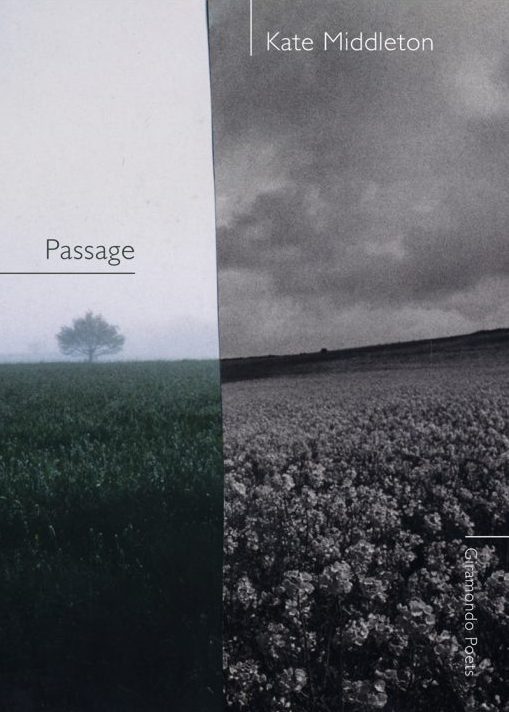
Kate Middleton, Passage

Kate Middleton, Passage (Giramondo 2017)

passage.jpg

Most of the poems in Passage are either erasures or centos.

/Explanatory note for the benefit of readers who know even less than I do:/
Cento is defined in my excellent Gepp & Haigh Latin–English dictionary (1888) as ‘a poem or composition made up of scraps from various authors or parts of an author’. A basic, nonsensical nursery-rhyme cento, for example, might be:

The mouse ran up the clock
to fetch a pail of water.
He put in his thumb,
see how they run,
How does your garden grow?

An erasure is created by erasing some or most of another piece of writing. I enjoy making them from newspaper columns that annoy me.  Here’s one based on a recent attack on the #changethedate movement:

erasure005-e1517140699925.jpg

/End explanatory note/

Both forms can be fun, but when, as in Kate Middleton’s work, the source material isn’t well known or readily available, and the poem is longer and more than a fun game, questions arise that I don’t know the answers to.

Given my new policy of just talking about a single poem when blogging about poetry books, I was tempted to choose one of Kate Middleton’s fine poems that aren’t centos or erasures or in some other way symbiotic with another text (such as the handful that are responses to episodes of a TV show I’ve never heard of). There are plenty of such fine poems –  but to choose one of them would feel craven. So here’s the cento ‘Elegance’, which I’ve singled out because I’ve read its source text, Luke Carman’s An Elegant Young Man.

elegance006.jpg

It’s possible to read this without any attention to its cento-ness. The opening couplet announces an emotional tone and names a locality. The next two stanzas sketch an unprepossessing urban landscape – this is not the West of movies but western Sydney. Then the poem turns to address the person looking at this landscape, and becomes a portrait of a writer as one who conceals his metaphorical knife in public, is loud alone at home, and struggles to avoid clichés (‘ordinary answers’).

It’s a cento not only from Luke Carman but for him. Writing cover letters to nowhere is a pretty nice description of a writer’s job, and the references to chance and repeated falls are extraordinarily apposite to the way Carman’s writing often mimics an intense distractibility, and so much of it is about his own social awkwardness and other struggles.

It’s a sweet tribute. By the end, one wants to revisit the capitalised ‘West’ from the second line. Carman is a kind of Western hero after all, even though his West is not Monument Valley, but Western Sydney.

So what does it mean that the poem is a cento?

Being by profession a proofread type editor, and by inclination a bit pernickety, I got out my copy of An Elegant Young Man. I didn’t have time to reread it all, but I read enough to find some of the poem’s source text. ‘Barred shopfronts flicker phantasmic blue’ is distilled from ‘shuttered-up Asian supermarkets and squash centres and brick unit blocks with TV flickering a phantasmic blue through the windows’. ‘I guess you’re like a minor Aussie character / in movies’ comes from this: ‘I mostly stood still and tried to seem happy-go-lucky, like those minor Aussie characters in movies like Chopper and  Getting Square’.

So Kate Middleton hasn’t been rigid in quoting the original. As the Emerging Artist said, she’s referencing the text rather than quoting it. In these examples, she leaves out the detail of the shopfronts and the TV, and the happy-go-lucky appearance (which is ironic in its original context anyhow). It’s not just referencing, but also repurposing. She finds in Carman’s text words that describe him in relationship to the milieu that is his subject in ways that he (presumably) wouldn’t think to describe himself. It’s a kind of alchemy.

I still don’t know how the longer centos work, from writers including Siri Hustvedt, Eliot Weinberger and Sir John Mandeville; or erasures that run to several pages. I’m happy to leave that question to better informed readers than I am.

Passage is the third book I’ve read for the 2018 Australian Women Writers Challenge. I was given a complimentary copy by Giramondo, for which horizon-expanding gift I am grateful.