Tag Archives: poetry

B R Dionysius’ Curious Noise

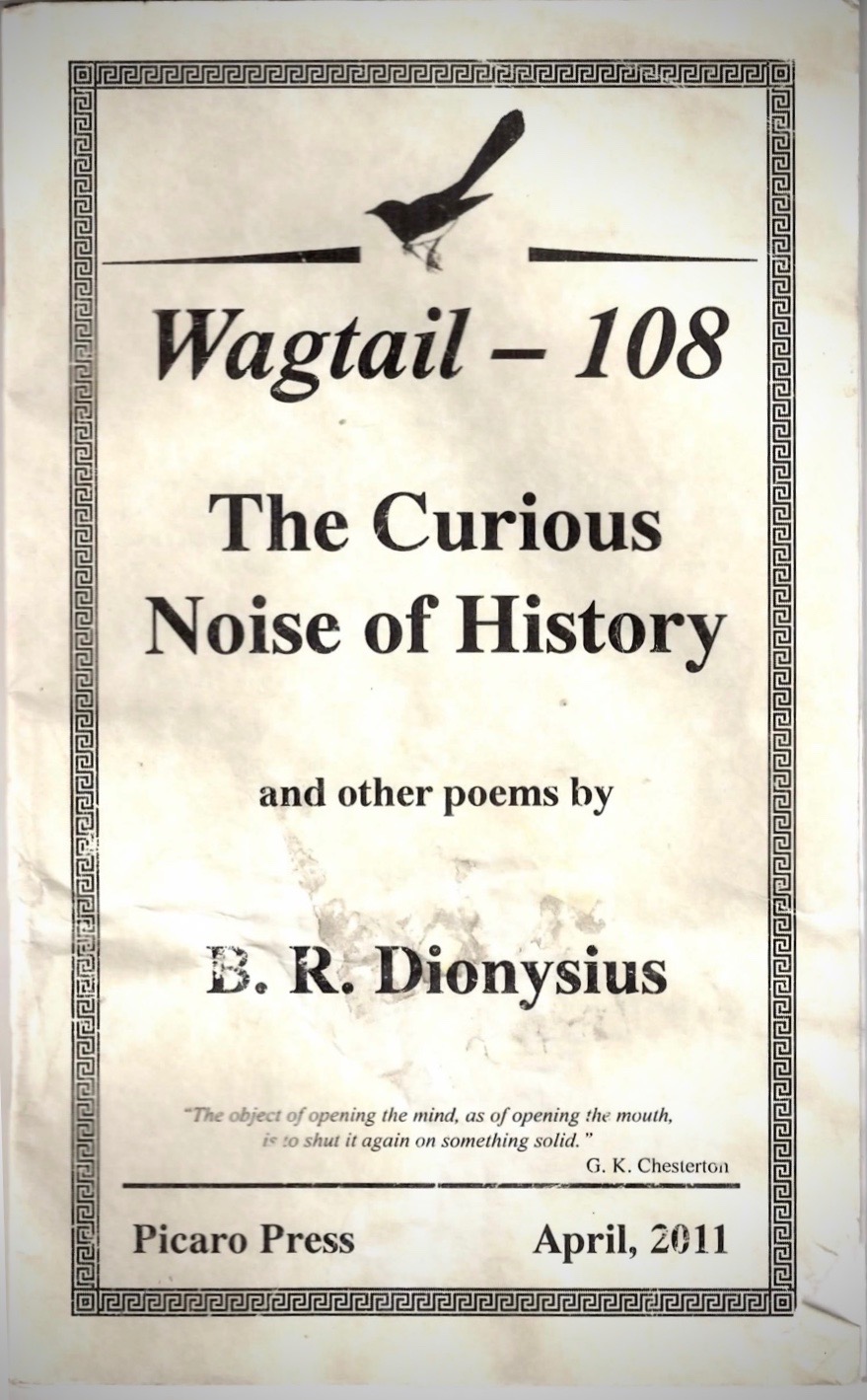
B R Dionysius, Wagtail 108: The Curious Noise of History and other poems (Picaro Press 2011)
noise

I first heard of the Wagtail series a couple of years ago when a member of my book group told us he subscribed: chapbooks, tiny publications each featuring work by a single poet, one arriving in his mailbox eleven times a year. They didn’t cost much, so if you didn’t hit it off with a particular poet you hadn’t wasted a fortune, and if a chord was struck you could go searching for more. More than 120 issues of the series were published by Rob Riel of Picaro Press in Warners Bay, New South Wales, before it finally folded last year. You can see a full list, unnumbered, here (it’s the Ginanderra site – Picaro is hard to find on the web), and an incomplete list with numbers, prices and availability here (at Gleebooks). The best account of the series I could find was this article by Warwick Wynne in Famous Reporter in 2004.

I came to Wagtails more than a day late and a dollar short when I spotted Book 108 among the economics textbooks and salvation tracts in an Erskineville Street Library. B R (Brett) Dionysius is a much published poet. A quick look at his web site, Bitter as the Cud, shows him to be a mover and, especially recently, shaker in the Queensland poetry scene. I’ve previously read poems by him in journals and anthologies and online, most memorably a sonnet sequence about the Brisbane floods, but never a whole book. Taking this 16-pager home seemed like a good step forward, even though it doesn’t send any money his way.

The Curious Noise of History is full of assured poems, mostly about violent or overbearing men, mostly a father who may be drawn from Dionysius’ own life. Possibly all of them appeared in his first book, Fatherlands. In ‘Crossing‘, the poem I want to single out, the man in question is the poem’s speaker. I’m drawn to talk about it because a) it’s probably the simplest poem in the book, and b) it reminds me of the mortification and joy of being a parent to young children.

IMG_2132.jpg

(In case you can’t read it here, it’s on Dionysius’ web site at this link: you need to scroll down quite a way.)

I remember turning into that ogre myself more than once.

The narrative is straightforward, but there’s plenty to linger over. For example, what is ‘it’ in the first line? At first blush, it’s punching the pedestrian button. But the poem is about a different kind of hurting. The man is in a rage for an unspecified reason (what he says to his daughter isn’t necessarily the truth), and aims that rage at his little daughter. The ridiculously hyperbolic image of fairytale monsters captures, with just enough irony, the horror a raging parent feels at his (or possibly her) behaviour. But in this case the child takes a stand – she may be twisting her ring because internally she is terrified, but her words brings perspective to the emotional storm with the mundane adjective ‘grumpy’. So perhaps the first line also refers to the dissipation of the speaker’s rage; the daughter wasn’t hurt by the rage, and her calling him on his poor behaviour didn’t hurt either.

His wrist starts to throb. They hold hands. There is no more talk of monstrous ogres, but it a little man turning from red to green.

The poem is sweet enough, but taken in the context of the other poems in the collection – in which, for example, a father plays a game involving a stock whip and his children’s toes – it is also powerful. In those other poems, Dionysius looks at male domination from the perspective of one who has suffered it. Here, the perspective is that of the man swept up in the compulsion to voice his rage, and one feels a rush of gratitude to that little girl.
Fiona Wright’s Domestic Interior

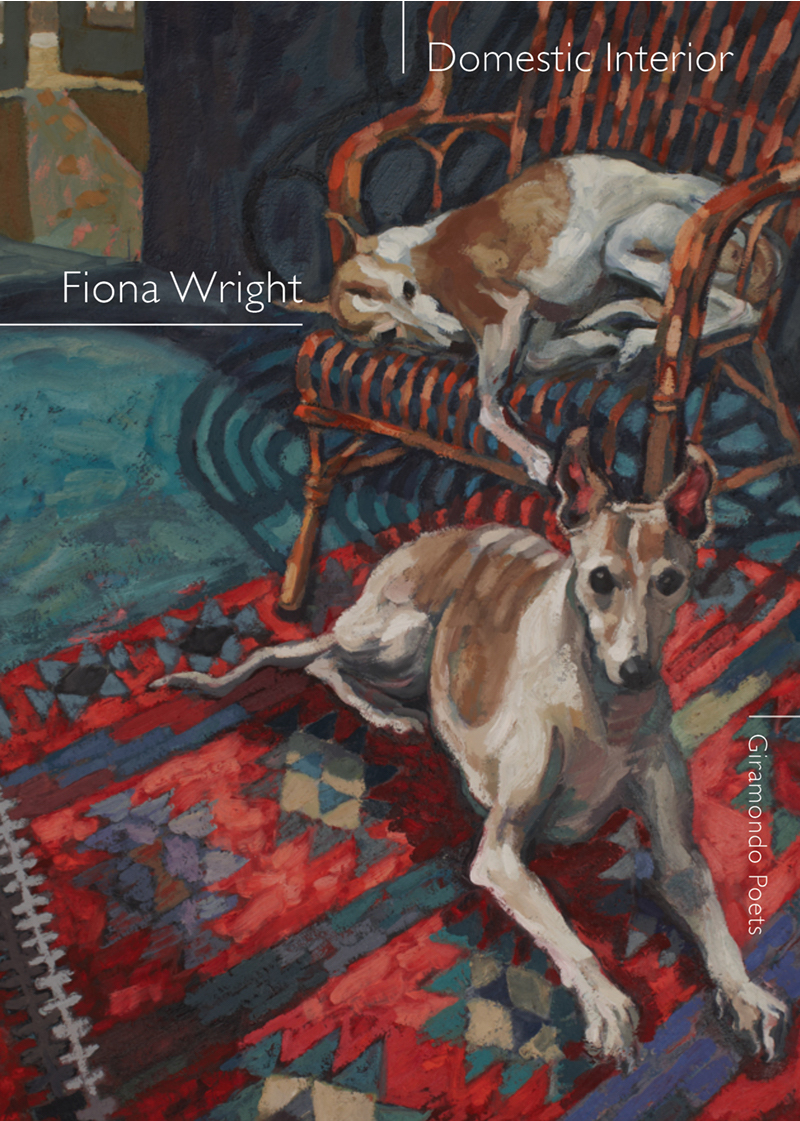
Fiona Wright, Domestic Interior (Giramondo 2017)

Domestic.jpgOne of my New Year resolves for the blog is not to attempt to review every book of poetry I read. I’ll still blog about them, but for each book I’ll focus on one or possibly two poems that resonate with me in some way.

Domestic Interior tests that resolve, because an awful lot of its poems speak to me loud and clear.

I haven’t read Fiona Wright’s first book of poetry, Knuckled (2011), or her collection of essays, Small Acts of Disappearance  (2015), both published by Giramondo, but somehow I’d picked up an expectation that her work would bristle with introspective misery. That expectation, even though endorsed by the back cover’s reference to ‘highly charged moments of emotional extremity’, turned out to be wide of the mark. Even the section titled ‘A Crack on the Skin: On Illness’, there’s much lightness, grace, good humour and a pervasive celebration of friendship. And always, especially for Sydney readers, there’s plenty of recognisable life as we know it or, in a number of poems, as we overhear it.

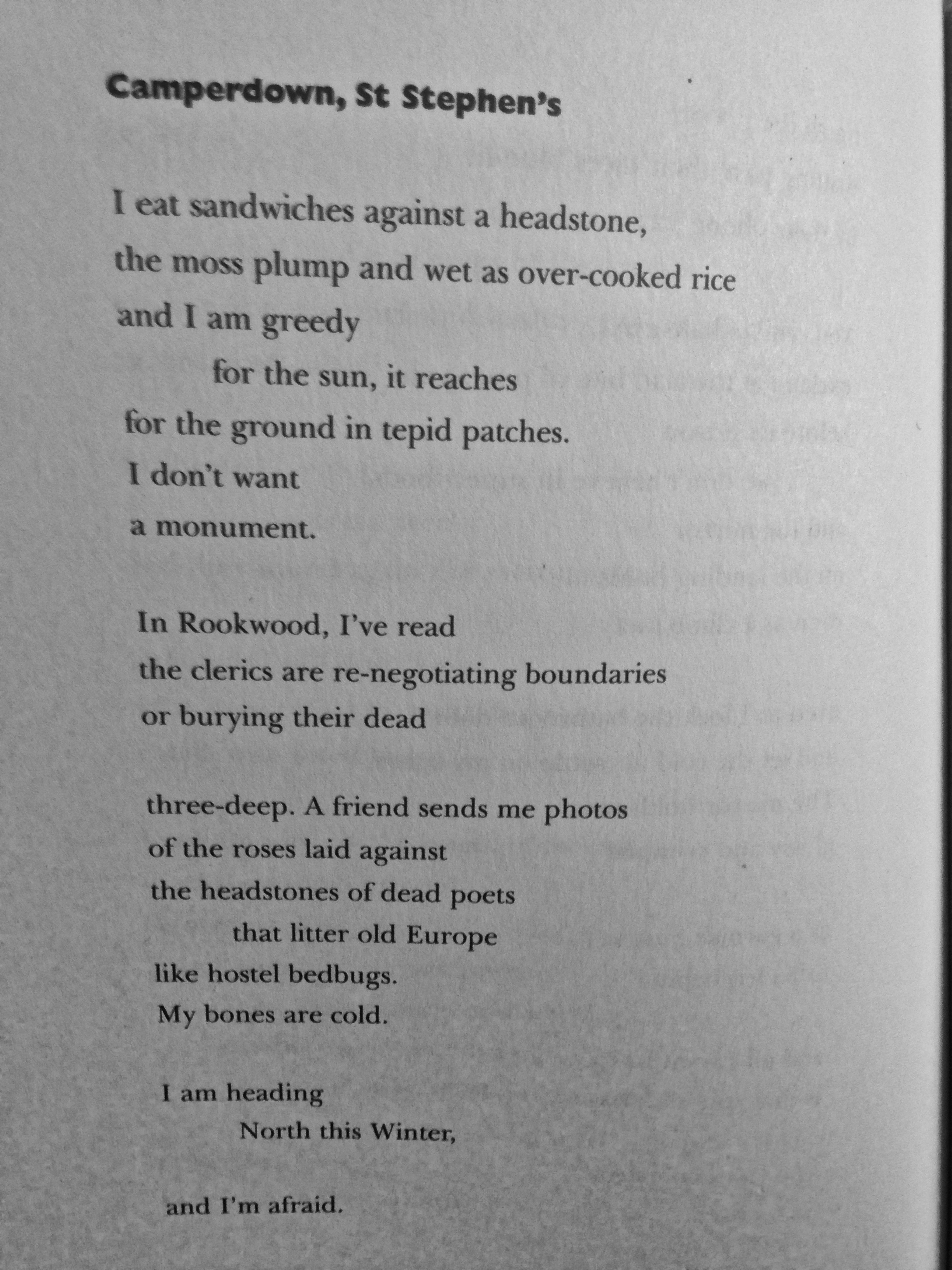
I caught a glimpse of Fiona Wright at a funeral when I was still part way through my first reading of the book, reason enough to choose to blog about ‘Camperdown, St Stephen’s’:

StStephens

For the benefit of non-Sydneysiders: St Stephen’s Anglican Church is the site of the historic Camperdown Cemetery. The Moreton Bay fig that grows there featured in Nadia Wheatley and Donna Rawlins’s classic and totally not-morbid picture book, My Place. It’s a beautiful and almost intimate setting, where it’s not terribly weird or morbid to eat a sandwich leaning against a headstone, so it may take a while for the force of that image to sink for a local reader. Rookwood is a suburb in Sydney’s west whose name is enough to evoke thoughts of mortality in most of Sydney and well beyond: it is home to what Wikipedia calls the ‘largest necropolis in the southern hemisphere’, now facing problems of overcrowding.

From the opening image, in which a stark memento mori lurks beneath a pleasantly mundane lunchtime scene, the poem plays first with the idea of hunger, associated with the sandwiches: the moss is like rice, the speaker is greedy for sun, and the sun for the earth. (It must be autumn, warm enough to have lunch outdoors, but cool enough that patches of sunlight are tepid.) Then, in a neat couple of almost rhyming short lines (‘I don’t want / a monument’), the headstone comes to the fore.

Which leads to Rookwood – yes, it stands in for death on a grand scale, but the lines are rooted in this specific time and place: there really are debates about how to deal with the vast numbers of bodies needing to be buried. Camperdown Cemetery is comfortably historical; Rookwood is today’s news. The dead are named for the first time, slyly rhyming with ‘read’ (maybe she’s reading news on her phone while eating her sandwiches).

Then she thinks of her friend’s photos (received on the same phone?). Roses lie against headstones, just as the poet does in the first stanza. Only now it’s many poets and they are the dead.  No sun no pleasant sandwiches there: the roses laid in homage don’t carry much force – images of litter and bedbugs come to mind, and from this distance perhaps the roses are reduced to something like little bursts of blood on hostel sheets.

‘My bones are cold’: she now identifies with the dead poets. And in the last three lines, the chill of that identification goes deeper: she is heading North, to that Europe littered with dead poets, and she fears that she is about to join them.

Maybe it’s just me, but I laughed. I don’t think the poem or I are trivialising death or the fear of dying. But the poet’s fear here is not the kind that strikes with a diagnosis of stage 4 pancreatic cancer. There’s something fancifully neurotic about it, an edge of mockery that doesn’t trivialise the fear but allows us to breathe around it, to approach it playfully: after all, how seriously can you take the the graves of poets when they are presented as littering Europe like bedbugs in a hostel?

My writing of this blog post was interrupted by an expedition to Manly. After visiting North Head Project at the Manly Art Gallery (open until 18 February and worth the ferry ride), we went up to North Head itself and wandered in one of the three cemeteries connected to the Quarantine Station there. Walking among the graves of mostly young people, I thought of this poem, and realised that for all its lightness of touch, its rootedness in 21st century Sydney and a particular friendship network, it sits squarely in a tradition: ‘and I’m afraid’ echoes the refrain, ‘Timor mortis conturbat me (The fear of death confounds me)’, common in mediaeval European poetry. I went hunting and realised I knew it from William Dunbar’s ‘Lament for the Makers‘. That 16th century poem, of which every stanza ends in the Latin refrain, includes a kind of honour roll of poets who have died, beginning with ‘noble Chaucer’ and continuing with names now long forgotten. Rereading ‘Camperdown, St Stephen’s’ in that context, I like it even more, but you don’t have to have read Dunbar or visited North Head for the poem to work for you.

Domestic Interiors is the second book I’ve read for the 2018 Australian Women Writers Challenge. I received a complimentary copy from Giramondo, for which I am grateful.

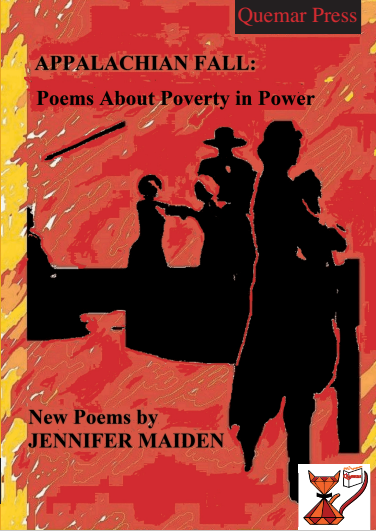
Jennifer Maiden’s Appalachian Fall

Jennifer Maiden, Appalachian Fall: Poems about Poverty in Power (Quemar Press 2017)

appalachian.pngQuemar Press published the ebook of Jennifer Maiden’s  Metronome the day after the 2017 US presidential election. In its last poem, Maiden’s fictional alter egos George Jeffreys and Clare Collins watch the election results on TV, and chat to Donald Trump on the phone. One insistent strand of Appalachian Fall is a continuation of the Trump theme.

Jimmy Carter chats with his re-awakened distant cousin Sara Carter Bayes at Trump’s inauguration. Jane Austen comments on his rivalry with Kim Jong-Un. Eleanor Roosevelt and Hillary Clinton chat about him.  Trump himself appears with George Jeffreys, with his mother, Mary Anne Macleod, and solo.

Maiden’s lively, questioning intelligence worries away at the double mystery of Trump: who is he and what happened to make him President? The book’s subtitle, ‘Poems of Poverty in Power’, gestures towards her answer to the second question: Jimmy Carter, reflecting on Sara’s music, articulates it:

thought: we knew ourselves when we heard it:
the low gut scream of hunger,
for some food, some pride, for any sort of
civilising action, answered passion, and if all
these people were Trump voters, maybe that in fact
was why he couldn’t despise their desperation.

Maiden addresses the first question –’who is he?’– with something approaching compassion, or at least an attempt to understand the human being, which is a kind of poetic heroism. Just as, years ago, she made poetry from her observations of George W Bush’s nose and Kevin Rudd’s pursed lips, in ‘Wind-rock’ she makes us see Donald Trump’s characteristic walk, and so the man himself, with fresh eyes:

 brace and blend into a finish. Trump’s erratic pace
wind-rocked staggers stubborn with its hunching
at growth and gust in air and no escape.

There’s a lot more than Trump here, but I won’t attempt a proper review. I’ve spent far too long on this blog post already, partly because I keep rereading the poetry – I love the sound of Jennifer Maiden’s voice, even when, occasionally, I don’t get what she’s saying or think she’s way off the mark. And partly because, well, see the next paragraph. For an excellent review, I recommend Magdalena Ball’s at Compulsive Reader.

So this is what took me too much time. There’s an extraordinary wealth of reference in Maiden’s poetry: to the Australian poetry scene past and present, poetry in general, politics in Australia, the US, the UK and Catalonia, art, music, the publishing industry, TV shows, movies, famous and little-known political and cultural figures. I thought it would be interesting to put together a visual representation of the intricate web of associations and connections created in this book, and produced the slide show below, which is still not exhaustive).

Enjoy. And then read the book. Quite a lot of it is up on Quemar’s website as a PDF.

This slideshow requires JavaScript.

Though I read Appalachian Fall last year I’m counting it as my first book  for the 2018 Australian Women Writers Challenge.

Andrew McDonald’s Night Music

Andrew McDonald, Night Music (Arcadia 2017)

nightmusic

As I was ruminating on Andrew McDonald’s Night Music, I kept thinking of Chaucer’s phrase ‘the life so short, the craft so long to learn’ the opening of The Parlement of Foules:

The lyf so short, the craft so long to lerne,
Th’assay so hard, so sharp the conquerynge,
The dredful joye, that alwey slit so yerne

Chaucer is talking about love, but I’m not alone in thinking they apply at least as well to art, specifically to poetry.

Andrew McDonald has quietly persisted with the craft for decades. Night Music is his third book in 40 years. His first, Absence in Strange Countries, was part of UQP’s Paperback Poets series in the 1970s, the series that launched David Malouf as a poet. His second, The One True History, appeared in 1984 (and can now be bought for more that £50 from Amazon). Though his poetic voice hasn’t been completely still since then – poems have appeared in journals and end-of-year anthologies – it’s been a long time between books.

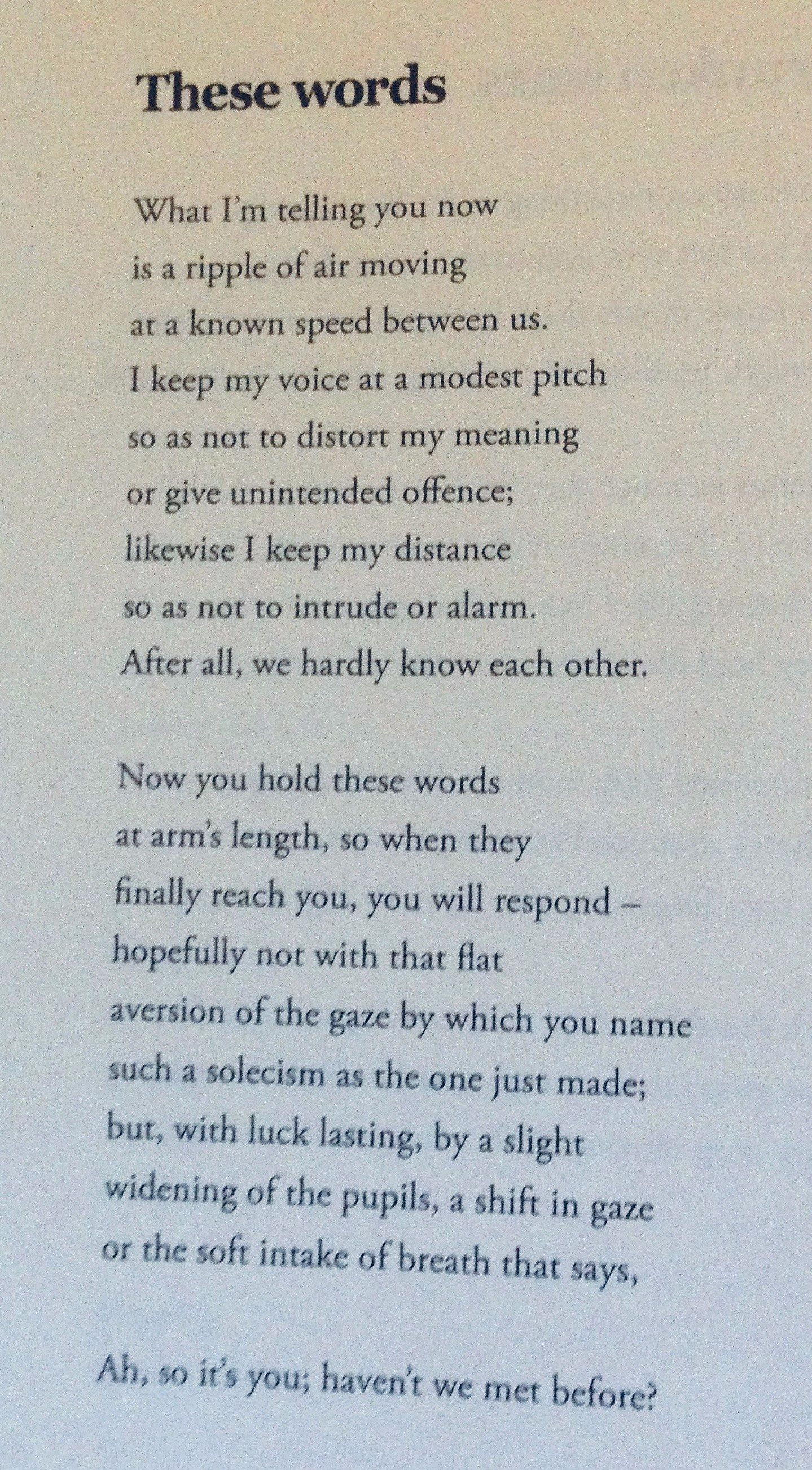
So it’s fitting that the opening poem ‘These words’, can be read as marking a kind of re-entry, moving from a tentative impersonality to a moment of relief and the possibility of a meeting of minds:

these-words.jpg

There’s a strong sense of place in what follows. The inner-western Sydney suburb of Leichhardt features in early poems, notably ‘Ode: Marketown’, which is dedicated to JF, il miglior guida and John-Forbes-ishly yokes images of tatty urban life to erudite allusions:

It’s shaping up as a day for reading cornflakes
packets in the supermarket considered as prolegomenon
to a proper reading of the Purgatorio.

Later, there are places visited – in rural New South Wales, North Queensland, Scotland,  Ireland, the Lake District (I think), an unnamed tropical beach. As an old Innisfail boy, I love ‘In the Rainforest’, one of the longest poems in the book, in which the Daintree National Park takes on metaphorical power:

The trees assemble themselves in their lack of rows or thought,
higgledy-piggledy, overgrown with creepers and vines and palms,
undergrown with mantras of the unnamed, the undiscovered, the unsuspected –
yet all this vast hubbub has, somewhere or other, to stop:
at the sea, at the incision of a road, at the counter-text
of pasture or cane or tea or some other human blankness,
so that the voice of the forest must finally cut short
its ancient murmurings and chatterings, its breath steam up
the pane of some other idea, until it simply ceases.

There are domestic moments. I’m a sucker for a poem about men and babies (see Francis Webb’s ‘Five Days Old‘ (at the link you need to scroll down a bit for the poem) or Galway Kinnell’s ‘After making love we hear footsteps‘). There are two here: ‘Night’, in which the speaker worries that his baby son will stop breathing:

I lean over him long, feeling the small warmth
that rises with his milky breath,
the smell if not the sound of life.

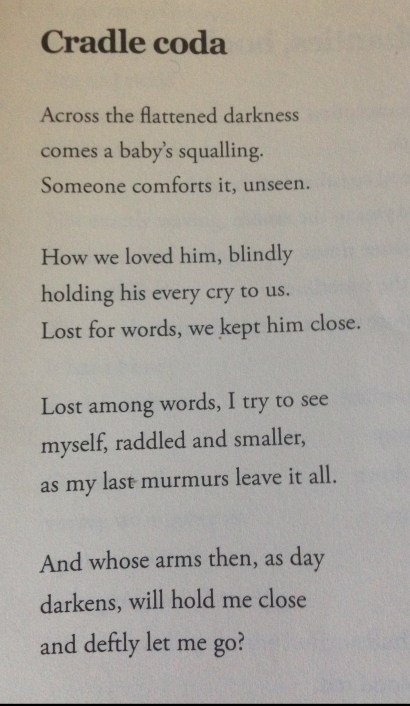
and ‘Cradle Coda’, which reads as written decades later. Here is the whole poem:

cradlecoda.jpg

It’s just a couple of weeks before my own first grandchild is due, so this poem strikes a chord. And I seem to have come back to Chaucer: ‘the lyf so short.’

There’s lots more than this in the book, much to enjoy. A fourth book is on the horizon. I’m glad.

My copy is a gift of the author, who has commented on this blog occasionally but whom I don’t think I’ve met in person.

Adam Aitken’s Archipelago

Adam Aitken, Archipelago (Vagabond Press 2017)

archipelago.jpg

Adam Aitken is a Sydney poet whose work often deals with aspects of living, working or travelling overseas. He has written about time spent in Asia, particularly his mother’s birth country, Thailand, in England and Hawaii. Most of the poems in Archipelago have to do with Paris or tiny villages in the south of France.

Aitken has written about his own work (in ‘A poetics of (un)becoming hybridity’, an article in Southerly Nº 73, 2013):

I would say that like many Australian poets who live and work overseas, I write as a temporary sojourner who is acutely aware of the limits of a touristic perspective.

In most of the poems in Archipelago, the voice is that of a temporary sojourner who may at times be a tourist (and part of the pleasure of the book for me is that evokes my own time in the south of France a couple of years ago), but is generally more engaged.  Possibly the closest thing to a simple tourist poem is ‘What (not) to do in St Victor-des-Oules’, in which the (non-)attractions of a tiny village are enumerated with wry humour:

Out of reception we stroll to the recycling depot
through a pall of burning autumn leaves.
A shooter lets off his blunderbuss
in a village with no twin – no cafes, no post office,
no fountain in the square.

Other ‘touristic’ poems are less ironic. In ‘At Maruéjols’, for example, the speaker’s stroll through the town is also a stroll through the centuries, beginning in the 5th Century, and arriving in 2012 with ‘two men on extended leave /around a fire / growing beards in a silk worm attic’.

Mostly, though, the poems engage with their places more intimately, as from the perspective of someone visiting family. Pam Brown told us at the launch of this book that Aitken has visited the south of France regularly because his partner’s parents lived there, but even without that information, that kind of connection is palpable in the poems themselves. ‘Postcard’, for example, which made me laugh out loud, could only be addressed to someone of whose affection you were confident. It starts out ‘Chère Margaret, / Thank you for letting us stay so long’, and goes on to a litany of complaints – not about the hospitality, but about the winter weather:

I am yet to cough up blood.
The other day I found a dead thrush in the letterbox.
I swept a few frozen comrades off the driveway.
Every day they are falling out of the sky.

‘Maruéjols’ (a different poem from ‘At Maruéjols’) captures the eerie process of going through the possessions of someone who has recently died:

Later, coming to empty your house, we felt
the dark matter of your brain
and what came through it.

The poems move beyond touristic engagement with place in other ways as well, mainly by engaging with other writers and artists associated with the place, and with its history.

The book drew me in and held me. I spent time reading around it, looking up the places, artists and poets described, addressed, mentioned or imitated, and then rereading the poems. My copy of the book is now bulked up with printed-off photos of tiny French villages – including Maruéjols-lès-Gardon (population 179 in 2007), Saint-Victor-des-Oules (pop. 254), Notre Dame de la Rouvière (pop. 410), Mareuil (pop. 1130) –  and images created by Alfred Stieglitz, Henri Rousseau, John William Ashton and Charles Méryon. I’ve read or reread work by or about Jean Jacques Rousseau, Roland Barthes, Ezra Pound, Raymond Roussel (including Adam’s blog post, which is a very useful gloss to his poem ‘Rousselesque’), Jules Renard, John Clare, Kenneth Slessor, New Zealand poet Jenny Bornholdt (the poem quoting her being one of the few with no French connection) and Australian Ouyang Yu, among others.

Subbed In’s first books

Aisyah Shah Idil, The Naming (Subbed In 2017)
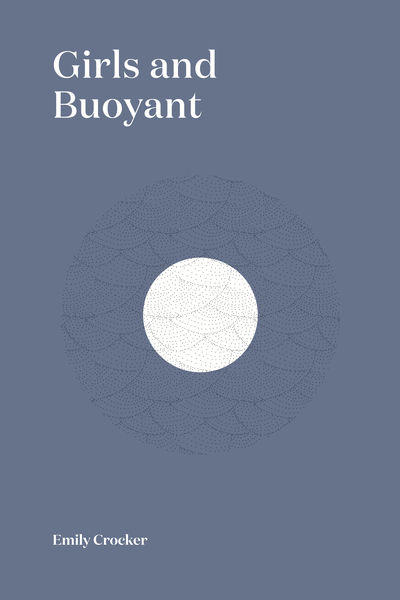
Emily Crocker, Girls and Buoyant (Subbed In 2017)

Subbed In, described on its website as ‘a DIY literary organisation based in sydney’, organises poetry readings and other events, often in the East Sydney dress shop Funky Bruiser. Its directors, Dan Hogan, Stacey Teague and Rory Green, aim ‘to provide grassroots support for new and underrepresented voices as well as helping emerging writers to achieve publication or performance’.

subbedinlogo.png

In September they launched three chapbooks – the two I’m blogging about here and Parenthetical Bodies by Allison Gallagher, of which I haven’t bought a copy and haven’t read (sorry Allison!). I’m not sure what ‘DIY’ means in this context. Perhaps it’s just a way of proclaiming a hipster ethos. It certainly doesn’t mean slipshod or amateurish. These books are beautifully designed inside and out, and lovely to hold in the hand. The Subbed In logo manages to make an ibis perched on a garbage bin look elegant. (There is at least one typo – see below – but not as many as turn up in non-DIY poetry books.)

naming

The Naming has an epigraph from the Qur’an – ‘And He taught Adam the names of all things’ – and its poems are rich with reference to Islamic practice, Malaysian folklore, and Arabic and Malay language. They are also rich with feeling and playfulness.

For example, ‘Malay Sketches’ consists of three one-page versions of the same poem. In the first, headed ‘Jiwa’, all the words have been blacked out as if redacted; in the second, ‘Malay’, about a quarter of the words are visible; in the third, ‘English’, nothing has been redacted.

At first, you might tentatively think the subject is censorship – that some things are not allowed to be said in Malaysia. But no. Of the first line, the English has ‘Bobbing heads circle platters of rice’, and only the Malay for heads (‘kepala’) and rice (‘nasi’) remain unredacted; later, only curry (‘kari’) survives from ‘Fingers covered in curry point to the sink’. Surely there’s nothing censorable in this, or in the sweet picture of family domestic life that follows. I read it as enacting the loss of language by a second generation migrant: the poem was composed in English, and the speaker’s attempt to translate into Malay was thwarted by her lack of knowledge. I’m pretty sure the details will yield nuances to readers fluent in both languages: for example, the last line in English, ‘We figure God has seen us in less’ becomes (I think) ‘God has seen us’ in the Malay .

Which raises the question of the completely redacted ‘Jiwa’ version. I guessed that this was a more local language, completely lost to the speaker. But a web search made that seem unlikely. ‘Jiwa’ means ‘a living soul’. Perhaps, then, the blacking out of this section is enacting the impossibility of speaking directly what is in one’s heart.

Then I found the place where the poem was first published, on the Language on the Move website (you can see the whole three-part poem at the link), and there the first version is headed ‘Jawi’ rather than ‘Jiwa’. A Wikipedia describes Jawi as ‘an Arabic alphabet for writing the Malay language … and several other languages in Southeast Asia’, it seems likely that ‘Jiwa’ is a typo, and that the blacking out signifies the speaker’s inability to read the Jawi alphabet.

For once, I’m not just irritated by a typo. This one took me into a deeper reading of the poem: it is about the loss of language, but the metaphorical force of the Jawi/Jiwa typo brings home what a terrible loss that is.

Not all the poems ask for so much research. It helps to know that ‘Pontianak’, about the grief and rage of women, is named for a female vampiric ghost in Malaysian folklore. ‘Laylatul-Qadr’ is named for one of the last days of Ramadan, called the Day of Power in English, but the poem, which celebrates the birth of a baby and laments the murders of Muslims and Muslim defenders, all in the context of Ramadan, works well without that knowledge. ‘Instances of Allahu Akbar’ expects you to recognise ‘Allahu Akbar’ as a common exclamation among Muslims asserting the greatness of God, and possibly offers a corrective to the assumption that it is exclusively or even primarily a war-cry. The first ‘instance’:

My mother, after
a long period of somnolence,
where getting up is only possible
through divine assistance.

And the last one:

a newborn sleeps.

The title of girs&buoyantGirls and Buoyant says a lot. There are no boys in this book, and the girls are doing OK.

The opening line of ‘Smashed’ evokes the milieu of these poems, and the intelligence in them:

Avocado, I didn’t want to settle down anyway.

This is a voice from the generation that’s forever being reprimanded by millionaires and (mainly) conservative politicians. It’s speaking to people who recognise the reference to smashed avocado and it’s speaking with good humour, irony and its own confident point of view: slightly grungy, vegetarian, inner-city inflected.

There are so many lines I’d like to quote. From ‘Aoraki’:

I realise I’m waiting for a way to see the earth
not as a tourist.

From ‘Guyra’, a visiting-the-family-on-the-farm poem:

_________________________________I’m here
for both of us to see what I am made of

or:

My brother loves good men.
Wins meat-raffles like a vegan.

From ‘Uproot’:

_________________________________ Time does not pass
with the quiet awe of a monk. It bustles by,
blows us down, and grumbles when we don’t keep up.

It’s the love poems that hit home most for me. Like ‘Plate’, which begins:

‘Ceremony’ has a dirty taste
but for the way we eat.
The ritual of back and forth
of olives off your pizza.
The potatoes off my plate
when you give me too many
with all intention of
eating them yourself.

Or ‘Covers’, which my partner had to explain to me was about a partner with period pain rather than suicidal depression; or ‘Illawarra’ (roadside scenery seen when driving with a lover); or (spoiler alert, I guess), the ending of ‘Gaps’ , the last poem in the book:

You make me conscious of the void
and how blessedly we inhabit it.

aww2017.jpg

The Naming and Girls and Buoyant are the twelfth and thirteenth books I’ve read for the 2017 Australian Women Writers Challenge.

Nicola Knox’s Green Light Running

Nicola Knox, Green Light Running (self published 2012)

glr.jpgThis is not one of those self-published books with a chip on its shoulder about the publishing industry.  It’s much more modest than that – so modest that I can’t find any information about where to buy a copy. Mine was a gift from the author, an honour to which I owe a number of Nicola Knox’s poems having appeared in The School Magazine when I was editor. My impression is that she only ever intended a small, intimate circulation. (Maybe I’m projecting: my own three self-published books of verse are glorified end-of-year greeting cards – though of course I’m delighted whenever someone buys one from Lulu.)

The book is a witness to the value of creativity, of making in response to experience. Where one person might take out a sketch book and pencil or paints, another will reach for pen and notepaper. Poems here have been inspired by travel, by family life, by childhood reminiscence, by works of art, by ancient and modern history. They are the fruits of life lived with an active mind, a mind that it’s a pleasure to spend time with.

Just to give you a taste, here’s a poem that speaks softly but carries a big stick to one of the big issues facing us at the present moment:

Refugee Boat

The heart of Pharaoh
was dry and shrivelled
as an old walnut.

But his daughter
dove gentle
beautiful and kind
was loved as her father
was feared.

On a morning
splashing with court ladies
in the Nile, she did not hide
her pity for the plump infant
found in a coracle
rocking gently
among river reeds.

So the princess
and the alien child
gazed upon each other
and from that moment
all things changed.

A second volume of Nicola Knox’s poetry, Verandah Man, was published by Ginninderra Press in 2016, and is available from the Ginninderra website.

aww2017.jpg

Green Light Running is the eleventh book I’ve read for the 2017 Australian Women Writers Challenge.

Australian Poetry Journal 7:1, Skin

Ali Cobby Eckermann and Ellen van Neerven (editors),  Australian Poetry Journal, Volume 7, Issue 1: Skin (2016)

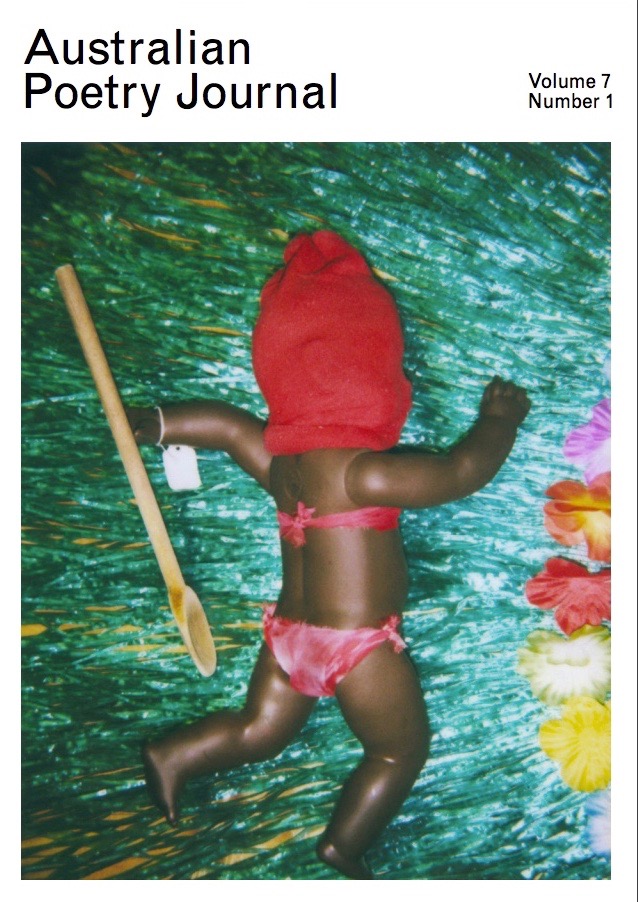
apj71The cover of this issue of Australian Poetry Journal features a brilliantly eye-grabbing Destiny Deacon photograph, Escape from the Whacking Spoon (2007). As the first issue covered by the new policy of having different guest editors for each issue, this one is edited by two leading Aboriginal poets, which ensures that it follows through on the cover’s promise.

There are three sections:

  • Skin 1: 34 poems by 25 Indigenous writers
  • Skin 2: 16 poems by 13 non-Indigenous writers
  • Transforming My Country (edited by Toby Fitch): 12 poems responding to Dorothea Mackellar’s ‘My Country’,

The selection is very rich, for many of the individual poems and for the extraordinarily valuable dialogue created by placing them between one set of covers. I dog-eared the pages with these poems from the first two sections in my copy (your mileage will very – I recommend you get hold of your own copy via Australian Poetry Pty Ltd’s web site):

  • Claire G Coleman, ‘Strawberry Juice’: starting from the image of spots of strawberry juice staining her writing paper, the poet plays with the notion that directions for colonial killings and records of them were written on paper. Ink stains, like blood stains, can’t be removed, and the lines that bring it home:
    _
    __Notice how paper covers rock
    __Covers
    __My country, my people are one
    __Notice how easily paper tears
    _
  • Aunty Kerry Reed-Gilbert, ‘Love comes in many colours’ The poet greets her granddaughter:
    _
    Her blonde hair cool against my black skin her whiteness grabs my heart a new day dawning for this land Australia as we dance to the sounds of the oldest culture in the world. Love comes in many colours.
    _
  • Kate Adler, ‘Sorry’. A non-Indigenous person at a Sorry Camp:
    _
     __Hard to witness wounds like these
    __but love is deeper than skin.

The third section includes work by some heavy hitters of Australian poetry, including brilliant poems by the editors of this issue, Ali Cobby Eckermann and Ellen van Neerven. Eileen Chong (‘My music is wrong – nothing / has been written down right’) and Hani Abdile (‘Opal-hearted country / I’m now one of your unwanted beings / I’ve come to love you sunburnt’) write from immigrant and refugee perspectives. The poem is deconstructed, thesaurised and anagrammatised. Toby Fitch’s introduction describes Lisa Gorton’s conceptually and concretely thrilling poem as an ‘almost-epic’ that ‘explores in microscopic detail the history of the grounds of Royal Park, Melbourne’. I’ll end with some lines from each of the Indigenous takes on the Mackellar poem:

Alison Whittaker (‘A love like Dorothea’s’):

I’m sorry, sweet Mackellar, that it famished all your cows,
y’paddock’s yellow-thirsty-sudden-green; no telling how.
That the gold-hush-rainy-drum hard to your violence and your plow.

Natalie Harkin (‘Heart’s Core Lament’, which is hard to represent accurately here, as it depends on justifying the text on the page, and includes quotes from colonisers’ texts in the margin, but here goes):

harkins.jpeg

Ellen van Neerven (‘My Country’):

my country
is between two rivers

two ribs
two hip bones

Ali Cobby Eckermann (‘Transforming My Country’, which plays with Mackellar’s words to produce radically different meanings):

Who pays back to Earth?

Not she and soft-hearted love
What a hush of her heart, and her
I have her share, her jewel
Though not her land
Your love of my land is tragic

——-

(I won’t repeat my own favourite anecdote about ‘My Country’ and Dame Mary Gilmore, If you’re interested you can read it here.)


Jenny Blackford’s Loyalty of Chickens

Jenny Blackford, The Loyalty of Chickens (Pitt Street Poets 2017)

chickensLike Jenny Blackford’s earlier book, The Duties of a Cat, this is beautifully presented collection of poetry. This one’s bigger – there are more pages and more poems, and it has a broader scope of subject matter and tone.

As in the earlier book, there are sweet celebrations of pet cats (‘All that he asked / was total control’) and a range of animals wild and domestic, including the chickens, which, according to the title poem,

show no loyalty. It seems that any girl
who’ll delve a scoop of free-range mix
is She Who Brings the Grain,
or close enough for these
red-feathered hens
to worship her.

Jenny Blackford’s biography mentions that her work is published regularly in The School Magazine. One of the attractive features of this book is the way poems that are eminently suitable for children are mixed in with poems of mature sensibility, with no sense of incongruity. The lovely imagistic ‘sweeping’ (‘the wind is sweeping / the tide out to sea’), is followed by ‘South Steyne’, which recalls childhood events from an amused adult perspective (‘The South Steyne ferry was heaven / for me, though doubtless hell for parents’), and then by ‘Some slight redemption’, a meditation on Coventry Cathedral as a monument ‘not to war / nor even peace / but to forgiveness’.

It seems inevitable that any collection of poems by a person of a certain age that touches on domestic life will at some point touch on dementia. This collection manages the subject with tenderness and humour in ‘Dipping into that Lake’: ‘There are fairies at the bottom of Mum’s garden now / and butterflies, and owls.’

The poet lets slip at one point that she graduated in Classics from Cambridge, and classical references are scattered through the book, but the erudition is lightly worn. A personal favourite of mine (for reasons that you can easily guess) happens to be an example of this. There’s the whole poem:

Earth-shaker, bed-shaker

According to inscriptions
in a lost Poseidon temple
soon to be discovered
somewhere in southern Greece
Poseidon Earth-shaker is patron
and protector of snoring men.
Without his godly nasal power,
so many men of twenty, forty, sixty
would be discovered (in soft morning silence)
smothered by bed-pillows,
domestic earthquakes
permanently stilled.

The temple vaults hold tributes
from his snoring worshippers:
gilt effigies of elephants,
yellowed tusks of snorting walruses,
and woolly mammoths’ freeze-dried trunks
as fat as anacondas,
all given to the god
by grateful bed-shakers.

I would happily have the poem end there but of course it goes on:

In Aphrodite’s nearby temple of love,
ears of silver, gold and clay
are mounted on the walls
or heaped in shelly stacks,
donated by the snoring men’s
sleep-deprived bedfellows.
May the merciful goddess
muffle our night-time senses
forever and ever. Amen

aww2017.jpg

The Loyalty of Chickens is the eighth book I’ve read for the 2017 Australian Women Writers Challenge. My copy was a gift from Pitt Street Poets and the author, whose work I first met, and published, when I was editor of The School Magazine.

Alan Wearne’s Things Are Real

Alan Wearne, These Things Are Real (Giramondo 2017)

things (1)

Despite the increasing frequency of narrative poems, the work of Alan Wearne is unmatched. Nobody has even begun to approach the complexity of his portraits of life in post-war Australia.

That’s Martin Duwell in 2013 reviewing Alan Wearne’s Prepare the Cabin for Landing. He could have been introducing the five narrative poems that make up the first 70 pages of These Things Are Real. The book’s title doesn’t so much make a claim of non-fiction status for these narratives, as insist that the kinds of stories they tell, stories that don’t make the headlines, and that are unlikely to make it into the history books or best-selling novels, are nevertheless poignantly human.

A widow renews her friendship with a friend from her youth, but they drift apart after some years when she rejects the overtures of her friend’s husband, all in Menzies-voting suburbia. A Ceb (which, as the poem had to spell out for me, is argot for a member of the Church of England Boys Society) tells the story of his multiple coming-out. A young woman, single mother, has a relationship with a musician who turns out to be abusive. A school teacher, a ‘happy-go-usey’ drug addict, struggles with his moral compromises and worse, including an involvement with squalid and murderous criminality. A ‘recently retired femocrat’ recalls the contradictions of her middle-class radical youth.

These are five complex yarns, told in irregular verse that occasionally breaks out into rhyme. There’s a strong sense of an idiosyncratic speaking voice, rough around the edges and often assuming shared knowledge that isn’t always there (not necessarily a problem when Google is at hand). The narratives don’t offer easy resolutions to the uneases and tensions they raise. In fact, mostly they don’t offer resolutions at all. Maybe that’s another meaning of the book’s title – in the real world things stay complex and unresolved.

Just a taste of how the language works, from ‘Anger Management: a South Coast Tale”

His screaming’s recommenced. The kids are home.
And you are bruised, walking-into-a-door bruised,
like you’ve seen enough before except
now it’s his, his bruise and possible fracture.
You saw the good man (if nobody else did)
the one who rolled you your White Ox,
the one who actually wrote songs,
the man you were loving who disguised
so much (no doubt from himself).
Well, it is all out now with a sort of noise
that’s heading to your kid’s guts
to stay for decades. But it’s when
he starts up, ‘Don’t you get it, I love kids,
I love them!’ you grab yours and lock away
the three of you, three hearts deranged
with thumping, with him outside the toilet
howling, whilst you phone your girlfriends.

The remaining 50 pages of poems are grouped under the general heading, ‘The Sarsaparilla Writers Centre’. They range from throwaway couplets (an unkind ‘Elegiac Proposal’ for Cardinal George Pell, a note on being a runner up to Lily Brett in the 1987 Victorian Premier’s Prize, a gleeful skewering of an error in something written by Les Murray), through several songs of praise to AFL personalities and others who remain mysteries to me, to longer rhyming poems about Australian politics, religion and, in particular, poetry: ‘For Chris Wallace-Crabbe at Eighty’, ‘The Ballad of 68 or I Was Dransfield’s Dealer’ and ‘Ode for Johanna Featherstone & Fiona Wright’.

My copy of These Things Are Real was a gift from Giramondo Publishing.