Tag Archives: poetry

Sonnet #3: Not By Ron

I’m making my way through Byron’s ‘Don Juan’ (pronounced Joo-ahn, as everyone except me probably knew) on the iPad. This sonnet’s first six words and other scattered phrases are from Canto the First. Because it’s Melbourne Cup day, I thought I’d work in a little gambling reference.

Sonnet 3: Not By Ron
‘My days of love are over,’ By-
ron wrote when he was thirty. How
the times have changed for lovers. I
met you when twenty-nine, and now
it’s thirty-six years later. ‘‘Tis
still sweet (long since the first-born’s birth,
the first and passionate love) to kiss
the lips you say have thinned. The earth
will have us soon enough – and then –
what then? – I do not know, or care.
We’ll die somehow, some time, somewhere,
but when that comes I’ll bet you ten
to millions that our loving days
aren’t over. All may change. This stays.

Sonnet #2: The dogs outside Orange Grove Markets

There are so many more important things to be thinking about, from Woolworths’ continuing to make money out of problem gamblers to an Onion article about Sandy that rings too true for comfort, with the NSW government’s plans to destroy the employment prospects of thousands of aspiring artists somewhere in between. But the muse has handed me half a dozen dogs tied to a fence:

Sonnet 2: The Dogs outside Orange Grove Markets
The dogs line up at Orange Grove.
A Whippet whimpers, Shih Tzus yip
and won’t take comfort, Collies move
their twitchy eyebrows, Labs – so hip –
refuse to look abandoned, while
undaunted Staffies wag and smile.
It’s farmers’ market day. They’re tied
here while their owners go inside
for reasons past dogs’ understanding.
There is affection between species.
We house them, feed them, bag their faeces.
But now, resigned, sad or demanding,
dogs wait until, they know not when,
the rapture when we come again.

Rhyll McMaster goes late night shopping (with washed money?)

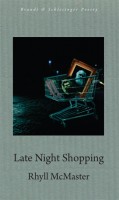
Rhyll McMaster, Late Night Shopping (Brandl & Schlesinger 2012)
—, Washing the Money (Angus & Robertson 1986)

At Sappho’s recently, Kate Lilley said she had always enjoyed the work of the poet whose book she was launching but had never previously had to speak to that enjoyment, a very different and challenging  thing. I sympathise. I enjoyed Late Night Shopping – a lot – but don’t know that I’m up to giving an account of my enjoyment. As often happens to me when I contemplate writing about poetry – any poetry from ‘My Love Is Like a Red Red Rose’ to, I dunno, Christopher Brennan’s translations of Mallarmé – I feel a bit lost for words.  If you want a proper review of Late Night Shopping, I recommend Lyndon Walker in the Rochford Street Review. But here’s my two bobs’ worth.

‘The Shell’, the first poem in the book, confronts us with the fresh corpse of a woman who has died in hospital:

After that rasping sound when the woman died
she was bleached pale on the surface like a sponge.

The poem foreshadows the main subject of the collection: not so much death as the relationship between physical reality and the reality of the mind; ‘The mind [is] embodied and embrained’; ‘A sheep’s skull is a sculpted housing / fine and hard for a sheep’s brain, / built to retain its idea of itself’; or this, from ‘The Image of the Box’:

All philosophy's a game,
It's a clever fox
That stops us thinking

of the universe
as void condensed,
a roaring silent trinket

of energy rampant

It’s not nihilism or morbidity, but a kind of cool, radical wondering. On the one hand there’s the physical universe, including us, and on the other there’s what we make of it all. Rejecting illusion, perhaps, but still enchanted. The lines from ‘Nomenclature’, ‘Call the unknowable / what you will / from your dug-in position / on the side of a hill,’ could be read as advocating intellectual despair, but that hill, coming at the end of a poem full of abstractions, feels to me like a promise.

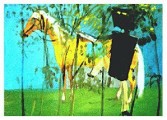
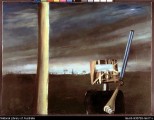
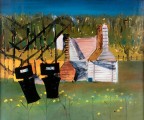
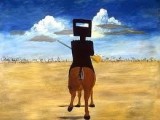
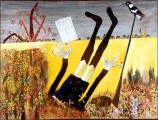
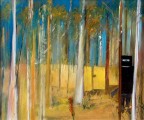
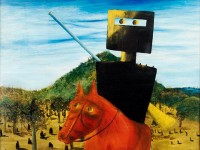
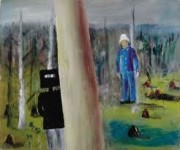
A number of poems are responses to images – a photograph, nine paintings by Sidney Nolan, five drawings by Terry Milligan. It seems to me that the surreal Nolan sequence, ‘Evolutionary History of Edward Kelly in Primary Colours’ needs to be read beside the paintings it refers to. As a public service, then, here are the Nolan paintings that I could identify from the notes on the poems, with the name of the poems that refer to each of them (I’ve struggled with the formatting here. I hope it looks the same in your browser as it does in mine):

)


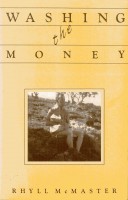
The day I finished reading Late Night Shopping for the first time, I found a copy of Rhyll McMaster’s Washing the Money, published 26 years earlier, in a secondhand bookshelf (the aforementioned Sappho’s, as it happens). Self-described as ‘Poems with Photographs’, this is full of verbal snapshots of the poet’s early life and her life as a young mother. These poems give us the remembered world of a 1950s childhood in precise detail – a ‘narrow crack at finger-running height’ in a brick wall, a newspaper delivered ‘with a stuffed thud’, ‘grandma’s hair like silkworm thread’. There are actual photos, and some of the poems are responses to them; other poems refer to photos not included.

This book spoke to me in a very personal way: Rhyll McMaster and I were both born in Queensland in 1947, so when she uses words like ‘port’ and ‘togs’ I’m there. The family car, the beach excursions, the mosquito nets are all home territory for me. My father didn’t wash and iron the family’s money at weekends, but the description of the notes strikes a chord. (Incidentally, the poem ‘Washing the Money’, which documents a weird family ritual to comic effect, becomes a rich and deep reflection on family connections when read, as it was by me, with the recent book’s elegiac ‘His Ordered World’ fresh in the mind.)

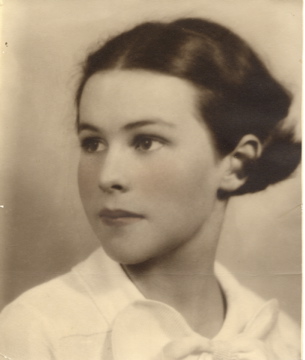
My biggest pleasure from this book, though, was a piece of uncanny serendipity. Among the photographs is a 1939 studio portrait of the poet’s mother, Jean Isobel. Here it is, and next to it is a studio portrait of my own mother, Esme Isabel, taken a few years earlier. It’s not the first time I’ve felt that a writer knew something very private about me, but I don’t know that any other book has ever come this close:

Tricia Dearborn’s Ringing World

Tricia Dearborn, The Ringing World (Puncher & Wattman 2012)

When I blogged about Tricia Dearborn’s first book, Frankenstein’s Bathtub, I said I responded to the poems as if meeting an old friend for the first time. This is her second book, 11 years later, and I find myself weirdly reluctant to blog about it. It’s not that I haven’t enjoyed it. I think it’s because it feels as if commenting on the poems would be like reporting on a late-night conversation among friends – one of those conversations where guards can come down and people talk easily and openly, crying a little and laughing a lot, about a first kiss (‘The changes’), about the moment when you realise your mother is a vulnerable being (‘Mother seen from below’, especially part iii, ‘Shard’) and other childhood memories (I particularly like ‘The smiley spoon’), about the death of a baby niece (‘The quiet house’), about tinnitus (‘The ringing world’), about your creepy empathy for someone who volunteers to be eaten (‘Eat my secrets’), about proofreading (‘Galley slaves’), about those fanciful moments when it feels that the world is sending you a message (‘Memo’) or you’re caught off guard coolly contemplating your own death (‘Gravity’ and ‘The waiting earth’), about dramatic (‘Projectile’) or sweetly romantic (‘Anniversary’) moments in a long-term relationship. It’s not the intimacy of the confessional, the therapy room or the pillow, but it is intimate.  And tactful – never Too Much Information, which is quite an achievement given that one or two poems (especially ‘Come in, lie down’) are pretty explicit about sex, and one (‘You are my perfect’) is a poignant avowal of love.

I read these poems, more than once, while out walking. Reading poetry while walking is something I recommend: often the rhythm of walking and the rhythm of a poem play nicely off each other, and the poems and the world can speak to each other in unexpected ways. In this book ‘Gravity’ made me notice what my feet were up to. Here is its last six lines:

Earth’s substance draws us, yet
stops us plummeting to her core.

But see how we, through the rhythmic
daily greetings of our feet

the transmitted pressure of our bodies at rest
eventually get under her skin.

‘The rhythmic daily greetings of our feet’ – isn’t that fine? It’s an example of another main joy I found in these poems – the way they unapologetically sing within a western scientific, materialist view of the world.

Tricia Dearborn’s work, including a number of the poems from this book, featured in Jim Bennett’s Caught in the Net 79.

Ali Cobby Eckermann

Ali Cobby Eckermann, Kami (Rare Object No 54, Vagabond Press 2010)
——-, Ruby Moonlight: a novel of the impact of colonisation in mid-north South Australia around 1880 (Magabala Books 2012)

Like other Rare Objects chapbooks, Kami is beautifully crafted. A hundred copies were printed, signed by the author, with a small, square, torn-edge print of an Australian desert landscape glued to the cover. I mean no criticism when I say it reminds me of a tasteful bijou hotel, each guest/poem with a room/page to itself. Ali Cobby Eckermann is a Yankunytjatjara woman, and the guests, it turns out, aren’t as genteel as that analogy might suggest. They don’t trash the rooms or anything of that sort, but they raise their voices any way they want. There’s throwaway surrealist satire (‘Pauline Hanson’, about a giant carrot), poignant domestic vignettes that shed light on the stolen generations (‘Comical’ and ‘Sink’), astringent comment on the intersection of sexism and racism (‘Intervention Allies‘), a sweet-sad love song (‘Kami‘ – at the link it’s the first of five ‘Yankunytjatjara Love Poems’), C&W dramatic monologue (‘I Tell Ya True‘ – click to hear Joe Dolce sing his own musical version), and so on. It’s a wonderfully diverse set of poems.

If any one poem out has special resonance for me it’s ‘Wild Flowers‘. It reminds me of Douglas Stewart’s ‘Glencoe‘, one of the few poems I remember from school days. I’ve thought a lot about ‘Glencoe’ over the years: it’s fascinating that an Australian nationalistic poet wrote this lament for the victims of a massacre that took place centuries ago on the other side of the planet (‘Terrible things were done / long, long ago’), as if that’s as close as he could get to acknowledging the terrible reality of our own colonising history, but was impelled to make at least that much. Cobby Eckermann’s poem includes similar imagery of children’s bones, but she can name the event as very much of this place and not safely consigned to the past. An additional, idiosyncratic resonance – you’ll have to take my word for his – comes from the way the poem’s opening lines almost be describing a moment from our short movie, Scar:

Mallets pound fence posts
in tune with the rifles
to mask massacre sites

There’s a massacre in Ruby Moonlight too, though most of the book is about what happens next for the sole survivor. The book is a lot slimmer than you’d expect of a novel, just 80 pages all up, and you’ll look in vain for the lecture that subtitle (see above) might suggest. This is spare, restrained story-telling. If it wasn’t for the power generated by the flash of imagery, it would feel like notes for a novel rather than the thing itself. It’s a story of ill-starred love. A young Aboriginal woman survives the murder of her community and after wandering for some time with just nature and an ancestor spirit for company, she finds companionship and intimacy with an isolated Irish fur trapper. Their idyll, forbidden by both their cultures, can’t last. You might think you know this story before you open the book. You don’t.

In an interview with Michael Brennan on the Poetry International Website, Ali Cobby Eckermann has some very interesting things to say about her work, including this:

I want to use my poetry to educate Australians, to overcome their innate fear of Aboriginal people. Most Australians have never met an Aboriginal person outside school, sport or work. I want to highlight the benefits that Aboriginal people can provide through friendship and equality, and highlight the dangers of racism and judgmentalism. I have been happy with the heartfelt responses from festival audiences, and the new friendships shown to me and my family.

MB: Do you see your work in terms of literary traditions and/or broader cultural or political movements?

Ali Cobby Eckermann: I think it is impossible to be an Aboriginal writer, and be free from a political view. I always use cultural ethics in my writings. Some of my poetry has a unique style, due to my life between my adopted German Lutheran family and my traditional Yankunytjatjara family, who have also adopted the Lutheran religion. I hope my sense of truth becomes my literary tradition!

Lionel Fogarty’s 1995 selection

Lionel Fogarty, New and Selected Poems – Munaldjali, Mutuerjaraera (Hyland House 1995)

Lionel Fogarty is described on the Australian Poetry Library (APL) website as ‘a poet who has opened up the new space of black Australian post-surrealist writing and done much to reformulate our understanding of poetic discourse and its roles in both black and white communities’.

I bought this book years ago and it has been intimidating me from the to-be-read pile ever since. Now that I’ve finally read it I’m not so much intimidated as baffled, which, come to think of it, isn’t so unusual for me around poetry: I remember feeling that many of Frank O’Hara‘s poems might as well have been written in Icelandic for all I could make of them. But you know, even if straightforward poems aren’t all alike, every difficult poem is difficult in its own way. I experience Lionel Fogarty’s poetry as difficult in a number of interesting ways, some of them suggested by the APL quote above.

First, he writes in a version of Aboriginal English, and uses words from Aboriginal languages. The book’s glossary is some help with the vocabulary, but the syntax isn’t always easy to follow on the page, and Fogarty doesn’t go out of his way to ease the task for white readers. He writes in his introduction, ‘White man will never really fully interpret what a black man is thinking when he is writing.’ Fogarty writes as an Aboriginal man, heir to a genocidal history and survivor of continuing genocidal policies and practices; I am reading as a beneficiary of the same history and still with a world view largely conditioned by white privilege. That probably sounds dreadfully pious, but the fact is he can quite reasonably expect me to put in some work.

In a fascinating 1995 interview with Philip Mead published in the online poetry magazine Jacket, Fogarty responded to a question about his use of language:

I think what people should do is read my poetry, in an Aboriginal way, take the Aboriginal side of my language, and then reflect back on the English side. That’s the only way you’re going to get a balance of understanding. I think my most important thing, like I always say, is to revitalise or to get a full language into practice of the detribalised areas, of the urbanised, so-called, Aborigines. That’s my main thing.

I don’t know if it’s a separate thing, but there’s also what the APL calls his post-surrealism. I take this to refer to the hallucinatory element of some poems and something that’s happening in the language that isn’t just about Aboriginal English. From that same interview:

What I like to get into people’s minds, when they read my things, is that they get a picture, they get a painting from it and that’s the only way they can really understand all the mosaic, the patterns of the words I put down on paper. At the same time they can hear my voice coming through quite clearly, then they can really understand the poet.

I need to spend a lot more time with this poetry before I can do much more than struggle with it. But so as not to completely chicken out of saying something, here are the relatively unproblematic opening lines of ‘Farewell Reverberated Vault of Detentions’, a poem that imagines a day of freedom from oppression:

Today up home my people are
indeedly beautifully smiling
for the devil's sweeten words are
gone.
Today my people are quenching
the waters of rivers without grog
Today my people are eating delicious
rare food of long ago.

This isn’t difficult, if difficult means hard to understand. However, I do have difficulty with it. I don’t know if indeedly is Aboriginal English. In any other context I would have read it as a Ned Flandersism. Likewise, sweeten used as an adjective, quenching as something done to waters rather than by them, apparently erratic use of full stops and capitalisation: my copy-editor reflexes go wild. I don’t think that Fogarty has written these lines with an intention of discombobulating white pedants. This writing just doesn’t care about my concerns. It’s talking to someone else altogether, and if I want to keep up I have to let go. But then I’m at sea. I am as much at a loss to pick up on the nuances of this language as I am when I’m reading French or Italian – which is very at a loss.

It’s true, in the couple of videos I found of Fogarty reading, the poetry communicates much more effectively than when I read it for myself and hear it, inevitably, in my own white, middle-class, linear-syntax-conscious voice. This TEDxSydney 2010 video is fabulous, for example:

Two Rare Objects and a Stray Dog

Christopher (Kit) Kelen, Green Thought – Green Shade: A Sabbatical Set (Vagabond Press, Rare Object No 79, 2012)
Adrian Wiggins, Chooks (Vagabond Press, Rare Object No 81, 2012)
J S Harry, Sun Shadow, Moon Shadow (Vagabond Press, Stray Dog Editions No 3, 2000)

I bought these three books last weekend at the Gleebooks launch of half a dozen chapbooks from Vagabond Press. A chapbook is a small collection of poetry – usually cheaply produced and inexpensive to buy. The Rare Object series, now numbering more than 80, small (16 pages), saddlestitched and without ISBNs, with a print run of 100 copies each, are at the deluxe end of the chap spectrum: they have swanky, translucent fly leaves, and a small printed image glued on the front cover, and each numbered copy is signed by the author.

At the launch there was some uneasy joking about the presence of non-poets. Like sceptics at a seance or woman reporters in a male football team’s change room, we were kind of welcome but unsettling. (Although I’ve had a handful poems published, as a reader I’m definitely a non-poet.) Pam Brown’s launching remarks, an edited version of which is up at the Rochford Street Review site, had none of that uneasiness. She was generous and straightforward, made all six books sound desirable, and modelled in an unfussy way the kind of work needed to read these compressed, allusive and/or oblique contemporary poems. (Besides the books by Kit Kelen and Adrian Wiggins, the others being launched were by Niobe Syme, S. K. (Steve) Kelen, James Stuart and Nicolette Stasko.)

Kit Kelen’s book is a set of poems written while home on sabbatical in country New South Wales. For a prosaic reader like me, it helps to know that before you start, and to know that he mainly lives in Macau, and is a painter as well as a poet. You may also need to be warned that you’re entering a punctuation free zone, so a little extra decoding work will be needed. Given all that, the poems speak very directly, with a sweet sense of place, and a whiff of Chinese or Japanese sensibility. From ‘Iona’:

mosquito the size of a small bus
comes and passes and is gone

Kelen has made some interesting remarks about how these poems relate to the pastoral tradition and to the problematic nature of non-Indigenous land ownership in Australia. ‘The challenge,’ he says, ‘is to have fun while you problematise (otherwise please don’t write a poem).’ The elegance, humour and directness of the poems mean the problematic elements slide into the reader’s mind without a bump.

Chooks is Adrian Wiggins’s second book of poetry – it’s 18 years since the first. I understand the title to be presenting these poems as a yard full of chooks, each going in its own direction, scratching, pecking, clucking, fussing over chickens, and generally filling the yard with life. I can’t say I follow them all, or even most of them. For example, ‘The Astronaut’s Lovesong‘, which mixes cosmic imagery with images of bondage, might have been impenetrable to me without Pam Brown’s gloss: ‘Yes, it’s about the wildly jealous astronaut Lisa Nowack who tried to kidnap a female airforce captain who was involved with an astronaut on whom Lisa had a big crush.’ I suspect there’s a lot of play with poetic conventions and politics in the book, some of which I get: I find the idea of John Forbes cosplay (in ‘New Season’) irresistibly funny, but there are almost certainly people who would be driven to Google by both ‘John Forbes’ and ‘cosplay’. One person’s esoterica are another person’s commonplaces, and if the prose meaning eludes me I still enjoy the ride – in some ways it’s like being a child reader again.

For the fun of it, I scribbled all over the first poem in the book, ‘Galah’ (a photocopy – I wouldn’t dream of defacing this beautiful rare object), just to have a visual take on where the poem took me. It’s not a particularly obscure poem, but it does fly off in many directions:
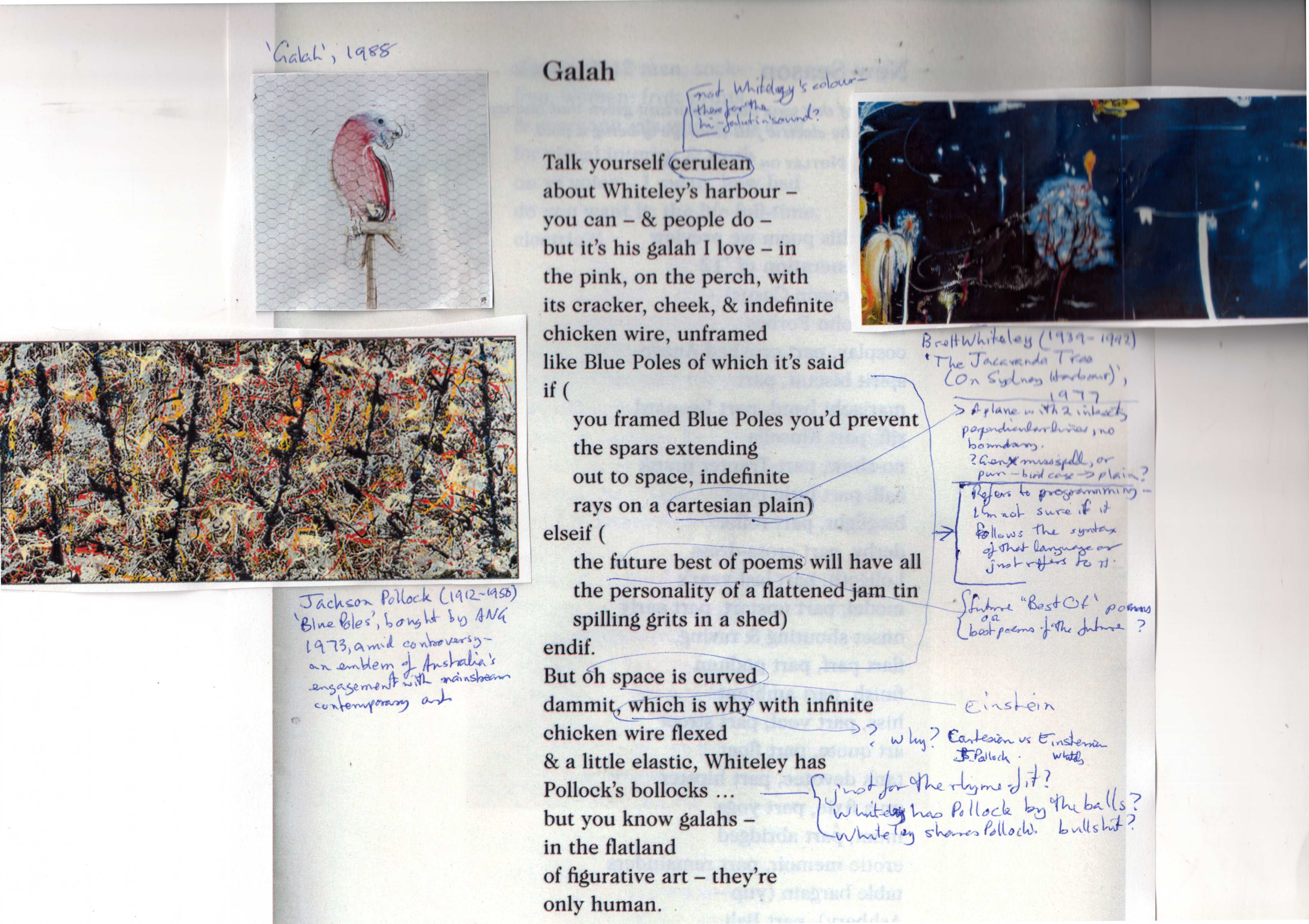
It’s a measure of how much I enjoyed the poem that my inner proofreader didn’t spot the misspelling of ‘plane’, deliberate or otherwise, until I was quite a way into the annotating.

For me (Mr Prosaic Reader), apart from ‘Galah’ the prize fowl is ‘Macquarie River swimming’, a sharply rendered piece of nostalgia for youthful days when the poet and his friends, swinging on ‘a straggly rope tied to a river-gum’,

________________________let rip
with an imitation aerialist’s flip, a shout,
and fell through the day, new bullets

through old rifling, laughing from the noon’s
blue meridian to a cold, dark hole midstream.

J S Harry’s Not Finding Wittgenstein (2007) featured the adventures of Peter Henry Lepus, a rabbit who goes to Iraq and other places and knocks around with philosophers. I was intrigued by this odd character, and tantalised by the few poems about him I’d read. I thought Sun Shadow, Moon Shadow from 2000, not much bigger than the Rare Objects (though big enough for an ISBN) – might be a way to ease myself into his world. Alas, there was no easing to be had, no Origin Story, just a rabbit who has been provoked into trying to think. He’s a strange creation, and the poems are strange too, peppered with erratic spacing and capitalisation and font changes. But definitely alive, and wide ranging. Peter tries without much success to understand the poetry scene. He encounters a literary critic in a poem that might be more fun for readers who know or are willing to find out who Altieri is. In ‘They‘, Peter tries to explain to ‘the flowerbed rabbit / who lives deep in dark leaves’ what humans (‘they’) mean by the ‘pronoun called I’. In ‘A Sunlit Morning, Labor Day, Late Twentieth Century’, he sees and does not understand the death of a magpie friend. He’s clearly a device for looking freshly at the world, for exploring philosophical questions and any number of things, but he is also a character in his own right. His meeting with the cat Chairman Miaow (a different Chinese whiff from Kit Kelen’s) in “Moonlight Becomes You?” may be an enigmatic meditation on art, but it’s also a scary confrontation with a predator. After his conversation with the flowerbed rabbit about the pronoun called I, he realises he has lost an opportunity to

follow the white
bobs of her tail
disappearing
into the scarlet flowers.

I guess I’ve now got Not Finding Wittgenstein on my To Be Read list.

Tricia Dearborn’s Frankenstein’s Bathtub

Tricia Dearborn, Frankenstein’s Bathtub (Interactive Press 2001)

I read this book in Istanbul, mainly in brief snatches while waiting in queues or similarly engaged. To lift a phrase from one of its poems, (‘this book will change your life’) you could say it was ‘the necessary unwelcome weight in [my] backpack’, though as it’s a very slim volume it was hardly unwelcome.

As one of the striking features of Istanbul in this hot summer is the length to which some tourists go to conceal the female body, I was delighted by the sweet, witty female sensuality in the poems of the book’s first section, ‘Body Parts’. When I say sweet, I invite you to think of mangoes rather than sugar cubes or apple tea – ‘slicing slivers of yielding flesh / that fill my mouth with / lusciousness / and after-tang’, which of course is about actual mangoes. I would have liked ‘the white dress’, from a later section, anywhere, but its tale of childhood rebellion gained an extra poignancy from the proximity of so many young women sweltering obediently beneath layers of black cloth:

the white dress

I knelt with your sewing scissors
beside the towering wardrobe

carefully I snipped holes in
your authority

I would see my life
through those holes

creating them I rained to the red rug
triangles of fine corduroy

I would not wear that dress

There are poems about growing up female, having a female body, female friendships, mother–daughter relationships. And quite a bit that doesn’t fit easily into that field. The titles of the book’s other sections give an idea of its range:

laboratory days, which includes the magnificently named ‘the biosynthesis of 3-nitropdropanoic acid in penicillium atrovenetum’

the leaping spark, about books and sex

short-circuit, which includes ‘the white dress’ and other poems about childhood, reproduction, same-sex attraction and violence against women (yes, I’m not sure what the common thread is there either!)

the uncertain human, containing the title poem and eight other short, strong poems, in which again the body asserts itself:

I think, therefore I am
said Descartes, but

while he thrice denied
the body, his neurones

pulsed with electric
solutions
(from 'proof')

home, dealing with cockroaches, visitors, travel

I respond to these poems as if meeting an old friend for the first time. I have met Tricia Dearborn once or twice, but that’s not what I mean. I think it’s the way the poems refer back, fairly obliquely, to a Catholic childhood, and turn their back on it, joyfully asserting the materiality of humanness.

Death’s Directives to Bruce Beaver

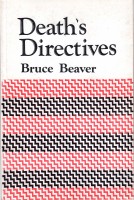
Bruce Beaver, Death’s Directives (Prism Books 1978)

I love Bruce Beaver’s poetry, though I usually feel that I don’t really get it, and I hadn’t read this book, so I was delighted to find it on Sappho’s second-hand poetry shelves when I went in search of slim volumes to pack for Turkey. I read most of it on our overnight cruise from Kas, feeling just a bit self conscious about reading poetry, let alone poetry with such a grim title, in those hedonistic circumstances. But I’ve done odder things (embarrassingly, this morning I caught myself noting the typos in a menu in Turkish, a language I don’t know at all), and my life doesn’t seem to be any worse for it.
There are 20 poems in the book, ranging from 40 lines to about four time that long. In all of them the poet has some kind of dialogue with death. Death may be a personification of his sense of his own mortality, or of mortality in general, or something less easily defined, like an acceptance of things as they are. There is painful introspection, exploration of the poet’s less than admirable past, reflections on his experiences with sex and religion, meditations on art and ethics, one splendid love poem, three elegies of sorts (for Mao Zse Dong and the poets Neftali Reyes and Anne Sexton). As I’d expected, I was carried along and sometimes carried away by the way he imbues conversational language with a particular, personal music, and am aware that my enjoyment would be greater if I was better read. I’ve never heard of Neftali Reyes, and have read about two poems by Anne Sexton. I got a lot of pleasure from some references like the echo of Yeats’s ‘This is no country for old men. /The young in one another’s arms’ etc in the first poem’s

In another month it will be on
again, the girls will stop hugging their cold
tits, and the boys denim flies
will be bulging, the little kids
here and everywhere else
on the continent will be rolling
around in clover grass and on
the warming asphalt. Dogs, cats
and birds will go madder than usual
about their courting. Everything
and everyone will come alive

and I know there was much more to be had.

The youngest woman in our group asked on the boat to read some of the book. I recommended X and XI, about his mother and the love of his life respectively. She read them slowly, thoughtfully, exclaimed over the way her education had put her off poetry by wringing every drop of meaning out of it, read a phrase or two out loud. I don’t know if her life was any richer for her encounter with Bruce, but mine was. By my own encounter too. I’ll quote you two bits from XI. First a chatty abstraction:

And the best times together come back at moments
that catch me up in the embrace of a rare
music that at the time of making we must have
overlooked and failed to overhear
because of the noise of our hearts and our spontaneous cries.

And then the end of the poem, that gives an example of what he may have meant:

There was a tree, there was a road,
there was a woman with me. And for once
there was forever in an instant
so that I picked a fallen leaf from out
the scruffy grass, a skeletal leaf
and she said, how beautiful,
and made even death appear to smile.

Colleen Burke’s Wildlife in Newtown

Colleen Burke, Wildlife in Newtown (Feakle Press,1994)

Poetry is good to travel with. Slim volumes are attractive when you’re packing light, and short poems are well suited to the short grabs of time for reading, in between gawking, eating, finding toilets, blogging and all that. Apart from such practicalities there’s this little syllogism: a) Whenever I travel I have intense dreams about home; b) poetry has been described as a waking dream; c) it makes sense to take poems about home when travelling. So of course I brought this book whose title promises poetry about places a couple of blocks from my home.

True to that promise, the book’s sense of place is very strong, in poems celebrating working class, culturally diverse Newtown, acknowledging its Dharug past and present, and repeatedly evoking Newtown houses, Camperdown Park and the historic cemetery adjoining it. The latter is the subject of elegant photographs scattered through the book, which I’m guessing were taken by the author. It’s evident that Colleen walked through that park on the way to and from work, that she often spent time in the cemetery. If that small part of the world were to be allocated a Poet Laureate, she’d be hard to beat.

The book has a number of interweaving strands: the walks home from work, often involving sunsets: relatively impersonal narratives about the history and make-up of the suburb; conversations with the poet’s children; the cemetery poems, some of which are about the history, some intensely personal; a very few strong poems that directly address the death of the poet’s partner. All the poems are short. If I was at home, I’d find the lovely line about Colleen Burke’s lyrics in Jennifer Maiden’s 1999 collection, Mines, but as I’m gallivanting in Turkey with fitful Internet access, I’ll just recommend that you look it up.

I hope Colleen won’t mind if I quote a poem that, while not necessarily my favourite, struck a chord because I was away from home – in Turkey, not India – when I read it.

And so I was there
for Kerry
‘And so I was there –
a recognition. My
heart full to bursting.
There’s something in the smell of
heat, dust, exhaust fumes,
oxen, tea, animal piss,
garam masala and ghee.
There’s something about women
in saris, beggars of all ages
and people living on the
cramped narrow streets –
an atmosphere of the
Arabian nights that
intoxicates and frees you –
like a window opening.’

ii
I read your letter
in the crumbling
graveyard sheltered
from the August winds
by the empty sandstone
church. Spring
murmured in the winter
soil, a whisper of wattle
in the air. I was close
to you in the gnarled
shadows and slender vines
of sunlight. Close to
the bare bones bound
down by the long dark
roots of the Moreton
Bay fig tree.

iii
‘In the small crowded
Kali temple people
sang, danced and gave
us flowers. Held our hands.
And so I was there’

Place calls out to place calls out to place.

Full disclosure: I published one or two of these poems in The School Magazine in my past life, and may have rejected one or two others; Colleen Burke taught a creative writing class to my mother-in-law, which was a significant event in her pre-dementia life; more than 20 years ago I heard Colleen read poems about her bereavement and her children that still move me, though I remember only a phrase or two.