Tag Archives: poetry

SWF 2112: Poets, Harbour, pitches and more poets

This was my first day at Walsh Bay, and in striking contrast to recent weather, the sky was cloudless and there was no wind – perfect festival weather.

The tiny harbourside room generally reserved for poets at the Festival couldn’t have been a more appropriate venue for my first event of the day, Harbours and Rivers, with Robert Adamson, Neil Astley, Martin Harrison and Jennifer Maiden. I joined the uncharacteristically long queue with minutes to spare, and only when it became clear I wasn’t going to get in I realised I was in the wrong place: this time the tiny room had been given to young writers talking about the Second Novel Effect, and the poets had been given a much bigger and incidentally much darker space. I briskly walked the length of the Wharf and arrived part way through the introductions.

The poets, refusing as poets should to be pigeonholed, paid at best slant regard to their allocated topic. Jennifer Maiden read a long new poem, ‘The Uses of Powerlessness’, which she described as a diary poem but was actually pretty much a philippic on Julia Gillard, not in the ‘X woke up in X’ form, but a straightforward furious meditation. I wrote down one of many striking lines: ‘The Labor Party, like Gillard, is an obedience addict.’ Martin Harrison and Robert Adamson both spoke of the complex interplay between observation of the natural world and self-discovery. ‘All my harbours and rivers are internal,’ the latter said, somewhat disingenuously, ‘even though I live on a river.’ Among the poems he read was the sublime ‘Kingfisher’s Soul’, an intensely personal love poem that grows richer with each hearing. Neil Astley, advertised as editor of English publishing house Bloodaxe Books, turns out to be a poet as well. He was in Darwin for Cyclone Tracy, about which he read two striking poems followed by an excerpt from a novel that engages with an English countryside.
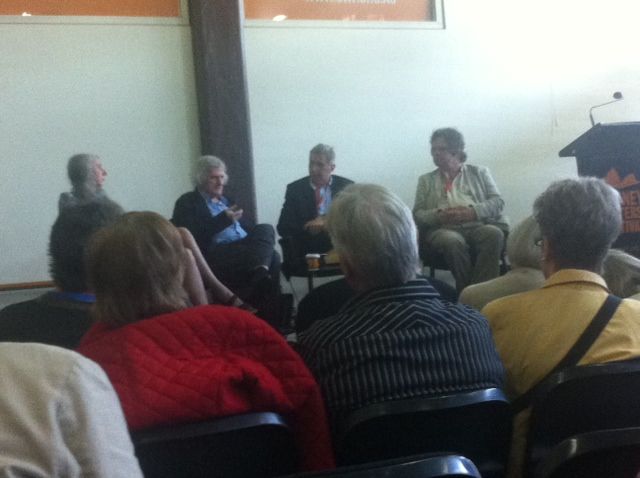
Jennifer Maiden, Robert Adamson, Martin Harrison and Neil Astley not far from the Harbour

In short, it was very good. Afterwards I ventured to introduce myself to Jennifer Maiden, but I was probably working so hard at no being too fanboyish for the conversation to have made much sense.

After a brief interval I went to the Club Stage for So You Think You Can Write, my first time to this a regular Festival event in which random audience members get to pitch a project to a panel of publishers.
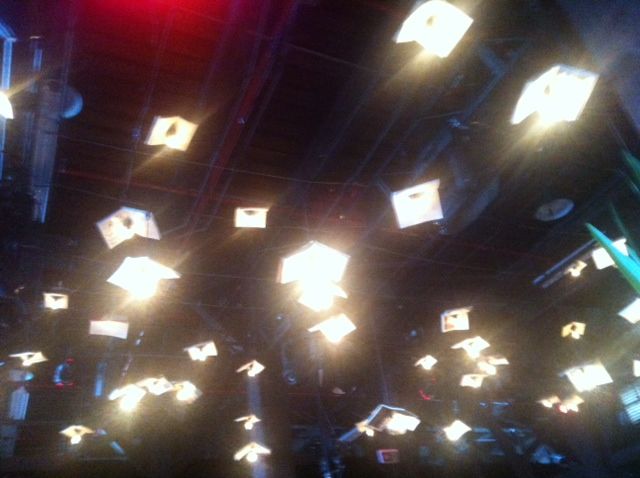
The specially decorative lights for the Club Stage area – each bulb has an open book for a shade.

I don’t know that anyone who was at all savvy about publishing would participate in this, unless for the sheer fun of it. And it was mostly fun. A 15 year old boy pitched a detective story set among the Egyptian pyramids. There was an earnest tract for children aiming to foster leadership skills and an understanding of democracy. One or two pitches were for books that could have been anything, so broad were the descriptions. One woman had already had an iBook version of her project downloaded thousands of times. The winner – of nothing apart from the glory – was a psychological detective story in which the character realises a day of her life has gone missing and then is shown photos of herself taken on the missing day. The thing that won the audience and panel’s approval was that the photos were improbably and bizarrely orgiastic, involving vegetables and cigars in unspecified lewd ways. It may not be Scandi-Crime, but this audience loved it. You read about it here first.

And then off to the poets’ lightfilled room. Gig Ryan and Kate Lilley, feminist-identifying experimental poets, drew an overflow crowd, including Adamson, Harrison and Astley from this morning, plus John Tranter, Ivor Indyk, Toby Fitch and many faces familiar from the Sappho open mike nights. Each of the poets introduced the other. They read from recently published books and, on being requested by an audience member to  compose a poem together on the spot, they parlayed the request down to each of them reading a poem by the other – with interesting results.

I confess that I went to this session expecting to suffer. I’ve read very little of either of them and my experience has been that if I don’t know a poet’s work I have trouble hearing it when read to me. (A possible contrary experience was hearing Jennifer Maiden this morning, but I am familiar with her voice and preoccupations, so had a head start.) Gig Ryan reads quickly, and her language is very compressed: I had difficulty distinguishing the words, let alone grasping the connections between them. Kate Lilley has a gratifyingly expressive delivery, and the woman beside me kindly allowed me to look over her shoulder and read along as the poems were read. But I was still pretty completely mystified. Both women talked about how people in their lives met their work with blank expressions, so I didn’t feel too stupid, or at least not alone in my stupidity.

One of Kate Lilley’s poems, ‘Maisily’, consists of a string of about a hundred adverbs. This was the first time she’d read it aloud and it was quite a feat – all those lys. It seemed like pointless nonsense to me. Then she explained that it was made up of all the adjectives used by Henry James in What Maisie Knew. That made it seem like hi-falutin pointless nonsense to me. Then I remembered that it was part of an elegiac sequence about the poet’s relationship with her mother, and it no longer seemed so pointless – maybe I was finding an emotional subtext because that’s the kind of reader I am, but I did find one, like a deeply submerged nostalgia for childhood when the adult world was as inscrutable as to little Maisie in James’s novel. I wonder how it wold go if read, not as a near tongue twister, but with the rhythm of a tolling bell.

As if the poets had read my thoughts, their conversation turned to the business of reading poetry aloud. Lilley said she knew and loved her poetry long before she heard her read, but when she did hear her read it was a revelation. Maybe my difficulty is as much to do with my increasing deafness as with unfamiliarity with the poetry.

So the poetry was difficult, but the session was excellent. Both were very funny about the business of being poets, and how they see each other’s poetry. Even when they drew our attention to the complete absence of critical articles on Gig Ryan’s work, even though she is generally acknowledged as an important Australian poet, and surmised that this absence may well be because she is a woman, somehow that seemed richly comic.

On the way home in the bus, I ran into an old friend who had been to a panel with Peter Hartcher, George Megalogenis and a third journalist talking about Australia’s parlous economic situation. I felt I had been very frivolous, but I was glad of it.
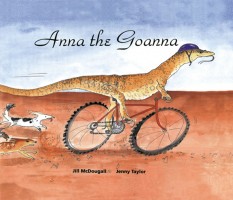
Anna the Goanna

Jill McDougall & Jenny Taylor, Anna the Goanna and other poems (Aboriginal Studies Press 2000)

This is a collection of poems written by a schoolteacher ‘in order to provide classroom reading material which reflected the daily experiences of her students’. That description, taken from Jill McDougall’s bio at the back of this book, could be a recipe for semi-literate, patronising disaster, all the more so when the students in question are Aboriginal. On the contrary, this collection is a delight, words and images both. Not that the opinion of a 65 year old urban middle class white men matters all that much, but I’d be surprised if this book didn’t go down very well indeed, in the classroom and out of it, performed for the students or by them or read in private, by curious non-Indigenous as well as Indigenous children.

Why did I read it? Well, reading the Kevin Gilbert books reminded me of how much I enjoyed his children’s poems, and this was a gift that has been sitting on my shelves for a couple of years now, waiting for a suitable child to turn up to be read to from it. I just decided to stand in for that hypothetical child.

As the title promises, there are silly poems about goannas. There are also mosquitoes, crows, flies, and a crocodile, but it’s not all animals. There are babies, big sisters, football and baseball, a sweet   comedy about the difference between Aboriginal and mainstream economics, and two pieces that depart from the general cheerful tone – ‘Too Many Drunks’ and ‘Sad Boys’ , the latter being about petrol sniffing.

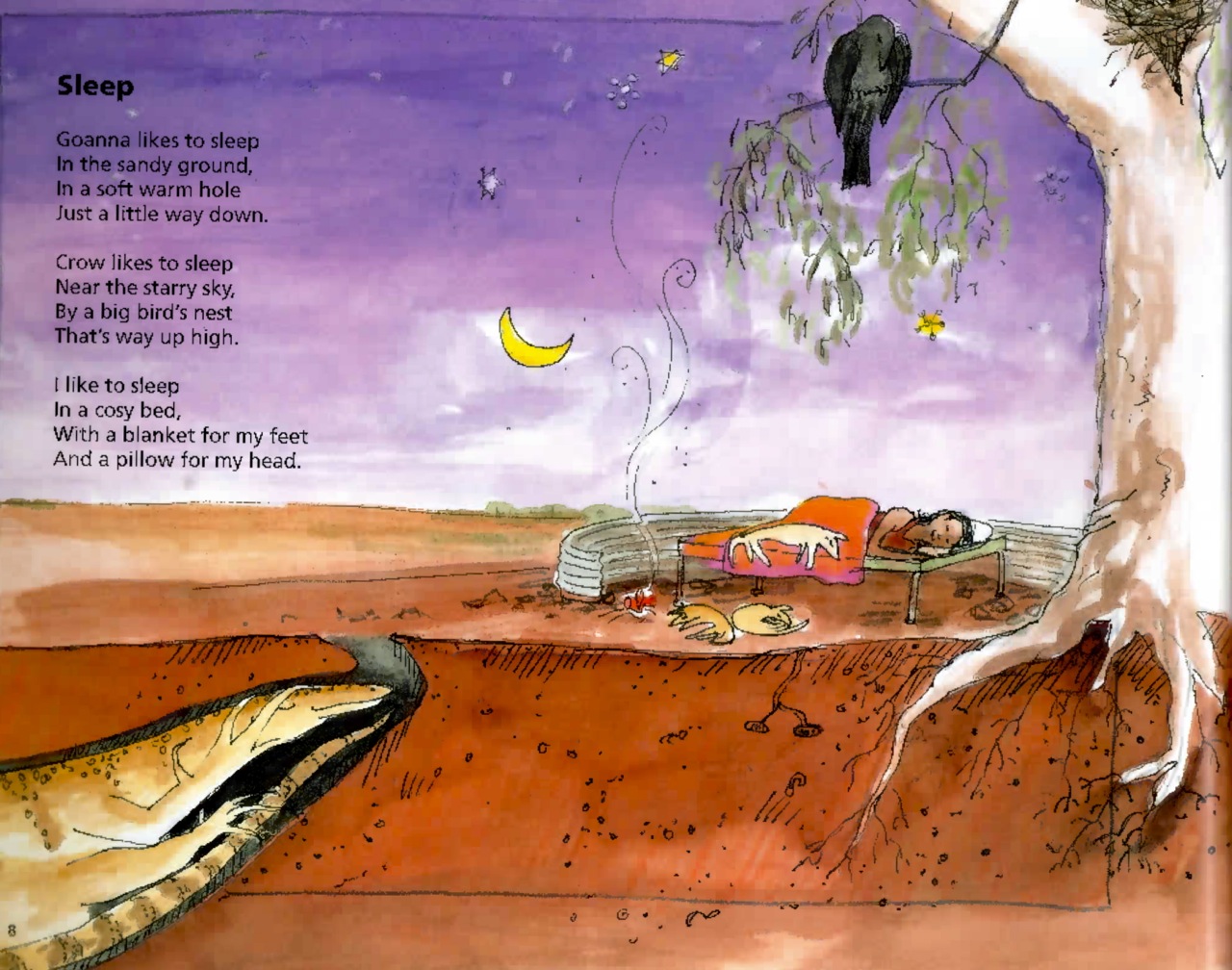
Jenny Taylor’s illustrations demonstrate just how important the interplay of text and image can be in a picture book. One page that struck me in particular was ‘Sleep’. The poem:

Goanna like to sleep
In the sandy ground,
In a soft warm hole
Just a little way down.

Crows like to sleep
Near the starry sky,
By a big bird’s nest
That’s way up high.

I like to sleep
In a cosy bed,
With a blanket for my feet
And a pillow for my head.

The final stanza could be spoken by any child, anywhere. One could easily think of a room with pastel wallpaper and shelves of stuffed toys. The illustration is a revelation about possible meanings for the word ‘cosy’:

Lehmann & Gray’s Australian Poetry since 1788: A first post

Geoffrey Lehmann & Robert Gray, Australian Poetry Since 1788 (UNSW Press 2011)

This was a thoughtful and generous Christmas present, and it’s a daunting 1080 pages. After a bit of dipping and checking, I started at the beginning on Australia Day (after all, the title implies that in this book Australian poetry began on or after 26 January 1788), expecting to take a year or so to read it in bits here and there. Rather than wait till next January or thereabouts to blog about the book all in one go, I’ll post now and probably a couple more times over the coming months.

It’s the age of the interwebs, so naturally before I’d gone much past the Introduction I went looking to see what other people were saying. It was no surprise to come across snippets of ‘poetry-war’ conversation. John Tranter called the book the Death Star and blogged some inflammatory sarcasm. Someone on The Rereaders called it the Grey Lemon. So far so expected. I followed a trail of links to a video of a lecture given by Peter Minter at a seminar last October, and suddenly we were out of the poetry wars (in so far as that phrase implies squabbles among the marginalised) and into serious cultural issues. Minter starts out by saying that as a poet you don’t often have to take a stand, but this is one of those moments, and even though some of the lecture, particularly the discussion of the endpapers, is gleefully sarcastic, the over all feeling is a kind of passionate no pasaran. The anthology, he points out, includes only two modern Aboriginal poets. [Have a guess who they are, and if you’re at all familiar with Australian poetry you’ll probably get one right, but almost certainly your other name is one of the excluded. If ten of my readers did this in a room together we’d probably come up with ten names – that is to say, it’s an obviously significant exclusion.] This wouldn’t be such a big deal if it wasn’t being sold as a grand canonising statement rather than a selection of stuff that a couple of men happen to like. As it is, though, the omission, along with the ethnographic treatment of the traditional Aboriginal songs that are here, amounts to a ‘disappearing of modern Aboriginal poetry’ (Minter’s phrase), a contribution to this country’s continuing genocide (my phrase, and though it’s intemperate I’ll defend it if need be). Minter lists numerous omissions beyond the Aboriginal poets, and says there are many errors in the commentaries (the only one he specifies is the description of the 1967 referendum as giving Aboriginal people ‘special recognition’ in the Constitution, whereas in fact it removed ‘special’ provisions). The video is well worth watching, even though it misses a lot because it doesn’t show us Minter’s slides.

Poor old Geoffrey and Robert! I’d heard one of them on the ABC’s late lamented Book Show being quietly pleased with the representation of women among their poets. ‘Whew!’ you could almost hear him saying. ‘We dodged that bullet.’ One mitigating factor is that while the book is generally being touted as in some way definitive, the actual Introduction presents it pretty unambiguously as a product of the compilers’ idiosyncratic tastes and preferences.

All the same, I gave quiet thanks for Edward Said’s notion of counterpoint (that is, roughly, rather than boycotting a work of art that is, say, racist, it is preferable to read it along side of work by the people it has belittled or slandered or erased), and promised myself that I would dig out my books of poetry by Lionel Fogarty, Kevin Gilbert, Samuel Wagan Watson and read them and other Aboriginal (and non Anglo, and so on) poets in parallel with this anthology.

The two Aboriginal poets who made the cut are Odgeroo Noonuccal and Elizabeth Hodgson. There are quite a few versions of Aboriginal songs and stories ‘as recorded by’ white men, and in the case of those recorded by Roland Robinson, the storytellers’ names are given. This doesn’t negate Minter’s main point, but it does indicate that the editors were more aware of Aboriginal people as cultural creators than his lecture might seem to imply.

Southerly 70/3

David Brooks & Elizabeth McMahon (editors), Santosh K. Sareen & G. J. V. Prasad (guest editors), India India: Southerly 70/3

Southerly is a venerable institution – the Journal of the English Association, Sydney, it has been going for 70 years (which isn’t long compared to children’s literary journals such the School Magazine or its New Zealand equivalent, but impressive among little magazines for grownups). This issue has a central focus on Indian–Australian literary relations, but I bought it for Jennifer Maiden’s poem, ‘The Year of the Ox’, which doesn’t relate to that focus.

‘The Year of the Ox’ is to an end-of-year family letter what many of Jennifer Maiden’s poems are to diary entries, that is to say, same same but different. It brings us up to date on characters who have been inhabiting her poetry for some time: herself and her daughter, current political leaders (Obama, Clinton, Gillard), iconic figures of the recent and not so recent past (Diana Spencer, Mother Teresa, Florence Nightingale, Queen Victoria, Eleanor Roosevelt) and her fictions George Jeffreys and Clare Collins. It’s a long and complex poem, but from one point of view, it brings us up to date on the doings of this mental family during 2009, the Chinese Year of the Ox, and into 2010, Year of the Tiger, all the while ringing the changes on the images and connotations of ox and tiger. I love the way the poem swings with apparent nonchalance from observations on her own close relationship, the political scene and the nature of poetry, to – what to call them? – Platonic dialogues between icons, to vividly realised domestic scenes from a virtual novel, and all the while there’s a sense of poet-as-ox pulling a plough through the furrows of a mind alert to the world.

There are other excellent poems: by Ali Alizadeh (whose ‘Election Announced’ chillingly mentions someone as ‘the theocrat / a retributivist in speedos’), Judith Beveridge (whose two poems are actually India-related, thanks to her interest in Buddhist lore), Richard Deutsch, Craig Powell and a list of other Australians, and by a handful of Indian poets. I couldn’t get into any of the short stories, with the exception of Sarah Klenbort’s ‘The Chinese Circus Comes to Cessnock’, in which three fruit-picking backpackers encounter the complexities of Australia’s policies about Asian immigration.

Southerly comes from academe, and there a number of academic pieces, in particular surveys of the India-Australia literary connection and studies of particular texts. I intended to read the journal from start to finish, but decided to skip the scholarly bits when I read on page 20 that one novelist’s work ‘might be taken as a case study of Deleuzean deterritorialised nomadology […] Derridean self-critique in which text and meta-text mutually […]’. Too much like hard work! I skipped pieces by Indian critics on Mollie Skinner, Hazel Edwards, and a number of Aboriginal subjects with words like subjectivity, constructing and historiography in their titles. But I was wooed back by Mark Macleod’s ‘Reading my first time in India: the ACLALS Conference 1977’. Once you get past the daunting title, this is a fabulous piece of travel writing structured around two literary conferences. It sheds light all over the place, and abounds with striking images and telling anecdotes.

The other stand-out piece was by Patrick Bryson, a white Australian married to an Indian woman and living in rural India. His ‘The Men Who Stare at Bogans’ explores the Indian press’s coverage of the anti-Indian racism in Australia, and moves on to a brilliant essay on the treatment of ‘tribals’ in India.

As I was writing this, the next issue of the Asia Literary Review arrived in the mail. It’s an English language journal reflecting writing in and about Asia. This Southerly does a nice job of reminding us of one of our strong Asian relationships.

Andrew Motion’s Natural Causes

Andrew Motion, Natural Causes (Chatto Poetry 1987)

Andrew Motion is one of those poets you can know about without having a clue about his poetry. I knew he was the Poet Laureate who broke with tradition and actually resigned from the post, the chair of the Man Booker Prize committee that produced some controversial short lists in recent years, someone who is disparaged in passing in hip poetry circles, in short, someone who had been pigeonholed as typically middlebrow. But I don’t think I’d read a single line by him.

I bought this book for $2 at Sappho’s, which probably means there are plenty of copies around, and I should be glad it’s not adorned by student marginalia. I enjoyed it a lot, perhaps because there’s a strong narrative element, and I’m a sucker for narrative. Two substantial sequences stand out: ‘Scripture’, about Motion’s time at boarding school, to which he was sent, barbarically, at the age of seven, and ‘This Is Your Subject Speaking’, an elegiac sequence in honour of his friend Philip Larkin, who died a couple of years before the book was published. There are some sweetly moving poems about his baby child.

I found a nice interview with Andrew Motion on the Oxford Poetry web site, where he talks among other things about his use of his own history:

But I still intend my poems to function as photographs taken from one person’s life, which are put on show to everybody else so that they might perhaps recognise things about their own lives from those photographs. I think that that process is more likely to succeed if you colour the photographs with those feelings which you have to say are yours, and personal. I’m sure this sounds very unsympathetic to the new critics, but that’s how I am.

Harpur on the sonnet by way of Middlemiss

Perry Middlemiss often blogs Australian newspaper articles from decades past on literary subjects. He recently treated us to a  essay on the sonnet by Charles Harpur, originally published in the Sydney Morning Herald in 1866, which I found fascinating for reasons that might be obvious. Here’s a sample:

the untransgressible limits of the sonnet often tend to induce that closeness of expression, and that sublimation of imagery which are proper to the highest kind of enduring poetry, namely, that kind which is suggestive rather than descriptive, or which by a few select images, intensified in the putting, suggests infinitely more than could be circumstantially described, or otherwise than wearisomely; and which, therefore, while it amply recompenses the imagination of the reader, exercises it as well, and thereby quickens and strengthens it for direct conception upon its own account, or as an individual and self-sustained faculty. And, having, as I think, this tendency, of course these exact limits prevent in an equal degree that verbal delusion of the sense which is the besetting weakness of most modern writers, both in a verse and prose.

LoSoRhyMo #13

I read some lines from Les Murray’s poem ‘Poetry and Religion‘ somewhere recently, and they became an ear worm. It’s a wonderful poem, and very challenging to readers like me who have no sense of the religious.

Sonnet #13: Not exactly Ars Poetica
Every poem’s a small religion
said Les Murray. P’raps that’s true
of his. Mine’s more a kerbside pigeon
[I’ve found a rhyme – now from the slew
of possibilities find reason]:
puffed up in the mating season
it coos alliteration, rakes
the ground with fanned iambics, makes
a strut around its object. Full
religion, Les says, is the large
poem. Buddha, Jesus, Thor,
the Prophet, Moses: metaphor.
Oh Dawkins! If no god’s in charge
poems like pigeons when they fly
in large flocks can blot out the sky.

Added later: Close readers will notice that this one has 15 lines. All I can say by way of explanation is ‘Oops!’

And later again: perhaps the last six lines should have gone:

Full
religion, Les says, is the large
poem. If no god’s in charge
can poetry be meaningful?
Shall poems like pigeons when they fly
in large flocks obfuscate the sky?

Michael Dransfield revisited & LoSoRhyMo #12

Michael Dransfield, Streets of the Long Voyage (UQP, Paperback Poets 1970) and The Inspector of Tides (UQP Paperback Poets 1972)

Around 1970, when Sydney poetry readings drew relatively large audiences, a young Michael Dansfield, roughly my own age as it happens, created something of a stir. With unruly shoulder length curls, he looked every inch the romantic. He was evidently much loved by the community of poets and his death of an overdose inspired a number of moving elegies. I bought his books and applauded his readings, but it was my guilty secret that I found his persona and his poetry vaguely irritating.

Recently a friend who was culling her bookshelves gave these two books to me rather than tossing them or lugging them to a secondhand shop (where the Internet suggests they might have been worth a bob or two, if not for a small child’s large writing in the margins of ‘Still Life with Syringe’ and elsewhere). I’d long since disposed of my own copies, and was glad of a chance to revisit the poetry after some 40 years.

Half way into Streets of the Long Voyage I realised I was looking for irritants, and finding them: the self pitying romanticisation of drug addiction (‘a needle spelling XANADU / in pinprick visions down your arm / what of nostalgia when/ the era that you grew in dies’), the hi-falutin’ name-dropping (no John Forbesian Ramones for this lad, just Chopin, Scriabin, Taktakishvili all the way), the crude social commentary, the weird nostalgia for a fictional(?) decaying family home; and a pervasive self-absorption. The self-absorption came into focus for me in these lines from ‘goliard’:

The driver wonders what I’m writing
but with the superb manners of an Australian
merely asks, ‘Got enough light there, mate?’

Anyone who understood the idiom would realise, as the speaker evidently doesn’t, that ‘the driver’ was indirectly – and yes, politely – asking what his passenger was writing. One imagines that the driver’s account of that moment would not include the phrase ‘superb manners’; nor for that matter would it include the essentialising ‘Australian’.

The Inspector of Tides was more of the same: more ‘this world is going to the dogs so I’m leaving it on a needle’; more ‘ah, my ancestral home now in ruins’; more social commentary that seems quite untouched by the upsurge of optimistic activism that was happening at the time. There’s even a unicorn. ‘Endsight’ got up my nose with its reference to

00000000000000000000000the Official Poets, whose genteel
iambics chide industrialists
for making life extinct.

Since the poem is dedicated to A D Hope among others, this is a reasonably transparent jibe at Hope. I couldn’t lay hands on anything by Hope about environmental issues, but perhaps Dransfield was thinking of something like ‘Inscription for Any War’:

Linger not, stranger, shed no tear;
Go back to those who sent us here.
We are the young they drafted out
To wars their follies brought about.
Go tell those old men, safe in bed,
We took their orders and are dead.

Iambics, yes, but genteel chiding? I don’t think so. It would still take guts to read that at a military funeral, or even a parliamentary debate on Afghanistan.

There are plenty of things to enjoy in both these books – especially when the poetry relaxes, as in ‘Ryokan’:

at the window
rain

the sparrow
feathers puffed out

sings brightly but alone

my hand makes
black marks on white

the sparrow
pink marks on grey

But this is a blog entry not a review. Dransfield is a much better poet than, for example, I will ever be. He just brings out the irrits in me.

And since it’s November and I’m behind on my quota of sonnets, a quick question in rhyme:

Sonnet 12: Re-reading
Oh you who love to read again
the books you loved, who tell us how
the love you had for Austen when
you were fourteen is burning now
with brighter and more subtle fire,
how Dostoevsky, then so dire
a challenge to your questing brain
now sparks your neural paths again,
you haven’t said, do you re-read
the books that stirred you not at all,
or those, perhaps, that made you fall
asleep mid sentence, ‘Meh!’ indeed?
If it annoyed in sixty-seven
what hope for it in twenty eleven?

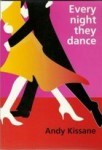
Andy Kissane’s Every night they dance

Andy Kissane, Every Night They Dance (Five Islands Press 2000)

Someone I’ve never met emailed me to say they’d stumbled upon my blog post about Andy Kissane’s recent book, Out to Lunch, and told me among other things that the one remaining copy of his previous book was on the shelves at Gleebooks in Dulwich Hill. Well, what is one to do in response to such individualised marketing? I caught the 428 to Dulwich Hill that afternoon.

I probably would have bought this book if I’d picked it up by pure chance and opened it at the table of contents. It’s got ‘The Ghosts of Marrickville Metro’ – the ‘Tro is now my local shopping centre. It’s got ‘Jean Devanny Writes’ – Jean Devanny wrote Sugar Heaven, the socialist realist novel set in my town of origin. And it’s got ‘The Separation Sonnets’, a title that could have been designed as bait for me, sucker for the sonnet that I am.

The book is in two parts. The contents of the first could be described as public poems in one way or another. There are historical pieces, some of them monologues, like the Marrickville Metro poems or ‘The Station Owner’s Daughter, Narrandera’ (an elliptical account of a massacre). Other monologues are vehicles for meditation on art and artists: Arthur Streeton, John Brack, Jean Devanny (though that one is a letter – to ‘Miles’ – rather than strictly a monologue). And there’s a longish narrative, ‘Tristan and Isolde’, that has genuine emotional force, but somehow feels public, like a reflection on modern relationships rather than a cry from the thick of it.

The second part gets personal. Narrative is still the dominant mode, but mostly it feels as if the voice of the poems is close to being Andy Kissane’s. Even an obvious exception, ‘Fanny Burney’s Mastectomy, 1811’, takes on a very intimate feel from being part of ‘Breast Triptych’, in the other two poems of which the poet tells of his mother’s breast cancer. There are poems about the vicissitudes of renting, the joys of sex (‘Beyond Metaphor’), the awkwardness of a father-son relationship. The 12 unrhymed ‘Separation Sonnets’ tell a story that may be just as much a fiction as ‘Tristan and Isolde’, but it’s much more rooted in a sense of real life and cuts much closer to the bone.

And then there are the poems about reproduction – ‘Miscarriages’, ‘Nineteen Weeks’, ‘Christmas Tree’ and ‘Birth’. All of these are wonderful, wonderful. I don’t remember reading anything by a man on these subjects, certainly nothing as unaffectedly heartfelt. The middle two in particular, dealing with a late-stage abortion, are finely poised, tender, undefensive, generous, heartbreaking.

Thanks, Andy.

Adam Aitken’s Tonto’s Revenge

Adam Aitken, Tonto’s Revenge (Tinfish Press 2011)

Tinfish Press is a small Hawai’ian publishing house run by Susan M Schultz, the poet who wrote Dementia Blog. It publishes poetry in the Tinfish journal, in books and in chapbooks. Even if Adam Aitken hadn’t been Distinguished Visiting Writer at the University of Hawai’i–Mānoa in 2010,  would have been a natural fit for Tinfish. He wrote recently on his blog:

I have spent my whole career as a writer trying to critique and understand a cross-cultural poetics and [my] multicultural cultural capital.

Almost like call and response, the Tinfish website says:

We publish work from the Pacific region, concentrating on language issues, colonialism, Buddhism, place, and poetic form. Above all, we seek to create alliances between writers whose work crosses national and aesthetic borders.

Tonto’s Revenge is the second title in the Tinfish Retro Series, which will comprise 12 chapbooks, $3 USD each or $36 for the set, available from http://tinfisheditor.blogspot.com. (You can read Susan Schultz’s blog entry on this book here.)

I enjoyed the book’s twelve poems very much. Most of them are responses to Hawai’i: conversations on TheBus (not a typo), an encounter with a homeless woman, an elegy for the actor who played Danno in Hawai’i Five-O, a meditation on a major shopping precinct. Five monologues by ‘The Sheriff’ are less Hawai’i specific, but they too relate to encounters with the US more broadly. For example, ‘The Sheriff as Recidivist’ which gives the book its title, plays with a particularly US flavour of political correctness, in which certain words have been declared ‘bad’:

I know I can't call him that, my dusky Injun,
but I does.
[...]
Tonto.
Now that Tumbleweed U's banned the term
now that it's banned
it's even sexier.

Here, as elsewhere, the play turns serious in a surprising way, but you’ll have to read the poem to find out how.  There’s a lot of playfulness in the book as a whole – playful puns, play with syntax, play with paradox – and a lot of affection.

Since this is a blog entry and not a review, here begin a couple of paragraphs on a very minor matter:

As is pretty inevitable these days, when we can never assume a common set of references between a poet and any given reader, there are plenty of obscurities. For example, in ‘Ala Moana’, the piece on the shopping precinct, which to my mind is the most interesting poem in the book, the narrator has been meditating on nostalgia:

So I want to write 747 poems
and not worry. Whose home is it?
Whose nostalgia?

Presumably he doesn’t mean he want to write seven hundred and forty-seven poems. Is he looking forward to the time when we will be nostalgic for 747s?  Perhaps he is stating an ambition to write big poems that will carry many people to new places. This morning, re-reading the poem while walking the dog, I stumbled on this line, and moved on – as you do. Just now, checking to see if Adam had uploaded the poem to his blog as he has some of the others, I read this: ‘I feel deeply complicit in a kind of poetic tourism, where I am always unmoored, or detached from a deep sense of belonging to a place. Susan Schultz calls this the “747” poem, a poem of shallow impressions, a sketch.’

Ahh! (And since I wrote that last sentence, I’ve googled ‘747 poems’ and found lots of references: it’s not a deliberate obscurity.)

Added later: Susan Schultz has added a clarification in the comments.