Tag Archives: poetry

A neighbourhood encounter involving Emily Dickinson

When I came home on Monday evening from a long weekend away, I found a small mystery in the room where my desk lives: three poetry books in a pile on the floor. Who could have taken the selected Du Fu, the selected Emily Dickinson and the Shambala anthology of Chinese poetry from the shelves? Surely not the Art Student, who is a staunch hater of poetry (unless, she says, it was written by me)? Perhaps she was looking for something to console a sick friend. Unlikely. Then I remembered she had pulled a muscle in her back  and been in pain all Saturday, barely able to sit at her desk. The books on the floor weren’t reading material at all, but a tool for an Alexander Technique Lie-Down. Apparently they were efficacious, because by the time  I arrived the back pain had gone.

Since the Emily Dickinson book had made is way into my hands, I decided to take it for a walk the next morning. The day was brilliant, cloudless, cool and pleasantly humid.  The third poem in the book is about spring, but it chimed beautifully with my Sydney-early-winter-induced mood:

The morns are meeker than they were –
The nuts are getting brown –
The berry’s cheek is plumper –
The Rose is out of town –

The maple wears a gayer scarf –
The field – a scarlet gown –
Lest I sh’d seem old fashioned
I’ll put a trinket on!

As I strolled past a friend’s house, by this time carrying a bulky plastic bag of dog poo as well as my book, the friend happened to be in her front yard. ‘That’s charming,’ she said.

I chose to interpret her as referring to the book. ‘Yes,’ I said. ‘I studied Emily Dickinson at uni but I’ve hardly looked at this book since.’

‘I love her,’ said my friend.

‘Listen to this,’ I said, and read her the poem.

‘She could have been writing about today.’

And we went our ways, me with the dog, her to her garden, wearing invisible Dickinsonian trinkets
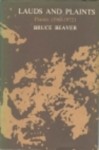
Bruce Beaver, Lauds and Plaints

Bruce Beaver, Lauds and Plaints (South Head Press 1974)

I was going to start this off by reminiscing about two occasions on which I’d met Bruce Beaver. But some dim recollection made me go trawling back through this blog and confirm that I would have been fogeyishly repeating myself. If you want the reminiscence, it’s here.

I must have bought this book in 1974, the year it was published, but have no memory of it. Maybe I tried to read it fast and so didn’t really read it at all. Whatever, I enjoyed it hugely this time around: there’s a lovely ode on Arthur Stace, Sydney’s ‘Eternity’ graffitist:

oooooeternity

I knew it was here already surrounding
ooooousooooadding to subtracting from
oooooour moments

crossing and dotting our Is and lives
oooowith its big beautiful script looping
oooovolute

that was before I learned of the commonest
ooooagony of allooootime’s rape of
oooothe timeless

as I watched the generations of dogs
ooooexcreting religiously over it
oooothe myriad

leather soles taking a little of it
oooowith them into homes shops
oooooffices

and the closest thing to sanctuaries
ooooof grass stone leaf sand
oooowave-lapped

rockooooout of the streets and into
ooootheir lives blindly underfoot
ooooalways

A series of poems marks a week’s separation from his beloved, of which you can read one at the Poetry International site. There’s an elegy to a 98 year old Manly character, two powerful pieces about a door in his family home, and all through the book an engrossing play of mind – reflective, chatty, impassioned, anguished, erudite.

Excuse me if I now say something that has been glaringly obvious to everyone else, but reading these poems I finally twigged that when a poem lacks all punctuation apart from line breaks and occasional larger spaces between words, it’s not necessarily trying to be obscure, ambiguous or even generally annoying. It may be trying to slow the reader right down. At least that’s the effect in these poems. They can’t be read fast. Nor is it generally possible to coast along on their sonorousness – too many latinate words and unsonorous sibilants. Reading them is a constant process of deciphering, of immersion, allowing the meaning to make itself known, and as such is tremendously pleasurable.

Dennis Hopper does Rudyard Kipling

… on the Johnny Cash show. (via Harriet the Blog)

I don’t known what Rudyard would have thought of the little improvisations – I guess they were the young Hopper’s way of laying claim to the poem as his own.

Why Brendan Ryan Is Not a Farmer

Brendan Ryan, Why I Am Not a Farmer (Five Islands New Poets Series 2000)

This is a slim volume of poetry, published 10 years ago, so what are the chances of it still being in the shops? As it turns out, the chances are a hundred percent at Gleebooks, thanks partly to the poet’s name being towards the back of the alphabet so that the book is shelved just off the carpet where only the diligent searcher will see it,  and partly to the cover, which includes a clever photomontage of dairy cattle in a paddock with Melbourne’s skyline towering in the background but somehow manages to look like a pamphlet issued by the State Department of Agriculture. Of course I’m glad I was able to get a copy, but sad that sales have evidently been so slow. Perhaps other readers of Brendan Ryan’s article on the Ash Wednesday fires in the current Heat will be stirred, like me, to seek the poems out. There were at least five more copies there in the middle of last week.

Rural life tends to be romanticised in Australian poetry – or deeply imbued with identity politics. You don’t have to go back to the 1890s. Here’s David Campbell from ‘Cocky’s Calendar’

The hawk, the hill, the loping hare,
The blue tree and the blue air,
O all the coloured world I see
And walk upon, are made by me.

Even Les Murray, from the other end of the socio-economic spectrum, mostly keeps farm work at arm’s length, as in ‘The Family Farmers’ Victory’:

Cane work was too heavy for children
so these had their childhoods
as not all did, on family farms

Brendan Ryan’s poetry in this book is spattered with the shit and blood of work on a dairy farm. ‘Losing to the Cow’, for instance, is a graphic account of a bull calf’s difficult birth. ‘The Benefits of a Rotary Dairy’ takes the reader into the process of milking a herd of cattle. (Brendan Ryan spent his childhood on a dairy farm in western Victoria. On my father’s cane farm in north Queensland, we only ever milked two cows, and I didn’t do any actual milking, but the poem rings all sorts of bells for me just the same.)

 Back then, most cows
had names. You knew their history by the type of knot
you tied their outside ankle back with.
A double knot for the heifers and mongrel choppers
who kicked in a three-foot arc, and kept you wary,
a single knot for old Jerseys like Mary, who dragged her teats
in the mud and stood in the bail meditating
before the nail holes of light in the door.

Alan Wearne gets it right on the back cover: ‘these clear, sombre pieces make the reader exclaim “So that’s what it’s like!”‘

My high school Latin teacher said you could tell Virgil was a city man because in the Georgics he speaks of cow manure as disgusting. Brendan Ryan may well be citified, but he doesn’t shrink fastidiously from the details of labour on the family farm. He’s not whingeing. He has no obvious chip on his shoulder. And there’s no self-pity, as there would be if he took on Les Murray’s ‘not all did’. There is nostalgia perhaps, but it’s not so much a vague yearning for a lost home, as an ache to integrate, to come to terms with experience. In ‘May Day Reunion’ he meets another refugee from the district (‘it’s our eyes that give us away’):

As the reason for leaving
becomes the need for another beer,
the idea of going back
becomes a type of union against
being seen on the street as someone's son
who can't get a job.

Still, we lean forward

Really , I don’t know if anyone else has written as well as this about what is after all a very common experience, the migration from small rural community to city life.

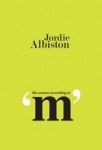
Sonnets according to ‘m’

Jordie Albiston,  The sonnet according to ‘m’ (John Leonard Press 2009)

The M in these poems is not from Fritz Lang (‘When out of grace in Peter Lorre’s eyes’?) or the James Bond franchise (‘If gin and vermouth stirred not shaken are’?), but is, as the back cover blurb tells us in a manner ominously reminiscent of the  labels in contemporary art exhibitions, ’emblematic of recurrence and precipitousness’. It’s a commonplace that poets nowadays don’t generally have a huge audience. The most recent variation I’ve heard was from David Brooks, at a Sydney Writers Festival workshop: the world is desperate for poetry but poets aren’t writing the poetry that the world wants. It’s almost as if, he said (but blame me if this is crudely expressed, I took skimpy notes), you have to choose between writing for poets or writing for the public. As a reader, I definitely identify as part of the public, and Jordie Albiston’s clever play with the sonnet form in this book tends to intimidate and alienate me rather more than it delights. Yet, there is delight here, and a little sharpening of attention brought rewards.

There are at least three Ms: ‘me’, Marsi  and em. Marsi, the acknowledgements page informs us,  was the poet’s maternal grandmother, whose diary, kept for a month in 1959, provides the basis for 12 of the book’s 54 sonnets.  Em is Emily Skinner, Jordie’s paternal great-great-grandmother, whose memoir lies behind another four of them. I found the use of these sources fascinating. At the Sydney Writers’ Festival, Adam Aitken read a poem based on his father’s letters, so perhaps this kind of familial translation is a common practice. It’s certainly an interesting one, and here the Marsi sonnets in particular provide a kind of rootedness. They tend to observe metrical and rhyming conventions, not strictly, but more so than the ‘me’ poems, and the quiet intelligence they bring to the concerns of a 50s housewife  demonstrate Albiston’s range marvellously:

well we have waited twelve months to see
what the nuns would do with the old wood
house 00 a noise at last from the sainthood:
the roof is coming off! 00 now of course we

are curious to know What Next!

and so on. Compare this to the ebullient play with form in ‘mandatory’ (all but the ’em’ poems have titles beginning with  m):

well you gotta be good 00 but
you gotta be bad 00 you gotta
be both glad & sad 00 yep you
gotta be human it says in the
book but look! 00 there’s that
creature inside! 00 you gotta be
nothing you gotta be all 00 you
gotta be both great and small

Would you have picked that as the octet of a sonnet? There’s a huge variety here. There’s quite a bit that seems to be just for fun (as in ‘methinx (i)’, ‘2moro 2moro & 2moro / goes slo frm day 2 day’). Katherine Mansfield scores a sonnet. There are a number entitled ‘mural’ that celebrate and mourn the passing of verbal graffiti. Some seem to embody a very contemporary feeling of derangement. And so on.

I ended up being completely won over.

Glebe Annandale Balmain elegies

David Brooks, Urban Elegies (Island Press 2007)

‘Ars Poetica’, the first poem in this lovely collection, begins

When I woke first I imagined it was starlings
mid-demonstration on the galvanised roof,
a thick forest of chirpings,
claws like the scratching
of a thousand sharp pencils

then, waking again, thought
swallows
perched for a briefing
before launching out over Annandale
like a hundred miniature scimitars

but of course it was the Rainbow Lorries
fresh over from Manly
unable to contain their Springfulness

He had me, as they say, at ‘Annandale’. After that he’d have had to do something terribly wrong for me not to love this book. He didn’t. I did.

Robert Adamson says in his intro that he read the book in one sitting. I almost read it in one dog walk. It’s not difficult poetry, but its appeal goes well beyond the pleasure of recognising places and events from Sydney’s inner west – the apartments built on the site of the old Children’s Hospital, street names, the two local giveaway newspapers, a rat in the compost, headlice in a child’s hair. The pieces that most hit home for me are those that touch on the numinous. ‘Flying Fox on Wire’, for example, begins:

A human poet, trying to remove
a fallen powerline from his roof, accidentally
touching the cable and surviving the
J-U-D-D-E-R-I-N-G shock of it
might think it is as if
he’s grasped a tendril of his Al-
mighty God

and draws a comparison to a flying fox on overhead wires

completing a
circuit it could
never have imagined – what
vast
grids and
networkings of night, what
chittering labyrinths of
tree and
air, what
soundless shrieks of
pain or
joy or
prophecy are
there?

Out of the Box

Michael Farrell and Jill Jones (editors), Out of the box: Contemporary Australian gay and lesbian poets (Puncher and Wattmann 2010)

I approached this anthology with suspicion. Does it really make sense, I wondered, to read David Malouf’s or Pam Brown’s poetry in a context that draws attention to the poet’s sexuality? Wouldn’t it skew, and narrow, the reading? My suspicion wasn’t allayed by having recently read editor Michael Farrell’s ultra-skewing assertion in Jacket Magazine 39 that he has ‘always read Judith Wright’s “Woman to Man” as referring to the experience of gender transfer’. But … well, once again the Book Club has dragged me from the path of least resistance.

Of Michael Farrell’s introduction and its use and abuse of the Concise Oxford Dictionary, I can reasonably say I didn’t find it congenial, and his readings of poems strayed too far into hip idiosyncrasy for my taste. Jill Jones, his co-editor, gives a nice potted history of identified gay and lesbian writing in Australia since the late 70s, and provides some useful orientation to the lesbian poems – I mean of course the poems written by identified lesbians, because as the book’s subtitle makes clear it’s the poets, not the poems, that have sexual identitites.

The poems are wonderfully diverse. They belong together not because of shared themes or concerns or formal qualities, but because their creators are contemporary (ie, alive?), Australian and gay or lesbian. A number of the poems are outed by the context – that is, poems I would elsewhere have read as heteroerotic I here read as homoerotic. That’s probably a good thing – my heteronormative mentality is being challenged. Others shrink: Pam Brown’s ’20th Century’ (‘And as we were the tootlers / we tootled along’) here tends to read as referring to the Gay and Lesbian Mardi Gras rather than something more global. I don’t know that that’s so good. At times I caught myself approximating a Beavis and Butthead snigger: ‘Hur hur! He said fist!’ Definitely not cool, though I plead in mitigation that Michael Farrell’s introduction does something of the sort more than once, and a handful of poems seem to be intent on a kind of high-culture gay Beavis-and-Buttheadism.

A good bit of the time while reading these pages, I got to feel very straight – not necessarily in the sexual sense, but in the sense that I prefer my language syntactical, don’t warm to commas at the start of sentences or parentheses that don’t close, and hate it when I can’t tell whether something is a typo or deliberate wordplay (when Javant Biarujia’s ‘MappleTROPE’ gives us Mapplethorpe’s deathbed utterance as, ‘I just hope I live long / enough to see the frame’ – has he inserted that r into the last word as a piece of witty surrealism or is it just bad proofreading? I genuinely don’t know, and it bothers me).

There are wonderful poems by David Malouf (‘A History Lesson’), Dorothy Porter (‘The Ninth Hour’), Pam Brown (‘Peel Me A Zibibo’), Martin Harrison (‘About the Self’), Peter Rose (‘Plague’), Kerry Leves (‘the escape’ – I’ve known Kerry mainly as a children’s writer, and he is definitely not that here) and joanne burns (‘aerial photography’), among others. I was delighted to be introduced to Stephen J Williams (‘Museums of beautiful art’), Andy Quan (‘Oath’, possibly the single poem that touched me most directly) and Tricia Dearborn (‘Life on the Run’) among others.

It probably doesn’t make sense to talk about a book of poetry without quoting any, but every poem I wanted to quote turns out to feel like an all or nothing proposition. I guess if you’re interested you’ll just have to find the book.

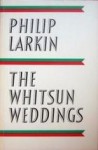
Philip Larkin, The Whitsun Weddings

Philip Larkin, The Whitsun Weddings (© 1964, Faber & Faber 1977)

This slim volume was published seven years before Philip Larkin’s most famous poem, ‘This Be the Verse‘, and a couple of years before I studied Eng Lit at university. It’s possible we read some of Philip Larkin’s poems in our eminently forgettable third year elective on Post War English Poetry. But in effect I’ve just met what Wikipedia says is one of Britain’s most popular poets for the first time.

According to Wikipedia again, Larkin said that deprivation was for him what daffodils were for Wordsworth. I found that comment illuminating – most of the poems here are performing a kind of wretched isolation, sometimes mocking people who are in relationships, at other times wistfully celebrating the possibilities, or the might-have-beens, of love. The quality of performance stops them from being just plain dispiriting. A paraphrase of ‘This Be the Verse’ would go something like, ‘Parents ruin their children’s lives so we might as well let the human race die out,’ but each time I read the poem it has a weirdly cheering effect, which I think is because its meticulous formality and obvious pleasure in language are so not gloomy. That poem isn’t in this book, but there are others just as gloomy and just as cheering, ‘Mr Bleaney’, say, or ‘Nothing to Be Said’, or … most of them.

Anyhow, I don’t have much to say, except that I enjoyed these poems a lot and expect to enjoy them many times – the sheer formal pleasure of them, but also the complex musings they embody.

The student who left her marks here (and I know it was she because her name, Allison XXXXX,  is on the fly leaf) was more attuned to the poetry than he who annotated my copy of Immigrant Chronicles. (Click the image for a bigger version.)

Mind you, her notes on ‘Afternoons’ seem almost completely wrongheaded: I don’t see why the recreation ground prompts the comment ‘consumerism’, where the idea comes from that the mothers who set their children free are ‘still trapped’, or why it is ‘bleak’ that the women have husbands behind them. But Allison’s pencil seems to grasp ‘An Arundel Tomb’ well enough. At least, I found the poem completely lovely, and felt quite companionable toward her as I read it: ‘Yes, Allison, it is nice the way the word link occurs at the start of the fifth stanza after that big enjambement,’ ‘But is the tomb undated, Allison, or just the snow?’

The final lines of the poem remind me of one of my favourite movie moments, the declaration of love at the end of Ingmar Bergman’s Scenes from a Marriage. I can’t find the Bergman line, but here’s the Larkin:

0000000The stone fidelity
they hardly meant has come to be
Their final blazon, and to prove
Our almost-instinct almost true:
What will survive of us is love.

Skrzynecki’s Immigrant Chronicle

Peter Skrzynecki, Immigrant Chronicle (UQP 1975, 2002)

This book boasts back-cover blurbs from an extraordinary bunch of Big Names: Kenneth Slessor, Randolph Stow, Rosemary Dobson. But it’s probably the least famous of the blurbers who nails the reason it has stayed in print for 35 years when, say, David Malouf’s or Les Murray’s first volumes are long out of print and fetching vast sums on e-Bay: Stephen Magee announces that ‘Immigrant Chronicles can fairly be claimed to be the best poetical treatment of the immigrant experience, in Australia, since the nineteenth century’. Ah, poetical treatment of a significant historical subject – perfect for study in high school.  And indeed, the book has been set in the Higher School Certificate. This is how Peter Skrzynecki, acknowledging reality, welcomes visitors to his web site:

On this site you will find information about my life which may help you understand some of my poems – especially those set down for study on the New South Wales HSC syllabus.

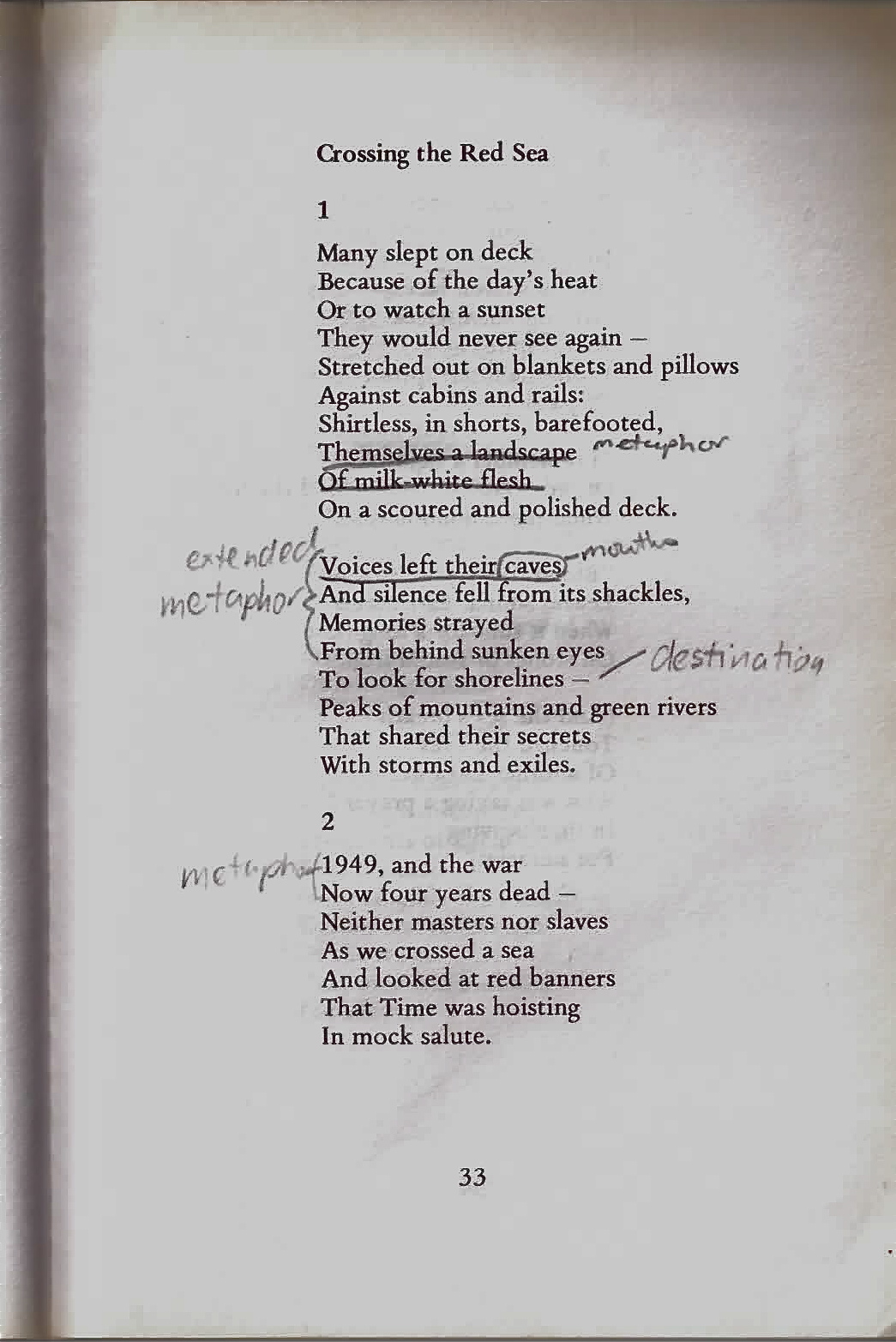
None of this should have anything to do with my reading the book, but the copy I bought bears the scars of having been ‘studied’, and they exerted a disproportionate influence on me:

This unhappy student’s search for metaphors succeeds in making the writing look awfully prosaic: for jus one example, if there’s a metaphor in ‘the war / Now four years dead’, it’s been dead a good bit longer than the war has. Yet the poem ‘Crossing the Red Sea’ (of which the above is the first of four pages) is a moving attempt to imagine the post-war emigrant experience.

The book isn’t a verse novel. There are poems about pelicans, a snake, Michael Dransfield, a death mask and so on. But it does encompass a narrative arc that justifies the Chronicle in the title. Apart from ‘Crossing the Red Sea’, there’s the much anthologised ‘Migrant Hostel: Parkes 1949–51‘ (if you click on the link, try to avoid the class notes at the end), and perhaps a dozen more, including some raw and melodramatic poems that seem to be about Skrzynecki’s mother’s experience of the ‘mental health’ system (though he explains on his web site that they are not to be taken as factual in every detail) and a number about becoming a father. A good part of the interest is documentary – that is, the poems are interesting because they inform us about ‘the immigrant experience’, or more accurately an immigrant experience.

Skrzynecki’s novel Boys of Summer was launched at Gleebooks last week – it deals with growing up Polish in Sydney suburbs in the 1950s. So he is still mining the same rich vein. But whereas now, according to the Gleebooks description, there’s a nostalgic flavour to the work, Immigrant Chronicle was written by the 20-something Skrzynecki, and there’s a pervasive, complex sense of the past’s insistent presence, memorably caught in the last lines of the final poem, ‘Post Card’ (which is also representative of what to me seems a peculiar flatness of the poetry). The speaker is looking at a ‘post card sent by a friend’ from Warsaw, his father’s lost home:

I stare
At the photograph
And refuse to answer
The voices
Of red gables
And a cloudless sky.

On the river’s bank
A lone tree
Whispers:
‘We will meet
Before you die.’

Dorothea, Andrew and Mollie

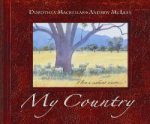
Dorothea Mackellar and Andrew McLean, My Country (Omnibus 2010)

I’ve always vaguely resented this poem. ‘I love a sunburnt country, a land of sweeping plains’, it seemed to my young self, consigned the lush east coast of North Queensland to some non-Australian limbo. So I was happy to learn that Dorothea Mackellar wrote it as an exercise in reverse cultural cringe while living in England, that there was an opening verse that went on about ‘field and coppice’. I was delighted in a schadenfreude kind of way years ago when I came across a letter from Dame Mary Gilmore in the School Magazine files replying to a request for permission to reprint the poem: the Dame explained loftily that it was unlikely that she had written a poem with such hackneyed images and dreary rhythms. I passed that splendid letter on to the Department of education’s Historian, and hope it is preserved under glass somewhere, but it was unfair. It turns out the poem was just waiting for Andrew McLean to illustrate it.

Penny bought our copy at the Orange Grove Markets this morning to read to Mollie. When I joined them after walking the dog, Penny asked me to have a turn at reading it – I don’t know how many times they had already been through it. Mollie was attentive all the way through, and as far as we could tell enjoyed the book.  So did I. It has to be one of the best presentations of a poem. Ever.  Andrew McLean’s landscapes are superb: the soft English countryside, the drought stricken farmland, the flood plain, the ringbarked gum trees ‘tragic to the moon’, the lush rainforest (yes, it’s there – just not in the only stanza that is usually quoted). The Grand Dame may have been right about the imagery and the rhythms, but there’s something wonderfully complex in the profession of love for an environment so full of challenge and suffering.