Tag Archives: poetry

Les Murray, Prone to be Tall

Les Murray, Taller When Prone (Black Inc 2010)

A new book by Les Murray is an event, and I didn’t hesitate to use my birthday voucher to buy this. And I wasn’t disappointed. The book has already been reviewed well by people more articulate and perceptive than I am. Clive James in The Monthly, for instance, may be a little OTT in suggesting the Nobel for Literature and characterising the intemperate and possibly libellous ‘The 41st Year of 1968’ as ‘a sharp rebuke to ageing hippies who imagine themselves to be in sympathy with Gaia’, but he generally does a nice job of illuminating the poetry.

I was struck many years ago by something Francis Webb – who like Les Murray experienced severe depression – wrote about poetry:

I do value in poetry that heightening or ameliorating sense of companionship in human experience. What do we seek of the trusted companion? His honesty, and that half-loaf of comfort. Poetry, as in Dante, can teach; but that is not its primary function. And pure, honest companionship may implicitly carry  comfort within itself, neutralising the often frightening sense of solitude in our affairs.

Much as I admire and enjoy Murray’s poetry, I don’t get much sense of companionship from it.  I don’t have anything against the man – after all he published a poem of mine in Quadrant. And I’m a fan – I’ve been buying his books for decades. I’ve just seen a copy of The Weatherboard Cathedral going for more than $500 at Biblioz.com, but I’m not even slightly tempted to part with mine. But I do have a creeping sense that his poetry doesn’t much like me. I don’t mean just the splenetic outbursts like ‘The 41st Year’ (which, though its explicit targets are amalgamated Hippies and Greenies and New-Classies, none of which I quite am, I manage to take personally). Nor do I mean only the obscure pieces – Robert Gray says in The Australian that about a third of this book leaves him not having the faintest idea what it is about, and not ‘cajoled by the expression into wanting to find out’. I have a sense that the poetry generally doesn’t seem to want to communicate, to expect a relationship with the reader: it’s as if it’s reporting brilliantly on the world sharply seen and heard and thought about, on understandings (and positions and judgements) reached, even on emotions felt, and all it expects of me is that I look on,  admiring its brilliance. To vary the metaphor, the poems are like grenades lobbed over a wall – they may explode in verbal fireworks, release lyrical aromas, or scatter the shrapnel of opinion, but the wall stays there, solid and opaque between us and the thrower.

Or maybe that’s all rubbish. One of the many poems I liked here is ‘The Filo Soles’:

When tar roads came
in the barefoot age
crossing them was hell
with the sun at full rage.
Kids learned to dip
their feet in the black
and quench with dust,
dip again, and back
in the dust, to form
a dark layered crust
and carry quick soles
over the worst
annealing their leather
though many splash scornfully
across, to flayed ground.

When I wrote just now that I liked this poem, I thought of writing instead that the poem ‘spoke to me’, but actually it didn’t, even though I lived in the barefoot age in the tropics, and know about crossing a bitumen road in the summer heat. The poem doesn’t work on me by reminding me of that experience. What I like about it is the way the title adds a clever visual element, the way the disintegration of the rhyme and metre towards the end  mimics the desperate, unprotected run as opposed to the methodical application of protection, and the way ‘flayed’ unexpectedly describes the ground rather than the young feet in the last line. There’s a lot to like. Maybe my grumbling about lack of communication is just lack of sleep. I’d be interested to hear other people’s thoughts.
Pirate Jenny Maiden

Jennifer Maiden, Pirate Rain (Giramondo 2010)

Jennifer Maiden’s poetry never fails to delight me, so a new book is a thrill. I don’t understand why she doesn’t get rockstar treatment.

Her last book, Friendly Fire, included a ‘cluster’ of poems featuring George Jeffreys and Clare Collins, characters from two of her novels (one of them ‘notoriously unpublished’). Clare had killed her two younger siblings when she was nine years old. George has been her probation officer and is now her mentor, friend and lover. As Jennifer Maiden explained in an introduction to the poems, through these characters ‘the horror-inhibited portions of [her] brain might speak’. First, in a prose piece, they were in the New York of 9/11. Then came the six poems, each of them beginning:

George Jeffreys woke up in [Kabul/Kandahar/London/ Berlin/the White House/Baghdad].
George Bush Junior was on the TV, obsessed
as usual with Baghdad.

and then going to unexpected places. In the five years since then, as seen in Pirate Rain, she has written four more ‘George Jeffreys woke up’  poems (in New Orleans, Rio, Beirut, and a Pirates’ Ship), which are collected here along with one in which ‘Clare Collins woke up in the Paris Hilton’, eight in which Eleanor Roosevelt or Hilary Clinton wakes up somewhere, and one each for Florence Nightingale’s pet owl Athena, Mother Teresa and Grahame Greene, who wake up respectively ‘on the wild cliffs of Crimea’, ‘in London, at /The Inquest for Princess Diana’ and ‘in the Saigon Caravelle/ Hotel in 2006’.

That might sound like a bit of a bore, but it’s actually quite the contrary. Those first-line awakenings are launching pads for a wide range  of poems: a couple come close to being straight action-adventure, others enter strange supernatural fantasy worlds, and always there’s a serious play with the big news of the day. (I would have liked the poems to be dated, which would have made it possible to find out easily at what stage of George W Bush’s foreign adventures the conversations in the poems were taking place. For instance, I seem to remember that the bit where George talks about torture in the Abu Ghraib prison was written before those sensational photographs were made public – and this surely affects how the poem is read.)

Maybe one day I’ll write something in which I figure out why I love Maiden’s poetry so much. Penny says it’s because her mind is like mine. I wish it were so! One thing that I can tell is that she writes about the public world, the world we see on the television, and makes sharp observations and judgements about it. Her portraits of George W Bush and Condoleezza Rice are wonderful. In this volume, there are Jim Cairns, Hillary Clinton and, most touchingly, Don Dunstan. (I want her to do Rudd, Abbott, Gillard, Obama, Kristina Keneally, … … … ) She argues about the nature of poetry, and fame, without every disappearing up her own kazoo. She reports conversations with her daughter without going cute – in fact, the poems involving those conversations generally astonish in the way they bring disparate elements together. ‘Night on water’ does this superbly. I hope it’s fair dealing to quote the whole poem:

night on water
Seeing him was like reading Shakespeare by flashes of lightning – Coleridge on Edmund Kean’s acting.

‘Mum, are you famous?’
______ with insouciant irony asks
my daughter, when one of her friends
says, ‘Is your mum famous?’
on the phone. That flirty incorruptible
compassionate eyebrow arches
at me and I answer, ‘No, just
an ageing hippie who’s had
a few books published,’ wishing that
either this or the fame thing were true,
momentarily, as she repeats my reply.
Later, she comforts as usual,
‘Don’t worry – you’ve got me,’ and I agree
‘Yes,’ as usual, feeling the old nervous
delight at that, think that if she has
as I once wrote, ‘eyes like night on water’,
there is also there the rapid glow
of fireworks on the harbour, remember
how once in a storm season when
the fences were blowing away, she
illuminated me from the bathroom window,
held onto its hinges to stop
it leaving as I gripped the fence sheets
together in the blinding, deafening rain.
Her torchlight and the lightning swung
wildly on my face and she called down,
sincerely and suddenly. ‘Mum, you
look beautiful.’______I’ve thought
ever since, this the most powerful
thing that the concept of beauty can do:
glance into the heart of you, like her,
and keep you going. __I’ve thought the
concept of fame somewhat like that, sometimes:
without too much charm,
money or position, it seems to me
a vague modicum of fame, however
mysterious it may seem to others, gives
one enough currency to survive. But
there’s still no real security, except
_____in some stunning
moment in practical tempestry when
one is seen as one would see, is read
like Shakespeare by flashes of lightning.

I didn’t fold any page-corners down in this book, because I’ll want to reread the whole thing, many time I’m sure.

Adamson’s best of 2009

Robert Adamson, The Best Australian Poems 2009 (Black Inc 2009)

This is an excellent anthology. In fact, in the context of previous years’ round-ups, both from Black Inc and UQP, it’s a strong contender for Best of the Best. It includes a wonderful range of poetic styles and modes and subjects – incomprehensible post-modern stuff, impassioned story-telling, linguistic virtuosity, delicate lyric. There’s Clive James‘s assured iambic pentameter, Pam Brown‘s asthmatically short lines, Ali Cobby Eckermann‘s lines you might need to know didgeridoo breathing to recite adequately. In the introduction, Robert Adamson talks about his solution to the difficulty of reducing his short list to fit the space available – he persuaded Black Inc to give him more space. I’m glad he did, and that he kept commentary, analysis and explanation to a bare minimum. He does offer this gem of commentary:

People ask me, why are so many bird poems being written and published? I have a theory: we miss having poets among us who can imagine that a soul can ‘clap its hands and sing, and louder sing’, that we need to acknowledge visitations by intense psychological presences, and that birds are the closes things we have, more or less, to angels.

Perhaps that’s mainly a clue as to how to read his own poems, but it’s an interesting general thought as well.

I’m not going to try to name the poems I liked best.  My copy has far too many page-corners turned down for that.

As I was reading this anthology, my Art-Student Companion, as part of her preparation for an assignment on Australian Federation, was reading The Sentimental Nation by John Hirst, and kept regaling me with interesting bits about the major role poetry played – poetry, he says, is ‘the best guide to the ideas and ideals that inspired the movement’ for Federation, and again: ‘The nation was born in a festival of poetry.’ Well, even though poetry festivals rarely make the news pages these days, to judge by this book poems are still looking for words for what inspires and ails us as a nation and a species. But now, instead of writing bush ballads or ponderous and forgettable sonnets, they tell about Iraq, global warming, the ills of capitalism, but they tell it slant. There are any number of examples, but I’ll just mention Luke Davies’ ‘Maldon, 991 AD’ which ends:

oooooooooooo I felt an outsider
to laughter. Out there the Vikings sang,
that was more like it, something eerie
to get spooked about, distracted by:
and the world so tenderly
unveiling its final unveiling.

I was also struck by the sense of community among the poets, particularly as shown in the number of poems honouring those who have died: Dorothy Porter (‘Word‘ by Martin Harrison), but also John Forbes (‘Letter to John Forbes‘ by Laurie Duggan, Jan McKemmish (Pam Brown’s ‘Blue Glow‘), Francis Webb (‘Reading Francis Webb‘, by Philip Salom [the link is to a PDF]) and Bruce Beaver (a couple of mentions, but mainly Peter Rose’s beautiful imitation, ‘Morbid Transfers‘).

Buying this book in March felt a little bit silly, like buying hot cross buns in July, but it turns out it’s not a seasonal thing at all. It’s an anthology that I’m sure I’ll go back to.

Footnote: One of my wise younger relatives recently chided me for reading while walking: ‘It’s as bad as walking around with those things in your ears, Jonathan,’ she said (by which you can she’s not so very young). ‘You have to let the world in.’ She may be right in general. But sometimes reading while walking is a way of letting in both world and poetry. The other morning I was throwing the ball for Nessie at the bottom of the hill and noticed that the longish grass was pearled with dew so that previous walkers both human and canine had left tracks of darker green, and the rosellas wouldn’t shut about something. I realised it must have rained quietly in the night. The next words I read were these, from Sarah Day’s ‘A Dry Winter: Some Observations About Rain‘:

… an elemental transition from dry to damp.
Listen, you can hardly hear its outward breath

on the tin roof. In the morning,
grass and earth are wet and everything

but the mercuric globe in the nasturtium leaf
is translucent.

I don’t know anything about nasturtiums, but the rest could have been a condensation from my surroundings. (The whole poem is lovely, by the way.)

Added later: Tara Mokhtari on the Overland blog has a completely different view. She does identify herself as a ‘shunned poet’.

Patricia Wrightson and Chinese poetry

This blog post is the love child of two recent ones.

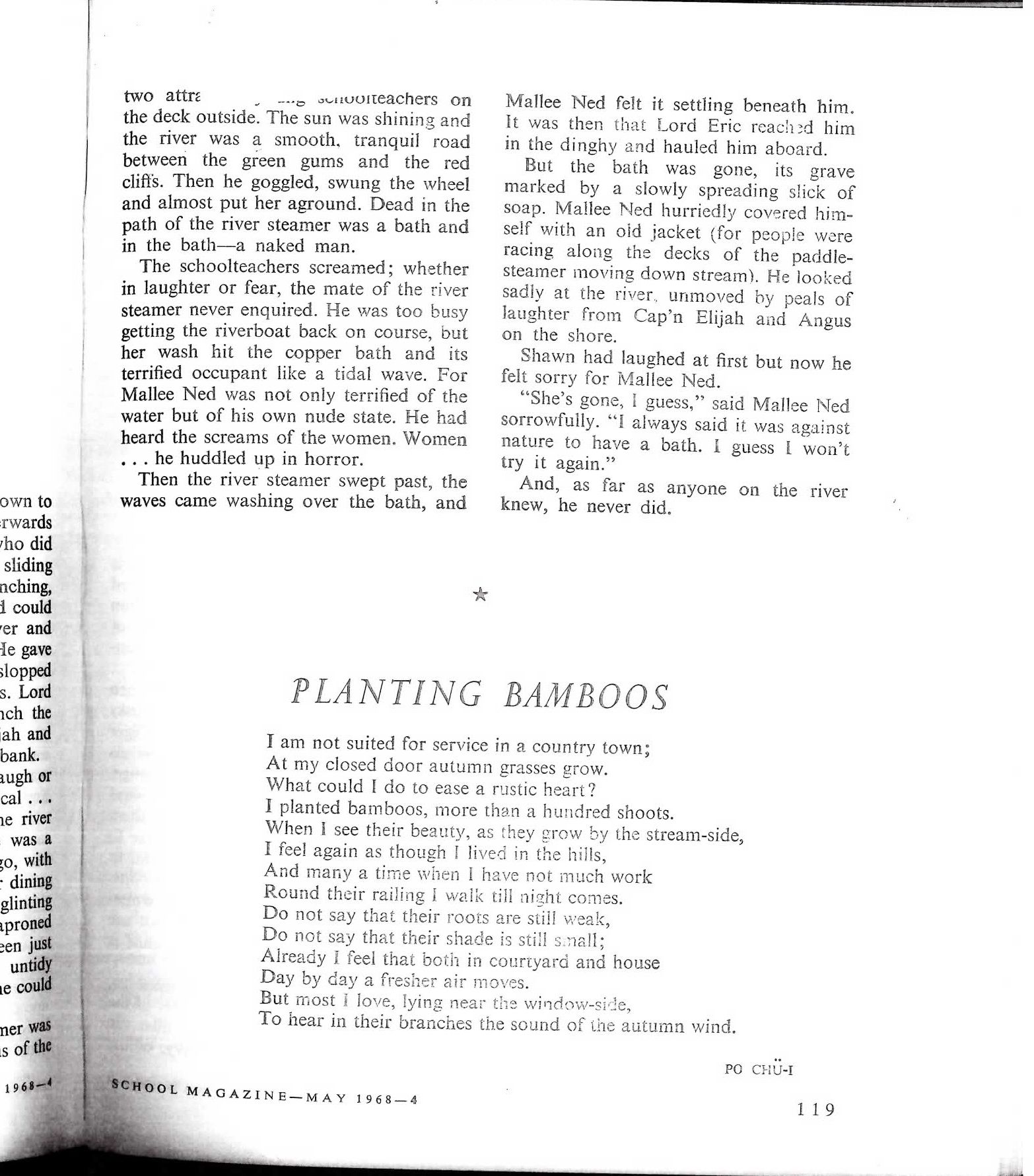
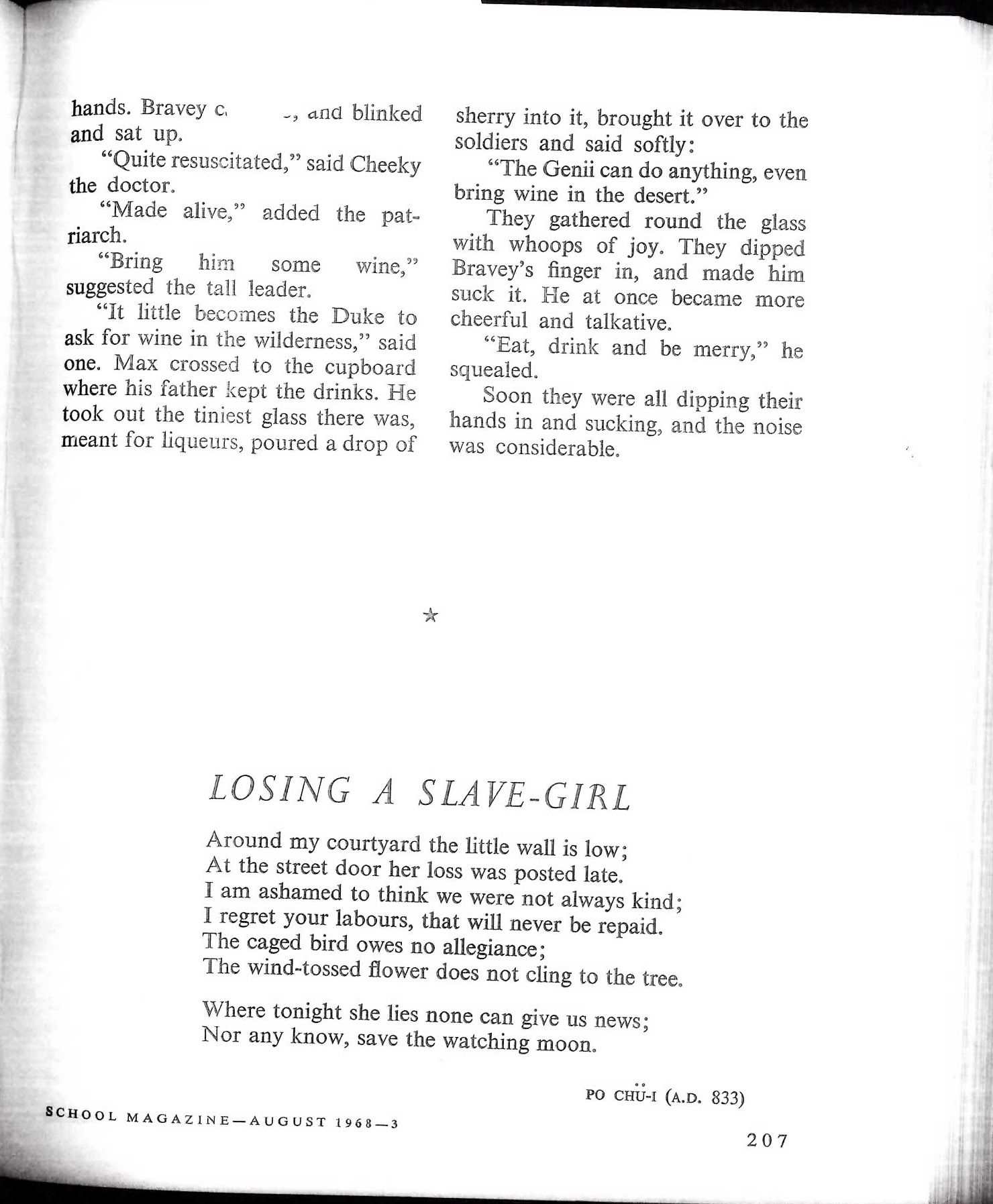
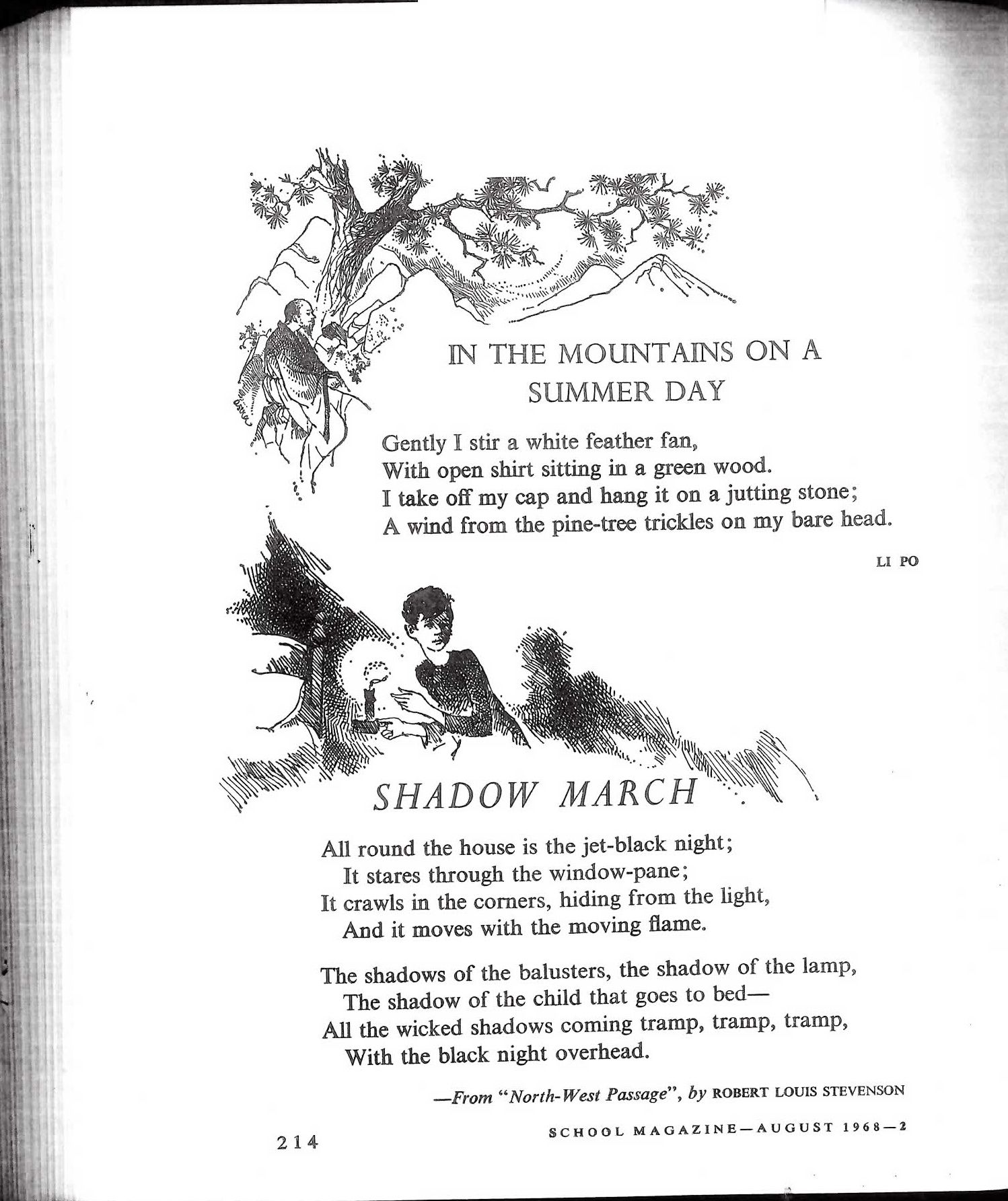
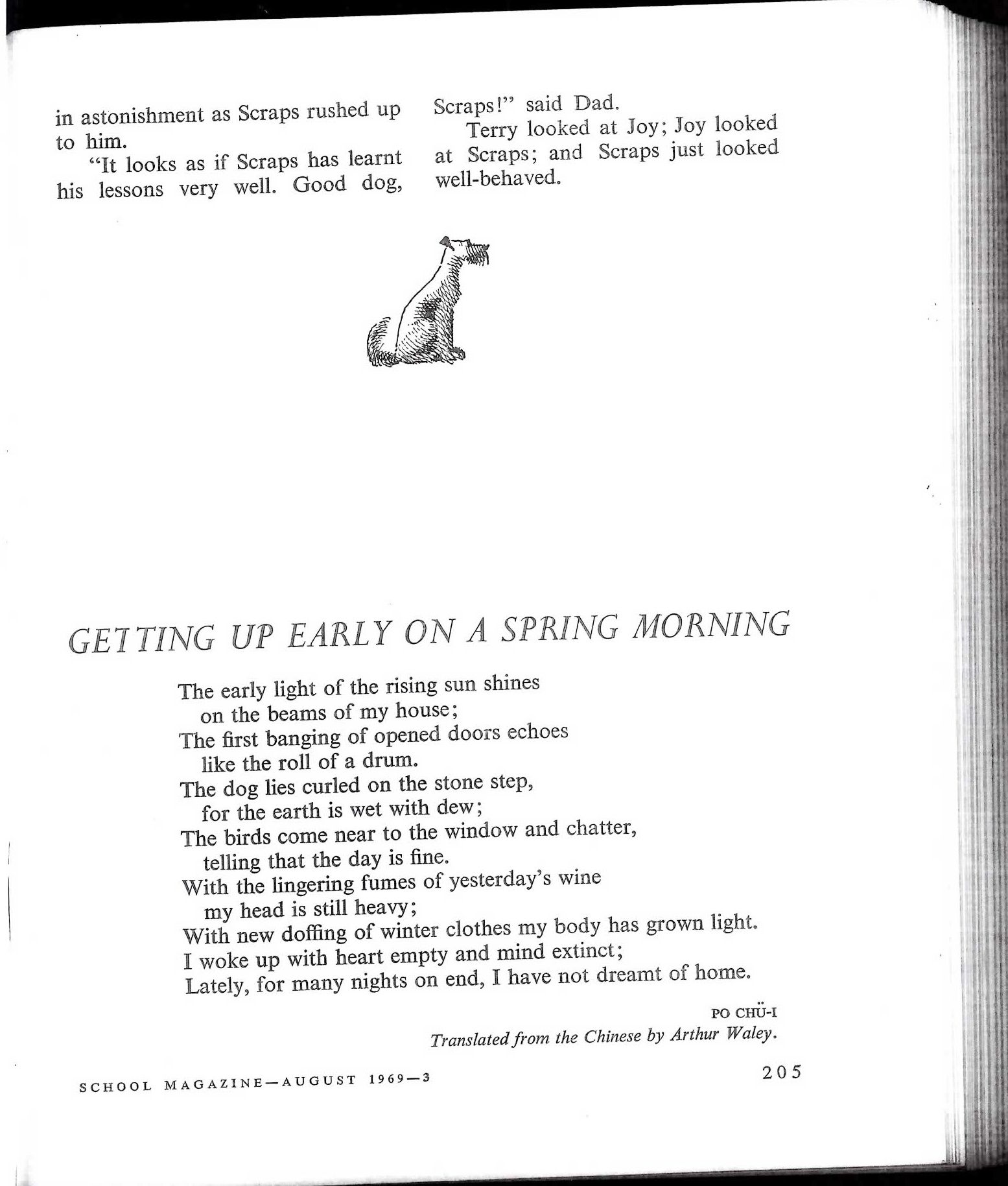
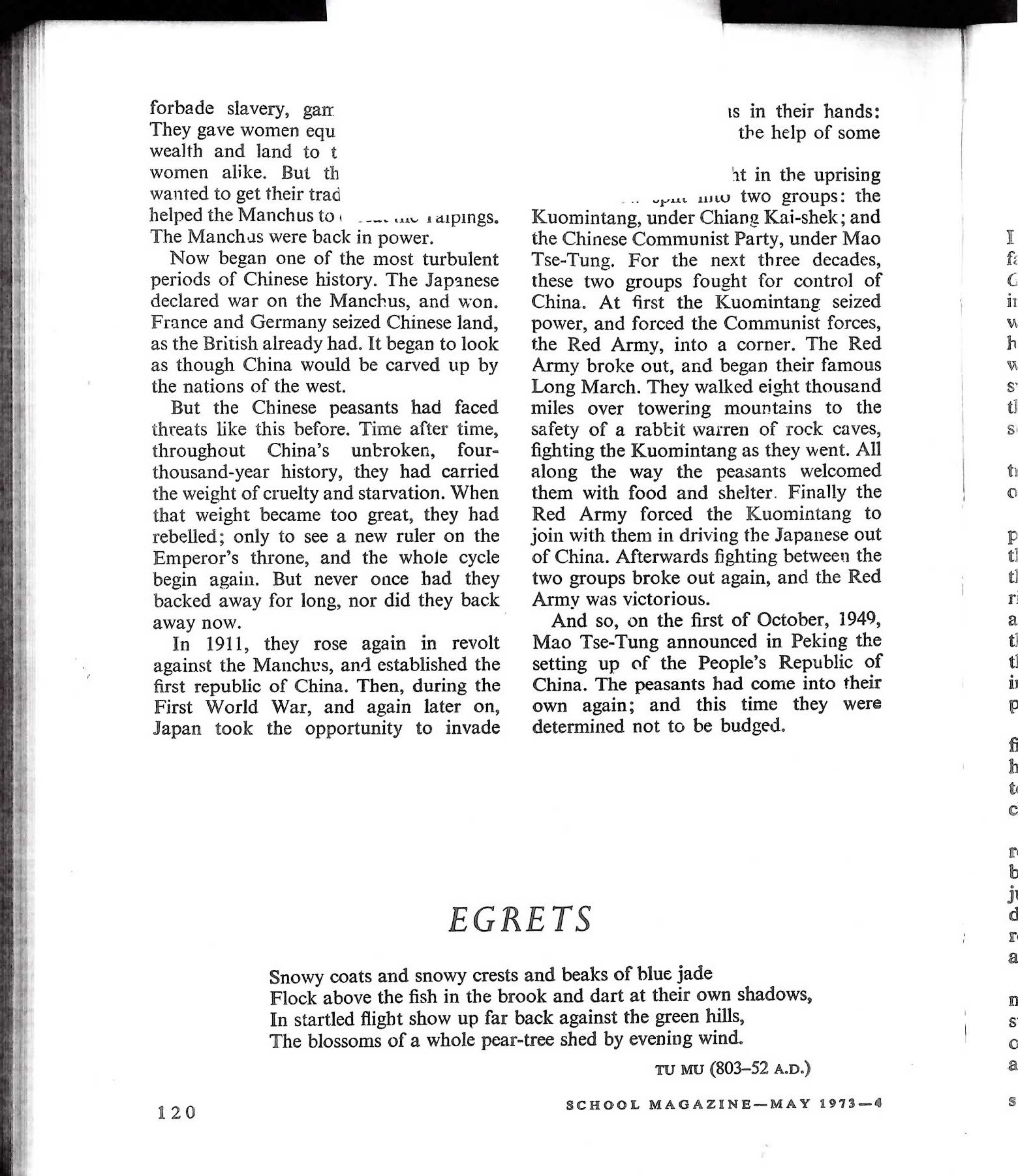
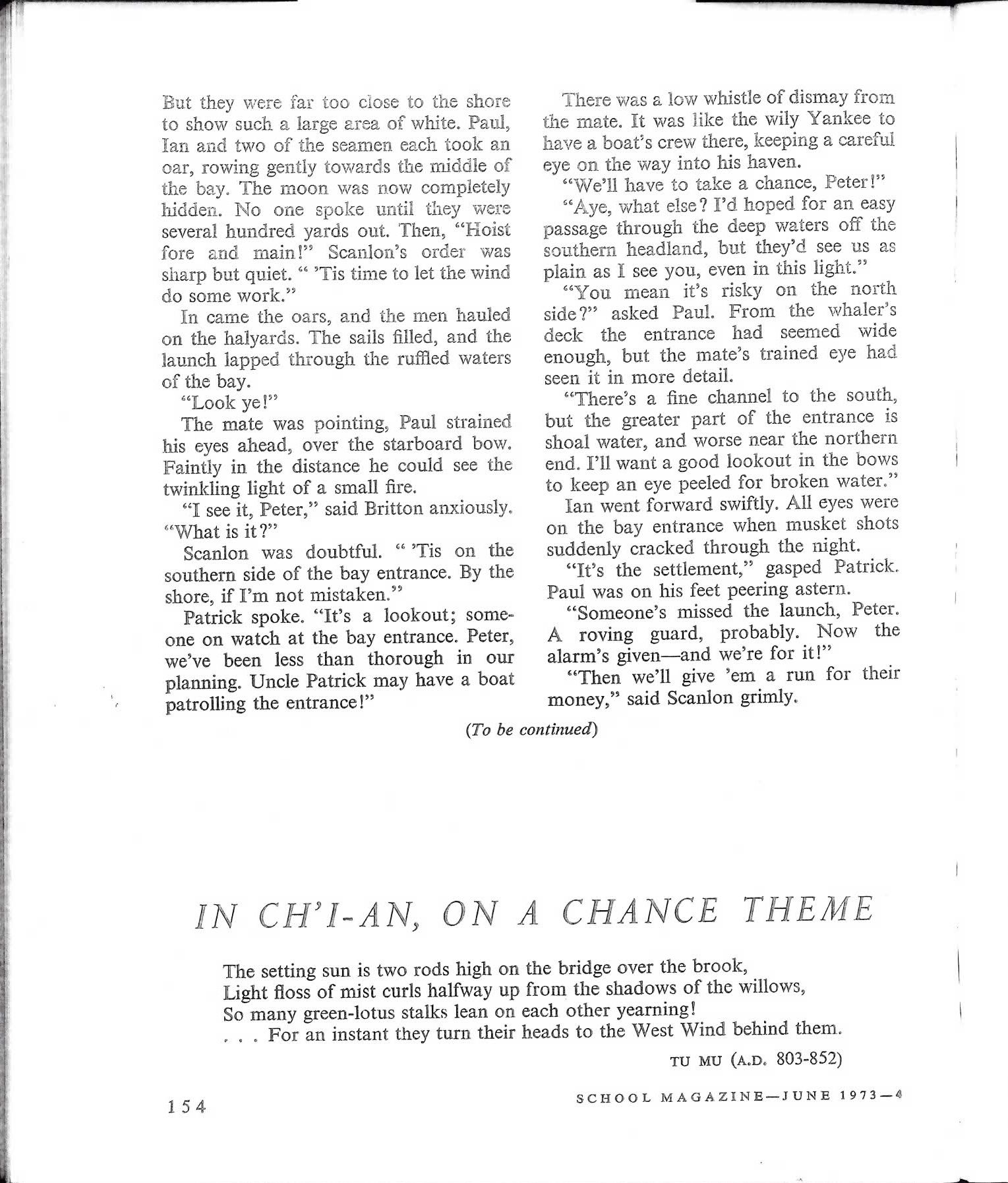
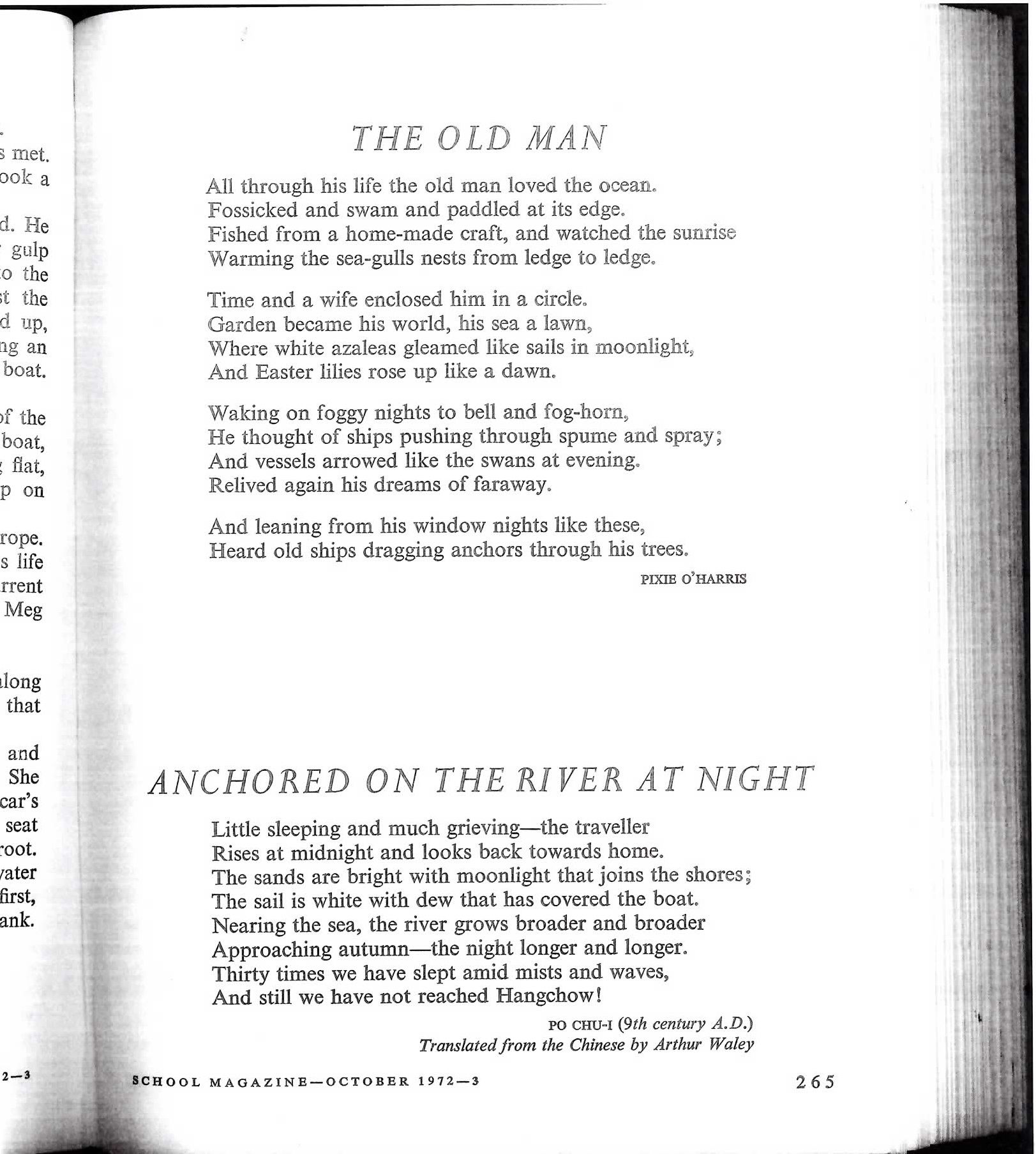
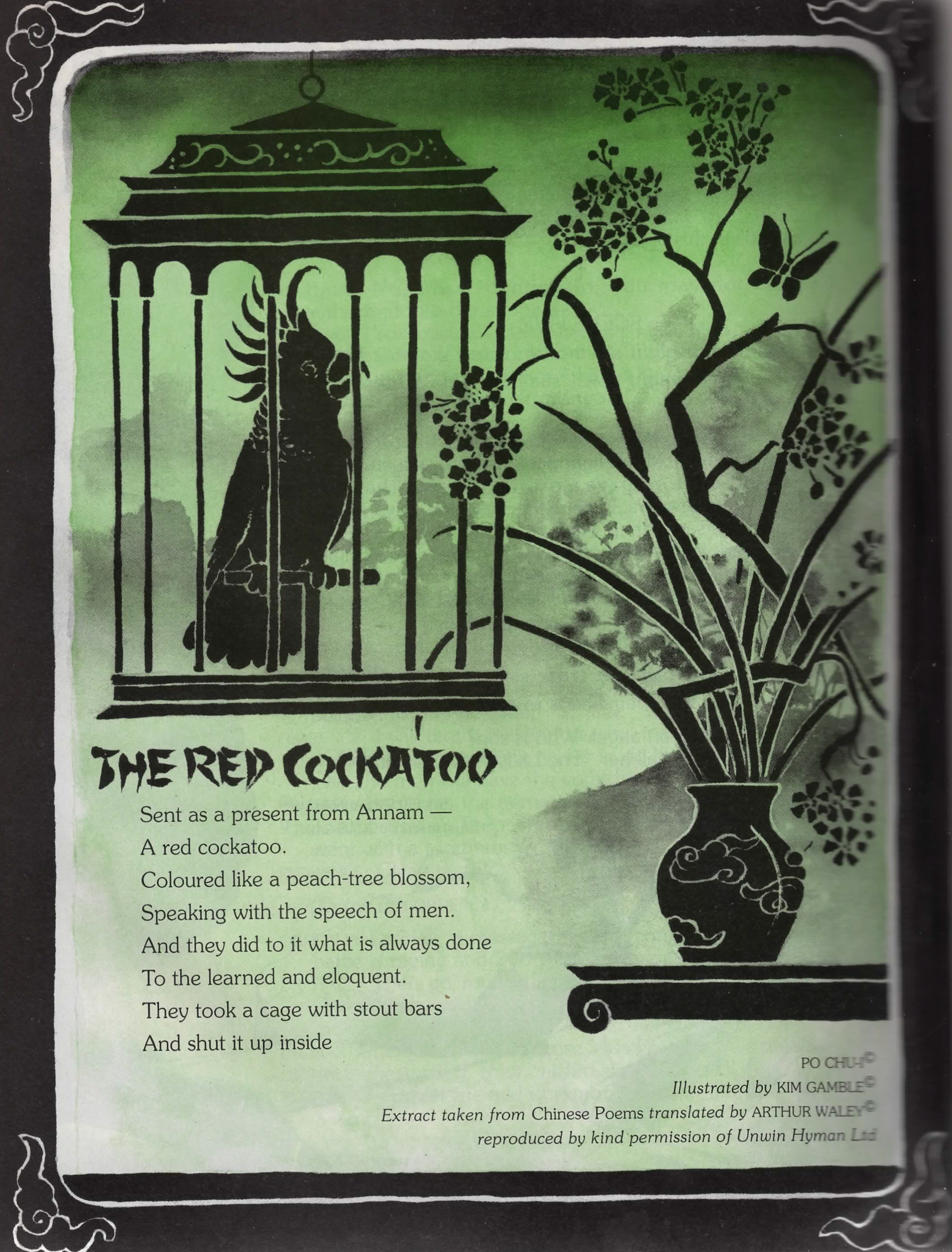
Patricia Wrightson was on the editorial staff of the School Magazine from the mid 1960s and was its editor for pretty much the whole 1970s. My acquaintance with Chinese poetry prior to reading J P Seaton’s anthology came largely from poems published in the magazine during those years. None of the poems I could lay hands on were published in the anthology. I think they are all translated by Arthur Waley. They all stand on their own merits, not sending the reader off in search of that which they have translated (not, as I was saying when blogging about the anthology, that there would be anything wrong with that – in fact, from some points of view, a translation should make a reader go searching for the original).

Click on the thumbnails to read the poems and see a little of their contexts in the magazine: Robert Louis Stevenson, Pixie O’Harris, a story about a dog, a Pauline Clarke serialisation, a historical article. The illustration of Li Po’ s ‘In the Mountains on a Summer’s Day’ is by the great Astra Lãcis. The last one, illustrated by Kim Gamble, was published in my day, but I found the poem in back copies from Patricia’s era.

Shambhala Chinese Poetry

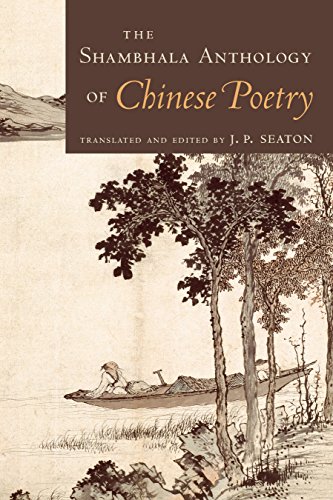
J P Seaton (editor, & translator of most poems), The Shambhala Anthology of Chinese Poetry (Shambhala 2006)

This was a present for my 60th birthday. I was delighted to receive it but obviously, given that I’m now 63, I was slow to actually read it. Seymour Glass’s passion for Chinese poetry and wisdom is what provided the necessary extra spur (I mean, who was that poet who wanted to be a dead cat? And why?).

The anthology opened a space in my head. It didn’t answer the question about the dead cat (the dead cat poem is absent), but it raised many more. It covers 3000 years of Chinese poetry in 246 pages, including notes. It would hardly be fair to expect more than a taster. What’s more, it would be unrealistic for someone as ignorant of Chinese history and culture as I am to expect more than broad-brush help with interpretation. Despite J P Seaton’s lucid introduction and notes, I confess that many if not most of the poems eluded my grasp – all those proper names and elliptical allusions to Taoist, Buddhist and Confucian traditions amounted to little more than mystifying clutter to my uneducated brain. I could appreciate some lines, like Li I’s wonderfully cinematic

Three hundred thousand men, among these rocks,
this once, as one, together turn: gaze on the moon.

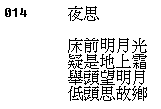
I was moved by some whole poems. But all too often I felt as if I was reading a coded message or a paraphrase, missing the actual poetry, roughly an equivalent of ‘Will I compare you to a day in summer? / You are prettier and cooler: / Strong winds rustle May’s lovely blossoms, etc). Once I caught myself thinking, ‘I hope I get to read that poem one day.’ It became obvious to me that if I am to understand and enjoy this poetry I need to devote a lot more time to it. And maybe I will one day. For now I’ve decided to play around in one poem, ‘Thoughts of a Quiet Night’ by Li Po (701–762). I went searching and found an image of the actual poem, on the China the Beautiful site:

That’s 20 characters. On the Poetry Kit site, Li Po’s biographer An-Lee Chang Williams gives a literal one-word-per-character version:

Bed  fore  bright  moon  light
Doubt  is  ground-on  frost
Raise(d)  head   gaze  clear  moon
Dropp(ed)  head  reminisce  home  country

It’s starkly obvious that a translation has to do more than give such a word-for-word rendering. (Incidentally, I notice that even here, if my copied image is correct, the same character has been rendered as ‘bright’ in line 1 and ‘clear’ in line 3.) In his introduction, J P Seaton discusses the visual qualities of the Chinese:  the first line ‘contains among its five characters a moon (the pictograph for moon) and two more moons, one in the compound ideograph bright and another shining dimly and insistently out of the character for the preposition before.’ He comments, ‘The writing system lets Li Po literally fill his little poem with moonlight.’ He doesn’t mention the difficulty of reproducing the musical effects of a tonal language, or the complexities of navigating the distance between the two grammar systems, or what to do about deeply ingrained terms of reference or understandings of poetic form (though he does discuss form elsewhere).

Translating  a poem from Chinese to English will probably never be straightforward. The sound and look of the words cannot be decanted unchanged from one language to the other. From one point of view all a reader can expect is an honest paraphrase. But when you paraphrase a poem, you’ve lost the poetry, so perhaps one ought to hope for a little more: perhaps a poem in English that corresponds as closely as possible to the original, which means taking liberties. On page 90 of this anthology, the poem becomes:

Before the bed, bright moonlight.
I took it for frost on the ground.
I raised my head to dream upon that moon,
then bowed my head, lost, in thoughts of home.

So much has, perhaps inevitably, been lost, and if An-Lee Chang Williams’s list of words is correct, so much has been added.

China the Beautiful and the An-Lee Chang interview give more than a dozen translations between them. And I just found more. Seeing all these attempts to translate 20 words gives a fascinating glimpse of the art of translation and the nature of poetic composition. It also allows for a deeper grasp of this particular poem, as one person after another tries to capture it in all its suggestive particularity. Here’s An-Lee Chang Williams, who inserts less than J P Seaton (she offers us no emotional guidance as Seaton does with ‘dream’ and ‘lost’, but interestingly changes tense from past to present) without being any more lossy (it’s interesting that both of them have avoided the repetition of ‘bright moon’ in line 3 of  the Chinese):

Bright moonlight by my bed:
First I thought it was ground frost.
I gaze up at the moon,
Bow my head, remembering my homeland.

And here, at the further extreme of adding stuff, is L Cranmer-Byng’s art song version from the early 20th century:

Athwart the bed
I watch the moonbeams cast a trail
So bright, so cold, so frail,
That for a space it gleams
Like hoarfrost on the margin of my dreams.
I raise my head,
The splendid moon I see;
Then droop my head,
And sink to dreams of thee –
My father land, of thee!

And how about this, by someone whose name I can’t read, which goes too far on its own merry way to be called a translation as such, but which brings out a meaning of that ‘dropped’ in line 4 that none of the others seemed to notice or even allow:

A splash of white on my bedroom floor. Hoarfrost?
I raise my eyes to the moon, the same moon.
As scenes long past come to mind, my eyes fall again
on the splash of white, and my heart aches for home.

The very first poem in the book is from at least the fourth century BCE. J P Seaton describes it as ‘certainly an honourable expression  of the ideals of democracy as well as a perennial feminist one’. I don’t read it that way at all, but I agree that it captures something profound:

The Peasant’s Song

Sunups, we get to work;
Sundowns, we get our rest.
Dig wells and drink,
plough fields, to eat:
what has some ’emperor’
to do with us?

Now that’s a poem I’d like to read when I have the time.

Fortuitously, this quote from Jorge Luis Borges turned up in my RSS reader while I was drafting this entry:

Not knowing Greek and Arabic allowed me to read, so to speak, the Odyssey and The Thousand and One Nights in many different versions, so that this poverty also brought me a kind of richness.

(From Fernando Sorrentino’s Seven Conversations with Jorge Luis Borges via The Literary Saloon)

Note: I’ve Australianised the spelling in the quoted passages.

I’ve been mentioned!

I may be easily thrilled , but thrilled I am. I’ve been mentioned in a review – Tim Howard’s review of Going Down Swinging No  28 in the July–August 2009 issue of the Australian Book Review.

In case you can’t read it, the bit that thrills me is this:

[Lisa] Greenaway and her co-editor, Klare Lanson, share a taste for free verse; their selections include pithy and expansive poems. Jonathan Shaw’s ‘Correspondence’ is a concise, sardonic jab at historical amnesia and bureaucratic impotence.

And I don’t even know Tim Howard!

North: Poems of Home

Maurice Kenny, North: Poems of home (Blue Cloud Quarterly 1977)

This book found me by serendipity. A BookMoocher  said she’d be willing to send me the book I wanted if I mooched at least one more at the same time (same postage for her, twice the BookMooch points). I chose this pretty much at random from her list of moochable titles.

Maurice Kenny is a Native American poet who has twice been nominated for the Pulitzer Prize. The blurb on this little book explains that the poems deal largely with ‘his childhood in the Mohawk Nation and his friendships there’. But the book lacks the personal touch that this description led me to expect, especially in the many incantatory list poems. I went looking on the web, and the very first Maurice Kenny poem I stumbled across, ‘Going Home‘, published a decade or so after this book, was of a completely different order. It’s as if in this book, he is in some way claiming, or proclaiming, his heritage:

north
north by the star
we go home, we go …
to the pheasant, woodchuck, muskrat
the last deer standing the summer
of flies on the blood of the wolf
howled in the north
(from ‘Home’)

And having claimed the heritage, he could look more closely at his relationship to it in the 1988 poem, which concludes:

home from Brooklyn to the reservation
that was not home
to songs I could not sing
to dances I could not dance
from Brooklyn bars and ghetto rats
to steaming horses stomping frozen earth
barns and privies lost in blizzards
home to a Nation, Mohawk
to faces I did not know
and hands which did not recognize me
to names and doors
my father shut

I don’t think I would have felt the pathos of that exclusion as fully if I hadn’t read these earlier, rhetorical poems.

Armantrout on the trot

Rae Armantrout , Up to Speed (Wesleyan University Press 2004)

As I was reading this book on the way to the Fish Markets this morning (Christmas Eve), a friend called from where she was supervising her dog in the Harbour: ‘What are you reading?’

‘Mostly incomprehensible poetry,’ I called back. ‘But she’s just described time as

a ghostly appendage
of uncertain length.'    [from 'In Time']

‘Hm,’ said my friend, ‘that’s pretty nice,’ and we returned to our dogs.

There’s not a lot more I want to say, except that there are many lovely moments in these 80 pages, and a lot of stuff that I don’t get (but I don’t necessarily need to). Possibly my favourite lines, from ‘Another Sense’:

I don't mind
learning
I'm in hell
if
I can learn it
again and again.

Two self-published poets

John Malone, Big Blue Mouth (johnlmalone at yahoo dot com dot au 2009)
Stephen Whiteside, The Paterson Parodies (self published 2009)

You know how US presidents retain the title of president until it’s prised from their cold stiff hands? Well, it’s not like that for magazine editors, but some of the perks of office do survive long after one loses the right to use the editorial ‘we’. One of these perks is free books. Mind you, in my days of wielding editorial power any free books were for the magazine, not for me personally, so maybe this is a perk of the afterlife. Both these little books arrived in my mail from poets who graced the pages of The School Magazine in my day.

big blue mouthBy no means all the poems in Big Blue Mouth were previously published in the magazine, but the collection benefits from monochrome versions of the illustrations that accompanied some of them there – by Kerry Millard, Andrew Joyner, Noela Young and Tohby Riddle on the cover (every one of those links leads to delightful things) [Correction: The cover is not by Tohby but was put together by John Malone and the printer].  They’re mostly short poems from a young boy’s point of view, many featuring a grandfather who must surely resemble the poet himself. If you’ve found this page by googling John’s name, hoping to find a collection of his poems for yourself or a young fan, or if you’re a regular here and ditto, you can buy a copy direct from him – his email address is johnlmalone at yahoo dot com dot au (notice that his second initial is in that address). Stocks, I’m told, are limited.

.

paterson parodiesAs far as I know, none of the poems in Stephen Whiteside’s book have been previously published, though he has recited them at folk festivals and to other audiences – as you read them you feel a building pressure to give them voice: they’re meant for performance. This is bush verse, not specifically for children, but I imagine that anyone of whatever age who enjoys the ballads of Banjo Paterson will enjoy them. In ‘Clancy of the Undertow’, Clancy is a surfie; the eponymous Son of Mulga Bill has trouble riding a horse, and is at ease on a bicycle; the likewise eponymous Man from Ironbark wreaks revenge in kind on the dapper barber. ‘The True Story of the Man from Snowy River’ isn’t really a parody – it’s a piece of serious revisionism, but it scans as impeccably as the rest. You can buy this book from the BookPOD bookstore. You can find out how to get hold of a copy at http://www.abpa.org.au/bush_poetry_forum/viewtopic.php?t=591.

I do have one complaint about both books. It’s that the economics of publishing are such that the only way for them to see the light of day was through self-publication: single-author Australian collections of children’s poetry are rare as hen’s teeth. Because they are self-published, these boooks are unlikely to reach a four-figure audience. And that’s a shame.

Melancholy derangement

Kate Jennings, Come to Me My Melancholy Baby (Outback Press 1975)

jennings coverI’ve mentioned Kate Jennings once or twice in my blogs, mainly because her New York based writing has given me much pleasure. I don’t think I’ve mentioned that she won a place in my heart nearly (gasp!) forty years ago with a speech she gave at a Vietnam Moratorium meeting on the Front Lawn at Sydney University. On that day, after a number of rousing speeches from various anti-war organisations, a number of women, perhaps there were ten of them, came to the front of the speaking area and fanned out across its full width, standing with legs apart and arms folded. I was off at one side near the front of the thousand-strong crowd, and was impressed by the deliberate drama of the moment. I noticed that the woman closest to me was trembling, and realised that they were doing something that terrified them. Kate stepped to the microphone – the painfully thin designated speaker – and delivered her speech in a voice that shook but didn’t break. The speech was intemperate, overblown, bitter, profane and inelegant. It changed my life.

The speech was printed five years later as ‘Moratorium: Front Lawn: 1970’ in Kate’s first book, Come to Me My Melancholy Baby. It’s a slim vol of poetry, plus the speech and one other short prose piece. I lost my copy decades ago, and was delighted when a slightly battered arrived in the mail last week from a friend who was culling her bookshelves. The poems, it turns out,  haven’t generally aged well, though the pain in some of them fairly leaps off the page. When Kate was interviewed on the ABC by Julie McCrossin a couple of years ago (published in Hecate Vol 14 Nº 1), Julie asked her about this book, and in particular about that speech. Here’s a relevant bit:

KJ: I think you’d call that speech ‘in your face’. They were wild, rackety outrageous days and we were not getting the attention of the men at that point. We were a very small group that started meeting and that was the speech I gave. I’m not sure that we can actually say it out loud on radio. It was that outrageous.
JM
: But what was the core content, the cry from the heart?
KJ
: The cry from the heart was that we were all Vietnam activists and the men were all gung-ho about fighting that cause, and nobody cared about women, and at that stage women could not have legal abortions.
JM
: And when you look back are you amazed at the courage you had, that was a new voice then, the voice of women saying: ‘Look out over here, something’s happening, or not happening?’
KJ
: When I look back at all my life I am amazed, I do keep walking a plank. I thought those days were terrific.
JM
: Why?
KJ
: We were very inventive. We weren’t as earnest as people are making us out to be now. I don’t think of course those tactics are necessary now.

The bit of the speech that made me sit up and listen wasn’t the vile man-hating rhetoric. What made it possible to listen to that and hear what was being said was the opening lines, printed in the book as an epigraph:

you’ll say I’m a manhating braburning
lesbian member of the castration
penisenvy brigade, which I am

I’d remembered the last three words as ‘Well, I am.’ The thing that so affected me was that Kate and the women who flanked her were proclaiming that they would no longer be silenced or kept in their places by even the most vicious putdowns anyone could throw at them. If need be they would claim the putdowns as badges of honour. It made my young, impressionable, male heart sing.

The poems that precede and follow the speech recount some of the personal cost behind that stand:

If it’s not booze, it’s drugs
if it’s not drugs, it’s poetry,
if it’s not poetry, it’s feminism,
if it’s not feminism, it’s love
if it’s not love,
well, you’re just plain crazy.
When you are crying like that
how long before you stop?
I’ve stopped.

Part of the pleasure of her more recent books is in their sheer urbane poise, a great relief to the reader who followed her through the derangement, rage and ‘racketiness’ of this book.