
Edwina Shaw, Dear Madman (AndAlso Press 2026)
Revisionist exploration of family lore is a rich vein of story telling. As one of many examples, Tasma Walton’s novel I Am Nannertgarrook grew from that kind of impulse, and it’s part of the truth-telling project that stems from the Uluru Statement from the Heart. Dear Madman doesn’t deal with First Nations issues, but it is a gripping addition to the genre, and it also deals in truth-telling.
Edwina Shaw’s great-aunt, her maternal grandmother’s sister, was murdered as a small child. The murder was part of family lore, a historic family tragedy, a scary tale told to children by a loving grandmother. The book is part memoir – how the story featured in the lives of Edwina and her family, and how she scoured newspaper accounts, prison records, the murderer’s mental health files and more, to find a fuller story. And it’s part novel: alternating chapters take us into the life of the early 20th century family and, most grippingly, into the murderer’s mind.
Edwina is my niece, and I have been privileged to see the book in a number of drafts, so I should leave it to others to discuss it in detail. I’ll just say that it’s a white-knuckle tale of suspense and a marvellous achievement of empathy. It’s a family history, a True Crime essay, a horror story, a dark and violent version of A B Facey’s A Fortunate Life, a hard but rewarding read.
Page 79* is in one of the sections where the author speaks about her task:
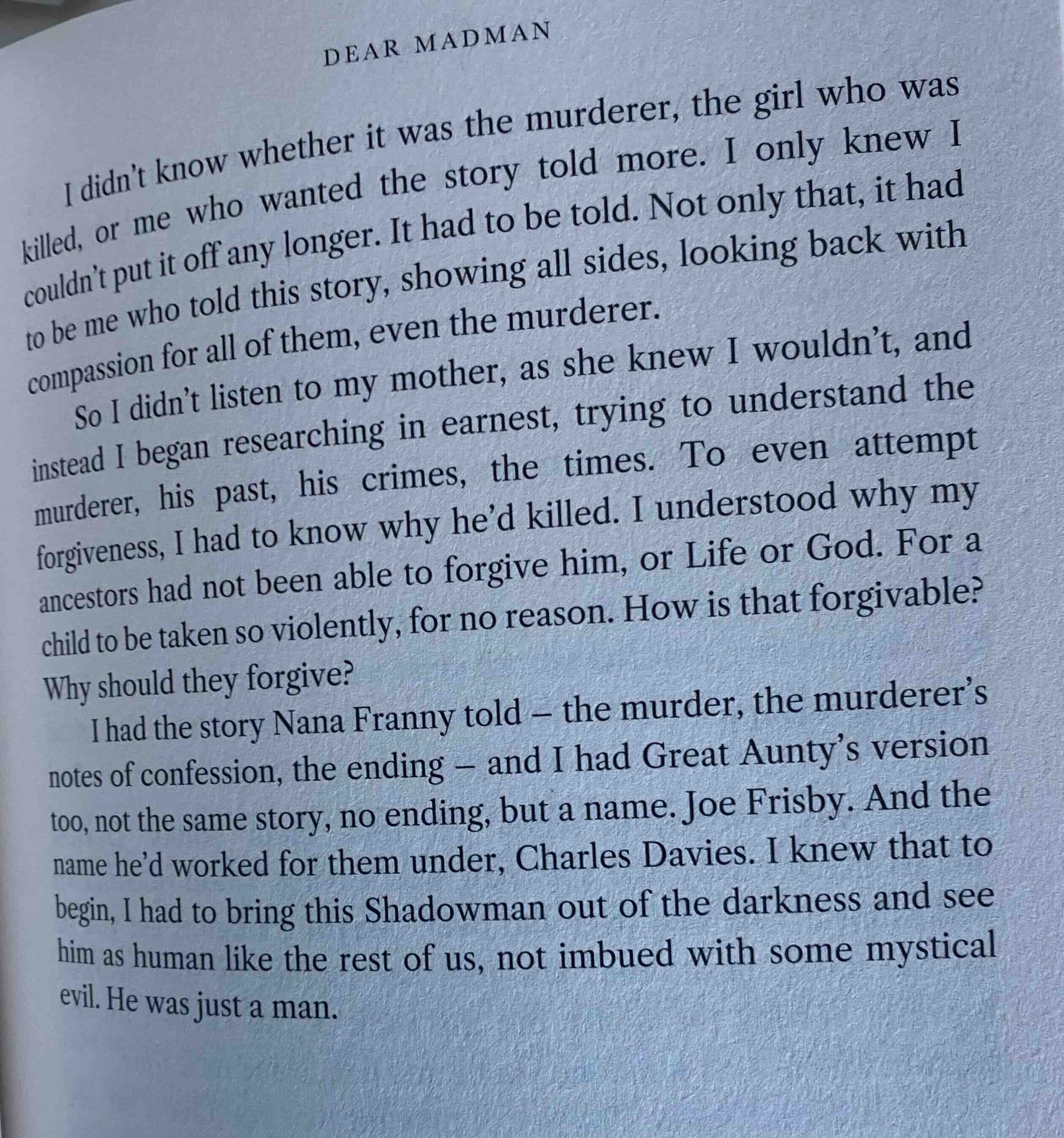
I didn’t know whether it was the murderer, the girl who was killed, or me who wanted the story told more. I only knew I couldn’t put it off any longer. It had to be told. Not only that, it had to be me who told this story, showing all sides, looking back with compassion for all of them, even the murderer.
… I began researching in earnest, trying to understand the murderer, his past, his crimes, the times. To even attempt forgiveness, I had to know why he’d killed. I understood why my ancestors had not been able to forgive him, or Life or God. For a child to be taken so violently, for no reason. How is that forgivable?
Why should they forgive?
I had the story Nana Franny told – the murder, the murderer’s notes of confession, the ending – and I had Great Aunty’s version too, not the same story, no ending, but a name. Joe Frisby. And the name he’d worked for them under, Charles Davies. I knew that to begin, I had to bring this Shadowman out of the darkness and see him as human like the rest of us, not imbued with some mystical evil. He was just a man.
It’s rare that a book includes such a neat statement of its goals. Maybe it’s an underlying goal of all good story telling – to have compassion for all one’s characters. And maybe the extent to which that’s achieved is a test of all serious story telling. I think this book does it in spades.
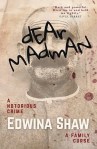
Without being too spoilerish: the cover image is the photo of the murderer taken on his admission to Goodna Mental Asylum ten years after the murder, which Edwina found very late in the research process, after reading about him, having conversations with him on car journeys, meeting some of his descendants, and imagining her way into his mind. In some ways, the appearance of this photo is the moment in the book when he becomes ‘just a man’. Here’s Edwina’s description of it:
Joe’s forehead is deeply creased, and his moustache, huge and grey, is hiding his lips. Above the collar of his rough cotton uniform, you can make out the scar across his neck from where he slit his own throat, but there’s also a softness about the image that makes him look like an old Labrador. His eyes, dark and bright and mad, are looking up with hope as if he’s glimpsing God. He seems happy to me, though others don’t see it.
I propped up his photo as I wrote on, but when it came to the murder scene, I had to turn the picture face down.
I’m one proud uncle (on the murderless paternal side).
I am an Australian man of settler heritage. I’ve written this blog post on the land of Gadigal and Wangal of the Eora Nation. I acknowledge Elders past and present of those clans, and welcome any First Nations readers and commenters.
* My blogging practice is to focus on the page that coincides with my age, currently 79.


Thank you dear Jonathan for all your help with this project, for this beautiful review and for all your love and support (and the beautiful artist’s too) these many many years. I hope to invite you to squire me to another awards ceremony some day!! Love you xxx
LikeLiked by 1 person
Maybe 2027!
LikeLike