
Omar Musa, Fierceland (Penguin 2025)
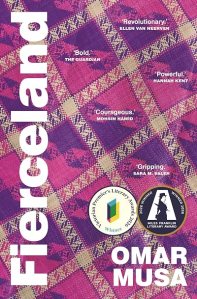
Before the meeting: This is a fabulously ambitious novel.
Two children in a village in Sabah in northern Borneo are taken into the forest by their father on an excursion that turns out to be the beginning of his ruthless acquisition of ever-increasing areas of jungle to turn them into ecologically disastrous palm oil plantations. While there, the children witness brutally murderous treatment of an Indigenous man whom they have come to love. The rest of their lives is dominated by that experience, and by their troubled relationship with a father who represents the worst of rapacious, extractive capitalism.
Omar Musa is a brilliant spoken-word performer (see the YouTube below where he is accompanied on cello by his wife, Muriel Roberts Musa). The novel, his second, is not confined to a naturalistic mode of storytelling. In its opening pages the forest speaks, and the language cries out to be read aloud, even chanted. Here’s a taste:
mud-gravy & gizzard stones, steeple my long luminous bones & carnal green – the unseen seen – green is God naming itself, green is the sprawl, rot & fern-tickle of time – my steaming velvet a sprung floor for trickster tango – orang, hutan, orangutan, mousedeer, leopard, vampire ghost – black loam & clay blue-grey, sequinned by skulls, I wear my sapblooded heart on sleeve
The forest has further chapters, but as the palm-oil plantations spread, it has less to say and becomes less exuberant, until its final utterance is just a few plaintive words.
The main story unfolds in alternate chapters focusing on the two children, Rozana (known as Roz) and Harun – first in 1998 when they witness the terrible violence, then over the decades as they live with the privilege that comes from their father’s enormous wealth. They are sent to separate boarding schools in Sydney, where Roz, after a troubled adolescence, becomes an unsuccessful artist (and there is some finely honed satire of artists exploiting their diasporic status). Harun makes a mint from a virtual reality forest creation in Los Angeles. They return to their tiny village in 2018 when their father dies, and they inherit enormous wealth – unfairly distributed between them, but enormous all the same. They have both come to understand the devastation that their father has caused to the environment and Indigenous people, and the inheritance brings their ethical dilemma into focus.
The story is enriched by historical excursions – into 19th century Venetian glass-making, the beginnings of Malaysia’s palm-oil industry in a trade visit to Nigeria in the 1970s, tables as emblematic of colonisation. There are elements of what I’ll risk calling magical realism: mainly figures from Malaysian folklore like the vengeful female ghost, the pontianak. A character known affectionately as Crazy Auntie, a poet living in exile in Sydney, is the voice of reason – speaking against extractive capitalism. Roz’s redemption as an artist comes when she creates an installation based on Crazy Auntie’s poem, ‘The Song of the Wood’, translated into the more than 50 languages of Sabah: the book gives us 15 versions of the poem, printed in white on a mildly decorated black background. The English version ends:
Kill a language and a forest dies
Kill a forest and a language dies

Children of ash –

Be gentle with my heart.
While I was thinking about this book, I heard a radio program about some children of top Nazis (it’s at this link) who are facing the implications of their origins. And I thought of a close relative who is currently researching how our recent ancestors, sugar farmers in Queensland, benefited from the blackbirding of Pacific Islanders. Roz and Harun’s ethical quandary resonates.
I don’t think the book entirely succeeds. There are bits where you can feel things being hammered into shape. The conclusion (no spoilers) has a poetic logic but leaves too many questions unanswered. There’s a moment on page 132 when I nearly stopped reading. It’s in the chapter that tells the story of a glass bead, a murrina (but also a macguffin), from its creation in mid-nineteenth century Venice, through its passage from owner to owner until it ends up in the forest of Sabah. As a poetic history of colonisation, it’s laboured, but it works, until the moment early in the twentieth century when the Rajah of Pandasan, then owner of the bead, plays chess with a Polish visitor named Josef Teodor Konrad Korzeniowski. The Pole asks the Rajah what he will find if he keeps going upriver:
You get to the heart.
The Pole’s eyes light up. The heart? The heart of … darkness?
No, you fool, says the Rajah, laughing. The heart of spirit. The heart of light. Follow any River and you’ll get to a mountain peak. – no place on earth is more full of light.
Josef … Konrad, ‘The heart of … darkness?’ Get it?
Happily, this awkward knowingness is not at all typical, and I’m glad I decided to read on.
Page 79* gives you a better idea of the writing.
It’s 1978, 20 years before the inciting incident in the jungle of Borneo. Yusuf is the main characters’ father. Here he is a young man, a recently graduated engineer, in Nigeria with a group of Malaysians to explore ‘the age old cultivation’ of oil palms. At the start of the page, Yusuf is telling their genial Nigerian host, Ekben, that ‘he had grown to hate poverty with a passion that most people reserved for other human beings… He spoke unashamedly about his long-term plans. How he would have many sons and start an empire. He’d come to realise he was less an engineer and more a businessman, he said, although the engineering would come in handy.’
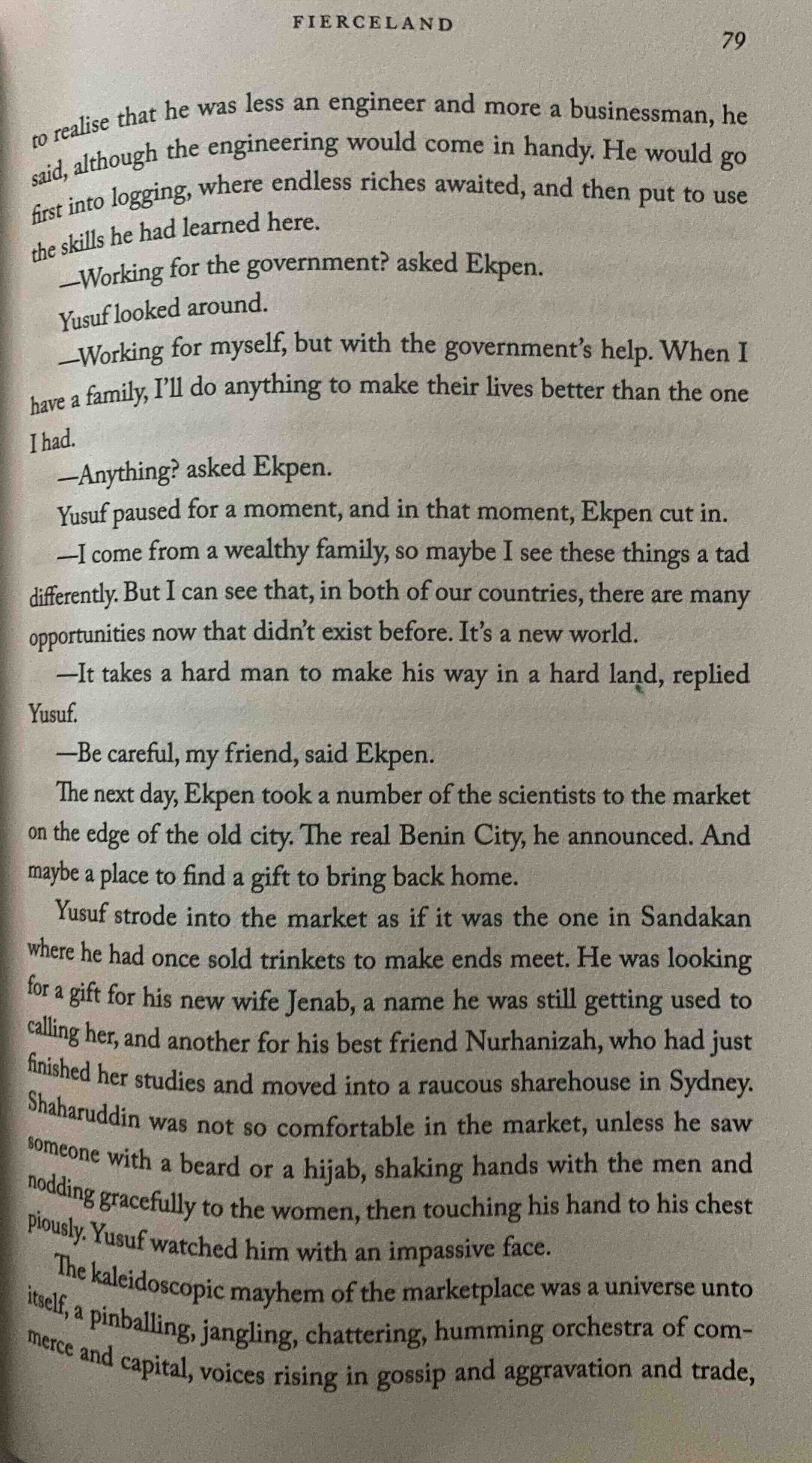
In this quiet moment where one young man proclaims his ambitions to another lies the seed of ecological and genocidal disaster. The novel doesn’t follow Yusuf’s career – in fact, the first full sentence on this page is the only account it gives of the career’s overarching shape.
He would go first into logging, where endless riches awaited, and then put to use the skills he had learned here.
—Working for the government? asked Ekpen.
Yusuf looked around.
—Working for myself, but with the government’s help. When I have a family, I’Il do anything to make their lives better than the one I had.
—Anything? asked Ekpen.
Yusuf paused for a moment, and in that moment, Ekpen cut in.
— I come from a wealthy family, so maybe I see these things a tad differently. But I can see that, in both of our countries, there are many opportunities now that didn’t exist before. It’s a new world.
— It takes a hard man to make his way in a hard land, replied Yusuf.
— Be careful, my friend, said Ekpen.
You get a taste here of the breadth and generosity of Musa’s imagination. However great the harm Yusuf is to do, there are real forces compelling him: the hatred of poverty, the harsh realities of his society, a fierce commitment to his family. As this is a flashback, the reader knows that Yusuf’s decision to go after those ‘endless riches’ will lead to the destruction of his family’s happiness and much more.
Yusuf strode into the market as if it was the one in Sandakan where he had once sold trinkets to make ends meet. He was looking for a gift for his new wife Jenab, a name he was still getting used to calling her, and another for his best friend Nurhanizah, who had just finished her studies and moved into a raucous sharehouse in Sydney.
This moment reminds us that Nurhanizah, ‘Crazy Auntie’, who is to become Yusuf’s main moral antagonist, and whom he will destroy, was once his best friend. She too is westernised, but the values that go with a ‘raucous sharehouse’ pit her against him. We’re also reminded that Yusuf’s loyal wife, Jenab, was once named Ruth. In the underlying schematic of the novel, it’s an outsider who is willing to support Yusuf’s rapacity.
The final paragraph on the page is an example of the kind of writing that makes the book live. Whatever Musa’s characters might be up to, his prose celebrates the vibrant reality of communal life, in Nigeria as well as in Malaysia.
The kaleidoscopic mayhem of the marketplace was a universe unto itself, a pinballing, jangling, chattering, humming orchestra of commerce and capital, voices rising in gossip and aggravation and trade, meat and fish lying on newspaper, some fresh, some flyblown, some smoking and drying in the sun, piles of chillies, okra, cassava, fufu wrapped in plastic, machines cleverly devised from spare parts into utensils for grinding and blending, the roar of these machines, and more upon more, the chatter of people hustling for every square inch, foot or naira in this city, wearing football jerseys and batik, the whole market like one giant textile woven from many different threads, creating a oneness that then frayed into disparate parts again.
This vision of the market celebrates organic, messy, apparently chaotic life that moves from oneness to disparate parts and then back. It’s like the jungle, in contrast to the regimented rows of the palm-oil plantations.
Incidentally, one of the small pleasures of the book is the use of non-English words without explanation. This page’s action is taking place in Benin City, Nigeria, so the two words that are new (to me) are Nigeria-specific: naira is not a measure of space as the context may suggest, but the Nigerian currency; and fufu is just what you’d expect from the context, a food – ‘a pounded meal found in West African cuisine’ according to Wikipedia. Elsewhere, the scattering of Malaysian and (I think) Arabic words contribute to the rich sense of place that is one of the beauties of the novel.
At the meeting: We started out the night with non-alcoholic prosecco, which meant that I could join in the toasting for a change. The excellent meal prepared mainly by the Mid-career Artist culminated in her signature pavlova. Then we discussed Douglas Stuart’s John of John, and finally turned our attention to Fierceland, which we had picked because it won the 2026 Miles Franklin Award.
It tended to divide us. One person didn’t read much of it and didn’t care to say why. Another felt an overwhelming sense of dread and stopped reading before the halfway point. Another said that too much of the book was taken up with ‘devices’: the history of the bead/murrina was just one of them. She didn’t much care for the chapters where the forest speaks.
One person gave an eloquent account of the book as a work of great ambition that fails to fulfil that ambition but is still an admirable and enjoyable work. I felt as if she was reading my mind. We could have done without the little chapter about tables and colonisation; the genre-busting inclusion of fifteen pages on which the same poem appeared in fifteen different languages is a darling that could have been murdered; and so on. But without them it would have been a less interesting book.
One person felt that a didactic element made some parts tedious. Others (including me) didn’t register it as didactic, though we did feel that we were learning things we thought we already knew, which must be one of the things that successful fiction does.
In these conversations we sometimes flick back and forth between the two books, but that didn’t happen this time. Maybe there’s the germ of an exam question there: ‘What don’t John of John and Fierceland have in common? Do not compare and contrast.’
The Book Club’s five members, all of settler heritage, met on Wangal and Gadigal land, which is where I wrote this blog post. I gratefully acknowledge the Elders past and present of all those Nations and welcome any First Nations readers of this blog.
* My blogging practice is to focus on the page that coincides with my age, currently 79.


Loved reading this Jonathan – including about the nonalcoholic Prosecco. I still drink alcohol but decided a couple of years ago to cut out all those extra times you drink like at reading group. So far only one person had followed my practice of including non-alcoholic wine in the offering.
Anyhow my reading group plans to read this next year so I am putting off reading it until then. I will probably recheck your post then.
LikeLiked by 1 person
Thanks, Sue. I look forward to your take on it. If you want to follow up, It seems that High Hopes, the non-a prosecco made by Heaps Normal, was acceptable to people who have mostly found non-alcoholic wines undrinkable.
LikeLike
Thanks Jonathan … I haven’t tried that one but we have a few we like. I didn’t know Heaps Normal was doing a Prosecco. I think people need to approach non-a wines not expecting a wine per se, but looking for something that is pleasant to drink and not too sweet, like most non-a drinks have been? It’s easy to give up at the first barrier but if you are committed you can find good alternatives.
LikeLike
Hi JonathanLife is short. I dont have the patience to deal with the mise-en-abime intricacies of logging
LikeLiked by 1 person
If you mean you’re glad the novel doesn’t go into the details of Yusuf’s career, I’m right with you
LikeLike
Haven’t read it yet, only referring to the few lines you took issue with re the Conrad reference.I probably havent mentioned that my partner Christine is Malaysian Chinese/Kiwi now Australian, so I’ve been exposed a fair bit to the milieu of Malaysians becoming rich
LikeLike