The Screaming Rapture Cometh

Last year my son Liam was one of the team that created Social Fireflies for the Vivid festival. This year they’re producing Screaming Rapture. The social fireflies moved in response to light, from outside or from each other. The louvres of the rapture respond to sound. You make a noise. They flash. I don’t know about the title, but it’s looking cool.

Maurice Sendak

About 1970, when I was in my mid 20s I asked my school-librarian housemate for advice on what to give my niece for Christmas. She suggested Where the Wild Things Are by Maurice Sendak, and at a stroke she introduced me to a world of children’s literature that had been transformed since I was a child. I loved the book. So did my nieces and nephews, who named all the monsters after adults in their lives.

When I became a parent, I must have read the book, and In the Night Kitchen, and Higgledy Piggledy Pop and  The Sign on Rosie’s Door (which has the best last line ever) hundreds of times. Not to mention Pierre:

And when the lion gave a roar,
Pierre fell out upon the floor.
He rubbed his eyes and shook his head
and laughed because he wasn’t dead.

If only!

The moral of Pierre is: Care!

Dwight Garner has an excellent elegiac ‘appraisal’ of Sendak’s work, with lots of excellent links, here.

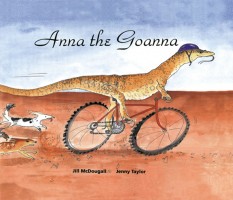
Anna the Goanna

Jill McDougall & Jenny Taylor, Anna the Goanna and other poems (Aboriginal Studies Press 2000)

This is a collection of poems written by a schoolteacher ‘in order to provide classroom reading material which reflected the daily experiences of her students’. That description, taken from Jill McDougall’s bio at the back of this book, could be a recipe for semi-literate, patronising disaster, all the more so when the students in question are Aboriginal. On the contrary, this collection is a delight, words and images both. Not that the opinion of a 65 year old urban middle class white men matters all that much, but I’d be surprised if this book didn’t go down very well indeed, in the classroom and out of it, performed for the students or by them or read in private, by curious non-Indigenous as well as Indigenous children.

Why did I read it? Well, reading the Kevin Gilbert books reminded me of how much I enjoyed his children’s poems, and this was a gift that has been sitting on my shelves for a couple of years now, waiting for a suitable child to turn up to be read to from it. I just decided to stand in for that hypothetical child.

As the title promises, there are silly poems about goannas. There are also mosquitoes, crows, flies, and a crocodile, but it’s not all animals. There are babies, big sisters, football and baseball, a sweet   comedy about the difference between Aboriginal and mainstream economics, and two pieces that depart from the general cheerful tone – ‘Too Many Drunks’ and ‘Sad Boys’ , the latter being about petrol sniffing.

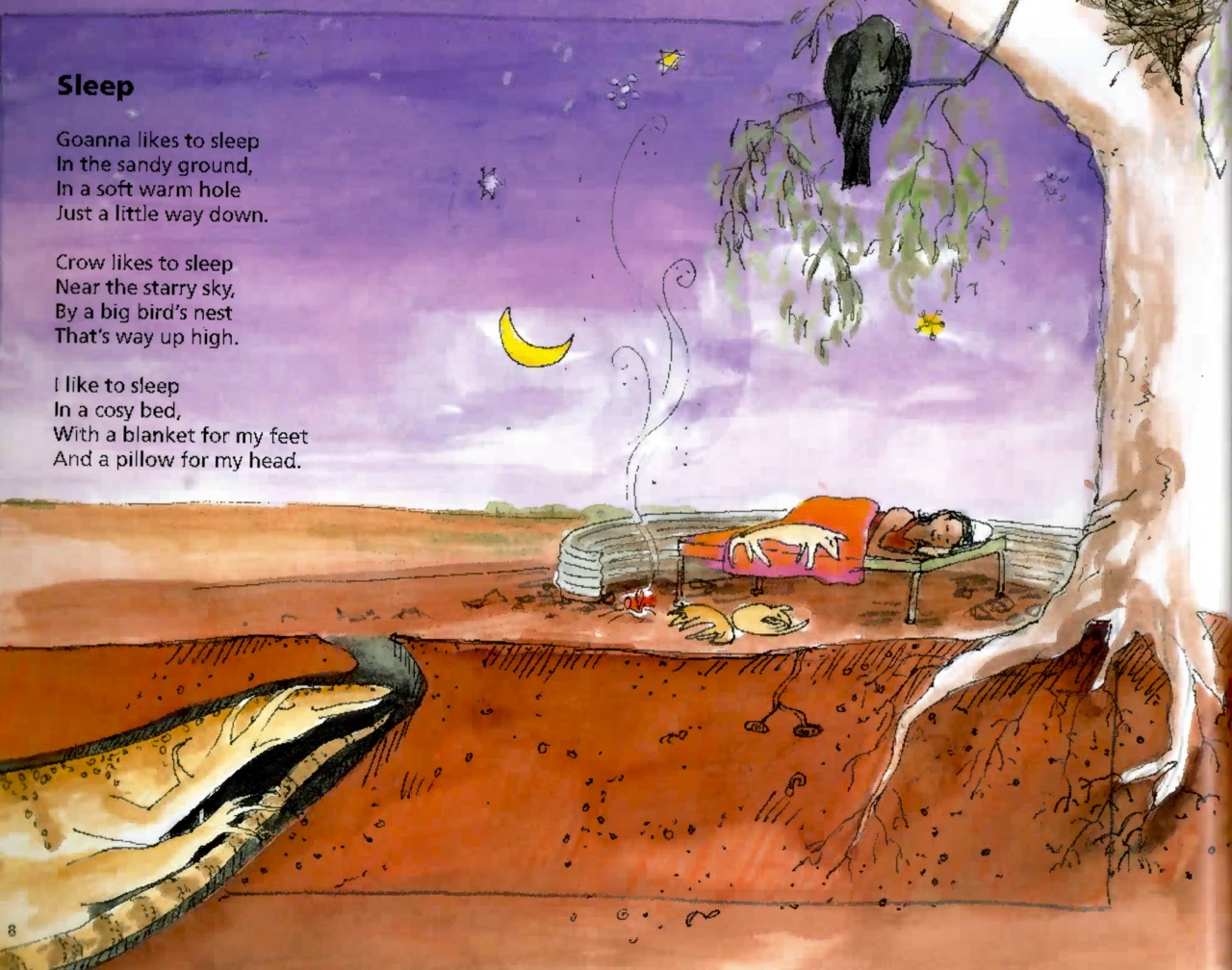
Jenny Taylor’s illustrations demonstrate just how important the interplay of text and image can be in a picture book. One page that struck me in particular was ‘Sleep’. The poem:

Goanna like to sleep
In the sandy ground,
In a soft warm hole
Just a little way down.

Crows like to sleep
Near the starry sky,
By a big bird’s nest
That’s way up high.

I like to sleep
In a cosy bed,
With a blanket for my feet
And a pillow for my head.

The final stanza could be spoken by any child, anywhere. One could easily think of a room with pastel wallpaper and shelves of stuffed toys. The illustration is a revelation about possible meanings for the word ‘cosy’:

Scary sign

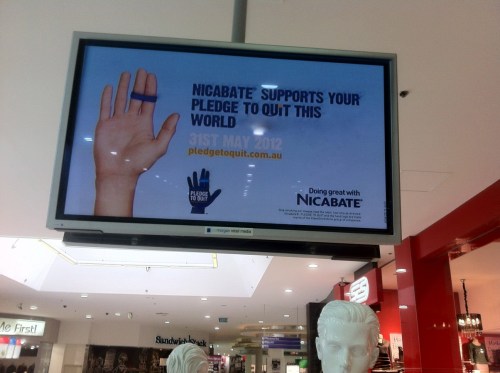
Seen in the Marrickville Metro:

True, that’s what I saw! Nicabate supporting someone’s suicide pledge! What I saw when I looked again, and what was in this photo before I took to it with the eraser tool, was ‘STOP SMOKING DAY’ after ‘WORLD’. How useful a comma would have been after “QUIT’!


Terry Pratchet’s Snuff

Terry Pratchett, Snuff (Harper, 2011)

Apart from the Tiffany Aching books (which are for children, and also for adults, and brilliant), I have been out of touch with Discworld, though each Christmas I’ve given the current novel to my younger son, who has been a fan for half his life. Last year he reversed the flow and gave me Snuff. I decided to read it just now for light relief from a string of books about grim subjects – only to find that it’s pretty much about a genocidal slave trade. I don’t know if Terry Pratchett had the European-American slave trade in mind, or Queensland blackbirding, or the Nazi Holocaust, and I wouldn’t be surprised to learn that he had read Sea of Poppies – both books feature a drug trade conducted by establishment people and a vessel (the Ibis/the Wonderful Fanny) carrying a viciously oppressed human cargo (not exactly human in Snuff, but certainly sentient) that makes its way down a personified river (Mother Ganga/Old Treachery) and encounters many kinds of turbulence.

There are three overlapping strands in the Discworld series: the witches, the wizards and the City Watch. This is a City Watch story, starring Commander Sam Vines, who when I last saw him was a mere Captain, but has now been elevated like his creator to the peerage. Sam is dragged from his putrid native habitat, the streets of Ankh Morpork, for a holiday on his wife’s ancestral country estate. It takes a while, but of course the country turns out to contain just as much nastiness, danger and corruption as the city, and just as much stumbling heroism, awkward romance and unexpected beauty. A Discworld Jane Austen makes a cameo appearance, and a scatological children’s writer plays a significant role.

Sam is a wonderful character, an uncompromising servant of the law and believer in the rule of law who is all too aware of his own dark side, his own demons (and this being fantasy, both the darkness and the demons are literal). He discriminates among kinds of evildoing. For example, when the main atrocity has been exposed one of the villagers who had failed to intervene approaches Sam, who is having a snack at the village pub:

‘Well sir, yes, of course we knew about the goblins and no one liked it much. I mean they’re a bloody nuisance if you forget to lock your chicken coop and suchlike, but we didn’t like what was done, because it wasn’t … I mean, wasn’t right, not done like that, and some of us said we would suffer for it, come the finish, because if they could do that to goblins then what might they think they could do to real people, and some said real or not, it wasn’t right! We’re just ordinary people, sir, tenants and similar, not big, not strong, not important, so who would listen to the likes of us? I mean, what could we have done?’

Heads leaned a little forward, breaths were held, and Vimes chewed the very last vinegary piece of crisp. Then he said, directing his gaze to the ceiling, ‘You’ve all got weapons. Every man jack of you. Huge, dangerous, deadly weapons. You could have done something. You could have done anything. You could have done everything. But you didn’t, and I’m not sure but that in your shoes I might not have done anything, either. Yes?’

Hasty had held up a hand. ‘I’m sure we’re sorry. sir, but we don’t have weapons.’

‘Oh, dear me. Look around. One of the things that you could  have done was think. It’s been a long day, gentlemen, it’s been a long week … [Addressing the barman] Jiminy, these gentlemen are drinking at my expense for the rest of the evening.’

This is the third book Sir Terry has written since he revealed to the world that he has Alzheimer’s. He can no longer type, but – with the help of voice recognition software – he can certainly still write. For those who have kept up this book may be showing signs of flagging mental ability, but it’s full of wit and passion and sheer inventiveness, and also wisdom. If you haven’t read any of his books I wouldn’t start here. Try Guards! Guards! or Witches Abroad or Mort or The Wee Free Men.

Elizabeth Jolley, My Father’s Moon

Elizabeth Jolley, My Father’s Moon (Penguin 1989)

I started this more from duty than for pleasure. Previously I’d read just the one short story by Elizabeth Jolley and seen the movie of The Well, and failed to be grabbed. But I want to be well read in Aust Lit, and I couldn’t be sure it wasn’t just sexism that had me avoiding this Big Name Author. It’s a slim book, easy to read on public transport, described by the cover blurb as ‘the novel at the heart of all her work’.
It’s probably very good. Middle class English schoolgirls, then nurses in a hospital during World War Two, then teachers at a ‘progressive’ school (though not in that order – this is a Literary Novel of 1989, remember, and a lot is told out of chronological order for no apparent reason other than to play with the reader’s mind) are variously mean, petty, homoerotic, spiteful, class-conscious, kind, gossipy, weird, naive, vulnerable, pretentious, callous, romantic, obtuse, pregnant – though the narrator, who happily has described two women waltzing naked, is too reticent to give us anything physical about the moment of conception. It’s very well written, and made me think of Blake: ‘Sooner murder an infant in its cradle than nurse unacted desires.’

So now I can say I’ve read some Elizabeth Jolley. I don’t feel the urge to read more.

Madlands launch at Gleebooks

Last night we went to Gleebooks for the launch of Anna Rose’s Madlands. This is her book about the experience of going on ABC television’s I can change your mind about … climate with Nick Minchin. I confess to not watching the show: there was enough condescension on the basis of age and gender in the trailers to do me for a lifetime, though Anna Rose seemed remarkably unflustered by it. He called her a warmist! It was as attractive as an hour ‘debating’ whether the earth is flat or passive smoking is a health hazard or Rupert Murdoch is rich.

Last night was not a ‘debate’, though it was largely about the vested interests, economic and ideological, that keep talking that way.

Louise Adler of Melbourne University Press referred in passing to the current debasement of political life and we realised that this was not the ABC, where Balance rules, and all opinions are equal.  Incidentally, she confessed (under a cone of silence so as not to build up other writers’ expectations, but us bloggers know no shame) that the book was written in two and a half months and then proceeded from manuscript to the bookshops in another couple of months.

John Hewson, once leader of the Liberal Party and sufficiently neo-liberal to have been called the Feral Abacus by Paul Keating, launched the book. (Incidentally, to have been insulted by Paul Keating must be a little like having been caricatured by one of the greats – it might not portray you in a good light, but the artistry is so fine that you will tell people about it for the rest of your life.) Hewson  talked quite a bit about his own activism in the business sector. He’s currently involved in a project, for instance, which will result in a published list of the top thousand superannuation funds rated according to their investment in sustainable enterprises – a listing which, he hopes, will result in a significant increase in investment in non-carbon energy options. But he wasn’t so much taking the opportunity to blow his own trumpet as to contextualise Anna’s book and her activism as co-founder and chair of the Australian Youth Climate Coalition: it’s no good waiting for government to act, was his message, but if you look around you’ll see that there are alternatives.

Anna Rose spoke too. Asked about her calmness on the TV show, she said that she kept remembering that her aim was to speak to the people watching the show, and if she allowed herself to be rattled by unpleasantness coming at her she wold probably lose those people. She invited us to applaud her mother (in the audience, almost as alarmingly young as Anna Rose herself), who over many years had given her a brilliant example of talking to people respectfully and changing their minds. Evidently she has received an enormous amount of hate mail since the show went to air – she commented that the anonymity of the Web allows some people to behave very badly, but shrugged and said you get used to it. (She’s married to Simon Sheikh of Get-Up, also there with a big smile on his face, so I guess she has some forces countering the hate.)

There was some talk about hope. Anna Rose quoted Paul Kremer (I looked it up and found the context here):

If you look at the science about what is happening on earth and aren’t pessimistic, you don’t understand the data. But if you meet the people who are working to restore this earth and the lives of the poor, and you aren’t optimistic, you haven’t got a pulse.

Any time we are feeling discouraged, she said, we should visit http://aycc.org.au/, see what the Australian Youth Climate Coalition is up to and make a donation. At the moment they’re raising funds to give a copy of this book to every member of the Australian Parliament.

We bought three copies of the book and went off to dinner knowing that we had pulses.

Jennifer and Julia and Nye in the Age

Having complained in this blog almost exactly two years ago that Jennifer Maiden had not turned her pen to (on?) Julia Gillard and Kevin Rudd, I ought to acknowledge when she does so.

This Saturday’s Age published ‘Poor Petal’, which also appeared in the online Sydney Morning Herald, at the end of the Bookmarks column. Like ‘A Great Education’, which was published in the Age in January 2011, it has a prefatory note: ‘When asked if there was an example who had inspired her as Dietrich Bonhoeffer had inspired Kevin Rudd, Julia Gillard replied “Nye Bevan”.’ It’s one of Jennifer Maiden’s ‘Someone Woke Up Somewhere’ poems; this time it’s Aneurin Bevan in Canberra opposite Julia Gillard in an armchair.

I recommend it to anyone who is made uneasy by Julia Gillard’s inscrutable public presence.

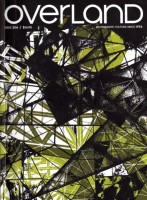
Overland 206

Jeff Sparrow (editor), Overland 206, Autumn 2012

I’ve just realised that this blog is largely about the vastness of my ignorance. In the years since I left full time work I’ve been reading widely and unsystematically on subjects in which I’m either uneducated,  misinformed or wildly out of date, hoping something will stick – and then blogging about it, sometimes in a shamelessly opinionated way.

Take this issue of Overland for instance.

I’ve never studied economics or political science or 20th century history, but I’ll tell you confidently that Richard Seymour’s ‘The European meltdown: Crisis across the continent‘ talks sense about the current economic crisis in Europe. He describes the European Community as ‘a project that, from inception to denouement, has evinced an extraordinary distrust of the masses’. The crisis, he argues, is brought on not so much by the fecklessness or other failings of the Greeks, Irish, Spanish and Portuguese, as by the inherent instability of a system built to give France and Germany dominance over the less powerful nations, and to foster profit over the interests of the working class (he says it much better than that). And Mike Beggs’s ‘Occupy abundance: On whether Australians are too rich to protest‘ does a similarly enlightening job of unpicking the current Australian affluence. It’s true that since mid-1997 there’s been a 10 per cent increase in purchasing power ‘over the whole consumer basket’, but:

The average hour’s pay now buys 59 per cent more clothing and footwear, 71 per cent more household appliances, and an incredible 1066 per cent more audio, visual and computing power than in 1997.

But such goods make up only around a fifth of the average household’s expenditure. Much of the rest of the consumer basket has actually become less affordable. Compared with 1997, the average hours work earns enough to buy 2 per cent less food, 8 per cent less housing, 26 per cent less water, electricity and gas, 18 per cent less petrol, 5 per cent less healthcare and 21 per cent less education.

That may not be news to people who understand economics, but it is to me.

What do I know about life as an immigrant targeted by racism? Yet I can tell you that Michael Green’s ‘Between two oceans: The life and death of Michael Atakelt‘ and ‘The dangers of a single story: On acting and identity‘ by Tariro Mavondo are brilliantly complementary explorations of the subject. In the former (of which an edited excerpt was reprinted in the Fairfax Age, which either takes the sheen off Overland‘s back-cover boast that it is of the loopy-Left or justifies the Australian‘s nickname for the Age, Pravda on the Yarra – you be the judge!), the writer is in touch with Footscray’s Ethiopian community as they struggle to come to terms with the drowning of a young man shortly after his release from police custody, and the extraordinarily long wait for any cause of death to be made public: ‘This has become a story about a community’s right to exist – its need to understand and to be understood – but it is also a story of grief,’ Green writes. I would add that it’s also a story of an amazingly resilient community. Tariro Mavondo is about to become one of the first African-born acting graduates of the Victorian College of the Arts: from a relatively privileged background (‘the higher echelon of Zimbabwean society’), she is up against a different face of racism – but this article too is about the right of a community to exist – ‘”6 billion stories and counting.” But where is mine?’

What do I know about the history of sexuality? I spent the prime of my youth in a monastery, and working as a children’s editor for fifteen didn’t send much writing about sex my way. So Robert Darby’s ‘Another other Victorian: George Drysdale, a forgotten sex pioneer‘ was even more news to me than it will be to people who’ve read The Other Victorians. Drysdale’s tome, The Elements of Social Science: Physical, Sexual and Natural Religion, published anonymously in the 1850s, was never mentioned by name in mainstream writing and is generally ignored or misreported even today, but it ran through 35 editions and sold some 100 000 copies in 50 years. The book ‘argued for a new religion of reverence for the human body, condemned abstinence as unhealthy and productive of misery, called for an unfettered right to intercourse among the unmarried, and recommended regular use of contraception to guard against pregnancy and condoms to avoid venereal disease’. Sex wasn’t invented in 1963 (or in my case 1970) after all. The article is seriously interesting

Now, poetry. I did study Eng Lit and have a BA (Hons) to show for it. But I got my piece of paper before postmodernism broke upon the world. I’m not quite the guy who puts his hand up at the Writers’ Festival and asks why modern poetry doesn’t have rhyme or rhythm any more, and why are modern poets so deliberately obscure. My own poetry, such as it is, probably wouldn’t please that guy. But sometimes I feel as if I’m almost as much in the dark as he is. So I was very glad that Peter Minter took a full two pages for his Judge’s report on  the 2011 Overland Judith Wright Poetry Prize for New and Emerging Poets. Sadly, if I was hoping his notes on the winning poem, rock candy by Joel Ephraims, would be a guide to reading it, my hopes were dashed. But I could tell there was thought there, and a world of knowledge that’s yet to become open to me. Having said all that, it will probably not be received as a compliment if I say that I enjoyed the night-time flâneurism of ‘Constant companion‘ by the late Kerry Leves (who occasionally graced the School Magazine, with both his presence and his poetry) and ‘Sunday poem‘, an impressionistic take on a visit home by Fiona Wright.

And then there’s genre fiction. Overland doesn’t go in for it much, and nor do I, though I’m doing my best to pick up where I left off when I was 14. It’s probably fair to say that James Bradley’s ‘The inconvenient dead‘ is a zombie story for people who don’t read zombie stories. Anyhow, it worked wonderfully well for me.

The whole contents of the magazine are readable online. All the links except the one to the Age will take you to the Overland web site.

Asia Literary Review 22

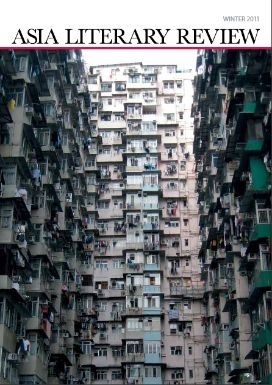
Martin Alexander (Editor), Asia Literary Review 22, [Northern] Winter 2011

20120416-173808.jpg

[Note added in 2021: All the links in this blog post are broken except the ones in the journal title above and in the image to the left, and the profile of Amitav Ghosh and ‘The Sacred Cow‘. The whole journal is still available online to subscribers.]

The Asia Literary Review has a new Editor in Chief, the third in the nine issues since I first subscribed. There’s no note of farewell to Stephen McCarty, as there was none to Chris Wood before him. The silent turnover is just a little unsettling, but I guess we don’t read the journal for news of its staff. Martin Alexander, the new occupant of the chair, was previously (and still is) Poetry Editor. In his editorial, he addresses the journal’s identity:

… while Asia is a concept we may broadly understand, it would be foolish to attempt a precise definition. Asia’s identity is in a state of motion; we aim to capture that motion in these pages.

That’s not bad: if Asia is an imprecise entity, it would be a mistake to overdefine the journal’s scope or purpose. Its contents are in English, and they ‘capture’ Asia in some way. That’s enough.

‘Capture’ can describe what a tourist snapshot does, and there’s quite a lot of that in this issue, mainly but not exclusively in its four photo essays – of street scenes in Java, Vietnam, Hong Kong, and the grand but as yet unpopulated city of Kangbashi in Inner Mongolia. The photography is brilliant in each case, but in the end they are all picturesque street scenes, and so a lot less interesting than, say, Jack Picone’s ‘Planet Pariah’ about life on the Burma Thailand border in issue 19.

There are a number of excerpts from longer works, both prose and verse, which are like snapshots in a different way: tantalising glimpses, but sometimes hard to tell what it is one is glimpsing. An exception is the excerpt from Chen Xiwo’s novel I Love My Mum (banned in China, translated by Harvey Thomlinson, and published by Make Do Publishing), which stands alone as a tale of desperate brutality with chilling allegorical implications. You can read the whole excerpt at the link.

Sticking with the idea of ‘capture’, there’s Fionnuala McHugh’s profile of Amitav Ghosh. I’ve only recently discovered his writing, and was delighted to learn more about him, and about his Sea of Poppies. He reveals, for example, that having done a little sailing he knew that sailing was ‘very dependent on words’:

I thought there has to be a dictionary. I happened to be at Harvard but I found the Lascari dictionary in Michigan – published in 1812 in Calcutta by a Scottish linguist. I didn’t have to make anything up.

He sounds like a terrific man – if a Sydney Writers’ Festival scout happens to read this, could you invite him some time soon, maybe when the third book of the Ibis trilogy comes out?

The Ghosh profile is also part of what Martin Alexander calls ‘motion’, if he means by that the kind of dynamic interplay that can add spice to a literary magazine.  Ghosh, we read, turned down the 2001 Commonwealth Writers’ Prize because it was for works written in English, from a region ‘that was once conquered and ruled by imperial Britain’. This is honourable and hardly surprising, given the unflinching portrayal of the Raj in Sea of Poppies. But here it resonates interestingly with a short piece by Pico Iyer, The Empire Writes Back, Revisited, which argues that the formerly colonised have taken charge of the cultural centre, and that the English language, no longer dominated by the former colonisers, is being reclaimed and revitalised by a host of writers from India, China, the Caribbean, Africa, New Zealand, Australia. This ALR tends to bear out Ghosh’s side of the conversation, as most of the contributors seem to be of European or US extraction, and there is that strong touristic element. But Pico Iyer would find material to support his view as well.

Of the short stories, ‘The King, the Saint and the Fool‘ by A. K. Kulshreshth weaves a sweet romance from elements taken from the folk history of Singapore, and Sindhu Rajasekaran’s ‘The Sacred Cow‘ tells a distinctly modern love story in the context of Indian village life. The essay that stands out is Michiel Hulshof’s ‘Special Academic and Art Zones‘. Hulshof is a Dutch journalist living in China. Among other things his essay gives a fascinating account of the economic and political context of contemporary Chinese art (of the kind Sydneysiders get to enjoy at the White Rabbit Gallery).

Almost as good as getting on a plane and travelling for six months.