A near immersive art experience

The one formerly known as the art student (TOFKATAS) and I are just back from a short weekend in Canberra – overnight in a wotif mystery hotel, and most of the rest of the time at the National Gallery.

The gallery’s new Aboriginal and Torres Strait Islander rooms are just fabulous, and I hope to spend a lot more time in them. From early Papunya boards to the work of urban Aboriginal artists, the collection is dizzyingly rich, and the presentation is superb. And occasionally it got personal. Tony Albert’s ‘Ash on Me‘, for one tiny example, consists of the words ‘Ash on me’ painted on the wall and, as you might not be able to tell from the photograph at the link,  decorated with actual ashtrays, most of them with images of Aboriginal faces or figures, some with Australian flora or fauna. It’s a powerful statement in anyone’s terms, but I was grabbed by the throat when I saw this on the S:

In  case you can’t see, it’s a kookaburra with the words ‘Innisfail Qld’. It was borne in on me that this was an object from my Innisfail childhood, that ashtrays just like these with cute, noble, comical or otherwise stereotyped Aboriginal figures were an unquestioned part of the world I grew up in. I was implicated.

We also spent time with James Turrell’s ‘skypace’ Within Without, which from the outside looks like an artificial grassy hill with a rock dome rising from the middle of it, approached by a path between expanses of water. Inside, it’s an ochre pyramid with a huge basalt stupa in the middle, surrounded by eerily turquoise water. The space is filled with the sound of water overflowing. You walk across a flat bridge to enter the stupa – around its inside wall is a bench that seats about 20 people. The bench, it turns out, is heated. There’s a large oculus (a word I know from the Pantheon in Rome) in the middle of the roof, and a patch of coloured stone in the middle of the floor. If I hadn’t been introduced to Turrell’s work on Naoshima in Japan a couple of years ago, I might have had a quick look and moved on, because nothing much was happening. But we sat for at least an hour, and watched the oculus as its patch of sky grew deeper and deeper blue until it was pitch black against the whiteness of the inner wall, which we gradually realised has its own light source, and wasn’t somehow trapping light from outside. The sky couldn’t really be as black as it looked to us, I thought, and announced that I was gong to take a stroll around the inside of the triangle. I walked out the door of the stupa and, looking up at the deep blue, starry sky, took a step to the right – up to my calves in now invisible water. Fully shamefaced, I went back to my place on the heated bench, took my shoes and socks off and endured the amiable mockery of what had become a small community of Turrellites.

If you’re in Canberra, I do recommend that you spend time in the Aboriginal and Torres Strait Islander Galleries, and that you let the James Turrell space work on you – but take seriously the signage saying that the work of art does not meet Australian Safety Standards for Buildings.
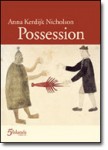
Anna Kerdijk Nicholson’s Possession

Anna Kerdijk Nicholson, Possession (5 Islands Press 2010)

I picked this up because it’s shortlisted for the New South Wales Premier’s Literary Awards. I’m pleased to report, however, that I read it without Barry O’Farrell in mind, not even a bit.

The subtitle, ‘Poems about the voyage of Lt James Cook in the Endeavour 1768–1771’ seems to promise a book that’s squarely in the Australian Explorer Poem Tradition (AEPT). Kenneth Slessor’s ‘Five Visions of Captain Cook‘, James McAuley’s Captain Quiros, some of R D Fitzgerald’s poems dealt with sea exploration, and used to be studied at universities, and land exploration has grabbed the attention of many of our poets, notably Francis Webb (in whom I’m currently immersed). The book’s apparatus seems to confirm this promise: the page before the table of contents quotes from the Lords of the Admiralty’s instructions to Cook to ‘proceed to the southward in order to make discovery’ of the fabled Great South Land, and the poems are followed by a seven page chronology, beginning with his birth and ending 56 years after his death, with the death of his widow Elizabeth.

It’s true the book engages with Cook’s voyage of ‘discovery’, but it does so with a postmodern, post-colonial sensibility. There is a sense of overall unity, but no grand narrative, no unifying point of view, certainly not an unambiguous sense of Cook as hero. Unlike the main works of the AEPT, it doesn’t shy away from the less than honorable episodes of the voyage, or from the devastation it brought to many people – peoples, in fact. The 31 poems fall roughly into three kinds: most of them are addressed to Cook, with headers giving place and date, referring to incidents on his voyage (‘You imagine the scent of South Sea fruit on your fingers / and the lustful smells of fresh roast pig and cocoanut.’). A second kind are set in the early 21st century, mainly in Kangaroo Valley in New South Wales, and feature the poet, sometimes but not always with her mind on James Cook. And then there are half a dozen with the page header ‘Extracted from notes on a lost manuscript’, which are generally more elusively reflective: the first of these has the look of a found poem – a dictionary definition of ‘explore’, with etymology, not as dull or as neutral as you might expect.

I’m enjoying the book so far. It’s like a music album, that you need to play a few times before you’ve absorbed it, and maybe you’ll go back to it from time to time and find something new each time. I’m still at the absorbing stage. For example, the acknowledgements page tells us that the titles of individual poems ‘make reference to the poetries of’ five poets. None of the titles rang any bells for me, and Google shed no light, so evidently they aren’t direct quotes from those poets. Maybe one day I’ll come across the references, but for now I’m happy to stay in the dark, for the titles to remain a tease. That dictionary definition poem, for example, is titled ‘Each object we name and place leads us’ – I have no idea whose poetry that makes reference to, but it sits in nice tension with the poem.

This teasing intertextuality – which is echoed in the often oblique relationships between the modern and historical poems – is hardly in line with the cafe poet-in-residence program described in today’s SMH, which aims to ‘demystify the work of poets and deliver it to a broader audience’. But it’s fun – probably even more fun for people who get the references. I look forward to hearing Anna Kerdijk Nicholson read and perhaps talk at the Sydney Writers’ Festival next month.

Shall I come baby…

My brother in law got me to download a wonderful phone app that takes dictation, thereby saving lots of typing. Early the other morning I read a sonnet to it, and got results that would thrill the heart of any post-human poet. I read the same sonnet again, articulating as clearly as I could, though softly, so as not to wake the household. Here’s a conflation of the two results, with some punctuation by me, plus rollovers to remind you of the original if you want:

Shall I come baby to a summer’s day,
though I’m more lovely, and tempo
wins to shake the valentine’s day
and summer’s movie’s at all too short a date?
Sometime too hot here and show hello
is off. This is God to confession of everything.
Compare some time playing iTunes.
A chance … Tension course
and the guy isn’t till summer, shall not say
on this position of that fear. The boasts
with your shopping bag and wondrous thing
someone interesting to share with you,
so I was thinking peas, or eyes can see
too long lunch time at Christ a fee.

The Brothers Size at the Stables

On Friday night we went to Imara Savage’s production of Tarell Alvin McCraney’s The Brothers Size at the Stables Theatre. Let me say up front that I’ve known Imara since she was a baby, and it’s fair to say I’ve been a fan of her theatrical productions since she was two years old. But I’m perfectly capable of a tactful silence, and this production made me want to shout from the rooftops.

Close to forty years ago, theatre critic Katharine Brisbane observed that drama being produced by African Americans at the time was in some ways strikingly similar to contemporary Australian drama – something to do with coming out from under racism and the legacy of slavery in their case, and a colonial past and the cultural cringe in ours. If she was right the almost complete absence of African American writing from our stages in recent years is our great loss. And even if she was wrong, if this play is any indication it’s been our great loss anyhow.

The play was first performed in 2007 in New York and London. It’s a three-hander: Ogun Size (played by African American Marcus Johnson) has a small car repair company, his younger brother Oshoosi (played by Indigenous Australian Meyne Wyatt) is recently released from gaol, and Elegba (played by Tongan-heritage Anthony Taufa) who befriended Oshoosi in prison, became a brother to him, turns up. The Stables’ tiny stage is completely bare, the walls painted black, with a lighting design that seems to accentuate the darkness. A woman (Marian Lieberman) plays a drum – I don’t know anything about African drumming, but it felt to me that drum’s function was to summon up the action rather than merely to accompany or punctuate it. Once you know who the characters are, you more or less have the plot: Oshoosi is pulled in opposite directions by his two ‘brothers’, with tragic results. But that’s a framework for a wonderful 75 minutes in the theatre. For one thing, the dialogue is richly poetic, rising at times to operatic intensity, and the performances are absolutely up to the challenge. It seems to me that in some Australian productions of US plays, a focus on getting the accents right results in wooden performances – at least that’s my guess at what made Philip Seymour Hoffman’s production of True West at the STC last year so deadly dull in spite of the great talents at work in it. That wasn’t a problem here. As in the Nimrod’s legendary Tooth of Crime in this same theatre in 1972, the accent-work generated a stylistic rhythm, a music that was completely engaging. The bare stage allowed the language to fill the space.

But I’m making it sound like the equivalent of a concert performance of an opera. It wasn’t like that at all. One of the things that made it so powerful was its intense physicality. The director’s note says someone has described the play as a choreo-poem, which might sound wanky to anyone who hadn’t seen it, but isn’t a bad description at all. One of my companions said she couldn’t help wondering who this young woman was, to be able to direct such a testosterone-charged show, yet with such a nuanced take on possibilities for tenderness.

Sometimes, though rarely, shows transfer from the Stables to larger venues, and it seems a shame that the size of the space limits the number of people who see this. On the other hand, it gives a great sense of privilege to see such excellence at such close quarters.

If you can get to it, do. If not, make a note of the names I’ve mentioned. If there’s any justice you’ll be seeing a lot more of all of them.

In which I go on a bit about buying two books

I happened to be in Glebe this morning, and as I had earned a little bit of money last weekend I allowed myself to yield to the allure of the bookshops.

First, the secondhand poetry shelves of Sappho’s beckoned. There were a number of tempting morsels – enough to make me think that a Sydney poetry lover had recently died or radically downsized. There was a book of Philip Martin’s, inscribed in a shaky hand  that suggested he had already embarked on the disease that was eventually to kill him; Adamson’s Waving to Hart Crane signed ‘affectionately Bob’. But the one I bought was a selection of Stevie Smith’s poems. When I worked at Currency Press, our Editor in Chief Phillip Parsons impressed me hugely by reciting the last page of Stevie Smith’s Novel on Yellow Paper, and I became a fan on the spot (of Phillip, yes, but also of Stevie Smith). I recently saw a copy of her slected poems on a friend’s bookshelf – I took it down, and behold it was inscribed on the inside cover as a birthday present to a different close friend – a birthday present from me. The birthday girl later denied all knowledge of having given the book away, so I was left with a nagging sense that one or other of my dear friends was a book thief, a liar or an ingrate. Somehow when I saw this book in Sappho’s today – same selection, different cover – it seemed that buying it would make everything all right again. So I bought it.

Oh I am a cat that likes to
Gallop about doing good.

And then next door to Gleebooks. I’d listened to Poetica’s excellent two part broadcast on France Webb recently, heard Geoff Page deliver a  lukewarm account of him on the Book Show (Maybe you need more than one poetry reviewer, Ramona! But I don’t need to say much, as commenter named Junius has given you the rounds of the kitchen on this one.) and been prompted to open up my 1969 Collected Poems. This is one of my favourite books – I mean the actual battered, slightly foxed object on my shelf, which I love because I spent quite a bit of intensive time with it in my mid 20s. I was planning on writing an MA thesis on Webb’s poetry. It didn’t happen, but I did a bit of work that left its traces in the margins of my copy (as well as in a little exercise book in which I pasted photocopies of poems by Webb that had been published but not collected). His explorer poems sent me off to read the published journals of Leichhardt, Sturt, Grey and Edward John Eyre. My book has notes on when and where poems were first published, textual variations and any annotations, and occasionally there’s a commentary from me. For example, in ‘Leichhardt in Theatre’, just before the explorer’s party is attacked by the people whose land they have invaded, the poem goes:

————————————Gilbert, the naturalist,
is planting some precious flowers that he has found,
Cradles them in his hands like diamonds

There’s a pencilled note in the margin:

This indicates he had probably not read the Journal – Gilbert was learning to plat (sic)

Presumably it was Leichhardt who misspelled ‘plait’. I imagine these notes would annoy anyone else, but they fill me with an affection for my younger self.

But back to the visit to Gleebooks. On the display table in the poetry section was the new Collected Poems, published by UWA Publishing and edited by Toby Davidson. I flipped it open and had to buy it. Not only does it include the poems I had found in my postgraduate days, plus more. It also promises to correct errors Webb had noted in the 1969 edition (his notes evidently came to light in the 1980s). Am I doomed to read with both books open – one for the poetry and the other for young Jonathan’s occasional comment?

I thought you’d like to know.

Sad news

I notice that my note from last June about Diana Wynne Jones’s illness has risen to the top of my ‘Top Posts’ list over on the right. I assume people are coming here to learn something of her death on the weekend. For anyone who has come for that purpose,  some links:

The Diana Wynne Jones Official Website
Neil Gaiman: Being Alive. Mostly about Diana
Misrule: Saying Goodbye to Diana
Emma Bull on tor.com: Remembering Diana Wynne Jones
Farah Mendlesohn, also on tor.com: Diana Wynne Jones
Christopher Priest in The Guardian:  Diana Wynne Jones obituary

No doubt there are others. The Australian newspapers may mention it, but don’t hold your breath – she’s not a sports star or an obscure US politician. In 1973 it took the Sydney Morning Herald weeks if not months to mention the death of Francis Webb, a great poet who had spent his last decades living in Sydney.

David Malouf and the Happy Life

David Malouf, The Happy Life: The search for contentment in the modern world (Quarterly Essay 41)

If I ever need to be reminded of the depths of my ignorance, I need only read an essay by David Malouf, any essay. In this one, he draws for his argument on Plato, Heidegger, Jefferson, Montaigne, George Herbert, Solzhenitsyn and Condorcet, gives illustrations from Chekhov, Rembrandt and Rubens, and refers in passing to Dostoievski, Horace, Marvell, Shelley – there are cameo appearances by at least twenty writers and artists we know by a single name, that is to say, key figures in European cultural history. He’s not Wikipeding. Nor is he showing off. You know that these writers are part of his mind’s living furniture, that he needs to refer to them if he is to lay out his own thinking. At the same time he realises many of his readers won’t share his erudition, so he becomes a tactful and gracious teacher, elegantly spelling out Heidegger’s interpretation of the Platonic story of Epimetheus and Prometheus, for example, or explaining Condorcet’s pivotal role in the history of ideas. It’s quite a change of pace from the electoral politics of even-numbered Quarterly Essays.

It’s a change of pace in another way too. At least the way I read it, it’s not so much a thesis, a marshalling of evidence and argument to convince the reader of something, but an essay, as in the French essai, an attempt at its subject, a reflective chat with past thinkers and makers, a teasing away at a question and a stab at partial answers. Here’s the question – I should preface it by saying that by us here, he means ‘the new privileged, those of us who live in advanced industrial societies’. (‘The truth is,’ he writes, ‘ that though we are all alive on the planet in the same moment, we are not all living in the same century.’)

How is it, when the chief sources of human unhappiness, of misery and wretchedness, have largely been removed from our lives – large-scale social injustice, famine, plague and other diseases, the near-certainty of an early death – that happiness still eludes so many of us?

He explores the question down many interesting paths – because of course the question of happiness has been addressed by great thinkers for millennia – with excursions into art history He reflects on elements of the modern world from the effect of seeing our planet photographed from space to the way we think of our bodies has changed since his childhood in the 1940s (this is as close as he gets to the personal note that is a key element of the classic personal essay). Insofar as he arrives at an answer, it seems to be that ‘we’ need to slow down, shrink our horizons, accept limits. I won’t give any more detail: it’s beautifully argued, by means of a compelling image from a great piece of fiction, and I don’t want to spoil the reading for you. I do want to argue, though, that while this ‘answer’ may appear formally as the essay’s conclusion, it doesn’t resolve the argument. So much of the rest of the essay is arguing for something much more zestful, for the value of restlessness that the reader is inclined to think, ‘Well, if that’s the way to happiness, I’ll stick with my discontent, thanks.’ It’s a subtle, elegant, shape-changer of an essay, not easy to pin down, but very easy to enjoy.

There is one major perspective that makes an appearance only by virtue of an explicit exclusion. While it’s clearly legitimate to ask a question about happiness for the ‘new privileged’, leaving the happiness of the rest of humanity for a different essay, the rest of humanity must surely figure in the answer. No privileged elite is an island, entire of itself, and so on. My crude thought, which amounts to a central article of faith, is that none of us can be content while we don’t challenge and actively oppose the monstrous disparities covered by the notion that we are not all living in the same century. Didn’t we (and I think I mean David’s we) feel a surge of joy when the crowds in Tahrir Square had their moment of exultant hope recently, as if a weight had been lifted from our shoulders? And don’t we sleep less soundly knowing, even while we push it to the backs of our minds, that Aboriginal people in this country are still living in a different century from us, as the result, not of some geological time slip, but of ‘our’ forebears’ deliberate policies, and that ‘we’ all benefit personally from those policies? Someone said, ‘No one can be free until all of us are free.’ I think a corollary of that is that none of us can be happy as long as we are indifferent or ineffectual in the face of the misery of others. I can’t say I’m an unqualified fan of Alice Walker, but the banner that unfurls at the end of Possessing the Secret of Joy comes to mind: the secret of joy is resistance.

That is to say, this is a terrific Quarterly Essay, one that makes ya think.

Airport interlude

Last night I spent a couple of hours at the International Airport. I was waiting for someone who had booked on a JetStar flight from New Zealand. According to the web, their flight was a couple of hours late, at 7.20, and also cancelled. When I phoned JetStar in the afternoon, the person I spoke to said that meant it was arriving at 7.20. Once I arrived at the airport it was clear that it was actually cancelled, but since I hadn’t heard from my friends since the morning it was likely that they had been bumped onto the next available Qantas flight, a surmise with which the Travel Concierge agreed. Customs couldn’t help – the rules are that information about passenger lists can be revealed only three hours after a plane arrives. Thanks for that, regulators! I went looking for someone from JetStar, but their second-floor office was closed and their first-floor check-in desks deserted. I was collecting my email regularly on my phone, and my stranded friends finally managed to get word to me that they weren’t flying out until very early this morning, hoping fervently that they’d make their connecting flight to the US.

But stories about JetStar stuff-ups are commonplace, and that’s not what I wanted to write about. (My friends are now flying across the Pacific.)

An Emirates flight arrived during my vigil, and the waiting area was filled with Middle Easterners – plenty of women in hijabs and one in a niqab, a pleasant music of spoken Arabic, much familial kissing. When I was wandering aout the near-deserted third level, no doubt with a lost and confused look on my face, three young men came bounding up the stairs. One of them accosted me, speaking in rapid, excited Arabic, gesturing for me to join them. ‘I don’t speak Arabic,’ I said. He replied with more incomprehensible syllables, but this time made a fleeting gesture, not so much miming for my information as involuntarily illustrating his meaning – a slight bow of the head and two hands patting the air in front of his torso. ‘Ah, you’re going to pray,’ I said. He had no idea what I was talking about, and rushed off with his friends on their urgent quest.

I went back to the wall map I had been consulting, this time looking for any information about a prayer room. Sure enough, there was a little icon in the legend at the bottom showing a kneeling figure. I called them back and all four of us searched for the icon on the map itself. We found toilets, lifts, a first aid room, maybe a fire extinguisher, but no prayer room. We parted company, me heading back to the arrival gates, them about to settle, I expect, for a deserted patch of corridor where they could face in the correct direction and not be disturbed.

It was a surprisingly sweet encounter. Maybe the most sweetly surprising part was having someone assume I was Muslim, and probably, pink though I am, an Arab. It must be the famous Shaw nose.

Election Horror

When I turned up to cast my vote this morning I saw something I had never seen before. Yes, there was a raffle and a table groaning with baked goods. Yes, there were people in colour coded T-shirts handing out how-to-vote paper. Yes, the cyclone fencing at the front of the primary school was festooned with images of incumbent Carmel Tebbut,  insurgent Fiona Byrne and maybe others whose names I’ve not absorbed. All of this was as it ought to be. And inside the room, there were the usual tables, the usual ridiculously huge sheet of paper for the upper house, the usual cardboard booths, the usual air of muted celebration as we the people (to use an Americanism) exercise our power.

And then there is was: scrawled on the cardboard of the booth where I was to vote was one of those hideous slogans we’ve seen recently in as backdrop to Tony Abbott addressing his bussed-n revolters. I won’t reproduce it – suffice to say it included a hostile pun on the Prime Minister’s first name, a bit of sexist US jail-slang and a pun suggesting another federal parliamentary party leader is a disease.

Who are these people who think it’s OK to write vile graffiti in a polling booth? Isn’t it illegal? What does Tony Abbott think he’s achieving by validating them?

NSW Premier’s Literary Awards Shortlist

The 2011 NSW Premier’s Literary Awards Shortlist seems to have been announced without the usual Macquarie Street gathering for PowerPoint and photo ops. That probably makes sense, given that the Premier has a lot on her mind just now, and barring a total windfall for the bookies she won’t be Premier when the awards are presented in May. Or maybe I just wasn’t invited this year. But I’m not bearing a grudge, and I was busy that day anyhow. For those who find it irritating to have to flick back and forth to read the different short lists on the Awards site, here they all are at the bottom of this post – the links take you to the NSWPLA website’s discussion of the title.

I haven’t read, or in the case of the plays seen, very much from the list at all. Speaking from the heart of my prejudice, I don’t much want to read any of the Christina Stead titles except Utopian Man and Night Street, both novels about eminent Victorians (the State rather than the era). I’m tempted by all the Douglas Stewart titles – this is where literary awards really do serve a purpose, by drawing attention to books like Tony Moore’s history of political prisoners among the Australian convicts, Death or Liberty, which might otherwise have gone unnoticed, at least by me. I’m glad to see Jennifer Maiden’s book on the Kenneth Slessor list, but I haven’t read any of the others. In the past the NSWPLA lists have led me to interesting poets, so I’m inclined to go in search of Susan Bradley Smith, Andy Jackson, Jill Jones (of whom I’m ashamed to say I’ve yet to read a book), Anna Kerdijk Nicholson and Andy Kissane.

Of the remaining lists, what can I say? I’m out of touch with writing for ‘young people’ (a term I understand here as designating teenagers), but my friend Misrule was an Ethel Turner judge, and I’m confident in her judgement. Though I’ve only read one from the Patricia Wrightson list,  I know the work of five of the six writers, and will be delighted whichever of them becomes several thousand dollars richer come mid-May. If the other books are as good as The Three Loves of Persimmon, it’s a vintage year. I’ve seen four of the six scripts produced for the big or little screen, and wouldn’t know how to choose between them for excellence – another vintage crop. I heard Ali Azadeh read from Iran: My Grandfather at last year’s Sydney Writers’ Festival, and it’s been on my TBR list since then.

Here are the lists:

The Christina Stead Prize for Fiction
Peter Carey – Parrot and Olivier in America
Stephen Daisley – Traitor
Lisa Lang – Utopian Man
Alex Miller – Lovesong
Kristel Thornell – Night Street
Ouyang Yu – The English Class

The Douglas Stewart Prize for Non-fiction
Malcolm Fraser and Margaret Simons – Malcolm Fraser: The Political Memoirs
Anna Krien – Into the Woods: The Battle for Tasmania’s Forests
Tony Moore – Death or Liberty: Rebels and Radicals Transported to Australia 1788-1868
Ranjana Srivastava – Tell Me The Truth: Conversations With My Patients About Life And Death
Maria Tumarkin – Otherland
Brenda Walker – Reading By Moonlight: How Books Saved a Life

Kenneth Slessor Prize for Poetry
Susan Bradley Smith – Supermodernprayerbook
Andy Jackson – Among the Regulars
Jill Jones – Dark Bright Doors
Anna Kerdijk Nicholson – Possession
Andy Kissane – Out to Lunch
Jennifer Maiden – Pirate Rain

Ethel Turner Prize for Young People’s Literature
Michelle Cooper – The FitzOsbornes in Exile: The Montmaray Journals – 2
Cath Crowley – Graffiti Moon
Kirsty Eagar – Saltwater Vampires
Belinda Jeffrey – Big River, Little Fish
Melina Marchetta – The Piper’s Son
Jaclyn Moriarty – Dreaming of Amelia

Patricia Wrightson Prize for Children’s Literature
Jeannie Baker – Mirror
Libby Gleeson and Freya Blackwood – Clancy and Millie and the Very Fine House
Cassandra Golds – The Three Loves of Persimmon
John Heffernan – Where There’s Smoke
Sophie Masson – My Australian Story: The Hunt for Ned Kelly
Emma Quay – Shrieking Violet

Community Relations Commission Award
Ali Alizadeh – Iran: My Grandfather
Anh Do – The Happiest Refugee
Maria Tumarkin – Otherland
Ouyang Yu – The English Classm
Yuol Yuol, Akoi Majak, Monica Kualba, John Garang Kon and Robert Colman – My Name is Sud

UTS Glenda Adams Award for New Writing
Stephen Daisley – Traitor
Ashley Hay – The Body in the Clouds
Lisa Lang – Utopian Man
David Musgrave – Glissando: A Melodrama
Kristel Thornell – Night Street
Gretchen Shirm – Having Cried Wolf

Play Award
Patricia Cornelius – Do Not Go Gentle…
Jonathan Gavin – Bang
Jane Montgomery Griffiths – Sappho…In 9 Fragments
Melissa Reeves – Furious Mattress
Sue Smith – Strange Attractor
Anthony Weigh – Like a Fishbone

Script Writing Award
Shirley Barrett – South Solitary
Glen Dolman – Hawke
Michael Miller – East West 101, Season 3: The Hero’s Standard
John Misto – Sisters of War
Debra Oswald – Offspring
Samantha Strauss – Dance Academy, Episode 13: Family