I never know how to write about a poetry collection, where every page is a new beginning. Some poems grab you, some don’t. Some yield their meaning immediately, some take a while, others need a bit of research before they make any sense at all. Occasionally you have to put the book down and go for a walk to get used to a world where what you’ve just read can exist. Sometimes you’re compelled to read something aloud to a friend who happens to be at hand, whether they want to be read to or not. All these things were part of my experience of reading Of Mutability, which was Book of the Year in this year’s Costa Book Awards. (Thank you, judging panel, for pointing me to it.)
I often feel that I need a bit of help with poetry, and dust jackets, being unavoidably more interested in potential buyers than actual readers, aren’t always much help. The dustjacket flap here, for instance, talks about poems ‘which have a way of turning physics into the physical, the subatomic field of matter into one vast erogenous zone’. That’s all very sexy, but it doesn’t help with, say, these lines from ‘Era’, early in the book:
I left home shortly after eight-thirty
on foot towards the City. I said goodbye
to the outside of my body: I was going in.
What would have helped was a little note somewhere telling us that many of these poems were written when the author was dealing with breast cancer. OK, not such a good marketing ploy, and any bookshop browsers who weren’t put off might buy the book expecting something like a Health Crisis Novel in Verse, only to be bitterly disappointed to find that many of the poems are about other kinds of mutability (dementia, ageing, the seasons …), and some about completely unrelated subjects such as urban architecture or peeing.
It turns out that, though I found out about the breast cancer elsewhere, Jo Shapcott points the acute reader to that information, and offers other useful tips, in her acknowledgements. An electronic version might present the last part of the acknowledgements something like this:
Adding those links and titles took me far too long, but if you were to read a version of the book with them in place, life would be much simpler. You could not only be looking at images of the two works by Helen Chadwick within moments, you could find out with two clicks that doctors Guglani and Elyan specialise in cancer, and you’d have a fair idea of what they and their team did for the poet: ‘I was going in’ starts sounding a lot more like surgery than catatonia. Cancer isn’t named anywhere in the book, but things like:
Too many of the best cells in my body
are itching, feeling jagged, turning raw
or
forgive, and forget what's
happening in my cells.
It's you I'm thinking of
work a lot better for me if I have a ballpark idea of what’s going on with the cells.
Of course, I wouldn’t have gone searching like that if the poetry hadn’t already grabbed me, and some of the poems don’t need any supporting apparatus at all. ‘Procedure’, which you can hear Jo Shapcott read in this interview with Sarah Crown of the Guardian, is one such. Perhaps my favourite of the selection, ‘Uncertainty is Not a Good Dog’
Uncertainty is not a good dog.
She eats bracken and sheep shit,
drops her litters in foxholes
and rolls in all the variables

wriggling on her back until
she reeks of them,
until their scents are her scents.
is another. (That’s not the whole poem, in case you’re wondering.)
Two last remarks: baldness will never look the same to me again, and the phrase ‘piss holes in the snow’ is changed forever.
After 14 years, Heat is to appear no more in book form. In this final issue Ivor Indyk, the editor and publisher, departs from his usual practice and speaks to us, explaining the reasons for his decision and sketching some possibilities for an electronic afterlife. (He spoke again to Ramona Koval on the Book Show.) The sad economic reality is that as a 240 page book, Heat is a monster to produce several times a year and then to distribute and warehouse. The community of people who are glad of its existence is much larger than the journal’s market – the people who buy it, and so contribute to its viability. As I’ve subscribed for ten years and written blog entries (I don’t really think of them as reviews), I have a twinge of smug virtue mixed with my sorrow: like, ‘It’s not my fault!’ I don’t know that I’ve ever felt part of a Heat community – too middlebrow, too whitebread, too shy – but it hasn’t been a purely economic relationship. I’ll miss this regular dose of austere high culture, and emergent/experimental/cosmopolitan writing.
Some of the culture in this final issue is incontestably high. Adrian Martin’s article, ‘Devastation’, after a wonderful anecdote about a working class man’s response to Terence Davies’ Distant Voices, Still Lives, goes on to discuss the films of Maurice Pialat. I’m a keen and frequent filmgoer, but I had to check with Google to be sure the article wasn’t a spoof and Pialat a comic invention – an archetypally grim French auteur whom Martin praises for daring to have sitting and standing characters in the same shot, and compares to a number of other auteurs I hadn’t heard of. It’s not a spoof: it’s the kind of article that sheds enough light on its subject to reveal the dark vastness of its reader’s ignorance. By way of contrast, Andrew Riemer’s brilliantly erudite ‘Four Glimpses of the Zeitgeist’ takes one gently by the hand and illuminates a web of connections joining Freud, Mahler, Riemer’s ancestors, conductor Bruno Walter, His Master’s Voice records, Hitler, playwright Thomas Bernhard and others, all converging in a Viennese theatre in 2010. Jeffrey Poacher’s reflection on the poetry of Peter Porter , who died last year, is likewise kind to general readers without, I hope, boring those who know Porter’s poetry well.
Cosmopolitanism is alive and well, particularly n Andreas Campomar’s ‘Uruguay Made Me’, a discussion of Eduardo Galeano in the context of his native Uruguay that makes me want – need – to read Galeano.
There’s plenty of emerging/experimental work too, mainly in the poetry. I was happy to see two typographically adventurous poems by Patrick Jones, who commented critically on this blog a while back.
But I don’t want to get hung up on classification. There’s a terrific poem by Adam Aitken dedicated to Susan Schultz – both Adam and Susan have graced my comments section recently. Ali Alizadeh and Jennifer Maiden are in fine form. Alan Wearne does some Gilbertian editorialising on the current move to form an Australian peak industry body for poetry. Amanda Simons interviews Antigone Kefala on her writing practice: Kefala says that, for her, writing and speaking are two completely different forms, and it’s delightful to encounter the conversational Antigone here alongside two characteristically non-conversational poems (there’s that austere high culture again).
I was struck by two examples of things a book you hold in your hand can do that a boundless (the word is from Ivor Indyk’s editorial) electronic creation can’t. In Nicolas José’s ‘What Love Tells Me’ a recently widowed man and his young son attend a performance of Mahler’s Third Symphony where the ‘blasting and pummelling and smashing’ music opens them up to emotional resolution and communication. The story is moving in its own right, but it gains an extra fizz from the fact that 150 pages earlier Andrew Riemer has been telling us something of what Mahler’s music (though not this precise symphony) meant at the time it was written. In my mind at least, that mental connection is made possible by the weight of the book in my hand
The other moment is a theatrical coup in Gillian Mears’ ‘Fairy Death’. This memoir begins with a title page: a right-hand page that’s blank except for the title and a brief note on the author. When you turn over, expecting the story to begin on the verso, you find instead a striking image of what seems to be a dress-shop mannequin with a crack or join around its middle, arranged on a bed and photographed from above. The figure’s face makes you realise that it’s actually a live, extraordinarily thin woman, that what looked like a join is a string tied around her waist and attached to what you now recognise as a red balloon in the photo’s foreground. The photo, taken by Vincent Lord Long, is of the author, and her mannequin-like thinness is the result of advanced multiple sclerosis. The article is in part an account of how it came to be taken. Though the memoir is astonishingly powerful, addressing (with what in another context would be Way Too Much Information) the effects of MS on the author’s sexuality, the act of turning the first page onto that image creates extraordinary poignancy – which I don’t believe could happen in an electronic form.
One perhaps minor advantage of ceasing to exist as a physical object is that proofreading and even copy editing can continue after publication. Heat 24 is far from egregious in that department – apart from a miniscule (which is a special case as the Microsoft spellchecker ignorantly allows it), I was plunged into confusion and irritation by only one editing error, which I won’t bore you with. It looks as if the presumably underpaid copy editor had enough time and/or other resource to do an excellent job on this issue, so he can go out with his head held high.
Just to be half clever, here’s the last stanza of John Shaw Neilson’s ‘The Poor Poor Country’, slightly altered:
The New Year came with Heat and thirst and the little lakes were low,
The blue cranes were my nearest friends and I mourned to see them go;
I watched their wings so long until I only saw the sky,
Down in that poor country no pauper was I.
Update 1 March 2011:
Over at Adam in (), Adam Aitken was kind enough to link to this page, and he asked me a question. I tried three times to respond in his comments section but for some reason my comments wouldn’t stick, so I’ll have go here.
Adam:
Jonathan, I don’t know why you see yourself as “whitebread”. Are HEAT writers “brownbread”? I won’t miss the so-called austerity of HEAT, as I feel on the contrary that HEAT would sometimes verge on the too rich, too dense side of things (by virtue of each issue being such a fat book).
Well, Adam, I’m not sure where I picked up the term ‘whitebread’, but my (now former) suburb, Annandale, got described that way by some of my more hip friends. They meant that the people of the suburb were the kind who ate only white, preferably sliced and packaged bread, remaining ignorant of or uninterested in the existence of pumpernickel, sourdough, ciabatta and challah, let alone pita, roti and naan. So my implication was Heat writers (and anyone else who belongs to its community) can come from anywhere in that vast world of different breads (quite a few of which are actually white, come to think of it). I have never read an issue of Heat without having my horizons extended, and I was amusing myself by saying that in a self-deprecatory way.
I agree with you on the richness and density of Heat. It’s been admirably austere in the sense that it would never have given us a review of the latest Oprah recommendation or blockbuster movie, and in a different way I’ve thought of Ivor Indyk’s editorial silence as austere. In this final issue he speaks to us, but presents it as asking our indulgence. I for one would have happily indulged him in this way many times over.
VIDA, an organisation concerned with women authors, has published statistics on the gender of authors writing for a number of literary journals, and reviewed by them. The figures are alarming, though I suppose they shouldn’t have been surprising. Michael Schaub, on the unfortunately named Blog of a Bookslut, examined his own statistics and was shocked, having assumed that the books he reviewed were roughly 50 per cent by men and 50 percent by women.
Rising to the challenge I had a look at the books I wrote about in 2010. I secretly hoped, of course, to find something close to 50–50. It turned out I wrote about 19 books written by women, 52 by men, and one that was written by a man and a woman. (I’m including the books I gave up on after 50 pages or so, of which at least two were by men and one by a woman.) That means I managed a little more than 37 per cent. Oops! It’s small consolation that the proportion of women authors on my blog is substantially bigger than VIDA’s equivalent for The New Yorker, The London Review of Books and others.
Our Book Group’s last title was Delia Falconer’s Sydney, which quotes liberally from Ruth Park’s writing about this city from the middle of last century. One guy was keen to have Park’s Companion Guide to Sydney as our next title, but the general feeling was that we didn’t want another book about Sydney (Jan Morris’s Sydney was rejected for the same reason). The Harp in the South – a novel set here – was proposed as a compromise, and rejected on the night, but when the next day the papers were full of news that Ruth Park had died we ditched our first choice.
Before the meeting: I loved this book. I believe it was written with the passionate aim of calling attention to the lives of the poor in Sydney’s inner suburbs. That documentary impulse means that 60+ years later it’s full of fascinating historical detail: the shape of Australian coins in the 1940s, the way garbage was collected in Surry Hills (dumped from household rubbish bins onto a big sheet of hessian laid out in the street), how the poor celebrated New Year’s Eve (with a bonfire built from the neighbourhood’s rubbish), ways of thinking about sexual morality, sexual politics, Aboriginality, cultural diversity (yes, in the 1940s that we’re always being told were totally monocultural). I don’t mean to imply that my interest was purely anthropological-historical: the woman who was to give the world the Muddleheaded Wombat knew how to create solid human characters and spin a gripping yarn. In the late 1940s the book caused upset by insisting that its slum-dwelling characters be taken seriously, and that unpalatable facts of life such as abortion be acknowledged. The subject matter is no longer shocking, but some of the characters’ resigned acceptance of, say, a touch of domestic violence or callous racism can still wring a reader’s withers.
We follow the lives of the Darcy family: overweight Mumma who holds everything together, Hughie who has given up on life and seasons his stoicism with alcohol, teenage Roie and her younger sister Dolour. Roie’s two romantic relationships – one disastrous, the other redemptive – constitute the backbone of the plot. Her febrile panic as she finds true love is wonderfully realised. The young Ruth Park was well up to the challenge of writing about sex without what has come to be known as explicit language. There’s a brilliant example in the account of Roie’s wedding night. Roie is frightened. She eventually gets into bed and Charlie, her new husband, comes out of the shower, drying his tousled hair:
He looked down at her. ‘Are you scared of seeing me with my clothes off?’ ‘A little bit.’ He dropped the rest of his garments on the floor. He was slender and shapely and tawny-skinned. His neck rose out of his shoulders like a short pillar of bronze; his dark head was beautifully set on it. He looked at her without any selfconsciousness, without any shyness or embarrassment in his golden eyes. ‘I’m just like other men.’
That seems bland enough, but then, if you’re me, you realise that Roie has seen Charlie’s head and neck a thousand times, she’s just been swimming with him so she knows what his body looks like. You realise we’re meant to see through the chaste language here and understand that Roie is actually looking at a different short pillar with a dark head on it, and finding what she sees to be beautiful.
At that moment, I fell in love with Ruth Park.
After the meeting: Sadly, a sudden intense flu-ish infection meant I didn’t go to the meeting last night. The official report, just to hand, said: ‘Mostly approved of Harp in the South, as much for its historical flavour as for its literary qualities. Then a deep discussion about whether men are afraid of other men.’ So I didn’t get to see whether my reading of that wedding-night passage would be dismissed as peremptorily as my finding a coded reference to Aboriginal massacre in The Tree of Man.
Jebediah is back. I admit I didn’t know they’d been gone, but evidently their many fans have missed them and are delighted to have them back. Here’s one of the videos from their new album Kosciuszko.
Nicely directed, I thought, by one who recently completed the postgraduate directing course at the Australian Film Television and Radio School, who happens to be a close relation of mine and recent commenter on this blog. I was quietly pleased to see that the video had more than a thousand hits on YouTube after two days.
I generally avoid the term ‘graphic novel’, because I don’t kowtow to the view that comics need to be called something else if they’re to be taken seriously. But this hefty tome (1.248 kilos by my kitchen scales) is definitely a graphic novel, not a comic. It’s not a book you can read with half your attention somewhere else. The dominant visual style is brooding halftone; the lettering is mainly tiny; the story emerges from fragments told from many points of view, and some of the fragments are at best tangential to the overarching narrative. You can see the first 28 pages, pretty well all of them in the tangential category, here.
In the world of the book, animals are fully sentient and communicate fluently in human languages, though they do retain their otherness in relationship to humans. When a pet puppy is taken out for a walk, for example, he rushes towards the nearest tree, calling, ‘There’s the tree!’ The higher mammals – particularly the apes – chafe at human arrogance and there’s a general sociopolitical movement towards full equality, involving some human allies. Naturally, this movement has its violent elements, and a terrorist bombing of a human college provides the central story line.
There’s a lot here that’s brilliant, and I gather that it’s intended as the first of nine equally hefty and demanding volumes. I’m not hooked. In fact, I took some dialogue between a man and a starling on page 287 (‘[This book] has been a ball and chain around my neck and I’ll be happy to be done with it’] as a sly but gracious acknowledgement from the author of readers like me.
Partly my lack of enthusiasm has physical causes. The diminutive type and the ink wash that predominates in the images make the book hard to read in poor light or with less than optimal eyesight: even in the middle of the day I had to choose in which chair or at which bench to read, and even in full sunlight, many of the full page images were murky to the point of illegibility. This may be deliberate (given that parts of some images and some text are deliberately obscured by other images or other text, I’m not ruling that out). It may be a result of poor printing, or of Mr Hines poor understanding of what kind of image prints up well. The book’s sheer bulk make it uncomfortable to read in bed or bath (not that I’ve tried that), and impossible to read while walking the dog.
If you have young, sharp eyes and a sensibility attuned to postmodern self-interruptions, if you’re passionate about the pushing the boundaries of what can be done with sequential graphics, if animal liberation issues stir the fire in your soul, then I recommend Duncan the Wonder Dog to you. Please say something in the comments here.
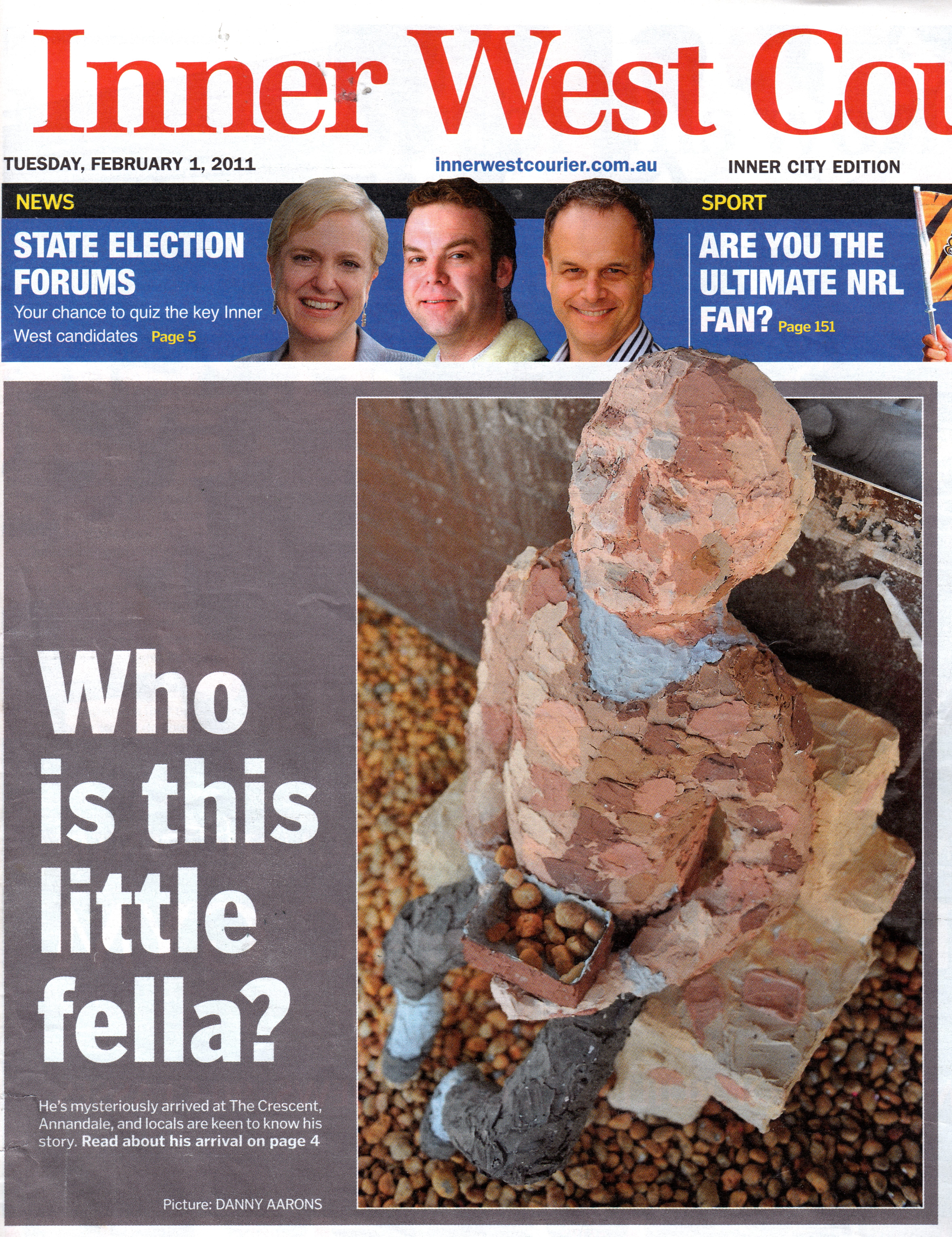
The Inner West Courier has noticed the little man:
Longtime resident David Lawrence tends to the roadside garden regularly and is mystified as to who placed the statue there.
‘It can be put down as a true Annandale mystery,’ Mr Lawrence said. ‘He seems to be collecting something, maybe it’s part of a bigger theme, who knows.
He said locals have largely welcomed the new addition, and would like to know who created the work of public art.
Well, as regular readers of this blog know, it’s an open secret. It’s nice to see it become a mystery.
Later addition: Two things have happened in the hours since I posted that.
The Art Student identified herself as the sculptor on the Inner West Courier site (over my objection that by doing so she was depriving the Inner West readers of the pleasure of a mystery).
We found a copy of the paper and discovered that the front page photo is much more impressive than the one reproduced on the web (both by Danny Aarons). Here’s part of the front page, for those unfortunate enough not to have the Inner West Courier delivered to their door.
On Wednesday I attended my first ever citizenship ceremony, in a marquee in lovely Enmore Park. After a welcome to country with dance and didj, we had mercifully brief speeches from the local state member, the state member for nearby Canterbury, the local federal member, the local Woolworths manager (who won the brevity medal), an Olympic sportswoman (who quoted bad Henry Lawson), and the Mayor of Marrickville. Then the mayor put on her new chains for the first time – ‘Just a sec,’ she said, ‘I have to get dressed up for this bit.’ The new citizens took the oath and the affirmation of allegiance (the ones with pink name tags had ‘under God’ in their formula, those with orange tags were godless) and each went up to receive a certificate and enjoy a photo op with the mayor. We stood for the national anthem, and it was all over.
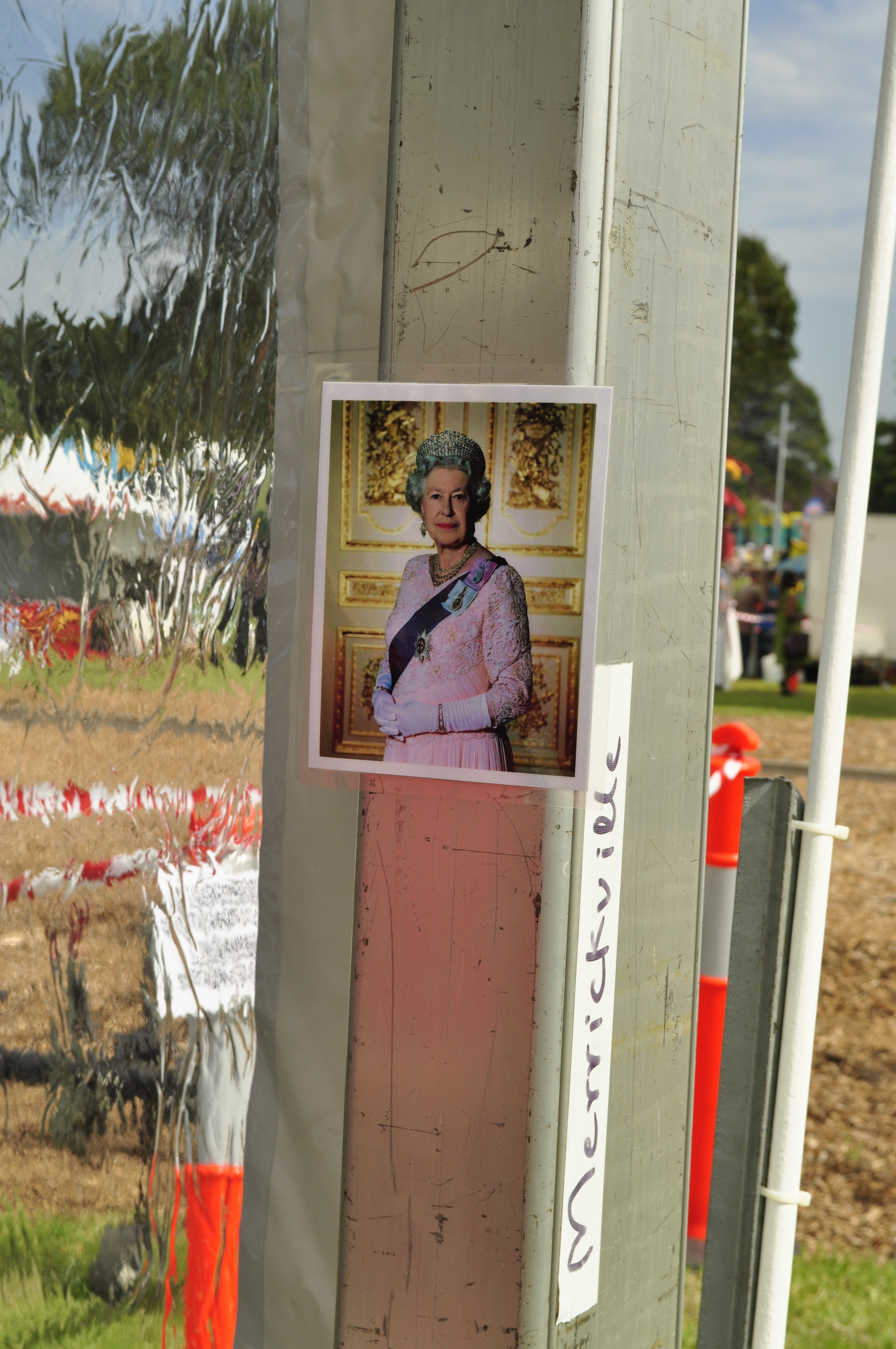
And then we found the queen. Unlike God, I don’t recall her being mentioned during the ceremony, but perhaps a photo of our head of state is compulsory for these events. because there she was, sticky-taped to one of the posts of the marquee. This photo doesn’t do justice to the image: the actual pink was much pinker than this, the gold more golden, the blue of her hair much, much bluer. It could have been Dame Edna.
A dear friend of mine was once a member of the CPA (that’s the Communist Party of Australia, not the Chartered Accountants’ thingummyjig). Years after she left the Party, a former editor of Tribune asked her what she was reading to keep up to date with politics. When she named the National Times, an eminently liberal weekly of the day, he was scathing: ‘Surely you don’t think you can get decent information from the bourgeois press!’ I thought of him as I was reading these magazines: at least part of my motivation for subscribing to them is to ensure that I have a regular injection of thinking from respectively left and non-Western perspectives, neither of which – to put it mildly – is dependably represented in the mainstream press.
So, for instance, Jeff Sparrow’s article ‘The Banality of Goodism‘ starts with a quote from Aimé Césaire on the dehumanising effect that colonisation has on the coloniser, and goes on to argue that the war in Afghanistan is actually a colonial enterprise, that colonial enterprises have always dressed themselves in the robes of what he calls ‘goodism’ (we’re in Afghanistan for the sake of the women, the peoples of Central America needed to be rescued from human sacrifice), that the Soviet invasion of Afghanistan (bad) used some of the same justifications as the US invasion (good). He also reminds us that in the week after 11/9 George W Bush visited a mosque and described Islam as a religion of peace, a gauge of how the dominant Western conservatism has degenerated in the last nine years. This kind of thing has to be good for the soul.
Similarly refreshing are a debate on population policy, a reply to Cate Kennedy’s anti-Internet rant in issue 200, a piece on Bruce Petty’s heroic cartoon-wrestling with economic subjects, an article that discusses the state of ‘flow’ (that focused state attained by craftspeople), a challenging argument against corporations’ providing breast pump ‘lactation’ rooms in lieu of maternity leave, and indeed the replacement of ‘maternity leave’ with ‘baby leave’. I may have come across any of these pieces on the net, but I would have skimmed them there. Here, I either read them with full engagement or skipped them altogether (I couldn’t bear to read Marty Hiatt’s rebuttal of Cate Kennedy, for example, because Kennedy’s piece was exactly the kind of intervention that an incipient Internet addict such as I needed: I don’t want it watered down).
A third of this issue is given over to showcasing the work of Young Writers. No ages are given, but it’s fairly evident that the four writers involved aren’t young in the sense that term would be used in the context of children’s literature. The introductory note by retiring fiction editor Kalinda Ashton and Samuel Cooney invokes Mark Davis’s Ganglands, thereby apparently implying that these ‘young writers’ are Gen Xers. Whatever! In my naivety I had assumed that magazines like Overland would publish work by Gen X and much younger writers as a matter of course, and I found myself reading these four stories with half an eye out to see what made them ‘young’, not a good frame of mind for enjoying a story. They’re all good stories, but Sam Twyford-Moore’s creepy ‘Library of Violence‘ was the only one that overcame the handicap created in my mind by the pigeonholing.
This issue of Asia Literary Review focuses on China, to the extent that all but three items are on topic. There are photo essays, travellers’ tales, expat narratives, an odd little memoir by Jan Morris, and short stories. A short essay by John Batten, ‘Cracking the Sunflower Seed’, reflects on contemporary Chinese art such as we have seen at the White Rabbit Gallery in Sydney. There’s a poem by last year’s Nobel Peace Prize winner Liu Xiao Bo, as well as ten or so other modern poems, with a useful five page orientation by Zheng Danyi. I miss a lot of what’s happening in Chinese poetry – Zheng quotes a quatrain that ‘infuriated Mao’s wife, Jiang Qing’, but all I can see is a lament for a broken stove. So Lord knows what’s happening in Liu Xiao Bo’s poem, ‘You Wait for Me with Dust’, besides surface action of a man in prison writing to his waiting wife.
The three pieces that aren’t about China are almost worth the price of admission: Marshall Moore’s short story, ‘Cambodia’, about three US siblings visiting Phnom Penh, Burlee Vang’s ‘Mrs Saichue’, set in a Hmong community in the USA, and Anjum Hasan’s piece on E M Forster’s time in India, which includes this glorious photo:
I think it’s fair to say that Asia Literary Review is more fun than Overland this issue. Overland, on the other hand, invites sharper engagement with issues closer to home.

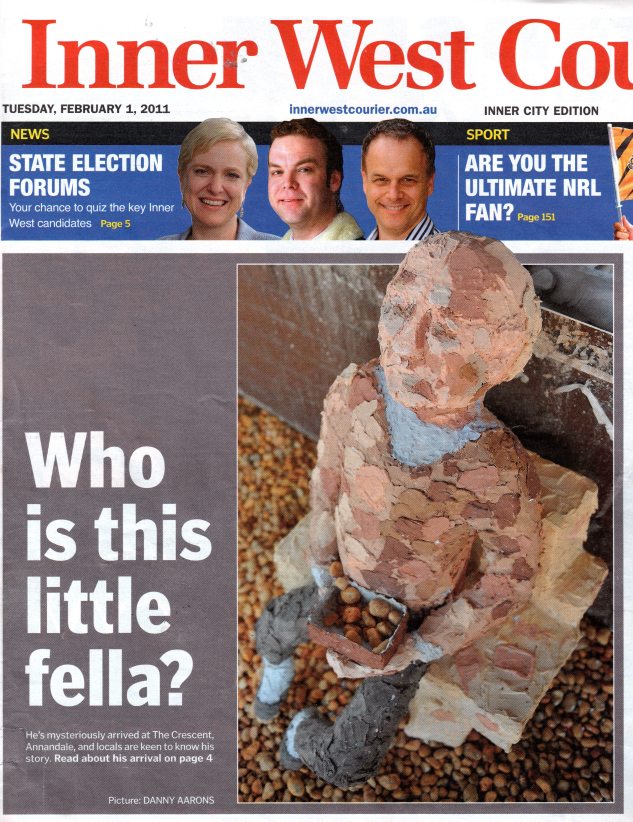 Today’s Inner West Courier has the story and photo.
![Man to starling: [This book] has been a ball and chain around my neck and I'll be happy to be done with it](https://shawjonathan.com/wp-content/uploads/2011/02/1duncan0051.jpg "1duncan005")


 Currently reading & watching


 Me fail? I fly!
