Not funny, guys! (Updated)

One of my joys in our new house has been to sit at my desk looking out onto the street and observe the reactions of passers-by to Matilda – Matilda being the Art Student’s first ever sculpture, created from copper piping, wire mesh, plaster and ceramic tiles when she was still The Consultant. It was years of work, a joy in the making and a delight to live with. Now, several times a day, I eavesdropped on conversations like, ‘It’s not a real dog, Daddy,’ or  ‘Now we’ll just say hello to Spot and then say hello again on our way back,’ or ‘No, you can’t climb in there with the doggy.’ She has become a small neighbourhood landmark.

So it was a shock this morning when the Art Student headed off to school  this morning and saw that Matilda was gone. A passerby told her she’s seen ‘the dog’ on top of the bus shelter in Enmore Park. Sure enough, there she was:
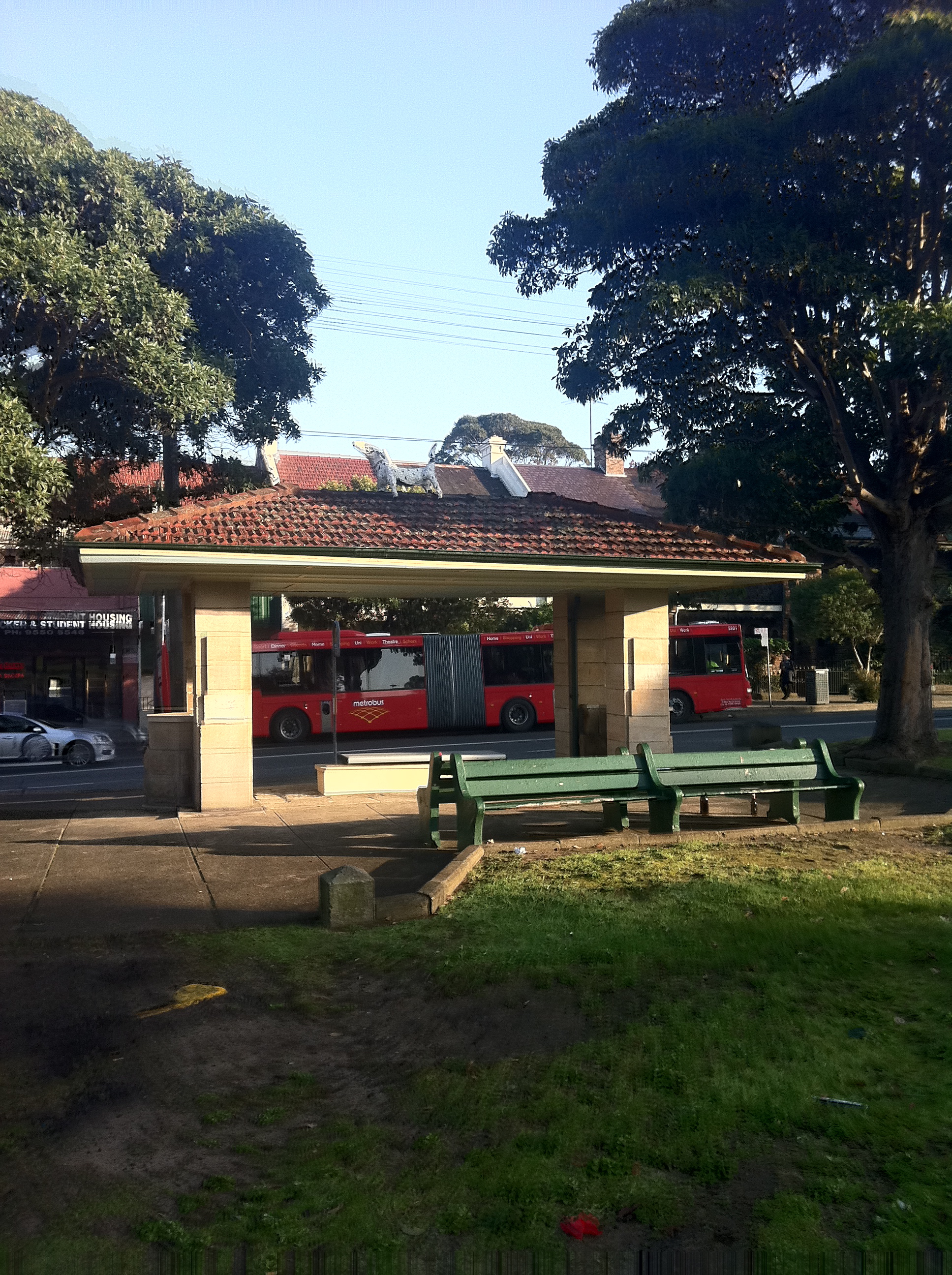
It was obviously meant to be funny. It may also have been meant as a kind of compliment: instead of lurking in the bushes in a tiny front yard, Matilda was set free to sniff the wind above the street. It took some ingenuity to get her up there – at least two men and probably a ladder. This was planned. Our neighbour who sleeps in his front room said he hadn’t heard a thing in the night. It was stealthy.

It was also callous. Matilda lost an ear and two of her legs were broken. The Art Student was distraught.

I called the Council, the police and the fire brigade. The Council gave me a number and said they’d get back to me. The police said I could ring 131444 and lodge a complaint of malicious damage (it’s not theft because they didn’t keep it), and if they decided to tie up a police officer’;s time with the incident, fingerprints might be taken. The fire brigade said they’d come out in a couple of hours. Then Peter, the guy who’s been transforming our back yard for us, arrived and said he could do it. I held the ladder while he risked life and limb to manhandle the statue back to firm ground.

She’s now safely back home. I have no idea how much of th damage can be repaired, or whether the Art Student will ever again be quite so free about putting her work in the public eye.

Added in the evening: It’s now clear that the sculpture can’t be repaired. The armature is broken in at least five places. An ear is sheared off. Even if the armature was repairable, we no longer have the tiles that made up the mosaic.

Where the dog once stood there’s now a notice:

We’re not holding our breath.


The Book Group, the Finkler Question and the SWF by night

Howard Jacobson, The Finkler Question (Bloomsbury 2010)

This won the Booker Prize last year. Howard Jacobson lectured on Dickens to at least one member of my book group at Sydney University in the 1960s. He’s a guest at this year’s Sydney Writers’ Festival and we’d decided to combine our group meeting with a visit to the festival. Even if three members of the Book Group weren’t gentiles married to Jews, this book, which is broadly speaking about gentile–Jew relationships, would have been a logical choice.

Before the group meeting:
When I’d read to about page 80 I wrote a draft blog entry explaining why I didn’t finish the book. Mainly, I found the central narrative thread, in which a gentile man obsesses over the implications of having been mugged and called a Jew, to be both flimsy and ponderous. That wouldn’t have mattered if it was funny – and after all, much has been made of the Booker going to a comic novel – but I didn’t laugh once. Too often a character is given just enough two-dimensionality to allow the writer to take a satiric pot shot at her/him. There are jokes. Our gentile hero (he’s a serial romantic, Treslove by name, get it?) is in love with a woman who confesses that she’s ‘a bit of an arsonist’, and in the morning he wakes to ‘twin realisations’:

The first was that she had left him. The second was that his sheets were on fire.

Boom-tish! or Clunk! You be the judge.

In that draft I said, with only slight exaggeration, that a two page account of a Google search was the most interesting thing in the book up to that point. I did read on, hoping only for a cute line to quote as the point where the book and I parted company.

It was not to be. The Google search – “Anti-Semitic Incidents” – foreshadows a transition to something much more interesting. The unfunny humour keeps coming, and all but one or two of the characters stay paper thin, but from about the halfway point the book begins ringing the changes in a tantalisingly complex way on themes of Jewish identity and culture, Judaism, anti-Semitism, internalised anti-Semitism, Zionism and anti-Zionism. Viewpoints multiply, transmogrify, collide, dissolve. Just as you think the book is coming to a settled view, a telling incident or a forceful argument challenges that view. It’s not just the familiar ‘two-Jews-three-opinions’ thing, though it includes that. It becomes a dramatisation of intractable complexity.

Raissa Maritain, Russian Jew turned French Catholic philosopher, wrote what could have served as an epigraph to the second half of The Finkler Question: ‘To every argument can be opposed an argument, and thus appears the futility of all argument.’ Or perhaps it wouldn’t serve, as she was talking about faith as superior to reason. Up to a point, the arguments are tested here, not against faith but against the characters’ experiences – of love, loss, betrayal, disappointment, kindness, stupidity, brutality – but the characters are so thin it’s hard to believe the testing is real.

Yet other people, including the Booker judges, have loved the book. I came away feeling that I’d somehow missed the point, much as Treslove does throughout the book.

After the group meeting:
We met at a pizzeria in the wharf precinct. Three of the seven of us came straight from Howard Jacobson at the Sydney Recital Hall. Those three and I had read the book, a third had reached page 225 and was enjoying it. All the others had a much better time with than I did. One said that like me he’d noticed page 79 as the point where things became interesting, but unlike me he’d found what came after that funny in the I’ve-got-to-read-this-to-my-wife way. Others related strongly to Treslove. When I said there was almost nothing to the character they agreed, but saw that as a brilliant depiction of a certain kind of personality: ‘There’s a little Treslove in all of us.’ Someone related strongly to the theme of men of a certain age (he said ‘our age’) looking out for each other when their wives have died. Sex scenes that I found weirdly unfunny and not much else were to other people touchingly intimate. The scenes towards the end that I read as competently introducing some much needed pathos (please note the emotional distance in that way of saying it) made St least one grown man cry.

I found myself conceding that I’d enjoyed more of the book than I’d been willing to admit. But mainly it was interesting to see that the book spoke so personally to the others who had read it. Evidently I was right – I’d somehow missed the point. And the thing is, if I were to reread the book, I expect I’d miss it again. I’m the wrong horse for that course.

Our plan had been to go to the Chaser’s Empty Vessel  show at  nine o’clock, but by the time we got to the venue it was half past, and the person in orange T-shirt told us it was sold out. Some of the others went on to the poetry reading at the Number One Wine Bar. I came home.

SWF 2011: Bombs and Poetry on Thursday

After I uploaded my sketchy report on last night’s SWF event at the Town Hall I searched for #swf2011 on Twitter and saw that everything I’d quoted had been tweeted to the universe within seconds of being uttered. Undaunted, here I am again, lumbering along with my antiquated longwindedness to bring you My Thursday at the Festival Part One: 10 till 2.

10 am: The Poetry of War with Daniel Swift and A C Grayling
Daniel Swift’s grandfather flew in planes that dropped bombs on German cities in World War Two. He failed to return from a bombing mission in 1943 when Daniel’s father was four years old. The book, Bomber County, tells of Daniel and his father visiting the grave. Daniel, by my calculations now 34, wanted this small story to open out into a bigger picture. He sought out and interviewed participants in bombing missions, and people who were in the cities bombed by his grandfather on the nights of his missions All this, plus an exploration of World War Two poetry, which anyone (else) will tell you barely exists, fed into a project of considering the bombing campaign, not to praise the heroism of the men or condemn or defend the atrocity involved, but to try to imagine – resurrect was Swift’s word – the human experience.

A C Grayling , when he’s not busy being the nice one of the current crop of aggressive British atheists, is an ethicist. His book, Among the Dead Cities, deals with the ethics of those same missions. The focus of this session was on Swift’s book, which Grayling clearly loves. They claimed to disagree on the ethical question, but I couldn’t spot any disagreement. The conversation was lovely in many ways, not least for the spectacle of an eminent professor putting his considerable intellectual heft into recommending the work of a much younger man. The air fairly crackled with respect – mutual between the speakers, from both of them to the men who flew on the mission, and during question time to the rambler and the autobiographer.

11.30 am: Antipodes: Poetic Responses
Antipodes is an anthology, edited by Margaret Bradstock, of Aboriginal and non-Aboriginal poets addressing the relationship between Aboriginal Australians and settlers – the survivors of genocide in conversation with the perpetrators, descendants and beneficiaries, as it were. The facilitator, Martin Langford, said it was the first book of its kind, and warned us that some of the sentiments, especially in the early settler poems, might be repugnant to modern readers – the book is meant to be read as whole. In order of appearance we were read to by:

Anna Kerdijk Nicholson, who read a number of poems from Possession. It was good to hear them read, though my impression was that the poet was intimidated by the context. I wouldn’t have objected if she’d explained the universally cryptic titles of her poems, but she just read and then sat down.

Lionel Fogarty: again I was very glad to hear him read, as I have a copy of his New and selected poems : munaldjali, mutuerjaraera but haven’t been able to read very much of it. Now that I’ve seen and heard him I may have a better chance. He read a semi-rap, ‘True Blue, Didjeridoo’, which he and his son wrote when Nicole Kidman was culturally insensitive enough to play a didjeridoo on television.

I don’t know the work of either Margaret Bradstock or Brenda Saunders. They both read well, but I have trouble absorbing non-narrative poetry that I’m hearing for the first time. Ali Cobby Eckermann, a little of whose work I’ve read in anthologies and journals, read us excerpts from an unpublished verse novel, Killing Fields, a massacre story. ‘You’re privileged,’ she said.

Anita Heiss read last. With her brilliant control of tone she had us laughing and devastated from moment to moment. A woman of many talents, she thanked the organiserd for calling the writing in her book I’m Not racist, But poetry. ‘It’s not really poetry,’ she said, ‘but it’s not prose because it doesn’t go to the end of the line.’

I’m not sure what this anthology is. It may be intended for schools. Not that there’s anything wrong with that of course, but it does make me hesitate to rush out and buy it for myself.

1 pm: The Poetry of Three
This was Mark Tredinnick, Kim Cheng Boey and Cate Kennedy. Mark is a nature writer, and the poems that worked best in this context dealt with the nature of a parent-child relationship. I particularly liked ‘House of Thieves’. Kim Cheng, whose work I know only from his readings last year, was again delightfully urbane. Cate’s poems are narratives, and went over like a charm. I plan to buy her book.

Probably the strongest visual image from the Festival is the huge queues, all of which today seemed to have Bob Ellis in them. The queues for poetry were all short, and at each poetry session one of the readers expressed gratitude and surprise that so many people turned up.

SWF 2011: A Good Leader is Hard to Find

The reason I am not a politician is that I want to understand.

That’s what the French political scientist Raymond Aron said when asked why he hadn’t gone into politics. The remark came to mind when I saw the number of politicians and ex-politicians in this year’s Sydney Writers’ Festival line-up. Maybe there’s room for a separate Sydney Politicians’ Festival, or a Sydney Politicians’ and Political Journalists’ Festival.

Whatever misgivings I might have had, I turned up with 1600 or so others at the Town Hall last night to hear Lenore Taylor, Bob Ellis, George Megalogenis, Bob Carr, Barrie Cassidy and Kerry O’Brien chat under the heading, ‘A Good Leader Is Hard to Find’. Kerry O’B was moderator, and the first thing he did, whether deliberately or not, was to reframe the discussion. He announced the title as ‘Good Leadership Is Hard to Find’. I breathed a tiny sigh of relief, as the shift away from the personal made it a bit less likely that we’d be treated to misogyny-flavoured wit at Julia Gillard’s expense.

The composition of the panel – four political journalists, five if you count Bob ‘Sui Generis’ Ellis, and a former politician who was also once a journalist – made it inevitable that the discussion would focus on the relationship between politicians and the media. There seemed to be consensus that we lack effective or convincing leadership in the Australian parliament, that the interplay between the politicians and the relentless 24-hour news cycle is partly to blame, and that the attention both of them pay to opinion polls adds toxin to the brew. Our leaders are so busy feeding the media beast they don’t have time to think. They’re reduced to selling a message rather than advocating a case, performing rather than communicating. Political coverage is dominated by opinion polls, leadership challenges and early election speculation, with not a lot of room forin depth analytic conversation. Gone are the days when the Prime Minister would chat with journalists at the end of a long day and explain his/her thinking about proposed legislation – when Paul Keating would say to Lenore Taylor, ‘Love, this is what you need to know. The discussion was refreshingly free of blame: the way the media works has changed, and neither the politicians nor the journalists have figured out how to deal with the new reality.

There were no revelatory insights, but it was an interesting evening. Ellis and Carr stood out as phrase-makers, Carr describing himself as an amateur historian, Ellis enacting his familiar contrarian persona. For example, Carr:

In a democracy the normal relationship between people and their elected representatives is mistrust and dissatisfaction. It’s the job of the people to be disillusioned. It’s the job of politicians to disillusion.

Ellis, when asked why the ALP doesn’t adopt what he had just described as an obvious strategy

They do research instead of thinking.

It’s not that the others lacked flair, but as working journalists perhaps they were a little more willing to let the facts get in the way of a good story. So after Bob C made his fourth or fifth remark on the theme that things may be bad but they’ve been ever thus, George M said, ‘I’ve followed many election campaigns but this was the first one where the main candidates feared the electorate.’ And when Ellis spoke of the minority government as ushering in a new era of negotiation and persuasion in parliament, Lenore challenged him: ‘And you’ve seen this happen with which piece of legislation?’

The journoes have their own unrealities. George M told us how his faith in the electorate had been restored when ‘they’ decided to choose neither side of politics at the last election, but to have a hung parliament. No one on the panel said, ‘George, you’re talking nonsense. No one made that decision. All the millions of actual deciders chose one or the other. There was no “Neither” option on the ballot paper.’

There was half an hour of questions. Only one person mistook the microphone for a soapbox.

Overland 202

Jeff Sparrow, editor, Overland 202, Autumn 2011

I have one major complaint about this issue of Overland: it won’t be read by enough people. It gets classified, correctly, as of the left, and so there’s an assumption that only people who identify as left-wing should read it. It gets marginalised, when item after item in it deserves the widest readership and engagement. Rather than saying too much, here are a couple of excerpts.

From Guy Rundle’s ‘Open-eyed conspiracy his time doth take‘, a look at the theory and practice (‘praxis’) of Julian Assange and WikiLeaks:

In Assange’s model, the failure of the anti-globalisation movement to challenge the governmental conspiracies that emerged post-September 11 resulted from the very dispersal that they celebrated […] WikiLeaks, in that respect, represents a dialectical development: recognition that a counter-conspiracy,  to  be effective, must decisively reject openness  in favour of an ultra-conspiracy. […]
WikiLeaks’ massive category-shifting leaking is not intended to dissolve governance but to uncouple governance and conspiracy, to make it impossible for governments to fall back on conspiracy as a mode of action.

From Rjurik Davidson ‘s ‘Imagining New Worlds‘ on ‘New Wave’ science fiction of the 1960s and after:

The New Wave [demonstrates] that approaching culture politically (in the broad sense of the term) does not necessarily result in the production of dour and didactic texts. On the contrary, political interventions underpin many of the greatest formal
 revolutions, the most experimental and original work.

From Bob Gosford’s ‘They took our culture – now there is no law‘, one of three pieces on the Northern Territory under the Intervention:

[A] Northern Territory judge who in 2009 considered the effect of the changes to the Emergency Response Act 2007 noted that: ‘the precise mischief that [the section] is intended to remedy is unclear’. He went on to argue that because the legislation precluded consideration of a range of previously acceptable and relevant issues, it ‘distorts [the] well established sentencing principle of proportionality, and may result in … disproportionate sentences’.

From Alexis Wright’s ‘Talking About Tomorrow‘, an open letter to Bob Brown and Rachel Stewart:

I cannot believe that the Intervention can be  justified  when   families  are  leaving their
traditional lands – the lands where they have lived and that they have taken care of for tens of thousands of years – unable to endure the heaviness of government controls over their lives. They are becoming the new gypsies, vilified by residents of Australian towns and cities opposed to having them as neighbours.

She goes on to argue that ‘the only way forward is through treaty-making with individual nations and regions in northern Australia. in particular in the Northern Territory ‘.

From Patricia Gillespie’s ‘[In]Dignity‘, which is largely a graphic account of her elderly mother’s experience with the health system:

From a medical perspective, the treatment for her congestive heart failure – the reason for her admission to hospital – was a success. She was no longer ‘dying’ or ‘drowning’ in fluid. But Marie inherited […] problems such as vitamin deficiencies, suicide ideation, muscular weakness and mobility issues, chronic rash, a bleeding tongue, bedsores and ulcers, which made a mockery of the notion ‘do no harm’.

There are eight wonderful pages of images and pensées from Sean Tan. There’s poetry, including K A Nelson’s ‘Chorus of Crows‘ (winner of the 2010 Overland Judith Wright Poetry Prize, and another angle on the NT Intervention) and  Jennifer Compton’s sweet celebration of the quotidian, ‘I Came Home with the Shopping‘.

Almost teh whole lot is up on line. Have a look.

Gallery

NSWPLA Dinner, a report from the trenchers

Last year a woman premier presented the NSW Premier’s Literary Awards at the Art Gallery. Tonight a non-Labor premier, just as rare a beast in the 10 of these dinners I’ve been to, did it at the Opera Point Marquee, … Continue reading →

A launch

Ursula Dubosarsky’s new book, The Golden Day, was launched yesterday with a suitable sense of occasion. I’d spent the morning as an extra in a rap video clip (about which I may blog some other time), but no one at the launch seemed to notice that my usually shiny forehead was sporting a light dusting of make-up.

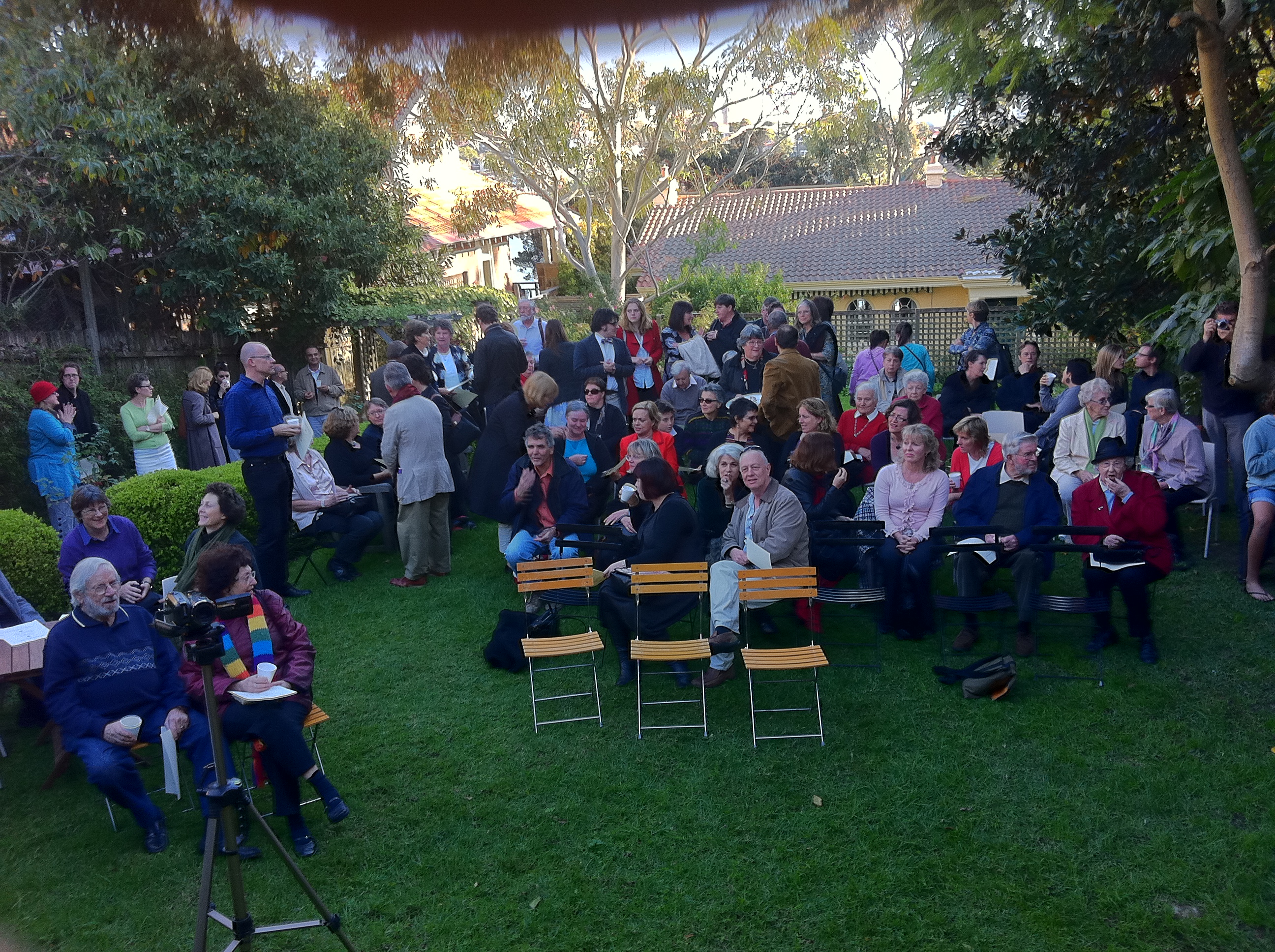
We were at Nutcote Cottage, home of May Gibbs, a lovely site for a launch. The golden light of a fine Sydney autumn afternoon, tiny muffins, cupcakes and Lamington slices would have made the mood celebratory even without a subject. As you see from the pic a new Dubosarsky book draws quite a crowd: from the publishing world, family, writers (not just for children), artists and illustrators, colleagues, Marrickville dwellers, the wife of a former Federal Minister, former students of SCEGGS Darlinghurst and even some of the book’s target audience, that is to say, children.

The Nutcote lawn

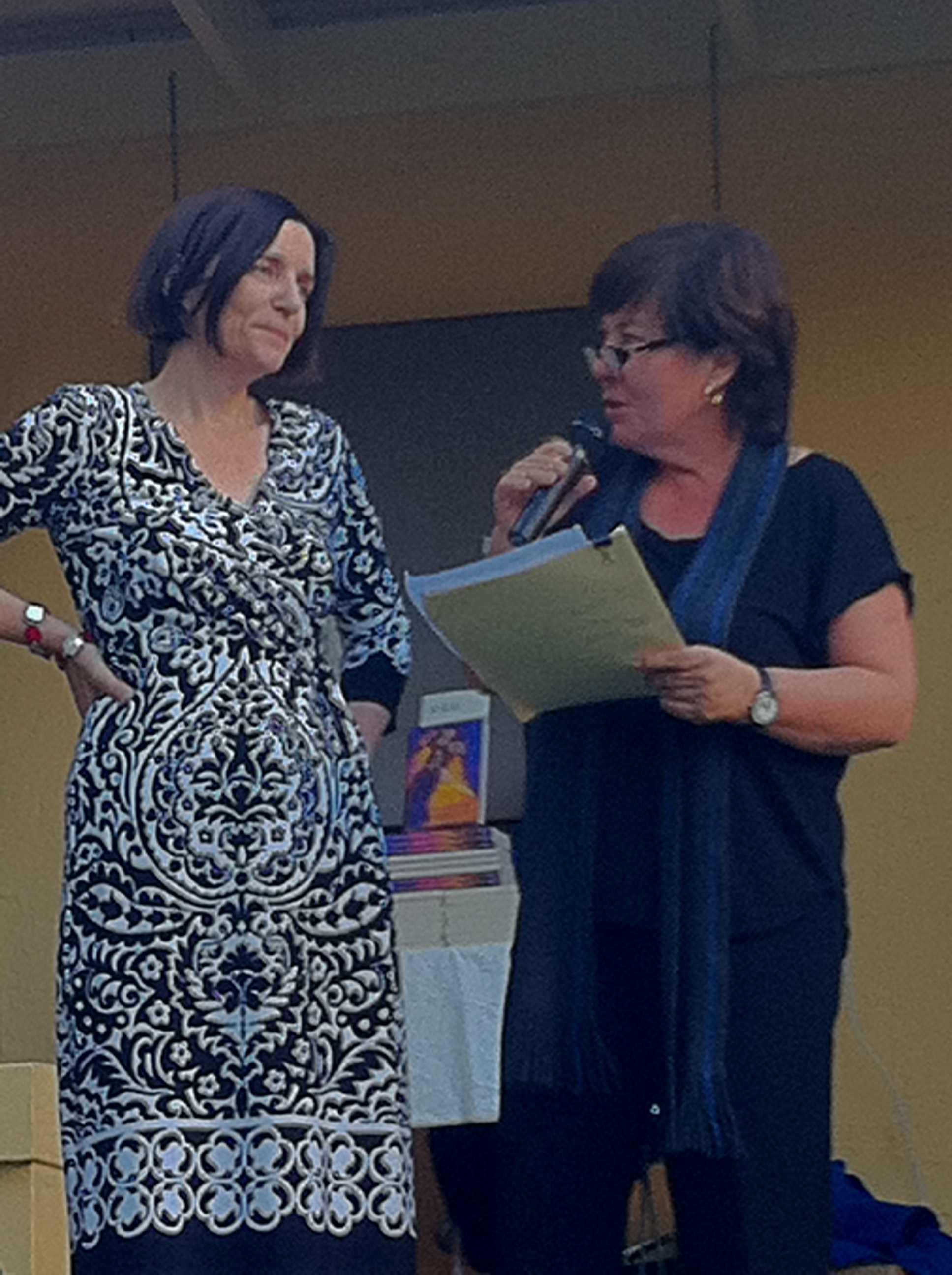
Julie McCrossin presided. Drawing on her experience as radio interviewer and stand-up comedian, she put Ursula through her paces, quizzing her about her inspiration for the book. It’s set in a genteel girls church school in the inner eastern suburbs of Sydney, a school that evidently bears an uncanny resemblance to SCEGGS Darlinghurst, of which both Julie and Ursula are alumnae. Calling on contributions from other Old Girls, they evoked a startling picture of uniformed schoolgirls making their way from the bus stop to the school gates though filthy streets where junkies and prostitutes hung out. One member of the class of ’78 was coaxed by Julie into saying that she didn’t remember much out of the ordinary, apart from an occasional flasher and the naked woman who appeared in a doorway one morning asking her to get help.

‘There are myriad kinds of writers,’ Ursula said, responding to Julie’s pressing her for the meaning of some of the incidents in the book. ‘I’m the kind of writer who lets herself go to the dream.’ I quote this because it rings so very true of Ursula’s work, but also because just a few moments later Julie referred to the ‘ ‘myriad of influences’ she detected in the book (Picnic at Hanging Rock, classical myth, etc), thereby adding a little fuel to the fire of a conversation I’ve been having recently about usage: Ursula the classicist uses ‘myriad’ as I do; Julie the journalist agrees with my journalist friend. (Are you reading this, L–?)

Julie: Might I suggest that there's an underlying theme of sexual awakening? Ursula: Oh, that's what my book's about!

Michael Moore on the killing of OBL

Michael Moore may get a bit too smart-arsey in his movies, but this piece on the killing of Osama Bin Laden is worth reading.

Perhaps there was no way to bring him back alive – I sure as hell wouldn’t want to be in that dark house trying to make that snap decision. But if the execution was ordered in advance, then I say we should be told that now, and we can like it or not like it.

I recommend the whole thing.

Pretty as a picture

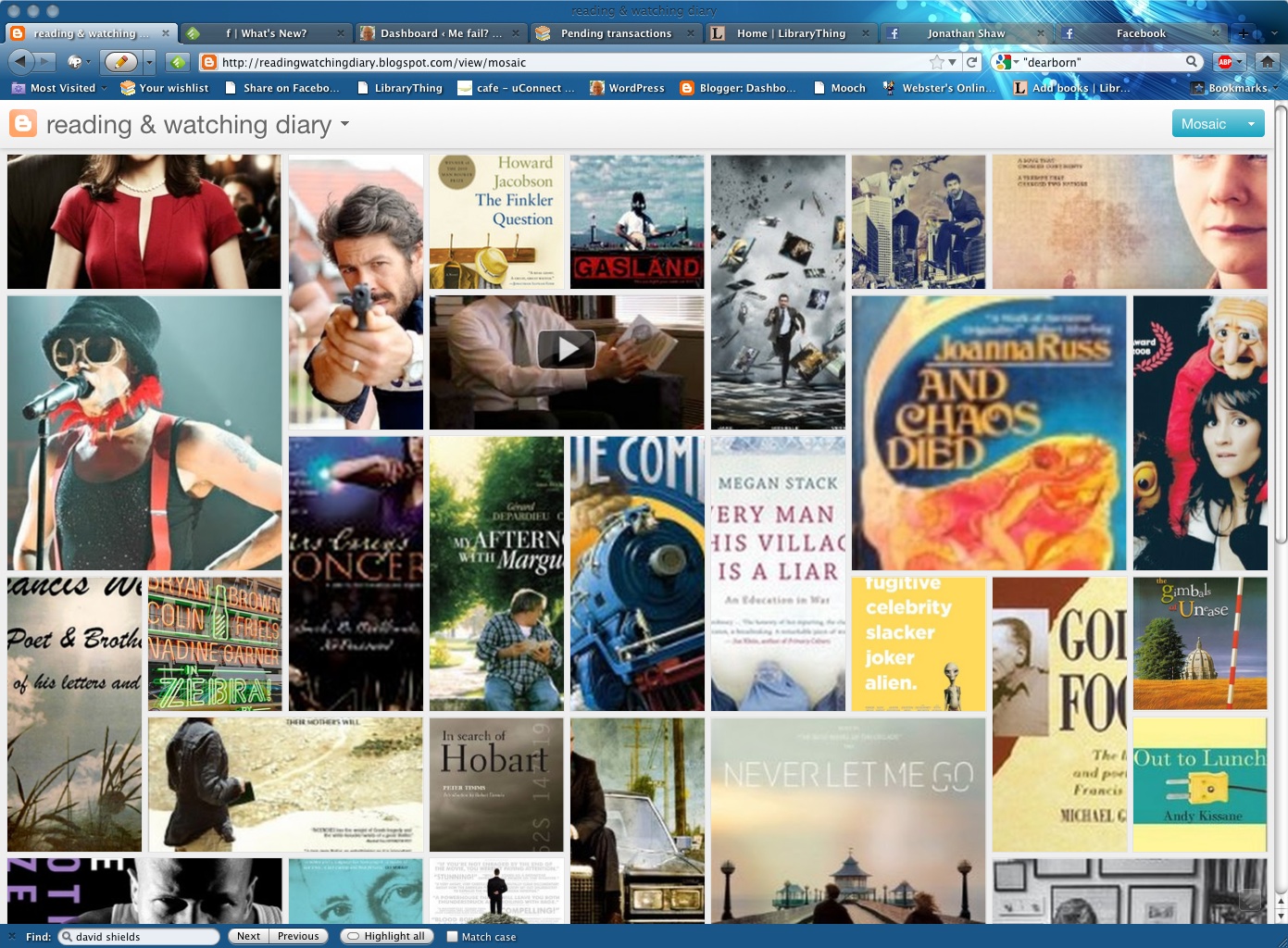
I love the way Blogger can display its blog in a number of ‘views’. In particular, I love the Mosaic view of my ‘Reading and Watching Diary’ blog, which exists mainly so I can have that list of books, movies and so on over in the right hand column of this blog.

Rhyll McMaster at Sappho’s

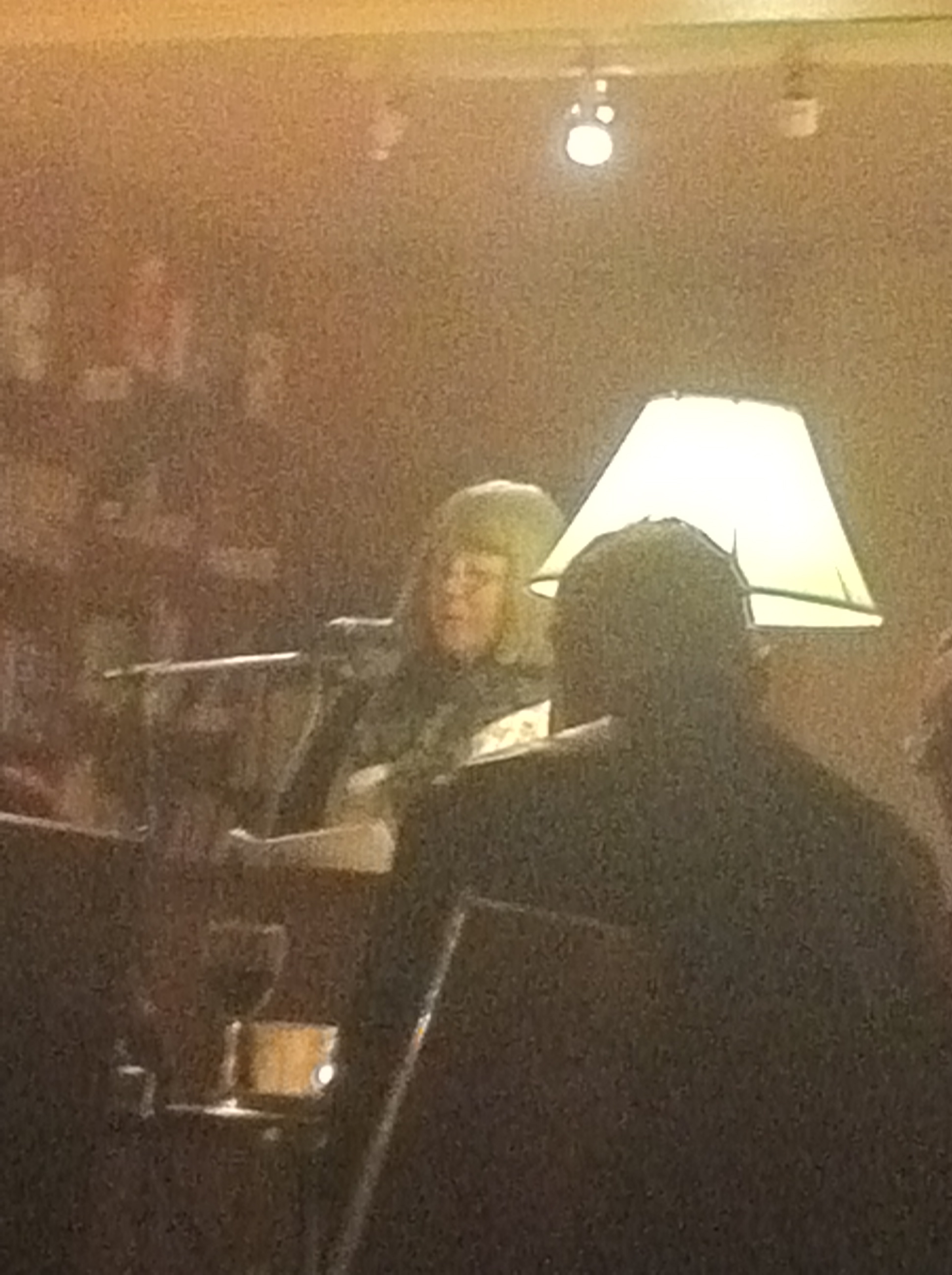
Next door to Gleebooks, Sappho’s Book Shop stages monthly poetry readings. Last night Rhyll McMaster read from her next book – she’s writing poetry again after years engaged one way or another with the novel Feather Man.

No one was smoking in Sappho’s courtyard, but I like the way this phone photo suggests the classic smoke-filled ambience for poetry reading.