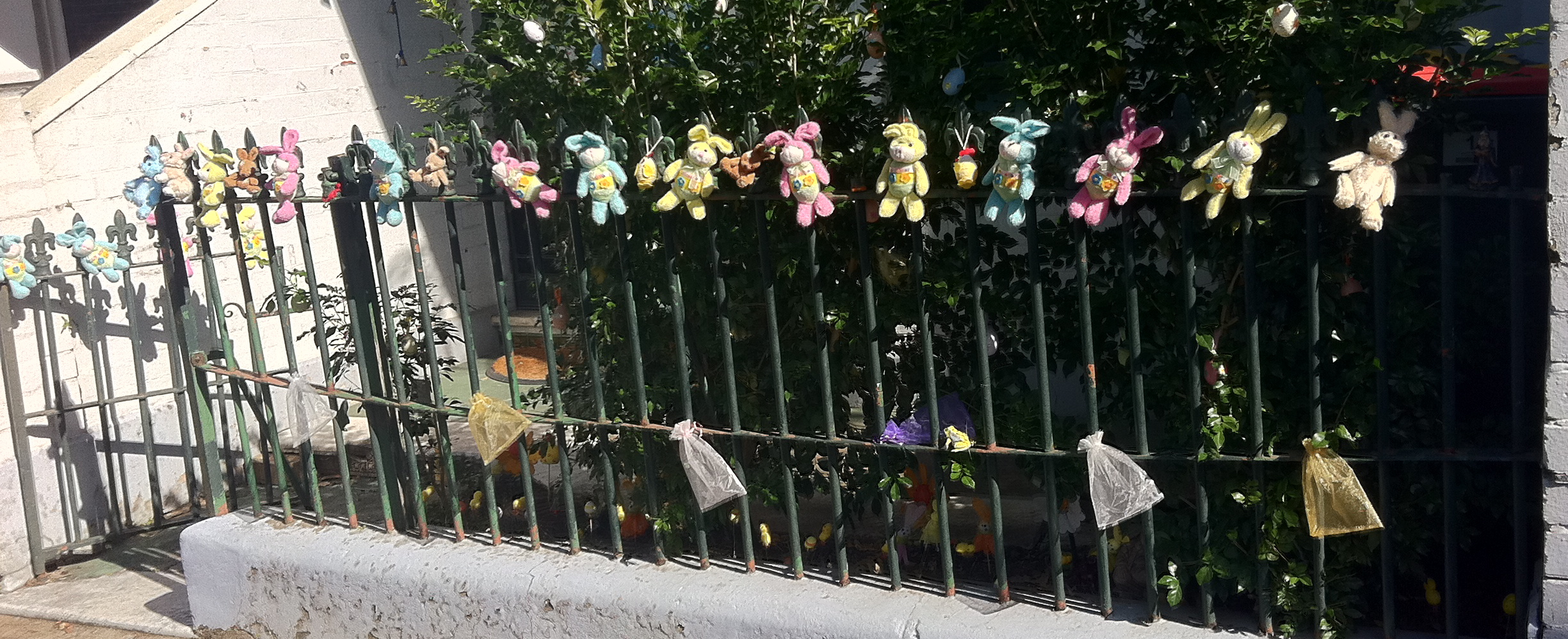
… although maybe these all got impaled when they tried to get into the property at Easter

… although maybe these all got impaled when they tried to get into the property at Easter
Joanna Russ, And Chaos Died (1970,Berkley Books 2009 )
 Joanna Russ died on 29 April. This book has been beside my bed for a while now and I decided to read it as my small personal obsequies. It might have been better to reread The Female Man or read How to Suppress Women’s Writing for the first time, these being the books usually seen as marking her place in the history of Science Fiction, but I don’t have copies of either of them. The New York Times obituary doesn’t mention And Chaos Died, which was first published five and 13 years respectively before those books.
A lot of the time it’s hard to tell what’s going on in this book, though it does become slightly less bewildering after the first 20-page section. The main reason for the bewilderment is that the main character, Jai Vedh, having crash-landed on an alien planet, encounters people there who communicate mentally, reading each other’s feelings and thoughts but also perceiving the world at a molecular level and communing with plants (a wise daisy plays a crucial role) and even inanimate objects. When they communicate with ‘visuals’, their words are oddly elliptical, responding to things the others aren’t quite aware they’ve even thought or felt, let alone expressed, and drawing on the others’ vocabularies (‘I’m not used to talking this at all,’ is one of the first sentences he hears spoken). Nothing is explained; the reader, if anything, understands even less than Jai Vedh.
Jai Vedh identifies as homosexual in the early pages, but he becomes sexually and psychically involved with a woman of the planet and soon is telepathing and teleporting with the best of them. He’s captured and taken back to ‘Old Earth’, a late 60s nightmare of overpopulation, pollution, corrupt authoritarian government, and psychedelic licentiousness, where he escapes death many times, befriends a boy who tries to kill him, and so on. Through all this he uses his mental skills without ever gaining complete control of them, so that he often isn’t at all sure whose thoughts and feelings he’s experiencing and has trouble seeing what’s physically in front of his eyes because other aspects of reality, whether microscopic or purely psychic, are claiming his attention – and the prose takes us along with him. It’s hard to pick a representative passage, because the writing keeps changing with Jai Vedh’s level of competence and the mind/mood-altering agents he encounters. But this might give some idea – he’s collapsed into an exhausted sleep on a California beach, and this is his waking up:
He thought he had been taken inside by someone. They were going to fight over his body. He was on the floor or on the sand, sprawled asleep part of a ritual like a piece of wood, the thought: hold him, hold him, hold him, and somebody holding his head and saying (over and over) ‘Sleep, torn man, sleep. Yang only. Sleep, torn man, sleep. Yin only.’ The lights passed over his closed eyes with exaggerated slowness, vanishing off his chin: purple, green, blue, red, yellow, white, with pictures, too, a very old-fashioned and silly piece of stuff. Last year’s. He was lying in a woman’s lap, in some sort of barn with a lot of smoke around and people shuffling. Jingle-bonk. And could not open his eyes. Jingle-jingle-bonk. Foolishness. It occurred to him that he must have been drugged, for the naked woman whose lap he was in had as much mind or as much sex as a puppet, though he could smell her strongly. That is, she had been drugged. (I’ve been drugged!) Although he did not think that he usually thought that way. … There was a small, irritated, hopping-mad part of her mind, too, somewhere; he noted that with interest. He guessed it was the smoke and began to fend it away from him – big, bumbling molecules, as complicated as antique steamships – to let through the little, keen, live ones.
According to Samuel Delaney, The Female Man was written partly as a critique of this novel. You can download the whole book as a PDF.
The Art Student doesn’t blog, except by remote control, as in saying to me, ‘You should write on your blog about…’ This is one of those posts.
In the last week, in spite of my otherwise debilitating head cold, we’ve been to five cultural outings. This is a brief review of the audiences. (Distances in brackets are from our house to the theatre.)
1. The Drama Theatre of the Opera House: Nina Conti’s Talk to the Hand (7.9 km)
We got a pretty good look at the front row of this youngish, well-heeled crowd, as Nina and her monkey held them up to ridicule one after another. The foul-mouthed monkey made a series of outrageous remarks, shocking sweet, well-bred Nina. ‘Are you married to her?’ the monkey asked one man, indicating the woman next to him. ‘Sometimes,’ the man said, which I think you’ll agree is a pretty good response. ‘What do you mean, sometimes?’ Nina asked. ‘Well, at other times she’s [insert your own misogynist end to sentence].’ Even the monkey was taken aback, and moved on quickly. The joke was in danger of failing as the audience promised to be even more obnoxious than the monkey. The same man called out further insults about his wife later in the evening. Of course, it would be wrong to tar the whole audience with his brush, but whenever Ms Conti or one of her dummies called for suggestions, the replies were mostly sex- or bum-themed. The show was fabulous, but the audience had a significantly vocal leavening of misogyny and middle-class yobbery.
2. Gleebooks: Gerard Windsor and Giulia Giuffrè in conversation about the latter’s book, Primavera (3.7 km)
The smallest, most serious and most mature of the five audiences. When we arrived, the two performers were mingling with the audience-to-be. Someone asked me, ‘How do you fit in?’ and told me Giulia had commented with pleasure when she saw some strangers arrive. (I probably count as a stranger: I met Giulia a couple of times in the early 70s, but she didn’t remember me.) Someone from Gleebooks introduced the event in 10 seconds flat (‘perfunctory’ doesn’t begin to cover it), leaving Gerry to say who he was. This only deepened the sense that we were at an intimate gathering – friends, family (Giulia’s 20-something daughter was there, and spoke briefly), colleagues.
3. Seymour Centre: iOTA’s Smoke & Mirrors (3 km)
In many respects similar to the Nina Conti audience, this crowd were hip rather than heeled. An older woman in the front row opposite us kept her face fixed in a scowl the whole time except for one brief smile. She applauded politely at the end of most items, and winced when the stage lights fell on her, as they did often. But the great bulk of the audience applauded enthusiastically not only the songs, acrobatics and magic tricks, but also iOTA’s sexually ambiguous clown-crying-on-the-outside musical performance. When the lyrics got, as they say, explicit, the crowd was unfazed, but when a decorous striptease ended with the unveiling of the stripper’s beard there was no noisy clamour for more intimate exposure. This audience, with nothing to prove, seemed happy to be entertained and challenged.
4. Dendy Cinema Newtown: special advance screening of Sunshine and Oranges (1.6 km)
This was a 6.30 screening for Club Dendy members, of a movie about Margaret Humphries exposing the secretive deportation of 130 000 children from the UK to Australia. There was a lot of silver hair in this packed house and, at least near us, a smattering of English accents. The Art Student thought there was a preponderance of women, not young, but not yet of a certain age, who could have been social workers. I was struck by the number of phone screens that stayed lit up until the last possible moment, by which I mean several seconds after the film began.
5. The Factory: Fear of a Brown Planet Attacks (.7 km)
Another packed house. My guess is that the vast majority of the audience were young Muslim Indians or Pakistanis.Here we were definitely in the minority, as white people and also as people over 40. There were plenty of hijabs and other headscarfs, but I didn’t see any older women in saris or salwar kameez. Aamer Rahman’s performance of a Bollywood song in (I’m guessing) Hindi provoked a lot of recognising laughter. And when Nazeem Hussain, the other half of Fear of a Brown Planet, did a caustic impersonation of a white Australian calling him ‘Zeemo’, ‘Nazzer’ and so on, he had the audience right there with him. Racism was mocked. A child ran about noisily at the back of the large auditorium for most of the show’s second half, and no one got into a state about it. Perhaps the White People were a little more subdued than usual as we left, but my impression is we were among people who not only had been entertained but also had had significant issues named out loud.
All but the first of the events happened within walking distance of our house. It’s as if we live at the junction of different worlds. Ah, city life!
Megan Stack, Every Man in This Village is a Liar: An Education in War (Scribe 2010)
 Megan Stack was a 25 year old US journalist on assignment in Paris on 11 September 2001. She was sent to Afghanistan after the US invaded, and over the next years she reported for the Los Angeles Times on war and upheaval in Afghanistan, Israel, Iraq and half a dozen other Middle Eastern countries. She’s no slouch as a journalist, as her bio demonstrates. She’s won prizes, been shortlisted for the Pulitzer and is now LA Times bureau chief in Moscow. If you’re looking for a brief, accessible introduction to the 21st century Middle East (at least as it was before the events beginning with the Egyptian Spring) this book probably fits the bill as well as anything. And I suspect we all need regular introductions and re-introductions like this, because of the phenomenon Stack describes in her Prologue:
As Americans we have the gift of detaching ourselves and drifting on; it has saved us over and over again from getting mired in guilt or stuck in the past. Sometimes we are too good at it. Here in the same generation, the wars happening over there, elsewhere, already have the irreality of a dream. […] But the wars are still happening, and they have been happening all along. People died. Promises were broken. Things were destroyed. And as Americans these actions belong to us.
Detachment and moving on are even more rife in Australia. ‘Over there, elsewhere’ is even further away for us. And we can tell ourselves that we’re only bit players after all.
The book is animated by a passionate concern to break through that detachment. It’s a series of personal essays, more personal and more ambitious than a collection of journalistic pieces. Again and again she brings us the reality of war on the ground: not the prurient suspense of The Hurt Locker, the heroics of embedded journalists, or the ever so slightly smug satire of, say, Wag the Dog, but the purple corpse of a baby found in a bombed house in Lebanon, an Iraqi boy shot by US soldiers on his way to the corner shop, US expatriate women living in luxury and fear behind high walls in Saudi Arabia, the appalling realisation that two university students have disappeared after being seen talking to her, the hardening of an Ammanese interpreter friend against the US when she learns about Abu Ghraib.
This book, in other words, has shit on its shoes and, to push the metaphor, blood on its boots. It stands as a formidable challenge toawful lot of coverage of the Middle East – things like spin about spreading democracy and freedom, ‘balanced’ reporting of the bombing of civilian populations, or cant about collateral damage and rebel strongholds. As just one example, the other day a former CIA operative said on the radio that George W Bush’s one chance to capture Osama Bin Laden, at Tora Bora in December 2001, failed because he entrusted the task to two Afghans who had fought alongside Bin Laden against the Soviets, who were therefore ‘going to be a day late and a dollar short’. Well, maybe. Megan Stack was near Tora Bora at the time, and spoke to both the Afghani warlords involved: she doesn’t claim to know what happened, but she saw how upset they both were at Bin Laden’s escape and heard their frustration at the US military’s handling of the situation. On the evidence the CIA man’s version is conveniently self-exonerating.
The book has one major flaw which I think comes from Stack’s having to work against her training as impersonal, objective reporter. To tell this story, she needs to be present as a character in the story, to convey the emotional reality of what she witnesses, and the emotional reality of being a witness. To do this, she seems to have felt the need to write in a literary mode, and hardly a page goes by without a strained simile, an adjective that’s working too hard or a dubious epigram. ‘Zaman came out, tall and deliberate, his face sagging from his skull.’ ‘Violence is a reprint of itself, an endless copy.’ ‘The sun had teeth and a hard glare; every blade of grass glowed like a stalk of ice.’ Even the book’s title is an example: it’s meant to evoke the difficulty of determining the truth in a war zone, but it refers to a famous logical puzzle, and sends the reader down a trail of irrelevant associations. In the Epilogue she writes, ‘By now I have given up on pulling poetry out of war.’ If only a great bully of an editor had persuaded her to give it up before the book got into print, this very good, useful book might have been a great one.
Stephen Sondheim, Finishing the Hat: Collected Lyrics (1954-1981), with Attendant Comments, Principles, Heresies, Grudges, Whines, and Anecdotes (Virgin Publishing 2010)
 This was a birthday present from the Art Student. We’ve both been Sondheim fans since seeing the fabulous Sydney Theatre Company production of his collaboration with James Lapine, Into the Woods, in 1993. It’s not that I’ve been dying to pore over his lyrics, as I once did (and still occasionally do) over Bob Dylan’s, but the book’s subtitle promises much more than a set of songs drained of their music. And so it transpired: lyrics of songs you’ve never heard or recall only vaguely don’t make riveting reading, but a master craftsman’s unsparing reflections on his work, and that of his colleagues, collaborators, mentors and rivals is another story.
The comments of the subtitle turn out to be illuminating notes on the writing of particular songs and brief accounts the development of thirteen musicals – from Saturday Night in 1954 (not actually produced until 1999) to Merrily We Roll Along in 1981 (to be reshaped into a success for a James Lapine production in 1985). There are three principles: Content Dictates Form, Less Is More, and God Is in the Details, all in the service of Clarity. The heresies, grudges, whines etc, range from classic showbiz anecdotes (Hermione Gingold’s audition for A Little Night Music is my favourite, closely followed by Ingmar Bergman’s praise of her performance) to mini-essays on a score of eminent writers for musical theatre. There’s a list of the cardinal sins of lyric writing, a spirited advocacy of full rhyme, and any number of fascinating insights into the elation, heartbreak and drudgery of working on Broadway.
Approaching 80 when he wrote the book, Sondheim doesn’t mince words. You don’t have to agree with his evaluation of Noel Coward as the master of condescending blather or Lorenz Hart as gifted but lazy to relish his straight talk. Mostly, his frankness remains respectful: he may ‘cringe at the bloodless quaintness of the ballads’ of Gilbert and Sullivan and be baffled when he hears an audience laugh at one of their songs, but he acknowledges their importance in the history of musical theatre, and allows that his failure to enjoy them may reflect a lack in himself. On the subject of ignorant, lazy or arrogant reviewers and critics, though, he gives no quarter. In particular, he writes scathingly about the first production of Burt Shevelove’s The Frogs by academic George Brustein, who is portrayed as arrogant, self-serving, disingenuous and incompetent. (Brustein, incidentally, didn’t do himself any favours by writing an unconvincing alternative account of that production, though he did at least score a point by saying that while revenge may be a dish best served cold, Sondheim, who waited more than 30 years to tell his story, seems to prefer it frozen.)
This, along with the companion volume due out later this year, Look, I Made a Hat, is probably as close to an autobiography as Sondheim will give us. Although there’s almost nothing of his non-professional life, something of a pictorial biography emerges from the charming personal photos scattered among the images of manuscript pages, playbills, rehearsals and productions – beginning with him, aged about 5, serious at the piano in a school rehearsal, and ending with him grey-bearded and beaming at a theatre entrance.
The book ends on a cliffhanger. The Broadway premiere of Merrily We Roll Along was a flop, closing after 16 performances. Sondheim writes:
It was a show I adored and a deep disappointment in its first outing, and it marked an important period in my professional life.
But then I met James Lapine.
INTERMISSION
Posted in Books
Tagged Ingmar Bergman, James Lapine, Stephen Sondheim, Sydney Theatre Company, theatre
We headed off before dinner last night to another well attended Sydney Ideas talk in the new Law School building: Dr Amina Wadud on ‘Spirited Voices of Muslim Women in Islamic Reform Movements’.
We hadn’t read the fine print on the web site, and didn’t realise that the talk was part of a symposium, ‘Spirited Voices from the Muslim World: Islam, Democracy and Gender Rights’, or that the talk was preceded by a performance by the University of Sydney Gamelan Orchestra. So we were pleasantly surprised to arrive at a very full auditorium that sounded like a Balinese night. Marie Bashir, the Governor of NSW, who is also the Chancellor of the University and acting Governor General, launched the Symposium before Dr Wadud took the lectern. The last time I saw her launch anything it was a book published by South Sydney Youth Services, and she brought the same respectful gravitas to that room full of pierced and tattooed young people as to this gathering of distinguished academics.
Amina Wahud is at the forefront of the ‘gender jihad’ – the struggle for gender justice within the global Islamic community. Actually, I just re-read the blurb about her on Sydney Ideas website, and realised that it gives a very adequate summary of the talk:
Dr Wadud’s writings and vision for gender equality, within an Islamic ‘tawhidic paradigm’, incorporate the wider struggle against other forms of oppression such as racism, bigotry, religious intolerance, economic exploitation and the erasure of human dignity.
She described how at the World Conference on Women in Beijing in 1995 the Muslim women met with the aim of coming up with a joint statement, but no agreement could be reached between those who talked in terms of a human rights agenda and those who talked in terms of Islam. She went away from that meeting determined to find a way of reconciling the two, of finding, as she said, epistemological, theological, and other kinds of logical grounds for a Muslim feminism. Like Professor Muhammad Abdel Hameen on the Book Show recently, she has a thoughtful, non-literalistic approach to the Qur’an and pretty much scorns the approach that would take isolated verses as prescriptions for living. She takes the concept of ‘tahwid’, which is literally the notion that God is One, central to Islam, and argues from it that all humans are equal because each has a direct relationship to God the Transcendental.
I’m not at all engaged in Islamic theology, but it was a joy to hear this flexible alternative to the version of Islam that dominates the airwaves. Dr Wadud began her talk with an invocation of God in Arabic, and when she mentioned the Prophet she said something in Arabic, presumably the traditional ‘Upon him be peace and blessings’. It seems to me that to wage a feminist struggle from inside Islam in this way must be more fruitful in the long run than any number of feminist denunciations of Islam.
There were other, smaller joys. Dr Wadud, who was born in Maryland, USA, wore a shalwar kameez with an elaborate scarf tied over her hair, and a loose scarf over that. For the first quarter hour of the talk, this loose scarf kept trying to fall off. As we strove to follow her explanation of the background to her theoretical work, she had a struggle of her own, repeatedly hitching the back over her head. In the end, the scarf won. The other small joy only made itself known in the Q&A: Dr Wadud explained that some of her points would have been clearer if she had used her PowerPoint version of the talk, but she has moved to an iPad and wasn’t able to connect it to a projector. The joy: we had a person talking to us, instead of to a bunch of explanatory slides.
Rosemary Wells, On the Blue Comet (Candlewick 2010)
 This book is a beautiful object. Nicely proportioned, with just the right heft to appeal to its intended readers, ten- or eleven-year-old boys, it has a number of gorgeous full page illustrations by Bagram Ibatoulline, but gorgeous in a boy-friendly way – lots of model trains, and a threatening gun or two. The illustrations remind me of my infatuation with my parents’ illustrated Last of the Mohicans when I was 10 or so – all that’s missing is the interleaved tissue paper.
Rosemary Wells was responsible for an extraordinary number of small picture books that gave delight to my family when the young were small. ‘You’re cruisin’ for a bruisin’,’ the eponymous hamster heroine’s threat to the eponymous hamster hero in Benjamin and Tulip, was often quoted in our house, and the domestic struggles between stubborn Max and his bossy big sister Ruby never grew old.
Many young readers will be engrossed and delighted by the plot of On the Blue Comet, which features not only model trains, and real ones, but also a mysterious Chinese hypnotic device, time travel, almost-plausible nerdy science, armed bank robbers, an idealised father, and a gratifying number of twists on the way to an expected conclusion. But it’s not one of those children’s books, like the best of Max and Ruby, that adults can enjoy in the absence of a hypothetical child reader. Some of the plot mechanics creak, and there are occasional inconsistencies. My experience is that those things don’t matter if I’m engrossed in a book, so something else may have been going on. Perhaps I was a little alienated by the Americana aspects: US cities, iconic US trains, US Presidents, famous US tycoons, US movie personalities, all appear or are lovingly named with an almost liturgical effect, and the book feels at times as if its emotional driver is love of 1930s USA, or perhaps even an agenda to awaken such a love in the reader. Not a jingoistic love by any means, but definitely an insider’s love. I enjoyed it, as an undemanding read when I’ve been struck down by a head-clogging lurgie, but I feel as if Rosemary Wells and I live in different parishes.
Last night half a dozen of us had dinner at Wafu to celebrate a sixtieth birthday. Wafu is an establishment with policy. Evidently, Yukako – the owner, chef and entire wait staff – found that as her restaurant became popular some years ago she was appalled to realise she was becoming part of the great system of waste that prevails in the West. She decided to lay out some requirements. The restaurant is now open only to members and their guests, and there’s a sign near the front door asking visitors NOT to enquire how to become members. The Art Student (who insists that one newspaper article doesn’t mean she has to give up that title) and I, guests of a member, arrived before the rest of our group. Yukako welcomed us and gave us a sheet outlining the policies. Here they are, from the website:
To contribute towards creating a sustainable future we request a little more of our guests than most other restaurants. Please bear in mind the following points.
DO NOT WASTE FOOD
“Please imagine people who live on the other side of the earth – every 6 seconds, one child under the age of 5 dies because they have no food”
Be mindful of the amount of food you order – try to order just the right amount, in harmony with your appetite. When eating with company, please consider sharing meals, family-style, as you would at home. We request that any dishes ordered be finished, as far as possible.DO NOT WASTE CONTAINERS
“Please imagine wild animals”
If purchasing takeaway meals, please remember to bring your own containers. Sturdy, long-lived containers are the best. Failure to do so will result in a surcharge, and possible refusal of service.
We advocate respect for food, waste prevention and doing what is best for the environment. Help us to do what we can to shape our future!“Please re-think”we can do more preventative things before resorting to the 3Rs
(Reuse, reduce & recycle)Eat-in Policy
First, read our policies and mission statement on our front door or on our website. If you agree to our terms (namely, not wasting food and sharing meals as if you would at home) we will gladly welcome you to Wafu.
Please note that vegetables and salad on the side are NOT decorations; they are part of the meal too. Finishing your meal requires that everything is eaten except lemon slices, gari (sushi ginger) and wasabi.
If you think you might have trouble finishing your meal, order a little less or tell us in advance so that we might put less rice on your plate, for example. As an extra precaution, you could also bring a sturdy reusable container.
“We hope you always keep a suitable container in your bag”Takeaway Policy
Takeaway orders are available. Please allow extra time for large orders. It is best to pr-order your takeaway meal via SMS. Please be clear in what you want to order and make sure you bring a sufficient amount of containers or plates (bring extra if you are unsure).
Please bring your own reusable storage containers or plates.
However, please ensure that the containers or plates have been well washed and dried – unclean containers will cause food to go off.
When using your own storage containers for takeaway food, we will give you a 30% discount and stamp your Wafu card towards the reward of a $20 voucher to be used for anything in the store!
Trying to order takeaway without your own containers or plates may also result in refusal of service. We advocate respect for food, waste prevention and doing what is best for the environment. Help us to do what we can to shape our future!
What this version doesn’t include is the threat of expulsion if a diner doesn’t clean up everything on her or his plate. Last night, I ate every grain of brown rice, every curl of spring onioon, every drop of sauce. When two of us ordered the salmon hotpot, Yukako recommended that they order one between them, and it turned out she was right .
At the end of the evening, I’m pleased to report, the Art Student and I were given membership cards.
Oh, and the gluten-free, dairy-free, sugar-free, egg-free, vegan friendly food was excellent, though I’ll skip the chocolate soy mousse dessert next time.
Bill Ashcroft, The Gimbals of Unease: The poetry of Francis Webb (Centre for Studies in Australian Literature 1996)
Michael Griffith, God’s Fool: The life and poetry of Francis Webb (Angus & Robertson 1991)
Poetry Australia September 1975: Francis Webb (1925–1973) Commemorative Issue
Peter and Leonie Meere, Francis Webb, Poet and Brother: Some of his letters and poetry (Old Sage Press 2001)
Having recently re-read Francis Webb’s collected poems, I didn’t want to just put the book back on the shelf. In order to be as booked-up as possible for the Sydney Writers’ Festival session on Webb next month, I got hold of three books about him, and dusted off my copy of the 1974 Poetry Australia commemorative issue. I can now assert that I have read every book published on the subject of Francis Webb.
Bill Ashcroft was writing an MA thesis on Webb in the Sydney University English Department in the early 1970s when I was a postgraduate student there. Michael Griffith was also in the Department then, and interested in Webb. Both of their books were published in the 1990s. Poetry as dense as Webb’s yields its riches slowly, so I was interested to read the results of such long gestations.
 Bill Ashcroft’s emphasis is on explicating the poetry. He talks about Webb’s use of language, and about Webb as Catholic, as schizophrenic and as explorer. I believe Bill approaches Catholicism as an outsider, since he seems to miss references to Catholic liturgy and lore, but his analysis may be all the more useful for that, as he goes instead to major spiritual and intellectual traditions within Catholicism (namely the Thomist–Ignatian and the Augustinian) and locates tensions between them in the poetry.
His discussion of schizophrenia reads as if it was mostly thought through in the 1970s when R D Laing and the anti-psychiatry movement hadn’t lost the battle with Big Pharma for domination. In my opinion it’s all the better for that. He argues that Webb’s extraordinary use of metaphor is intimately connected to the condition for which he was repeatedly hospitalised, drugged and subjected to electroconvulsive therapy; that people diagnosed as schizophrenic often don’t distinguish, as others do, between metaphoric and literal ways of thinking, that this is generally a brilliant way of dealing with impossibly painful situations rather than the symptom of an illness. In the section on Webb as explorer, he argues that Webb’s poetry is groundbreaking post-colonial work, holding ‘a balance between the European spiritual roots and the post-colonial vision’.
According to the book’s back cover, Bill Ashcroft has been a trailblazer in post-colonial studies. As might be expected, then, his prose is heavy with theoretical ballast, and occasionally reaches dizzying heights of abstraction. I expect book would repay close, careful study, but at least for now I’m happy to have read it in a companionable way: I might not understand a lot of what this bloke says, but it’s good to have listened to him talk at length.
 Michael Griffith co-edited Cap and Bells, a selection of Webb’s poems that came out the same year as God’s Fool, so he’s probably done as much as anyone to keep the poetry in print for the last 20 years. This book is an offshoot of Griffith’s PhD Thesis. ‘In reducing the work from its longer academic form,’ he writes in his introduction, ‘I have tried also to introduce some aspects of Webb’s humanity which had less place there.’ For this departure from academic rigour, I for one am grateful.
When I studied Eng Lit we did a lot of close reading, and the idea of approaching literary work by way of the author’s biography was sneered at. Bill Ashcroft deals with such potential sneers by talking about the poetry and the poet’s life as two intersecting texts that illuminate each other. Michael Griffith doesn’t see the need for such justification, and just gets on with the illuminating. He does do some explicating of the poetry, but I found much more value in his delving into Webb’s life story than in any tight focus on the text. He draws on Webb’s letters and other documents, including two ‘Hospital Confessions’ written as part of campaigns to have him released from institutions. He quotes correspondence with Norman Lindsay, Douglas Stewart and David Campbell among Webb’s elders, and Rosemary Dobson, Nan Macdonald, Vincent Buckley and others of his contemporaries. One day a collection of Webb’s letters may see the light, but in the meantime this book draws on those that have been preserved by colleagues and family to show us a working poet who, in spite of long periods of incarceration and serious difficulty in coping outside of institutions, was a cherished and active member of a creative community. In particular, it is fascinating to learn details of his early connection to Norman Lindsay, and to consider his poetry of the 1950s in the context of the resurgence of Christian, even Catholic, themes in Australian poetry and art at that time.
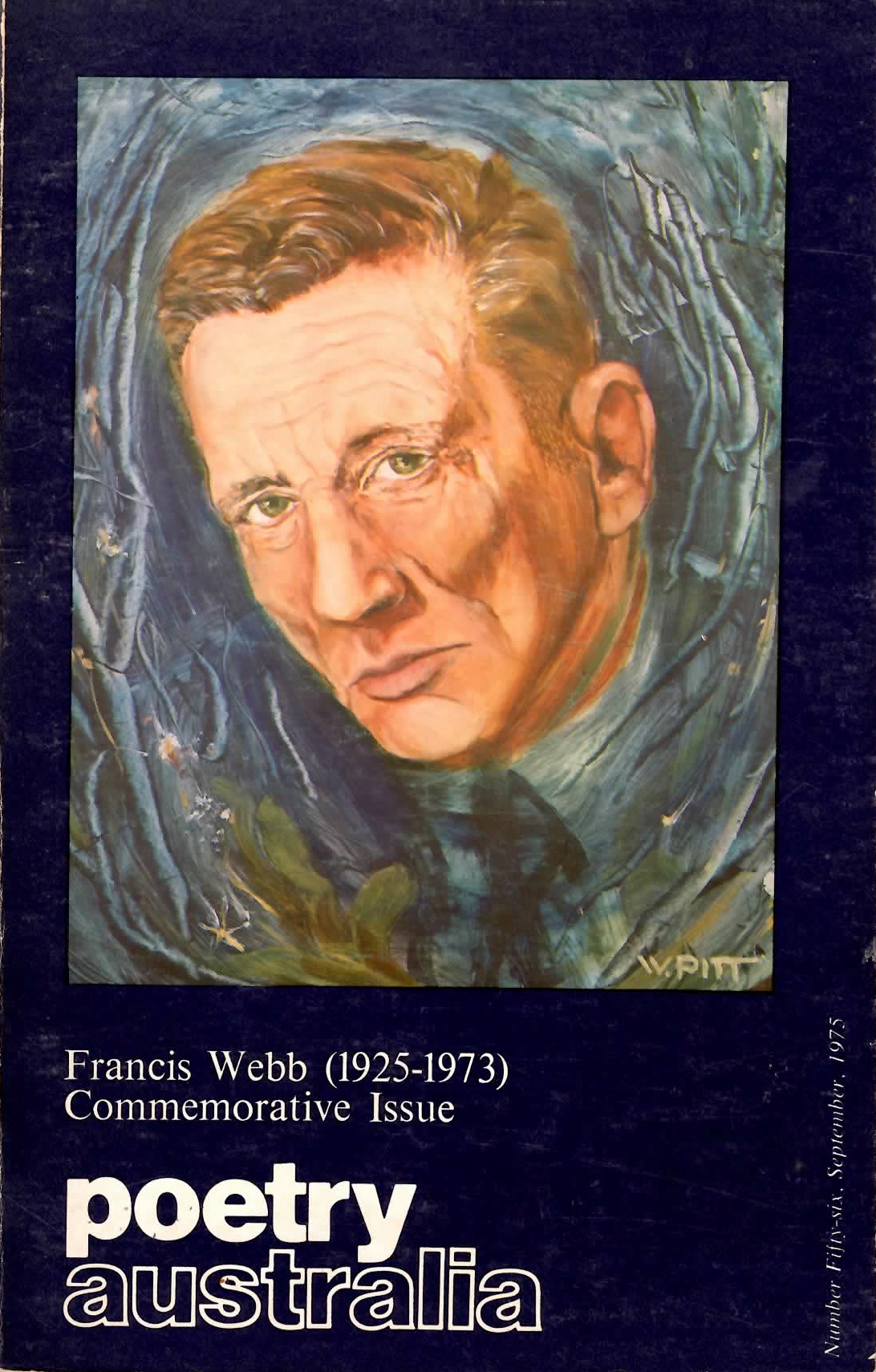 The September 1975 issue of Poetry Australia was devoted to Webb, who had died nearly two years earlier. As well as several previously unpublished poems (all of them now available in Toby Davidson’s 2011 Collected Poems), it includes essays by Griffith, Ashcroft and other scholars, but its enduring interest lies in contributions from Webb’s fellow poets who knew him and appreciated his work – Rosemary Dobson, A D Hope and Vincent Buckley among them. There is also a poignant memoir by Sister M. Francisca Fitz-Walter, a Good Samaritan Sister who befriended Webb.
These essays are a striking reminder of how the language of literary criticism has changed in the last 40 or so years. Compare Vincent Buckley, in his essay ‘A Poet of Harmony’:
He was a great phrase maker and there are phrases, sentences, cadences in poem after poem that are quite unforgettable. He was a great master, and sometimes a victim, of metaphor, the most metaphor addicted poet in this country, I would say, and it is noticeable that time and time again the energy of those very ample driving rhythms is also the energy with which metaphors are picked up, created and extended through the stanza.
with Bill Ashcroft, 30 years later:
The compatibility of schizophrenia and the post-colonial, or to put it a different way, the schizophrenic discourse of post-colonialism, is seen most markedly in the similarity between the absence of the metacommunicative mode in schizophrenic language and [the] metonymic gap [of post-colonial discourse].
I don’t discount the importance of Bill’s theorising – on the contrary, it opens up great vistas of understanding. But Vin (as Webb called him) says a lot more about the immediate experience of reading the poetry.
 Francis Webb, Poet and Brother is a labour of love, compiled and self-published by Webb’s younger sister and her husband in 2001, when they must have been in their 70s. It includes a number of poems that had not been previously published – but which are mostly in Toby Davidson’s collection. Its appendices include an impressive bibliography of critical writings about Webb; nearly 60 pages listing all his poems, the place and date of first publication, the place of composition where that’s known, and all subsequent publications; and 12 pages listing errors in those publications and in writings about Webb. All this will probably be of interest to scholars, but then there are the letters – 56 of them, written to his three sisters and his brothers-in-law from 1943 when he was 18 to a month before his death in 1973, with linking passages by the Meeres, including occasional quotes from other sources, such as for example Vincent Buckley’s memoir Cutting Green Hay – a quotation which, incidentally, tells a story of youthful drunkenness that Buckley hinted at but declined to tell in his Poetry Australia essay. If Webb’s letters to colleagues are as compelling, and poignant, and interesting as these, someone really ought to be getting a collection together.
Four things shine through: Webb’s great affection for his family, especially for Leonie and Peter Meeres; his Catholic piety (almost every letter ends asking to be remembered in the recipient’s prayers, and promising to remember them in his); his single-minded dedication to his calling as poet; and his mental anguish. The reason for his repeated confinement in psychiatric institutions remains (of course) obscure: he repeatedly insists that he is completely non-violent, but the letters are peppered with references to incidents such as ‘a silly brawl’. Whatever the reason, it’s heartbreaking to read his pleas for help, his assurances of his harmlessness, his wretched descriptions of himself as a no-hoper, and towards the end his warnings not to upset and possibly damage children by bringing them to see him in his abject state – and through it all, his piety, his affection and his hunger for solitude and peace enough to write poetry.
The Japanese artist Yayoi Kusama lives in a mental hospital in Tokyo, and is able to go to her studio regularly. It may be that Francis Webb needed to be kept apart from the general community, for his own or other people’s safety, but that he lived a life of such deprivation must surely stand as a reproach to the way people labelled mentally ill have been treated in this country. Yet the miracle of it is that he too created marvellous works:
Are gestures stars in sacred dishevelment,
The tiny, the pitiable, meaningless and rare,
As a girl beleaguered by rain, and her yellow hair?
Posted in Books
Tagged Bill Ashcroft, Francis Webb, lit crit, Michael Griffith, poetry, reminiscence, Sydney Writers' Festival, Vincent Buckley
 | Jonathan on Kit Kelen’s Food of… |
| Viscount Kit Kelen on Kit Kelen’s Food of… | |
| Jonathan on Florence Knapp’s Names |
 | This Reading Life on Florence Knapp’s Names |
 | kathyprokhovnik on Paul Lynch’s Prophet Son… |
| Jonathan on Paul Lynch’s Prophet Son… |
| kathyprokhovnik on Paul Lynch’s Prophet Son… |
 Currently reading & watching