Ordinary Affects

Kathleen Stewart, Ordinary Affects (Duke University Press 2007)

This starts most inauspiciously:

Ordinary Affects is an experiment, not a judgement. Committed not to the demystification and uncovered truths that support a well-known picture of the world, but rather to speculation, curiosity and the concrete, it tries to provoke attention to the forces that come into view as habit or shock, resonance or impact. Something throws itself together in a moment as an event and a sensation; a something both animated and inhabitable.

Whooee! It’s going to be a rough ride, with tortured syntax, unconventional semicolons and words that don’t seem quite to mean what one would expect. It doesn’t get any more comfortable, but I persisted because it was a Book Club book, and Book Club books are meant to take me places I wouldn’t necessarily go if I just followed my nose.

A couple of pages in, I decided that even though this is a scholarly work, probably belonging to the discipline of postmodern anthropology, I lack the background to be able to read it in a scholarly manner. Instead, I let it kind of break over me. I read it as if it was poetry. And I enjoyed it. I can’t tell you what it’s about, mind you. It abounds in anecdotes, ranging from a pleasant but odd encounter in a check-out queue to horrific violence, bizarre plane travel incidents to odd things seen from the car. It offers fascinating reflections on public responses to big events – the OJ trials, the Columbine shootings, child care sex abuse scandals, nuclear waste disposal, 11 September 2001. It positively bristles with gnomic utterances that would make great epigraphs for poems (‘The ordinary can turn on you,’ or ‘Dream meets nightmare in the flick of an eye’) or citations in other scholarly works (‘Like a live wire, the subject [which I think here means a person] channels what’s going on around it in a the process of its own self-composition. Formed by the coagulation of intensities, surfaces, sensations, perceptions and expressions, it’s a thing composed of encounters and the spaces and events it traverses or inhabits’).

By chance, the first thing I read after finishing this book was Raewyn Connell’s characteristically incisive essay in the current issue of Overland, in which she says:

Any system of doctrine, any powerful concept, becomes in time an excuse for not thinking: Marxism, radical feminism, deconstructionism, post-colonialism, the lot. … We need harder thinking, not fluffier thinking, about social reality – and that includes rethinking the ideas earlier generations of socialists worked with.

I think Kathleen Stewart would agree with that (even while, being from the US, she might flinch at the word ‘socialists’), but Ordinary Affects deals in something that precedes thought: ‘The ordinary can happen before the mind can think.’ (Let me share with you the pleasure I felt in using that limp word ‘something’ here. It’s a word that Stewart uses often and interestingly, usually in the phrase ‘or something’, as if to insist on the provisional nature of her thinking.) Before we can rethink, we need to re-see, and re-feel, re-attend, and at least part of what Stewart means by ‘ordinary affect’ is what happens when we pay attention, how we integrate, or not, the many influences on our perception, our emotional responses, our unreflective thoughts.

I found myself remembering the only lines I know from the US poet Muriel Rukeyser:

PAY ATTENTION TO WHAT THEY TELL YOU TO FORGET

The capitals are hers.

If I get a chance I’ll re-read this book, though I expect it will be a matter of letting it break over my head again.

Luke Carman audio

One of my highlights of last year’s Sydney Writers Festival was Alleyway Honour in the Bankstown Town Hall. Some of the same people who made it so brilliant will be in the prosaically named Inside the Westside Writers Group this year at Bankstown on 18 May. I hope Michael Mohammed Ahmad will read again. And Alexis Wright will be there as a special guest.

But my reason for blogging is to let you know that Luke Carman, whose readings at Alleyway Honour were a thrill and a delight, having had a couple of pieces in the latest Heat, has now, thanks to Penguin Plays Rough and FBi Radio, turned up in audio on the internet. You can hear him with just one click.

Open letter to Jennifer Maiden

I think this is a poem, but the chances of anyone else publishing it are very slim, so here it is, blogged.

Open letter to Jennifer Maiden
Dear Jennifer, please write about Kevin
and Julia. The best I could manage
was a clerihew when they won the election:
oooKevin Rudd
ooomay be a bit of a fuddy-dud
ooobut at least we’ll no longer be showered
ooowith the duplicitous spittle of Howard.
But now that he’s backed off
from tackling climate change
and Julia’s refusing
to talk to the teachers’ unions
we need something stronger
and wiser
than my easy rhymes  –
a muddy rabbit, mesmerised by moonlight,
a studied habit, of playing to the polls,
or bloody sabot-age.
Couldn’t you write us something
about the way his top lip tightens
or hers curls,
her pontifical drawl, his parsonical clip?
Something like your George’s
lethal little injections and your Condi’s
costume jewellery, to help us see them
as human?

Jennifer Maiden’s poems that this refers to explicitly are ‘Together We Will a Cheese Achieve‘ and ‘Costume Jewellery‘ both in Friendly Fire.

Philip Larkin, The Whitsun Weddings

Philip Larkin, The Whitsun Weddings (© 1964, Faber & Faber 1977)

This slim volume was published seven years before Philip Larkin’s most famous poem, ‘This Be the Verse‘, and a couple of years before I studied Eng Lit at university. It’s possible we read some of Philip Larkin’s poems in our eminently forgettable third year elective on Post War English Poetry. But in effect I’ve just met what Wikipedia says is one of Britain’s most popular poets for the first time.

According to Wikipedia again, Larkin said that deprivation was for him what daffodils were for Wordsworth. I found that comment illuminating – most of the poems here are performing a kind of wretched isolation, sometimes mocking people who are in relationships, at other times wistfully celebrating the possibilities, or the might-have-beens, of love. The quality of performance stops them from being just plain dispiriting. A paraphrase of ‘This Be the Verse’ would go something like, ‘Parents ruin their children’s lives so we might as well let the human race die out,’ but each time I read the poem it has a weirdly cheering effect, which I think is because its meticulous formality and obvious pleasure in language are so not gloomy. That poem isn’t in this book, but there are others just as gloomy and just as cheering, ‘Mr Bleaney’, say, or ‘Nothing to Be Said’, or … most of them.

Anyhow, I don’t have much to say, except that I enjoyed these poems a lot and expect to enjoy them many times – the sheer formal pleasure of them, but also the complex musings they embody.

The student who left her marks here (and I know it was she because her name, Allison XXXXX,  is on the fly leaf) was more attuned to the poetry than he who annotated my copy of Immigrant Chronicles. (Click the image for a bigger version.)

Mind you, her notes on ‘Afternoons’ seem almost completely wrongheaded: I don’t see why the recreation ground prompts the comment ‘consumerism’, where the idea comes from that the mothers who set their children free are ‘still trapped’, or why it is ‘bleak’ that the women have husbands behind them. But Allison’s pencil seems to grasp ‘An Arundel Tomb’ well enough. At least, I found the poem completely lovely, and felt quite companionable toward her as I read it: ‘Yes, Allison, it is nice the way the word link occurs at the start of the fifth stanza after that big enjambement,’ ‘But is the tomb undated, Allison, or just the snow?’

The final lines of the poem remind me of one of my favourite movie moments, the declaration of love at the end of Ingmar Bergman’s Scenes from a Marriage. I can’t find the Bergman line, but here’s the Larkin:

0000000The stone fidelity
they hardly meant has come to be
Their final blazon, and to prove
Our almost-instinct almost true:
What will survive of us is love.

Footnote on my blog note on Sacco’s Footnotes

I’ve just heard Chris Flynn’s excellent review of Footnotes in Gaza on the ABC’s Book Show of 21 April. It’s preceded by interesting discussions of European comics (‘graphic novels’) in translation and South Korean comics, in a refreshing antidote to the patronising treatment often handed out to comics in the mainstream media. Chris Flynn says in part:

Sacco tries his level best to build up an accurate picture of what might have happened. he comes at the massacres from all angles, presenting eyewitness accounts that sometimes correspond and sometimes conflict. Footnotes in Gaza is thus a fascinating document of ordinary people, but it is disappointing that it lacks an Israeli perspective on what happened. In his introduction  Sacco bemoans that he was stonewalled, and the limited access that he was granted to UN and Israeli Defence Force archives, and he puts out a plea for Israeli soldiers who were present on the days in question to come forward with their versions of events.

As an eye-opening piece of war reportage, Footnotes in Gaza succeeds largely thanks to Sacco’s innovative, fresh approach in presenting a forgotten moment in history in such a modern fashion. As a narrative piece of story-telling, it contains several moments that made me put the book down and hold my head in my hands. As illustrative journalism, it has a huge emotional impact, particularly during the grand vistas of destruction and the final, silent pages that transcend words. There are no answers here, just terribly sad questions.

You can download the whole thing or listen to it streamed.

Skrzynecki’s Immigrant Chronicle

Peter Skrzynecki, Immigrant Chronicle (UQP 1975, 2002)

This book boasts back-cover blurbs from an extraordinary bunch of Big Names: Kenneth Slessor, Randolph Stow, Rosemary Dobson. But it’s probably the least famous of the blurbers who nails the reason it has stayed in print for 35 years when, say, David Malouf’s or Les Murray’s first volumes are long out of print and fetching vast sums on e-Bay: Stephen Magee announces that ‘Immigrant Chronicles can fairly be claimed to be the best poetical treatment of the immigrant experience, in Australia, since the nineteenth century’. Ah, poetical treatment of a significant historical subject – perfect for study in high school.  And indeed, the book has been set in the Higher School Certificate. This is how Peter Skrzynecki, acknowledging reality, welcomes visitors to his web site:

On this site you will find information about my life which may help you understand some of my poems – especially those set down for study on the New South Wales HSC syllabus.

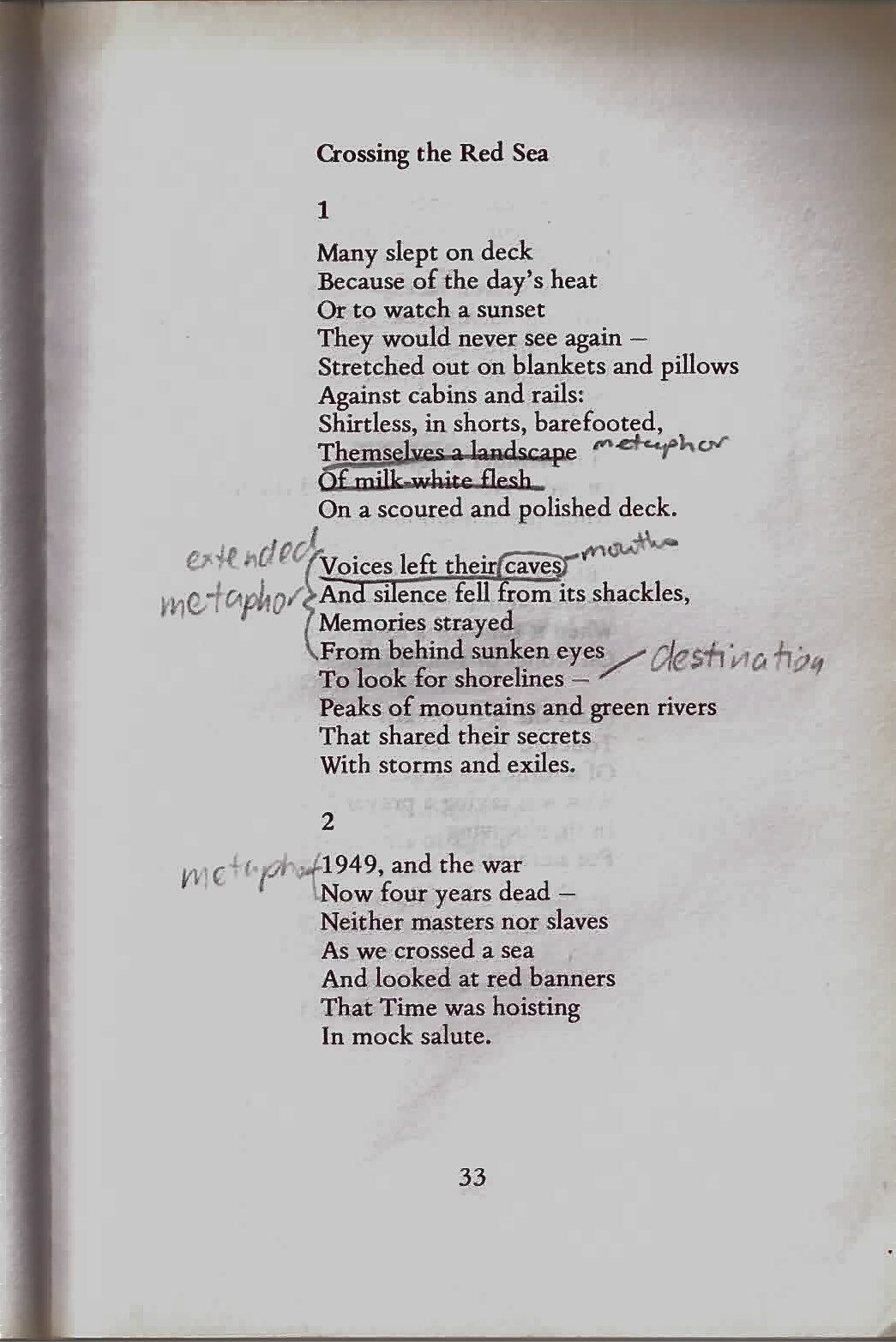
None of this should have anything to do with my reading the book, but the copy I bought bears the scars of having been ‘studied’, and they exerted a disproportionate influence on me:

This unhappy student’s search for metaphors succeeds in making the writing look awfully prosaic: for jus one example, if there’s a metaphor in ‘the war / Now four years dead’, it’s been dead a good bit longer than the war has. Yet the poem ‘Crossing the Red Sea’ (of which the above is the first of four pages) is a moving attempt to imagine the post-war emigrant experience.

The book isn’t a verse novel. There are poems about pelicans, a snake, Michael Dransfield, a death mask and so on. But it does encompass a narrative arc that justifies the Chronicle in the title. Apart from ‘Crossing the Red Sea’, there’s the much anthologised ‘Migrant Hostel: Parkes 1949–51‘ (if you click on the link, try to avoid the class notes at the end), and perhaps a dozen more, including some raw and melodramatic poems that seem to be about Skrzynecki’s mother’s experience of the ‘mental health’ system (though he explains on his web site that they are not to be taken as factual in every detail) and a number about becoming a father. A good part of the interest is documentary – that is, the poems are interesting because they inform us about ‘the immigrant experience’, or more accurately an immigrant experience.

Skrzynecki’s novel Boys of Summer was launched at Gleebooks last week – it deals with growing up Polish in Sydney suburbs in the 1950s. So he is still mining the same rich vein. But whereas now, according to the Gleebooks description, there’s a nostalgic flavour to the work, Immigrant Chronicle was written by the 20-something Skrzynecki, and there’s a pervasive, complex sense of the past’s insistent presence, memorably caught in the last lines of the final poem, ‘Post Card’ (which is also representative of what to me seems a peculiar flatness of the poetry). The speaker is looking at a ‘post card sent by a friend’ from Warsaw, his father’s lost home:

I stare
At the photograph
And refuse to answer
The voices
Of red gables
And a cloudless sky.

On the river’s bank
A lone tree
Whispers:
‘We will meet
Before you die.’

A great idea from the Netherlands

Richard Tulloch has given his blog a small roadside rest to tell us about a brilliant bookish idea from the Netherlands:

Each year the Netherlands Book Week committee publishes a novella commissioned from a Dutch author. This little book is then given away by bookstores to customers who purchase books to a certain modest value. Good value for them and the publishers and authors because it stimulates book buying and reading.

Then on the Sunday of Book Week itself, copies of this Boekenweekgeschenk (Book Week Present) become valid train tickets. Anyone clutching a copy of the book can travel free all day on the trains to anywhere in the country. The idea is that readers will meet up with other train travellers on a Book Week pass and run an informal book club session during their journey.

The possibilities are endless! What say the winner of the Miles Franklin was commissioned to write a novella that then became a universal public transport ticket on, say, Henry Lawson’s birthday? And given that Henry Lawson was born on 14 June, why not have a public holiday on the nearest Monday so people can use their book–ticket to best effect?

The Man Who Invented History

Justin Marozzi, The Man Who Invented History: Travels with Herodotus (John Murray 2009)

In the movie The English Patient, the Kristin Scott Thomas character tells a story from Herodotus over the campfire, which apparently resulted in a spike in sales of The Persian Wars. The product-placement dimension of that moment was lost on me. I’d read some Livy at school, and quietly assumed that all ancient historians were alike, concerned with wars and not much else, and generally to be avoided. It would have taken more than an erotically charged Herodotean moment in a movie to shake that assumption. Justin Marozzi has done what Kristin Scott-Thomas failed to do. He’s an English travel writer–historian (with his own web site), at pains to make us know he’s not an academic – more like a Herodotus fanboy. His message in short is something like: Herodotus invented the West, Thucydides sux, and Plutarch double sux. (Those last two aren’t direct quotes – he’s much more grown-up than that.)

Marozzi sets out in this book to follow in Herodotus’s footsteps, visiting places he visited, or at least claimed to visit, quoting good bits from his Histories and reflecting on the enduring relevance of some of his themes. He visits Turkey (Herodotus’ birthplace Halicarnassus, now Bodrum), Iraq (where Marozzi spent a year ‘setting up a nationwide civil affairs program’, whatever that is, but manages to take us with him on a private guided visit to the mostly inaccessible museum in Babylon), Egypt and of course Greece. He finds value in Herodotus’ genial appreciation of cultural diversity and mockery of cultural arrogance (it seems that ‘Everyone thinks his own society’s customs are best’ was a refrain in Herodotus; it certainly is in Marozzi, with many confirming examples). He finds in George Bush’s Iraq and elsewhere validating echoes of Herodotus’ belief that hubris leads to nemesis and his repeated observation that those in power ignore at their peril those who counsel caution. He enjoys and emulates Herodotus’ propensity for sexual titillation, though here he seems to be trying a little too hard to establish his non-academic bona fides, and comes off as a happily married man hoping to pass as a bit of a lad. Above all, he conveys a sense of Herodotus as an excellent travelling companion, a great listener, an accomplished entertainer (apparently he wrote his books to be read aloud, and Marozzi imagines a number of reading–performances for us), a tireless gatherer of information, a cheerful embellisher, and one who got it right more often than he has been given credit for. Maozzi has put Herodotus on my To Be Read list.

My timing in reading this could hardly have been better because of its resonances with other recent reading. Marozzi spends a whole chapter in Siwa, the setting of Sunset Oasis, and includes some photographs. It’s unlikely he had read the novel, but Bahaa Taher, its author, is named in his acknowledgements. He doesn’t mention the theory, a major plot point in the novel, that Alexander the Great may be buried in Siwa, but he does spend quite some time on matters mentioned by neither Herodotus nor Taher: the oasis’s tradition of homosexuality and the prevalence of magic there, in spite of the current Muslim establishment’s disapproval of both. But it’s clearly the same place, and the counterpoint of fiction and travel-writing is fun.

Though Marozzi makes no direct reference to Palestine, one chapter in particular plays well with Footnotes on Gaza. The latter is history painfully gathered from eyewitnesses and survivors of brutal events, a necessary and important counter to the bland evasions of the official story, as recorded by the powerful. But Justin Marozzi’s account of  Southeast European Joint History Project (JHP) reminds us of the dangers of history that perpetuates a people’s view of themselves as victims, a danger that Joe Sacco’s book certainly risks. In a visit to Thessaloniki, not part of Herodotus’ world, but justifying its place in this book because of the light it casts on the nature of history, Marozzi interviews Nenad Sabek, chain-smoking director of the NGO that produces the history. The state of history-teaching in the Balkans as surveyed ten years ago makes Australia’s History Wars look like a game in a kindergarten sandpit. Sebek tells Marozzi, and us, that the school history syllabus

is where you instil into the young a sense of victim mentality, a feeling that everyone around them is their adversary and that’s how it’s always been. … I believe history is one of the fields  where if you teach it badly you produce serious damage way ahead in the future. If you tell a ten-year-old his country has always been beaten up by its neighbour throughout its history, and then years later it’s war, he’s wearing uniform and he’s got a gun in his hands and his leaders are saying, ‘They’re still slaughtering us,’ this is what he believes and he goes on a rampage.

The JHP has produced a set of history textbooks that offer a multi-faceted account of the seven centuries from the emergence of the Ottoman Empire to the Second World War that aims to supplement (rather than replace, which would be politically impossible) the lethal nationalistic-victim texts currently in use. It sounds like a project that could, even should, be emulated in any number of hotspots – Tel Aviv, Ramallah, Belfast, Canberra …

Dorothea, Andrew and Mollie

Dorothea Mackellar and Andrew McLean, My Country (Omnibus 2010)

I’ve always vaguely resented this poem. ‘I love a sunburnt country, a land of sweeping plains’, it seemed to my young self, consigned the lush east coast of North Queensland to some non-Australian limbo. So I was happy to learn that Dorothea Mackellar wrote it as an exercise in reverse cultural cringe while living in England, that there was an opening verse that went on about ‘field and coppice’. I was delighted in a schadenfreude kind of way years ago when I came across a letter from Dame Mary Gilmore in the School Magazine files replying to a request for permission to reprint the poem: the Dame explained loftily that it was unlikely that she had written a poem with such hackneyed images and dreary rhythms. I passed that splendid letter on to the Department of education’s Historian, and hope it is preserved under glass somewhere, but it was unfair. It turns out the poem was just waiting for Andrew McLean to illustrate it.

Penny bought our copy at the Orange Grove Markets this morning to read to Mollie. When I joined them after walking the dog, Penny asked me to have a turn at reading it – I don’t know how many times they had already been through it. Mollie was attentive all the way through, and as far as we could tell enjoyed the book.  So did I. It has to be one of the best presentations of a poem. Ever.  Andrew McLean’s landscapes are superb: the soft English countryside, the drought stricken farmland, the flood plain, the ringbarked gum trees ‘tragic to the moon’, the lush rainforest (yes, it’s there – just not in the only stanza that is usually quoted). The Grand Dame may have been right about the imagery and the rhythms, but there’s something wonderfully complex in the profession of love for an environment so full of challenge and suffering.

Steven Vella at NG Galleries

It seems decades ago, and it probably is, that my eldest niece was living in Sydney with a number of creative young men. The Art Student and I have just come in from the opening of an exhibition of splendid art created by one of them. Steven Vella’s Garden of Natural Wonders [Do click on the link and scroll along for some of the pieces] is the kind of exhibition that has you looking constantly from the artworks to the catalogue sheet, not to see what the piece is called, though some of the names are revelatory, but to see what materials it’s made from. It’s a gleaner’s equivalent of the treasury of a renaissance church, with bean pods, palm inflorescence, feathers, banksia seed in place of precious stones and metals. The religious dimension of that comparison isn’t too wide of the mark – there’s at least one cross, a couple of stupas, and a wall of ceremonial staffs that remind me of the theatricality of Mediterranean Catholicism. Steven’s North Queensland provenance and his Maltese heritage are both strongly present. But then the room is dominated by ‘Medusa’, which if not for its gorgeous flowing lines could be a homage to the Flying Spaghetti Monster:

But you know, my favourite piece is probably ‘Aunt Bibi’s Salad Bowl’, one of the smaller works, which assembles durian skins and a vintage teak bowl, among other things, to create a weird, spiky, domestic icon. Sadly I can’t find a photo, so if you want to see it you’ll have to go there yourself.

The NG Art Gallery is in Little Queen Street, Chippendale, just around the corner from the White Rabbit Gallery, and the exhibition will be there until 8 May.