We didn’t come to blows …

… but we did have a spirited conversation over pizza after seeing Samson and Delilah last night.

20e7fdb0-7ada-482b-ad9e-cd778fb0bf4d.jpgWe both agreed that it’s a marvellous film, that it’s just beautiful to look at, that the performances are miraculous, that the almost complete silence of the main characters is devastatingly effective. We’re both glad it won that prize at Cannes and we both disagreed point blank with statements (quoted from US trade journals) about how joyful and humorous it is.

Where the conversation got spirited was when my companion, who knows much more than I do about such things, lamented the misrepresentation of life in and near Alice Springs: where were the other sniffers? where were the social services, the Tangenyere Council, the camp in Todd River of people from their mob? where were all the Aboriginal faces in the mall? how come the community at the start had a store and a health clinic but almost no people? why did the women who beat Delilah up not know that she had taken care of her grandmother when in such a small place surely everyone could see that’s how she spent her days?  I assume she’s right about these and other complaints. But I thought maybe she was wanting a kind of documentary verisimilitude that the film wasn’t pretending to. After all, in the community where the film starts, a group of men sit on a verandah and play the same boring fragment of music over and over day in and day out, which works brilliantly to create a mood of deadening boredom, but which is clearly not meant as a literal representation of life on a community.

No, she insisted, she wasn’t wanting a documentary, but the film suffered from its distorting of reality in this way: the young protagonists’ profound isolation was profoundly improbable, and this made it hard to take their suffering seriously – unless you were a Cannes jury and understandably ignorant of the condition of Aboriginal people in the Centre, both their devastation and their resilience. I insisted in turn that a story teller doesn’t have to tell the story. All he (or she, but in this case he) has to do, all he can do, is tell a story, and this film tells its story very powerfully.

I think we were probably both right. The only actual disagreement we had was whether the character Gonzo was Aboriginal (as I thought) or not (as she did). The internet has just told me that I was right – at least, the actor is Aboriginal, director Warwick Thornton’s brother, in fact, playing a character based on himself.

When we got home I went to Bernhard Schlink’s Guilt about the Past. He’s talking about representations of the Shoah, but I think it’s relevant:

We don’t want fiction just for the facts being presented to us. We want reality to be presented to us and explained to us and turned into something that, even though it is not our reality, we can imagine ourselves into. We read [and go to the movies – JS] because we want to share the lives of those we read about, we want to empathise with them, fall in love with them, train our hatred on them, and ultimately learn about ourselves from them.

Even though the composition of these fictitious realities with their fictitious plots and situations and characters is something other than a presentation of facts, I experience it as something that has to be true. … I don’t know exactly what I mean and how to define this truth. What I am talking about is the feeling I have when a story that I have thought about, played with, thought about some more, and played with some more is finally ready to be written. … The feeling doesn’t have to do with me putting something autobiographical or something else of which I am particularly certain into the story that I am going to tell. It doesn’t concern having a message I want to convey that I am finally about to convey successfully or with any other agenda. It is a feeling devoid of any agenda except: now I have it, now I can tell it. And it feels like I have found the truth.

I think Warwick Thornton found that kind of truth here, and handed it to us.

(Incidentally, in interview on Cinema Autopsy, the blog I linked to above, referring to his brother Scott, Warwick Thornton says that Gonzo, the parky who shares what little he has with the two lost young people ‘is in a sense the audience’. My own point of identification, which caused some soul-searching, was a woman in the cafe who watches Delilah go off down the street off her head on petrol: the woman’s face shows genuine concern, but it’s clear she’s not about to do anything about it.)
My book club swag

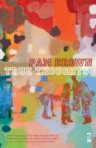
Pam Brown, True Thoughts (Salt Publishing 2008)
Margo Lanagan, Tender Morsels (Allen & Unwin 2008)
Peter Steiner, Le Crime (Thomas Dunne Books 2003, 2008)

Apart from the conviviality, the food, the cards, the ever expanding list of draconian (and largely ignored) rules, what I love about our book club is that it makes me read things I might otherwise not have touched – books about secret rendition and Guantanamo Bay, someone else’s favourite detective novels, intimidating poetry.

One of the welcome consequences of my self-imposed task of blogging something about every book I read is that it pushes me to reflect on my reading.

True thoughtsSo with Pam Brown’s True Thoughts I’m doubly blessed: without the book club I doubt I would have read it, but here it is with an affectionate inscription to one of the club members; without the blog my mind might not have lingered on it any longer than it took my initial bemusement to fade. But here I am, remembering that poetry usually requires the reader to do a little work, and knowing that I would be revealing myself as an unforgivably lazy reader if I just wrote something like, ‘I don’t get it,’ or even, ‘I don’t grasp how these pieces hang together to make poems — I can barely tell where one ends and the next begins.’ (By pure serendipity, after I’d written that para I heard a Poetry Off the Shelf podcast in which Matthew Zapruder talks about immersing himself in John Ashbury’s poems because they moved him somehow even though he didn’t understand them at all, so I’m clearly in good company, and I imagine Pam Brown would be happy to be discussed analogously to Ashbury.)

So, in spite of feeling that I needed someone to take me by the hand and explain how to read Pam Brown’s poems, I went back, took my time, ruminated, savoured, absorbed and, eventually, enjoyed. It was a fascinating process. At the start I was like a colour-blind person looking at one of those red-and-green patterns, then with sustained, though not strained, attention it was as if the colour-blindness healed and the formless array of dots and squiggles reorganised themselves before my eyes into elegant shapes. For example, ‘Peel me a zibibbo’ begins:

I could go [extra characters are spacers &  meant to be invisible]
oooooooin any direction
but it’s best that ooohere and now
ooI remain lesbian,
ooooo keep my vanishing cream
sealed.

On first reading, this seemed little more than verbal noise, a bit like the start of an Ern Malley poem. And in the middle of the poem, there’s this:

imperfection in kindness
ooooooocomes with the void,
oyou need to
ooooochoose
ithe ‘I’m feeling lucky’ google option.

To which I said, ‘Huh?’

I still don’t really get this second quote, but now that the green dots and the red dots have sorted themselves out, I do get that the first quote is meant to tease, and not meant to yield its meaning until the last line, where she addresses the poets and others whose names have cropped as the poem meanders with apparent aimlessness through a day in the life of the poet, and we realise they are all men:

Hi Kurt, ooooooo oooooooooohi John T,
oooo
hi Nick, oPaddy, oooohi Shakespeare,
ooooooo
opeel me a zibibbo
ooooooo
ooooooo ooooo would you,
ooooone of you guys?

(A zibibbo, as a note up the back tells us helpfully, is a delicious kind of grape.) The first lines suddenly yield their meaning. The busy-busy Lesbian poet, after making workaday contact with male poets and artists alive and dead, indulges for a moment in a fantasy that she’s some kind of Mae West femme fatale surrounded by male attendants. And I am amused.

tendermorselsTender Morsels an exception as book club books go: I would have read it with or without the BC’s agency. In fact, I’ve been wanting to read it since it came out nearly 12 months ago. I gave it as a Christmas present to one of our members, secure in the knowledge that it would come to the table at one of our meetings. When it did surface, I was a little taken aback when the person offering it, she to whom I’d given it for Christmas, said she’d stopped reading at about 40 pages because she didn’t want to go on reading a litany of suffering. And I confess that when it was my turn, I was close to giving up on page 40 myself. But I read on, and can report that on page 42 everything changes!

This is a wonderful book, and the gruelling first movement is absolutely essential. We need to know just how much the heroine suffers, so that we understand her need to escape, and when other characters (and possibly the back cover blurb as well) make assumptions about what she is avoiding, we know that they completely fail to grasp the strength of character that has enabled her to survive and function as well as she does. The fairy tale ‘Rose Red and Snow White’ plays through the story beautifully. The use of language is exhilarating. Though in one sense things are resolved by about the two thirds mark, there are unexpected twists and turns right to the very last page. Margo Lanagan walked across in front of my car when I was stopped at lights in the city recently. She looked like just another person on her way to an office job. I wondered how many of those others crossing the street were also total geniuses in disguise.

lecrime Le Crime‘s cover quotes compare Peter Steiner to John Le Carré, Len Deighton, Peter Mayle, Agatha Chsitie, Robert Ludlum, Alan Furst and Graham Greene. I have no idea how embarrassed the quoted reviewers are to see their phrases taken out of context like that. The book is not in the league of any of those writers. It creaks, its psychology is implausible, the plot is completely silly, and the structure barely holds up – but it’s a quick, enjoyable read. I liked it mainly for a flashback that lasts for three of the 26 chapters, in which the hero goes on a long walk through the French countryside, starting at Charles De Gaulle Airport and finally crossing the border into Spain (though we don’t go all the way with him). P and I have just booked in for a much shorter walk in France later this year, supported as befits our ageing selves, and these thirty-odd pages make it seem like a very good idea.

Ready for the next Book Club meeting now, I am.

A late spider

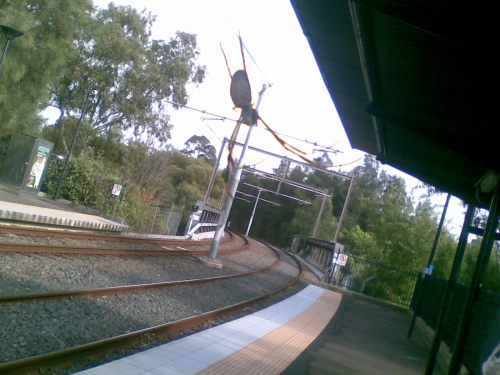
Most of the golden orb webs around my place are empty or torn down at this stage of our wet and chilly autumn. But this hardy specimen is still holding her own at the light rail stop, and seemed not to mind posing for my phone camera (and giving me a chance to figure out how to do images on WordPress).

Spider24052009(002)

/Blinks/

Oh brave new world that has such gizmos in it!

Family Life is now behind me, and I’m about to take wing in this new blog. Too much work to be done today, though, and my last couple of posts in the old place have satisfied the urge for a while. So I’ll just say, ‘Hello sky, hello flowers, hello WordPress,’ and get on with other things. Come in and make yourself at home

Bookblog #68: The joys of non-fiction

[This is reposted from my earlier blog because I want to link to it from a 2020 post. It first appeared on 19 May 2009 – JS]

Bernhard Schlink, Guilt about the Past (UQP 2009)
Theodore Seifert, Snow White: Life Almost Lost (©1983, translation into English, Chiron Publications Illinois 1986)

Pasted Graphic 2

It’s a truism that as men get older we prefer non-fiction to fiction. I hesitate to say that that’s true me in particular, but this collection of lectures by Bernhard Schlink thrills me much more than The Reader did some years ago. The Reader was a bloody good, thought-provoking read. Guilt about the Past strikes sparks from my brain with just about every paragraph.

These essays/lectures deal with the question of collective guilt: is it a legitimate concept, and if so what is to be done about it? Who has the right to forgive? How can a valid reconciliation be achieved between those who inherit a shared history of monstrous deeds in which their forebears were perpetrators and objects respectively? Bernhard Schlink has recent German history in mind and refrains from talking about his subject in universal terms, but what he manages to articulate is powerfully relevant to all manner of situations. He talks in terms of law, and morality where it’s not covered by law. I won’t try to write a proper review here, but recommend that you read the book. It’s short, clear, and lively. Every time I picked it up, as I flicked through the pages looking for my place, sentences would leap out at me. At random:

The notion that the past could be brought into form and order is foreign to the law.

… simply stated, everyone whose relationships have been damaged can reconcile. While forgiveness lifts the burden of guilt from the guilty parties, reconciliation merely makes it a bit lighter.

… understanding does not have only positive connotations.

… my mother was right. If a person does not believe in a forgiving God, then they have to live with their guilt when they can no longer obtain forgiveness from the person they injured.

The book is very readable, but I’ll need to re-read it and meditate on it.

sw021

Snow White: Life Almost Lost, on the other hand, does the meditating for you. It’s a discussion of the fairy story from the point of view of a Jungian therapist. Much wisdom is dispensed about the challenges of the inner life, and the Grimm Brothers’ 1859 version of the tale provides a mostly plausible springboard for it, but Herr Seifert surely sets a record of some kind by taking 32 pages of discussion to get us through the first 45 words of the story – and that’s without any attention to ‘Once upon a time’! The words themselves, in case you need reminding:

Once upon a time in the middle of winter, snowflakes were falling like feathers from heaven; a queen was sitting at a window that had a frame of black ebony, and she was sewing. As she sewed and looked up at the snow, she pricked her finger with the needle.

You’ll have to read the book to discover what profundities about life and death, hope and despair, belief, imagination, love, law and deprivation those words contain – assuming that like me you can’t see these profundities unaided.

My favourite couple of sentences, from much later in the book (remember there is no married couple in the story, until the wedding in its last paragraph):

Even after many years of marriage, going to bed at different times is still a problem for many couples. Every evening they suffer the same irritation: The one has to go now, the other can’t go yet. Each always experiences this as a form of a seeming demand; and without exception the mate is accused. We talk only of what the other did to us; we do not talk of our own lack of readiness to risk corresponding conflict and stand up for our own wishes. Ultimately all these poisoned thoughts suffocate our soul, just as the bodice laces suffocated Snow White.

Leaving aside the incomprehensible phrases, which can probably be laid at the translator’s door, this measures up fabulously against some of the most ingenious of mediaeval biblical hermeneutics. And for all that, and for all the preoccupation with marriage as the one road to a fully human life, I have come away from the book with a much deeper appreciation of the Snow White story.

Posted: Tue – May 19, 2009 at 11:57 AM

NSWPLA Dinner [2009]

[Retrieved from 18 May 2009]

Tonight writers, translators, illustrators, publishers, agents and fans put on their glad rags and turned up for a glittering evening in the Art Gallery. The occasion was the annual NSW Premier’s Literary Awards dinner. This year’s dinner cost $15 more than last year’s.

In previous years the dinner has been organised by staff of the Ministry of Arts. This year it was in the hands of the Department of Arts, Sport and Recreation. The transition was seamless, though there was a slightly awkward moment when the Department’s Director General, who was our MC, said we were doing very well for an arts event and only running half an hour late. There was no hiss of indrawn breath, but I did think it indicated she was much more familiar with sporting events than with arty ones, where my experience has been there is an obsession with punctuality. And at times, as she urged us to resume our seats after a break, her tone was reminiscent of what one would hear over the loudspeaker at, say, a netball tournament. But these were amusing foibles that in no way took away from the pleasure of the evening.

Nathan Rees, more famous for his stint as a garbo and for having inherited a train wreck of a government than for his Eng Lit Hons degree and likeability, gave the impression that he was much happier here than in the bearpit of politics. In his welcome (which followed Aunty Sylvia Scott’s Welcome to Country, in which she said, ‘Your books let me travel’), he spoke of his own passion for books, and told us that some left him cold, surely a mark of a genuine book lover. And he said, interestingly, ‘The examined life is only ever the turn of a page away.’

This was the thirtieth year of the awards, and there was slightly more reminiscence than usual. Neville Wran, the first Premier of the Literary Awards, was there and gave a brief talk on their genesis. Success has many parents, he reminded us, but failure is always an orphan. Of the many people who have claimed m/paternity of these awards, he assured us in his ruined voice, the one who could truly claim parenthood was his wife Jill, who insisted that Sydney should have a writers’ festival distinguished by literary awards. He mentioned the legendary Night of the Bread Rolls in 1985 when the guest speaker Morris West was pelted with bakery products. I’d heard that it was because he droned on. One of my dinner companions was there on that night, and he assured us that it was because the literary types were envious of Morris West’s best-seller status.

Marieke Hardy, of Reasons You Will Hate Me, gave the Address, with a tattoo on each shoulder and a large red flower behind one ear. She spoke of Twitter and quoted Stephen Fry to good effect. In the past, I’ve referred to these dinners as the Oscars of the introverted. Marieke went several steps better and, referring to booklovers out and proud, called it ‘our Mardi Gras’.

As in past years, it’s my pleasure to list the winners with random observations:

The UTS Prize for new writing: Nam Le, The Boat
There’s no short list for this prize, so the announcement was a bit of a surprise. It’s a wonderful book. The award was accepted by Nam Le’s publisher, who read out a short speech Nam had sent him from Italy.

The Gleebooks Prize for an outstanding book of critical writing: David Love, Unfinished Business: Paul Keating’s interrupted revolution
Nathan ‘s script described this as an accessible account of important economic matters. I’m afraid I didn’t understand a word of the brief acceptance speech after the initial ‘This is one for the true believers!’

The Community Relations Commission Award : Eric Richards, Destination Australia: migration to Australia since 1901
Eric Richards spoke of how Australia’s immigration program has been an outstanding success, yet has been and is still a cause of widespread anxiety. He was expecting the book to provoke ‘historical warfare’, but so far there has been none.

The Translation Prize and PEN Trophy: David Colmer
He seems to be a nice man – he translates from Dutch.

The Play Award: Daniel Keene, The Serpent’s Teeth
I saw the STC production of these plays, and was less than impressed by the production, though the plays as written seemed to be marvellous. I approve.

The Script Writing Award: Louis Nowra and Rachel Perkins and Beck Cole, First Australians
In announcing this prize the Premier said, quite rightly, that it was hard to go past this show, but then he went and spoiled the moment by feminising Mr Nowra’s first name. When Rachel Perkins took the mike she pointed out the error. Our Nathan looked suitably abashed, and Louis clearly couldn’t help himself: ‘How long do you plan to stay in government?’ he asked, trying to make it sound good-natured. Ow!

The Kenneth Slessor Prize for a book of poems or for a single poem of substantial length published in book form: LK Holt, Man Wolf Man
Possibly intimidated by the compere’s reminders of the importance of being brief, LK Holt simply thanked her publisher and took her prize. She did stand at the microphone long enough to enable those of us close enough to read the enigmatic tattoo on her left shoulder: ‘MCMLXN’.

The Ethel Turner Prize for a work written for young people of secondary school level: Michelle Cooper, A Brief History of Montmaray
At this stage I began to feel very under-read.

The Patricia Wrightson Prize for a work for children up to secondary school level: Ursula Dubosarsky & Tohby Riddle, The Word Spy
And then I started to feel like an insider again. Tohby and Ursula have both worked at The School Magazine. I read this book in its first incarnations as a series of columns in the magazine, and I was sitting at the same table as both of them – along with two other generations of Ursula’s family and Tohby’s wife Sally. This is the fifth gong Ursula has collected from NSW Premiers. Though it’s no longer a gong.: to mark the 30th anniversary, a new trophy has been created, by Dinosaur Designs: a hefty, transparent, book-shaped objet.

The Douglas Stewart Prize for a prose work other than a work of fiction: Chloe Hooper, The Tall Man: Death and Life on Palm Island
I’ve read this too, and think it deserves any prize anyone chooses to give it.

The Christina Stead Prize for a book of fiction: Joan London,The Good Parents
I haven’t read this, but it’s been very well reviewed in my house. Joan London gave a sweet speech, acknowledging , among other things, her debt to her children.

The People’s Choice Award: Steve Toltz, A Fraction of the Whole
I hadn’t voted, because I’d only read two of the books, and this wasn’t one of the ones I’d read. The same man who had accepted Nam Le’s award accepted this one, but Steve Toltz, who couldn’t be there, hadn’t tweeted him anything to say, so he just looked pleased.

Book of the Year: Nam Le, The Boat
Then the poor guy had to get up for the third time, and gave us the second half of Nam Le’s emailed acceptance speech, in which he thanked his readers, ‘both professional and normal’. As one who used to be a professional reader who is striving for normality, I loved this.

The Special Award: Katharine Brisbane
Katharine was my first employer, when she was Managing Editor at Currency Press, and I couldn’t be more pleased at her receiving this recognition. She adlibbed an elegant speech about the importance of recognising achievement in the arts. She has received a number of awards in her time, she said, but this is the first one to come with money attached. She closed by saying that she too had been there in 1985. ‘We pelted Morris West with bread rolls because he warned us that we had to be prepared for bad things. The Baader Meinhofs were in the news, and he was warning us against terrorism. We thought he was ridiculous, but he was right.’

And then it was all over bar the networking …

… and the journey home. As I was walking back towards the city from the Art Gallery, I drew alongside a rough looking man going in the same direction. He said hello and asked how the evening had gone. ‘We’re homeless, you see, we sleep just beside the porch there.’ We chatted for a couple of minutes. He told me who had won the People’s Choice at the Archibald. I tried to tell him about the Literary Awards, but I think he still thought I’d been at something to do with paintings. As we parted, he said, in an eerie echo of Nathan Rees’s comment about the examined life: ‘People don’t realise it, but you’re always just one step away from the gutter,’ and we wished each other good night and good luck.

No corner shop in time for the ascension

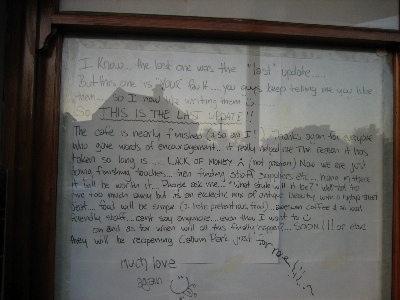
I ran into Rod the corner shop reviver the other day and asked him if Revolver would be open for Ascension Day. ‘When’s that?’ he asked. When I told him it was forty days after Easter, he replied in the emphatic negative. Shortly after that conversation, this notice appeared in the window:

IMG_3324.jpg

In case you can’t read it because of the lovely suburban sunset glare, it says:

I know, the last one was the “last” update …

But this one is YOUR fault … you guys keep telling me you like
them .. so I now like writing them

So … THIS IS THE LAST UPDATE!!

The cafe is nearly finished (so am I!). Thanks again for everyone
who gave words of encouragement … it really helped me. The reason it has
taken so long is … LACK OF MONEY (not passion). Now we are just
doing finishing touches … then finding staff, suppliers, etc … Hang in there
it will be worth it … People ask me, ‘What style will it be?’ Well not to
give too much away but it’s an eclectiv mix of antique beauty with a hiphop street
beat … Food will be simple (I hate pretentious food) … awesum coffee and all local
friendly staff … can’t say any more …even tho I want to.

Oh and as for when will al this finally happen? … SOON!!! Or else they will be reopening Callan Park just for me!!!

Much love again

Rod

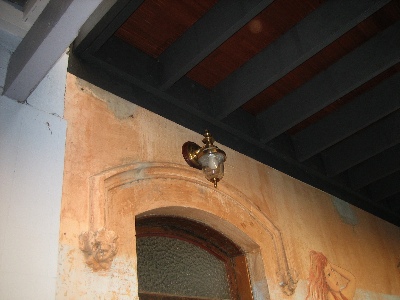
Cute little lights have appeared at the front of the shop:

IMG_3323.jpg

The balcony is built, complete with bullnose awning. Iron lace and railing are
stacked on the veranda, not visible here:


IMG_3327.jpg

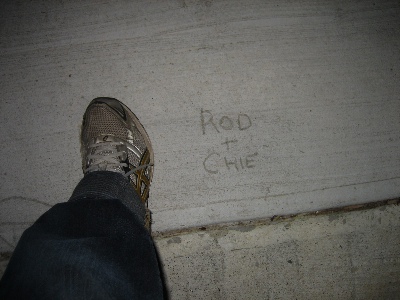
Rod and Chie, the owners, have made their mark in the footpath outside the converted
butcher shop next door:

IMG_3329.jpg

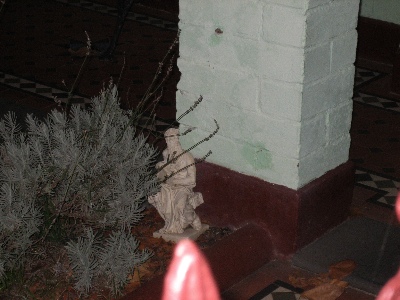
And just because it’s there, here’s a tiny replica of Michelangelo’s Moses that passes for a garden gnome in this part of the world.
IMG_3328.jpg

Hello world!

No action here just yet. I’ve signed up on WordPress because I’m planning to close down my existing blog, Family Life, and continue it here under a new name. The transition will happen on 25 May. See you here then!

Bookblog #62: More UKLG

(Published 6 April 2009, retrieved 29 July 2021.)

Ursula K Le Guin, The Farthest Shore (1972, Bantam 1975)
—, The Left Hand of Darkness (1969, Ace 1975)
—, The Dispossessed (1974, Avon 1985)
—, The Beginning Place (Harper & Row 1980)
—, Illustrated S D Schindler, Catwings (Orchard Books 1988)

Months ago, I mooched four books by Ursula K Le Guin from BookMooch , and have been reading them semi-assiduousy since. I’ve waited until I’d read them all to do a combined post.

92a

A sufficient interval having passed since reading The Tombs of Atuan, I moved on to the third of the Earthsea books and was not disappointed. It reminded me at some moments of The Voyage of the Dawn Treader, probably because both books feature a ride in a boat that goes on and on and on. There’s no character as irritating as Reepicheep, however, and though the final destination was fairly clearly signalled, I didn’t have the oppressive sense in this book that all was predetermined, as I did in the C S Lewis book. (If you haven’t read VDT, don’t let these remarks put you off. I believe many people found it utterly delightful, and Reepicheep among its finest elements.)

There are really only two characters in this book: Sparrowhawk, now the Archmage of Earthsea, and young Prince Arren who comes to ask Sparrowhawk’s advice on a problem in his home island, and stays to be his companion in seeking out the cause of the problem – much bigger than Arren knew – and in the end overcoming it. The relationship between the two men, old and young, is a thing of great joy. Arren is described early on as falling in love with the old, wise man, and I can’t help lamenting that the moral panic about paedophilia that has corrupted our culture in the last 30 years has made such a description feel risky. I didn’t care very much about the villain: though the final confrontation with him wasn’t written perfunctorily, I read it without any particular commitment. On the other hand, a splendid non-human character makes its first appearance less than ten pages from the end, completely convincing, completely memorable. How does she do that?

Incidentally, the author biog in this book answers the question about the author’s middle initial: the K stands for Kroeber, the name of her anthropologist father and writer mother.

Then I moved on to a couple of adult books, to both of which I brought preconceptions.

22b9

I knew The Left Hand of Darkness had a lot of gender-bending, and I had a subliminal assumption that it was a bit of a women’s liberation tract. It’s not that I expected to be out of sympathy with its sentiments. I just didn’t relish the idea of 300 pages of right-on propaganda from forty years ago.

I needn’t have worried. UKLG is a story teller with a great gift for aphorism (my mooched copy has quite a bit of pencilled underlining of sentences like ‘A profound love between two people involves, after all, the power and chance of doing profound hurt’) and a miraculous capacity for world-building. On the planet Winter, the humans become sexual for only a couple of days each month unless they are pregnant, and there’s no telling whether a given individual will be male or female in any given month. This holds a distorting mirror up to our assumptions about the primacy of gender for human identity, but there’s no preaching, and the reader is not told what to think about it all. The visitor from a planet where sexes are differentiated much as ours are (perhaps he’s actually from Earth) develops a close bond with a member of the other species, and is alone with him (every individual is referred to as him, even when pregnant) for several months – we know that he will be in ‘kemmer’, kind of like oestrus, during their time together, and the sexual tension will be huge. Not only that, but it’s clear that the shape of the book requires that their relationship reach a new level of intimacy. In the hands of a lesser writer this could have led to erotico-bathetic disaster. Not so here. The author plays completely fair; the tension is resolved; intimacy is achieved; nothing is icky.

03a86

If I had subliminally prejudged The Left Hand of Darkness to be 60s feminist polemic, The Dispossessed was filed in my brain under Anarchist Agenda. I may have actually read an excerpt when it first came out, in which there was a lot of exposition about the workings of anarchism on the planet Anarres. As expected, the book was a joyous surprise. The society founded by the followers of the sage Odo is, if anything, more profoundly challenging to our assumptions about human possibilities than the ‘bisexual’ characters of The Left Hand. These are people who learn from babyhood that you can’t own anything, that ‘excess is excrement’. They speak not of ‘my mother’ but of ‘the mother’; they have trouble grasping the concept of class or understanding the function of a state; they refer to the society on their twin planet/moon Urras, from which they are in voluntary exile, as archist and propertarian; and they find institutionalised sexism puzzling:

He knew from Odo’s writings that two hundred years ago the main Urrasti sexual institutions had been ‘marriage’, a partnership authorised and enforced by legal and economic sanctions, and ‘prostitution’, which seemed merely to be a wider term, copulation in the economic mode.

So yes, I guess you could read the book as utopian anarchist propaganda, but it’s much more impressive and engaging than that. The word ‘magisterial’ comes to mind. In Odo, who died two centuries before the action of the book, Le Guin has created a great visionary anarchist. We are given snippets of her life and works; the characters are steeped in them, quote chapter and verse, argue their meaning in a changed context – all in ways that make her a completely believable presence in the society based on her thinking

But the Odonians haven’t got everything right. Shevek, a brilliant temporal physicist (that is, one who deals in the physics of time – Shevek’s general theory of Simultaneity will transform space travel possibilities) can’t get his theoretical work published because the Odonian opposition to ‘egoising’ has congealed into a bureaucratic stymying of creativity, and sometimes wells up into mob hatred of anyone who challenges received ideas. Facing down accusations of treachery – and dodging hurled bricks – he goes to Urras to further his work. Chapters telling of his life up to the point of departure alternate with those narrating his culture shock, seduction and eventual disillusion among the propertarians. The book is still powerful and inspiring after all these years, bodying forth the truism that how things are is not how they have to be forever. I suspect that fans of Ayn Rand would see it as ridiculous fantasy from beginning to end, but then …

09c1ee

What do you do after you’ve written something as profound as The Dispossessed? I hope Ursula Le Guin managed to rest on her laurels for at least a little moment. it may have been a mistake for me to move straight on to another book of hers, away from the ‘Hainish’ world of the last two, because The Beginning Place seemed very pale by comparison. It is fantasy love story rather than political science fiction, and if it wasn’t written in impeccable, musical prose, it would be too long by half for its simple, and predictable, story. But predictable is sometimes just another word for archetypal, and there’s plenty to surprise and delight. Having just intimated a couple of paragraphs back that I was relieved at the absence of a sex scene in The Left Hand of Darkness, I should say that the sex scene in this is handled with a degree of frankness that all the same manages to avoid disrupting the story. We do have this sentence, however, as a warning that sex is dangerous to write about (the characters are fully clothed at this very serious point in the narrative): ‘His desire for her stood up and throbbed against her belly, but his arms held her in a greater longing even than that, one for which life cannot give consummation.’

Catwings

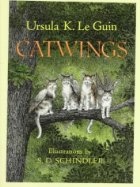
Some time in the middle of my Le Guin Readathon, a friend said she’d read everything by UKLG in her Anarchist youth. I rushed from the room and brought back the first two Catwings books – this book and Catwings Return – which she admitted she hadn’t heard of. When she brought them back a couple of days later she said she’d enjoyed them, but two were enough: no need for Wonderful Alexander and the Catwings and Jane on her Own (neither of which I’ve read, so it seems I agree with her). Before putting them back on the shelf where we keep books for visiting children, I re-read just this one, and found it just as magical as the first time. I believe the idea for this book came to Ms Le Guin while she was standing in a queue at a supermarket, and she drew a sketch of a cat with wings on the back of her shopping list. S D Schindler’s convincingly realistic illustrations are a large part of the book’s charm. This was probably my fifteenth reading, and the last line still brought tears to my eyes.

Again a little while and we will see it

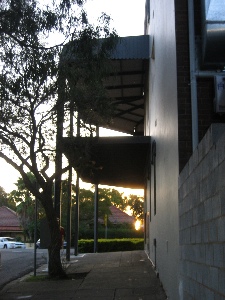
It’s Passion Sunday. The statues in the Catholic churches are swathed in purple (or used to be when I was a frequenter of churches). We’re in the countdown to Easter. If you’ve been following the saga of our corner shop, about to be a cafe, you’ll undoubtedly remember that Easter is the latest of a series of promised opening dates. There’s been definite movement. I don’t know if you can tell from these phone photos, but the balcony with its bullnose awning is coming along well. A stylish grey paint job is under way on the upper outside of the building. We’ve had some heavy rain – who can complain? – but the two or three guys who’ve been up on the scaffolding for weeks now seem to be cheerful about progress. I’m not banking on an Easter rising, but I’ll be surprised if Revolver (as the shop is to be named) fails to be there by the Ascension Thursday. A little while and we won’t see it, but again a little while …

This slideshow requires JavaScript.