Les voies d’Anubis

Tim Powers, Les voies d’Anubis (J’ai Lu 1986; translated by Gérard Lebec from ‘l’americain’, original title The Anubis Gates)

2290020117When this turned up on BookMooch en français I decided to seize the chance to brush up my French at the same time as crossing an Apollo Award winner off my TBR list. The plan worked out excellent well. The novel is a fabulously over the top fantasy, like an extended episode of Doctor Who, only there’s no Doctor to help out when the quantum mechanical (or in fact magical) time travel to the England of Coleridge and Byron, and beyond, goes horribly wrong. Or it could be likened to a Cairo Jim adventure with an organisation very like the Old Relics Society and a time-travelling Eng Lit scholar cum pseudo-werewolf in place of Geoffrey McSkimming’s poet-archaeologist: it’s got Egyptian gods, animated statues, history mysteries, but sadly no animal companions. It’s a vastly inventive, rip-roaring picaresque adventure, with a lovely array of grotesque villains, some almost Shakespearean crossdressing, and much derring-do.

Reading it in translation reintroduced me to the childhood pleasures of incomplete comprehension, guessing meaning from the context, sometimes with a fair degree of confidence, occasionally looking a word up, every now and then having a word’s meaning emerge into clarity with repeated appearances, and even – once in a while – knowing what a word means without knowing the English for it (I had to look up embarcadère, for instance, to translate it as landing stage, but I knew what structure it referred to without benefit of dictionary).  I could just about feel my neurons reconfiguring.

The other pleasure came from pace: I was forced to read slowly, so slowly that by the time I’d finished the prologue and the first chapter, I felt as if I’d read a whole book, so in effect I got four or more books for the price of one. This effect was helped, of course, by the episodic structure.

I probably missed a lot, though I did laugh out loud more than once, which means I got at least some of the jokes, and that’s supposed to be the hardest thing when you’re reading in a language you’re not fluent in. In fact, there was at least one joke that might easily have been tailor-made for my situation: a character says at one point ‘Psaume en chemise sans cote de quarte?’ and I wracked my brains (‘Psalm in shirt on side of quad?’ Really?), only to be relieved five lines later when the character articulates carefully, ‘Sauté en mille six cent quatre-vingt-quatre’ (‘Jumped to 1684?’ which is simply reiterating incredulously what someone else has just said). [I just Looked Inside This Book at Amazon, and found that the original poorly articulated line was ‘Jutmoop sidskeen eftee door?’, gibberish which I don’t think would create the same puzzlement in someone who knew English as well as I know French.]

If this had been a ‘serious’ literary work and I’d enjoyed it this much, I’d probably feel that I ought now to read it in the original. While I now have Tim Powers on my list of authors to look out for, I’m happy with one reading of this, happy to recommend it as a constantly surprising and delighting romp either in French or in English.

Middle aged men talk about Anna K

anna002Last night my men’s group book group met to talk about Anna Karenina (Anna Karenin, as she’s called in the second hand copy I bought on Monday), and an excellent evening it was. We had Russian-themed food, largely bought from the venerable Cyril’s delicatessen, and unlike other books this one had us talking from the moment we arrived until suddenly, after a couple of hours, we moved on to fierce debate about what to read next.

Having been distracted by Other Things, I’d only managed to read a little more than 100 pages. But that didn’t stop me from joining in. In fact, as people talked about their favourite bits, I was able to remind them that almost all of those bits were foreshadowed in the early chapters. Another guy, who’d grown a Leninesque beard for the occasion, had read about half as much as I had (pushing out hairs on the chin clearly saps the reading power). Undeterred, he became a technical consultant for the evening, reading passages of exegesis or commentary from the essays up the back of the uni library copy someone had brought: why an adulterous woman in Russia at that time would lose her children, Tolstoy’s quasi-pointilliste method (not at all the mimesis it first seems – and we did have to chat a little about that word mimesis), the way Levin and Anna were two quite different ways of seeking, um, transcendence …

Sadly, if the way Anna dies hadn’t been the one thing I knew for sure about the book, it would certainly have been spoiled for me. No one bothered, in the manner of Mark Kermode discussing the latest Harry Potter, to refer to ‘the unhappy event’. I guess Anna’s suicide isn’t the big surprise that  Dumbledore’s death is.

What a wonderful book! As someone said, it’s a page-turner, yet it had us talking about spirituality, sexism, the industrial revolution, deep moral dilemmas, the uses of fiction, Tolstoy’s journey, the fascinating architecture of the book, excellent university moments from bygone days (two people remembered with awe Peter Shrubb‘s lecture on the first paragraph of Emma), the perils of translation (three translations in the room, three versions of the famous opening sentence) and much more. ‘I don’t read classics,’ one man said, ‘I don’t want to read stuff that someone thinks is good for me – but this was terrific.’ Now I’ve got a week to finish it.

The future prime minister and other animals

In days of yore at The School Magazine we used to comment to each other that Noelene Martin had a nose for the parts of someone’s life that would grab young readers’ interest. Her first book, Freda, a biography of Freda Whitlam, shows that her nose stays good when she’s writing for adults. In today’s Spectrum, it’s Bruce Elder’s Pick of the Week, and his review gives a good sense of the book:

This is not a conventional biography. It is, essentially, a life crafted out of a series of interviews and conversations with the subject. It reads like a quirky, chatty, anecdotal account of a life full of interest and incident. Some events, important in an individual life, but unimportant in an overview of a career, keep interjecting themselves into the narrative to such a point that Ms Whitlam’s childhood comes across like young Gerald Durrell in My Family and Other Animals.

freda002

But of course my regular readers read about it here first. Oh, and in case you’d like a copy (and you know you would) but are shy about calling the phone number given in the Spectrum, you can email mrsmarty AT aapt DOT net DOT au.

Not everybody hates the Chaser

In case, like me, you’ve ever wondered how people who are involuntary participants in a Chaser skit feel about the event, you may be interested in this one sample.

It was slow in the Annandale Post Office just now. When the two women behind the counter exchanged a couple of words in a language I didn’t recognise, I asked what language it was. ‘Tagalog,’ they said, ‘we weren’t talking about you.’ Which reminded me of last night’s Chaser skit, one of the very few I found funny, where they pretended to be USians who couldn’t understand the language spoken in England, asking people repeatedly if they could speak English. When I mentioned the Chaser, I didn’t get as far as mentioning that skit, because both women beamed with delight:

‘The Chaser! They came here! They tried to post a piano. They said they were moving to Burwood and wanted to send the piano through the mail.’

They both laughed and laughed, describing the absurd conversation, pointing to where the cameraman had stood. I asked if that bit had been screened, but they didn’t know: they don’t actually watch it.

I came home and found some photos of the shoot, which includes Glebe Post Office as well as Annandale. My interlocutors are in the background of one or two.

piano

Screen grab of a photo by Edwina Pickles

Of course, the hapless employes of tobacco companies, the odd minister of religion woken in the wee hours to be asked if he’s had any more predictive dreams, the Rudds who are just trying to go to church looking as if they’re weathering a family crisis, the US vox pops who are made to look stupid in the extreme – these may not look back on their encounters with quite as much joy. But it’s good to know that some people do.

Corner shop: the (inside) story so far

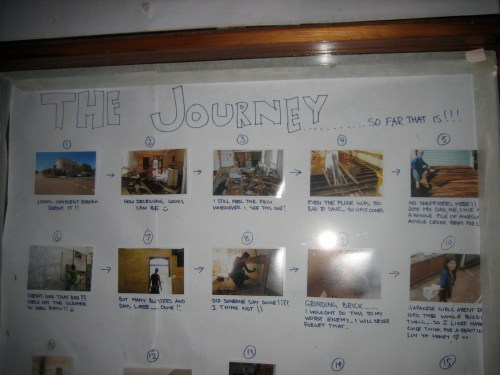
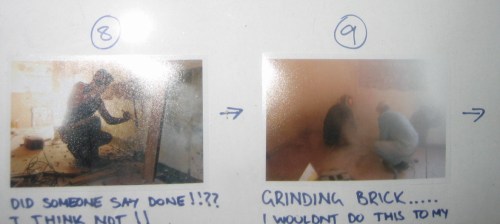
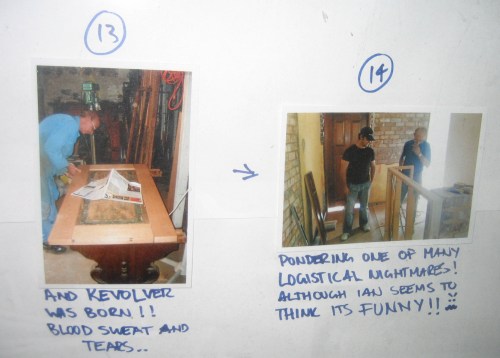
Rod, proprietor of our approaching corner shop /cafe, has had enough leisure time to post a photo essay in the window:

shop

Here’s the detail:

shop1

shop3shop2

shop4

shop5shop6

shop7shop8shop9

Finished! Woo hoo! Opening day can’t be far off.

Annandale pride

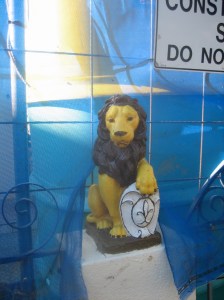
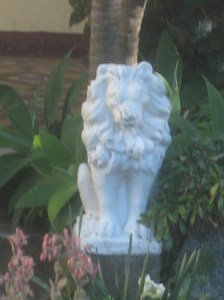
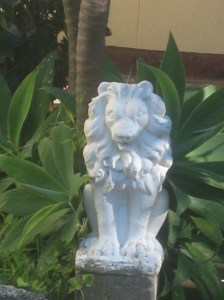
When I mentioned to a neighbour that I have a blog where I occasionally post snaps from around Annandale, she said she had an idea for me: ‘If archaeologists are sifting through the ruins of Annandale one day, they might think we worshipped lions. You should photograph some of them and make a joke about pride.’

So here they are, all within a hundred metres of each other, though they’re not a pride because, oddly enough, they’re all male.

IMG_3356 IMG_3357

IMG_3358

IMG_3359

IMG_3360IMG_3361

A poem I love that you won’t have read

I googled a phrase from this poem and came up with nothing, so I’m putting it up on the web for the world. It’s from Andrew Huntley’s Lyrical Ballast, Ode and Divers Poem, published (along with Martin Johnston’s first book, shadowmass, and Terry Larsen’s Tar Flowers) by Arts Society Publications in (I think) 1970. It was a big hit with student audiences.

An Essay on Criticism
(for Martin Johnston)

Maisie were a critical
Severe she wore her bun
She lecturing on literature be grim.
Arnold he be engineer
He’s reading just for fun –
Maisie meaning all the world to him.

Maisie has her secret
She blush when she bethink:
‘Tide me woe I Arnold loving you.’
But engineer is simple
He silently and blink
So other love the neither lover knew.

He pass around her passage
She walk with head abstruse
But fingernail she clench into a page.
Poor engineering Arnold
What skulking is the use?
She bridges scorn, he building them in rage.

Thus pass they days in likewise
Till one day force his mind –
He burst upon a paper ‘I love you’.
The brain alit in lightning
He search and searching find
A blending rhyme that rhyming ‘Eyes of blue’.

In short he writing poem
His first and only work.
He nameless post to Maisie English Lit.
Her greenly eye she cast up from
The paper with a jerk
She running find her colleagues of the crit:

‘Oh someone be me sending
Such funny little verse
What drivel are this word upon the sheet.’
They look and fog their glasses
It torn to shreds, and worse –
For Arnold pass and hear them in their heat.

His ears start to burning
His soul it next to go
He sneak away before his hair catch flame,
For Maisie she were laughing
At all the love he know
And take apart he’s poem like a game.

Her echo follow Arnold –
He rush where to forget –
Go building bridges on the upper Nile;
And one day – is it accident? –
He fall and getting wet
And getting eaten by a crocodie.

Maisie now professor are
A virgin do I add
She going down ‘The Great Tradition’ way –
She whittles off the authors
She think they mostly bad
And glaring from her pedestal she say:

‘Dismiss dismiss disnissing
Minor minor miss
Discuss disgusted there is only one!’
Her nightmare re-occurring
(She always dreaming this)
She in the campus bookstore getting Donne.

She publish pile of article
She talk and talking talk
She crossing out in pen that mostly red,
She pouring scorn on versicles –
Through literature she stalk –
She only still and silent in her bed.

If moment had y0u faltered
O Maisie long ago
You spy the love that helplessly he send,
You might have found it Arnold
You might have come to know
A poem can be way to make a friend.

I can’t track Andrew down to get his permission. (If you read this, Andrew, please get in touch. Of course I’ll take it down if you want, but I do think it deserves to live.)

Added 22 June 2020: Andrew has given this poem as his contribution to the Recollections page on the website commemorating the 30th anniversary of the death of poet Martin Johnson (at this link).

Leave to remain

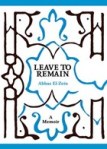
Abbas El-Zein, Leave to Remain (UQP 2009)

9780702236921

There was a piece on the news recently about a conference on Islamophobia. My lay thought on the subject is that the best way to make headway against that polysyllabic malady is to make friends with actual flesh-and-blood Muslims. A probably less efficacious but also less challenging cure might be to read books by Muslim writers. Irfan Yusuf’s Once Were Radicals is a case in point. So is Leave to Remain. Both books are memoirs by Australian Muslims who were born elsewhere, both deal with what it means to be Muslim and ‘of Middle Eastern appearance’ living in Australia; Irfan Yusuf comes from the rough and tumble world of blogdom and doesn’t know when to write ‘my friend and me’ rather than ‘my friend and I’, whereas Abbas El-Zein is a university professor and novelist, parts of whose book have appeared in literary journals. Once Were Radicals did a beautiful job (for me at least) of ‘de-Othering’ Islam – that is to say, I felt that the author had done a brilliant job of bridging the Islamophobia chasm. I approached Leave to Remain expecting something of the same, for a different generation, a different national background (Yusuf left Pakistan for Australia when he was a small child; El-Zein was an adult when he came here from Lebanon).

Paradoxically, even though Abbas El-Zein’s childhood and youth in war-torn Lebanon could hardly have been more different from mine in what someone has called the cotton-wool peace of White Australia, I had much less of a sense of chasms being bridged with this book. Perhaps that’s because Yusuf’s memoir deals largely with his adolescent exploration of Islam, which is still pretty much a closed Book to me; while El-Zein identifies unwaveringly as ‘an adherent … to Enlightenment ideas and practices concerning the secular state, pluralism, science and technology’, close to my own cultural identity.

The book has elements of biography, but is actually a collection of personal essays, each with a stage of the writer’s life as subject and springboard. It’s divided into two parts, of roughly equal length: the first, ‘Origins and Departures’, takes us up to the 32-year-old El-Zein’s arrival in Sydney in 1995, the second, ‘Unhappy Returns’, deals mainly with his return visits to Lebanon and his responses to the wars that have afflicted that part of the world since. I don’t have time to say much more than that there’s some wonderful writing and give some samples.

On his adolescent anti-Americanism (which he repudiates as naive, but records all the same):

As a teenager, I worried about America because I could not understand how it could show off its wealth so casually on screens around the world. Was it not afraid of exposing itself, of being so present in the lives of so many individuals, a presence which was all about America itself? Once, during the war in Beirut, my mother told my teenage sister not to go out with too much jewellery round her neck because the only men she would be likely to attract were robbers. I thought America could benefit from a little talk from my mother. Not that America was likely to grant an audience. America was a blind Narcissus, constantly playing mental images of himself with no hope of seeing himself, let alone anyone else, because he was Narcissus and because he was blind. America could not see. It was made to be seen.

On the War on Terrorism:

A Manichean view of history – in which ‘we’ are indisputably good and ‘they’ are inherently evil – remains the West’s dominant form of expression about terrorism, post–September 11, and barely disguises its racial overtones. It is one of the mysteries of our time that the Soviet nuclear warheads and the IRA campaign on the British mainland, to name two relatively recent threats, did not cause nearly the same ‘existentialist’ panic that a Middle-Aged tribesman has succeeded in inflicting on the West’s collective psyche from his remote hideout in Afghanistan. For all the atrocious deeds of Al Qaeda and European Jihadists in New York, London and Madrid, who does seriously believe that they pose a threat to our existence in the West?

There is a wonderfully comic–grotesque description of his first walk from Redfern Station to Sydney University a few weeks after his arrival in Australia. ‘There was more mutilation around this street than I could live with,’ he writes – and we remember that this is a man who grew up in a civil war. He writes beautifully about his parental anxieties: his little son Ali announces with glee that his name can be found in the word Australia, and a few days later, just as excitedly, that it’s also in Alien. He writes graphic and instructive accounts of religious practices, especially of the Shi-ite festival of Ashura – mentioning in an aside that the public bloodletting that is so alien to Western sensibilities may well have been imported into Islam from the practices of Catholic Spain.

Incidentally, the book was designed, beautifully, by Jenny Grigg, who has been responsible for some of Australia’s most beautiful books (she redesigned The School Magazine ten or so years ago).

His foster parents went to Japan …

… and brought him back this fabulous hoodie.

IMG_3353

Sociopaths in suits

I don’t have anything intelligent, or even probably intelligible, to say about the Productivity Commission’s recommendations about parallel imports of books. Except maybe WRITE TO YOUR LOCAL MEMBER. But I liked this piece from Henry Rosenbloom’s blog:

This is how a civilisation commits suicide these days: it invites sociopaths in suits to dismantle its culture.