I’d like to think this little bit of graffiti was done in a spirit of whimsy, but I fear it’s part of a constant battle of signs. The signs on the other side of the battle say obnoxious things like: ‘This is not your dog’s toilet.’


I’d like to think this little bit of graffiti was done in a spirit of whimsy, but I fear it’s part of a constant battle of signs. The signs on the other side of the battle say obnoxious things like: ‘This is not your dog’s toilet.’
Vivian Smith, Along the Line (Salt Publishing 2006)
Having mentioned the ‘sixty-eighters’ a couple of times on this blog, I poked around on the net to find out what I was talking about. It looks as if the idea of a distinct ‘generation of 68’ among Australian poets can be traced to John Tranter’s 1979 anthology, The New Australian Poetry: the work of twenty-four poets from Australian poetry’s most exciting decade. The notion of a ‘generation’ was challenged almost immediately by, among others, Rae Desmond Jones (‘the … highly successful anthology and the polemical introduction had only marginal relevance to each other’), but it has lived on. More recently, as one might have predicted, the 24 68ers have been portrayed as a mob of up-themselves, cliquish poetry warriors, and – also no surprise – have been defended against those charges. (The article by Alan Wearne on that last link demonstrates nicely that reality is more complex, interesting and benign than the labels might suggest.) When the Tranter anthology came out I was distracted by being a new parent and earning a living and the like, but during the late sixties and early 70s I had been a regular at poetry readings in Sydney (and once, memorably, in Canberra) and can testify that the poetic times were pretty exciting. I have a copy of a 1971 publication, We took their orders and are dead: An anti-war anthology (edited by Shirley Cass, Ros Cheney, David Malouf and Wichael Wilding), which captures some of the feel of the Moratorium Poetry Readings where elder statesmen of Aust verse like AD Hope shared a stage with as yet un-labelled 68ers like John Tranter or Vicki Viidikas and quite a few in-betweeners like, say, David Campbell. (The 68ers themselves, of course, are now either dead or approaching elder status.)
 All of which is a convoluted lead-in to Along the Line, which I bought a while ago as my contribution to Salt Publishing’s Just One Book campaign. If memory serves, Vivian Smith read at those long-ago Moratorium readings. He’s certainly got a poem in the anti-war anthology. But he’s not a 68er – and not just because John Tranter didn’t include him. The poems in this book have a quiet formality that shows none of the influences or impulses that besotted the young ones in those heady days. The poems don’t spread across the page like spider webs catching and displaying apparently random flies of perception. They aren’t Chinese boxes or monkey puzzles. Neither the Ramones nor Bob Dylan are referred to even once. Iambic pentameters rule and straightforward subjects dominate: there are many arrivals in Sydney, the poet’s home, and at least as many returns to Hobart, where he grew up; there are poems about poetry, poets and painters, depression, friends alive and dead. I used the word ‘quiet’ , and that is the overwhelming effect: quiet reminiscence, quiet elegy, quiet observation, quiet wit, even, in ‘Deathbed Sketch’, some quiet philippic. Something of a quiet achiever, then, and reading him is a quiet pleasure.
Incidentally, ‘Return to Hobart’, the poem that appeared in the 1971 anti-war anthology makes another appearance here, unchanged except for much improved editing, which makes me realise that this is not a collection of new poems, but some kind of unspecified retrospective, which accounts for a sense of temporal dislocation – the poet’s daughter is a little girl on one page, for instance, and quite grown up a couple of pages later, and all those comings and goings between Sydney, Hobart and the rest of the world don’t have any discernible sequence.
Rather than say more about the poetry, let me declare an interest. Vivian Smith was the supervisor of my aborted MA thesis in the mid 1970s. Of course it wasn’t his doing that the thesis came to nought, though I wish I’d got my facsimile copy of Edward John Eyre’s Journals of Expeditions back from him before leaving the university. (Vivian, if you chance to read this and happen by some miracle to have those books still in your possession, I love your poems, please drop me a line …)
I have a vivid memory of a Year 3 elective in which Dr Smith gave a series of lectures to a tiny scattering of students. He was a quiet, unassertive lecturer, poles apart from, say, David Malouf, who lectured us with passionate brilliance on the Jacobean playwrights. At about the third lecture, there may have been only three of us in the audience – me up the front dutifully taking notes, and two older women (they must have been at least 28), one of whom has since gone on to wield power and influence in the ABC and elsewhere, the other to do impressive work as a journalist and writer, leaning together like grumpy conspirators. As Dr Smith was discussing the two main kinds of poetry being written in England during the post-war years, open and closed poetry if I recall correctly, the future journalist interrupted his flow:
‘Excuse me, but aren’t these generalisations almost completely meaningless?’
She had a point. Dr Smith responded quietly, modestly, and not at all defensively, ‘Yes, but they provide a structure that allows me to talk about the poetry.’
And he continued with the lecture, of which I remember nothing else. (Maybe I should be explicit here: I’m not suggesting that the poetry in this book is ‘completely meaningless’: rather that it isn’t out to impress, or seduce, or dazzle, but offers itself as a mind at work and play, take it or leave it.)
The long list has been announced for the John Button Prize for ‘Australia’s best piece of writing on politics and public policy in the past year’. I’ve read a number of the essays and books that made the cut, but the one that’s relevant to today’s nepotistic agenda is Paula Shaw’s Seven Seasons in Aurukun.
The judges – Bob Carr, Kerry O’Brien, Morag Fraser, Judith Brett and J.M. Coetzee – don’t look corruptible, otherwise I’d urge all four of my readers to try to influence them by any means necessary. They meet at the end of July to choose a short list of six, and the winner will be announced on 28 August.
Carn the Shaws!
Yesterday afternoon, in our customary sybaritic manner, Penny and I trotted off to a public lecture at the University of New South Wales: Deborah Cameron on the Myth of Mars and Venus. Since I blogged about the book on Thursday, and the lecture covered the same material, I won’t say much about the lecture here, except that I was fascinated to observe the way DC compressed the substance of the book to fit a one-hour time slot and reshaped it to fit her mainly academic audience. On the one hand (sadly) she left out most of the more colourful examples; on the other, with the help of a handout, she gave us a map of modernist and postmodernist takes on gender and language and of current challenges to the latter. One of the challenges she’s all in favour of, and in some ways amounted to the point of her book: it’s all very well to discuss linguistic diversity, but you have to include the concept of power as well. The other, which didn’t feature in the book, is the challenge from the recent renewal of arguments that differences between women and men are biologically based. ‘It’s no good,’ she said, ‘saying, “Oh not that old thing again. I thought we got rid of that in the 70s.” We have to engage with it. We may even learn something from it.’ In response to a question about the politics behind the resurgence of biological psychology, she was refreshingly blunt: “It’s the new academically respectable face of sexism.”
I was glad I’d read the book beforehand, because it equiped me to understand a lot of what got said during the Q& A at the end about gender as performance rather than something that simply exists in the real world. ‘I am completely free to decide how I speak, but I have no control over how I will be understood.’
There were 32 people there. I counted. About five men. Also sandwiches, red cordial, teabags and biscuits.
This morning, DC’s comments about the necessity of engaging seemed relevant to this spectacle:
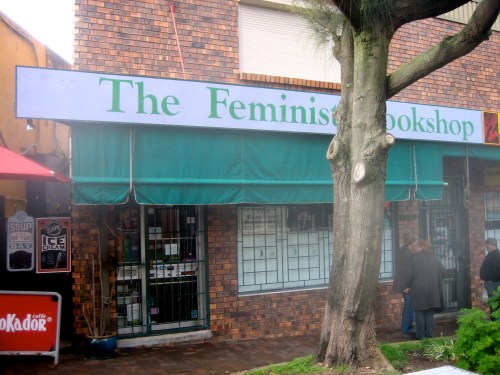
It’s Saturday morning, when this locality comes alive because of the Orange Grove Markets across the street. A coffee shop is doing a roaring trade jus a couple of metres from where I was standing to take the photo. People are everywhere, and in a buying mood. But even when the Feminist Bookshop opens at 10.30, two hours or so after serious activity starts, its shop front is hardly inviting. Even if the permanent bars on window aren’t as paranoid as they seem, surely the frosting can only be read as deliberate discouragement of casual shoppers. Of course, there’s no reason a feminist bookshop has to court customers. But wouldn’t an invitation to engagement be a better look?
Posted in Around Annandale, Diary
Tagged Deborah Cameron, Feminist Bookshop, lecture, snark

As typos go, I thought this was fabulous.
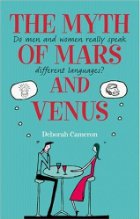 Everybody loves a good smackdown, especially when it’s delivered judiciously, with careful marshalling of evidence and argument. The Myth of Mars and Venus is such a smackdown to the noxious theses of John (Men are from Mars, Women are from Venus) Gray and his ilk.
Deborah Cameron, currently visiting Australia and speaking at the Uni of NSW tomorrow afternoon, is a linguistics scholar (according to the jacket flap she is actually Rupert Murdoch Professor of Language and Communication at Oxford University, a title that might itself spawn a learned paper or two). And she casts an unfriendly eye on the agenda-driven cherrypicking, or worse inventing, of research results that lead to all those fabulous scenarios about women and men being hard-wired to use language differently, coming from different cultures, etc.
I recommend the book to anyone who has been made to feel not quite man enough, not quite woman enough, ot trapped in a role because of intransigent and immutable biological inheritance, to anyone who has run some of their writing through the gender genie and wondered what was wrong with them (rather than what was wrong with the GG, as Deborah Cameron points out would be a more sensible response). I also recommend it to anyone who wants to read fabulous snippets of research into the language of adolescents in US cities, in a traditional New Guinea village, in 19th century Japan.
That is to say, this is a debunking book of the best kind: it puts sound research in the place of shonky, restores one’s faith inhuman beings, and has fun on the way.
The book in brief:
The genius of the myth of Mars and Venus is to acknowledge eth problems and conflicts many people are now experiencing as a result of social change, while explaining those problems and conflicts in a way that implies they have nothing to do with social change. They are as old as humanity (quite literally in some versions of the myth) and their root cause is the irreducible natural difference between the sexes. … The belief that [these problems] are timeless, natural and inevitable stops us thinking about what social arrangements might work better than our present ones in a society that can no longer be run on the old assumptions about what men and women can do.
Here’s a sight that struck fear into my heart. After months of work, a development proposal has been lodged. Oh, as they say, noes! The whole thing has been skating on very thin ice and now it might be declared illegal.

But closer examination revealed that the proposal is to have the number of outside tables increased ‘from four (4) to twenty (20)’. Incidentally, since I was about eight years old, I’ve wondered why notices from local councils and similar organisations do that with numbers. My mother explained to me that it’s so people who have trouble reading the spelled out version will be helped by the numerical version. I wasn’t convinced then, and now it just looks like ornamentation to indicate officialness.
I wrote off to Council expressing my support.
I had a brief chat the other day with Rod, the proprietor, who is looking slightly less harried though possibly more panicked with each passing day. He’s now chasing up suppliers, and said he was confident the grand opening would happen before 12 August.
Did anyone else notice in the 7.30 Report’s segment on parallel import of books last night the bit where the commentator said that on the one hand, those who argued for the lifting of restrictions said that the music industry had suffered no ill effects from the lifting of similar restrictions on importing CDs, and on the other hand those who argued the opposite said that there had been massive loss of jobs as a result of the change, and missed out the fairly obvious next step of telling us which of those two assertions was borne out by the facts.
This was the ABC, where ‘balance’ is now apparently valued above finding out the facts.
According to one strand of received wisdom, Alzheimers brings about a kind of regression: whereas a small child gradually learns skills such as walking, talking or handling cutlery, and builds mental models of the world, a person with dementia loses these skills in roughly the opposite order. In this model, my mother-in-law Mollie, who has almost completely lost the ability to read, walks with great difficulty and is rarely able to finish even a simple sentence, is almost back to infancy. The fact that as often as not she doesn’t have her teeth in might seem to confirm the impression. I don’t think it’s right.
Yesterday I dropped in for a short visit in the middle of the afternoon. She greeted me cheerfully, though not with any obvious sign that she knew me as more than a friendly stranger. After a mainly one-way conversation about the weather, I cast about and found a small picture book called Wild Animals to read to her. The book is exactly what you’d expect – photos of elephants, bears, cockatoos (in the Exotic Birds section), zebras, with a scattering of text. Mollie and I made our way through it, admiring the photos and occasionally referring to the text. Mollie was alert and responded with interest to everything I had to say. She singled out an ocasional word in a heading – Birds she could say; Owls she pointed to, and asked (‘That, that…?’) for help. When we came to an image of a bat, she traced the outline of its wings with a finger, saying, ‘Lovely.’ ‘Good,’ she said a number of times, and when I replied, ‘Beautiful,’she smile in a gratified way.
And you know, extremely limited as the conversation was, it was a conversation. I wasn’t conducting a kind of learning session in reverse, a test of her powers of cognition. We found a place where we could share the world, person to person, no big deal, enjoying each other’s company and pushing the dementia to the side for a moment, rather than having it the subject. I think Penny does this with Mollie all the time.
Mark Tredinnick, The Blue Plateau: a landscape memoir (UQP 2009)
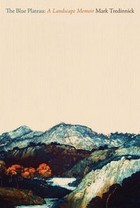 As well as being a poet and writer of personal essays, Mark Tredinnick teaches writing in both creative and business contexts (not that I think business is never creative, but you know what I mean). I went to one of his Sydney Community College courses a couple of years ago, and not only got a boost for my writing but also was introduced to contemporary nature writing – Mark had us read passages from some of the great American practitioners, did a non-pushy but in my case successful sales job on The Land’s Wild Music, his book about them, and talked about his own longterm project, a memoir about the Blue Mountains. At the Sydney Writers Festival this year, beside stacks of his Little Red Writing Book and Little Green Writing Book, there was the memoir, The Blue Plateau, in print at last.
You don’t have to scratch far in non-Aboriginal Australian literature before you come across the idea, usually accompanied by an element of yearning, that people live in close mutuality with the land they inhabit. It could hardly have been otherwise – the first settlers were discovering a new nature. Barron Field had fun describing a kangaroo
Nature, in her wisdom’s play,
on Creation’s holiday
and it probably makes sense to read a lot of Henry Lawson’s stories as exploring the deep interconnection of humans and environment – as in the oddly bathetic final sentence of ‘The Bush Undertaker‘:
And the sun sank again on the grand Australian bush – the nurse and tutor of eccentric minds, the home of the weird, and of much that is different from things in other lands.
Not to mention Judith Wright and all those poets who wrote about the landscape of the mind (‘South of my days’ circle, part of my blood’s country,/rises that tableland’ etc).
Mark Tredinnick is consciously part of a different tradition. Just as Patrick White decades ago revolted against ‘the dreary, dun-coloured offspring of journalistic realism’ which he saw as dominating Australian literature, looking instead to European models, Mark T looks to North American models. I know this, not because I’ve read any of them, and not just from the enthusiasm of The Land’s Wild Music, but from references embedded in the text – explicitly to Barry Lopez, in a nod and a wink to James Galvin, and perhaps by a mention of bell peppers where someone writing in an Australian tradition might have said capsicums or red peppers. The book offers a wealth of stories, mainly of three families – two who lived in the region for generations, transformed it in big and small ways by their labour, and were transformed by it; one who came as an immigrant and found home there. Actually make that four families, the fourth being the author, his partner and children: their stay in a place up on the ridge by Katoomba, and Mark’s attempt to belong there, is a central narrative thread. Many of the stories are classic bush yarns – miraculous escapes from bushfires, lives lost from flood and rockfalls. That is to say, they have the subject matter of classic bush yarns: they are told in elevated, mellifluous language, rich with simile and, especially, personification, a very far cry from the tightlipped, sardonic discourse we have come to think of as typically Australian. I wouldn’t want to give the impression that the book is a tapestry of yarns in the manner of Joseph Furphy’s Such Is Life, though in more high-falutin language. True, like Furphy’s fabulous book, it lacks a straightforward linear structure. But it is a very different beast: self-described as something that has been eroded, leaving only fragments of its whole, it is indeed fragmentary, to be read, I think, almost like a book of poetry. Some of the “poems” are ten pages or more long. The narrative of Les and May Maxwell stretches through the whole book like a backbone. There are many outcrops of observation, reflection or anecdote that are barely a paragraph long.
(A newspaper review on the weekend lamented the absence of Indigenous people, except ‘obliquely’. And it’s true that no Indigenous person appears as a character. But one of the distinctive features of The Blue Plateau is the way the Gundingurra people are a constant, though abstract, presence. Perhaps this is a book that’s easy to skip. And that’s every reader’s right, but one that, when exercised, makes it hard to be an accurate reviewer.)
Improbably, the opening paragraph reminded me of Terry Pratchett’s descriptive writing. I thought at first that to mention this would be to make fun of Mark Tredinnick’s elevated style. But that ain’t necessarily so. On reflection, I think it’s fair to say that my favourite fantasy writer manages to slip brilliantly lyrical writing past our defences by taking the mickey, Mark’s lyricism is full frontal, dares us to laugh, and restores the mickey to readers who are timid about lyricism in their prose. Here are a couple of excerpts from The Blue Plateau and bits of Terry Pratchett. See if you can tell which is which.
It’s early September, the driest month of the year, and the valley is rolling over into summer. The sun has been out all day, and now what’s left of it has fallen into the valley and is lying there on the yellow grasses like whisky in a glass.
The sun rose slowly, as if it wasn’t sure it was worth all the effort.
[The] soft yellow light of dawn flowed over the sleeping landscape like the caress of a gentle lover or, as some would have it, like golden syrup. It paused to fill up valleys. It piled up against mountain ranges. When it reached [placename here], it built up in heaps until it finally crashed in great lazy tsunami as silent as velvet, across the dark landscape beyond.
The valley is a woman who likes a bath, and she likes to smoke while she lies there. She breathes down the sky, and she lets it travel through her body, and she holds it a long time, and then she breathes it out again, heavy with desire and complaint.
Posted in Books
Tagged Barron Field, Henry Lawson, Mark Tredinnick, non-fiction, Patrick White, Terry Pratchett
 | Jonathan on Kit Kelen’s Food of… |
| Viscount Kit Kelen on Kit Kelen’s Food of… | |
| Jonathan on Florence Knapp’s Names |
 | This Reading Life on Florence Knapp’s Names |
 | kathyprokhovnik on Paul Lynch’s Prophet Son… |
| Jonathan on Paul Lynch’s Prophet Son… |
| kathyprokhovnik on Paul Lynch’s Prophet Son… |
 Currently reading & watching

