Me on Annabel on Malcolm

What might have been a blog entry grew up to be a paid review.

Sydney Ideas: Margaret Levi

I’ve been slack in my self-imposed duty to be a blog of record – that is, to keep you informed about what I get up to by way of going out to stuff in the evenings, often stuff you won’t hear about from the newspapers. Could it be that newspapers are dying because they don’t report on events like Tuesday night’s lecture in the Sydney Ideas series, A Challenge to the Hip Pocket: Evoking Commitments to Social Justice by Margaret Levi. After all, there were nearly 50 people at the Seymour Centre to hear her (the myriad other people seemed to be there for a children’s show in one of the other theatres).

All limp attempts at irony aside, it was a really interesting hour.

Professor Levi is joining the US Studies Centre at Sydney University and there was a sense that a fair whack of the audience was made up friends and colleagues from there. In acknowledging this, she looked around cheerfully and expressed the hope that there were new friends in the audience as well. Unusually for a visitor from the US she was remarkably well informed about things Australian, casually dropping John Howard’s name and referring affectionately to the Wharfies , the BLF and Australians’ love of acronyms, at least when talking about trade unions.

Her talk, which is promised to appear on the web soon – here – addressed the question: what is it about the culture and organisation of some trade unions that has their members willingly take on broader goals than the preservation of wages, conditions and so on? What was it about the BLF that made the Green Bans possible? How come the Wharfies (and the Longshoremen on the West Coast USA) went on strike to prevent pig iron being sent to Japan inthe 1930s after the invasion of China? In other words, she said, it’s the Lenin question, from his What Is to be Done? How does one induce workers to look beyond economist self-interest to broader, in Lenin’s case explicitly revolutionary, goals?

I didn’t take notes, but her answer boils down to a couple of things: genuine commitment to democracy in the union (or other organisation), not necessarily in the sense of rotating the main leadership, but in having plenty of openings for membership to have their say, and having had their say to determine policy; membership given accurate information about the world; opportunities for discussion. She’d given a talk at (I think) the MUA recently, and afterwards an old man approached her to say that back in his days on the wharves he didn’t have much time for Communism, but when the Communist leadership told them what the Dutch were doing in Indonesia, and that Dutch ships were passing through Sydney, he and the membership were outraged and willing to take action: they didn’t have an ideological position, but they stopped the Black Armada.

This stuff isn’t taught in history classes. It’s clearly not a huge crowd-drawer. But you know, there was something very sweet about being addressed by a US academic who didn’t shudder when she used the word ‘Communist’, and who responded with respect to questions from the floor from men who I’d guess were old truckdrivers. In fact, one of those men spoke at some length about the importance of workers getting together to talk about their situation, to learn from each other, about how email was no substitute. When he’d wrestled what he wanted to say into some kind of rough question as per the chair person’s instructions, Margaret Levi said, ‘That wasn’t a question. It was a statement, with which I agree.’ She got a laugh, but it was at no one’s expense.

My Place on our street: Mr Malaprop

As I passed the filming site just now, in the almost dark, they’d all but finished packing up. I had a short chat with the security guy. Excerpts:

Don’t let anyone tell you they don’t work hard. They’re here at five every morning…. You’ll like it when you see it.

Yes, I really liked the book.

If you read books you’ll have read Mayo’s Last Dancer. We made that last year. With Bruce Beresford, from Growing Miss Daisy.

I want to read that book, and see that movie: waltzing for the dressing, and raising a flower child.

Thank you for listening.

Once Were Radicals

Irfan Yusuf, Once Were Radicals: My years as a teenage Islamo-fascist (Allen & Unwin 2009)

Once Were RadicalsOver the years, I’ve regularly resolved to rectify my appalling ignorance about Islam. My bookshelves bear witness to my good intentions with a smattering of titles like The Complete Idiot’s Guide to Islam (though I don’t have that precise book) and What’s Wrong with Islam, and none of them have I ever read.

Enter Once Were Radicals. Perhaps it was the hint of B-grade horror movies in its subtitle that made it seem accessible, or perhaps it was the ludicrous cover image of the author – dark-skinned, bearded and brandishing an automatic weapon, but wearing a boxing kangaroo T-shirt, one cricket pad and a Gen-X smirk in front of a bullet-pierced rifle-range target. Whatever, this is book broke through my worthiness barrier.

Irfan Yusuf, Pakistani Muslim from North Ryde, former member of the Liberal Party, old boy of St Andrew’s (Anglican) Cathedral School, blogger (in fact, the book has its own blog), winner of the Iremonger Award for Writing on Public Issues the year my niece Paula Shaw was runner-up, has written a kind of demotic Apologia Pro Vita Sua, an extended episode of Pizza with political Islamic writings in place of bongs.

The comparison to the Apologia isn’t as far-fetched as it might seem. Compare John Henry Newman’s opening words

I cannot be sorry to have forced Mr Kingsley to bring out in fulness his charges against me. It is far better that he should discharge his thoughts upon me in my lifetime, than after I am dead.

to the way Irfan Yusuf begins his acknowledgements:

Believe it or not, the first person I’d like to thank is the former US President George W. Bush for popularising the clumsy term ‘Islamo-fascist’.

Both writers take personally the insult – of untruthfulness and terrorist tendencies respectively – to their religion, and respond with what Newman described as ‘draw[ing] out the history of [his] mind’:

I will state the point at which I began, in what external suggestion or accident each opinion had its rise, how far and how they were developed from within, how they grew, were modified, were combined, were in collision with each other, and were changed; again how I conducted myself towards them …

In Yusuf’s case this is a history of growing up as a middle-class immigrant in Sydney, revisiting Pakistan a number of times as ‘an Aussie kid’, gradually learning to distinguish among the interpenetrating religious heritages of his South Asian ‘uncles’ and ‘aunts’,  going to Muslim youth camps, learning parts of the Koran by rote in Pakistan and at home, reading books given him by his Wahhabist aunt, toying with conversion to Christianity, engaging passionately with Islam in a number of ways in his teenage years, and in the end achieving an impressive equilibrium. He is given a copy of The Protocols of the Elders of Zion, but his parents remove it deftly before he can read any of it; he reads The Satanic Verses, and his mother objects because it might interfere with his studies.

As one who was deeply involved in Catholic matters in my teenage years, I could relate to young Irfan’s trajectory, including the bit that involved learning by heart slabs of text in a language he didn’t understand. Even though I’d be hard pressed to name withy any confidence even one of the authors who attracted him to political Islam, the sheer complexity of his reading is in itself instructive: everybody knows there’s not just one Islam, but following the teenage Irfan’s quest made the complexity of Muslim cultures tangible, almost tasteable.

The Pizza connection: Once Were Radicals is at times very funny, with plenty of a specifically Australian quality of ethnic self-mockery. Yusuf impresses on us early in the book that his mother is highly educated, and that she made a calculated decision to speak Urdu in the home so that her children would not lose the language of their cultural heritage, and there’s no disrespect in his lampooning of her heavily accented English in the rest of the book. Lakemba’s Sheikh Hilaly features in one or two scenes whose comic effect couldn’t be further than the pot-shots taken at him by journalists and aspiring satirists: he treats a young bikini-clad Australian woman with friendly courtesy, and tells his astonished teenage charges:

Ostraalyan beebul goodh, nice friendly beebul. Wee Muslim fighth thoo mush. Vee should lurrn from za Ostraalyan beebul how show respect.

All of this is pretty much what I expected of the book after hearing the author speak at the Sydney Writers’ Festival. I didn’t expect to be moved to tears. It’s against my religion to tell how a book ends, but I can tell you that for me this one did end in tears.

This needed saying

From one of my favourite political blogs, A Tiny Revolution, some belated but incisive reflections on ‘humour’ about Michael Jackson and by extension other tormented celebrities:

Anybody who runs for President, much less does what it takes to win, is just as weird as Michael Jackson was. They simply hide it better. Here was a guy so terrorized by his father that he’d vomit at the sight of him; a guy whose talent robbed him of his own childhood; a guy who spent the rest of his life mutilating himself and possibly mistreating others in an utterly doomed attempt to find release from his pain. Apportion the blame however you like, but what the hell is funny about that? The moment you stop to think about it–for one second–it no longer becomes fodder for humor. So when we laugh at a Michael Jackson joke, we should know: that’s not laughter, that’s keeping yourself dead inside.

Read the whole post.

Corner shop: Foreshadowing

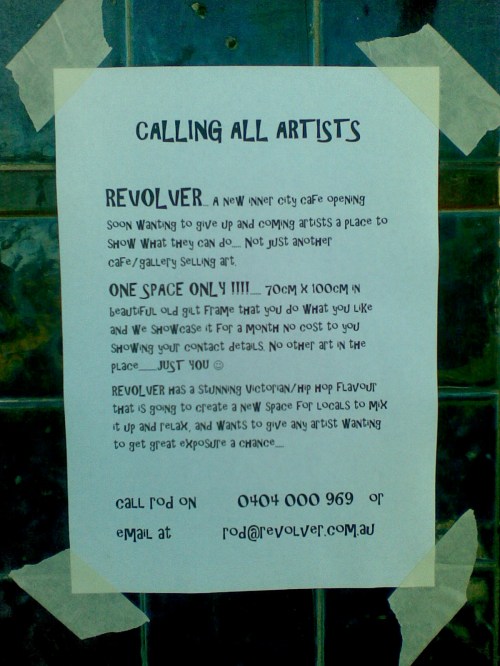
A little glimpse of what may be in store in the store:

callingartists

Transcription:

CALLING ALL ARTISTS

REVOLVER … a new inner city cafe opening soon wanting to give up and coming artists a place to show what they can do … Not just another cafe.gallery selling art.

ONE SPACE ONLY!!!! … 70cm x 100cm in beautiful old gilt frame that you do what you like and we showcase it for a month no cost to you showing your contact details. No other art in the place … just you 🙂

REVOLVER has a stunning Victorian/Hip hop flavour that is going to create a new space for locals to mix it up and relax, and wants yo give any artist wanting to get great exposure a chance …

Call Rod on [see image above] or

Email at rod at revolver dot com dot au

Brought to you as a community service

The sixty-eighters’ young appreciators

Beautiful day in Sydney, what better to do than take the bus into town for a free event at the Museum of Contemporary Art. ‘The Young Appreciators‘ was part of the fourth floor exhibition, avoiding myth & message: Australian artists and the Literary world (capitalisation not mine!), which seems to be mainly about artists and literary folk from the late 1960s and on – that is to say, not so much Sidney Nolan–Ern Malley as Tim Burns–John Forbes.

Today is the first time I’ve realised that there is a group of Australian poets known as the 68ers, or perhaps the 69ers: John Forbes, Robert Adamson and John Tranter (whom those in the know refer to by second name only), and quite a few others who are sometimes hard to see because of the long shadows cast by those three. The three speakers at today’s event are younger than the 68/9ers: the oldest admitted to 39, and I’d guess the other two were quite a bit younger. That is to say, none of them had been born in those days when I used to go  regularly to poetry readings to hear John Forbes, who I thought was a bit of a smart aleck and not as interesting as, say Martin Johnston (another 68/9er who doesn’t seem to cast such a long shadow).

Anyhow, it was fun. The first speaker spoke of Vicki Viidikas, beginning her talk by saying she hadn’t known much about her until after she’d accepted the invitation to talk. Since I’d heard the ABC radio programs that she based most of her talk on (with acknowledgement), I can’t say I was riveted. The second tackled John Forbes, mostly, as she said, in terms of marginalia and biography – mentions of herself she’d found in published Forbes letters, for example. It was in her talk that I became aware that those poets of my youth have since become the subject of academic attention. The third, the elegant poet Tim Wright, speaking softly and swiftly enough to be near to incomprehensible to me, talked about Pam Brown, visibly writhing with embarrassment at having the subject of his talk actually in the room.

I loved the moment during the brief question time when Kerry Leves, another of the apparently short-shadowed 68/9ers, admitted that when he’d seen a particular person’s work on a table in the exhibition, he’d said, ‘I don’t remember her!’ It’s a small world, the world of Australian poets and artists.

And I got a real hand in my understanding of Pam Brown’s poetry. I managed to hear Tim Wright say that her work was in many ways similar to Jennifer Maiden’s, but that whereas you tend to read one of Jennifer Maiden’s poems right through to the end, and when you do you feel you’ve learned something (a true statement), with Pam Brown’s work it’s not like that. You tend to stop and ponder a phrase, stare into space, let it sink in or just be distracted (he called her the master of the poetry of distraction, or something of the sort), then go back and read it again: it’s perfect for reading on public transport. I realised that my unexamined working assumption that reading is a linear process – you start at the beginning and go to the end and derive meaning on the way – has made quite a lot of poetry hard to enjoy. And I do read it while walking the dog — surely picking up a bag of dog poo or playing tug-of-war with a stick between lines should have put me in the perfect state of mind. I’ll try again, not so much harder, as with less resistance to the forces of distraction.

The corner shop: swish doors

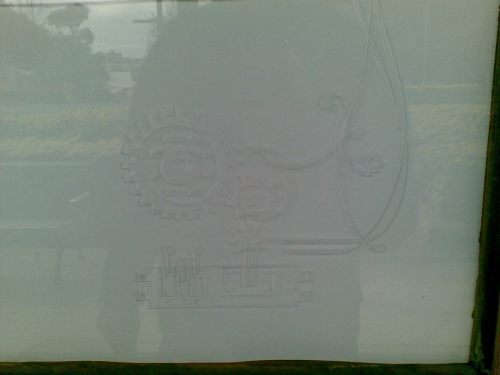
This isn’t one of those paintings that looks as if it’s just a white canvas but turns out to be covered with tiny Arabic characters or the like. It’s a much poorer thing: a photograph by way of progress report on our corner shop that has been in the making for a very long time.

I noticed on my walk yesterday that the ply panels in the doors, which functioned as a chat board of sorts for while, allowing people to argue the merits of the mermaid and various bread suppliers, to exclaim about desirability of having coffee on our corner, those panels have been replaced by glass. And the glass, backed by white paper to hide the shop’s interior, is etched with a design whose mechanico-Victoriana lines echo the painted wall that an unphotographed sneak preview revealed to your blogger some time back.

27062009

So, we have glass in the door. Can opening day be far behind?

Stay tuned.

My Place on our street

For a little while now, a clump of big white vans has been turning up a block or so along our street. Marquees have been pitched in our nearest pocket-handkerchief park. Bevies of young women in long skirts, lace-up boots and bonnets have been ushered across the road by what should probably be described as school-marms. Yes, someone has been shooting a period film in Annandale. My curiosity wasn’t particularly piqued. We may not be New York City, but over the years our suburb has contributed its bit to the big and little screens, and we may have become a little blasé.

Then on Wednesday this week a letter appeared in my mailbox from little leaf pictures indicating that the action was about to move closer to our house, and that there would be ‘stop/go traffic control’ between 8 in the morning and 5 in the afternoon today. But here’s the interesting bit:

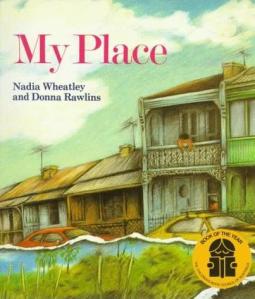
We are producing a children’s television series to be screened on the ABC, called ‘My Place’, based on a book by Nadia Wheatley. [Each of thirteen episodes] tells the story of the changing physical and cultural environment of a Sydney suburb from 1888 to 2008, seen through the eyes of thirteen children (a decade apart) whose common element is the terrace they all live in.

I love that book. I bought it because I’d known Nadia when we were both a lot younger, and read it with Penny in a state of high excitement over a hot drink in a Glebe cafe: how much history, of class and colonisation in particular, was worked into its pages! I wept into my hot chocolate at the last page. It’s wonderful that it’s being made into a television series, though they seem to have decided to leave out the first 100 years, which will surely risk pushing it right out of shape. And I’m not sure that broad, leafy Annandale Street can really stand in for the narrow lanes of Newtown (or was it Redfern?) of the book.

My Place IMG_3337

So I was out there today bloggerazzing.

IMG_3344 IMG_3347

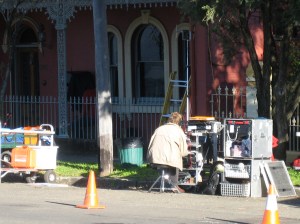
Sadly, on my morning walk-past all the action was inside the house. The black shrouded thing on the porch is a monitor and the people in the foreground seem to be keeping track with a vast array of tech gear.

The afternoon was marginally more interesting: filming was over for the day. One or two children were hanging about in pyjamas and dressing gowns, but such are the times that I wasn’t game to take their photos. The ABC’s press release mentions a dozen fabulous actors, but none of the ones I would recognise were in evidence. I did spot one elegant 50s housewife ducking into the costume van and she graciously posed for me:

IMG_3349

They’re filming all next week, but I can’t promise any more images. A man in a three mile jacket told me the series will be screening on the ABC in January next year.

Disillusioned with Dylan (a little)

I’m having a lovely time these days listening sporadically to Bob Dylan’s Themetime Radio Hour. He plays a marvellous range of music, from the full version of ‘You Are My Sunshine’ to totally esoteric blues, with lots of banjo in between, and gives good gravel-voiced DJ spiel, full of biographical snippets about the singers and songwriters he features.

But just now, listening to the program ‘Musical Map‘, I had the uneasy feeling that there was some clay in his cowboy boots. He played a song by one Hank Snow, which he described as Hank Snow’s signature song. It was ‘I’ve been everywhere, man’, a charming patter song consisting mainly of a string of US place names. No mention of a writer, just the fascinating information that Hank Snow was the man who introduced Elvis Presley’s first stint at the Old Oprey.

Bob, just in case you’re reading this, the writer of that song could have done with a mention. He was Geoff Mack. And before it was Hank Snow’s signature song, it made Lucky Starr a household name in his home country. But both of them were Australians. Not worth a moment’s notice. Apparently. Hmph!