Anathem, Heavy

Neal Stephenson, Anathem (Atlantic Books 2008)
14f4541I approached this book with enthusiasm (based on my love of everything by Neal Stephenson I’ve ever read) tempered with guilt (is it the best use of my time to read a 900 page science fiction novel?) and resentment (surely he could have told his story in fewer pages than that, and given us something not quite so heavy to lug around). Three hundred pages later, resentment was a dim memory, guilt had faded to irrelevance, and enthusiasm was transformed into something like exhilaration.

Imagine a cross between Harry Potter and The Name of the Rose, with a substantial dash of A Brief History of Time thrown in, and the faintest possible hint of The Da V*nci Code. A group of adolescent (that is, awfully earnest but also charmingly naughty) members of an religious order set out to solve a mystery, not of a murder but of an invasion from outer space, and uncover a secret conspiracy that’s thousands of years old – only it’s not a religious order exactly, but a vast enclosed community devoted to reason, debate and theoeticcal (theoric in the world of the novel); it’s oversimplifying to say that the invasion is from outer space, and the conspiracy … well, I’m not sure I quite grasped what was going on there, something you could never say about D*n Brown’s plots). There’s maths, there’s physics, there’s philosophy, all redolent of what we know on earth but twisted into new and strange shapes. There are space ninjas (sort of), time travel (sort of), 7000 years worth of back story, and more diverging alternative realities than you can poke a Diana Wynne Jones at. In fact, just when you think you’ve got the measure of this book, it does some kind of athletic sault (oh yes, it makes you want to do that sort of thing to language) and you’re casting about for a new measuring device. The sheer energy of Neal Stephenson’s mind is amazing. His erudition is matched only by his playfulness. His acknowledgements page more or less wrings its hands, says there’s not enough room, and refers the interested reader to 4700 words or so on the web. He can make a fifty-page conversation about the philosophical idea of multiple cosmi not just readable, but fun, though I confess that in that part of the book I was occasionally tempted to skip. But it’s hard to skip when the text is so thick with invention he coins the term Artificial Inanity to describe something that sounds very like spam, for example, and one of his ‘aliens’ says incomprehensibly alien things such as  ‘say zhoost’ to signify agreement or ‘monyafeek’ to express admiration. For those who enjoy an in joke, the marvellously long-lived Enoch Root, a character from earthbound novels Cryptonomicon and the Baroque Cycle, makes an appearance here – he has a different name, but there was no mistaking him.

I marked this passage at about the half way mark, just because I liked it. Interestingly, I think it comes close to articulating what the book, beneath all the prolixity, the explosions and the mind boggling theorics, is about:

Thousands of years ago, the work that people did had been broken down into jobs that were the same every day, in organisations where people were interchangeable parts. All of the story had been bled out of their lives. That was how it had to be; it was how you got a productive economy. But it would be easy to see a will behind this; not exactly an evil will, but a selfish will. The people who’d made the system thus were jealous, not of money and not of power but of story. If their employees came home at day’s end with interesting stories to tell, it meant that something had gone wrong: a blackout, a strike, a spree killing. The Powers That Be would not suffer others to be in stories of their own unless they were fake stories that had been made up to motivate them.
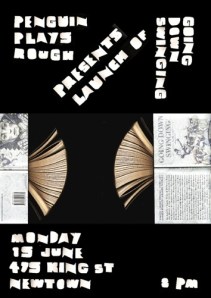

GDS launch at PPR in Newtown

GDS28SydneyEflyer

Last night I went to the Sydney launch of Going Down Swinging No 28. As I may have mentioned, I have not one but two poems in this excellent publication, and I’d missed the Melbourne launch last Wednesday. So of course I made my way to Penguin Plays Rough headquarters in Newtown for last night’s event.

I’d left my PDA at home, so we had a little trouble finding the place. I remembered the address as 475 King Street. That turned out to be a convenience store, which didn’t seem right. My companion wanted to phone home for instructions, but my dim recollection of the Google Street Image made me expect to find a door down the side street. And sure enough there was one.

‘But look, through the windows, you can see that it’s someone’s home,’ said Madam Circumspect.

‘Remember the New American Vaudeville,’ I said.

‘That was fifteen years ago,’ she muttered, but the little New York adventure I was referring to had taken us to a door just as unlikely as this one in the Bowery, and it had opened onto a strangely enjoyable evening of fire-eating, Groucho Marx impersonations and bad folk music. So we climbed the stairs last night, to an evening that was at least as enjoyable, with its own kind of strangeness.

It turns out that we had been seeing someone’s home through the windows. The story as I gleaned it in the course of the evening is that two young women moved into the flat above the convenience store, and when they took a good look at the high-ceilinged, crumbly front room, they decided it was too big to waste as a bedroom or even as a shared living room, and should be put to work as ‘a space’. And so Penguin Plays Rough was born: at 8 o’clock on the third Sunday of every month five programmed writers and five wild cards sit in a red velvet wing chair and read from their work to a paying audience (a wild card is someone who puts their name on the blackboard at the door on arrival).

Last night the room was comfortably full of mostly young people drinking beer and what I thought at first was soup but was actually mulled wine. An assortment of chairs – wooden from the kitchen, wrought iron from the garden, upholstered and plastic – lined two walls, but most people sat in comfortable, picnic-style circles on the floor. My companion’s prediction that we would be the oldest people in the room proved correct by a good ten years, and we were possibly as much as 30 years above the mean. Klare Lanson and Lisa Greenaway, editors of GDS, were there. I knew a couple of people, including Mark Tredinnick, poet, essayist and creative writing teacher, who was there to give moral support to one of his students who was reading. But mostly I had a sense that this was a thriving group of people who enjoyed each other’s work, had fun writing and reading and providing an audience for each other. We were treated, among other things, to the final instalment of a Philip Marlowe spoof serial drama with a zombie and cheerful gay male incest. My favourite PPR part of proceedings was a nasty homophobic encounter on Windsor Railway Station told in the language of Shakespeare (‘Ho, varlet, what music doth enter thine ear through yon iPod buds?’ ‘This be Anthony and the Johnsons’), and incorporating a giant green tentacled alien.

A charming young man introduced simply as Shag (who Google tells me is a Radio FBi personality) did the launching. He hadn’t actually seen a copy of GDS until he arrived at the venue, but that didn’t stop him from doing a nice job: he had written a piece of ‘Creative Writing’ entitled ‘What I Imagine It will be Like to Launch Going Down Swinging’ which managed to be funny, self-deprecating and devoid of actual reference to the subject of the launch. Nonetheless there was a sweet mood of celebration. Klare Lanson had a few moments in the chair, and managed to slip us a couple of factoids (Peter Carey and Brian Castro appeared in early issues, and in spite of the implied pessimism of the title, it’s now been going down and swinging for 30 years). A couple of contributors read their poems and stories from the GDS,

Literary culture is alive and well and having a good time in a room above a convenience store in Newtown.

Mark Tredinnick mentioned in a break that his book The Blue Plateau is to be launched tonight at Macquarie University. ‘Do you imagine it will be like this?’ I asked. ‘Absolutely not,’ he said.

Olga from the Volga

Sunday was Mollie’s 87th birthday. We turned up at the dementia dining room en masse (if six people can be called a masse) to celebrate, bearing a cake, chocolates and a gift. Penny and I, having decided to give Mollie a book, had contemplated a coffee-table extravaganza filled with sumptuous photos of Australian landscapes, and a number of similarly attractive art books. In the end, though, hang the absence of expense, we opted for two little books, one full of cute puppy photoes and the other with even cuter kittens.

When we arrived at the nursing home, Mollie was more deeply withdrawn into herself than I’ve ever seen her, so deeply that it took her quite a while to recognise, or at least acknowledge, that she had any connection at all to any of us. Even the kittens left her blank and listless, and the chocolates might as well have been chunks of gravel. Penny’s persistent, loving cheerfulness finally stirred the embers of relationship, and once there was a glow, it was the kittens that provoked a smile. By the time we left, things felt not so different from what passes for normal at this stage.

In that context, it was initially hard to appreciate the woman who persistently attempted to join our lilttle gathering.

Our gate-crasher is new to the dementia wing – none of us had seen her before – and is not ready by a long shot to lapse into slack-jawed impassivity. We first became aware of her when she came up behind Alex and started playing with his shoulder-length hair, a little like an expensive hairdresser feeling the weight of a customer’s hair while deciding what wonder to work on it. As her fingers moved, she murmured softly, sweetly and incomprehensibly in his ear. Alex gave a reasonably convincing impersonation of a young man about to die of embarrassment. We’re used to residents approaching us and talking in broken sentences (‘I’m sorry to interr but they’ll be coming soon to when umbrella the ice cream,’ another woman had said to us, earlier, and then wandered off). But Alex’s admirer wasn’t talking English-based dementia-speak. After a couple of minutes, I became convinced it was Russian, or at least Russian-based. I asked her, ‘Russki?’ In English, she said, ‘I speak Russian, Belorusian, Japanese.’

Tiring of Alex for the moment she walked around the table and picked up Mollie’s two new books. Mollie had recovered her spirits enough by then to look alarmed. Penny tried to  take the books back, but our visitor held on tight and moved out of her reach. ‘Do something!’ she said to me.

So I engaged the book thief in conversation. I had five words in Russian: dosvidenya, spasibo, Kristos viskriest, and da and niet. Perhaps it was a da that had tipped me off to the Russian in the first place. It wasn’t much, but enough to turn our unwanted guest’s attention to me. Soon I’d remembered pravda, nichevor and borge moi. (Bear in mind that these are all words picked up from my first quasi mother-in-law and from Russian movies, so I expect the spelling is off.) I told her my name. She said, in English, ‘I am Olga,’ then smiled and added, ‘Olga from the Volga.’ She spoke at length, cheerily, every now and then pausing for me to give an opinion. It didn’t seem to phase her when I indicated at every pause that I had no idea what she’d just said. She scowled and shook her fist at Penny’s back. ‘Niet,’ I said, stroking the threatened back, ‘she’s my sweetheart.’ That provoked what was probably a Russian harrumph, but a little later she put the books back on the table in front of Penny and went back to Alex’s hair.

Around about then, I went for help. I explained our difficulty at the nursing station and returned to the dining room with two determined women in uniform in tow. One of them put her arm gently around Olga’s waist and led her away. Olga and I squeezed each other’s hands as she left. I said ‘Dosvedenya,’ hoping it meant ‘See you later.’

And a little later, like a coda, another new resident came drifting past speaking loudly in what sounded like German.

From the shop

Opera on a notice board?

11062009

To save you from having to squint to read them, the words across the top of the board read, Aireys Inlet and District Association.

From the hilltop

The split point lighthouse

10062009

From the road

At Fairhaven

08062009

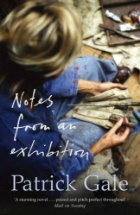
Notes from an Exhibition

Patrick Gale, Notes from an Exhibition (2007, Harper Perennial 2008)

Consensus at the Book Club was that this is excellent. Penny brought it home as part of her swag and urged me to read it. Since she also sounded as if the book made her yearn to become a Quaker, and went to the Glebe Library to borrow every Patrick Gale novel she could find to take away on our current holiday, I understood her to be strongly recommending the book. Resistance was useless. I agree – it’s a wonderful read.

Far too many novels, even very good ones, have me at least occasionally counting how many pages I am from the end. Not this one. It reminded me of the two-laughs-a-page rule that a comic novelist friend of mine swears by – any fewer than that you’re losing the reader, he says. Notes from an Exhibition isn’t a comic novel, but it manages at least two flashes of something a page. If the descriptions of Quaker practice and ethos don’t hold you, there’s the engrossing web of relationships of a family whose mother is diagnosied as bipolar. If that’s not enough, there are engrossing accounts of an abstract painter’s creative process. There’s a steady progress towards the heart of a mystery, and a sense from early on that we’ll get the detail of a family tragedy before the last page. The narrative shifts among at least half a dozen convincing points of view and back and forth in time, so that the story emerges with four-dimensional solidity. There are sharply visualised minor characters, some of them trailing hints of complex, heart-wrenching narratives of their own. I wish I’d got to the final chapter before my other Book Group’s evening on erotica, because it includes a lovely account of a teenage boy’s first sexual encounter: a straightforward narrative, with the emotional meanings front and centre.

As you can probably tell, I’ve joined the consensus.

Patrick Gale was on Radio National’s Book Show in February, and among other things it was heartening to hear him defend his main character against Ramona Koval’s charge of being a terrible mother.

From the bush

Sent from my phone

07062009001

From the beach

06062009

Picture book for grown ups

Jenny Joseph and Pythia Ashton-Jewell (illustrator),  Warning : When I am an old woman I shall wear purple (poem © 1962, this edition Souvenir Press 1997)

0285634119I was mooching a book from someone in England, and they wanted me to take more than one book to make it worth their while. They had this illustrated Warning on their inventory. It’s a poem I’ve seen on feminist fridges for more than 30 years, so I added it to my list. I had it in mind to give to someone as a gift, but by the time it arrived – by surface mail – yesterday I’d forgotten who. So I gave it to the self-described poetry loather I live with.

She read it, said it had more in it than she remembered, and read it to me. Helped by the layout – one or occasionally two lines a page – she read it beautifully, slowly, thoughtfully. I vaguely remember reading somewhere that Jenny Joseph has said she wishes she’d never written the bl*dy thing. Certainly she’s famous for issuing take-down notices when her many fans put it up on their sites without thinking to ask. But it’s a good poem.

There’s a lot to be said for publishing poems with illustration. This is something I had used to agonise over when publishing a children’s magazine. By presenting poems with illustration were we straitening the readers’ responses, telling them how to read the poem rather than giving the words free play? It made the page more inviting, but at what expense?

I’ve had a couple of experiences recently that make me think there should be much more of it.

When Carol Ann Duffy was recently appointed Poet Laureate, I came across an animation of  one of her poems, and though I found the animation not at all to my taste, or a fair reflection of the poem, it slowed my reading down, and let the poem sink in – it’s a good poem. I’ve just found it on YouTube.

A couple of years ago, I was very taken with the Poetry Foundation’s sadly brief series Poem as Comic Strip, which similarly slowed the brain down to receptive speed. I particularly liked the Emily Dickinson–Gabrielle Bell page (this link is to a 580k PDF). See what you think.