I’m loving WordPress: all that information at one’s fingertips, the list of automatically generated similar posts, the automatic snaring of possible spam etc etc. But there are one or two puzzling oddities. On my “Dashboard” I’m given a list of the links on my site that people have clicked on, and a list of the sites that have referred people here. Today the former list included three porn sites. I went through my site, including a look at the source code, and couldn’t find any such links here. And the other list included referrals from a site that, when I went to it, was some kind of template, unreadable and containing no discernible link to me.
Oh well. I suppose some of it is my own fault somehow for using the word “er*t*c*” in not one but two titles. Mind you, that word has attracted very few searches and only one comment promoting steamy prose so far, so it doesn’t look like a disaster at all.
Having done a “before” post, I now feel obliged to do an “after”.
As it turned out we were all white, middle-aged, heterosexual and in long-term relationships. No one had much interest in discussing Anaïs Nin – most hadn’t been interested enough in Delta of Venus to read the whole thing, though one chap had read a second, similar collection of her dollar-a-page pieces, and another had read some of her diaries. Someone went to the trouble of saying he found some of it offensive. We decided she belonged to another era, and moved on. (Is there something of hers that you, dear reader, would recommend?)
It turned out that if I am timidly vanilla in my taste for erotica I was in a room of similarly minded souls. I did read the Kathryn Lomer poem, and people liked it. One of our number had assiduously ransacked his memory, the web (by googling “erotic poetry”) and the bookshelves at an auction down the road, and shared some gems he’s found. He read us a steamy encounter between Elizabeth Bennett and Darcy in Pride and Promiscuity : The Lost Sex Scenes of Jane Austen – we agreed that that’s probably a perfect read-aloud book for consenting adults. He played recordings of two marvellous poems, one from ancient Egypt and another incorporating a Native American story about a winged penis. He read, with some apologies, Charles Bukowski’s “Like a Flower in the Rain” (warning, that link includes anatomically correct four-letter words), in which one can only marvel at how one word can transform a poem. Someone mentioned the bath scene in The Reader. We talked a little about the early scenes in Silk.
We kept asking each other what makes something erotic rather than pornographic. Clearly our collective taste veered to the non-pornographic end of erotica. We agreed we like our erotica with a bit of wit, a lack of emphasis on the plumbing (though no aversion to it being named), a context, and a sense of minds being engaged.
My fabulous nieces turn up in the most unexpected places. One of them is in the shortlist for Cosmopolitan’s Fun Fearless Females 2009 awards. I’m not surprised to discover that I hadn’t heard of most of the other people on the short list. None of the bloggers, for example, have crossed my radar– I went for a look and understood why, but I won’t go on about that. My niece Paula is on the Authors shortlist – along with the formidable Chloe Hooper and a number of others who have been invisible to me until now, though I don’t expect my ignorance has caused them much heartache.
I cast my vote in a number of categories. Why don’t you go and cast yours? The good thing is you’re not restricted to the names they’ve listed. You can add your own. Perhaps there’ll be a write-in landslide for Lowitja O’Donoghue in the Inspirational Role Model category.
Tonight at my book group (this is the all male one) we turn our collective attention to erotica. (Welcome everyone who found this entry via a google search.) A number of us had heard of Anaïs Nin, so we decided to go with a couple of her books, though there was an invitation to bring along a passage to read aloud from anywhere else. I’m posting this before the meeting.
Of A Spy in the House of Love, the less said by me the better: not so much erotica as neurotica. The long, ecstatic paragraph near the start that ended ‘but only that one ritual, a joyous, joyous, joyous impaling of woman on a man’s sensual mast’ had me thinking that if that was erotica I’d happily do without it. Thankfully there were no recurrences.
Maybe I’m showing my age, but I can’t say I warmed to Delta of Venus, either, which had lots of impaling. The most interesting thing about the book is probably the introductory pages, excerpts from Anaïs Nin’s 1940 diaries describing the way she and a swathe of her literary friends churned out erotica for a mysterious ‘Collector’ for a dollar a page.
Back in 1970 or so, there was a lot of anti-censorship activity in Sydney, including the publication of pornographic editions of student newspapers and “Porn Fests”, at which distinguished academics and undistinguished enthusiasts read rude bits from Henry Miller, Sam Shepard, John Wilmot second earl of Rochester, the Marquis de Sade and so on to crowded lecture theatres. It was all in a good cause – blows struck in the struggle for free speech – and some of it was funny, but overall it was squirm-making. Delta of Venus seems to me to belong in that context: it does contain some characters and narrative, but the ‘dirty bits’ are its raison d’être. Already dated in 1976 when Anaïs Nin decided to publish it, it reads as totally quaint now, quaint and vicious in its playing with paedophilia, incest, rape and so on. However, I did read it from cover to cover, so it clearly has titillation value. What I’ve realised is that if writing is to work as erotica for me, it needs to arise from a complex, recognisably human reality. Maybe we should have agreed to read Anaïs Nin’s diaries, where presumably she talks about more than who is doing what to whom with what.
I went to the theatre on Sunday with another group member, who was similarly unenthused by the Anaïs Nin books. Someone had recommended Silk to him, and he lent it to me with his recommendation. It’s a very short book, something of a fable about love and passion. Most of it is taken up with a slow-building sexual charge. Then there are a couple of explicit, erotic pages – which work because they’ve had 80 pages of build-up. Then the tale ends with a bitter-sweet twist that makes one want to re-read the erotic pages again …
At the moment I’m tossing up what read-aloud to take tonight: A D Hope’s ‘The Countess of Pembroke’s Dream’ perhaps, or Kathryn Lomer’s ‘Tentative love poem’, which begins:
Snow comes late; only the air
between our mouths is warm,
a microclimate in which whispered words
are storms building. Our skins catch
what little light is cast – mine reflects,
yours absorbs.
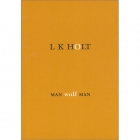
man wolf man won the Kenneth Slessor Award this year. Whatever may be wrong with literary awards (promoting the view that art is a competition, for example), they do extend some readers’ range, mine included. How would I have picked this up if it hadn’t been singled out by the judging panel? I’m glad I did pick it up.
Luke Davies is quoted on the publisher’s website as saying, ‘Holt’s is one of those voices that blast from the sky now and again, like a lightning bolt.’ To which I reply, ‘Fair enough.’ The writing in this book is sharp and playful and versatile and makes wonderful music. There are two long pieces, series of long sonnets (that is, sonnets with 18 lines – I don’t know if this is something L K Holt invented). One of them, ‘Unfinished Confession’, starts out with almost A-D-Hopish gravitas, talking about an ancient pioneer of anatomical knowledge, then in the last lines of the first sonnet lurches into crude, impatient vernacular and reveals its totally contemporary subject, still serious, still – like much of A D Hope – rich in scientific reference and allusions to works of art, and preoccupied with sex, but very much its own thing. (I’m trying not to be spoilerish, and also keep my PG rating.) In the book as a whole, there are many delights in the patterning of language, many memorable lines.
The very first poem, ‘Man is Wolf to Man’, begins with a grim commonplace:
Until the consummation of things
man, wolf, man.
and goes on, elegantly, with a catalogue of horrors, ending:
Sometimes the enemy knocks before
entering. A baby is hidden in the drawer.
It seems to be saying that humans, or perhaps just men, are incorrigibly vicious to each other and that the best we can hope for is sometimes to protect something precious. I find this view of things repugnant, its pessimism in some way too easy (not the attribution of lupine viciousness, but the notion that it will be with us forever, that it cannot be effectively resisted). It’s a gauge of how good the book is that I intend to keep it, and reread it, and will seek out more of L K Holt’s work.
(An unsatisfactory explanation of the title of this post can be found in a post on my superseded blog, Family Life.)
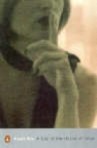
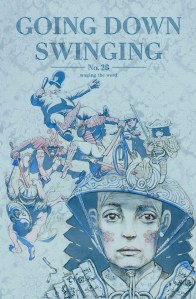
I was in Gleebooks this morning buying yet another copy of A Case of Exploding Mangoes, this one for a friend who has just gone into hospital for a longish stay, when I saw a stack of the new issue of Going Down Swinging:
Not only is it very beautiful, its contents include two poems by me. I didn’t buy a copy because I’ve pre-ordered six which I’ll pick up at a launch. But don’t let such considerations prevent you from splurging. There are a couple of hundred pages and a CD that feature stuff not by me, and my first quick impression is that it’s fabulous.
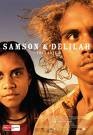
… but we did have a spirited conversation over pizza after seeing Samson and Delilah last night.
We both agreed that it’s a marvellous film, that it’s just beautiful to look at, that the performances are miraculous, that the almost complete silence of the main characters is devastatingly effective. We’re both glad it won that prize at Cannes and we both disagreed point blank with statements (quoted from US trade journals) about how joyful and humorous it is.
Where the conversation got spirited was when my companion, who knows much more than I do about such things, lamented the misrepresentation of life in and near Alice Springs: where were the other sniffers? where were the social services, the Tangenyere Council, the camp in Todd River of people from their mob? where were all the Aboriginal faces in the mall? how come the community at the start had a store and a health clinic but almost no people? why did the women who beat Delilah up not know that she had taken care of her grandmother when in such a small place surely everyone could see that’s how she spent her days? I assume she’s right about these and other complaints. But I thought maybe she was wanting a kind of documentary verisimilitude that the film wasn’t pretending to. After all, in the community where the film starts, a group of men sit on a verandah and play the same boring fragment of music over and over day in and day out, which works brilliantly to create a mood of deadening boredom, but which is clearly not meant as a literal representation of life on a community.
No, she insisted, she wasn’t wanting a documentary, but the film suffered from its distorting of reality in this way: the young protagonists’ profound isolation was profoundly improbable, and this made it hard to take their suffering seriously – unless you were a Cannes jury and understandably ignorant of the condition of Aboriginal people in the Centre, both their devastation and their resilience. I insisted in turn that a story teller doesn’t have to tell the story. All he (or she, but in this case he) has to do, all he can do, is tell a story, and this film tells its story very powerfully.
I think we were probably both right. The only actual disagreement we had was whether the character Gonzo was Aboriginal (as I thought) or not (as she did). The internet has just told me that I was right – at least, the actor is Aboriginal, director Warwick Thornton’s brother, in fact, playing a character based on himself.
When we got home I went to Bernhard Schlink’s Guilt about the Past. He’s talking about representations of the Shoah, but I think it’s relevant:
We don’t want fiction just for the facts being presented to us. We want reality to be presented to us and explained to us and turned into something that, even though it is not our reality, we can imagine ourselves into. We read [and go to the movies – JS] because we want to share the lives of those we read about, we want to empathise with them, fall in love with them, train our hatred on them, and ultimately learn about ourselves from them.
Even though the composition of these fictitious realities with their fictitious plots and situations and characters is something other than a presentation of facts, I experience it as something that has to be true. … I don’t know exactly what I mean and how to define this truth. What I am talking about is the feeling I have when a story that I have thought about, played with, thought about some more, and played with some more is finally ready to be written. … The feeling doesn’t have to do with me putting something autobiographical or something else of which I am particularly certain into the story that I am going to tell. It doesn’t concern having a message I want to convey that I am finally about to convey successfully or with any other agenda. It is a feeling devoid of any agenda except: now I have it, now I can tell it. And it feels like I have found the truth.
I think Warwick Thornton found that kind of truth here, and handed it to us.
(Incidentally, in interview on Cinema Autopsy, the blog I linked to above, referring to his brother Scott, Warwick Thornton says that Gonzo, the parky who shares what little he has with the two lost young people ‘is in a sense the audience’. My own point of identification, which caused some soul-searching, was a woman in the cafe who watches Delilah go off down the street off her head on petrol: the woman’s face shows genuine concern, but it’s clear she’s not about to do anything about it.)
Apart from the conviviality, the food, the cards, the ever expanding list of draconian (and largely ignored) rules, what I love about our book club is that it makes me read things I might otherwise not have touched – books about secret rendition and Guantanamo Bay, someone else’s favourite detective novels, intimidating poetry.
One of the welcome consequences of my self-imposed task of blogging something about every book I read is that it pushes me to reflect on my reading.
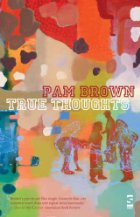
So with Pam Brown’s True Thoughts I’m doubly blessed: without the book club I doubt I would have read it, but here it is with an affectionate inscription to one of the club members; without the blog my mind might not have lingered on it any longer than it took my initial bemusement to fade. But here I am, remembering that poetry usually requires the reader to do a little work, and knowing that I would be revealing myself as an unforgivably lazy reader if I just wrote something like, ‘I don’t get it,’ or even, ‘I don’t grasp how these pieces hang together to make poems — I can barely tell where one ends and the next begins.’ (By pure serendipity, after I’d written that para I heard a Poetry Off the Shelf podcast in which Matthew Zapruder talks about immersing himself in John Ashbury’s poems because they moved him somehow even though he didn’t understand them at all, so I’m clearly in good company, and I imagine Pam Brown would be happy to be discussed analogously to Ashbury.)
So, in spite of feeling that I needed someone to take me by the hand and explain how to read Pam Brown’s poems, I went back, took my time, ruminated, savoured, absorbed and, eventually, enjoyed. It was a fascinating process. At the start I was like a colour-blind person looking at one of those red-and-green patterns, then with sustained, though not strained, attention it was as if the colour-blindness healed and the formless array of dots and squiggles reorganised themselves before my eyes into elegant shapes. For example, ‘Peel me a zibibbo’ begins:
I could go [extra characters are spacers & meant to be invisible] oooooooin any direction
but it’s best thatooohere and now ooI remain lesbian, oooookeep my vanishing cream
sealed.
On first reading, this seemed little more than verbal noise, a bit like the start of an Ern Malley poem. And in the middle of the poem, there’s this:
imperfection in kindness ooooooocomes with the void, oyou need to ooooochoose ithe ‘I’m feeling lucky’ google option.
To which I said, ‘Huh?’
I still don’t really get this second quote, but now that the green dots and the red dots have sorted themselves out, I do get that the first quote is meant to tease, and not meant to yield its meaning until the last line, where she addresses the poets and others whose names have cropped as the poem meanders with apparent aimlessness through a day in the life of the poet, and we realise they are all men:
Hi Kurt,ooooooooooooooooohi John T,
oooohi Nick,oPaddy,oooohi Shakespeare,
oooooooopeel me a zibibbo
ooooooooooooooooooo would you, ooooone of you guys?
(A zibibbo, as a note up the back tells us helpfully, is a delicious kind of grape.) The first lines suddenly yield their meaning. The busy-busy Lesbian poet, after making workaday contact with male poets and artists alive and dead, indulges for a moment in a fantasy that she’s some kind of Mae West femme fatale surrounded by male attendants. And I am amused.
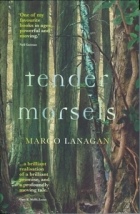
Tender Morsels an exception as book club books go: I would have read it with or without the BC’s agency. In fact, I’ve been wanting to read it since it came out nearly 12 months ago. I gave it as a Christmas present to one of our members, secure in the knowledge that it would come to the table at one of our meetings. When it did surface, I was a little taken aback when the person offering it, she to whom I’d given it for Christmas, said she’d stopped reading at about 40 pages because she didn’t want to go on reading a litany of suffering. And I confess that when it was my turn, I was close to giving up on page 40 myself. But I read on, and can report that on page 42 everything changes!
This is a wonderful book, and the gruelling first movement is absolutely essential. We need to know just how much the heroine suffers, so that we understand her need to escape, and when other characters (and possibly the back cover blurb as well) make assumptions about what she is avoiding, we know that they completely fail to grasp the strength of character that has enabled her to survive and function as well as she does. The fairy tale ‘Rose Red and Snow White’ plays through the story beautifully. The use of language is exhilarating. Though in one sense things are resolved by about the two thirds mark, there are unexpected twists and turns right to the very last page. Margo Lanagan walked across in front of my car when I was stopped at lights in the city recently. She looked like just another person on her way to an office job. I wondered how many of those others crossing the street were also total geniuses in disguise.
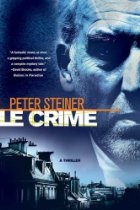
Le Crime‘s cover quotes compare Peter Steiner to John Le Carré, Len Deighton, Peter Mayle, Agatha Chsitie, Robert Ludlum, Alan Furst and Graham Greene. I have no idea how embarrassed the quoted reviewers are to see their phrases taken out of context like that. The book is not in the league of any of those writers. It creaks, its psychology is implausible, the plot is completely silly, and the structure barely holds up – but it’s a quick, enjoyable read. I liked it mainly for a flashback that lasts for three of the 26 chapters, in which the hero goes on a long walk through the French countryside, starting at Charles De Gaulle Airport and finally crossing the border into Spain (though we don’t go all the way with him). P and I have just booked in for a much shorter walk in France later this year, supported as befits our ageing selves, and these thirty-odd pages make it seem like a very good idea.
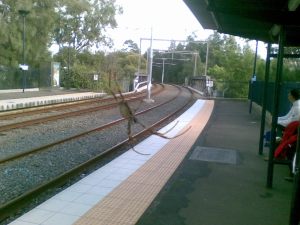
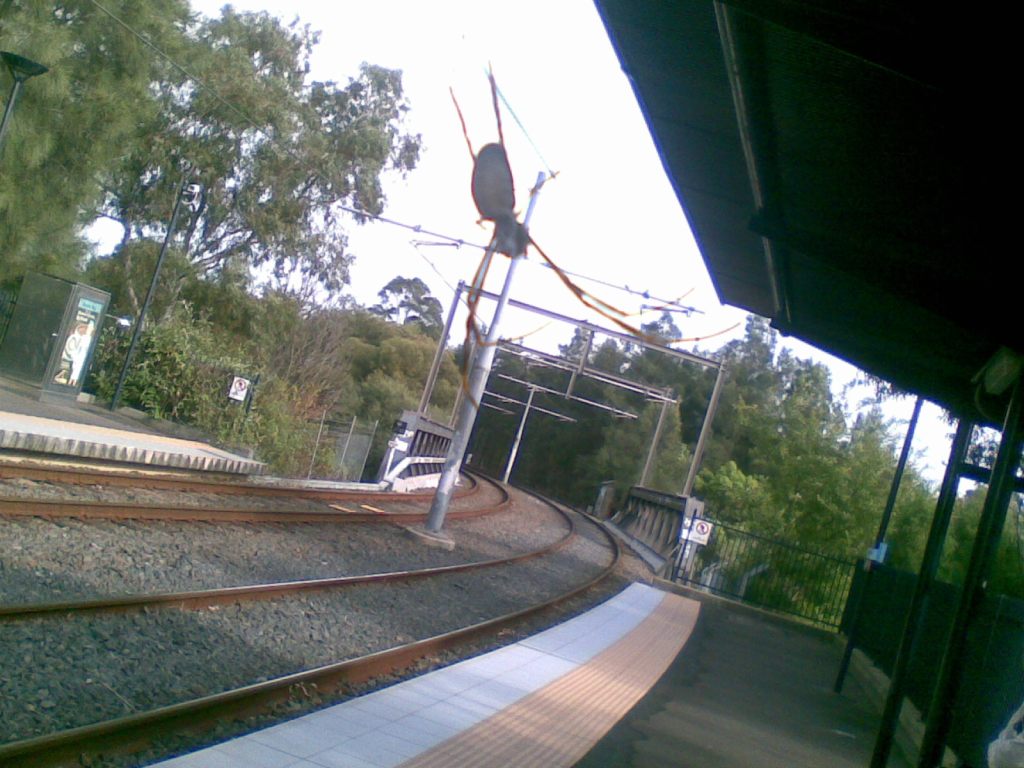
Most of the golden orb webs around my place are empty or torn down at this stage of our wet and chilly autumn. But this hardy specimen is still holding her own at the light rail stop, and seemed not to mind posing for my phone camera (and giving me a chance to figure out how to do images on WordPress).
Family Life is now behind me, and I’m about to take wing in this new blog. Too much work to be done today, though, and my last couple of posts in the old place have satisfied the urge for a while. So I’ll just say, ‘Hello sky, hello flowers, hello WordPress,’ and get on with other things. Come in and make yourself at home