Tag Archives: Ellen van Neerven

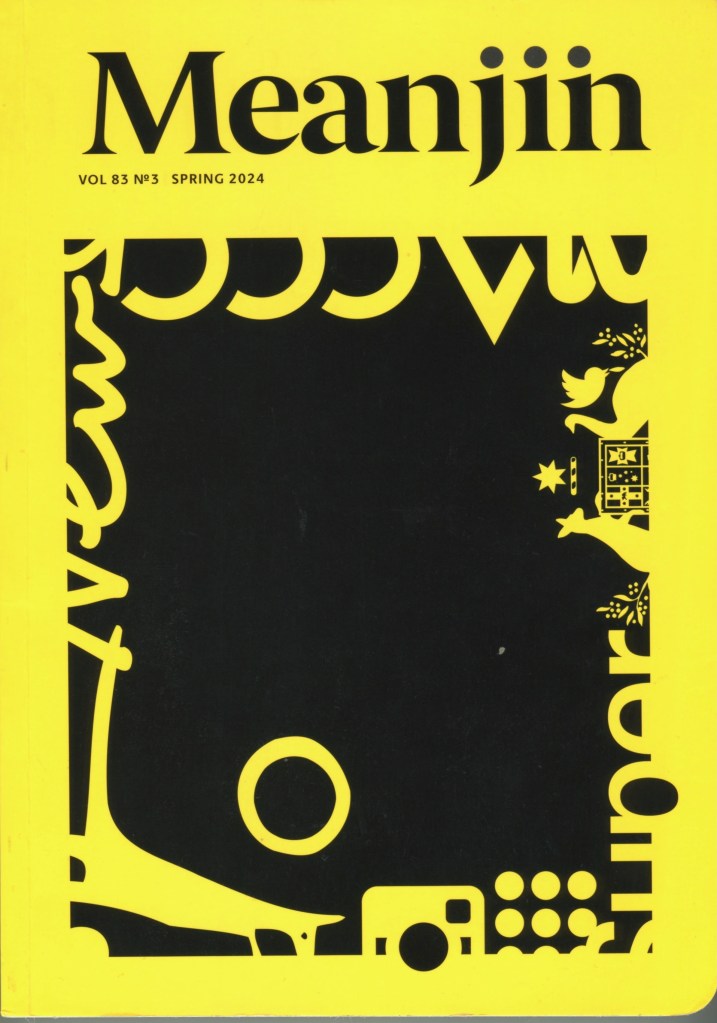
Journal Catch-up 28: Meanjin Spring 2024

Esther Anatolitis (ediitor), Meanjin Vol 83 Nº 3 (Spring 2024)
(links are to the Meanjin website: some but not all of them are available to non-subscribers)

This Meanjin was published before King Charles visited Australia last year. This means Jenny Hocking’s blistering essay, ‘Remnants of Empire: Racism, Power and Royal Privilege‘, appeared well before Lidia Thorpe’s headline-grabbing outburst. The article, which amply fulfils the promise of its title, made me feel much more sympathy for the outburst.

There’s a lot else in this issue to delight and enlighten. Some pieces that I think of as necessary. Apart from Jenny Hocking’s, three that stand out are:

  • Well, It’s Beautiful Country, Really –‘ by Mike Ross. Each issue of Meanjin these days begins with a ‘Meanjin Paper’ – an essay by a First Nations person. In this one Mike Ross, an Olkola man who has been at the vanguard of land rights for the people of Cape York for three decades, talks about finding meaning in Country, about constantly learning
  • Lucky for Some‘ by Frank Bongiorno on the 60th anniversary of publication of Donald Horne’s The Lucky Country, which I read in tandem with Nick Bryant’s recent piece on the same subject in the Guardian
  • Jews, Antisemitism and Power in Australia‘ by Max Kaiser, which parses the way accusations of antisemitism have been used to silence important points of view. This article may have been published six months ago, but it feels hyper-relevant today as actual vicious antisemitism and and dubious accusations of antisemitism are ramping up.

There are pirces that may not be necessary, but they’re fun and educative all the same:

  • an interview with poet Ellen van Neerven (which I enjoyed even though it focuses on a book of theirs I haven’t read)
  • a scathing annotation of the Australian Constitution from First Nations writer Claire G. Coleman

There is some excellent fiction, including these two:

  • The Feeling Bones‘ by Lucy Nelson, which tells a family’s story in terms of their bone ailments; and incidentally informs me that ‘sits bones’, a term for the backside I had only heard used by my Pilates instructor, actually comes from the world of dance.
  • The Other Doctor‘, in which James Salvius Cheng finds a way to talk about the exhausting business of being a medical practitioner without coming across as a whinger.

A trio of memoirs call out to each other about disability, religion and sexuality:

  • Love Is Worship by Adrian Mouhajer, about finding peace in a Muslim family as a queer person
  • Dirty Things, Precious Things by Anna Hickey-Moody, about Catholicism, disability, family violence
  • Crocodile by Ella Ferris, brilliant, complex piece of writing which includes experiences of Aboriginality and disability

There are some excellent poems. The ones I warm to most (not necessarily the ‘best’) are:

  • ‘Mothertongues’ by Grace Chan, which begins ‘My son is starting to speak / in English’ and later, as she tries to teach him some Chinese, ‘our tongues stumble / in synchrony’
  • ‘The Women’s Shelter’, a rhyming sonnet by Claire Watson, in which a woman creates a knotted rag rug from strips of old bedsheets

There are things that aren’t my cup of tea: a smart-alecky essay on satire, an incomprehensible poem, some ‘experiments’, a review or two that convinced me not to read the books under consideration. But I can imagine each of those finding readers who will delight in them


I wrote this blog post on the land of Gadigal and Wangal of the Eora nation. I acknowledge their Elders past present and emerging, and gratefully acknowledge their care for this land for millennia, as once agin the sun is rising later in the mornings, and spiders are making their presence known in the bushes.

2024 End of year list 5: Blog traffic

In case you’ve had just about enough of my end of year lists, be reassured: This is the last one, and I don’t expect you to read it – it’s mainly so I’ll have a record.

Here are the posts that attracted most clicks on my blog in 2024:

  1. Claire Keegan’s Small Things Like These (October 2023, 1618 clicks)
  2. The Book Club and Paul Murray’s Bee Sting (April 2024, 775 clicks)
  3. Ocean Vuong’s Time is a Mother (March 2023, 744 clicks)
  4. Ellen van Neerven’s Throat (July 2020, 625 clicks)
  5. Mary Oliver’s Twelve Moons (January 2019, 597 clicks)
  6. Anne Enright, The Wren, the Wren, the book club, page 77 (March 2024, 533 clicks)
  7. Trent Dalton’s Boy Swallows Universe (July 2019, 412 clicks)
  8. Robert Alter’s Psalms (September 2020, 365 clicks)
  9. Jenny Erpenbeck’s Kairos and the Book Club (April 2024, 364 clicks)
  10. Rebecca Huntley’s Italian Girl (April 2022, 357 clicks)

Ocean Vuong’s book was at the top of the list for most of the year, and then news of the movie of Small Thiings Like These sent a lot of clicks to that post. Shirley Hazzard’s The Transit of Venus dominated the list for years, but has now dropped off altogether. Mary Oliver, Ellen van Neerven and Robert Alter are the stayers.

One more bit of nerdiness. Here’s WordPress’s list of my all-time top ten posts. Apart from changing positions, the main change from last year is that Philip Larkin got bumped by Claire Keegan:

  1. Travelling with the Art Student (November 2014, 3558 hits)
  2. The Book Group and Shirley Hazzard’s Transit of Venus (June 2018, 2721 hits)
  3. (Re-)reading Kevin Gilbert’s poetry (April 2012, 2430 hits)
  4. Mary Oliver’s Twelve Moons (April 2020, 1841 hits)
  5. Bran Nue Dae (January 2010, 1805 hits)
  6. Mary Oliver’s House of Light (April 2020, 1784 hits)
  7. Claire Keegan’s Small Things Like These (October 2023, 1676 hits)
  8. The book group’s Harp in the South (February 2011, 1431 hits)
  9. Jasper Jones at the Book Group (May 2010, 1352 hits)
  10. Contemporary Asian Australian Poets (June 2013, 1236 hits)

That’s it. Thanks to everyone who has contributed to those statistics. Some of you I know IRL, some I’ve met through email etc, some only in the comments section, some I know only as anonymous clickers. I’m happy that you’ve visited the blog. Come again.

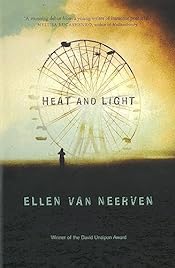
Ellen van Neerven’s Heat and Light, page 76

Ellen van Neerven, Heat and Light (UQP 2015)

This book of short stories gives no external indication that it’s a work of Blak queer fiction. The back cover and introductory pages describe the contents accurately enough – traditional story telling with ‘a unique contemporary twist’, characters ‘caught between a desire for freedom and a sense of belonging’ – but make no reference to First Nations, unless you count mention of the NSW Premier’s Literary Awards – Indigenous Writing, and the David Unaipon Award, and a discreet badge that reads ‘Black Australian Writing’. Queerness gets even less acknowledgement: apart from a quote from the ABR that the stories ‘evoke mystery and sensuality in equal measure’, there’s no mention of sexuality at all.

So let me tell you: this is a book in which there’s a lot of sex. In most of the stories, queerness and Blakness are taken for granted.

Having got that off my chest, I can tell you that this collection of stories by Mununjali Yugambeh writer Ellen van Neerven is terrific. It’s in three parts: ‘Heat’, five stories that amount to a compellingly compressed family saga; ‘Water’, a single longer story that is the big surprise of the collection; and ‘Light’, ten tales of complex intimate relationships. Most, perhaps all, the main characters are First Nations and most of the action takes place in either Queensland or Western Australia. (One character refers to my home as ‘slimehole Sydney’.)

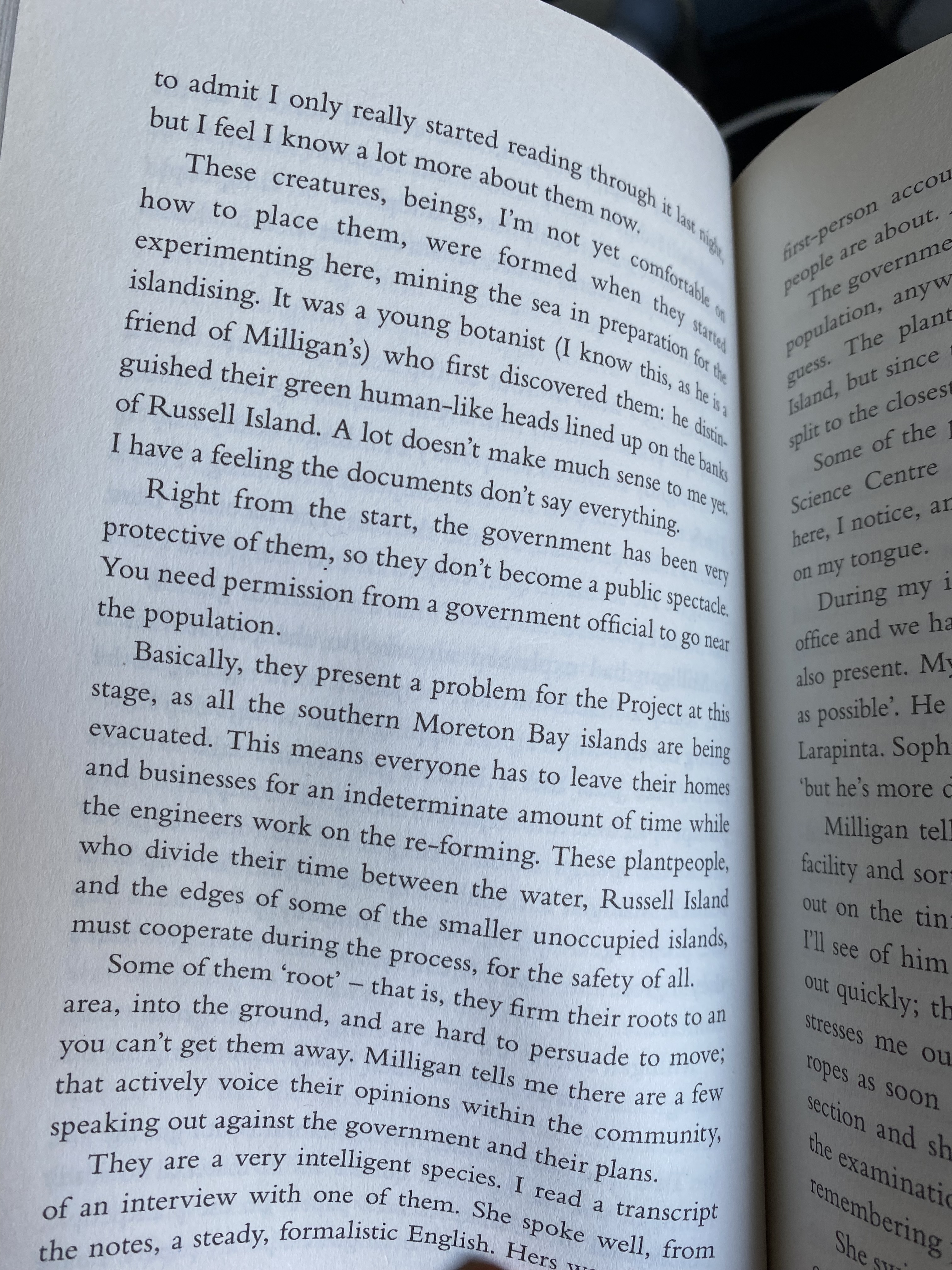
Page 76 (still my age) comes part way through ‘Water’. The story is set in a future Australia, where ‘Aboriginal spirituality’ is a dominant religion, and President Tanya Sparkle is implementing some dire policies regarding First Nations people while presenting a veneer of respect – creating chaos in the public transport system by changing all route destinations to not-always-accurate Indigenous names and, at the heart of this story, re-forming offshore islands to create a ‘super island’ where Aboriginal people can apply to live, a kind of apartheid dressed up as innovative native title.

The reader has barely settled in to this brave new Australia, when further weirdness is revealed. The narrator has been employed as ‘Cultural Liaison Officer’ for the first re-formation project, in the islands of Moreton Bay. Her job places the story well into the realm of the fantastic: she is to liaise with non-human beings who have recently appeared on the islands, the ‘plantpeople’. Page 76 introduces them:

These creatures, beings, I’m not yet comfortable on how to place them, were formed when they started experimenting here, mining the sea in preparation for the islandising. It was a young botanist … who first discovered them: he distinguished their green human-like heads lined up on the banks of Russell Island …

Right from the start, the government has been very protective of them, so they don’t become a public spectacle. You need permission from a government official to go near the population.

Basically, they present a problem for the Project at this stage, as all the southern Moreton Bay islands are being evacuated. This means everyone has to leave their homes and businesses for an indeterminate amount of time while the engineers work on the re-forming. These plantpeople, who divide their time between the water, Russell Island and the edges of some of the smaller unoccupied islands, must cooperate during the process, for the safety of all.

Some of them ‘root’ – that is, they firm their roots to an area, into the ground, and are hard to persuade to move; you can’t get them away. Milligan tells me there are a few that actively voice their opinions within the community, speaking out against the government and their plans.

They are a very intelligent species. I read a transcript of an interview with one of them. She spoke well, from the notes, a steady, formalistic English. Hers was the only first-person account and insight I have into what these people are about. A plant’s mind.

So in the middle of a collection of more or less social-realist stories about queer Blak life in Australia, there’s a weird – and very funny – piece of fantasy science fiction.

It’s a complex set-up. The Cultural Liaison Officer’s job is to persuade the plantpeople to cooperate, to allow themselves to be displaced. At first she is successful – she gets on well with these non-human creatures and comes to believe, as her white employers don’t, that they are fully sentient. As her sympathy for their plight deepens, she comes to suspect a darker purpose behind her ‘liaison’ work. She forms a forbidden bond with Larapinta, a female of the species, and that bond … well, I already said there’s a lot of sex in this book. But then there are further twists as the origins of the plantpeople are revealed and the parallels with the original dispossession of First Nations peoples on this continent come into sharp focus.

Ellen van Neerven is better known as a poet than as a fiction-writer. Their two books Comfort Food and Throat (links are to my blog posts) are wonderful. I found Heat and Light in a street library. I’m not parting with it.

End of year list 5: Blog traffic

Thanks to kind help from Sue at Whispering Gums, I can now find out which of my blog posts have received most hits in the last year. It’s hard to know what these figures mean. Maybe a lot of people visited the post for a second or so, long enough to realise that there was nothing useful there about the subject of their interest. Maybe the post is on a school reading list somewhere, and has been semi-plagiarised by hundreds of students over the year. Maybe this is an indication of which of my posts is most brilliant. Maybe none of those. Anyhow here’s the list for 2023:

  1. The Book Group and Shirley Hazzard’s Transit of Venus (June 2018)
  2. Mary Oliver’s Twelve Moons (January 2019)
  3. Ocean Vuong’s Time is a Mother (March 2023)
  4. Mary Oliver’s House of Light (April 2020)
  5. Ellen van Neerven’s Throat (July 2020)
  6. Ellen van Neerven’s Comfort Food (also July 2020)
  7. The Book Group on David Mitchell’s Utopia Avenue (February 2021)
  8. Robert Alter’s Psalms (September 2020)
  9. Ruby Reads 29: Gift (December 2021, about The March of the Ants, by Ursula Dubosarsky and Tohby Riddle)
  10. Abdulrazak Gurnah’s Afterlives at the Book Group (April 2020)

It looks as if my posts on poetry generate most traffic, though the one on The Transit of Venus, mysteriously to me, is way out ahead of the rest. The book group makes three appearances, which is probably an indication that we choose books that have a lot of social capital. I suspect the post on Robert Alter’s translation of the psalms is visited so often because it includes an embedded video of Boney M singing ‘Rivers of Babylon’.

Having learned how to find these statistics, I’ll try your patience a little by giving you the all-time top 10 posts:

  1. Travelling with the Art Student (November 2014)
  2. The Book Group and Shirley Hazzard’s Transit of Venus (June 2018)
  3. (Re-)reading Kevin Gilbert’s poetry (April 2012)
  4. Bran Nue Dae (January 2010)
  5. Mary Oliver’s House of Light (April 2020)
  6. The book group’s Harp in the South (February 2011)
  7. Jasper Jones at the Book Group (May 2010)
  8. Mary Oliver’s Twelve Moons (January 2019)
  9. Contemporary Asian Australian Poets (June 2013)
  10. Philip Larkin, The Whitsun Weddings (April 2010)

Someone lifted a close-up photo of a painting by Brian Rutenberg from ‘Travelling with the Art Student’ and put it up on Pinterest, and hordes of people came looking for more – sadly it was the only photo in the post. Shirley Hazzard has otherwise been consistently in the lead, and Book Group books and poetry have pulled in the crowds. I think my post on Kevin Gilbert’s poetry was on a school reading list somewhere for a time – it gives a brief account of what can go wrong when a well-meaning whitefella edits a First Nations book.

I don’t know what to make of the absence of any posts I’ve written since 2020.

That’s it for my 2023 round-ups. Thank you all for swelling my statistics, for your likes and comments, and your silent, lurking presences.

Journal Blitz 8b

So much to read, so little time. So many journals, so few subs, and still I can’t keep up.


Evelyn Araluen and Jonathan Dunk (editors), Overland 238 (Autumn 2020)

Published more than a year ago, this is the first issue of Overland edited by Evelyn Araluen and Jonathan Dunk. The new editors swept in not so much with a new broom as with a sandblaster. The regular columns are gone; issues are themed (though judging from a quick look ahead this change only lasted three episodes); and there’s a bold new feel to the design.

It may be part of the new approach, or perhaps it’s teething problems, but I found some of the articles in this issue hard gong to the point of being unreadable. Some dispense with sentences as we have known them. Others disappear unapologetically down etymological and literary-history rabbitholes. Yet others drop unexplained references to – I assume – French theorists, with no apparent purpose other than to discourage non-insiders. I tried, I really did, and I’m pretty sure I missed out on some terrific insights, but I just couldn’t finish a number of them. And that’s before I got to John Kinsella’s sequence of poems, ‘Ode to the defenceless: from hypotaxis to parataxis‘, whose prolix obscurity lives up to the promise of its title. I’m not completely sure that some kind of complex leg-pulling isn’t involved, as in the infamous Sokal affair.

This was all the more disappointing because the journal kicks off with a genuinely interesting piece, Toby Fitch’s obituary for British revolutionary socialist poet Sean Bonney (1969–2019), ‘Our Death: Aspects of the radical in Sean Bonney’s last book of poems‘. Toby describes Bonney as having ‘a performative ethics of scathing animosity and nihilistic humour’, and gives the reader plenty of what is needed to grasp the two poems by Bonney that follow his article.

Of the other articles, I want to mention ‘Welcome to the Nakba: notes from the epicentre of an apocalypse‘ by Micaela Sahhar – nakba is Arabic for ‘catastrophe’ and usually refers to the dispossession of Palestinians in the founding of the Israeli state. Writing in the aftermath of the 2019–2020 bushfires, Sahhar offers a startling perspective on Australia’s challenges:

Dear settler-Australia, your Nakba has arrived. Don’t feel helpless, powerless, frustrated, and above all, don’t pray for a miracle. I can tell you from the other side that it will never arrive. It’s time to tackle the structures you made, the structures that will ruin us all.

Poetry and fiction are still a major presence in the new-look journal, and this issue, like its predecessors, includes the results of literary competitions.

The Neilma Sidney Short Story Prize, judged by Joshua Mostafa, Margo Lanagan and Hannah Kent, was won by ‘The Houseguest‘ by Jenah Shaw, a story that captures brilliantly the uneasy situation of a young person who has left home in the country to stay with a family in a big city.

The Judith Wright Poetry Prize had three winners, published here with notes from the judges – Michael Farrell, Toby Fitch and Ellen van Neerven, had three winners. Each of these excellent poems left me bemused more than anything else.

Then there are four short stories, which arrive like a reward for persevering: ‘Creek jumping‘ by Cade Turner-Mann, a tiny moment in a rural community that reflects and resists the impact of environmental degradation and colonisation; ‘Mermaid‘ by Gareth Hipwell, a borderline science fiction tale of eco-guilt; ‘Pinches‘ by Emily Barber, an abject tale of sexism; and ‘Urban gods‘ by Cherry Zheng, which could be a starting sketch for a dark fantasy/sci-fi television series.


Jonathan Green (editor), Meanjin Quarterly: The next 80 years, Volume 79 Issue 4 (Summer 2020)

Far from being a new broom, this issue of Meanjin celebrates its continuity with the journal’s past 80 years, reproducing Clem Christensen’s first editorial and featuring short pieces from each of his ten successors in the editorial chair. A powerful narrative emerges of a publication that has managed to survive and thrive in the face of serious challenges, and that has transformed itself many times over to meet the changing times.

Then there’s a stellar line-up of writers, many of them responding to the ‘Next 80 Years’ theme.

Some I need only name for you to get a whiff of their excellence, and timeliness:

  • An email dialogue about time and memory between Behrouz Boochani and Tara June Winch, apparently an excerpt from an ongoing conversation between these two writers
  • An article from Jess Hill on police responses to domestic abuse call-outs – following up a chapter in See What You Made Me Do
  • A scathing piece about the tree-hating official response to the bushfires, by Bruce Pascoe
  • An even more scathing piece by Michael Mohammed Ahmed about White victimhood (starting with the observation that though people complain that it’s racist to name their Whiteness, it was White people who invented the term)
  • A wide-ranging and lucidly angry piece by Raimond Gaita on moral philosophy vs economics in the context of Covid-19.

And that’s only part of it. Of the remaining articles, the standouts for me are ‘Consider The Library’ by Justine Hyde, a wonderful account of the changing roles of public libraries in Australia and elsewhere, including their potential contributions to averting climate catastrophe; ‘More Than Opening The Door’ by Sam Van Zweden, which advocates for inclusion of people with disabilities in Australian literary life, arguing in particular that if a publication commissions a piece on, say, mental health issues from someone who is drawing on their own experience, then the publication needs to consider having a duty of care to the writer; ‘Heading to Somewhere Important’ by Martin Langford, a brief account of the changing face of Australian poetry over the last 80 years – an impossible task acquitted with grace; and Nicola Redhouse’s ‘Future Tense’, which engages with Shoshana Zuboff’s The Age of Surveillance Capitalism, in ways that are probably crucial to making that ‘intimidatingly thick opus’ as accessible and influential as we all need it to be.

Scattered like jewels through the pages are poems from David Brooks, Kim Cheng Boey, Eileen Chong, Sarah Day, Jill Jones, David McCooey, and more. If you count two pieces labelled ‘memoir’ that look back from the year 2200, there are six short stories, which project a range of pretty depressing futures. My pick of them would be Tara Moss’s The Immortality Project, where being able bodied is seen as indicating deficiency, and uploading one’s consciousness to Another Place leads to an interesting twist on the expected outcome.

Decades ago, I was a keen subscriber to Meanjin, and in my mid twenties I bought a swag of back copies (from Kylie Tennant, as it happens, whom her husband L C Rodd described to me over the phone as ‘an extinct volcano of Australian literature’). I loved my collection and browsed in it often, but sold it and let my sub lapse when space and time shrank around me with parenthood and a job that required a lot of reading. When I considered resubscribing some time ago, I was deterred by the tiny type – as noted on my blog, here. Someone gave me this issue as a Christmas present, and it seems very likely that I’ll resubscribe.


Journal Blitz 8a

I’m chronically behind in reading the journals I subscribe to. I’ve had seven goes at dragging myself up to date by blogging about a batch in one post. But blog entries get unwieldy when they deal with several very different publications, and I wouldn’t blame my readers fro giving up after the first screen or so. So this time, there’s just the one journal:


Ellen van Neerven, David McCooey, Felicity Plunkett and Eunice Andrada (editors), Australian Poetry Journal Volume 10, Number 1: modern elegy (2020)

At the 2019 Melbourne Writers Festival, poets Ellen van Neerven, David McCooey, Felicity Plunkett and Eunice Andrada met with Jacinta Le Plastrier, publisher of the Australian Poetry Journal, on a panel called The Heart Bent for a discussion on ‘the ethics of elegy and writing on and from love’. Jacinta suggested that the panel members put together an issue of the APJ on the theme, and this excellent publication is the result. No one could have guessed that a pandemic would come along to make the theme of elegy – a formal lament for the dead – bitingly relevant.

The journal is divided into four main sections, each wth a foreword by a different editor, a brilliant solution to the question of how to co-edit.

Each of the forewords ruminates on the nature of elegy. Ellen van Neerven invokes the context of the terrible happenings of 2020 – the ravages of country, Indigenous culture and First Nations people in Australia and around the world, and the rising up against racism that followed the deaths of George Floyd and David Dungay. In the thirteen poems she has selected, she says she feels ‘the energies of these pieces and the futures these poet don’t wish to mourn’. David McCooey writes, ‘We all live elegiac lives. Loss is endless, and the things we lose pile up like the debris in the wings of Walter Benjamin’s Angel of History.’ Felicity Plunkett starts from Denise Riley’s Say something back (2016), a book of poems that centres around the death of the poet’s son, and writes, ‘The question of what the elegy – and, more broadly, the elegiac mode – can and can’t do is one the poems in this anthology approach from different angles, counterpoints in an extensive song.’ Eunice Andrada hopes ‘that through engaging with these elegies, we can widen our collective vocabularies when attempting to offer language to our loss’.

Behrouz Boochani has a special place. His ‘Forgive me my love’, hand-written in Farsi and translated by Moones Mansoubi, stands alone before all four sections. Even if it was drivel it would have justified its place, given his heroic history as a beyond-marginalised Australian writer. But it’s not drivel:

Forgive me, my angel!
I am not able to caress your gentle skin with my fingertips.
But I have a lifelong friendship with sea zephyrs
and those zephyrs strum my nude skin here, in this green hell!

What follows is extraordinarily rich and diverse. Well established writers have beautiful work here: Jennifer Maiden (‘Meteors’, since published in Biological Necessity), Eileen Chong (‘Cycle’, in A Thousand Crimson Blooms), Evelyn Araluen (‘FOR POWER FOR PRAYER FOR PROMISE FOR PEACE’, in Dropbear), Toby Fitch (‘Spleen 2’ in Sydney Spleen, which is on my TBR shelf), Andy Jackson, Sam Wagan Watson, Jordie Albiston, Tricia Dearborn, and more.

There must be something in this collection for all tastes and moods. I want to mention three poems by poets who are new to me.

Winnie Dunn’s ‘God in the Margins’ dramatises three episodes from a young woman’s life involving menstruation, contraception and herpes. They are told in straightforward vernacular, but with footnotes that link to texts from Hebrew, Christian and Muslim scripture. The effect is stunning: hard to demonstrate by quotation, because the thrill of the poem lies in the way the footnotes create a kind of cosmic miasma around the scenes of demotic Western Sydney life.

Merlinda Bobis’s ‘Air: For my parents and all who passed (2018–2020)’ starts with a school music teacher telling students, ‘Open your lungs when you sing’ and contrasts it to her dying parents’ difficulty breathing on their deathbeds. Here’s the poem’s turning point:

Death gags us, or swallows
all the air and never ever
gives it back, but today
walking in Haig Park,

under the cedars, I chance
upon a Chinese woman,

alone she sings with the beat
of a tambourine I hear
before I see, we're trees and trees
apart, socially distanced
but what amplitude her air,
its rise and fall of notes

giving back, giving me back 
a song I cannot understand 
except that it's lament

Perhaps I responded strongly to Elena Gomez’s ‘Death and all his friends’, because I read it just after hearing a review of the movie Fast and Furious 9, but it’s a terrific poem even if you’ve never heard of the franchise. it enacts the way emotions evoked by movies and TV shows – in this case a Fast and Furious movie, an episode of Gray’s Anatomy, and Jurassic Park – can be a vehicle for grief that has nothing to do with the movie. I desperately want to quote the poem’s surprising, brilliant and devastating last four lines, but that really would be a spoiler.

Tucked away at the back of the journal are two related sections: ‘Meditations in an Emergency’ – five poems from an event at the 2019 Melbourne Writers’ Festival (not all by Melbourne poets); and ‘Introducing the Tagelied, the Dawn Song’, a brief essay by Nathan Curnow followed by six poems – by poets including Cate Kennedy and Bella Li – that are either examples of the form or relate to it somehow.

So poetry is thriving in Australia. I’m pretty sure copies of this journal are still available for Australia Poetry.

SWF 2021 Sunday

Sunday was another beautiful late autumn day in Sydney, and another day of challenge and delight at the Sydney Writers’ Festival. Evidently one of our ideologically driven weeklies ran a piece online saying the Festival was extremely ‘woke’, which is apparently a bad thing. I don’t know about woke but, as someone who nods off whenever I’m in a dark room, I was kept awake almost without fail. (The one fail was inevitable, in the after-lunch slot when I would have slept through an announcement that I’d been granted the gifts of immortality and eternal youth.)


10.30: Land of Plenty

This panel addressed environmental issues about Australia from a range of perspectives. Philip Clark of ABC Radio’s Nightlife did a beautiful job as moderator, giving each of the panellists in turn a prompt or two to talk about their work, and managing some elegant segues. The panellists did their bit to make it all cohere by referring to one another’s work. (How much better these panels work when the panellists have read one another’s work!)

Rebecca Giggs, whose Fathoms sounds like a fascinating book about whales, said that whales are a Trojan horse for a conversation about other animals’ relationships to humans. She described a moment when she was close enough to a whale that she could see its eye focusing on her – and only to learn a little later that whales are extremely short-sighted and there as no way that that whale could have actually seen her. What is actually there isn’t what we want to think is there,

Bruce Pascoe, author of Dark Emu and co-author of Loving Country (about which more later) spoke about the difference between Indigenous and Western capitalist ways of relating to the land. Echoing Rebecca Giggs’s story of the whale’s eye, he said, ‘We look at animals and want to be friends with them, but as soon as a capitalist wants to be your friend …’ He begged us to take seriously the possibility of a reciprocal relationship with animals. Something terrible happened to humans, he said, when the combination of Christianity and capitalism happened. I think he has a book coming on the subject.

Victor Steffensen is a Tagalaka man from far north Queensland, author of Fire Country. Someone from my family had the privilege of doing some video work with Victor some years ago, and his stories from that time have given me a deep respect for Victor and his work in ‘using traditional knowledge for environmental wellbeing’, as the Festival site puts it. In this panel, he took off from Bruce Pascoe’s call for reciprocity with other animals, and spoke of relating to fire as a friend and not as something to fear. It’s about reading country, listening to landscape. His project of recording traditional knowledge that is in danger of being lost is not to archive it but to get it back into people, ‘to young fellas and then to the broader community’.

Richard Beasley, senior counsel assisting for the Murray-Darling Basin Royal Commission and author of  Dead in the Water about that catastrophe, said that the situation in the Murray-darling Basin had got so bad that ‘even John Howard’ did something about it. Howard’s legislation included clauses to the effect that whatever was done needed to be science-based. But then the lobbyists went to town, and in response to their pressure, politicians insisted that reports from the CSIRO were altered to suit the big capitalists’ agenda. His lawyerly rage was palpable.

There was a good question (a rarity at this Festival), about grounds for hope:

  • Rebecca Giggs: Thee’s hope. But you don’t get to be hopeful until you make yourself useful in some way – whatever your situation and abilities allow.
  • Bruce Pascoe: I have to think we can do it differently. We have to give our grandchildren a chance, not treat them with contempt. We need love of country, not nationalism.
  • Victor Steffensen: Language is important. [Sadly what I wrote from the rest of what he said was illegible. I think it was an elegant version of ‘Action is also important.’]
  • Richard Beasley: I’m a lawyer. I don’t know how to challenge any of this by law.

12 o’clock: Sarah Dingle & Kaya Wilson

We hadn’t booked this session in advance, but faced with a gap of a couple of hours, we spent one of our Covid Discover vouchers to buy rush tickets. Kaya Wilson, whose book As Beautiful As Any Other has the subtitle A memoir of my body, is a tsunami scientist and a trans man. Sarah Dingle, author of Brave New Humans: The Dirty Reality of Donor Conception is a donor-conceived person. Their conversation was aided and abetted by Maeve Marsden, host of Queerstories who was also donor conceived, though not anonymously through the fertility industry as Sarah was.

Sarah’s revelations about the fertility industry were nothing short of shocking. Not only is it monumentally unregulated, but records that might have allowed people to know what had happened to a particular donor’s sperm, even anonymously, have at least sometimes been deliberately destroyed. Couples using donated sperm have been systematically encouraged to lie to their children about their origins, leaving them unaware of any genetic predispositions to disease, let alone possible incest.

What Kaya told us about the systemic treatment of trans people was just as shocking. He said that he tended to keep his scientific life and his trans life separate. ‘In some ways they hate each other.’ But he has a chapter in his book that tries to reconcile them. The scientific literature, like legislation about, for instance, changing one’s ‘sex marker’ on a birth certificate, is shot through with assumptions that bear not relation to the reality of trans experience.

Both people spoke of the joy of finding themselves to be members of communities they weren’t aware of when young. When asked what they read for relief, both named writers I’ve loved: Sarah chose Terry Pratchett; Kaya chose Ocean Vuong, On Earth We Are Briefly Gorgeous.


2.30: Bruce Pascoe & Vicky Shukuroglou

Loving Country: A Guide to Sacred Australia was an initiative of Hardie Grant Publishers, who approached Bruce Pascoe suggesting a follow-up to Marcia Langton’s guide to Indigenous Australia, Welcome to Country. Pascoe joined forces with Vicky Shukuroglou, a non-Indigenous woman born in Cyprus, who took the photographs and also contributed to the writing. The Festival website says that the book ‘offers a new way to explore and fall in love with Australia by seeing it through an Indigenous lens’. Daniel Browning, host of ABC Radio National’s Awaye, chaired this conversation.

Again, we were called on to love this country. The thing I loved about the session was the way the two authors could disagree. Bruce Pascoe, speaking of the horrendous bushfires last year, said that the disrespect for Country shown by authorities afterwards was in some ways worse than the fires themselves. We meekly accept the terrible destruction of heritage in the Juukan Gorge. We have to rebel as a people, he said, meaning all of us, not just First Nations people. Vicky Shukuroglou argued against the idea of rebellion, and spoke of the importance of conversations and of love: ‘If we’re going to talk about marginalisation, we first need to look at our humanity.’ From where I was sitting it didn’t look as if the two things were incompatible, but I was struck by the way as a non-Indigenous woman she was secure enough in their friendship and working partnership to challenge an Indigenous man. I would have liked to know more about what she had done to achieve that confidence.

The book, Pascoe said, is about how to restrain human go and let Country have a voice, He got Vicky to tell a story about a sick echidna that, without her realising it, had come to know and trust her, as a result – she thinks – of her being still around it over time.

We don’t need a black armband.
We just need to know the facts.
This is the country that invented society, bread and the Richmond Football Club.


4.30 pm The Unacknowledged Legislators

This was a great way to end my festival. (The Emerging Artist’s festival ended with the previous session: she thinks poetry and she don’t like each other.) Seven poets read to us, hosted elegantly by ‘writer, poet, essayist and proud descendant of the Yorta Yorta’, Declan Fry. Here they are, in order of appearance.

Eileen Chong, whose poetry my regular readers will know I adore. She read five poems from A Thousand Crimson Blooms, which I’ll be blogging about soon. I was glad to hear her read the three part poem, ‘The Hymen Diaries’ after I had spent some time with it and checked out the artworks it refers to.

Maxine Beneba Clarke, poet laureate of the Saturday Paper, read three poems. I won’t report what they were because i wasn’t sure I heard their names correctly. One of them began, ‘When I say I don’t want to become my mother,’ and went on brilliantly to challenge the internalised sexism of that sentiment.

Ellen van Neerven read three poems from Throat (my blog post here), including ‘Treaty of shared power’ and ‘Such a sad sight’. The first-named is a play on the relationship between the writer of a poem and its reader that worked beautifully in this context.

Erik Jensen, reading to an audience for the first time, read six short poems from his first book of poetry, I said the sea was folded, a book that, he told us, is about falling in love and learning to be in love. He then read a poem by Kate Jennings, who has just died (this was how I heard the news) – and wept as he read it. He wasn’t teh only one to shed a tear.

Felicity Plunkett followed that hard act, reading four short poems from her 2020 collection, A Kinder Sea. The first, ‘Trash Vortex’, whose name tells you a lot, may be the kind of poem that Evelyn Araluen had in mind when she said artists have a responsibility to address the world’s urgent issues.

Omar Sakr read three poems, ‘Birthday’, Self-portrait as poetry defending itself’ and ‘Every Day’. This is the first time I’ve heard or read any of his poetry. I hope it won’ be the last.

Alison Whittaker, Gomeroi woman and a crowd favourite, read a piece that depended on knowledge of and (I think) contempt for ASMR, not that there’s anything wrong with such poems. She reminded us of the tragic reality of Black Deaths in custody and read a poem consisting of anodyne found phrases from court proceedings.


And my 2021 Sydney Writers’ Festival was over. There were at least four moments when someone on stage paid tribute to a parent in the audience or, in one case, on stage with them (I’d left my run too late to see Norman and Jonathan Swan, and I probably missed other trans-generational moments). I didn’t see any of the international guests who attended on screen. It was a thrill to hear such a diversity of First Nations voices. I came home with a swag of books and a list for borrowing from the library. Hats off to Michael Williams and his team for making this happen in the flesh, and making sense of the slogan Within Reach: a living demonstration that the famous cultural cringe, while it may not be dead, has not much reason to live.

SWF 2021: Friday

The Sydney Writers’ Festival has come back from the virtual world, and though it hasn’t returned to the splendours of its old harbourside venue, the Carriageworks is an expansive site whose acoustic problems of past years are no longer an issue, and for me it has the advantage of being just a 40 minute walk from home. My festival this year got off to a slow start, with just two sessions on Friday.


Friday 30 April 4.00: Writing the Unspeakable

The Unspeakable of the title didn’t refer to the Great Australian Silence about the massive wrongs of colonisation or other vast silences, but to personal unspeakables like depression, grief, trauma and addiction. Each of the panellists has written a memoir about that kind of unspeakable – and in some ways the session played out the implication of the session’s title: you’ve written about something that’s unspeakable, but maybe that doesn’t make it any more speakable?

I haven’t read any of the panellists’ books: Lech Blaine’s Car Crash, which tells the story of a car accident where three of his friends were killed but he and two others survived; Ashe Davenport’s Sad Mum Lady, about the difficulties of being a new mother that had its origins in a blog, ‘Sad Pregnant Lady’; and Fiona O’Loughlin’s Truths from an Unreliable Witness, which deals with her long struggle with alcoholism and addiction, often in the public eye as a successful stand-up comedian. Michaela Kalowski was the moderator.

Rather than start out with each panellist reading a short passage from their book – even, say, the opening paragraph – which would have grounded the conversation, MK opened with a question to each of them in turn, ‘Why are these subjects taboo?’ The panellists weren’t terribly cooperative, but the way each of them avoided answering the question, and pretty much every question after that, led to some entertaining and sometimes illuminating conversation. Here are some snippets that I have managed to decipher from notes I jotted in the dark.

Lech (I’m going to use first names) said that these subjects aren’t actually unspeakable. He spent his childhood in a pub and by the tenth or eleventh beer anything could be talked about, though not necessarily in a civil or constructive manner. Ashe told a horrific tale of her mother being groped when a child, in full view of a room full of people who pretended it hadn’t happened.

Fiona ventured to ask her mother if there was anything in the book that upset her. ‘Of course not,’ her mother said. ‘I haven’t even read it.’ This prompted Lech to tell us that he showed his brother a passage in manuscript where the brother is quoted as saying something profoundly offensive about Labor voters. His brother said, ‘That’s brilliant! You got that exactly right.’

Ashe described the process of making the transition from blog to book. In the blog she would work hard at creating amusing anecdotes out of her struggles. The book could still be funny, but she realised that she had to become less abstract: not so much, ‘It’s hard being a new mother,’ and more, ‘This is how I struggled as a new mother.’ At MK’s prompting she told the story of how she went to an anger management group for women, thinking it would make an amusing story for the blog – and she told it to us in a way that got laughs, until she got to the point where one of the group of older women asked her a question, she burst into sobs, and the other woman simply placed a supportive hand on her back until she was finished.

Fiona spoke beautifully about the shame of being an addict – and the importance of kindness. Tom Gleeson (the cheerfully cruel host of Hard Quiz) got a special mention as a kind person, but she said that the whole community of comedians is tremendously supportive.

Each of the panellists spoke about intensely personal difficulties. That they’ve written books about those difficulties didn’t make it any less easy to talk about them. Lech was often left staring blankly into his personal voice, and I felt that Ashe wasn’t quite ready to serve up her personal pain in person to a big audience. Fiona is a professional at airing her linen to live audiences, and did most of the work of keeping the conversation aerated by comic touches. At one stage Ashe turned to Fiona and said something like, ‘You know what it’s like to feel that you’re a bad mother.’ Fiona did a nice comic routine, turning away in mock denial. As Ashe continued with her point, it became clear that she was talking about something that was still raw. Fiona reached out and touched her on the forearm. A little later, doing her own bit of mock denial, Ashe waved her arms joyfully in the air and said, ‘And now I’m completely all right!’

Asked about how it felt writing this personal material for an audience, there were two very different, but equally memorable answers. Someone recalled the reassuring words of a wise editor: ‘Always bear in mind that no one is going to read every word you write.’ Fiona said that she wrote her book ‘for my children, to explain myself to them’.


Our only other event for the day was the Within Reach Gala at 8 o’clock. We managed to squeeze in a celebration dinner for a friend’s 70th birthday on our way to the Town Hall. Once there, we were taken back in time by the Town Hall’s insistence that masks were mandatory – though there was a lot more non-compliance than there was back in the day.

After a short introduction from Festival Director Michael Williams – in which he said among other things that Geoffrey Blainey’s concept of the Tyranny of Distance was regressive and idiotic but part of our culture – we were treated to a dozen writers speaking on the Festival’s theme, Within Reach, reflecting on the past year. Their interpretations of the brief ranged widely. Each speaker was identified simply by their name on a big screen, so that we were spared time-consuming introductions and appreciations by an MC, which made a huge difference to the pleasure of the evening.

Tony Birch told a beautiful story of how the gift of a stone at a wake made a huge difference to him when he was depressed and despairing from the death of a close relative and the lack of progress in action on climate change. He held up the stone.

Ceridwen Dovey said she has been working on space objects, and talked about the ‘golden records’ that have been sent out into space. There was a debate about whether those records should include material about the dark sides of humanity. In the end, the woman writer on the team managed to have the sound of a kiss included – and the actual kiss that was recorded was both an expression of tenderness and the beginning of a betrayal.

Sisonke Msimang spoke of the great movement of white women in response to allegations of sexual assault in Parliament. She was onside with the protests but couldn’t join them, knowing that she couldn’t ask her group netball mothers to join her on a BLM march. She spoke eloquently and generously about this impasse.

Ellen van Neerven started with the conviction of Derek Chauvin for the murder of George Floyd, and the question that resounded in her mind: ‘When will this country see as much justice?’ She said that like all First Nations people in Australia, deaths in custody was a family matter. She pledged to continue to tell the stories that need to be told.

Geraldine Brooks spoke from Martha’s Vineyard in the USA by video. I confess that the beauty of the country where she’s living largely overwhelmed my ability to take in what she was saying. I think that was her subject: missing home.

Trent Dalton, I think, meant to remind us of the importance of human contact and the pain of physical distance in pandemic times. He misjudged the moment by presenting himself as an indiscriminate hugger of strangers, telling a story in which he hugged woman after woman who were standing a in a queue for the toilet at a previous SWF. Sorry, Trent, but issues of consent are high on the agenda right now and the humour didn’t really work – but the crowd was forgiving.

Maria Tumarkin riffed on the question, ‘How close is too close?’ What she had to say was formidably complex and wide-ranging, and she spoke tantalisingly fast. I managed to jot down one sentence: ‘One person’s specific safety makes as much sense as one person’s piece of sky.’

Michael O’Loughlin, who came out as ‘not a writer’, told the story of his illustrious career as a footballer, from telling his mother when he was 11 that he would her a house to his final words, ‘I hope you’re enjoying the house, Mum.’ I’m appallingly ignorant about sport, so his story was a revelation to me in many ways, but especially about the significance professional sport can have for First nations players, and their families and their communities.

Adam Goodes, a footballer even I have heard of, did a brilliant, modest thing. He read to us the Uluru Statement from the Heart, and confined his own commentary to a single sentence: ‘That was 2017. It’s now 2021. We’re still waiting.’

Alison Lester told us a story of a medical crisis. As she was in hospital being wheeled into emergency she saw on a wall a clumsy copy of one of her illustrations. The orderly was unimpressed when she croaked, ‘That’s my picture.’ she described the experience of an induced coma as an awareness of darkness, cold and discomfort and nothing else, and the struggle to respond when at last she heard her daughter calling to her.

Fiona McGregor read what felt like a prose poem, ‘Eight scenes from a dancing life’: the profound joy of dancing as part of a community, witnessed and experienced

Christos Tsiolkas‘s opening words were, ‘I shouldn’t be here.’ It’s Orthodox Easter, and this present moment is one where the gap between the Julian and Gregorian calendars brings home for him the tension between his own life as a middle-class Australian writer and the life of his Greek migrant working-class parents, especially his much-loved mother.

Michel Williams then called all but Geraldine Brooks back onto the stage for a big round of applause and we all went home.


NSW Premier’s Literary Awards Night 2021

For the second year in a row, the NSW Premier’s Literary Awards Night has been an online event. I was one of 65 people watching it at the beginning, an audience that grew to 68 near the end. Not exactly the Oscars.

Here’s how it went:

After a number of introductory speeches – by State Librarian John Vallance who quoted Aristotle in the State Library’s Shakespeare Room, Wiradjuri woman Yvonne Weldon who welcomed us to Gadigal land, President of the Library Council of NSW George Souris, Minister for the Arts Don Harwin who promoted the government’s support for literature, Premier Gladys Berejiklian who came out as a passionate reader. We then went on to the winners, presented by John Vallance except where I note otherwise:

Multicultural NSW Award presented by Joseph La Posta, CEO of Multicultural NSW: Throat, Ellen van Neerven (UQP) – my blog post here. Ellen van Neerven skyped in. ‘This book has been more than just a book. It has been a chance to write alongside my mum among others …’

NSW Premier’s Translation Prize (awarded every second year) also presented by Joseph La Posta, to two winners: Imminence by Marian Dimópoulos, translated by Alice Whitmore (Giramondo) and Autumn Manuscripts, Tasos Leivaditis, translated by N. N. Trakakis (Smokestack Books). Both spoke beautifully; Nick quoted a poem.

Nick Enright Prize for Playwriting: Milk, Dylan van den Berg (The Street Theatre). In true theatre style, the winner thanked many many people, including ‘the Mob’ in the ACT.

Betty Roland Prize for Scriptwriting: Freeman, Laurence Billiet (General Strike and Matchbox Pictures). Laurence Billiet acknowledged her subject, Kathy Freeman. The novel was made during the Melbourne lockdown, ‘or should I say the Melbourne lockdowns’.

Patricia Wrightson Prize for Children’s Literature: The Grandest Bookshop in the World, Amelia Mellor (Affirm Press). ‘I was a broke student when I started writing this book.’ She thanked libraries for making the book possible.

Ethel Turner Prize for Young People’s Literature: The End of the World is Bigger than Love, Davina Bell (Text). ‘I am honoured and humbled and genuinely shocked.’ Among other people, she singled out her editor to thank.

Kenneth Slessor Prize for Poetry: Ellen van Neerven again.

Douglas Stewart Prize for Non-Fiction: The Warrior, the Voyager, and the Artist: Three Lives in an Age of Empire, Kate Fullagar (Yale University Press). Thanked the army of scholars who helped her write it. ‘I will donate some of the prize money to two scholarly organisations.’ One is a Cherokee organisation. The other is Pacifika Student Organisation.

UTS Glenda Adams Award for New Writing: Cherry Beach, Laura McPhee-Browne (Text). Interestingly, she thanked the judges by their first names. Her editor also got a big plug.

People’s Choice Award: The Dictionary of Lost Words, Pip Williams. when she has enjoyed a book she goes to the acknowledgements page and offers up a silent prayer of thanks to the author.

Christina Stead Prize for Fiction: A Room Made of Leaves, Kate Grenville (Text Publishing). ‘There is no best book, but the judges had to pick one, so thank you.’ She thanked the descendants of John and Elizabeth Macarthur for their generosity in depositing papers in the State Library, and spoke of Elizabeth Macarthur as a foremother.

Book of the Year, presented by the senior judge, Jane McCredie: Throat, Ellen van Neerven (UQP). They were stuck for words on their second prize, and even more so here. [Added later: But they did manage one glowing sentence: ‘It gives me a boost to continue doing what I’m attempting to do, which is to write as gently and as considerately as possible.’]

The Special Award: Melina Marchetta. Wow, and also Yay! Usually this prize goes to someone who is nearing the end of a career, possibly with death around the corner. Hopefully, Melina Marchetta has many years of creativity and literacy activism ahead of her. She spoke of how stories came into her life around a table during meals, and she wishes she could be with us in person. ‘I feel so much pride that I wrote my first novel on Gadigal land.’ And she expressed gratitude to her family who allowed her – ‘I don’t know if they allowed me, but I did it anyhow’ – to use their stories. She dedicated the award to her daughter.

That was it.

You can watch the whole ceremony at:

Ellen van Neerven’s Throat

Ellen van Neerven, Throat (UQP 2020)

This is Ellen van Neerven’s second book of poetry. It picks up the themes of the first book, Comfort Food (my post here), and expands and deepens them wonderfully (and sometimes alarmingly). van Neerven discussed the book with poet Tessa Rose at the virtual Sydney Writers’ Festival earlier this year. The podcast, which you can access here, spurred me to buy a copy. And I’ve just listened to the inaugural episode of UQP’s podcast series, Extraordinary Voices for Extraordinary Times, where van Neerven chats with Western Sydney poet Eunice Andrada (Soundcloud here). It feels as if they are everywhere. (Gender fluidity features in Throat, and ‘they’ is van Neerven’s preferred pronoun.)

In the Sydney Writers’ Festival podcast, van Neerven reads the long poem ‘Chermy’ – about the Westfield shopping centre, Chermside – and describes its evolution as a social poem for and by her First Nations family in south-east Queensland (it’s on the Overland website, here). Another long poem, ‘The Only Blak Queer in the World’ is a similarly social poem about the poet’s identity as part of the Blak Queer community (you can read it on the SBS site, here). ‘Blak’, by the way, is a word coined by artist Destiny Deacon to signify urban First Nations people in Australia, a coining whose origins you can read about here. These two poems, appearing early in this book, provide a kind of backdrop for much of what follows. I love this from about the midpoint of ‘The Only Blak Queer’:

I hadn't yet been to Mardi Gras.

I saw the white gays and the white gaze I was used to and
then I saw Blak Queers everywhere and every conversation 
was an insight into a Blak Queer past, the street becoming a 
site of multi-time, the past-present beat, the future love, and 
forty years of Blak Queer pride spread into more than sixty 
thousand years of we-have-always-been-here.

My dance joined a big dance. I saw a Wiradjuri/Yorta Yorta 
lesbian couple who had been marching since the beginning, 
who chanted, 'Stop Police Attacks! On Gays, Women and 
Blacks!' in 1978 and they told me off for knowing fuck-all.

Every chant is a line of a continuing poem and I am 
learning the words.

You don’t have to be Blak or Queer to feel the huge joy of finding a community and a history in those lines. And you don’t have to be a 78er to love the humility in the second paragraph and the pride in the last sentence.

The book’s five loose sections all revolve around the lived experience of being Aboriginal/Blak and queer. There are poems commenting on political news, from ‘The Last Apology’ which sees Kevin Rudd’s apology to the stolen generations as the apologies of a domestic abuser (‘You want to make up and make out / with the Aboriginal flag / I want you to promise /you won’t do it again’), to ‘Four Truths and a Treaty’, which begins: ‘We gotta talk about sexism, homophobia and transphobia in the community. No point pretendin it don’t exist’, or ‘Engaged’, a wry take on the legalisation of same-sex marriage. Some poems turn a challenging eye on white allies. ‘Expert’, for example, begins:

poor me
don't know how it happened
think I got
a non-Indigenous girlfriend
who thinks she's an expert
don't know how she got her expertise
think I'm the first one she's met

Some poems celebrate being part of the community of Aboriginal women and find strength there. There are poems of connection to Country, and poems of travel – solidarity found with Indigenous people elsewhere, and dread at returning to Australia. ‘Questions of Home’ ends:

I brace my self so much on arrival
I forget to breathe.

There are joyful poems about queer relationships. My favourite lines in the whole book (from ‘Pleasure Seeking’):

Tell her ...
go'n, tell her ...
you're not really dating
unless you're dating each other's ancestors

Like Comfort Food, this book features a number of poems responding to works by other artists and writers, including Destiny Deacon ( ‘Portrait of Destiny’), Kerry Reed-Gilbert (‘White Excellence’), Candy Royalle (‘Queens’), Michelle De Kretser (‘Questions of Travel’ and perhaps two other poems), Alice Walker (‘All that is loved (can be saved)’), an exhibition of contemporary Chinese art at Sydney’s White Rabbit Gallery (‘Body Flow’). In a category of its own is ‘HOMOFOMO’, brief, bitterly hilarious descriptions of eight (imaginary?) queer-themed mainstream movies.

It’s a rich, accessible, many-faceted collection from a strong, challenging and self-questioning voice. I had to use a search engine occasionally, but each time it was rewarding. I laughed a number of times. There is at least one too-much-information moment, but I think my embarrassed averting of the gaze was exactly the response the poet would have expected of me.

There’s so much to respond to but as usual I’ll just pick one poem to talk about in detail. Here’s ‘Call a Spade a Spade’. It wasn’t my first choice, but it kept waving its arms in the air demanding my attention:

Call a Spade a Spade

a heart a heart
a diamond a diamond
a club a club
call in invasion not settlement
call it genocide not colonisation
call it theft not establishment
don't call January 26 Australia Day
don't shy away from telling the truth
do't say 'no worries' say 'I worry'
for the future of our country, our environment
if we fail to listen and to act
don't say 'we're full'
say 'we're open'
call yourself an ally
call yourself a mate

This is one of a number of poems in the book addressed to non-Indigenous/settler readers. At first glance it feels pretty prosaic, even preachy, more Facebook post or Twitter thread than poem (though of course the categories aren’t exclusive). But if you take it slowly, that is if you read it as a poem, it opens out like a fan.

The poem falls into five parts: 1) the title 2) three lines, syntactically dependent on the verb ‘call’ in the title, with the form ‘a x a x’; 2) three lines that repeat that verb, and go ‘ call it x not x’; 3) four sentences starting with ‘don’t’, two of one line each, one of three lines, and the fourth of two lines; 4) two lines, back to the word ‘call’, each with the shape ‘call yourself x’.

The title for a start: it means of course, ‘Speak plainly without euphemism or hi-falutinness’: don’t call a spade an agricultural implement. As the title of a poem by an Indigenous woman, it also evokes a term of racist abuse, and if that were the primary meaning it would be a directive to use racist language. Clearly, in this context, that’s not what the poem is about to do, but the ambiguity hangs about, subliminally posing a question about the effect of racist abuse, and unsettling the white liberal reader (which is the only kind of reader I can speak for).

The first three lines takes us to a third and mercifully harmless meaning of ‘spade’ by enumerating the card suits. But thanks to the charged ambiguity of the title, each of these suit names now resonates with a charge of its own: ‘heart’ – these are people; ‘diamond’ – wealth, greed and the profit motive are major forces in our society; ‘club’ – so is violence.

If you were reading the poem as an instructional text, the next three lines are the core: four examples of language that names the reality without pussyfooting around. The list could have included, say, ‘call it massacre not dispersal’, ‘call it Uluru not Ayer’s Rock’, ‘write Aboriginal not aboriginal’, a seemingly endless stream of injunctions.

The first of the next three lines – lines starting with ‘don’t’ – adds to the list, and locates the poem as part of the current long-running conversation about 26 January, a conversation that ranges from Stan Grant’s Australia Day and the Twitter hashtag #ChangetheDate, and so carries with it a whiff of acrimony, a suggestion perhaps that the poem so far is making demands in the spirit of what is being called ‘cancel culture’, what an open letter to Harpers Magazine signed by 150 luminaries called ‘the intolerant climate that has set in on all sides’: use the language that I am specifying here or … But then, in my reading, there’s a turn away from that tone: ‘don’t shy away from telling the truth’ could still mean ‘my truth’, but it would be a stretch. The remainder of this section moves further away with ‘don’t say”no worries” … don’t say “we’re full”‘. Although the language is still about what the speaker wants us to say or not say, these are no longer instructions on how to clean up our language. The first is an exhortation against complacency; the second quotes a battle of slogans about asylum seekers and gives it tremendous metaphorical power: ‘say “we’re open”‘ surely is an appeal to the reader to open himself up to possibility, to other people’s reality, specifically the reality of Indigenous lives.

And the final couplet brings it home: ‘call yourself an ally / call yourself a mate’. The speaker isn’t calling on us for compliance, but for active allyship, and then, and this is the thing that lodged in my brain and made me go back to the poem, to be a mate, with all the associations of that word. We started out with card games, we stopped off at the problematic national day and what Wikipedia says (here) may be white Australia’s national motto, and we end with mateship. This isn’t about getting the words right or conforming to the current demands of wokeness: it’s an appeal for decency and an implied offer of friendship. An ally can retain a sense of superiority; not a mate.

For me this poem is a lesson in the value of slow reading. Skimmed, there’s not a lot to it that you haven’t heard at a hundred demonstrations. Taken meditatively, it pierces the heart.

Added later: If you’re interested in a review from an Indigenous perspective, there’s ‘On the Power of Being Still’ by Wiradjuri woman Janine Leane in the Sydney Review of Books, link here.


Throat is the fourteenth book I’ve read for the 2020 Australian Women Writers Challenge.


This review is a late contribution to Indigenous Literature Week, hosted by Lisa at ANZ LitLovers blog.