Tag Archives: Novel

Wanting

Richard Flanagan, Wanting (Knopf 2008)

Even though I’m addicted to print, or perhaps because I am, I approach most books with a kind of resentful suspicion. It’s as if I’m projecting onto the book an anxious feeling that Schopenhauer might have been right when he said, in the essay ‘Thinking for Oneself’:

Reading is thinking with some one else’s head instead of one’s own. … Nothing is more harmful than, by dint of continual reading, to strengthen the current of other people’s thoughts. These thoughts, springing from different minds, belonging to different systems, bearing different colours, never flow together of themselves into a unity of thought, knowledge, insight, or conviction, but rather cram the head with a Babylonian confusion of tongues; consequently the mind becomes overcharged with them and is deprived of all clear insight and almost disorganised.

I came to Wanting with my normal ambivalence, plus an extra burden of suspicion, because the only other novel by Richard Flanagan to have entered the cram in my head was the abysmal Unknown Terrorist. I was willing to give this one a go because he writes compelling non-fiction, and the earlier, terrible novel was set a long way from his native Tasmania, in a place he clearly loathed and equally clearly didn’t know at all well, whereas this one is largely back in Van Diemen’s Land. Book Clubbers recommended it (that’s the Book Club, where we swap, not the Book Group, where we discuss). I took it home and eventually opened it up.

I wish I could say my suspicion evaporated within a couple of pages, but I can’t. A Protector of Aborigines, Charles Dickens, Lady Jane Franklin (widow of Sir John Franklin, Governor of Van Diemens Land and explorer) are introduced to us in a series of clunkily expository scenes. That would be all right, but the clunkiness comes with lashings of heavy irony – the narrative voice is unpleasantly insistent that it knows better than the Presbyterian Protector, and really really wants us to know it doesn’t share the genocidal racism of all the white characters. Maybe things would improve once the story got under way, I thought. But there were other discouraging signs. On page 14, to pick the most striking example, the Presbyterian Protector, in 1851, sings some lines from ‘Lead Kindly Light’. That’s unlikely, I thought, given that the hymn was written by high Anglican John Henry Newman, no friend of Presbyterians. Fifteen seconds with Google revealed that though Newman wrote the words of the hymn in 1833, it wasn’t until 1857 that someone put them to music. So it’s not only unlikely, it’s a straightforward anachronism. And I don’t think that’s just nitpicking. If the novel, having already repeatedly pronounced judgment on this character, doesn’t care enough about him to know what hymns he would or even could have sung, why should I trust anything it says about any of its characters?

I did read on. But by page 55 I realised I was motivated entirely by some weird sense of obligation. There was no pleasure. I didn’t believe a word. I put the book back on the shelf. It may be very good. It may fully deserve the awards and critical praise it has attracted. It may successfully mirror the terrible anguish that accompanied the belief that Tasmanian Aboriginal people were about to die out, as an author’s note says it aims to do. It probably is a moving meditation on the conflict between reason and desire or some other Significant Dichotomy. I’ll never know. And I probably won’t bore you ever again with blog entries on Richard Flanagan’s work.
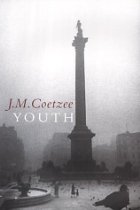
Coetzee’s Youth

J M Coetzee, Youth ( 2002)

This is the second of three (so far) novels in Coetzee’s Scenes from Provincial Life series, which are fiction, but also by strong implication unsparing autobiography. It takes up our hero as an 18 year old student and aspiring poet living in a one-room flat in Capetown and drops him again as a 24 year old computer programmer living in an upstairs room in a house in the depths of the Berkshire countryside, convinced that he is a total failure.

It’s the 1960s. The young Coetzee is committed to escape being defined by his family, trapped in the dullness of colonial life, and torn apart in what he sees as the impending revolution in South Africa. He aspires to the status of poet, and theorises endlessly to himself about how he should live (as opposed to write) to achieve that aim. He agonises over his incompetence in relationships with women, over which writers and artists he should emulate (Ezra Pound presides over his pantheon, and Beckett the novelist is a late apparition), over how to shake off his colonial identity. He rationalises his moments of appalling behaviour and then berates himself for his rationalising, and for his general coldness. He aspires to Angst, but realises his sole talent is for ‘misery, dull, honest misery’.

I loved this book. There are two possibilities: either Coetzee’s interior life as an adolescent/young adult was uncannily like mine, or he has turned a searing light onto his experience of that time of his life and laid bare something essential about the collision of adolescent romanticism with the demands of reality. Given that the externals of his life weren’t noticeably similar to mine, and I never had his overarching sense of destiny, I’m guessing it’s the latter. Young Coetzee’s misery, confusion about sex, self castigation, romantic theorising and bitter disillusion are all presented without commentary, but with a gentle irony – which may derive partly from the reader’s knowledge that this pathetic youth went on to win the Nobel Prize (and possibly that an idea that comes and goes on page 138 was the seed of his first novel), but which also simmers in the prose, bubbling to the surface as humour often enough to suggest, without invalidating the character’s intensely felt experience, that an older, wiser head is constantly there, shaping the story. My favourite bubble pops up when young Coetzee, who lives alone and feeds himself with classic adolescent male incompetence, is ruminating on Ford Madox Ford:

Ford says that the civilization of Provence owes its lightness and grace to a diet of fish and olive oil and garlic. In his new lodgings in Highgate, out of deference to Ford, he buys fish fingers instead of sausages, fries them in olive oil instead of butter, sprinkles garlic salt over them.

We do wonder if he misses the point about so much else by quite so wide a mark.

Young Coetzee was writing an academic thesis on Ford. The paragraph after the one I just quoted describes the thesis as involving ‘the task of reducing his hundreds of pages of notes in tiny handwriting to a web of connected prose’. My sense is that this book has achieved something very like that: whether Coetzee has drawn on actual diaries from the period or on the virtual pages of his recollection, he has created from the material a shiny, elegant narrative web.

Early in his stay in London, young Coetzee hears a BBC talk about the Russian poet Joseph Brodsky and is enraptured by his poetry. He reflects on what Brodsky and a handful of other poets mean to him:

they release their words into the air, and along the airwaves the words speed to his room, the words of the poets of his time, telling him again of what poetry can be and therefore what he can be, filling him with joy that he inhabits the same earth as they. ‘Signal heard in London – please continue to transmit’: that is the message he would send them if he could.

If in my early 20s I could have received this book as a signal, I would have responded, I’m sure, with a very similar joy. As it is, confident though I am that J M Coetzee won’t be reading my blog, I’m sending him a belated message on behalf of my younger self:  ‘Signal heard in Sydney 40 years later – please continue to transmit.’
—-
I read Youth in a library copy. A previous reader had ‘corrected’ the text:

  • on page 53 s/he fixed a simple typo, inserting be in ‘It would nice to write’ (‘Thank you,’ I thought)
  • on page 72 s/he altered pay to pays in ‘But none of the girls on the trains pay him any attention’ (‘Hmm, you are an old-fashioned pedant, but at least you left that But alone’)
  • on page 85 s/he changed oneself to one’s self in the sentence ‘Only love and art are, in his opinion, worthy of giving oneself to without reserve” (‘Someone please take the pen away from that person’)
  • on page 95 s/he changed the phrase to eat packet soup, possibly because one doesn’t eat soup, then – sensibly – scratched  out the alteration
  • thereafter, s/he presumably resigned themselves to the probability that Coetzee and his editors were competent after all.
  • Girl 3

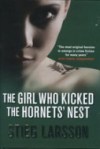
    Stieg Larsson, The Girl Who Kicked the Hornets’ Nest (2007; tr Reg Keeland, Maclehose Press 2009)

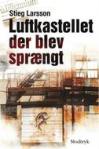
    Also known as: The queen in the palace of currents of air – A Rainha no Palácio das Correntes de Ar (Portuguese), La reina en el palacio de las corrientes de aire (Spanish), La Reina al palau dels corrents d’aire (Catalan), La reine dans le palais des courants d’air (French); The queen of the houses of cards – La regina dei castelli di carta (Italian); Justice – Gerechtigheid (Dutch); Forgiveness – Vergebung (German); Exploding  castles in the air The Castle in the Air That Was Blown Up (thanks to Reg Keeland in the comments for the correction) – Luftslottet som sprängdes (Swedish, original), Luftkastellet der blev sprængt (Danish), Pilvilinna joka romahti (Finnish), Luftslottet som sprengtes (Norwegian). Dear commenters, please correct my translations of these titles if you think they need it.

    Plenty of material there for a prediction exercise in a literacy class, and then there are the covers:

    In fact, as you would expect, neither the titles nor the covers actually tell you much about the book at all. It’s very long, hard to put down, and could have done with more stringent editing. All of its twists and turns are signalled well in advance, and there’s a prolonged anticlimax. but I liked it more than the other two. The Pippi-Longstocking-esque Lisbeth Salander is confined to a hospital bed and then a prison cell for almost the whole book, so the author’s irritating fascination with her didn’t have a lot of room to play. Perhaps perversely, I enjoy the regular pauses in the action in which characters explain to each other the specifics of the Swedish legal–political system and constitution. I even came to savour the meticulous plotting of police procedures and tracking of journalistic protocols that regularly slow the action to a crawl.

    Summertime, Boyhood and the book group

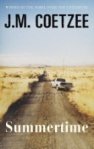
    J M Koetzee, Summertime (Knopf 2009)
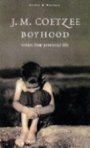
    —-, Boyhood (Secker & Warburg 1997)

    I wasn’t there when Summertime was chosen for the Book Group1846553180, and might well have argued against it. I’d read some bemused discussion about its mixing of truth and fiction and multiple perspectives that made it sound like the kind of clever writing that disappears up its own whatsit – you know, technically challenging but otherwise as gripping as batshit.

    It turned out I loved it, and put in orders at the library for the two previous volumes in Coetzee’s Scenes from Provincial Life series, Boyhood and Youth. It’s autobiographical writing, covering the years when Coetzee was teaching at school and university in Cape Town and writing his first novels. It’s not straightforward autobiography, though. The John Coetzee character is dead, so who knows in what other respects the narrative here differs from the factual record? The book consists mainly of transcripts of recorded conversations between an (almost certainly invented) academic biographer and a handful of people. I have no idea what relationship any of the interviewees have to actual people, but I am persuaded that there’s a genuine project here on Coetzee’s part of imagining how he was seen by a number of key people in his life at that time. ‘Coetzee’ doesn’t exactly emerge covered in glory. In fact, if this had been told in straightforward narrative, even in third person, some of it would have been cringingly embarrassing; and some of it, removed from the realm of hints and suspicions, might have laid the author open to criminal investigation. Coming mainly from women who had, or in one case (if she is to be believed) didn’t have, sexual liaisons with him, it’s funny, and for me at least very engaging. I’m in awe of Coetzee’s feat of creating self-portrait from the point of view of people he’d had unsatisfactory intimate relationships with, most of them much more interested in themselves than in him. It’s an act of great imagination and unsparing self scrutiny.

    BoyhoodAt the risk of appearing excessively diligent, I managed to read Boyhood before the Group met. At least on the surface, it’s a much more conventional piece of work, a possibly fictionalised memoir of the author’s childhood told in the third person. (We don’t learn that the boy’s name is John until about the halfway point.) Unlike the unreliable interviewees of Summertime, the narrator appears to be omniscient, though he reports the young John’s understanding of things without signalling to the reader when the boy has got it wrong. This sometimes results in a straightforward irony, as in matters of reproductive physiology. Elsewhere, as the boy struggles to make sense of his relationships to his parents, of the English, the Afrikaans, the Coloureds and the Africans, of South African history, of religion and his own preadolescent stirrings, the narrator leaves us alone with the boy’s painful sense of his own peculiarity. The effect, for me at least, rang very true to what childhood is like, stripped of the gloss of nostalgia and self-preserving sentiment. An unexpected bonus from having read the book out of order was the poignant discovery that the father for whom ‘John’ cares in Summertime was an object of his contempt and intense dislike in Boyhood.

    Tonight we discussed Summertime in the book group. There were ten of us, fairly evenly divided between those who loved the book and those for whom it did nothing except perhaps induce sleep. A couple of guys turned up with their books bristling with sticky yellow papers, and argued for particular ways of reading the book. Over melon and prosciutto and then strawberries, the conversation tended to take the form of them what enjoyed the book telling them what didn’t about what had given them pleasure or illumination. One man talked about the theme of embodiment – that the struggle of the character was to find a way of being in the body, of having a voice, and the structure with its multiple filters and distancing devices fitted the theme brilliantly. Another read it as an extended build-up to the passage towards the end where a woman says of the John Coetzee character that people may be interested in him because he’s won the Nobel Prize and is seen as a brilliant writer, but to her he is just a man, and not a very interesting one (though others saw that passage as a bit of almost mechanical rounding out of things). Yet another was interested in it as a portrait of a man whose masculinity was under attack. And so on. It was a terrific evening; the book is perfect for that kind of free-ranging discussion.

    Children’s literature is not a genre

    There’s a way of talking about children’s literature as if it’s a genre, like detective stories or police procedurals or thrillers or vampire stories or fantasy novels. I think this is quite wrong. A genre has acknowledged conventions, that can be followed flexibly or even violated in any particular specimen of the genre. The conventions change and grow with time. But they still rule. It’s not a vampire movie if no one sucks blood. It’s not a detective story if there’s no major crime in the first quarter of the book. Children’s literature isn’t like that. It’s defined entirely by the imagined readership. I like Margaret Mahy’s definition, which I remember as: Children’s literature is literature that you can start enjoying while a child.

    The two books I’ve just read illustrate my point.

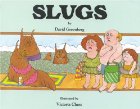
    David Greenberg & Victoria Chess, Slugs (Pepper Press 1983)

    0316326593

    I read Slugs for the first time in years the other night. My five year old great-niece was staying with her father. At bedtime, having scoured our bookshelves, she emerged with this unpleasant little book and asked me in her sweet, shy way to read it to her. Evidently she’d fallen in love with the book earlier in the year when they stayed here in our absence. I complied with as much gusto as I could muster. I find the book profoundly unattractive. It has rudimentary rhymes, describing a huge variety of slugs, many being subjected to would-be comic indignities, tortured and murdered in hideous ways, all with images showing the brown creatures impassively accepting their fates, until in the last pages they come and wreak a horrible revenge on a child (known in the book as ‘you’), ending:

    And after how you’ve treated Slugs
    It surely serves you right!

    My great-niece seemed to enjoy having this horror read to her, and when I’d finished she sat for maybe half an hour studying the pages intently.

    Clearly she is the reader the creators had in mind – as well as my sons twenty or so years ago. I am not that reader.

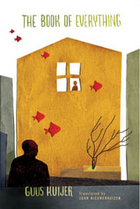
    Guus Kuijer, The Book of Everything (2004; Translation by John Nieuwenhuizen, Allen & Unwin 2006)

    1kuijer

    The Book of Everything is definitely a children’s book, but it couldn’t be more different. It has more in common with J M Coetzee’s Boyhood (which I’ll blog about during the week), in subject matter, point of view, even tone, than it does with Slugs. A lonely boy, helped by apparitions of Jesus and an old woman who is almost certainly a witch, finds a way to free himself and his family from the dominion of his harsh, violent, religiously extreme father.

    The book speaks in particular to literate children. The hero,Thomas, finds inspiration in Emil and the Detectives, Joanna Spyri’s All Alone in the World and the Book of Genesis. The narrative assumes familiarity with literary conventions (OK, there are some conventions!), particularly those about witches in children’s literature. I found my adult-reader self wanting explanations of Thomas’s visions: ‘Please be clear about this. Is the poor child hallucinating from terror, or is this a world where such things really happen?’ Such questions are just plain irrelevant to the book’s imagined reader, and once I moved over to occupy that position the book opened up to me – or I opened up to it.


    It occurred to me that some animated movies tend to wink knowingly over the heads of the children in their audience, both these books are winking at the children – ‘Don’t tell the adults.’ If we have to talk genre, the first is something like Perversely Cautionary Verse (which may be a genre found only in children’s literature), the second Domestic Magic Realism (and I doubt if that is limited to any age readers).

    I read The Book of Everything on Richard Tulloch‘s recommendation. His dramatisation of it will be playing at Belvoir Street at the end of the year. It seems to me that one of his challenges is to take the story away from the children and give it to the adults who will presumably make up the bulk of the Belvoir audience.

    Pamela’s Full Circle

    Pamela Freeman, Full Circle (Orbit 2009)

    Did I mention in my post about James Tiptree Jr’s Meet Me at Infinity that it’s full of quotable bits? Here’s Tiptree on High Fantasy, in 1975, a year or so before she was outed as a woman:

    I’ve been reading a mess of Tolkien, C. S. Lewis, Wm Morris, and T. H. White. And I find extraordinary the unspoken assumption that the greatest boon a people can achieve is – a king. The King Has Returned! Well, perhaps in the feudal state of things one can understand some of that. But I suspect it is largely a male contribution.

    It led me on to think that women are supposed to be more dependent, to slide easily into and adjust gratefully to domination. […] But who are the real dependents? Who insist on a captain, a boss, a Great Leader? Who have evolved lunatic systems of authoritarianism in every known activity except maybe solo farming? Who gratefully accept being beaten up and then faithfully follow the bully?

    Three guesses. And don’t say guppies.

    Full CircleI don’t for a minute believe Pamela Freeman intended the Castings Trilogy, of which Full Circle is the final book, as a feminist tract; I’d be mildly surprised if she’s read that bit from Tiptree; I’m sure she shares Tiptree’s bemusement at the persistence of monarchist ideology in fantasy; and there are moments in the narrative where I found myself thinking subliminally of guppies – though some of the characters who inspired that response were able to grow beyond their grateful adjustment to domination.

    I ought to declare that Pamela is a friend of mine, in the facebook sense as well as the english-language sense. So I’ll content myself with saying that this is a most satisfactory conclusion to the trilogy: there is an army of the dead, the living world as we know it is under threat of extermination, the web of comradeship and betrayal, love and loss, heroism and cowardice, filial piety well placed and misplaced, vengeance and forgiveness, violence and tenderness, epic sweep and intimate gesture is as complex as anyone could hope for. As an added fillip, things happen in the climactic scenes that make one want to go back to the start and graze one’s way through the whole 1000+ pages.

    Satisfied though I am, I’m nevertheless pleased to know that a further, stand-alone novel set in this same world is nearing the end of its first draft.

    Herovit’s bygone world (with addition)

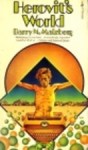
    Barry N Malzberg, Herovit’s World (Pocket 1974)

    HerovitI picked this out from my huge Science-Fiction-Books-To-Be-Read cache because it’s very thin, and because James Tiptree Jr/Alice Sheldon mentioned Malzberg as one of her favourites (though she did characterise him somewhat deterringly as a writer ‘in overt pain’, so that ‘Everybody and everything hurts, for no known reason’).

    This is almost certainly not a book that Barry Malzberg reputation rests on. It’s hardly science fiction at all, in fact, rather a grimly comic tale of a hack sf writer’s disintegration after writing 92 novels and 51 pages, plus innumerable magazine stories in little more than 22 years. It’s a prolonged self-hating in-joke, or possibly a prolonged in-joke about self-hatred. After much anguish, the writer, Jonathan Herovit allows his much more practical pseudonym to take over his own life, but when the latter fails miserably to deal with the real world, he is replaced by the even more man-of-action but even less cluey main character from Herovit/Poland’s SF series. It’s a book that has dated severely, as the science fiction world it satirises is (I imagine) no longer with us, and because its sexual politics are repulsive. Even allowing for irony, the portrayal of sex/sexism is strikingly unreconstructed. Herovit rapes his sleeping wife at one point; waking up, she makes it clear that she’s not a willing participant and that he’s hurting her. No one ever calls it rape: it seems to be just one of a series of terrible sexual experiences all round. A couple of days later Herovit’s wife leaves him. It’s not the rape that was the final straw, however, but an episode of impotence. Clearly, for the staunchly feminist Tiptree to have seen Malzberg as a favourite, his writing elsewhere must offer something extraordinary to offset this horror. It’s true, though, that in this book everybody and everything hurts, including the reader.

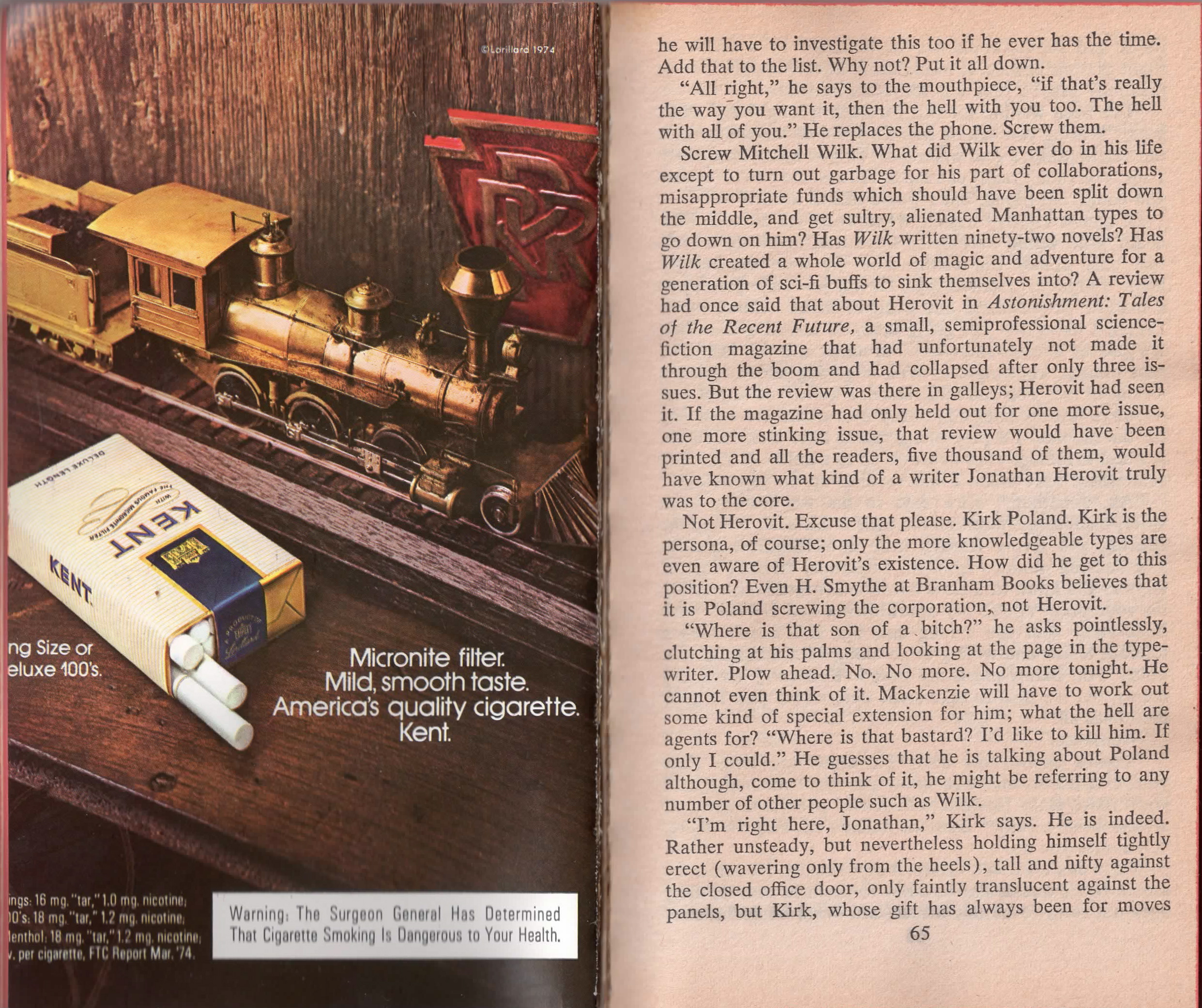
    There is a lighter note. I’m notorious for failing to respect books as physical objects (Hi Judy!). But considered as an artifact, this cheap US paperback from the early 1970s is a thing that even I could appreciate. Look at this spread:

    EPSON001

    The narrow margins suggest that the publishers really want to give you maximum wordage for your dollar, and then the ad takes even less of the burden of cost from the reader’s shoulders. I’m grateful that there are only two ads altogether, both for the same brand of cigarettes. This one is clearly for the romantic, the one on the reverse page features an elegant model steam train, clearly for the man’s man.

    Added later by request, the other ad:

    EPSON001

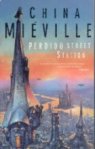
    Perdido Street Station

    China Mieville, Perdido Street Station (Pan Macmillan 2000)

    perdidoKim Stanley Robinson (you know who he is, right?) is quoted in a recent Guardian, in the context of a spray about the insularity of the Booker Prize judges, that ‘the best British literature of our time’ is science fiction. I can’t say I share his disparagement of historical novels, still enjoying the afterglow of Wolf Hall as I am, but he has a point. Certainly I feel more nourished by Perdido Street Station, a full-on chaotic, phantasmagorical, dystopian, steampunk boy’s-own-adventure-with-interspecies-sex-and-reanimated-cadavers than by any number of sensitive and self-important explorations of guilt, memory and adultery.

    It’s very long, and there was a bit towards the end where I wished he would just get on with it, but it sustained me very well through a very long plane trip and subsequent jet lag. I do feel when I read a genre work like this that I’m something of an outsider and can’t tell what’s original to it and what is a common trope. (I recognise echoes of Terry Pratchett and Neil Gaiman, for instance, but have no idea whether they are actual references or simply drawing on the same meme pool.) But when it’s done as well as this, that becomes an academic question.

    If you’re looking for a long, light, engaging read, I doubt you could find better.

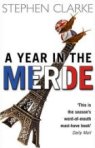
    Merde

    Stephen Clarke, A Year in the Merde (2004, Black Swan Books 2005)

    A year in the merde

    My travelling companion read three of Stephen Clarke’s Merde books in quick succession between Paris Gare de Lyon and La Grande Motte on the Mediterranean. Not only did she laugh frequently, but she would read bits out prefaced with phrases such as, ‘Ah, this is what was going on the other day.’

    We were in France at the start of September and the phrase la rentrée is everywhere. We’d gathered that it signified the equivalent of our Back to School, with added intensity gained from the fact that an awful lot of enterprises shut down for les vacances d’été and open their doors again at this time. But this book explained it from the point of view of someone working in Paris, and certainly enriched our grasp of its meaning – a time for resolutions and new beginnings, etc.

    Then there was the mysterious siren we heard exactly at midday in a small village during our walk on the Loire. Completely mystifying until – in Merde actually – we learned that at midday on a certain day every month all the airraid sirens of France have a practice run and are completely ignored by everyone except ignorant tourists. (We can vouch for the ignoring bit.)

    I was confirmed in my impression that one asks for un carafe d’eau rather than simply de l’eau at a café unless one wants to pay for mineral water.

    Apart from these useful snippets of information, and interesting bits of language artfully disguised as comedy, the book is a well-executed romp. I don’t plan to read the others, but if you’re travelling to France you could do a lot worse by way of preparatory or companionable reading.

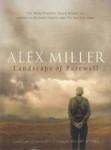
    Landscape of Farewell

    Alex Miller, Landscape of Farewell (Allen & Unwin 2007)

    It pains me to say it, but the best thing about this book as far as I am concerned is that it’s short. I read it in a day.

    In the first couple of pages, it seemed to hit wrong note after wrong note. Just two examples, tiny in themselves, but part of a cumulative effect that left me simply not believing in the characters: an elderly German professor, meditating on the notion of honour, remembers that somewhere in the bible, probably in the New Testament, we are told to honour our father and our mother; a young Australian History professor asks that same man what his father did in the war, and when he reacts with shock says it was just a piece of Australian humour. Just what planet do you have to be an academic on not to know the Ten Commandments, or that Germans of a certain age might not like to be asked by complete strangers about their family’s relationship to Nazism.

    In spite of encountering some fine prose and being invited to confront difficult realities, I never recovered from the blow my trust received in those first pages. The book’s centrepiece is a powerful account of a meticulously planned massacre of white settlers in North Queensland by Aboriginal men in reprisal for the unwitting violation of a sacred site. Everything else seems to be there to justify this piece of writing. It didn’t work for this little white duck. I was left with an uneasy feeling that some kind of equivalence was being proposed between the Aboriginal action and unnamed actions taken by German operatives during the Second World War. I’m sorry, but my response, in a word, is ‘Ewww!’

    My Book Group is to discuss this book at our next meeting. Since the meeting is on the evening of the day I get home from a month in France, I may not make it. If I do, I’ll let you know what other people thought.