
Michael Wesley, Blind Spot: South-East Asia and Australia’s Future (Quarterly Essay 101, 2026)
– plus correspondence in Quarterly Essay 102
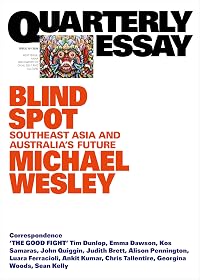
As I begin this blog post, the Guardian reports that Penny Wong will say, ‘We will continue to register our concerns about China’s vessels engaging in destabilising and dangerous conduct in the South China Sea, including towards Philippine, Vietnamese, Malaysian, and Indonesian vessels.’
Leave aside the oddness of a news item about what someone will say about something they will do. Penny Wong’s intended statement sits right in the middle of the concerns of Michael Wesley’s Quarterly Essay.
Wesley reminds his readers of a basic fact, which he says is ‘our most profound and enduring strategic reality’:
Australia nestles at the southern end of the longest archipelago on the planet. This chain of more than 50,000 islands stretches for over 7000 kilometres along the eastern coastline of the world’s largest, most populous and richest continent: Asia. From the Aleutian Islands in the north, the great archipelago extends south through Japan, the Ryukus, Taiwan, Micronesia, the Philippines, Indonesia and New Guinea, to Australia. It then curves eastwards into the middle of the Pacific, through Melanesia and Polynesia. (Page 3)
Logically, what happens in the rest of this archipelago, especially in Southeast Asia, is ‘of overwhelming importance to Australia’s safety, prosperity and sovereignty’, yet for more than a century, Australian governments have focused attention elsewhere, and the population has remained relatively ignorant about what is distinctive about our nearest neighbours. There are two main reasons for this. First, other parts of Asia – Japan, Korea, and especially China – have demanded our attention. Second, modern Australia has only ever known a world dominated by a great power that shares out language and has similar culture, and we have cleaved to that power, first the UK and then the USA.
The essay explores both these ‘distractions’ from the region in some detail. There’s a discussion of China’s project under President Xi of creating a ‘zone of deference’ in Southeast Asia, which it has traditionally seen as its hinterland. And the essay lays out the way our governments, treading a fine line between massive trade with China and diplomatic allegiance to the USA, have increasingly come to see Australia’s interests as identical with those of the USA – the Quad and AUKUS are not the only symptoms of this.
I like this encapsulation on page 67 of some of the issues:
China has accused Australia of operating according to a ‘Cold War mindset’, seeking to divide the region and increasing military tensions. This plays directly into historical and contemporary anxieties in Southeast Asia about unwillingly becoming a cockpit for great-power rivalry and conflict. The increased presence of US forces and capabilities on Australian territory is viewed as bringing the possibility of great-power conflict much closer to Southeast Asia. Equally damaging to Australia’s interests is that it risks being seen by its neighbours as a spear-carrier for US policy – a particularly dangerous perception at a time when US policy is increasingly unpredictable and unapologetically transactional and self-interested.
Wesley concludes that Australia needs to take four steps to deal with dangers to its national interest in Southeast Asia:
- Understand the scale of the challenge, and realise we have underinvested in diplomacy and development and focused our defence spending on capabilities that are more aligned with the USA’s needs than our own.
- Fundamentally to change the way we think about our alliance with the USA – stop thinking about it as an end and return to thinking about it as a means. We can say no to Washington and maintain the alliance.
- Start looking at Southeast Asia on its own terms. We must build a clear and nuanced understanding of the frameworks through which our counterparts in Jakarta, Singapore, Putrajaya, Bangkok, Hanoi and Manila think about the world.
- Develop a new discipline in assessing challenges and thinking rigorously about their likelihood and consequences, reversing the single-view culture that has led to so much scare-mongering about China.
I’m a long way from being able to judge the accuracy of Wesley’s diagnosis or the value of his proposed actions, but this is a thoughtful and instructive essay that helps to understand the complexities behind headlines like the one I started with blog post with. I find myself asking: Is Penny Wong talking about Southeast Asia through the lens of our alignment with the USA in the tension between the great powers, or is she concerned about Southeast Asia for its own sake?
Correspondence in Quarterly Essay 102 (The God We Created by Anna Goldsworthy), which also appears on the Quarterly Essay website along with the text of the essay, kicks off with a spirited defence of the Albanese Government’s engagement in Southeast Asia by Tim Watts, who was assistant minister for foreign affairs from 2022 to 2025. He presents an impressive list of activities, but Wesley responds, doesn’t really address the argument that Australian governments have failed to have a thought-through strategy for engagement with the region for its own sake, rather than as part of its China policy.
The other responses, from an impressive array of academics and policy wonks, add depth and complexity to the argument.
I am a man of settler heritage. I wrote this blog post on the land of Gadigal and Wangal of the Darug Nation, where the winter is finally beginning to bite. I acknowledge their Elders past and present and welcome any First Nations readers of the blog.


