Tag Archives: poetry

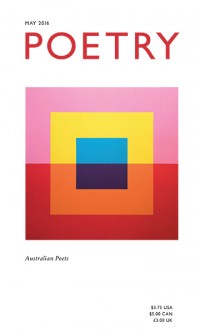
Poetry May 2016

Robert Adamson (guest editor), Poetry, May 2016 (Poetry Foundation, Chicago)

This special Australian Poets edition of Poetry magazine was launched at the Sydney Writers’ Festival this year by the regular editor Don Share. Guest editor Robert Adamson spoke and a number of the featured poets, including several who were coopted from the audience, read to us. Who could resist buying a copy?

The magazine contains 28 poems by 20 poets, along with 18 beautiful photo portraits by Juno Gemes and two survey essays by Jaya Savige and Bronwyn Lea, plus a charming note on Robert Adamson by US poet Devan Johnston.

Where the articles, particularly Bronwyn Lea’s ‘Australian Poetry Now‘, struggle with the impossible task of giving the readership, presumably mainly from the US, an overview of the state of Australian poetry, the selection does something different: it’s personal, making no claims to be representative or definitive. It includes a wonderful variety in forms and concerns: narrative, lyric, prose poems, formal experimentation. The landscape and geography are well represented. There are cultural references – both to settler and Aboriginal motifs – that will set non-Australians frantically googling, but at least as much Biblical and classical reference.

It’s hard to generalise about a collection like this, and equally hard to single out individual poems. But here goes with a few:

  • Ali Cobby Eckermann has two strong, plain-speaking poems, ‘Black Deaths in Custody‘ and ‘Thunder raining poison‘, the latter an incantatory response to a work of art about the effects of atomic tests on traditional lands at Maralinga.
  • Samuel Wagan Watson’s prose poems ‘Booranga Wire Songs‘ and ‘A one ended boomerang‘ really sing.
  • The first poem in magazine, Bonny Cassidy’s ‘Axe Derby‘, which plays tantalisingly on the image of a woodchopping competition
  • Anthony Lawrence’s ‘My darling turns to poetry at night‘ is a richly complex villanelle, whose title doesn’t mean what you expect.
  • Jaya Savige has fun with mangoes and anagrams in ‘Magnifera‘.

(The whole magazine has been up on the Poetry Foundation’s website, and you may still be able to read it all on screen. All the links are to that website.)

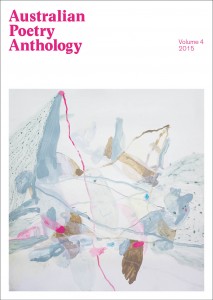
Australian Poetry Anthology 4

Sarah Holland-Batt and Brook Emery (editors), Australian Poetry Anthology Nº 4 (Australian Poetry Ltd 2015)

APA4.jpg

Paradoxically, the thing I like best about this anthology is the absence of stars. Think of three famous Australian poets, and I’ll bet you none of them is here. The starlessness isn’t a sign of mediocrity: many of these poems have been published in reputable places, and quite a few have been on shortlists or won awards. But there’s a sense of the book as a conversation rather than, say, a competition or a performance, or even a showcase. Poems bounce off each other, or not, tackling similar themes or taking similar forms, but each doing something different, individual.

Australian Poetry Ltd was formed four or five years ago, as an amalgamation of the Poets’ Unions in a number of states. It describes itself as ‘the national body for poetry in Australia, with a charter to promote and support Australian poets and poetry locally, regionally, nationally and internationally’. Among other ways of filling this charter, the underfunded, understaffed organisation produces a twice yearly journal which includes articles as well as poetry, and an annual members’ anthology, of which this is the fourth. Almost every page has pleasures to offer.

There’s the pleasure of meeting someone familiar. John Upton ‘ Unawares’ is a kind of aftershock to the poems of loss in Embracing the Razor:

Pulling an old dictionary from the shelf
I open it, see her signaure, and myself
back twenty years momentarily: intense
surprise, like pausing suddenly on stairs
to stop a fall.

There’s serendipity. Our cumquats were ripening as I read Pamela Schindler’s ‘Cumquats, Hobart’:

These little orange globes –
lanterns that floated
in the tree at dusk

There’s plenty of topical poetry. Jillian Kellie’s ‘the bus to baghdad 1966’ is a then-and-now poem – the bus trip of the title in which her family travelled with a Canadian journalist, alternating with grim dispatches from the present – that leaves you feeling you’ve learned something about Iraq:

held up for hours at the syrian border
 a problem with canada's passport and visa
 dad speaks in arabic to chain-smoking soldiers
 extolling the honour of his new journo friend
 i owe you a scotch when we get to baghdad
 i don't drink my dad says

Unconfirmed video and pictures of the photojournalist's heartbreaking final moments emerged this morning via Twitter accounts claiming to be associated with the Islamic State

There’s plenty of narrative, some explicit, some implied as in Cary Hamlin’s ‘Scraping the Night’, whose opening lines evoke a romantic assignation in a car:

Moonlight leers through the car window
 etching the valley of your cheek
 in razor-sharp shadow

fingering the crescents of your eyes
 fondly and crooning its siren song

And there’s lots of fine descriptive writing. I love Anne Elvey’s observation of pelicans in ‘This flesh that you know is all that you have’:

--------------Their synchronous glide was broken
by one pair of wings, and then another, that worked
 the air, not quite in time, and over again they wheeled.

Brett Dionysius’ ‘Brigalow: an extinct pastoral’ is a powerful evocation of a landscape being ravaged post World War Two, recalling newsreel footage that was meant to celebrate progress but even then struck a chill into young hearts like mine and, I assume, Brett’s:

----------------They strung a necklace of iron pearls
between two dozers; manacled violence, like nineteenth
century convicts kept under guard. The machines clawed
through six million acres, rubbing against bark, leaving
a scent trail of oil & diesel, as though they were some
type of ancient megafauna revisited; extinct, buttery-
furred thylacoleo, carnivorous in their vast appetite.

I can’t tell if any Indigenous poets get a guernsey, but a number of poets who I assume are white reflect on Aboriginal matters. Jill Gientzotis, for example, in ‘Each Morning, Every Day’, draws on her experience living and working in remote communities:

Anangu knew we were coming for a long, long time.
 Whitefellas, ghost people. They knew we were coming.

We were coming. Our horses and cattle churned up the land,
 water got sick, the animals fled. They heard about our killing.

You get the idea: there’s so much to enjoy. The anthology will probably be read mainly by Australian Poetry members – those who didn’t make it as much as those who did. But I think there’s a much wider pool of readers who would enjoy it. You can buy a copy from Aust Poetry Inc.

Eileen Chong’s Painting Red Orchids

Eileen Chong, Painting Red Orchids (Pitt Street Poetry 2016)

I’m an increasingly unabashed Eileen Chong fan, and I love Painting Red Orchids.

As in her previous books, these poems refer back to the poet’s childhood in Singapore, to the China of her forebears, and also to her present home in Australia; much food is prepared and eaten; there is conversation with other poets living and dead, Chinese and Western; and there are travel poems, this time to suburban Sydney and rural Australia as well as Singapore and Hong Kong.

All of this is given us with generosity and lucidity, and an occasional revelatory jolt. The restraint of classic Chinese poetry is never far away, and a number of poems are explicitly dedicated to great poets of the past.

There are love poems – heartbreak as well as new love. Someone (it might have been Margaret Mahy or Diana Wynn Jones) said that food is the sex of children’s literature. Food doesn’t quite equal sex in Eileen Chong’s poetry, but it comes close and may be even better, more intimate, as in ‘Xiao Long Bao (Little Dragon Dumplings)’, which describes the making of these dumplings and then the look on her lover’s face when he tastes them, and even more so in ‘A Winter’s Night’, in which the speaker, presumed to be of Chinese heritage, prepares Scotch broth for her Scottish-born partner:

This, here, made from my hands,
his memories – we consume spoon after spoon
of history and desire and laugh about the future.

A strand of deep melancholy runs through the book: there’s dementia, death, a relationship break-up, and this (I need to quote the whole poem):

Child
And if he had lived – grown
to fruition in my mother’s womb,
pressing against her bladder
so she would have needed to have emptied
it every hour – I would have been the middle
child. I would have had an older brother
and a younger; I, the singular female.
Instead, there are just the two of us,
brother and sister, circling like moons,
gripped by the gravity of disappointment.

My father would come home and pretend
he’d brought us a puppy. Once, the bag
even barked: but it was only a toy dog.
My mother named this dead brother.
She imagines he might have lived if she
had done this, or had not done that. If
he had lived, I might not have left home
so soon in search of my own arc and orbit.
If my own two had lived, what then? But the dead
remain dead, and I am the last child to arrive.

I love the way this edges up on its real subject. Not that the impact of the speaker’s mother’s miscarriage on their family – the siblings’ enduring sense of someone missing, the mother’s what-ifs, possibly the speaker’s leaving – wasn’t real. And the three lines  about her father’s teasing with pretend dog-gifts could have expanded into poem in its own right. But ‘If my own two had lived’ turns the poem inside out, and we realise that its emotional charge comes from the speaker’s own loss: she can speak of her mother’s bladder and mental processes, not from the perspective of her remembered childhood, but from her own experience as a woman; the barking of the toy dog is freighted with deep grief; the image of circling without a centre is conjured up by the much later loss. The final line, which at first reading I took to answer the question whether the lost brother was older or younger, does do that, but also laments the speaker’s childlessness – not just the last child in that family, but the last in the family line. So much is conveyed, so little said out loud. I think of James McAuley’s ‘Pietà, ‘I cannot tell, / I cannot understand / A thing so dark and deep, / So physical a loss’.

Eileen is currently blogging on the Southerly site. Her interview with herself at that link is well worth reading. Here’s an excerpt:

Do you consider yourself an Australian poet?
This is a question about hybridity. Am I a Singaporean poet? An Asian-Australian poet? An Australian poet? An interesting woman poet? A Chinese poet? A confessional poet? A food poet? I think I might be all of the above, sometimes all at the same time.

AWW2016Painting Red Orchids is the fifth book I’ve read as part of the 2016 Australian Women Writers Challenge.

Pam Brown’s Missing Up

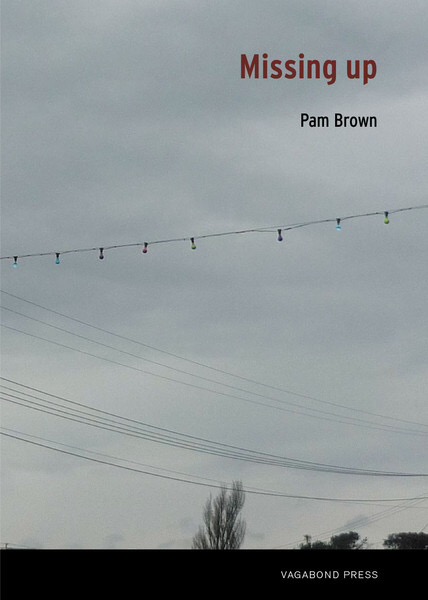
Pam Brown, Missing Up (Vagabond Press 2016)
Francis Webb once said that a poem was a meeting place of silences, or words to that effect. I don’t know if Webb would have taken to Pam Brown’s work (or vice versa), but the poems in Missing Up reminded me of his observation. It’s not that she writes things that ‘oft were thought but ne’er so well expressed’ (to invoke another unlikely poet), but I find in her poetry a kind of mental activity, the kind that generally precedes speech or even coherent thought, that is distractible, non-linear, associative, interspersed with snatches of other people’s words. I don’t know about you, but that’s the kind of activity that fills a lot of my silences. Pam Brown wrangles it into words.

Rather than try to say more about the book as a whole, let me have a go at a single poem. Here’s ‘Flat white’, which is far from being typical of the longer, non-linear, obliquely and sometimes grimly personal poems in this book, but which I’ve chosen partly because it’s the shortest in the book, and because I wanted to figure out what its title pun is doing:

Flat white
how to hold a genre
__who likes
______
genres
& how to
___handle filth___und drang
or
_(ring the bells here)
______
devise
__
a few innocent new myths
to resacralize
______the apostasy
of the bourgeoisie
_________________
the who?
they’re the ones
____
with unhappy consciousness
who are seeking
_
a brains & sex harmony motor
to spruce up
___
the non-lived
__________
flat white life
in
__
natural surroundings

First off, you can’t read this poem as you would a passage of prose, and that’s not just because of the line breaks. Like Pam Brown’s poetry in general, it asks for a different kind of attention: not requiring that it yield its meaning at a glance, but settling in, tolerating ambiguity and ok that some meanings and references may take a while to become clear, may even remain permanently inaccessible. I think I’m right in saying that if you feel like an outsider as you read this poem for the first time, then that’s not a bug but a feature: we’re not being addressed, lectured at or wooed; we’re eavesdropping – eavesdropping by invitation, if that’s a thing.

**** The next few paragraphs show me struggling to explicate the poem. I had fun and learned from the process, but you may find it a bit boring. ****

In the absence of conventional punctuation, some parsing is called for. Here’s how I read it – your mileage may vary.

The poem is in two parts, of 12 and 10 lines respectively. The first part ruminates on a project. ‘How to’ doesn’t introduce a set of instructions, but poses a question or challenge: how is one ‘to hold a genre & … handle filth … or … invent a few innocent new myths’. The reason for wanting to do these things is ‘to resacralize [sic the US spelling] the apostasy of the bourgeoisie’. The second part then offers a definition of the ‘bourgeoisie’, and in doing so indicates why the activities contemplated in the first half are called for.

So far, so straightforward. To complicate things, it’s as if a second voice heckles the first: when Voice A mentions genres, Voice B mutters in the reader’s ear, ‘Who likes genres?’; when Voice A mentions filth, Voice B adds a sarcastic, or perhaps clarifying, ‘und drang’; Voice B is surely mocking when she says, ‘Ring the bells!’; and then her question ‘The who?’ is the poem’s turning point. And I guess you could read the rest of the poem as integrating the two voices – the one who names the project and the one who derides it.

But grasping the structure doesn’t make the poem transparent. ‘How to hold a genre’ for a start: Harvard University’s Poetry Classroom lists 35 genres, from allegory to verse epistle – what does it mean to hold one of them? It’s probably not ‘hold’ as in ‘hold the mayo’ (though on first reading one may stay open to that possibility), but as in ‘grasp’. I provisionally take the phrase to mean to write a poem that follows clear conventions. As Brown’s work rarely fits into any established genre, perhaps here the poem’s speaker is wondering how she would go about doing this thing that she has no actual desire to do (hence Voice B’s interjection), or maybe she’s contemplating establishing a genre of her own, of holding her own poetry to some established form (in which case Voice B is questioning the worth of the project).

Then ‘hold a genre’ is paraphrased as ‘handle filth’: the meaning of ‘filth’ isn’t clear, and the interjected ‘und drang’ is funny, but hard to pin to a meaning. (I know I miss a lot of Brown’s poetic references, but I do know that Sturm und Drang was a highly charged German artistic movement, in which Beethoven was a major figure.) The line expresses emotional recoil from the idea of working in genres – the speaker likens it to handling poo. A quick internet search refined my understanding of Sturm und Drang: it translates literally as storm and yearning, which gives the joke an interesting twist: yes, to attempt that kind of poetry may be like handling filth, but that doesn’t stop the poet from yearning for it to achieve some higher end. (Alternatively, ‘handle filth’ may not be meant to paraphrase ‘hold a genre’ at all, but add to it, so the challenge is to hold to conventions while handling messy (filthy) and emotionally charged realities. Both readings can work, possibly at the same time.)

In the next lines the project becomes more ambitious. Voice B’s sarcastic injunction to ring bells and the deprecating irony of ‘few’ and ‘innocent’ (can myths ever be innocent) modify but don’t erase the ambition of ‘to devise … myths’. And ‘to resacralize / the apostasy / of the bourgeoisie’ sounds like a big deal. I’m inclined to take this phrase seriously, either as an aspiration or as a sorrowful recognition that something is needed, even though impossible. ‘The apostasy of the bourgeoisie’ is probably a reference that I don’t recognise – Google didn’t help me with it. The bourgeoisie have lost their sense of the sacred, perhaps of meaning, or not so much lost it as turned away from it: their sustaining myths are either dead or toxic/desacralised. It’s worth noticing, though, that the speaker isn’t contemplating reviving those myths, but devising new ones, not to reverse the apostasy of the bourgeoisie, but to (re)sacralise it. Whatever that means.

But bourgeoisie is such a nineteenth-century, Marxy term. Fair enough that the voice from the peanut gallery challenges it: ‘the who?’

The remaining nine lines answer the question in a single, only slightly obscure sentence: ‘they’re the ones / with unhappy consciousness / who are seeking / a brains & sex harmony motor / to spruce up / the non-lived / flat white life in natural surroundings.’

There is probably someone on the planet who doesn’t know that a flat white is a kind of coffee (cappuccino senza schiuma is how you order an approximation in Rome), that the cool people drink in some parts of the world. The phrase ‘the non-lived / flat white life’ is what drew me to the poem in the first place. Barry Oakley described marijuana as the new sacrament of rebellious middle class youth in the 1970s. This poem suggests that the flat white is currently the desacralised sacrament of certain alienated or spiritually lost middle class people. (When one of my sons was a teenager, he quipped that when God was giving out senses of humour, a certain adult thought he meant coffee and asked for a flat white. There’s a similar play of ideas here.) These are not the bourgeois who were shocked by Baudelaire; these are, more or less, Pam Brown’s people. (I don’t drink coffee, but the poem is pointing at me.) There’s discord between what they are seeking – ‘a brains & sex harmony motor’ – and what this poem has been contemplating – ‘to resacralize / the apostasy’. They want a mechanical solution; the poem is groping towards something more demanding. Their ‘surroundings’ are ‘natural’ only ironically, like Patrick White’s carefully natural gum trees in Barrenugli. No room for poetry to play a central role there: the poem ventures to consider the possibility, but recognises that the odds are against it.

The poem does all this while managing to feel tossed off (the technical term for which I believe is sprezzatura).

**** End of potentially boring explication *****

The Vagabond Press website has a very nice blurb on this book which describes the poems as ‘offbeat, fragmentary yet often discursive’, and includes this:

For Pam writing poetry is a habit, a disorganised ritual. Her poetic inventories begin in everyday bricolage. Real things interrupt the poems the same way thoughts and phrases do. You know – the fridge over there, the bus stop, surf music on a radio, a raisin squashed against a floor tile – always backgrounding a connection to the ‘social’ as the poems make political and personal associative links.
AWW2016Missing Up is the third book I’ve read as part of the 2016 Australian Women Writers Challenge.

Martin Harrison’s Happiness

Martin Harrison, Happiness (UWA Publishing 2015)

1742586864.jpgI’d pretty much finished writing this blog post when I discovered the special issue of Plumwood Mountain, an ‘Australian journal of ecopoetry and ecopoetics’, dedicated to the memory of Martin Harrison who died in 2014 while Happiness was being prepared for the press. I won’t be offended if you click over to that and don’t bother with the rest of my post. But here it is anyhow:

An email is doing the rounds with the subject line ‘Poetry Experiment’. It asks you to do two things: 1) send a poem – any poem – to the first on a list of two people; and 2) alter the email by moving the second person on that list to the top and adding yourself in second place, then Bcc the altered email to 20 friends. If everyone follows instructions, 400 poems will soon arrive in your inbox.

I did as instructed, and received 4 poems: four famous lines from William Blake, a prose quote from Mahatma Gandhi, Emily Dickinson’s ‘He ate and drank the precious words‘, and a Leunig verse. The person at the top of my list sent me copies of the poems she received. There were five from my friends: some lines from Auden, Shakespeare, and Rumi, and whole poems by Judith Wright and (again) Emily Dickinson.

Tentative conclusions: the vast majority of people don’t take to poetry, or at least to a combination of chain letters and poetry; people are generally more willing to share poetry than to ask other people to do so; and we’re more likely to share favourite lines than whole poems.

Which brings me to Happiness. There are any number of excerpts that would do perfectly for the poetry experiment. For example, this lovely evocation of a landscape in ‘Summer Rain Front, North Coast’:

the mountain mirrored in the instant’s stillness
of the calm sea flooding into the bay
the mountain photoing its image on the waters
over the grounds where dolphins track    and then its scarves
hanging high in the air like drifted parachutes
white against blue

But probably none of its poems is chain-letter material in its entirety – they’re too long, and mostly proceed like conversation rather than performance. That is, the pleasure of reading them doesn’t come so much from brilliant turns of phrase or striking metaphors as from the sense that one is being invited to join the poet in his experience of the world, his loving embrace of it, including that part of it he addresses as ‘you’, which at least sometimes is his lover Nizat Bouheni, to whom the book is dedicated, and who died in 2010. There are love poems, poems filled with meticulous, immersive observations of nature, forty-five pages of elegies. There are a couple of awkward but trenchant poems on the politics of climate change, and an ‘experimental’ poem that an author’s note (kindly) informs us is ‘made up of responses to a randomly sorted set of instructions repeated four times’. And there’s one satirical description of some US Americans abroad.

One of my favourite moments in the book, which is in some ways representative, is in ‘Wallabies’. After three pages of  two-line stanzas evoking the sights and sounds of a particular Australian landscape with something approaching ecstatic fervour (the absence of punctuation may make this hard to decipher at first, but patience pays off):

nothing is dead here the spaces between them are
inhabited leaves twigs debris fallen white-anted trunks

slopes rocks grass parrots galahs floating down
in pink streamers again the grey lack of edge

around sprays cream waterfalls of turpentines flowering
in high irrigated air-blue reaches

and much more, there’s this:

that twenty mile shadow across the claypan’s a fence

which as dusk comes is a lightning-quick snake
momentarily distracting the way they appear

as if from nowhere like sentinels weathered stone
camping in that stubble sunset-toned no like mushrooms

wallabies two of them and then three over there then more
pale half-red underfur letting them melt into late light

alert as the slanting hour’s alert to earth cool as wine
then the shriek as they scatter

I love how the poem enacts the way you often become aware of the presence of wallabies in a landscape rather than see them arrive: they’ve been in the poem for three lines before they are named. They may be the subject of the poem, but they are part of a much bigger field. Harrison’s poetry often seeks out and celebrates the tiny or the evanescent – a blue wren nesting under the eaves on a sweltering day, a moment in a changing skyscape, a half-heard sound in the upstate New York woods. These lines from ‘A Music’, which is the second part of ‘Two for You’, an elegy for Nizar Bouhemi, could be describing much of Harrison’s poetry:

________The singleness
of each event in

its own swerve and
sharpness, drawing

attention and attentiveness
making it seem as if anyone

could just see it, grasp it,
wait to understand

what no one understands

Martin Harrison’s death of a heart attack in 2014 makes this book’s attention to the fleeting and its grappling with the realities of death incredibly poignant


Self-promotion

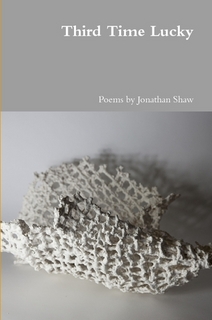
3tlIt’s all very well reading stuff online, but for my money you can’t beat the feel of a dead-tree book in your hand. Likewise, I enjoy putting my verses up on the blog, but it’s not the same as having them in an actual book. So in December last year, for the third time I collected verses written during the previous 12 months and got a book together thanks to lulu.com, again with a cover by the Emerging Artist, this time one of her fabulous ceramics. It’s now available from Lulu and Amazon.

Apart from pure vanity, my main motive for this and previous self-publishing ventures is to make a small gift to give friends the end of the year. If you’re a friend who hasn’t got a copy, then it’s an oversight on my part. Tell me in the comments or by email and I’ll send you one.


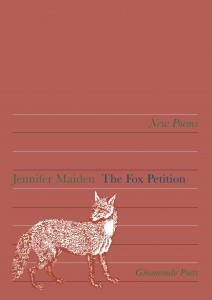
Jennifer Maiden’s Fox Petition

Jennifer Maiden, The Fox Petition (Giramondo 2015)

The-Fox-Petition Like all Jennifer Maiden’s books for several years now The Fox Petition has a huge cast of historical and fictional characters, as well as some living politicians and a couple of non-human entities.

Most of these appear in Maiden’s dialogue poems. Julie Bishop makes her debut, and so do father and son act Keith and Rupert Murdoch. Making return appearances are Kevin Rudd and Dietrich Bonhoeffer, who seem to be forever on an aeroplane; Tony Abbott and Queen Victoria, whose relationship is becoming even more tense; George Jeffreys and Clare Collins continuing their adventures, this time in the Greek financial crisis and with refugees from Syria; Hillary Clinton and Eleanor Roosevelt, still flirtatious and remonstrative in pretty equal measure.

I think the Hon. Carina Monckton, created by the inhabitants of the Carina Galaxy, has appeared in an earlier book, but I’m positive that the Harvard School of Business has not been seen before his chat here with Julie Bishop.

Then there are the Diary Poems, so called because they seem to ramble like diary jottings, though those appearances are hugely misleading. Many other characters get a guernsey in them, including Tanya Plibersek, Gillian Triggs, Penny Wong, Joan Baez, Labor politician Melissa Parke (Maiden’s ‘favourite politician / now’) and eighteenth century Whig Charles Fox (her ‘favourite politician / of all time’).

Heavily populated though the book is, it has an extraordinary coherence. The title refers to a recent protest against measures in New South Wales making it illegal to keep a ‘newly acquired fox’, even if neutered and vaccinated, and also to Charles Fox’s defence of habeas corpus during the Napoleonic Wars. What links the two, apart from the word play (of which there is a lot) is Maiden’s passionate dislike of the single-minded self-righteousness she has previously called ‘ethical security’, which here is represented literally and metaphorically by Biosecurity: the goal of being safe from germs, feral animals, refugees, and moral complexity of any kind.

As my regular readers know, I’m a fan. I love the voice of these poems. A Maiden poem characterically feels as accessible and even as interactive as a chat with a friend about the TV news, making you laugh and perhaps confirming your prejudices.Then extraordinary lines emerge, such as:

it is vital to be Australian, which
seems to mean rat poison and a flag.

Something else has been going on behind the chat. It is, after all, poetry made from the stuff of the nightly news, that pushes the reader to think and feel in new places. Did I also mention that it’s fun?

aww-badge-2015 The Fox Petition is the twenty-first and last book I read for the 2015 Australian Women Writers Challenge.

November rhyme # 14

Better late than never. At least the event that inspired this happened in November:

Rhyme #14: Dinner 
From canapes to mango cheesecake
conversation didn’t flag.
(Two teenage boys sat mute – like, please make
this weird food go. It makes me gag.)
A window shows the inner working
of lab mice. There’s no one smirking
that a boyfriend in North Bay
was hit by two cars. Who can stray
down George Street in a hypo stupor
or drop unconscious in a pool
while holding baby? The Art School
exhibition’s still on – super!
Records from ASIO. Oh my!
Too much man sex in London Spy.

And so ends my task of 14 rhymes for November for 2015. I told the emerging Artist (formerly the Art Student) that I was thinking of keeping the doggerel  up, if at a slower rate, as a regular thing in the blog. Tactfully, she said people really like my prose. So normal functioning will resume shortly.

November Rhyme #13

OK, this is a fridge door poem I made earlier, but since the object it describes is once again being exhibited I’m passing it off as done today

as+for+living+II+web

As for Living III, by Penny Ryan. Photo by Kate Scott

Rhyme # 13: Piece in an exhibition
A broken ribcage from some broken
evolutionary line?
But these  aren’t bones – too glibly spoken!
That’s no knotted ridge of spine.
This work displayed in art school stairway
is not by some apprentice Yahweh,
nor did the wondrous Burgess Shale
a woven life like this unveil.
And yet it speaks of some great sorrow,
something beautiful that’s lost,
A world bereft, left with a ghost.
Perhaps a warning for tomorrow
unless we act, lives we hold dear
will be as if they never were.

Rumi in Strathfield and November Rhyme #12

IMG_1447

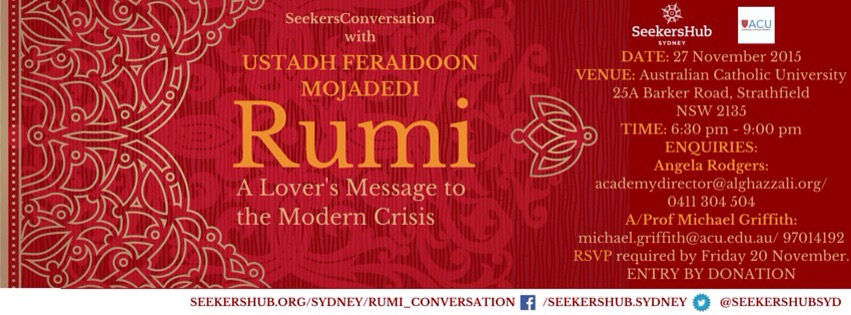
On Friday evening at the Australian Catholic University, two Muslim scholars sat with an audience and discussed the great 13th century Persian poet Mevlana Rumi.

Ustadh Feraidoon Mojadedi, an Afghani scholar who now lives in the USA, was in conversation with Imam Afroz Ali, of the Sydney Seekers’ Hub, a place of Islamic learning.

They spoke of Rumi as a great spiritual teacher, not just for Muslims, but for all humanity. Ustadh Feraidoon Mojadedi wears his enormous erudition lightly, and had us laughing even as he explained the complexity and depth of Rumi’s vision. He argued that what non-Persian readers need is more, better commentary rather than translation, because all translation is misleading. There’s much more to Rumi than you would gather from the quotes you see on Facebook.

I went along for a number of reasons, but mainly because a friend gave me a copy of The Essential Rumi decades ago which has remained, literally, a closed book. I’m also aware that my ignorance of Islam can’t be a good thing in the age of Corey Bernardi and Donald Trump.

Well, I know a tiny bit more about Rumi, and I’m planning to go to another event next week. But possibly more significant is how the evening altered my sense of Islam.

The relaxed, affectionate  relationship of the two scholars was in sharp contrast to images I have from movies.

In question time, it was women who asked all the questions – so much for the notion that women are silenced in Islam.

And most interestingly we were all invited to join the sunset prayer part way through the event. I’m not at all religious, but I’d joined in the Our Father at an Anglican ceremony the previous day. I checked with a number of people and joined the prayers. I did a lot wrong: I hadn’t arrived in an abluted state, I didn’t take my shoes off, I joined a line that turned out to be the women’s line, and I’m pretty sure I failed to follow all the standing and kneeling correctly (though my Catholic youth and childhood was some preparation for that). And of course I didn’t understand what was being said by the prayer leader. But there is something profound in joining a group of people who humbly bow repeatedly in the face of the mystery of the universe, and I returned to the lecture with an extraordinary sense of our shared humanity. Which was also the content of much of the talk.

So I went to the event expecting a literary evening, and found something quite different.

I’ve set myself a task of writing a 14-line rhyme with each blog entry in November (originally inspired by those people who write a whole novel in November – not sweating over quality, just getting the words out). Here goes for this one:

Rhyme #12: On joining sunset prayers
I bow, I kneel, I touch my forehead
to the grass. I have no God:
no disrespect, I take these borrowed
gestures (like my childhood’s nod
at Jesus’ name, or genuflection)
not to seek some Power’s protection,
but to say: The world is vast,
my time here comes and goes so fast.
Right now I humbly pay attention
to what is deepest in my heart:
my loves, my challenges, the part
I choose to take past good intention.
We bow, we stand, we’re flesh and bone
and mind. We’re none of us alone.