Tag Archives: poetry

Jennifer Maiden: A Rare Object

Jennifer Maiden, The Violence of Waiting (Vagabond Press Rare Objects Series No 95, 2013)

1vwAs Vagabond Press’s beautifully crafted Rare Objects series of chapbooks approaches its hundredth and final title, Jennifer Maiden makes her debut at Nº 95. There are just six poems in the book, mostly in modes established in Maiden’s recent books:

  • Nº 15 of the George Jeffreys series, which finds George and Clare Collins in a purgatorial Western Suburbs Poker Machine Palace
  • Nº 10 of the Hillary Clinton and Eleanor Roosevelt dialogues – this time with a little Lady Diana thrown in
  • A Lady Diana–Mother Teresa dialogue – this may be the second time they’ve appeared together in a Jennifer Maiden poem, the first time being shortly after they both died
  • a ‘Uses of’ diary poem, about cosiness and Sylvia Plath among other things
  • A Kevin Rudd–Dietrich Bonhoeffer dialogue
  • ‘Maps in the Mind’, a lyric that invokes successive Australian governments’ treatment of asylum seekers a little in the manner of ‘My Heart Has an Embassy’, which referred to Julian Assange

As I was starting this blog post, my Feedly reader presented me with ‘The poetic spirit of Rare Objects’, an excellent review by Jessica L Wilkinson of the four Rare Objects launched in Melbourne last weekend. Having read that review, which originated on the Overland site, I find it hard to think of anything else I want to say, so I recommend that you click on the link. For those who don’t click, here’s her final sentence, which captures the mood of the book beautifully:

This collection is quietly yet resolutely political, and leaves us considering our own strengths and vulnerabilities, and who we may imagine clinging to for guidance through tough decisions.

awwbadge_2013I nearly forgot and perhaps I should have as it’s such a small book, but this is another title in my Australian Women Writers Challenge for 2013.

Colleen Z Burke’s Splicing Air (and Sonnet 13)

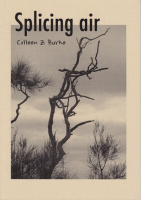
Colleen Z Burke, Splicing Air (Feakle Press, 2013)

1sa

More than 20 years ago in a pub in Glebe I heard Colleen Burke (I don’t think the Z had yet become part of her working title) read poems from which I still remember lines that move me, from what she presented as straightforward records of conversations with her children.

Many of the poems in Splicing Air capture moments with her grandchildren, and the conversations still smuggle killer lines into the poetry. Many others, in what I think of as her signature style, are short, impressionistic pieces about landscape or, especially, skyscape in and over Newtown and surrounds, or bushland. There are a number of pieces observing the social life of Newtown, past and present, and a handful of longer pieces. And some snapshots from New Zealand

Four of the longer pieces draw on the history of discovery and settlement of New South Wales: an narrative-essay on James and Elizabeth Cook, journal entries by the surgeon and an officer from the First Fleet, a biographical sketch of the early Australian poet Frank Macnamara. They lack obvious poetic embellishment, but in each of them the effect is unsettling and revelatory. There are straightforward accounts of the lives of two nineteenth-century women – ‘The publican’s daughter’ being the poet’s great grandmother, and ‘The fossil hunter – Mary Anning’ (which accounts for roughly a fifth of the book) an extraordinary Dorset woman who might easily have been lost to history because of her class and gender.

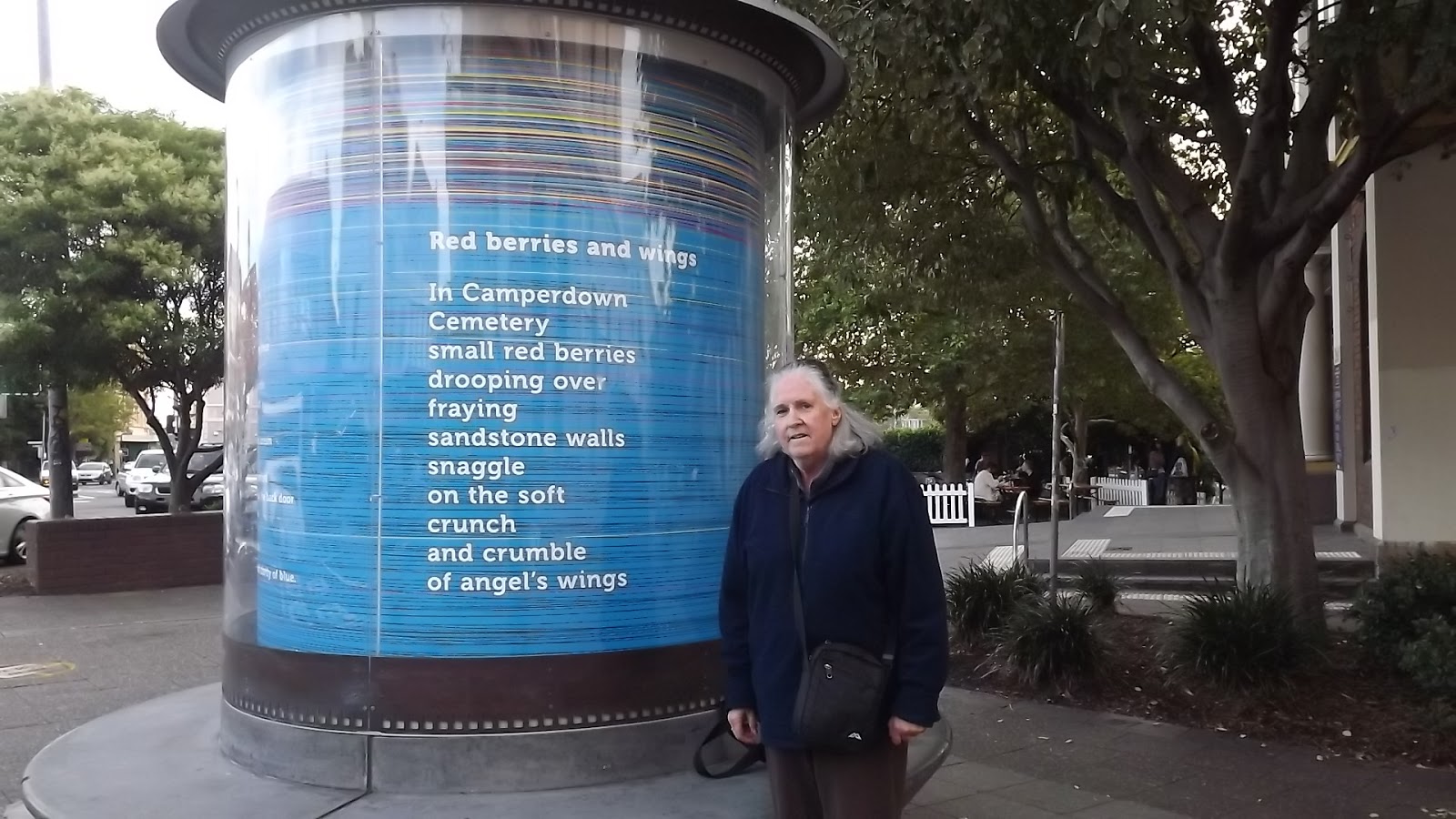
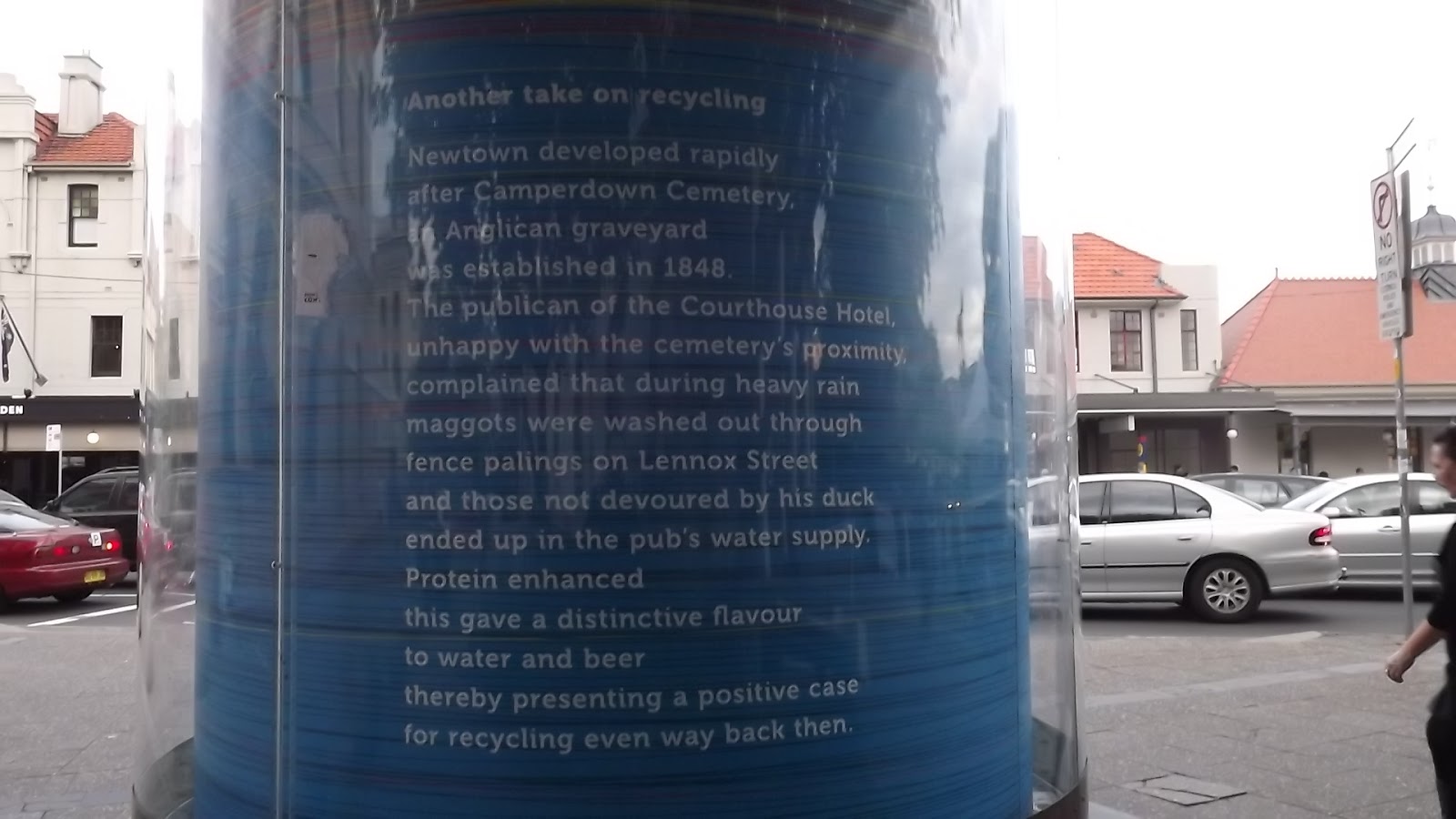
The sense of place is strong here as in all Colleen Z Burke’s work: I think of her as the poet of Newtown. Earlier books have included a number of pieces set in Camperdown Cemetery, and this book has two beauties set there too: ‘Kangaroo grasslands and my 20 month old grandson’ and the wicked ‘Another take on recycling’.

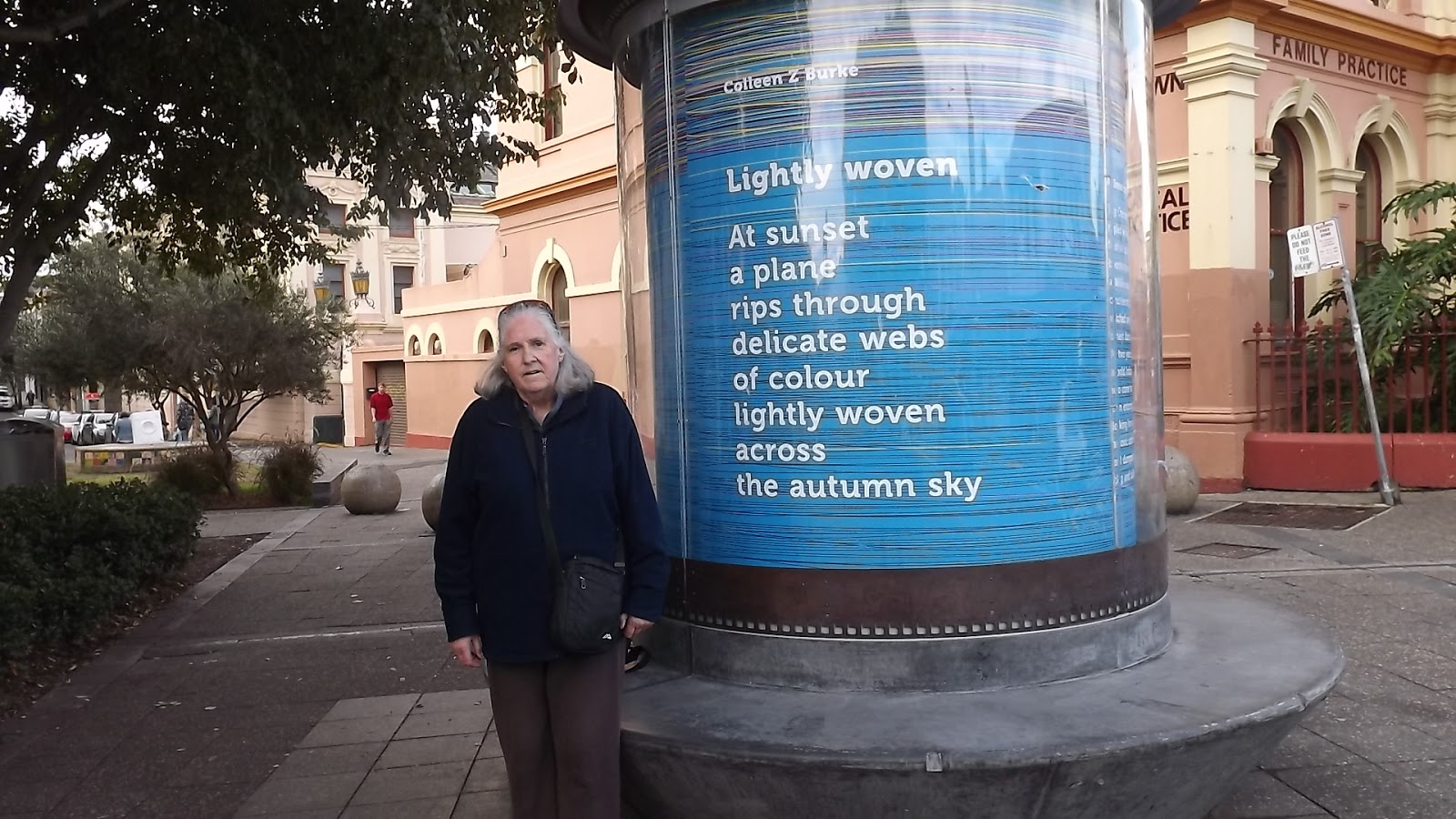
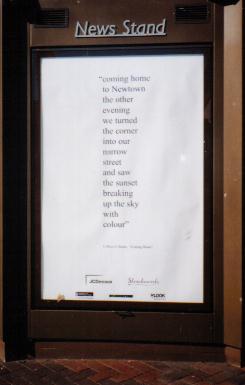
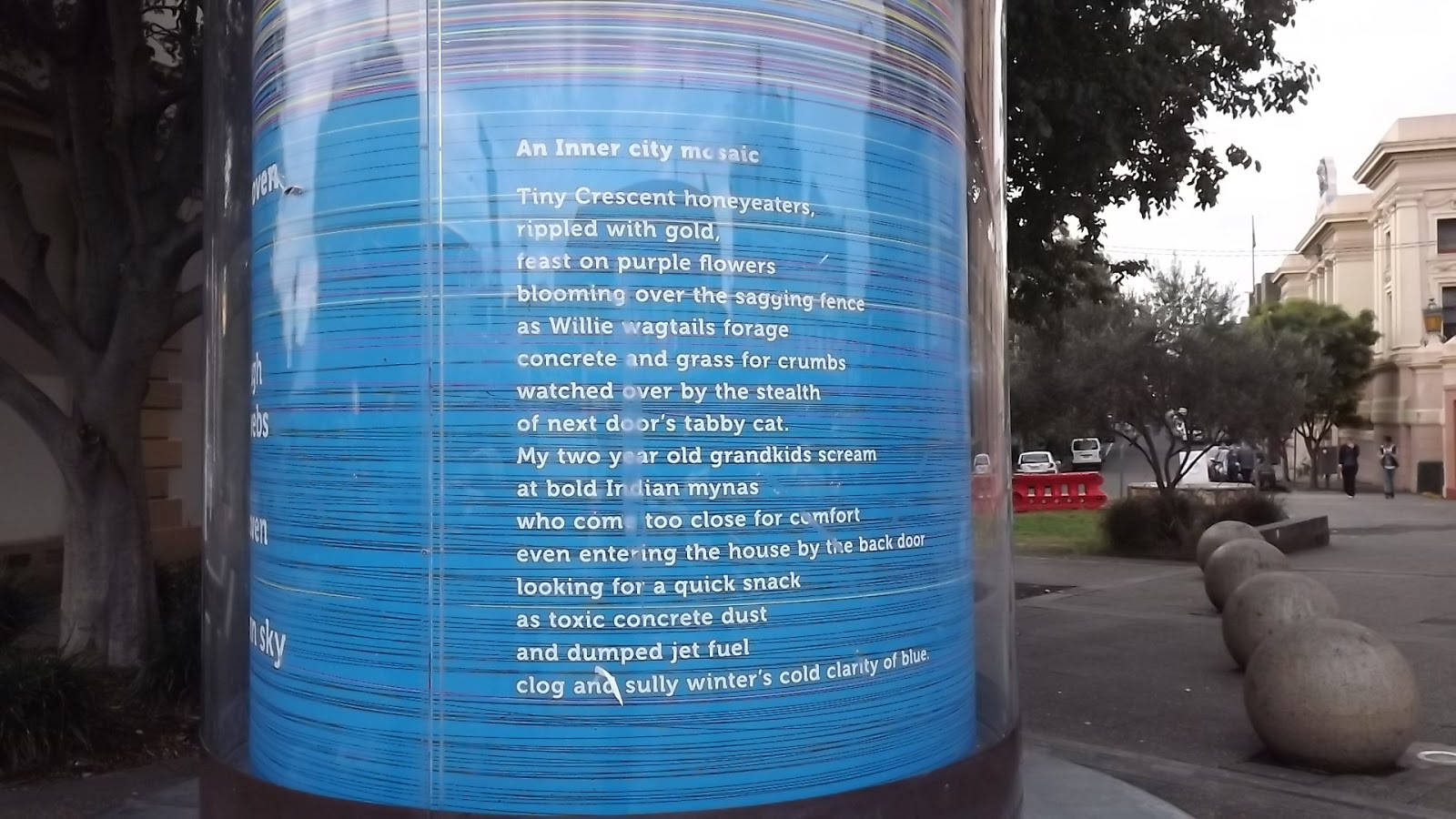
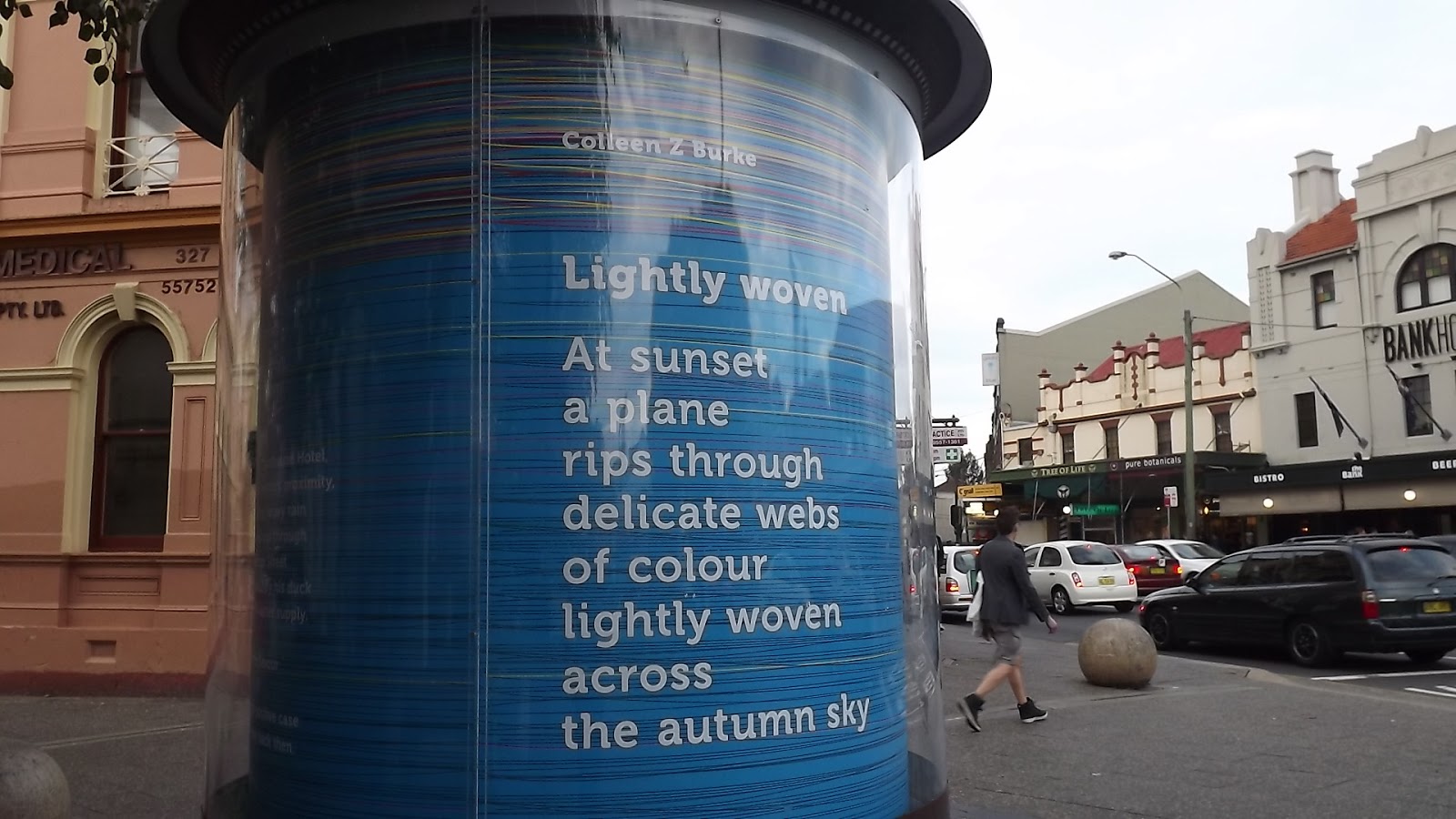
It’s November, so a sonnet is obligatory. This one draws on the last couple of times I laid eyes on the poet, and occasions when her work has featured large in the urban landscape, as illuminated posters that were part of the Sydney Festival some years ago, and more recently on the Newtown Art Seat. (there are six different links there, all to this site)

Sonnet 13: Colleen Z Burke
She reads to us beside a Whiteley –
her landscapes quiet, his lewd and loud.
I’ve seen her sunset words shine nightly,
tall amid a milling crowd.
Her tiny poems tread light, illumine;
the details of decay are human’
as she bids a friend farewell.
Human too what she can tell
of autumn air and Maralinga,
clouds, trees, coprolites, cats, birds,
muskets, trinkets, children’s words.
This poetry’s a pointing finger,
self-effacing, yet with grace
it helps to root us in this place.

Full disclosure: I published one or two of these poems in The School Magazine in my past life, and may have rejected one or two others A significant event in my mother-in-law’s pre-dementia life was a creative writing class taught by Colleen Burke.

awwbadge_2013

I think this is the 11th book I’ve read as part of the Australian Women Writers Challenge 2013.

Sonnet 5: An exhibition

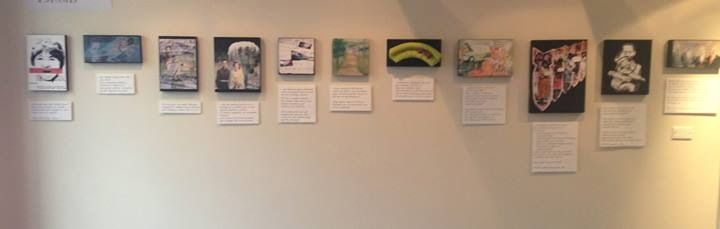
The opening on Wednesday night was fun, and the exhibition will be open for business at 51 Darling Street Balmain until 24 November, 11 to 6 Thursday to Sunday.

For those who came in late, the exhibition features work by three emerging older women artists: a narrative series by Penny Ryan about her mother and ASIO; exuberant work – mainly prints – by Janet Kossy that makes me think of Weimar art, only joyful; and delicate drawings by Charlie Aarons that reference Morandi‘s still lifes and traditional Kiribati designs.

Some men grow alarmingly sleazy moustaches in November. I do rhyme:

Sonnet 5: An exhibition
John Berger said, ‘Original paintings
are still and silent in a sense
that information [to explain things]
never is.’ Here’s my five cents:
that’s also true of prints and drawings,
whose lines are movement lashed to moorings.
Now frozen, mute, hung on the wall
of Darling Street’s Oddfellows Hall
are rage, desire, despair, compassion,
a mother’s joy, a daughter’s pain,
a moment freed from rat-race strain,
three days to hang, lifetimes to fashion.
We stroll around, we come, we go:
it’s just a little pop-up show.

IMG_0143

Photo by Penny Ryan

Sonnet 4: On Being Kept Awake by David Denholm

I’m falling behind on my sonnet quota – partly because I’ve had other things preoccupying me, but also because every time I sit down to write a paragraph from the David Denholm book comes into my head insisting that it be the subject. I’ll add the paragraph below, but first here is my Onegin stanza response to it (with a little input from Gitta Sereny’s The German Trauma, about which I expect to blog in good time.).

Sonnet 4: On being kept awake by David Denholm
Before we sang our soil as golden
before the settlers’ toil made wealth
long before the FJ Holden
this land was taken, not by stealth,
but violence and then watchful waiting,
armed and calm, anticipating,
one with musket, one with spear,
each the other’s direst fear.
We can’t claim Bach and not own Hitler,
a German lawyer said postwar:
we’re made of all that’s gone before.
The death toll here may have been littler
(I’ll write this, though my rhyme is weak)
If Anzac’s us, so’s Myall Creek.

From David Denholm, The Colonial Australians (Penguin 1979) page 40:

… the normal condition of inland life was an armed, watchful, wary, nervous calm. White and black spent months, even years simply watching one another, waiting for someone like Vincent James Dowling on the Paroo in Queensland in 1861 to drink at a lonely waterhole without first reconnoitring the vicinity, or like Paddy Finucane in 1853 to leave his musket in the hut while attending to a sick sheep, or like the Pinjarup in Western Australia in 1834 to camp the tribe down at night on a site familiar to white men. The victim had to deliver himself up. That is the whole point of the horror.

Fry’s Falen’s Pushkin’s Onegin

Alexander Pushkin, Eugene Onegin (1833, translated by James E Falen 1990, narrated by Stephen Fry 2013, Digital October Publishing House)

1eoThis audio book is sheer delight. James E Falen’s verse is fluid, witty, full of charm. Stephen Fry’s reading is superb – unfolding the pleasures of the language with the same infectious relish he brings to his role of BBC game-show host.

Vladimir Nabokov said it was impossible to translate Eugene Onegin into verse that kept the rhyme scheme or the  ‘bloom’ of the original. I know about 3 words of Russian, so I’m in no position to argue, but I’m going to assume that Falen’s attempt approaches the impossible, and  that the poem I’ve just had read to me is essentially Pushkin’s. I now agree with the quasi-mother-in-law who told me in my 20s that reading Pushkin was one of life’s great joys.

I mainly listened to it while driving around the city, which means that for the first couple of hours of it I was negotiating traffic with a slack-jawed grin. Incredibly, the cheerful, witty urbanity of the first parts – where the death of a rich uncle, the ennui of endless Moscow balls, a dilettante’s reading habits, and the passion of a young man who today would be called an emerging poet are all subjects of light, ironic banter – gradually yields to a more serious tone. By the end, the sprightly ‘Onegin stanza’ – shorter lines than Shakespeare, lots of feminine rhymes – has proved suitable for telling of calamity, betrayal and despair. It’s a much smaller story than Anna Karenina, but I’ve got no doubt that Tolstoy knew it well and expected his readers to have read it, and I bet scholarly papers have been written about the relationship between the two works.

I’ve done a tiny bit of research about the translation: Stephen Saperstein Frug’s blog, Eugene Onegin in English Translation, quotes 10 versions of the first stanza, including the one from Charles H. Johnston’s 1977 translation, which inspired Vikram Seth to write The Golden Gate. I’m very glad to have met Onegin in James E Falen’s version, but I recommend Frug’s site if you’re planning to read the poem and shopping around among Englishings. (Nabokov’s version of the first stanza, which ostentatiously avoids trying to sound like verse, manages not to read like English either.)

A bit of Baudelaire

As my November sonnet binge approaches, I apparently feel the need to limber up.

Among our dog Nessie’s amusing quirks is her terror of holes covered by grids. A couple of years ago, I was delighted when she sniffed warily at such a hole and had her terror justified when the darkness just beneath the grid turned out into a hissing cat. That gave rise to this:

She looks down
Wherever Nessie goes she takes her fear
of what might lie beneath the solid ground.
She doesn’t shrink from cliffs, she’ll gladly bound
down hillsides, but she comes all over queer
when asked to walk on grids that cover holes –
no matter if mere centimetres deep.
She turns to stone, responds to no controls
as one afraid of dreams recoils from sleep.

At times, off leash, ears pointing, she will dare,
tout pleine de vague horreur, and so so slow,
creep to the edge and, fascinated, stare
at unseen demons, the nothing-space below.

Today, green eyes stared back from an abyss,
and scared her silly with a black cat’s hiss.

A special prize if you noticed the references to Baudelaire’s poem Le Gouffre, itself referring back to Blaise Pascal’s existential terror. Now it’s not as if I’ve been abyss-obsessed myself, but I was thinking about Baudelaire’s poem recently and spent a couple of hours doing a version of it. My reading of the last line seems to be the opposite of everyone else’s, but maybe I’m the only one in step. Here it is:

The abyss
Pascal travelled with his own abyss.
Poor Blaise! all’s horror: deeds, desires, dreams,
and words! My nape too feels the screams
of bristles at the breath of Fear’s soft kiss.
Above, below, all round, on banks, in streams,
in silence, in great captivating space …
my night’s a wall for God’s hand to deface
with take-no-prisoners spray, where nightmare teems.

I fear my sleep, a door that opens wide
to formless horror on who knows what tide.
Infinity is every window’s view.

My heart, forever dizzy for a fall,
yearns for a void, for numbness over all.
Ah! Not to leave what’s solid, two plus two.

Re-reading Vikram Seth’s The Golden Gate

Vikram Seth, The Golden Gate (1986, Vintage International 1991)

I don’t do very much re-reading, at least not of whole books. This one was an ambush.

The copious notes in John Tranter’s Vagabond Press chapbook Ten Sonnets quote Wikipedia’s entry on the Onegin stanza, so called because Pushkin used it in his novel Eugene Onegin:

The work was mostly written in verses of iambic tetrameter with the rhyme scheme “aBaBccDDeFFeGG”, where the lowercase letters represent feminine endings (i.e., with an additional unstressed syllable) and the uppercase representing masculine ending (i.e. stressed on the final syllable).

That sent me looking for Vikram Seth’s novel in Onegin stanzas. Though it was this book that had launched my own excursion into sonnet land, and I had written and blogged quite a number of sonnets (for which, by the way, I don’t claim any great distinction) of what I thought was the Onegin variety, I had missed the crucial bit about the ‘feminine’ and ‘masculine’ endings (the quote marks are in deference to the Art Student’s objection to the gendered terminology). I went to see if Seth observed the aBaBccDD etc rhyme scheme, and indeed he did: each stanza has three feminine rhymes and four masculine, the feminine coming first in each of three configurations. That might sound awfully technical, but once you notice it you realise it accounts for the wonderful flow of the verse narrative – the feminine endings send the reader’s mind forward the way serifs in a typeface send the eye to the next letter, and the masculine endings have a kind of exclamatory effect, not necessarily stopping the flow but hitting a strong beat.

It’s a wonderfully seductive rhythm, and it had me in its grip again. I read whole slabs out loud to the Art Student as she was cooking dinner, and she who claims not to like poetry said, ‘It sounds as if he had a good time writing that.’

The narrative deals with relationships among a group of 20-somethings in San Francisco in 1980–81, with something of the feel of Armistead Maupin’s Tales of the City (written a decade earlier), but with significant differences. It’s the Reagan era: the threat of nuclear war forms a backdrop, which comes to the foreground in some heated arguments that threaten to destroy friendships, and at an anti-war rally where one of the speeches runs for close to 20 stanzas.  There’s a wonderful ill-tempered cat named Charlemagne, and some serio-comic conflict around religion and homosexuality (I don’t know how comic it was meant to be, but it made me laugh as well as rage). It’s not all froth and bubble by a long shot: there are birth and death, seasonal rhythms and harsh disruptions, silly spats and deeply wounding fights.

In one of the book’s few self-referential moments, Seth reflects on his chosen form, discusses both the use of feminine rhymes and the tetrameter (four beats to the line rather than the five beats used by Shakespeare). He then goes on:

Reader, enough of this apology;
But spare me if I think it best,
Before I tether my monology,
To take a stanza to suggest
You spend some unfilled day of leisure
By that original spring of pleasure:
Sweet-watered, fluent, clear, light, blithe
(This homage merely pays a tithe
Of what in joy and inspiration
It gave me once and does not cease
To give me) – Pushkin’s masterpiece
In Johnston’s luminous translation:
Eugene Onegin – like champagne
Its effervescence stirs my brain.

When I read The Golden Gate the first time I contemplated moving on to Les Murray’s verse novels, one of which is told in sonnets. I will read them one day, but they aren’t a natural successor to this novel. I have now downloaded an audio book of Eugene Onegin, in which Stephen Fry reads James E. Falen’s translation – not that of Sir Charles Johnston, which Vikram Seth so loved. It may be a while before I have ‘an unfilled day of leisure’ in which to listen to its 4 hours and 21 minutes, but I’m looking forward to it.

Sonnet for the doomed figs on the south-west corner of Enmore Park

November’s nearly here and with it my personal challenge of writing 14 sonnets in the month. Thanks to the rise in global temperature, Sydney’s jacarandas are flowering early: in a spirit of solidarity with them and other tress, here’s an early sonnet, inspired by a sign in Enmore Park:

construction

Improvement works are scheduled to commence
in our park soon, and if spring rains allow
will be complete by New Year’s Day. Immense
dark witness figs, gnarled amputees, are now
assessed as low performers or high risks
against criteria on Council’s disks.
They’re ugly, idle, falling bits could kill
a child or dog, and that’s a lawyer’s thrill.

This great construction project will proceed.
Remove, chop, mulch, rope off and rectify
by chainsaw, shredder, backhoe and the sigh
of paperwork. It’s progress. Figs don’t bleed.
Dear residents, though patience may be strained,
the park’s geometry must be maintained.

Contemporary Asian Australian Poets

Adam Aitken, Kim Cheng Boey & Michelle Cahill, Contemporary Asian Australian Poets (Puncher & Wattmann 2013)

1caap

This book seems to be part of a current efflorescence of attention to Asian Australian writing, and of Australian attention to Asian writing. The current Southerly focuses on ‘Contemporary Diasporic and Postcolonial Poetries’, with particular attention to Asian Australian (or Asian-Australian, or Asian/Australian etc) work. The recent OzAsia Festival in Adelaide included a two-day OzAsia on Page component which featured ‘significant and contemporary Asian and Australian voices’. Vagabond Press’s Asia Pacific Writing Series is looking formidably good.

It’s hard to imagine a more disparate gathering of poets than those collected between these covers, not just in nationality or ethnicity (‘Asia’ is a big and varied place, and there seems to be someone here from just about every part of it except, interestingly, Japan), but in just about every other conceivable way as well. The poetry ranges from work with the exuberance and directness of Spoken Word to compressed, elliptical, allusive capital-L Literary offerings. It’s the poets who are Asian Australian, not necessarily the poetry, so though there are poems of the pain of loss of home and culture (I was going to say ‘nostalgia’, but that’s a word that no longer conveys any sense of real pain), poems that explicitly deal with or enact cultural duality or hybridity, poems about multicultural relationships, poems that tackle white racism head-on, and poems exploring questions of cultural identity, there are also poems that don’t do any of those things.

There is a brief introductory essay from each of the three editors. Adam Aitken outlines and celebrates the extraordinary range of voices and attitudes in the anthology, and the range of possibilities in the term ‘Asian Australian’ itself. Kim Cheng Boey focuses on the experience of migration:

Home is never a given, for first-generation migrants, and continues to be a complex issue for subsequent generations. Being beneficiaries of two or more cultures, and entangled in a complex web of affiliations and attachments, they are wary of identity politics and monolithic formations.

Michelle Cahill points out the anthology’s significance in bringing greater visibility to Asian Australian women poets, who experience ‘the double exile of migration and mediation of patriarchal terrain, so inimical to the female psyche’. Seventeen of the 37 poets in this collection are women, and very few Asian Australian women have been included in any previous anthologies.

All three introductory essays are worth reading, and they give invaluable guidance to the poetry. But in the end, it’s the poetry you pay for – and I’m happy to report that I was immersed in this book for days, being dragged from one engaged mind to another. Christopher Cyrill, whom I have previously known as the events organiser at Gleebooks who always spoke too softly when introducing people, here turns out to have a clear, strong, brilliantly modulated voice in the extract from his prose poem novella Quaternion (and that’s me saying it who hates extracts and doesn’t much care for prose poems). Andy Quan’s ‘Is This?’ is a brilliant abstraction of the moment of anticipation on meeting a new person. Omar Musa contemplates buying a pair of shoes and redefines the notion of choice. I finally get to read Kim Cheng Boey’s ‘Stamp Collecting’, which I’ve heard him read at festivals and loved, and his ‘Plum Blossom or Quong Tart at the QVB’ – what can I say? Eileen Chong is here, with some of the finest poems from ‘Burning Rice’. I was about to read Debbie Lim’s ‘How to Grow Feet of Golden Lotus’ aloud to a friend and then realised I wouldn’t want to inflict it on anyone who didn’t have plenty of time to recover. Merlinda Bobis’s ‘Covenant’ (‘after you bomb my town / I’ll take you fishing / or kite-flying or both’) conveys the poignancy (another word that has lost its hard meaning) of peace for a defeated people. Jaya Savige’s ‘Circular Breathing’ could hardly be more mainstream Australian, a kind of version of Les Murray’s ‘Perfectly Ordinary Rainbow’ set it in Europe and acknowledging Indigenous Australia (with only the barest allusion to Asia, but who’s counting?). Louise Ho’s ‘A Veteran Talking’ is a killer poem, a chilling, hard, dry killer. I’m glad Adam Aitken included a decent, brilliantly varied selection of his own work.

Please don’t let this book be seen as a marginal anthology of poems by the marginalised. It’s a fabulous collection and belongs at the centre of our culture.

Tranter and Lilley: Rare Objects

John Tranter, Ten Sonnets (Vagabond Press Rare Objects Series No 90, 2013)
Kate Lilley, Realia (Vagabond Press Rare Objects Series No 91, 2013)

This series of elegant chapbooks finishes up this year at No 100, which means that John Tranter and Kate Lilley at 90 and 91 respectively are leading us into the straight – which may be the only straight thing about either of them (no reference to sexuality intended).

I went to the launch at Gleebooks on the weekend because I am generally baffled by the work of both these poets, and hoped for some guidance on how to read them, and I got it. John Frow, Eng Lit and Cultural Studies scholar, who did the honours, commented that in both books – and in The Tulip Beds by A J Carruthers, Rare Object No 92, which he was also launching – the poems were generated using a mechanism: in Tranter’s case the rhyming sonnet form and in Lilley’s a found-object framework.
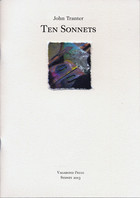
10sonnetsFive of Tranter’s ten sonnets have an additional mechanical dimension: they list the five vowels and assign each of them to a colour. And other mechanical elements turn up in other poems: for instance ‘Poem Beginning with a Line by John Anderson’ was written, we’re told in a note, ‘while listening to a paper on his poetry given by Ella O’Keefe at the University of Auckland in March 2012’, and incorporates lines from Anderson and from Ms O’Keefe’s talk. (I hope she’s flattered by being incorporated into the sonnet rather than offended by the lack of attention.)

Speaking of notes, six of the books 16 pages are taken up with notes, which quote liberally from Wikipedia. It’s hard to tell for the most part whether these notes are meant to inform the reader, to mock the reader for wanting information, to slip an extended prose poem or two under the radar or simply to get the book’s pages up to a multiple of eight. One note explains what ‘Scuba’ is an acronym for, but is no help in explicating the couplet in which it appears:

U, olive green of underwater hair –
Scuba, the acronym, in a crowded room.

Another manages to compare Tranter’s work to Shakespeare’s, if only on the matter of complexity. On the other hand, a good half of the very long note on ‘Poem Beginning with a Line by Bunting’ is a lucid explication of a poem that at first I found impenetrable, which begins:

Boasts time mocks cumber Rome.
Roasts thyme scents set on ledge.

Interestingly enough, the note explains, that first line (from Basil Bunting’s ‘At Briggflatts Meeting House’) can be decoded into standard English. So can the second, but the rationale for its existence is that it echoes the first – it’s not clear if its sense matters at all.
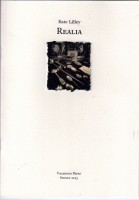
realia001Following John Tranter’s lead, I’ll now quote Wikipedia and tell you that the great modernist American poet William Carlos Williams ‘summarised his poetic method in the phrase “No ideas but in things”‘. It’s tempting to say of the poems in Realia, ‘no ideas, just things’. The longest poem in the book. ‘GG’, is mainly a list of items from the estate of Greta Garbo sold at auction last December, presented without commentary:

Greta Garbo flatware
Greta Garbo cordial glasses
Greta Garbo Sherbet stemware
Greta Garbo Swedish butter press
__Viking mould imprints 14 5/8″ x 4 1/4″

and so on.

Of course, the art is in the selection. I looked up the actual 302 page catalogue, and the poem got even funnier. You can almost hear Kate Lilley saying, like Anna Russell, ‘I’m not making this up!’ The weirdness of starting each item with ‘Greta Garbo’ is not her invention. I didn’t check that everything in the poem is genuinely from the catalogue, but I did search for the line that most aroused my suspicions

Greta Garbo Stim-U-Lax Jnr Hand-Held

and there it was, hidden in plain sight:

ggm

Some liberty taken as befits a poet, but an honest steal.

Neither of these books appealed to me much on first contact, but when I came to write about them, even so spottily, I warmed to them both. My own fiddling with sonnets has taught me that there’s a lot of mechanics in poetic form, and it’s interesting to put the mechanism front and centre and see what you get. And listing found verbal objects without comment or interpretation can create interestingly comic or disturbing effects.

The Vagabond Press facebook page predicts another five titles by the end of the year, by Emma Lew, Bella Li, Emma Jones, Ania Walwicz and Jennifer Maiden. To be launched in Melbourne.