Category Archives: Books

Pam Brown’s Missing Up

Pam Brown, Missing Up (Vagabond Press 2016)

Francis Webb once said that a poem was a meeting place of silences, or words to that effect. I don’t know if Webb would have taken to Pam Brown’s work (or vice versa), but the poems in Missing Up reminded me of his observation. It’s not that she writes things that ‘oft were thought but ne’er so well expressed’ (to invoke another unlikely poet), but I find in her poetry a kind of mental activity, the kind that generally precedes speech or even coherent thought, that is distractible, non-linear, associative, interspersed with snatches of other people’s words. I don’t know about you, but that’s the kind of activity that fills a lot of my silences. Pam Brown wrangles it into words.

Rather than try to say more about the book as a whole, let me have a go at a single poem. Here’s ‘Flat white’, which is far from being typical of the longer, non-linear, obliquely and sometimes grimly personal poems in this book, but which I’ve chosen partly because it’s the shortest in the book, and because I wanted to figure out what its title pun is doing:

Flat white
how to hold a genre
__who likes
______
genres
& how to
___handle filth___und drang
or
_(ring the bells here)
______
devise
__
a few innocent new myths
to resacralize
______the apostasy
of the bourgeoisie
_________________
the who?
they’re the ones
____
with unhappy consciousness
who are seeking
_
a brains & sex harmony motor
to spruce up
___
the non-lived
__________
flat white life
in
__
natural surroundings

First off, you can’t read this poem as you would a passage of prose, and that’s not just because of the line breaks. Like Pam Brown’s poetry in general, it asks for a different kind of attention: not requiring that it yield its meaning at a glance, but settling in, tolerating ambiguity and ok that some meanings and references may take a while to become clear, may even remain permanently inaccessible. I think I’m right in saying that if you feel like an outsider as you read this poem for the first time, then that’s not a bug but a feature: we’re not being addressed, lectured at or wooed; we’re eavesdropping – eavesdropping by invitation, if that’s a thing.

**** The next few paragraphs show me struggling to explicate the poem. I had fun and learned from the process, but you may find it a bit boring. ****

In the absence of conventional punctuation, some parsing is called for. Here’s how I read it – your mileage may vary.

The poem is in two parts, of 12 and 10 lines respectively. The first part ruminates on a project. ‘How to’ doesn’t introduce a set of instructions, but poses a question or challenge: how is one ‘to hold a genre & … handle filth … or … invent a few innocent new myths’. The reason for wanting to do these things is ‘to resacralize [sic the US spelling] the apostasy of the bourgeoisie’. The second part then offers a definition of the ‘bourgeoisie’, and in doing so indicates why the activities contemplated in the first half are called for.

So far, so straightforward. To complicate things, it’s as if a second voice heckles the first: when Voice A mentions genres, Voice B mutters in the reader’s ear, ‘Who likes genres?’; when Voice A mentions filth, Voice B adds a sarcastic, or perhaps clarifying, ‘und drang’; Voice B is surely mocking when she says, ‘Ring the bells!’; and then her question ‘The who?’ is the poem’s turning point. And I guess you could read the rest of the poem as integrating the two voices – the one who names the project and the one who derides it.

But grasping the structure doesn’t make the poem transparent. ‘How to hold a genre’ for a start: Harvard University’s Poetry Classroom lists 35 genres, from allegory to verse epistle – what does it mean to hold one of them? It’s probably not ‘hold’ as in ‘hold the mayo’ (though on first reading one may stay open to that possibility), but as in ‘grasp’. I provisionally take the phrase to mean to write a poem that follows clear conventions. As Brown’s work rarely fits into any established genre, perhaps here the poem’s speaker is wondering how she would go about doing this thing that she has no actual desire to do (hence Voice B’s interjection), or maybe she’s contemplating establishing a genre of her own, of holding her own poetry to some established form (in which case Voice B is questioning the worth of the project).

Then ‘hold a genre’ is paraphrased as ‘handle filth’: the meaning of ‘filth’ isn’t clear, and the interjected ‘und drang’ is funny, but hard to pin to a meaning. (I know I miss a lot of Brown’s poetic references, but I do know that Sturm und Drang was a highly charged German artistic movement, in which Beethoven was a major figure.) The line expresses emotional recoil from the idea of working in genres – the speaker likens it to handling poo. A quick internet search refined my understanding of Sturm und Drang: it translates literally as storm and yearning, which gives the joke an interesting twist: yes, to attempt that kind of poetry may be like handling filth, but that doesn’t stop the poet from yearning for it to achieve some higher end. (Alternatively, ‘handle filth’ may not be meant to paraphrase ‘hold a genre’ at all, but add to it, so the challenge is to hold to conventions while handling messy (filthy) and emotionally charged realities. Both readings can work, possibly at the same time.)

In the next lines the project becomes more ambitious. Voice B’s sarcastic injunction to ring bells and the deprecating irony of ‘few’ and ‘innocent’ (can myths ever be innocent) modify but don’t erase the ambition of ‘to devise … myths’. And ‘to resacralize / the apostasy / of the bourgeoisie’ sounds like a big deal. I’m inclined to take this phrase seriously, either as an aspiration or as a sorrowful recognition that something is needed, even though impossible. ‘The apostasy of the bourgeoisie’ is probably a reference that I don’t recognise – Google didn’t help me with it. The bourgeoisie have lost their sense of the sacred, perhaps of meaning, or not so much lost it as turned away from it: their sustaining myths are either dead or toxic/desacralised. It’s worth noticing, though, that the speaker isn’t contemplating reviving those myths, but devising new ones, not to reverse the apostasy of the bourgeoisie, but to (re)sacralise it. Whatever that means.

But bourgeoisie is such a nineteenth-century, Marxy term. Fair enough that the voice from the peanut gallery challenges it: ‘the who?’

The remaining nine lines answer the question in a single, only slightly obscure sentence: ‘they’re the ones / with unhappy consciousness / who are seeking / a brains & sex harmony motor / to spruce up / the non-lived / flat white life in natural surroundings.’

There is probably someone on the planet who doesn’t know that a flat white is a kind of coffee (cappuccino senza schiuma is how you order an approximation in Rome), that the cool people drink in some parts of the world. The phrase ‘the non-lived / flat white life’ is what drew me to the poem in the first place. Barry Oakley described marijuana as the new sacrament of rebellious middle class youth in the 1970s. This poem suggests that the flat white is currently the desacralised sacrament of certain alienated or spiritually lost middle class people. (When one of my sons was a teenager, he quipped that when God was giving out senses of humour, a certain adult thought he meant coffee and asked for a flat white. There’s a similar play of ideas here.) These are not the bourgeois who were shocked by Baudelaire; these are, more or less, Pam Brown’s people. (I don’t drink coffee, but the poem is pointing at me.) There’s discord between what they are seeking – ‘a brains & sex harmony motor’ – and what this poem has been contemplating – ‘to resacralize / the apostasy’. They want a mechanical solution; the poem is groping towards something more demanding. Their ‘surroundings’ are ‘natural’ only ironically, like Patrick White’s carefully natural gum trees in Barrenugli. No room for poetry to play a central role there: the poem ventures to consider the possibility, but recognises that the odds are against it.

The poem does all this while managing to feel tossed off (the technical term for which I believe is sprezzatura).

**** End of potentially boring explication *****

The Vagabond Press website has a very nice blurb on this book which describes the poems as ‘offbeat, fragmentary yet often discursive’, and includes this:

For Pam writing poetry is a habit, a disorganised ritual. Her poetic inventories begin in everyday bricolage. Real things interrupt the poems the same way thoughts and phrases do. You know – the fridge over there, the bus stop, surf music on a radio, a raisin squashed against a floor tile – always backgrounding a connection to the ‘social’ as the poems make political and personal associative links.

AWW2016Missing Up is the third book I’ve read as part of the 2016 Australian Women Writers Challenge.

Martin Harrison’s Happiness

Martin Harrison, Happiness (UWA Publishing 2015)

1742586864.jpgI’d pretty much finished writing this blog post when I discovered the special issue of Plumwood Mountain, an ‘Australian journal of ecopoetry and ecopoetics’, dedicated to the memory of Martin Harrison who died in 2014 while Happiness was being prepared for the press. I won’t be offended if you click over to that and don’t bother with the rest of my post. But here it is anyhow:

An email is doing the rounds with the subject line ‘Poetry Experiment’. It asks you to do two things: 1) send a poem – any poem – to the first on a list of two people; and 2) alter the email by moving the second person on that list to the top and adding yourself in second place, then Bcc the altered email to 20 friends. If everyone follows instructions, 400 poems will soon arrive in your inbox.

I did as instructed, and received 4 poems: four famous lines from William Blake, a prose quote from Mahatma Gandhi, Emily Dickinson’s ‘He ate and drank the precious words‘, and a Leunig verse. The person at the top of my list sent me copies of the poems she received. There were five from my friends: some lines from Auden, Shakespeare, and Rumi, and whole poems by Judith Wright and (again) Emily Dickinson.

Tentative conclusions: the vast majority of people don’t take to poetry, or at least to a combination of chain letters and poetry; people are generally more willing to share poetry than to ask other people to do so; and we’re more likely to share favourite lines than whole poems.

Which brings me to Happiness. There are any number of excerpts that would do perfectly for the poetry experiment. For example, this lovely evocation of a landscape in ‘Summer Rain Front, North Coast’:

the mountain mirrored in the instant’s stillness
of the calm sea flooding into the bay
the mountain photoing its image on the waters
over the grounds where dolphins track    and then its scarves
hanging high in the air like drifted parachutes
white against blue

But probably none of its poems is chain-letter material in its entirety – they’re too long, and mostly proceed like conversation rather than performance. That is, the pleasure of reading them doesn’t come so much from brilliant turns of phrase or striking metaphors as from the sense that one is being invited to join the poet in his experience of the world, his loving embrace of it, including that part of it he addresses as ‘you’, which at least sometimes is his lover Nizat Bouheni, to whom the book is dedicated, and who died in 2010. There are love poems, poems filled with meticulous, immersive observations of nature, forty-five pages of elegies. There are a couple of awkward but trenchant poems on the politics of climate change, and an ‘experimental’ poem that an author’s note (kindly) informs us is ‘made up of responses to a randomly sorted set of instructions repeated four times’. And there’s one satirical description of some US Americans abroad.

One of my favourite moments in the book, which is in some ways representative, is in ‘Wallabies’. After three pages of  two-line stanzas evoking the sights and sounds of a particular Australian landscape with something approaching ecstatic fervour (the absence of punctuation may make this hard to decipher at first, but patience pays off):

nothing is dead here the spaces between them are
inhabited leaves twigs debris fallen white-anted trunks

slopes rocks grass parrots galahs floating down
in pink streamers again the grey lack of edge

around sprays cream waterfalls of turpentines flowering
in high irrigated air-blue reaches

and much more, there’s this:

that twenty mile shadow across the claypan’s a fence

which as dusk comes is a lightning-quick snake
momentarily distracting the way they appear

as if from nowhere like sentinels weathered stone
camping in that stubble sunset-toned no like mushrooms

wallabies two of them and then three over there then more
pale half-red underfur letting them melt into late light

alert as the slanting hour’s alert to earth cool as wine
then the shriek as they scatter

I love how the poem enacts the way you often become aware of the presence of wallabies in a landscape rather than see them arrive: they’ve been in the poem for three lines before they are named. They may be the subject of the poem, but they are part of a much bigger field. Harrison’s poetry often seeks out and celebrates the tiny or the evanescent – a blue wren nesting under the eaves on a sweltering day, a moment in a changing skyscape, a half-heard sound in the upstate New York woods. These lines from ‘A Music’, which is the second part of ‘Two for You’, an elegy for Nizar Bouhemi, could be describing much of Harrison’s poetry:

________The singleness
of each event in

its own swerve and
sharpness, drawing

attention and attentiveness
making it seem as if anyone

could just see it, grasp it,
wait to understand

what no one understands

Martin Harrison’s death of a heart attack in 2014 makes this book’s attention to the fleeting and its grappling with the realities of death incredibly poignant


The Book Group & Salman Rushdie’s Two Years Eight Months & Twenty-Eight Nights

Salman Rushdie, Two Years Eight Months & Twenty-Eight Nights (Jonathan Cape 2015)

2yrs.jpgSadly (or not – you be the judge), I missed the book group meeting on Wednesday night. Unusually, though, there was a lot of email discussion of the book in the lead-up to the date. Here are annotated excerpts from the emails, with names changed and identifying detail removed:

3 March 1:35 pm, Alphonse:
NEXT BOOK: 
Salman Rushdie, Two Years Eight Months and Twenty-Eight Nights: ‘From one of the greatest writers of our time: the most spellbinding, entertaining, wildly imaginative novel of his great career, which blends history and myth with tremendous philosophical depth. A masterful, mesmerising modern tale about worlds dangerously colliding, the monsters that are unleashed when reason recedes, and a beautiful testament to the power of love and humanity in chaotic times.’
NEXT DATE: Wednesday 20 April / 7pm
NEXT VENUE: Bill … we voted last night that the next meeting would be at your place. Hope that’s OK with you and that you are able to join us.

That was all until:

15 Apr 2016 2:45 pm, me:
Hi all
I’m assuming our next meeting is confirmed for Wednesday 20th at Bill’s place, as in Alphonse’s last email.
Sadly I won’t be able to make it. I’m about three-quarters through the book, and mostly enjoying it. (I love the description of Obama on p 127.) I’ve read a number of children’s books dealing with similar subject matter and I’m not sure that this is any more engaging than the best of them. If you’re interested you could have a look for the Bartimaeus Sequence by Jonathan Stroud.

Having now finished Rushdie’s book, I would name Sophie Masson’s Snow, Fire, Sword as a more relevant children’s book: Sophie has supernatural beings from Arabic lore wreak havoc in Indonesia, with an implied parallel to real-world Wahhabism – a scenario not a million miles from Rushdie’s book. Here’s the Obama description I mentioned:

… the president of the United States was an unusually intelligent man, eloquent, thoughtful, subtle, measured in word and deed, a good dancer (though not as good as his wife), slow to anger, quick to smile, a religious man who thought of himself as a man of reasoned action, handsome (if a little jug-eared), at ease in his own body like a reborn Sinatra (though reluctant to croon) and colour-blind.

The prospective roll-call began:

15 Apr 4:02 pm, Chrysostom:
Apologies from me too. Am in the bush

15 Apr 5:18 pm, Dionysus:
I’ll be there

And then the opinions started:

15 Apr 10:37 pm, Errol wrote:
I’ll be there, but as a complete bludger I’m afraid. I couldn’t get traction with the book. I tried three times but then I put it down and just couldn’t pick it up again.
Looking forward to other opinions
PS. What’s the address?

17 Apr 8:52 am, Ferdinand:
Same.

17 Apr 10:49 am, Dionysus being a little more forthcoming:
Glad to hear I’m not alone.

That’s three people who couldn’t get past the first few pages. I’m guessing that’s because there’s a lot in those pages about 12th century philosophical debates between Ibn Rushd (known to the West until recently as Averroes, and surely not coincidentally sounding a bit like ‘Rushdie’) and Ghazali (said to be the most influential Islamic scholar since Mohammad), mixed in with a lot of lore about jinn, plus some unconvincing sex. For a book that’s going to feature fairies and magic and levitation and comic book monsters, this beginning is perhaps just a little anxious to establish that the author has a serious underlying theme. Surely Salman could hear his readers muttering, ‘Get on with it!’

Back to the correspondence.

17 Apr 4:52 pm, Graham:
Just back this morning from overseas. So far I am enjoying the book but not finished yet. Has Bill said it’s on for Wed?
I am keen to come but may need to cancel at the last minute.
Keen to hear what people thought of the book

Hmm, enjoying it, but not going to move heaven and earth to talk about it with the comrades. And still no word from Bill.

18 Apr 8:17 am, Harald:
I’m on, got half way so far, with a similar lack of interest. Too much jinnying, to too little purpose.

Was ever a book so unenthusiastically greeted?

For my part, the place where I nearly put the book aside was page 107, well before the halfway mark:

… in Times Square … for a period of time variously described by different witnesses as ‘a few seconds’ and ‘several minutes’, the clothes worn by every man in the square disappeared, leaving them shockingly naked, while the contents of their pockets – cellphones, pens, keys, credit cards, currency, condoms, sexual insecurities, inflatable egos, women’s underwear, guns, knives, the phone numbers of unhappily married women, hip flasks, masks, cologne, photographs of angry daughters, photographs of sullen teenage boys, breath-freshening strips, plastic baggies containing white powder, spliffs, lies, harmonicas, spectacles, bullets, and broken, forgotten hopes – tumbled down to the ground. A few seconds (and maybe minutes) later the clothes reappeared but the nakedness of the men’s revealed possessions, weaknesses and indiscretions unleashed a storm of contradictory emotions, including shame, anger and fear. women ran screaming while the men scrambled for their secrets, which could be put back into their revenant pockets but which, having been revealed, could no longer be concealed.

That’s clever, it’s funny in a number of ways, and nicely written, with a touch of surreal silliness (when did you last see a sexual insecurity lying on the footpath?). But I was overwhelmed with a sense that life is short and Two Years, Eight Months & Twenty-Eight Nights is long. Too much jinnying indeed, and if this is part of what the book calls the War of the Worlds, there’s a serious gap between what the book seems to be claiming to be and what it actually is. Oh Salman, Salman, the readers are still muttering. Still, I went in mildly to bat:

18 Apr 8:42 am, me:
I’ll be interested to know if people think his account of the ‘purpose’ towards the end makes up for all the jinnying.

And then things got all organisational.

18 Apr 09:12 am, Alphonse:
So we have:
*   4 apologies
*   3 yes (2 of whom haven’t got far with the book)
*   3 no reply
*   no confirmed venue
Do we reschedule to a new venue next week ?

18 Apr 1:16 pm, Errol (who, remember, hadn’t got past the first couple of pages):
The way I see it, it’s not our fault that Salman Rushdie is a stuffed shirt with funny ideas and a strange way of saying them.
What if we ignore him? How about those of us that are available just go out for a meal on Wednesday night and hang out?

Bill (who hadn’t read the book) finally surfaced from his heavy other commitments to say that his place wasn’t possible this week, and with a little back and forth it was decided to go ahead, in a restaurant, last night. Harald (of the ‘too much jinnying’ comment) said he’d try to finish the book in time, and Jamahl chimed in:

18 Apr 4:40 pm, Jamahl:
I’ve read the book and enjoyed it.
See you at the restaurant.

By now, I was spoiling for a conversation:

19 Apr 11:22 am, me: 
I’m sorry I can’t be there. Apart from the always excellent company, I would have enjoyed advocating for the book. It’s not as if I enjoyed it hugely. I struggled with the start and was tempted to give up at about page 100 (where the jinnery was getting tedious). Also, the sense that Rushdie was doing stuff that many children’s books had been doing for decades made me kind of resentful by proxy
BUT
in the end I was drawn in by the way he expects us to treat Arabic scholars with the same respect as we would western mediaeval ones; and the way he seduces us into seeing the ‘fairy’ world of northern Africa as central, with various more familiar Indian and Greek gods as manifestations of them. There’s a tiny bit where two characters are married at the Auribondo ashram in Pondicherry, by ‘Mother herself’ – an Indian email friend of mine has told me about Mother, who was a huge influence in my friend’s life. I wondered how many other references there were that non-Westerners would pick up on that just float by me. And yet, the book is definitely a novel in the western tradition, even if closer to children’s books and graphic novels than to Bleak House.
That’s my two bits.

Which drew Jamahl out with a perfect counterbalance to my over-seriousness. The book is after all a lot of fun, with goth-girls hurling lightning from their fingers and elderly gardeners floating a couple of millimetres above the ground, and terrible things happening to people’s skin if they tell lies in the presence of a magical baby:

19 Apr 5:06 pm, Jamahl: 
What a fantastic BUT.
Despite the river of references flowing by unnoticed while I read I still enjoyed the book. While I read I would suspend disbelief and wallow in the plasticity of time. There are also moments of ‘couldn’t give a fuck to consequence’ that I wholeheartedly supported.
While as a retiree you may be familiar with these freedoms this book allowed me to drift and swim in them.

No report from the dinner yet.

NSW Premier’s Literary Awards 2016 Shortlist

I love the NSW Premier’s Literary Awards. As a country boy at heart, I’ve had the best time when I’ve attended the awards dinner, just gawking at the Writers, including the ones I can claim as friends or – once – a relation. This year’s short list was announced this week. You can see the full list with judges’ comments on a pdf press release from the State Library, and you can click through to notes on the list on the State Library’s website here.

In case you missed it in the press (as I did), here it is, not as a dreaded PDF or requiring you to click back and forth, but with added links to my blog posts on the shamefully few I’ve read (or seen).

Christina Stead Prize for Fiction ($40,000)
Ghost River, Tony Birch (University of Queensland Press)
Locust Girl, A Lovesong, Merlinda Bobis (Spinifex Press)
Clade, James Bradley (Penguin Random House)
The Life of Houses, Lisa Gorton (Giramondo)
A Guide to Berlin, Gail Jones (Penguin Random House)
The World Without Us, Mireille Juchau (Bloomsbury)

UTS Glenda Adams Award for New Writing ($5,000)
Fever of Animals, Miles Allinson (Scribe Publications)
An Astronaut’s Life, Sonja Dechian (Text Publishing)
Relativity, Antonia Hayes (Penguin Random House)
In the Quiet, Eliza Henry-Jones (HarperCollins Publisher)
When There’s Nowhere Else to Run, Murray Middleton (Allen & Unwin)
Hot Little Hands, Abigail Ulman (Penguin Random House)

Douglas Stewart Prize for Non-fiction ($40,000)
The Nashos’ War: Australia’s National Servicemen and Vietnam, Mark Dapin (Penguin Random House)
One Life: My Mother’s Story, Kate Grenville (Text Publishing)
Across the Seas: Australia’s Response to Refugees: A History, Klaus Neumann (Black Inc.)
Reckoning: A Memoir, Magda Szubanski (Text Publishing)
Island Home, Tim Winton (Penguin Random House)
Small Acts of Disappearance, Fiona Wright (Giramondo)

Kenneth Slessor Prize for Poetry ($30,000)
Brush, Joanne Burns (Giramondo)
Eelahroo (Long Ago) Nyah (Looking) Möbö-Möbö (Future), Lionel G. Fogarty (Vagabond Press)
The Hazards, Sarah Holland-Batt (University of Queensland Press)
Fainting with Freedom, Ouyang Yu (Five Islands Press)
Terra Bravura, Meredith Wattison (Puncher & Wattmann)
Not Fox Nor Axe, Chloe Wilson (Hunter Publishers

Patricia Wrightson Prize for Children’s Literature ($30,000)
Tea and Sugar Christmas, Jane Jolly & Robert Ingpen (National Library of Australia)
A Single Stone, Meg McKinlay (Walker Books Australia)
Molly and Pim and the Millions of Stars, Martine Murray (Text Publishing)
The Greatest Gatsby: A Visual Book of Grammar, Tohby Riddle (Penguin Random House
Teacup, Rebecca Young & Matt Ottley (Scholastic Australia)
Flight, Nadia Wheatley & Armin Greder (Windy Hollow Books)

Ethel Turner Prize for Young Adult’s Literature ($30,000)
Battlesaurus: Rampage at Waterloo, Brian Falkner (Pan Macmillan)
Freedom Ride, Sue Lawson (Black Dog Books)
Laurinda, Alice Pung (Black Inc.)
Welcome to Orphancorp, Marlee Jane Ward (Seizure)
The Peony Lantern, Frances Watts (HarperCollins Publisher)
The Guy, the Girl, the Artist and his Ex, Gabrielle Williams (Allen & Unwin)

2016 Nick Enright Prize for Playwriting ($30,000)
Boys Will Be Boys, Melissa Bubnic (Sydney Theatre Company)
Broken, Mary Anne Butler (Currency Press)
The Bleeding Tree, Angus Cerini (Currency Press in association with Griffin Theatre Company)
Battle of Waterloo, Kylie Coolwell (Sydney Theatre Company)
Hello, Goodbye & Happy Birthday, Roslyn Oades (Malthouse Theatre)

Betty Roland Prize for Scriptwriting ($30,000)
Last Cab to Darwin, Reg Cribb & Jeremy Sims (Last Cab Productions)
Deadline Gallipoli, Episode 1, Jacquelin Perske (Matchbox Pictures)
The Secret River, Part 2, Jan Sardi & Mac Gudgeon (Ruby Entertainment)
Deadline Gallipoli, Episode 4: “The Letter”, Cate Shortland (Matchbox Pictures)
House of Hancock, Katherine Thomson (Cordell Jigsaw Zapruder)

Multicultural NSW Award ($20,000)
Shining: The Story of a Lucky Man, Abdi Aden & Robert Hillman (HarperCollins Publisher)
The Other Side of the World, Stephanie Bishop (Hachette Australia)
The Principal, Episode 1, Kristen Dunphy (Essential Media and Entertainment)
Good Muslim Boy, Osamah Sami (Hardie Grant Books)
We Are Here, Cat, Thao Nguyen (Allen & Unwin)
Vera: My Story, Vera Wasowski & Robert Hillman (Black Inc.)

Indigenous Writer’s Prize (New Award) ($30,000)
Ghost River, Tony Birch (University of Queensland Press)
Inside My Mother, Ali Cobby Eckermann (Giramondo)
Dirty Words, Natalie Harkin (Cordite Publishing Inc.)
Dark Emu, Bruce Pascoe (Magabala Books)
Heat and Light, Ellen van Neerven (University of Queensland Press)
Not Just Black and White, Lesley Williams and Tammy Williams (University of Queensland Press)

The awards are announced on 16 May, no longer at a dinner but at an exclusive cocktail event, at the start of the Sydney Writers’ Festival. I’m hoping to have read a couple more by then. It’s a big list.

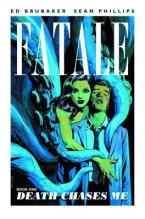
Ed Brubaker’s Fatale

Ed Brubaker and Sean Phillips, with colours by Dave Stewart, Fatale Book 1: Death Chases Me (Image 2012)

9781607065630.jpgI enjoyed Ed Brubaker and Sean Phillips’ The Fade Out immensely, so when I saw that this book of theirs was part of the ridiculously expensive pile of comics that one of my sons gave me as a birthday present (not so ridiculous, of course, when you realise that he would read them after me), I was pleased.

It’s a detective yarn combined with a Lovecraftian horror story. The telling is satisfyingly complex, shifting back and forth between two time periods and only gradually revealing the nature of the dilemmas facing the the lead characters, but laying out enough hints that when things take a turn for the bizarre there’s a sense of continuity. The artwork is consistently dramatic and serves the story well. Sex scenes are relatively tactful. Gore is over the top without being too realistic and the worst atrocity remains unseen by the reader. This is the first of five volumes (consisting of the first 5 of 24 comics), and does a great job of setting up the story, rounding out its own arc, and signalling a number of clear questions yet to be answered.

But my response was pretty meh. I guess horror’s just not my thing. The poet Martin Johnston once said that Lovecraft was a terrible writer but he gave you great nightmares. Sadly, I don’t expect even the nightmares from this.

Marlon James’s Brief History of Seven Killings

Marlon James, A Brief History of Seven Killings (OneWorld 2015)

1780746350.jpgI was reading A Brief History of Seven Killings in a cafe when I noticed that the young man at the next table was reading Oliver Twist, and the horrible thought occurred to me that Marlon James’s work might one day, like Dickens’s, be required reading in schools and universities. Assuming that its spectacular obscenity, violence and graphic sex won’t protect it from such a fate, I offer here, in lieu of a blog post, some possible essay questions:
  • ‘The book’s epigraph, “If it no go so, it go near so” implies a claim to historical truth. While the central event of the narrative, the attempted assassination of Bob Marley on 3 December 1976, is verifiable, the novel relies more on the tropes of US drugs-and-violence cinema and television than on historical research.’ Discuss.
  • James says in his acknowledgements: ‘I had a novel, and it was right in front of me all that time. Half-formed and fully formed characters, scenes out of place, hundreds of pages that needed sequence and purpose. A novel that would be driven only by voice.’ Is that an accurate description of the novel as it finally appeared? (Suggested answer: Far too modest, but kind of.)
  • ‘The novel is narrated by 12 different voices. Although most of them are Jamaican gunmen, they are brilliantly differentiated. At times, especially in the third of the book’s five sections, the sheer virtuosity of it becomes the point of the writing, and the narrative slows almost to a halt.’ Is this fair?  (Suggested answer: Yes, but the writing really is fabulous.)
  • What is the function of the many references to US popular culture? Does it differ with different characters? For example, a main gunman’s nom de guerre is Josey Wales and there are many other references to Clint Eastwood movies, while the only woman narrator refers several times to US television as a guide to how she is expected to behave. Is it necessary to be familiar with Dynasty and T. J. Hooker [whatever that is] to understand the novel?
  • Given that the book runs to nearly 700 pages, to what extent is the title ironic? Given that vastly more than seven people are killed, which are the seven referred to in the title?
  • The character known only as the Singer is definitely Bob Marley. Does the book make you want to (re)listen to all his music and read about his life? [Recommended answer: Yes]
  • Nina Burgess says in page 157: ‘The problem with a book is that you never know what it’s planning to do to you until you’re too far into it.’ Did this book tease the reader with other meta moments such as this? Were the many jibes at white men who think they know about Jamaica meant to prompt white readers of the book to check themselves for voyeuristic tendencies [or was that just me?]
  • We have become accustomed to some Hollywood movies’ preoccupation with penis size and certain sexual activities as easy metaphors for domination. Most of the characters here fall back on that rhetoric is a way that would be deadening if not for the Jamaican ‘bad chat’ elements. Does the one scene of tender sexual intimacy counterbalance this, or is it a token nod to alternative takes on sexuality?

There, that should do it.

Oh, another thing: One reason I read this book was that I had so enjoyed Andrea Levy’s Small Island, and wanted to read more from the Caribbean. Apart from the sheer exhilarating joy of the language in both, I can’t say they have much in common. But that could be the basis for one more essay question: compare and contrast.

Adrian Tomine’s Killing and Dying

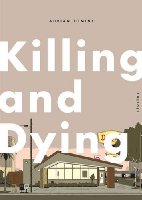
Adrian Tomine, Killing and Dying (Faber & Faber 2015)

0571325149.jpgRecently in my favourite bookshop a customer asked if they had any comics. The person behind the counter replied in a tone that reminded me of one of the sterner nuns from my childhood, ‘We don’t have comics. We do have some graphic novels.’ Maybe I’m just meeting snobbery with pedantry, but if a novel is an extended work of fiction, then Killing and Dying isn’t one. Nor is Joe Sacco’s Palestine or Art Spigelman’s Maus. If those works of sequential art, which aren’t novels but which surely meet the criteria of respectability implied by that bookseller’s tone, can’t be called ‘comics’, what can we call them? I’m sticking with ‘comics’.

Killing and Dying is an excellent comic, comprising six short stories. The first story, ‘A Brief History of the Art Form Known as “Hortisculpture”‘, is a laugh-out-loud tragedy of frustrated artistic ambition. The protagonist of the second, ‘Amber Sweet’, discovers that she is a dead ringer for a famous porn star, which explains why men have been relating to her oddly. ‘Go Owls’ is a longer story about an initially hopeful relationship between two recovering alcoholics. In the title story, the teenaged protagonist has her heart set on becoming a stand-up comedian, while a whole other story plays out in the images, only elliptically referred to in the text. (The title, by the way, is to be read literally but also as in the world of entertainment.) These four stories are told in a progression of almost completely uniform small frames, only some of them in colour, creating a sense of laidback confidence: no need for visual fireworks, this story will hold the reader. And indeed it does – with extraordinary art that conceals art, each of these stories unfolds seamlessly. They may be comics but they’re quality story-telling.

The other two stories, ‘Translated, from the Japanese’ and ‘Intruders’, apart from being interesting for themselves, serve to demonstrate that Tomine is capable of different visual effects. The former has the same neat figures and impeccable lettering, but uses larger frames of varying dimensions, as befits an illustrated version of what turns out to be a letter written by a Japanese woman to her infant son, to be read much later, perhaps after her death. The latter has a rougher graphic style, a complete departure from the contained precision of the rest of the book, which matches the simmering violence of the situation.

It’s no surprise that Adrian Tomine’s work appears in the New Yorker, including a number of covers. Not that I see the New Yorker very often, but his stories have the understated economy, the decorum, the sharp wit and the slightly downbeat wryness one associates with that venerable institution.

A hundred years of The School Magazine

sm100.jpegI will probably write more about The School Magazine as its centenary year progresses, but for now I want to draw your attention to a sweet thing that happened on World Poetry Day. A number of poets wrote blog entries about their experience of being published in the magazine, and they combine to create a powerful statement of the magazine’s importance. You can see at least some of them by clicking on these links:

Jackie Hosking
Claire Saxby
Janeen Brian
Julie Thorndyke
Lorraine Marwood
Pat Simmons
Rebecca Newman
Sally Murphy
Sophie Masson
Stephen Whiteside
Yvonne Low

I was editor of the magazine for some years, and  (ahem!) am mentioned by one of these poets as a ‘great encourager’. I’m relieved that none of the poets took the opportunity to mention any of my blunders. And I’m delighted that a good number of them have begun publishing since my time.

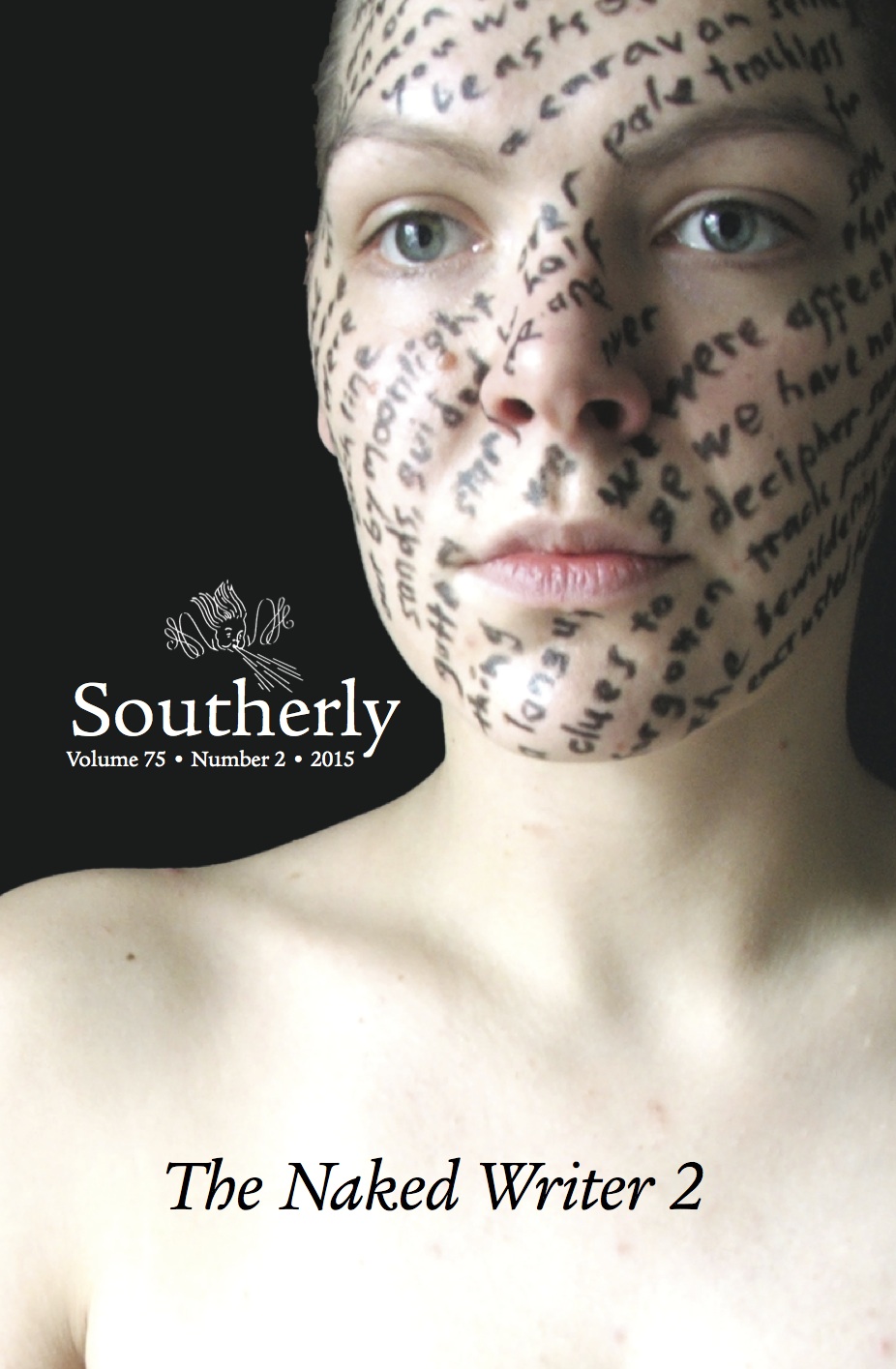
Southerly 75/2

Elizabeth McMahon and David Brooks (editors), Southerly Vol 75 No 2 2015: The Naked Writer 2 (The Journal of the English Association, Sydney, Brandl & Schlesinger)

southerly752.jpg

John Kinsella and Charmaine Papertalk-Green have a collaborative poem in this Southerly. The son of an Anglo-Celtic farmer, Kinsella lived in Geraldton, Western Australia, for the last three years of high school. Papertalk-Green is a Yamaji woman who grew up in nearby Mallewa and now lives just outside Geraldton. The poem – actually a sequence of poems written by the two poets alternately – responds to the works of Western Australian religious architect Monsignor John Hawes as enduring symbols of colonisation.

In what looks like an anxious concern that readers appreciate the significance of the poem, it is embedded in an article by Kinsella, ‘Eclogue Failure or Success: the Collaborative Activism of Poetry’, which among other things spells out the back story, makes learned observations about Virgil’s Eclogues, quotes Wikipedia, throws in a few Greek words, and makes sure we don’t confuse the poem’s first-person elements with the ‘entirely self-interested and subjective’ phenomenon of the selfie. Kinsella is willing to risk being annoyingly self-important if that’s what it takes to ensure that we take him and his collaboration with Papertalk-Green seriously.

Maybe it worked, or maybe the poems would have spoken for themselves, but it’s the kind of project that makes one glad to be alive in the time that it is happening. (Of course, it’s not unique: another stunning example is My Darling Patricia’s 2011 theatrical work, Posts in the Paddock, a collaboration between descendants of Jimmy Governor and descendants of a white family he murdered. That one seems to have sunk without a trace, so maybe all such works do need a John Kinsella to tell us how important they are.)

The challenge of unsparing conversation between Aboriginal peoples and settler Australians is also the subject of Maggie Nolan’s essay ‘Shedding Clothes: Performing cross-cultural exchange through costume and writing in Kim Scott’s That Deadman Dance‘. Apart from calling to mind the pleasure of reading the novel and quoting from it generously, Nolan suggests that, though Bobby/Wabalanginy’s failure to communicate to the colonisers by means of dance may end the book, ‘perhaps his invitation remains open, and Kim Scott, through this novel, is re-extending it to his readers’. I think she’s hit the nail on the head.

There is plenty else here to exercise and delight the mind. In no particular order:

  • David Brooks bids an idiosyncratic and clearly deeply felt farewell to his friend the literary critic Veronica Brady, who died last year.
  • Fiona McFarlane’s ‘On Reading The Aunt’s Story by Patrick White’, originally a Sydney Ideas lecture, is a warmly intelligent revisiting of that novel.
  • Hayley Katzen’s personal essay ‘On Privacy’ rings the changes on the perennial theme of its title, interestingly resonating with John Kinsella’s distinction between the writerly ‘I’ and the facebook or selfie ‘I’, and also with Kim Scott’s meditations on what happens when you write things down.
  • Jill Dimond and Helen O’Reilly delve into their respective family histories, the former with an engrossing tale of failed literary aspirations, the latter with the story of the connection between her second cousin Eleanor Dark and poet Christopher Brennan.
  • Joe Dolce, whom I should be able to mention without referring to ‘Shuddupaya Face’, interviews the late Dorothy Porter about C P Cavafy and they discuss his poetry’s importance to both of them.
  • Of the wide-ranging selection of poems, I particularly enjoyed Alan Gould’s ‘The Epochs Must Go Chatterbox’ and ‘The Insistent Face to Face’, Geoff Page’s genial ‘A Drinking Song for A D Hope’, and Mark Mordue’s Sydney train journey, ‘A Letter for The Emperor’.
  • Craig Billingham’s ‘The Final Cast’ reads like a slice of wryly observed Glebe literary life, though its ‘Fiction’ label should spare embarrassment all round.
  • Nasrin Mahoutchi’s story of widowerhood, ‘Standing in the Cold’, evokes a bitter Iranian winter with just the right amount of twist at the end.
  • In the review section, A J Carruthers discusses Michael Farrell’s Cocky’s Joy and Les Murray’s Waiting for the Past, justifying this unlikely pairing by claiming both poets as ‘experimental’, and arguing that experimental poetry is mainstream in Australia now (and as I write that I realise that the four poems I have singled out above are probably the least ‘experimental’ in this Southerly – ah well, I’m now in my 70th year, so I hope I may be forgiven).
  • In The Long Paddock, the journal’s online extension, Jonathan Dunk gives what he describes as a ‘gloves off’ review of Jennifer Maiden’s Drone and Phantoms, and elicits a bare-knuckled response from Maiden. Good on you, Southerly, for putting the conversation out in the open.

I tend to skip the densely scholarly articles (the ones that use words like chronotopic), or at best dip into them. Dipping can come up with some pleasant oddities. In this issue I stumbled on a quote from one Eric Berlatsky to the effect that in some ways ‘the institution of heterosexual marriage is “always already queer”‘. How far we’ve come since William Buckley Junior caused an uproar by calling openly gay Gore Vidal a ‘queer’ on US television in 1968. Now, it seems, in academic parlance, even those ensconced in heterosexual marriages are queer.

Steve Shipps’ (Re)thinking ‘Art’

Steve Shipps, (Re)thinking ‘Art’: A guide for beginners (Blackwell 2008)

1405155639.jpgI read this book as an act of solidarity with The Emerging Artist. Thanks to a year-long series of lunchtime lecture–slideshows given by an art enthusiast in the French Department in my undergraduate years, I had a general idea of the history of Western art up to Picasso, so I could engage intelligently as she tackled assignments on Rembrandt or Watteau, but when she needed a sounding board on anything postmodern, I didn’t even know when to nod interestedly. She said she found Steve Shipps helpful.

The first sentence gave me hope: ‘This book grows out of bewilderment, skepticism and something like awe.’ Visits to contemporary art exhibitions have often enough evoked in me just that mix of emotions, plus occasionally the urge to deride. The book starts out with Doug Fishbone’s work 20,000 Bananas, which is what it says, a big pile of bananas dumped in the street, but could easily have started with Robert Gober’s  Drainsor Aleks Danko’s Trick Bricks or Sandra Nori’s amateur video of a Japanese anti-nuclear demo in the last Sydney Biennale.

Now that I’ve read the book, my bewilderment, scepticism and awe are pretty much still in place, but now they’re better informed.

It’s a short book, a guide for beginners as promised, that sheds light on a lot of contemporary discussions of art, not to mention art works themselves. There’s a terrific chapter titled ‘Pragmatics’ that describes a way to think about any given work of art – designed mainly for the student who has a paper to write, but with much broader application. But the book’s real interest is in its trickier and more provocative elements.

Shipp worked the book up from college lectures he has been giving since the 1980s, but he doesn’t patronise the teenaged student who is its imagined reader. In talking about de Saussure (Course in General Linguistics) and Danto (After the End of Art) and the Prague Linguistic Circle, he’s exemplary in his concern not to leave the reader behind, always carefully defining his terms and introducing his characters. It’s not ‘talk to me like I’m stupid’ or even ‘”art for dummies’ but it provides what the readers of such texts are looking for.

Apparently the idea of ‘art’ as we understand it today didn’t appear in the West until the Renaissance, and that the idea of art history didn’t appear until the late 18th century. ‘Art history’ traced the development of art – mainly painting and sculpture – from the Renaissance to the historian’s own time, and projected the new concept back onto works dating from cave paintings and the Venus of Willendorf. When the sculptures and plays of the ancient Greeks were created, Shipps maintains, they weren’t seen as ‘art’ in the way we have understood it for the last 600 years or so, but as what we would call craft. I have trouble getting my head around that, because surely Euripides and Praxiteles were famous for their works in their own time. But Shipps is adamant, and he backs his argument up with solid argument and lucid examples.

‘Art’ is not something that exists independently of what we call it, like a cow in a field, which is still there whether we see it as prospective food, a deity or an outsized pet. The term ‘art’ refers to disparate objects and activities, linking them in a category that exists only because of the term itself, and so it becomes hard to define. After much complex but always readable discussion, he says this on page 120:

what we seem to have come to, finally, is this: when we say ‘art’ what we mean is something  that invites – and justifies – a certain kind of attention. It seems to be that simple.

I love that, especially the word ‘justifies’. But, even given the interesting challenge of describing the kind of attention art invites, life isn’t that simple. The book goes on for another 40 pages, first arguing that we should describe as ‘art’ only those works that are created in a state of ‘flow’ and finally calling on us to stop thinking in terms of ‘art’ and ‘artists’ at all, and get on with doing for ourselves the things we have outsourced to them:

So much of the world has been described by now, and so many of those descrioptions made the more permanent for being ‘written down’ in whatever form, so much of our described experience has thus come to seem to be the way it ‘is’, that most of us are forced today to spend unprecedented amounts of time learning how things are ‘supposed to be’ and/or ‘supposed to be done’, and then doing them that way, so that our lives will proceed satisfactorily …
We are numbed by all the information through which we have to sort every day, so our experience of our experience, of ‘art’ or of anything else, becomes increasingly numbed as well … becomes, that is, increasingly anaesthetic …
We needn’t look far to see that there are things in our world today that could surely use some (re)thinking, and (re)describing. And I suspect that if we didn’t have ‘artists’ making ‘art’ to trust with doing that for us while the rest of us got on with our conventional, anaesthetic day-to-day lives, we all just might then tend to do more of it ourselves.