We don’t need another Abbott

Yesterday afternoon we went to our first demo responding to Kevin Rudd’s PNG solution to the asylum seeker problem. It was the third such demo organised by Sydney’s Refugee Action Coalition, and the plan evidently is to keep them up on a weekly basis until the policy is dead.

It was a smallish demo, but spirits were high, and speakers assured us that there were millions of people all over the country who shared our opposition to the policy. A young Hazara woman stood out, reading an eloquent account of the sufferings of her people in Afghanistan, Pakistan, Iran and, heartbreakingly, Australia; with a postscript on the contribution her refugee family is making to Australian society.

We marched around the block, carrying placards and chanting. The Socialist Alliance and Greens were strongly represented in the placards, but there were also Labor for Asylum Seekers and iamaboatperson.com, and a beautiful patchwork banner for a student women’s collective, as well as any number of individually crafted signs. Some art students handed out crayon and people were chalking slogans on the street and footpath (‘Refugees are welcome’, ‘It’s not illegal to seek asylum’ ‘We’ve boundless plains to share’ etc). The main chant was

Say it loud! Say it clear!
Refugees are welcome here!

Although I think it’s generally a mistake to personalise these things, I liked:

Kevin Rudd’s a racist coward!
We don’t need another Howard!

and propose a variant:

Kevin Rudd’s a racist rabbit!
We don’t need another Abbott!

Given that both major parties are looking for quick political fixes rather than a solution to the problem of desperate people risking their lives in unsafe boats to seek asylum here, and given that both major parties seem to think it’s political suicide to have anything remotely like Australia’s response to the ‘boat people’ who came here from Vietnam in the 1970s, I was thinking it was probably futile to take to the streets about this policy. But something happened to make me think that it may actually be important.

About three quarters of the way around the block, we noticed a deeply unhappy looking man in a grey suit filming the march. As we were about to turn back into George Street, I saw him stop behind a traffic control box and put on an identifying badge. He was fairly obviously a policeman of some sort. A little later I saw him talking in a threatening manner to two young women with chalk in their hands, then approaching another young woman who was writing on the road. He took this young woman aside and was asking her questions, close to a uniformed policeman, filing her answers and filming the ID he evidently asked to see. I approached and asked what was going on. He siad it was a private conversation. I didn’t have the presence of mind to ask him why he was filming a private conversation and if he had the young woman’s permission to do that. She told me later that he had said writing on the road constituted malicious damage to public property and that she would be hearing from the police department within three or four days.

From this I deduce that the NSW Police consider these demonstrations to be potentially a serious problem.

I do wonder if a policeman asking someone for their ID while filming them and threatening them with legal action in the middle of a street can by any stretch be called a private conversation. I also wonder if writing on asphalt with crayon can by any stretch be called malicious damage. I have photos of this unpleasant, deeply unhappy looking individual if anyone is reading this and needs a record of his behaviour.

And meanwhile, the protests will continue, every weekend at Sydney Town Hall and I expect all over the country. The Refugee Action Coalition have an excellent web page.

Kevin Powers’ Yellow Birds

Kevin Powers, The Yellow Birds (Sceptre 2012)

1444756133Kevin Powers served in the US Army in Iraq in 2004 and 2005, and this novel draws on that experience. It’s a story about combat told by someone who was there. It needs to be approached with respect. And I did. I was repelled by some callous and/or confused anti-Islamic imagery in the first paragraph (‘The war tried to kill us in the spring … While we slept, the war rubbed its thousand ribs against the ground in prayer.’). But I read on.

The anti-Islam thing was clearly not deliberate. The narrative follows a small group of soldiers in Iraq – really just three characters. They do vile things, but they’re not triumphalist about it: this is what soldiers have to do, and they are pretty much as numb to the deaths of their comrades as to the enemies and the innocent bystanders they kill. There are flashbacks to home in rural Virginia. A terrible fate for one of them is foreshadowed. There’s a nasty scene in a brothel, a colonel who does what the narrator calls a ‘half-assed Patton imitation’, some clueless embedded journalists.

I had trouble believing any of it. I don’t for a moment think Powers is misrepresenting things. Certainly, there’s a fierce rejection of the sort of crypto-glamour of something like The Hurt Locker (I mean the movie – I haven’t read the book it draws on). I’m pretty sure he tackled some material that was unimaginably hard to face, and I admire him greatly for that. But nothing came alive for me, everything felt painfully constructed. I stopped reading at about page 90 when an embedded journalist was being a complete idiot.

So The Yellow Birds may be all the things that the distinguished writers quoted on its back cover say it is: ‘inexplicably beautiful and utterly, urgently necessary’, ‘born from experience and rendered with compassion and intelligence’, written ‘with a fierce and exact concentration and sense of truth’. It may, as one of them proclaims, be the All Quiet on the Western Front of America’s Arab Wars. Please don’t take my word against the combined judgement of Ann Patchett, Tom Wolfe, Colm Tóibín. Alice Sebold and more. As far as I read, I thought it was pretty good first novel on a very important subject, and hope Kevin Powers has a great writing career ahead of him.

The Book Group goes up Amitav Ghosh’s River of Smoke

Amitav Ghosh, River of Smoke (John Murray 2011)

0719568986 Before the meeting: After Karl Ove Knausgaard’s mountains of mundane detail, we wanted our next book to be one that spins a great yarn. Someone proposed the sequel to Amitav Ghosh’s Sea of Poppies, which we’d all enjoyed. There were no dissenting voices, so River of Smoke it was.

We’d forgotten that in his own way Ghosh is just as given to piling on the detail as Knausgaard. Especially in the first half of River of Smoke, hardly a paragraph is without its cluster of glittering facts or shiny words. A glossary would have to define a seemingly endless variety of boats, buildings, functionaries, items of clothing, financial processes, scientific equipment, dubious activities, plants, religious rituals and so on as they are named in Bengali and other Indian languages, Cantonese, Portuguese, Farsi, regional Englishes, Cantonese pidgin, Mauritian Kreol, and so on. And then there’s a wealth of historical anecdote: we see Napoleon at Longwood on St Helena; we hear of escaped slaves on Mauritius who committed mass suicide when they saw troops approaching their hiding place, unaware that the troops were coming to tell them that slavery had long since been abolished; we learn the origins of chai, and much much more. The effect isn’t intimidating: Amitav Ghosh is like a child let loose in a linguistic and historical lolly shop, and wants us to share his delight. The writer he most resembles in this love of the source material is Neal Stephenson.

As you would expect, River of Smoke starts out putting us back in touch with the main characters from Sea of Poppies. But pretty much as soon as they’ve been reintroduced most of them drop out of the picture, some never to be mentioned again, and those who remain gradually withdraw from centre stage to become relatively minor figures – the munshi (secretary cum newsgatherer) to a major character, the recipient of letters from another. The characters we engage with most strongly are new: Bahram Modi, a Parsi opium trader, and Robin Chinnery, artist, homosexual romantic and writer of long, flamboyant letters. Possibly the main character is fanqui-town, the brilliantly evoked, exhilaratingly diverse Babel on the edge of Canton where foreign traders were allowed to live and work in the 18th and early 19th centuries. The opium trade, whose viciousness was graphically evoked in the first book, is the most profitable activity of the fanquis, and the novel traces events leading up to the First Opium War in 1939: the Emperor is no longer turning a blind eye and a new, incorruptible man arrives in Canton to take definitive, dramatic action. According to Google the historical war didn’t turn out well for the Chinese and the trade continued for decades, but River of Smoke ends just before the war proper begins and that outcome isn’t at all obvious.

At the group meeting about Sea of Poppies, someone said he enjoyed the ripping yarn and learned a lot of history but wasn’t engaged in the way he wanted to be by a novel. For all its delights, River of Smoke was like that for me. The tension is real, the stakes are high, and I trust that I’m being told a true story – but sometimes it’s as if the novelist was swamped by his research and forgot that he cared about his characters. There are longish extracts from actual documents issued by the Chinese authorities and the fanqui opium traders, for example, which are fabulous to read, but leave our characters with little to do but react or comment from the sidelines.

Maybe the book suffers from the Middle Book Syndrome – in the first book the world and characters were new. In the third book we’ll find out how everything is resolved. In this one, we just have to get from Book One to Book Three. It’s a bridge rather than a stand-alone, and so not completely satisfying.

After the meeting: There were seven of us, of whom five had read the book.

Two people reported being on holiday and experiencing a powerful resistance to submitting to the world of the book – one ploughed on despite the resistance, the other followed his bliss after 20 pages or so.

The man who liked the book most described it – accurately – as very visual. At a level of simple pleasure it was the linguistic fireworks that appealed most to me. Someone else was most moved by the painful sense of history.

None of us were wildly enthusiastic about the epistolary chapters, tending to find the flamboyant Robin Chinnery a bit on the tiresome side.

Someone arrived with multiple tabs open on his iPad web browser: paintings of Canton’s foreign factories in the 18th and early 19th century, maps of historic Canton, etc. It turned out that a number of us had been to Wikipedia to look up the Opium Wars, and to see if various characters were real (many were). Amitav Ghosh’s web site has the Chrestomathy, mentioned in passing in the book, which is an odd linguistic document compiled in old age by Neel, the zemindar turned munshi who may well turn out to be the central character of the trilogy.

Attitudes to the as yet non-existent third volume ranged from eager anticipation to ‘meh’. I’m close to the eager anticipation end of that continuum.

[As I was about to upload this, I checked and found that Amitav Ghosh is on Twitter, which prompts two remarks. First, I hope Twitter isn’t distracting him from his writing, and if it is I apologise for adding to the distraction. Second, I was delighted to see that someone on Twitter actually drew the world’s, and Ghosh’s, attention to something that I kept to myself all through our meeting – ‘fanqui-town’ sounds very like ‘Funky Town’. Ghosh’s response was three exclamation marks.]

Gwen Harwood

Gwen Harwood, Selected Poems (Angus & Robertson 1975)

1gh Gwen Harwood is a Big Name in Australian poetry, but one whose poems have mostly been unread by me. In the early 1960s she had a pair of sonnets published in the Bulletin of which the first letter of each line spelled out so-l-o-n-g-b-u-l-l-e-t-i-n and  f-u-c-k-a-l-l-e-d-i-t-o-r-s. That’s about all I could have told you about her until Julie Chevalier’s ‘Corner of Glebe Point Road and Broadway’ sent me to her ‘Suburban Sonnet’, a powerful housewife’s lament that made me want more.

I picked this book up from the second-hand poetry shelf in Sappho’s in Glebe on one of my irregular visits soon after (and inadvertently paid a roughly new-book price for it; it’s inscribed by the author to a composer – I googled the name – who evidently didn’t reciprocate her ‘affection and admiration’ sufficiently to keep the gift). This isn’t where I’d have started if I was being systematic, because even though she was in her mid 50s in 1974, it was early in her publishing career. But it’s what turned up.

The book was in Angus & Robertson’s ‘Poetry Classics’ series, which is a bit rich given that the ink was barely dry on Gwen Harwood’s first book (Poems, published 1963). My reading may have been influenced by this presentation, but it felt to me that a lot of the poetry laboured to live up to a kind of poetic dignity. (If you clicked on the link to the scandalous Bulletin sonnets, you’ll see that even when taking the mickey she stuck to strict rhymes and laboured over her enjambments.) Many of the poems deal with the art and, especially, music, and there’s often a sense that the Australian social world is at odds with creativity – not so much cultural cringe as anti-Philistine rage, and the formality of the verse is perhaps a defensive structure. Still, it feels like museum art.

Which makes ‘Suburban Sonnet’ and ‘In the Park’, both harsh observations on the toll taken on a woman’s life by the social conditions of child-rearing, all the more breathtaking.

All the same, it was mainly poems towards the end of the book that I warmed to, that is, poems written closer to the mid-1970s publication: ‘Iris’, in which the Harwoods, ‘(husband and wife so long we have forgotten / all singularity)’, sail for the first time in a boat they have built and the poet tacks and veers among questions of identity and meaning; ‘At Mornington’, which I guess is a love poem, certainly a defiance-of-death poem; ‘David’s Harp’, a tale of lost young love; ‘Barn Owl’, which, well, it’s just a good poem.

Here’s a stanza from ‘In the Middle of Life’ that a) I like, and b) demonstrates nicely Harwood’s attachment to strict form and magisterial tone, and her ability to pull it off:

We need our enemies to teach us
what friends in kindness never show.
Where magnanimity can’t reach us
the darts of hatred lodge and glow,
lighting our follies and pretensions,
our self-esteem’s absurd dimensions.

I’ll read more of Gwen Harwood. I’m glad to have started at last.

awwbadge_2013 This is the ninth book I’ve read as part of the Australian Women Writers Challenge 2013.

Carrie Tiffany’s Mateship with Birds

Carrie Tiffany’s Mateship with Birds (Picador 2012)

mwb This little book is populated by a handful of painfully shy individuals living on the outskirts of a small Australian town in the 1950s. There’s Betty Fletcher and her two children, Michael and Little Hazel. The children were conceived and born elsewhere, but it’s not the kind of town where people pry into one another’s business. Mues, one of their neighbours, is a retired slaughterer and a pretty unsavoury character – he exposes himself to Little Hazel in the first couple of pages, and it’s a sign of things to come that the little girl, far from being traumatised, is profoundly disappointed that his promise to show her a pony was a trick, that adults can’t be counted on: ‘they hold one thing in their hand and call it another.’ the other neighbour is Harry, a dairy farmer, who has become a virtual member of their family, having dinner with them and being called over to help with masculine tasks like removing a dead possum from their roof. And then there’s Harry’s dairy herd, half a dozen kookaburras and sundry other specimens of animal and bird life.

Not a lot happens: Harry takes notes on the kookaburras’ family life, and his milking of the cows is beautifully described; Betty works in an old men’s home, and her warm-hearted management of their needs is not so very different from Harry’s caring for his cows; Hazel keeps a journal about the bird life at school, and it wins second prize; Harry and Betty have an undeclared mutual attraction that builds convincingly over years; Harry decides to take on young Michael’s sex education, which he does in awkwardly comic conversations and in long letters that are a mix of frank personal reminiscence and weirdly detailed accounts of human female anatomy (possible the book’s central tension hinges on these letters – will he actually give them to Michael, and if so what will happen?); Michael embarks on his own sexual experiences; Mues makes an occasional appearance, each less savoury than the last.

It’s not a book to read for the plot. Tension builds and is resolved without insulting the reader’s intelligence, but the main pleasure is in the way we come to know and care about the characters and understand their place and time. They live in a harsh enough world – not exactly nature red in tooth and claw, but death and an uncompromising physicality are everywhere. If you think of kookaburras as slightly comic, benign creatures, Harry’s observations will put you right. Likewise, big-eyed dairy cattle aren’t all sweetness and light, and looking after old men with dementia isn’t work for those of delicate sensibilities. Yet the depiction of this harsh world is suffused with a warm, compassionate affection the way a Drysdale landscape is with light. That is, things may not be pretty, but they’re closely observed with what, if it’s not love, will do till love comes along.

One small note: I was unsettled when I recognised one of Harry’s personal recollections as an episode from Havelock Ellis’s autobiography, relocated from the London Zoo to an Australian country orchard (if you’re curious you can google “Havelock Ellis” “I did not mean you to see that”). This made me wonder about the sources of the sex education passages. Harry does drop in at the town library and, improbably, read a book by Havelock Ellis (not the autobiography), so perhaps that is an implied acknowledgement. A note up the back acknowledges that the novel’s title is pinched from a 1922 book by Alec Chisolm, perhaps implying that the bird descriptions owe a debt to that book. I guess that’s all fodder for scholars.

awwbadge_2013 This is the eighth book I’ve read as part of the Australian Women Writers Challenge 2013.

Geoff Dyer’s Tarkovsky’s Zona

Geoff Dyer, Zona: A book about a film about a journey to a room (Canongate, Text 2012)

1zThis book about Andrei Tarkovsky’s Stalker came with plausible recommendation from the Book Club. Ignoring the back cover’s reassuring assertion that the book ‘fascinates from start to finish – even if you haven’t seen the film’, I decided to fill a yawning gap in my cinema-literacy and watch the movie before reading it. And I was underwhelmed, not to say bored. It may be one of the greatest films ever made, but for this viewer it’s mostly laboured, inconsistent, portentous and yet inconsequential, and dreary. ‘I do know,’ Dyer writes on page 10, ‘that if I had not seen Stalker in my early twenties my responsiveness to the world would have been radically diminished.’ So I guess it’s too late for me in my mid 60s. Admittedly I watched it on a small screen, but I suspect that if I’d gone to see it in the cinema when it was first released I would have quickly and irreversibly nodded off, and only partly because in 1979 I was a sleep deprived parent of a one-year-old.

Still, I’m always fascinated when someone I respect differs wildly from me about a book or movie, so I settled down to read, expecting to have fun. (I’d heard Geoff Dyer read hilariously from his Geoff in Venice, Death in Varanesi at the 2012 Sydney Writers’ Festival – at a time, it seems, when he was going on the Stalker marathon that led to this book.)

Zona isn’t a learned dissertation. It’s pretty much a blow by blow account of the movie, interspersed with making-of anecdotes, snippets of autobiography, descriptions of how other films have been influenced by Stalker or referred to it, comparison to other films (Dyer found Antonioni’s L’avventura intolerably boring, and perhaps this kind of book about that film just wouldn’t work at all), and reflections both serious and self-mocking on his own lifework as a writer. He probes at the reason the film has fascinated him so much: hallucinogenic substances may have something to do with it, though not, in his opinion, because they impair one’s judgement. In true essayist style, he chases off on detours, airs his snobbery (noting that Stalker has been compared to The Wizard of Oz, he tells us he hasn’t seen the latter film and ‘obviously’ has no intention of seeing it now), throws harsh adjectives at films he doesn’t like (Godard’s Breathless is unwatchable, Jim Jarmusch’s The Limits of Control is vacuous, Lars Von Trier’s Antichrist is absolutely repellent and silly), and quotes more or less casually from a vast range of cultural touchstones: Kundera and Wordsworth, Rilke and Billy Collins, Coetzee and Nadezhda Mandelstam, Cate Blanchett and Igmar Bergman, Bob Dylan and Bjork, Christian Marclay’s The Clock and James Turrell’s light sculptures. There’s a very funny account of his idiosyncratic response to Steven Soderbergh’s 2002 remake of Solaris, and an amusing account of some missed sexual opportunities.

I can’t say the book ameliorated my indifference to Tarkovsky in general or Stalker in particular. I don’t know that I’d enjoy going to the movies with Geoff Dyer, and even less watching television with him. But I have enjoyed spending a little more than 200 pages in his company as he engages with a movie that he has watched many times and been fascinated by for more than 30 years.

The Other Way

Mostly my theatre outings are relegated to the blog that appears in the right-hand column here. But as very few of my readers will have a chance to see The Other Way, here it is in the main body.

The Other Way, written and directed by Stefo Nantsou, is the third annual collaboration between the Sydney Theatre Company and Bankstown Youth Development Service (BYDS). The ABC’s inferior replacement for Ramona Koval’s Book Show (no disparagement of the excellent Michael Cathcart intended – the Powers That Be seem to have declared non-fiction books to be off limits, a stupidifying limitation) ran an interview yesterday with three people involved in the show, which you can hear here.

The show’s cast includes five professional actors, 23 school students and seven other performers from the community, some of whom wrote pieces On Western Sydney (Westside Publications 2012), an anthology of writing from and about Western Sydney edited by Michael Mohammed Ahmad & Felicity Castagna and produced under the auspices of BYDS. I mention the anthology because, although it wouldn’t be fair to say the show was based on it, there is a shared agenda of putting Western Sydney stories and story-makers into the public eye.

The action takes place in a single day, beginning with an old man summoning his family to prayer and ending with family prayer at night. In between, we see people commuting by train and going about their work days. Three main stories unfold, each involving children lost and found. In the most lighthearted, a woman loses her two small children in a shopping centre and they turn out to have been hiding for the fun of it. A second involves children being removed from a junky mother by Community Services and given into the care of a decent, loving couple. The third, which involves the family from the opening moment and nosy teenagers acting as chorus, has a young woman returning to the family after being missing for a long time. Alice Ansara has some big emotional moments of rock bottom despair as the junky mother, but it’s the story of the young woman returning to her family that is at the heart of the show. The responses of her siblings, her parents and her grandfather are richly complex (not glibly joyful, by any means). Only at the end do we discover why she left, and it’s a powerful statement about the difficulties faced by a generation caught between cultures and the vicious effects of anti-Muslim prejudice.

Binding it all together is brilliant hip-hop artist Matuse. He’s part of the family that prays; the returning daughter tells him her story; his songs provide the time frame and an exuberant conclusion; and his encounters with a little thief are a running joke whose punchline evokes not a laugh but breath of hope.

This isn’t professional/industrial theatre, where success is judged by the length of the run and size of box office takings. It’s community, where the division between audience and performers is porous, where there’s an intimate sense that people are telling their own stories and those of their neighbours. There’s a wonderful scene where a group of boys are teasing/harassing a group of girls, who are giving back as good as they get. In the middle of the chiacking and posturing one of the girls looks one of the boys full in the face and says, ‘Hello!’ and the group falls silent. The whole thing falls apart, moves onto a different planet. Sure, it was scripted and stylised, but it felt right then and there.

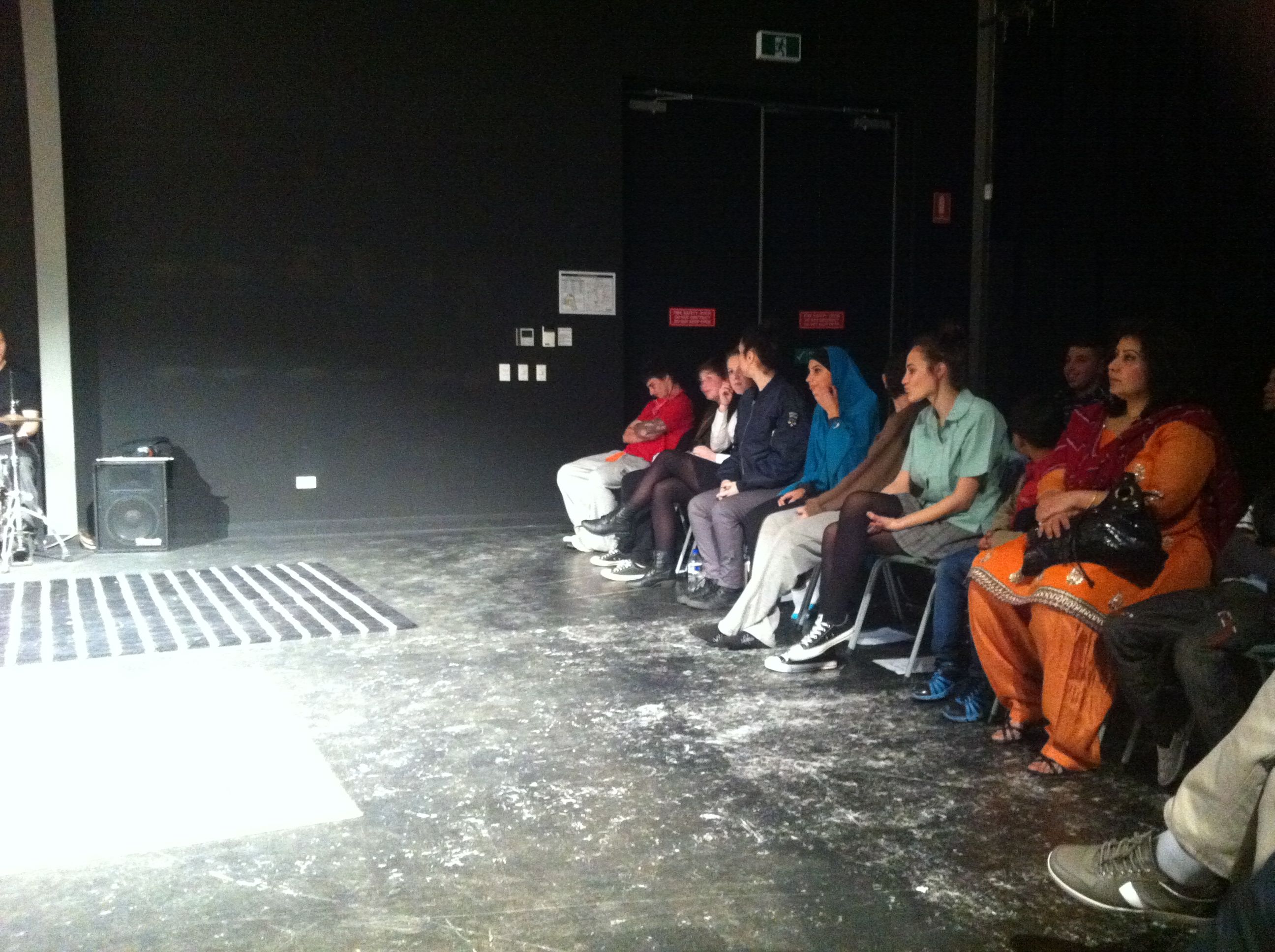
Just before the show started, a section, not of the audience but of the cast. I didn't get my hands on a program so can't say names, but from the left:

Just before the show started, a section, not of the audience but of the cast. I didn’t get my hands on a program so can’t say names, but from the left: a young man who did spectacular leaps to impress a young woman; two players of multiple minor characters; the junkie mother / train ticket collector; younger sister of the returning young woman / girl who was impressed by the boy’s athleticism; neglected son of the junkie;  Community Services worker / mother of the praying family / drummer; mother and two children from the lost-in-the-mall story.

The Other Way is on again tonight and tomorrow night and tomorrow morning (that is, Wednesday 17 and Thursday 18 July) at the Bankstown Arts Centre where tickets cost $5 or $3 (book at 02 9793 8324), and then Friday evening and Saturday afternoon at the Wharf 2 Theatre at Walsh Bay where there’s no charge, but bookings are essential (02 9250 1777 or online) and maybe impossible.

Half an acquisition

One by-product of living with an Art Student is that works of art proliferate around the house. Some are produced by the AS herself, some given to her, and some we buy. Our latest acquisition, which we bought jointly with another Art Student couple, is this photograph:

Janet-Tavener-Figs

It’s Figs, by Janet Tavener, from her recent exhibition at the Brenda May Gallery. The Art Student wanted to hang it over our bed, but it’s the middle of winter and the bed is generally cold enough to get into without having a huge photograph of melting ice sculptures hanging over it. So it has pride of place in the dining room, and the Art Student’s bright portrayal of the poppy’s life cycle keeps its place in the bedroom.

Incidentally, when we dropped in to pick up the photo today, we spent a good time enjoying Brenda May’s current exhibition, Mighty Small.

Jennifer Compton, Parker & Quink

Jennifer Compton, Parker & Quink (Ginninderra Press 2004)

1pq

Jennifer Compton was in her mid 20s when she burst onto the Australian theatre scene with her play No Man’s Land, which shared the 1974 Newcastle Playwriting Competition prize with John Romeril’s The Floating World (distinguished company!), was produced by Ken Horler at the Nimrod Theatre in Belvoir Street and, redubbed Crossfire to avoid confusion with Harold Pinter’s play of the same name, was published by Currency Press.

Parker & Quink came 30 years, 3 plays and at least 3 books of poetry later, and has been followed by other plays, other books of poetry. I came upon it by chance, as one still can in bricks-and-mortar bookshops. Time passes, we grow older, times change: that’s a recurring preoccupation of these poems, from the three-line title poem to the 18 stanzas of ‘During the Power Cut I Read, by Candlelight, “Ballade” by Kenneth Koch’.

Parker & Quink: the young might stare at these words blankly, but for us sexagenarians they have unmistakeable nostalgic power to evoke the sensual feel of a fountain pen, the aroma of quality ink, the dubious joys of blotting and smudging, perhaps even the quiet pleasure of receiving one’s first Parker pen as a reward for doing well in a school exam. The title poem, just three lines, draws on those associations, but its tone is more bemused than nostalgic:

Parker & Quink
To write your email address
with a fountain pen filled with ink
like lighting a candle on the moon.

The past isn’t just another country, it’s a whole other celestial body, with unbelievably limited, even ineffective communication technology. Yet to my way of thinking a lot of the poetry in the rest of he book uses just that technology: the kind that needs the reader to come and sit with it for a while, rather than providing instant hits, instant links. The second poem, ‘Imposing the Chat’, starts out with a chat room report of attending a gallery opening where (the capitals are hers)

ALL THE ARTWORKS HAD BEEN MADE BY
THE PARENTS OF MURDERED CHILDREN

I don’t understand chat room jargon, but I think the speaker is thrown out of the room, presumably because her subject is unacceptable. She is left to write in a form where ‘the words do not evaporate out of the top of the page’, where she can’t just shout in performative horror but goes on to grapple with the complex and disturbing experience of attending that opening, talking with some of those parents, remembering at least one of the murders and driving home wordlessly with her husband to look in at last on her sleeping children. As the first line of the poem puts it, ‘It should be hard to write.’ Sometimes candles and moonlight, however ineffective, are what’s called for.

That’s the first two poems. After them, the book touches on many subjects, speaks in many voices, reflects many moods. There are memories of a New Zealand childhood, private acknowledgement from an eminent theatre critic (though we’re left not knowing if this was real or imagined), a touch of Bildungsroman, the imitation of Kenneth Koch I mentioned earlier (a kind of compressed, fragmentary, cryptic autobiography), dreams, dramatic monologues, and perhaps my favourite, an imitation bird call whose title is, perhaps accidentally, three words from James McAuley’s ‘Magpie‘:

Every Morning, Waking
Out in the zero velvet of the night
swinging deep into left field
the first interrogatory of the aubade.

A startle of – Where was I? What!
Then the anxious, enquiring flex,
– And am I still a magpie? Yes!
awwbadge_2013

This is the seventh book I’ve read as part of the Australian Women Writers Challenge 2013. I undertook to read six and review four, and I’ve now read seven and reviewed six, so I guess I’ve met the challenge, but as a matter of interest and google fu I’ll keep adding a note when I read an AWW title.

Overland 211

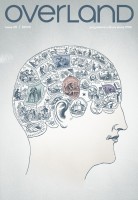
Jeff Sparrow (editor), Overland 211 Autumn 2013

OL211

As a happy subscriber (and not only because I won some free chocolate in last year’s subscriberthon), I’m glad to read in Jeff Sparrow’s editorial in this issue that although Overland is now a project, of which the print journal is only one part, the printed object will continue to appear regularly for the foreseeable future. I am one of the many people who, he says, ‘still like to read (in particular) long essays, literary fiction and poetry on paper, away from the distractions of their iPad’. I also enjoy the synergies that can arise within the bounds of physical covers, quite different from the boundless variety of the online world.

An example of what I mean by synergy occurs in the play of ideas and perspectives among: ‘The one day of pure form’, in which Guy Rundle argues that Anzac Day is a weird commemoration whose meaning can and does change to suit the needs of whoever happens to be in power; ‘Peregrinus Requiescat’, a short story by Warwick Newnham that, beneath a sophisticated play with form and some not always correct or correctly translated Latin, is moved by a straightforward impulse to honour a man who died in combat by marching in his place on Anzac Day; and Barry O’Donohue’s poem, ‘Vietnam ritual’, whose speaker is a Vietnam War veteran free of any commemorative or romanticising impulse. ‘The innocence of Australians’ by Ramon Glazov, a review of a collection of short stories that imagine terrorist attacks in Australia, takes on a different hue in the context of those three pieces. Glazov sees in most of the stories an inability to imagine a plausible motive for attacking Australia – because after all, so the ‘thinking’ goes, we’re innocent global citizens in the sense that what we do hardly matters, whether it’s sending a token force to kill and die in the US’s wars, or opening another coal mine. This presumed innocence isn’t the same as the ‘pure form’ that Guy Rundle sees in Anzac Day, but the two concepts talk to each other interestingly.

Synergy is there again in the way one’s mind bounces between ‘The possibility of patronage’ by Anwen Crawford, a curmudgeonly piece about the limitations of crowd-funding, pop-up galleries and other innovative ways of getting artists and money together, and ‘Paying the writers’, in which Jennifer Mills and Benjamin Laird are set up to debate responses to the trend to expect writers to accept ‘exposure’ as recompense for their work, but can’t help agreeing that some form of collective action is desirable. That bouncing affects the way one reads Alison Croggon’s characteristically elegant column ‘On Homelessness’. She doesn’t connect her two experiences of homelessness with being an artist except to imply that writing was her way of keeping her sense of self intact, but in this context one wonders if poor compensation for writing may have had something to do with the problem in the first place. And then there’s Judy Horacek’s cartoon parodying a current credit card ad: ‘A career in the arts: priceless. And for everything else, there’s dumpster diving.’

There are also stand-out stand-alones. In ‘Pump’, Stephanie Convery tells of her participation in a women’s body-building course, which manages to challenge some aspects of sexism and male domination while bowing to others: the article includes fascinating history, high comedy, memoir and challenging analysis. Apart from some Melburnian sneers at country Queensland, ‘All those women’ by Jacinda Woodhead is richly empathetic: in the context of Queensland’s dire abortion situation – abortion is a crime except under closely defined conditions; it’s hard to access, expensive and stigmatised – Woodhead presents a portrait of tiny anti-abortion, anti-war group Protect Life. While recoiling from their politics on abortion, she and pro-choice activists she interviews communicate a respect for their commitment to principles and sheer stamina. Jill Dimond’s ‘Ned Kelly’s Skull’, which justifies the phrenological cover image, includes a fascinating look at some eccentric colonials. Giovanni Tiso makes some alarming sense out of recent events in Italian politics in ‘The Net will save us’.

In the poetry section, I was relieved to see a couple of bird poems, since current Going Down Swinging submission guidelines specifically rule out ‘poems involving birds, wings, feathers or flight’ and it would be a shame if birds were to disappear from Australian poetry altogether. I’m grateful for The shearwaters by Jules Leigh Koch, ‘a long tideline / like a driftnet / to fish for stars’, and I probably would have loved ‘The swallows in Saint Peter’s Square’ by Luke Whitington for its name alone.

Not all those links will take you to a full article, at least not at the time of writing, but be patient. Overland does tend to put just about everything online in the weeks after an issue comes out. Or you could buy a hard copy and find your own synergies.