Jennifer Maiden in the Age

In yesterday’s Age, and in the online version of the Sydney Morning Herald, Jennifer Maiden has a new poem, ‘The Reflection’ (scroll down quite a way at that link). In it a re-awakened Kevin Rudd and Dietrich Bonhoeffer chat on a plane as they did in the earlier poem, ‘Deep River’ (you need a sub to the Australian Book Review to make that link work).

The earlier Rudd–Bonhoeffer dialogue took place soon after Rudd’s replacement by Julia Gillard as Prime Minister, and as in many of Maiden’s poems in which politicians converse with their proclaimed models it has a sense of moral jeopardy, sympathy for the one who is in jeopardy, and a respect for the enigma of their humanity. It ends with the observation that Rudd’s ‘strangely stylised’ slang seems to say:

‘Okay:
So we’re all self-constructed out of trauma.
Standing here,
I defy you to file me away.’

In ‘The Reflection’, the sympathy and enigma have receded, and the moral jeopardy intensified. Do read it.

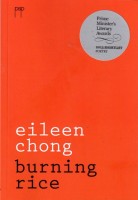
Eileen Chong’s Burning Rice

Eileen Chong, Burning Rice (Australian Poetry 2012, Pitt Street Poetry 2013)

1br

This pocket-sized volume was short-listed for the Prime Minister’s Literary Awards along with giants John Kinsella, Peter Rose and Jennifer Maiden. I approve.

I’ve recently read a bunch of scholarly essays about multiculturalism, postcolonialism, cosmopolitanism, hybridity, transnationalism, diasporic writing and other ways of creating or perceiving poetry that is not contained within a single cultural tradition. In that context, I guess these poems by Eileen Chong would be classed as diasporic: most of them deal one way or another with her Singaporean heritage and her separation from it.

But as it happens, I’ve also been rereading (with a heavy heart) some of Seamus Heaney’s poetry, and it strikes me that Chong’s poems about her parents and grandparents, the family’s food traditions, her childhood memories of Singapore streets, even Chinese history and classic Chinese poets, are part of a similar project to Heaney’s when he writes about his parents and forebears, his childhood memories of Irish fields, his tales of Irish saints and scholars. It would be as big a mistake to fence off this poetry in some semi-ethnographic corral as to do that with Heaney’s. Surely everyone can respond at a deeply human level to poetry in which a mind engages with the relationship between the present world and the world of childhood and heritage?

At least that’s my experience. Take the first poem, which also gives the book its title. It begins:

I did not mean to burn the rice tonight.
'Planting rice is never fun' – generations
of men, women and children ankle-deep
in padi fields, bent double at the waist,
immersing seedlings day after day.

then goes on to evoke the other kinds of work involved in growing and harvesting rice, before coming back at last to the burnt rice with a killer final line (you can read the poem here). At a personal level, this poem works wonderfully for me. It hooks my emotions by stirring into awareness something of my own very different heritage: four generations of my family – great-grandfather, grandfather, father and brother – have been sugar farmers. Substitute marmalade for rice, and there I am in my inner suburban kitchen, trying to get the quantity of sugar right, enough to make the marmalade set but not too sweet, and lurking not so very far in the background the memory of cane paddocks, cane fires, cane knives and all they meant in my childhood. My personal story is very different from Chong’s and the history of sugar in North Queensland has little in common with that of rice in east Asia, but that’s where the poem touches me, brings part of my mind alive.

I don’t know that that says much about the actual poetry. There are other deceptively straightforward poems about Asian food and about Chong’s parents and grandparents, some striking dramatic monologues spoken by women from east Asian history, including a number connected to Lu Xun (considered by many, according to Wikipedia, to be the leading figure of modern Chinese literature), some sweet encounters with other Australian poets. I’m looking forward to more.

awwbadge_2013

This seems to be the tenth book I’ve read as part of the Australian Women Writers’ Challenge.

Edmund White Flâneur and the Book Group

Edmund White, The Flâneur: A stroll through the paradoxes of Paris (Bloomsbury 2001)

1582341354 Before the meeting: I was very happy when this book was suggested as our next title. I’d come across the idea of the flâneur, the aimless wanderer through an urban environment, as an artist archetype (I think it was at the launch of Michael Sharkey’s The Sweeping Plain in 2007), and had somehow got the idea that Baudelaire and Edmund White were the go-to writers for anyone wanting to understand the archetype.

I was misled, at least about Edmund White. That is, I thought he was going to turn out to be a flâneur like the protagonist of Teju Cole’s Open City (which I suggested as a supplementary title), and that’s not how this book works at all.

It’s a short book, part of Bloomsbury’s The Writer and the City series, in which, according to the back cover blurb here, ‘some of the finest writers of our time reveal the secrets of the city they know best’. Peter Carey’s self-indulgent and forgettable 30 Days in Sydney was part of the series, and New South’s generally excellent Cities series may have been inspired by it.

There are six chapters: a general introduction to the idea of the flâneur and the general complexity of Paris is followed by essays about French (and mostly Parisian) attitudes on race, Jews and homosexuality, with an inserted chapter on eccentric and little known museums, and a final chapter on the weirdness that is the French monarchist and royalist movements. In other words, the bulk of the book is taken up with considerations of French culture through the lens of US-style identity politics, in particular through the lens of US gay culture.  There’s very little wandering the streets, though as the text wanders through its chosen themes it sometimes creates an illusion of appropriate lack of discipline.

I enjoyed White’s mini-essays on Colette, Sidney Bechet and Josephine Baker. He gives a fascinating account of the Club des Hachichins (frequented by Baudelaire, Balzac and Théophile Gautier, if you can frequent something that only happened half a dozen times). His discussion of why AIDS had so much higher an incidence in Paris than in London raises interesting questions about identity politics (big in the US, sneered at in Paris – guess which attitude turns out to be superior!). The stories of a number of individual 19th century Jews are strikingly similar to the story of Charles Ephrussi in The Hare with Amber Eyes – in a good way.

There is all that, and much more that’s enjoyable and illuminating, but more often than not I was irritated. I grew tired of the name dropping (he once dined with Foucault, but that’s only the high point), the preening (his Parisian dinner-party comrades hadn’t noticed until he mentioned it that Paris is no longer a predominantly white city), the false modesty (he once gave a talk on Genet to a Palestinian audience, who surprised him by loving it even though he is white and Western), the persistent essentialising of ‘the French’ and ‘Parisians’, the titillatory titbits (wife-swapping clubs, cruising by the Seine) and the unremitting gay perspective (the most emphatic detail in his description of a mosque is that the Gay men who cruise its hammam on Sundays don’t touch each other out of respect for the religious environment).

After the meeting: It’s Rosh Hashanah, so attendance at the Book Group was down last night. (Memo to selves: Must keep a sharper eye out for High Holidays in future.) The five of us ate a hearty French meal, gossiped, engaged with the problem of an iPhone whose screen had gone blank, and discussed the book.

One man had really loved it. He’d read it when in the south of France, just before going to Paris, and so was much more attuned to its sense of place than I certainly was. He enjoyed the way the text moved between tiny details and broad perspectives. He found himself stopping to re-read paragraphs just for the pleasure of them. Interestingly enough, he loved the first sentence for its elegance and its cheeky wit, while I was irritated by its Americo-Eurocentrism and its snobbish smart-aleckery:

Paris is a big city, in the sense that London and New York are big cities and that Rome is a village, Los Angeles a collection of villages and Zürich a backwater.

One man had surrendered his copy when the library insisted he return it (probably because I was asking for it), but he hadn’t been unhappy about that as he’d had three attempts at the first chapter and been unengaged – because as far as he could tell, all White was doing was quoting a lot of other people about Paris, which is less true of later chapters. One had read it overnight (I’d dropped off that same library copy to him on Tuesday afternoon) and had a similar mix of enjoyment and irritation to mine, though I think with more pleasure and less irritation. Perhaps part of the problem is that we had all read the entry on ‘flâneur‘ in Wikipedia, and then approached the book expecting it to be an example of flâneurism, which it really isn’t.

Spring joy

It’s about two and a half years since we moved home. About a year ago, the grass tree (Xanthorrhoea) that had stood outside our kitchen window in the old house was ailing in its new location – most of its fronds were brown or browning. I took a photo of it to our local nursery and the man there said the plant was almost certainly dying: they don’t take to transplanting,  and it will sometimes take as long as 2 years for them to die, and ours was well on the way. We could trim off all the dead and dying fronds, even sit a cardboard box on top of the plant and burn it, so that all the green growth was burnt back, but it was a slim chance, and the burning was the product of wishful thinking rather than a proven remedy.

I didn’t do the burning, but I took to the leaves with a pair of secateurs and for months our once thriving grass tree was like a dead lump with a few green sprouts sticking out of its top. We made sure it wasn’t over-watered, and gradually it came back to good health. And on the weekend, we noticed it had produced a spike.

grass tree

In no time at all, as measured by grass trees, that spike will be more than a metre high and produce seeds and, if we harvest the seeds and plant them properly, in 20 years time we may even have a new generation of grass trees.

Ngurrumbang at the AFF

I’m thrilled to learn that Ngurrumbang is screening at the Adelaide Film Festival. It’s part of Australian Heat, a session of four short films at 9.15 pm on 15 october. The other films are River Water (written and directed by Sara West), Summer Suit (directed by Bec Peniston-Bird, written by Francesca Sciacca) and The Hunter (directed by Margaret Harvey, written by Cameron Costello).

The Festival blurb says:

Tough, wild, brutal or haunting these shorts pack punch and are as scorching as the land that spawned them.

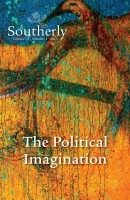
Southerly 73/1

David Brooks and Elizabeth McMahon (editors), Southerly Vol 73 No 1 2013: The Political Imagination

1spiRoughly two thirds of this Southerly is devoted to essays that started life as papers for ‘The Political Imagination: Contemporary Diasporic and Postcolonial Poetries’, a conference held in Melbourne in April 2012. So the political imagination under discussion is much more specific than the issue’s title suggests. It’s as if the god of the mailbox saw me tossing terms like ‘immigrant poetry’ around in my last blog post, and decided to send me some heavy-duty reading matter as a reproach for my lack of theoretical rigour (or theoretical anything, if the truth must be known). Ali Alizadeh, one of the subjects of that last post, was responsible along with Ann Vickery for editing the essays from the conference, and co-wrote one of them with Penelope Pitt-Alizadeh: and he more than adequately fits my description of him as way out of my intellectual league.

Of the theme essays, the clear stand-out is Danijela Kambaskovic’s superbly readable ‘Breaching the social contract: the migrant poet and the politics of being apolitical’. When Kambaskovic left Belgrade in the 1990s she had already published poems, translations and criticism in Serbian and was fluent and well read in English. She came to Australia, gained a PhD and eventually began to write poetry again, now in English. The essay addresses the question of her deep reluctance to write about migration, to write poetry from the migration experience. In vivid prose, she lays out her own story and that of others with similar experiences: it’s the story of someone fighting for her own mind, resisting pressure to further her career by commodifying her painful history and at the same time searching for an ethical practice:

Traumatised writers spend their lives searching for precise verbal equivalents for the dread, the horror, the identity shifts, the hatred of one’s environment, the inability to identify with the structures and institutions of society, the fear of reality, the mental dysmorphia – all non-verbal and confronting emotions made even more complex by the awareness that one has moved into a much ‘better’ society and ought to be ‘grateful’. How is it possible to write about these for an audience who may be baffled, even confronted, by the uneasy conjunction of praise and criticism of their own society, which may make the migrant writer seem negative and ungrateful, or at the very least, unnecessarily conflicted? I salute those migrant writers who can find enough clarity in their minds to write about any of those, and avoid the pitfalls. Any of my attempts that have been in any way successful have skirted on the surface of the experience.

This essay is worth the price of admission, for itself, and for the way its flesh and heart helps with the preponderantly academic tenor of the other essays.

Those essays explore similar issues. Alizadeh and Pitt-Alizadeh carefully and meticulously discuss the dangers of categorising people and/or poetry according to a single ethnic or racial identity, and give a model of how to read a poem that avoids those dangers without imposing mainstream assumptions on it. A full understanding of their model depends on the reader being familiar with Alain Badiou’s readings of Mallarmé, which sadly I am not. Adam Aitken’s demanding discussion of hybridity casts interesting light on his own poetry:

Rather than a poet who writes about travel I would like to be read as a poet who charts the changing nature of the ongoing historical meaning of the Asian-in-Australia.

Peter Minter floats an idea of imagining ‘a decolonised twenty-first century Australian poetics’ by thinking in terms of archipelagos – I think he’s saying something that’s not just interesting but exciting, but I’d have to make headway with 15 or so heavy-duty theorists he cites to understand him properly. Had I but world enough and time! There is a lovely moment where he quotes in quick succession and mutual support Les Murray, Karl Marx and the Whole Earth Catalogue.

I also enjoyed Timothy Yu’s discussion of Asian Australian poetry. As a US scholar, he was struck by the different way migrant communities talk about themselves here. Sydney comedian Michael Hing, who can trace his family’s history in Australia back some five generations, refers to himself, not as an Asian Australian (the equivalent of Asian American, the most likely term if he had been in the US) or even as a Chinese Australian, but as ‘a Chinese guy’. Yu ruminates interestingly on this difference, and gets down to specifics in considering aspects of the poetry of Ouyang Yu.

The rest of the journal is taken up with poetry, short stories and reviews, all interesting, some wonderful.

Danijela Kambaskovic stars again in the poetry section with ‘Belgrade Sunday Lunch’, a translation from her own poem in Serbian (incidentally, her article has a nice riff on what it means to translate one’s own poem as opposed to someone else’s). She has two more poems in Southerly‘s online component, The Long Paddock, just a click away.

Of the stories, I liked best Jeremy Fisher’s modest domestic scene, ‘Ready to Dance’, which has a predictable but satisfying twist, and Rachel Leary’s ‘God’s Lost Sheep’, which plays like a short grunge movie of a bus hijack.

There’s an interesting combined review by Jal Nicholl of Michael Farrell’s open sesame and Jennifer Maiden’s Liquid Nitrogen. He sees these vastly different poets as inhabiting ‘different wings of the same belated [ie, post-modernity/post-modernism] dream-house.’ And one of life’s little mysteries is solved on page 256 where Sam Franzway review’s Vikki Wakefield’s young-adult novel Friday Brown: Sam is known in these quarters as franzy, creator of the blog Writing. So now we know why he’s been neglecting his blog – he’s doing a PhD and writing scholarly reviews, thankfully without a single mention of Deleuze, Kristeva, Baudrillard or even Foucault.

Curmudgeonly footnote: I would pass in silence over the ‘back-peddling’ character in one of the stories, because there is pleasure in such misspellings. But I have to complain about a moment in Danijela Kambaskovic’s brilliant essay where she was left hanging out to dry by the editorial team. Observing that some people question whether a woman of non-English speaking background can adequately teach Shakespeare to Anglo-Saxon students, she comments in parentheses: ‘This reminds me of famous quip by George Bernard Shaw that women writers are like dogs dancing on their hind legs: the wonder is not that it is done well, but that it is done at all.’ It’s a slip that anyone could make, but surely one of the many pairs of eyes that read that paragraph on its way to press should have picked up that the famous quip was made by Samuel Johnson, and it was about a woman preaching.

‘weapons of mass distraction’

The US politician Anthony Weiner outdid even Shane Warne or Peter Slipper in having sexting behaviour exposed to the harsh glare of public scrutiny. A recent issue of  New York City newspaper The Villager has an article by K Webster, ‘Wounded Weiner just a symptom of society’s isolation‘, that looks past the scandalousness of it all to what it means about men in our societies. Given that very few of my readers are likely to read The Villager, I thought I’d point you to it:

Men are set up to be isolated. Thus they are often plagued by a seemingly endless quest to staunch insecurity and loneliness through some version of sexual contact. Too often, the search winds up landing them in the arena of the sexual exploitation of women. Lots of guys are derailed by the billion-dollar sex industry (or by self-driven intrigues) while seeking the very real human need for touch. Usually it ends in settling for the illusion of contact — a numbing or briefly satisfying relief.

Anthony Weiner got busted for his oddly disconnected effort at connection. Although self-driven, it happened in the context of a highly sexualized society that keeps men manipulated and preoccupied.

Profit seekers deliberately and increasingly entwine sex with the hardwired need for closeness. It sells. It tantalizes. It promises excitement in a seemingly dreary landscape. But despite the ads, commerce really doesn’t belong in between two people’s liking/loving/wanting each other. And trying to use the act itself or hints of it to avoid loneliness is a bit of a dodge. In a better world, the use of sex as a weapon of mass distraction would be seen for the aberration it is. Sex can give us back our sense of closeness, the goodness of life and passion. But really, when the sex is good, it almost wasn’t the point.

The rest is here.

(Footnote: I accidentally uploaded this from my iPad when it was just a title. That minimal post provoked a comment about Syria: which makes me think that K Webster’s description of the porn industry as a weapon of mass distraction has profound implications. Imagine if the time and attention currently soaked up by porn was directed to, say, creating world peace, preserving the environment, ending racism … !)

Ali Alizadeh’s Ashes and Brendan Doyle’s Bicycles

Ali Alizadeh, Ashes in the Air (UQP 2011, 2013)
Brendan Doyle, Glass Bicycles (Ginninderra Press 2012)

I needed books to read on a long plane trip and in the interstices of the conference at the end of the trip. These two jumped off the bookshop shelves, Brendan Doyle’s because I knew a little of his work from a previous life, Ali Alizadeh’s because I’ve heard him read from his memoir and have found his critical writings bracing.

0702238724To be honest, I’ve found Alizadeh’s critical writing intimidating rather than just bracing: way out of my intellectual league. So I approached Ashes in the Air expecting to struggle with obscure (post-)modernist play. Instead, I got a human voice, plainspoken, generous, sometimes raw, at other times laugh-out-loud funny, and at moments piercingly lyrical. There is impassioned politics, childhood reminiscence, love lyric, a number of verse essays.

Though it’s not a memoir, a narrative emerges: Ali Alizadeh came to Australia from Iran in 1991 in his mid teens. He struggled with the cultural transition, was subjected to xenophobic bullying and humiliation in Brisbane high schools, became an alcoholic and – if I’ve pieced the chronology together correctly – found his way to sobriety and equilibrium through the influence of his elder sister, through his relationship with the woman who is now his wife, and through poetry.

In some respects, this might seem like poetry that’s ripe for the dubious success of being set for classroom study, a sure way to generate sales but not necessarily build a readership. (A young friend of mine loathes the poetry of Peter Skrzynecki, which he was compelled to study for the Higher School Certificate.) Individual poems may be seized on in this way as shedding light on the immigrant experience: ‘Us and Them’ juxtaposes two deaths – of ‘another working class adolescent / charred by another Iraqi chemical / attack’ in the early 1980s, and of a ‘promising Creative Arts student / who threw himself under the train / one sunny day, at Southport Station’ a decade later; ‘A Familial Renaissance’ charts the immigrant family’s traumatic path to some kind of well-being. And others, including the complex and discursive ‘The History of the Veil’, would stir animated classroom conversation on ‘hot’ topics.

But the book as a whole is unlikely to be taken up by curriculum setters. It’s a long way from being categorisable as ‘immigrant poetry’ or ‘culturally diverse’. Some of the sweetest poems, including the first in the book, ‘Marco Polo’, are about travel that’s closer to tourism than migration. And how would you pigeon-hole ‘Sky Burial’, in which the speaker who has eaten many birds in his life contemplates making atonement by having his body eaten by vultures after he dies? On top of that, there are too many swear words, too many references to Baudrillard and other high theorists, too much fierce politics, too much that can’t be put to straightforward instructive use – you might say too much that a certain kind of teenager will love but that will deter a curriculum committee.

I expect I’ll reread it many times.
1bdgbGlass Bicycles also has an autobiographical dimension, but though the poems travel to Cambodia and France, and reach out to events in Iraq, Bali, Bosnia and East Timor, the unifying persona has a stable home base in the Sydney region. He starts out, in ‘Newtown Boy’, ‘Sittin’ on the gas box, / waitin’ for me dad’, has a romantic encounter in ‘Nielsen Park’, is revived by the Blue Mountains bush.

I read somewhere recently that a common difficulty with first books of poetry is that they lack thematic or structural coherence. In this book, structure seems to have been deliberately avoided: it would have been easy enough to group these poems into, say, commentary on current affairs, travel poems, nonsense poems, nature poems and family matters, but there seems to have been a deliberate decision not to do so. For what it’s worth, I think this was a good decision: it has given us a book where each poem stands alone, responding to its own occasion, whether it be a political commentator’s callousness, the bitter-sweetness of a child-access arrangement, or ash from a bushfire falling on the Harbour. the result is a friendly feeling, suggesting subliminally that readers could make poetry from their own occasions.

Since by happy accident I’m talking about these books together, how would this be for an exam question: ‘Ali Alizadeh and Brendan Doyle have both written poems about refugees. Compare and contrast.’

By Brendan Doyle:

Refugee
I kneel before the boatman.
The price is far too high.

I kneel before the pirate.
Not my daughter, not my wife.

I kneel before the aid man.
The land’s no longer mine.

I kneel before the soldier.
Will you spare a father’s life?

I kneel before the policeman.
A permit, to buy some rice.

I kneel before the altar
and pray for an end to strife.

I kneel before the embassy,
its heavy doors shut tight.

By Ali Alizadeh:

Shut Up
So he’s shut up. Vilified:
an unpleasant recalcitrant,

gagged for penning
Imperialist turpitude, then

summoned, sentenced
to purgation in Tehran’s

Evin Prison. How the writer
finally escapes, his fingers

nearly crushed and chopped. Has
himself smuggled, his heart

simmering with a whim,
freedom of speech, democracy

etc. Then branded ‘illegal
immigrant’ and caged in a camp

in Australia for three years, before
Temporary Protection after

his wrists have been indented
by his own razor, a rib fractured

by an overweight guard. He wants
to return to writing, but anger

blocks the passage of language
from the heart to the page. So he’s

shut up.

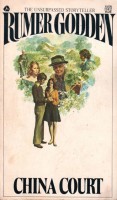
Rumer Godden’s China Court

Rumer Godden, China Court (1960, Avon 1970)

chinacourt002

China Court is a dilapidated old house in Cornwall that has been home to four generations of the Quin family. It has witnessed their loves and compromises, triumphs and subterfuges, sacrifices and betrayals. Each generation has changed the building, its garden, and its relationship with the village.

After the death of old Mrs Quin in 1960 (the year of publication), we meet her loving servant, the reformed scapegrace who rents the farm attached to the house, her beloved granddaughter who arrives from Rome too late to see her grandmother alive, her sensible daughters and their even more sensible husbands, an old man who has been called in by Mrs Quin (at the insistence of the most belligerently sensible son-in-law) to evaluate the paintings and other artefacts that have accumulated over the decades, and of course the benign old family lawyer who comes to read the will. Events unfold pretty much as that list of characters suggests: the will surprises all the characters but not the reader, unexpected treasure is found that makes everything work out, young love blossoms, and China Court is saved: no rude shocks there for the readers of the Ladies’ Home Journal, where the novel first appeared as a serial.

But Rumer Godden is a formidable writer. The present-time story unfolds in sentences filled with unexpected pleasures and strange twists and rhythms, using the conventional past tense. And intertwined with that narrative is what makes the book splendid: as if they are emanating from the stones and wood of the house, scenes from the past 120 years are told in the present tense. It’s a simple device, but it allows the narrating voice to switch without pause, explanation or any other signposting from a 1960 conversation in the kitchen to a rhapsodic account of how that kitchen has changed over the decades or to a completely different scene from 80 years earlier. Old Mrs Quin becomes Ripsie, the orphan girl from the village, childhood friend of the sons of China Court; the ferocious Lady Patrick who bullies little Ripsie becomes the aristocratic Irish beauty heartbroken at her husband’s infidelity; maiden aunt Eliza becomes a headstrong girl and a tragic figure as an old woman – at least five main stories, and any number of lesser ones, all woven together brilliantly, and the reader never loses track.

There are any number of reasons why this book and I are wrong for each other.

Gender: Not only are the main characters female but there is seemingly endless detail about flowers, clothes, household ornaments, cooking and domestic life in general, not to mention lots of pining after men in uniform.

Religion: I was brought up Catholic, and the book is high Anglican (though one character is ‘chapel’ and another Catholic). Key to the plot is a beautiful old Book of Hours, and the novel’s sections are named after the hours of the Office of the Blessed Virgin Mary – Prime, Terce, Sext, Nones, Vespers, Compline and Matins – with a Latin phrase (and translation) from the relevant Hour at the head of each section. My inner Catholic youth was torn between pleasure at being reminded of a prayer cycle that marked out my days from age 18 to 23, and a completely unjustifiable distaste at having those prayers used primarily as decoration.

Politics: Not that the book is overtly political, but it’s shot through with a kind of conservatism we know well from TV’s Downton Abbey (there are a lot of similarities, though the Quins aren’t aristos like the DA family). Early in the book, a family member is described as ‘go[ing] out to his great-uncle’s business in Canton when it has settled down again after the Opium War’ – having just read an Amitav Ghosh novel about the lead-up to that war, I’m alert to the human suffering glossed over in this passing comment, and suspicious when told that that business in Canton was just about tea. An uncritical acceptance of the spoils of Empire is deeply troubling, but doesn’t ruffle the surface here.

Pedantics: As a copy editor I would have gone nuts. The use of run-ons in particular is maddeningly irresponsible. I doubt if Ms Godden and the Chicago Manual of Style had ever been introduced.

There are probably other reasons why we shouldn’t get on. But in the event, I loved it. Sentence by sentence, scene by scene, I was eating out of Rumer Godden’s hands. She made me care about a dozen characters. She drives home the tragic effects of sexism and male domination on women, including women of the privileged classes. She fiercely opposes the creeping commodification of everyday life that was to blossom into neoliberalism. She may have cured me of my slavish devotion to the Style Manual.

The colonial past keeps changing

Brian Elliott and Adrian Mitchell, Bards in the Wilderness: Australian colonial poetry to 1920 (Nelson 1970)

1bwTo judge by pencil notes in the margins, I read Bards in the Wilderness 40 or so years ago, but – such are the joys of age-related cognitive decline – I didn’t remember any of it when I picked it up again recently, looking for information on how white settlers in New South Wales thought about Aboriginal Australians in the first half of the 19th century. The book’s title didn’t bode well – you can only refer to Australia as a ‘wilderness’ if you ignore millennia of prior occupancy: those ‘bards’ were actually living in what Bill Gammage describes as The Biggest Estate on Earth.

Elliott and Mitchell’s introduction explains that poems were selected for what they demonstrate about the colonies’ preoccupations – ‘political, social and moral’, ‘for what they contributed to the foundation of the Australian literary tradition’.

On the evidence of this selection, the settlers didn’t think about Aboriginal people much at all. Up to 1850, which is as far as I read, there are exactly four references:

  • Charles Tompson’s 1826 ‘Black Town’ is an elegy for a failed attempt by Governor Macquarie, ‘the chosen Delegate of Heav’n’, to educate ‘Poor restless wand’rers of the wooded plain’ in the joys of tenant farming – the failure, it is strongly implied, being the result of the Natives’ fecklessness (rather than because, as Heather Goodall puts it in Invasion to Embassy, to take part in the scheme ‘would mean that they would lose control over their children and be denied access to other areas of their country’). Aboriginal people themselves are notably absent from the scenes portrayed in the poem.
  • John Dunmore Lang’s ‘Colonial Nomenclature’ rattles off a list of ‘native names’ as preferable to ‘Downing Street appellatives’, though again none of the people who gave the settlers words like Parramatta, Illawarra and Woolloomooloo are acknowledged.
  • Charles Harpur’s ‘The Creek of the Four Graves’ does feature frontier violence and there are Aboriginal actors in its drama, but the poem tells of an unprovoked lethal attack by ‘stript and painted Savages’, who turn out to be terrible at bushcraft as well as mindlessly violent.
  • ‘Tullamarine’, by Richard Howitt, comes the closest to acknowledging a common humanity with Aboriginal people: the speaker is an Aboriginal woman who utters a distinctly Victorian lament for a child who has died – of natural causes, nothing to do with any dispossession.

So what some people these days consider the most interesting thing – politically, socially and morally – about the early colonial period is passed over in virtual silence, sometimes silence of a pretty aggressive kind, as in the common trope that this new land has no history, these plants and animals have never been celebrated in song.

Perhaps one has to look elsewhere than to poets to find the traces I was after: the notebooks of William Dawes (which hadn’t come to the attention of scholars when this collection was published), the journals of early settlers as explored by Inga Clendinnen (in Dancing with Strangers) and others, the journals of explorers like Eyre and Sturt, who had a lot to report. Forget the poets.

But hold on, maybe it’s not so much that the early colonial poets ignored Aboriginal people so much that these editors de-selected poems that didn’t ignore them. The book’s scholarly paraphernalia suggests this might be so. According to the note on ‘Tullamarine’, Charles Harpur wrote unsuccessful ‘poems on elegiac Aboriginal subjects’ (not included here because, presumably, the editors didn’t consider that they contributed to ‘the foundation of the Australian literary tradition’). And William Charles Wentworth’s long poem, ‘Australasia‘, of which no excerpt is included, is quoted in the Introduction as referring to ‘the mournful genius of the plain’, which, the editors gloss, may or may not signify ‘aborigines’ [sic]. ‘Australasia’, it turns out, includes a passage of 64 lines addressed to Aboriginal people. They may not be great poetry, they may include sentiments that make a modern reader of whatever heritage cringe, but they’re there, acknowledging the pre-colonial inhabitants, beginning:

Ye primal tribes, lords of this old domain,
Swift‐footed hunters of the pathless plain,
Unshackled wanderers, enthusiasts free,
Pure native sons of savage liberty,
Who hold all things in common, earth, sea, air

I can only surmise that in 1970 non-Indigenous literary scholars felt that the kind of verse written about contact between Europeans and Indigenous Australians was best left undisturbed in its place of first publication.

A quick look at John Kinsella’s 2009 Penguin Anthology of Australian Poetry suggests that times have changed: even though this anthology doesn’t have a particular emphasis on colonial times, it includes three poems by Eliza Hamilton Dunlop that indicate a level of awareness not even hinted at in the Elliott and Mitchell anthology.. ‘The Aboriginal Mother’ is similar in tone and form to Howitt’s ‘Tullamarine’ but the mother is lamenting the loss of her man and her firstborn in, according to the site I’ve linked to here, the Myall Creek Massacre of 1838. Her other two poems are ‘The Aboriginal Father’, a transliteration of an Aboriginal song, and the translation of a poem by an Aboriginal man named Wullati.

I wonder if any scholars have taken on a 20-teens version of the Elliott and Mitchell anthology that reflects early colonial poets’ contributions to what we now see as ‘the Australian literary tradition’.