Sonnet for the doomed figs on the south-west corner of Enmore Park

November’s nearly here and with it my personal challenge of writing 14 sonnets in the month. Thanks to the rise in global temperature, Sydney’s jacarandas are flowering early: in a spirit of solidarity with them and other tress, here’s an early sonnet, inspired by a sign in Enmore Park:

construction

Improvement works are scheduled to commence
in our park soon, and if spring rains allow
will be complete by New Year’s Day. Immense
dark witness figs, gnarled amputees, are now
assessed as low performers or high risks
against criteria on Council’s disks.
They’re ugly, idle, falling bits could kill
a child or dog, and that’s a lawyer’s thrill.

This great construction project will proceed.
Remove, chop, mulch, rope off and rectify
by chainsaw, shredder, backhoe and the sigh
of paperwork. It’s progress. Figs don’t bleed.
Dear residents, though patience may be strained,
the park’s geometry must be maintained.

Ngurrumbang at Seminci

We just heard last night that next weekend Ngurrumbang is being shown at Seminci – the Semana Internacional de Cine de Valladolid – in the fabulously named Teatro Zorrilla at half past four on Saturday 19 October and again at 7 o’clock the next day. It’s screening with Bart Van den Bempt’s 82 Days in April. This may be our little movie’s only European screening, so if you plan to be in northern Spain in nine or ten days time, add this to your calendar.

In case you haven’t heard of the Valladolid Festival, here’s a sentence or two from its web site:

Reivindicamos más que nunca el cine intimista, el cine hecho con pocos medios pero con dignidad, ambición y verdad. Ahora que peligra la presencia de ese tipo de cine en las salas, porque se cierran o porque los empresarios prefieren no correr riesgos con la taquilla, reivindicamos un cine que sirva para algo más que para entretener.

Or in English:

Today more than ever we advocate intimate films made on scanty budgets, yet full of dignity, ambition and truth. Now that the theatrical distribution of this kind of cinema is under threat (either because movie theatres are closing down or because the film business is reluctant take risks at the box-office), we firmly support motion pictures that do more than entertain.

Cordwainer Smith’s Norstrilia

Cordwainer Smith, Norstrilia (Ballantine Books, 1975, 1978)

1norstriliaNorstrilia is on a number of impressive lists, including Locus Best SF Novels of All-Time, David Pringle’s Science Fiction: The 100 Best Novels, The Classics of Science Fiction. It has been on my ever-growing and much-neglected SFF TBR pile for years.

Cordwainer Smith was a pseudonym of US author Paul Myron Anthony Linebarger, who under his own name was Sun Yat Sen’s godson, an expert in psychological warfare and an adviser to the US military in a number of  combats up to but not including Vietnam. He wrote quite a lot of science fiction (can you tell I’ve looked up Wikipedia?) of which this is his only novel, but many if not all of his short stories and novellas are set in the same universe as Norstrilia – and they leave tantalising traces in the narrative here, such as a number of references to the much feared but never explained Mother Hitton’s Littul Kittons, or the likewise never explained ‘underhuman’ saint D’joan.

‘Norstrilia’ is of course a corruption of ‘North Australia’: the story begins and ends on the planet of Old North Australia 15 thousand or more years from now. The Norstrilians are fabulously rich but deliberately simple people, presumably based on the impressions Australians made on Linebarger when he spent six months in Canberra in the 1950s. The Norstrilians’ wealth comes from giant sheep, not from wool but from the by-product of a sickness that has infected all the flocks … But I’m not giving a story outline. Suffice it to say that the book is very funny, and full of bizarre inventions – such as a lethal sparrow the size of a football, or beings known as underhumans who are basically animals genetically engineered to have human intelligence and other qualities, or the more or less self-explanatory Department Store of Heart’s Desires, or a future Earth where illness and enmity have had to be artificially reinvented to stop humans from going extinct from boredom. Some of the inventions are of the ooh-he-thought-of-that-in-1964 variety (the novel was first published as two separate stories in the 1960s) , such as in this exchange:

‘What’s postage?’ said the Lord Redlady, really puzzled.
‘Payments on messages.’
‘But you do that with thumbprints or eyeprints!’
‘No,’ said Rod, ‘I mean paper ones.’
‘Paper messages?’ said the Lord Redlady, looking as though someone had mentioned grass battleships, hairless sheep, solid cast-iron women, or something else equally improbable. ‘Paper messages?’ he repeated, and then he laughed, quite charmingly. ‘Oh!’ he said, with a tone of secret discovery, ‘You mean antiquities …?’

There are computer networks, videophones and CCTV. There’s cheerful female-to-male transition (anatomical details passed over in discreet silence). The plot hinges on spectacular manipulation of the global financial markets, though as this is fantasy there is no crash. There’s a totally gorgeous cat underhuman, named (according to the internets) after Linebarger’s own cat. At one point the hero has to restrain himself from running to kiss his computer – a moment imagined 40 years before the iPhone was invented. And there’s a revolutionary movement motivated, almost certainly without deliberate reference to Che, by love both for the oppressed and the oppressor.

It’s a rollicking read, rarely a dull moment, that reminds me of why I love genre fiction.

Contemporary Asian Australian Poets

Adam Aitken, Kim Cheng Boey & Michelle Cahill, Contemporary Asian Australian Poets (Puncher & Wattmann 2013)

1caap

This book seems to be part of a current efflorescence of attention to Asian Australian writing, and of Australian attention to Asian writing. The current Southerly focuses on ‘Contemporary Diasporic and Postcolonial Poetries’, with particular attention to Asian Australian (or Asian-Australian, or Asian/Australian etc) work. The recent OzAsia Festival in Adelaide included a two-day OzAsia on Page component which featured ‘significant and contemporary Asian and Australian voices’. Vagabond Press’s Asia Pacific Writing Series is looking formidably good.

It’s hard to imagine a more disparate gathering of poets than those collected between these covers, not just in nationality or ethnicity (‘Asia’ is a big and varied place, and there seems to be someone here from just about every part of it except, interestingly, Japan), but in just about every other conceivable way as well. The poetry ranges from work with the exuberance and directness of Spoken Word to compressed, elliptical, allusive capital-L Literary offerings. It’s the poets who are Asian Australian, not necessarily the poetry, so though there are poems of the pain of loss of home and culture (I was going to say ‘nostalgia’, but that’s a word that no longer conveys any sense of real pain), poems that explicitly deal with or enact cultural duality or hybridity, poems about multicultural relationships, poems that tackle white racism head-on, and poems exploring questions of cultural identity, there are also poems that don’t do any of those things.

There is a brief introductory essay from each of the three editors. Adam Aitken outlines and celebrates the extraordinary range of voices and attitudes in the anthology, and the range of possibilities in the term ‘Asian Australian’ itself. Kim Cheng Boey focuses on the experience of migration:

Home is never a given, for first-generation migrants, and continues to be a complex issue for subsequent generations. Being beneficiaries of two or more cultures, and entangled in a complex web of affiliations and attachments, they are wary of identity politics and monolithic formations.

Michelle Cahill points out the anthology’s significance in bringing greater visibility to Asian Australian women poets, who experience ‘the double exile of migration and mediation of patriarchal terrain, so inimical to the female psyche’. Seventeen of the 37 poets in this collection are women, and very few Asian Australian women have been included in any previous anthologies.

All three introductory essays are worth reading, and they give invaluable guidance to the poetry. But in the end, it’s the poetry you pay for – and I’m happy to report that I was immersed in this book for days, being dragged from one engaged mind to another. Christopher Cyrill, whom I have previously known as the events organiser at Gleebooks who always spoke too softly when introducing people, here turns out to have a clear, strong, brilliantly modulated voice in the extract from his prose poem novella Quaternion (and that’s me saying it who hates extracts and doesn’t much care for prose poems). Andy Quan’s ‘Is This?’ is a brilliant abstraction of the moment of anticipation on meeting a new person. Omar Musa contemplates buying a pair of shoes and redefines the notion of choice. I finally get to read Kim Cheng Boey’s ‘Stamp Collecting’, which I’ve heard him read at festivals and loved, and his ‘Plum Blossom or Quong Tart at the QVB’ – what can I say? Eileen Chong is here, with some of the finest poems from ‘Burning Rice’. I was about to read Debbie Lim’s ‘How to Grow Feet of Golden Lotus’ aloud to a friend and then realised I wouldn’t want to inflict it on anyone who didn’t have plenty of time to recover. Merlinda Bobis’s ‘Covenant’ (‘after you bomb my town / I’ll take you fishing / or kite-flying or both’) conveys the poignancy (another word that has lost its hard meaning) of peace for a defeated people. Jaya Savige’s ‘Circular Breathing’ could hardly be more mainstream Australian, a kind of version of Les Murray’s ‘Perfectly Ordinary Rainbow’ set it in Europe and acknowledging Indigenous Australia (with only the barest allusion to Asia, but who’s counting?). Louise Ho’s ‘A Veteran Talking’ is a killer poem, a chilling, hard, dry killer. I’m glad Adam Aitken included a decent, brilliantly varied selection of his own work.

Please don’t let this book be seen as a marginal anthology of poems by the marginalised. It’s a fabulous collection and belongs at the centre of our culture.

Erasure

Waltzing Matilda
a poem by A B Paterson, adapted to downplay ‘the Labor side’ and other unacceptable parts of Australia’s history

‘I don’t believe in handing over responsibility for government policy to third parties,’ Mr Pyne said. ‘The Westminster system of government requires ministers to take a hands-on approach to matters within their portfolio. … Mr Pyne said the national history curriculum played down ‘the non-Labor side of our history’ despite the Coalition governing for two-thirds of the past 60 years. Sydney Morning Herald 27 September 2013

Oncea jolly swagman camped by a billabong,
Under the shade of a Coolibah tree,
And he sang as he watched and waited till his billy boil,
You’ll come a Waltzing Matilda with me.

Chorus:
Waltzing Matilda, Waltzing Matilda,
You’ll come a Waltzing Matilda with me,
And he sang as he watched and waited till his billy boil
You’ll come a Waltzing Matilda with me.

Down came a jumbuck to drink at that billabong
Up jumped the swagman and grabbed him with glee,
And he sang as he shoved that jumbuck in his tucker bag
You’ll come a Waltzing Matilda with me.

(Chorus)

Up rode the squatter mounted on his thoroughbred
Down came the troopers One Two Three
Whose that jolly jumbuck you’ve got in your tucker bag
You’ll come a Waltzing Matilda with me.

(Chorus)

Up jumped the swagman sprang in to the billabong
You’ll never catch me alive said he,
And his ghost may be heard as you pass by that billabong
You’ll come a Waltzing Matilda with me

Chorus:
Waltzing Matilda Waltzing Matilda
You’ll come a Waltzing Matilda with me
And his ghost may be heard as you pass by that billabong
You’ll come a Waltzing Matilda with me.

Tranter and Lilley: Rare Objects

John Tranter, Ten Sonnets (Vagabond Press Rare Objects Series No 90, 2013)
Kate Lilley, Realia (Vagabond Press Rare Objects Series No 91, 2013)

This series of elegant chapbooks finishes up this year at No 100, which means that John Tranter and Kate Lilley at 90 and 91 respectively are leading us into the straight – which may be the only straight thing about either of them (no reference to sexuality intended).

I went to the launch at Gleebooks on the weekend because I am generally baffled by the work of both these poets, and hoped for some guidance on how to read them, and I got it. John Frow, Eng Lit and Cultural Studies scholar, who did the honours, commented that in both books – and in The Tulip Beds by A J Carruthers, Rare Object No 92, which he was also launching – the poems were generated using a mechanism: in Tranter’s case the rhyming sonnet form and in Lilley’s a found-object framework.
10sonnetsFive of Tranter’s ten sonnets have an additional mechanical dimension: they list the five vowels and assign each of them to a colour. And other mechanical elements turn up in other poems: for instance ‘Poem Beginning with a Line by John Anderson’ was written, we’re told in a note, ‘while listening to a paper on his poetry given by Ella O’Keefe at the University of Auckland in March 2012’, and incorporates lines from Anderson and from Ms O’Keefe’s talk. (I hope she’s flattered by being incorporated into the sonnet rather than offended by the lack of attention.)

Speaking of notes, six of the books 16 pages are taken up with notes, which quote liberally from Wikipedia. It’s hard to tell for the most part whether these notes are meant to inform the reader, to mock the reader for wanting information, to slip an extended prose poem or two under the radar or simply to get the book’s pages up to a multiple of eight. One note explains what ‘Scuba’ is an acronym for, but is no help in explicating the couplet in which it appears:

U, olive green of underwater hair –
Scuba, the acronym, in a crowded room.

Another manages to compare Tranter’s work to Shakespeare’s, if only on the matter of complexity. On the other hand, a good half of the very long note on ‘Poem Beginning with a Line by Bunting’ is a lucid explication of a poem that at first I found impenetrable, which begins:

Boasts time mocks cumber Rome.
Roasts thyme scents set on ledge.

Interestingly enough, the note explains, that first line (from Basil Bunting’s ‘At Briggflatts Meeting House’) can be decoded into standard English. So can the second, but the rationale for its existence is that it echoes the first – it’s not clear if its sense matters at all.
realia001Following John Tranter’s lead, I’ll now quote Wikipedia and tell you that the great modernist American poet William Carlos Williams ‘summarised his poetic method in the phrase “No ideas but in things”‘. It’s tempting to say of the poems in Realia, ‘no ideas, just things’. The longest poem in the book. ‘GG’, is mainly a list of items from the estate of Greta Garbo sold at auction last December, presented without commentary:

Greta Garbo flatware
Greta Garbo cordial glasses
Greta Garbo Sherbet stemware
Greta Garbo Swedish butter press
__Viking mould imprints 14 5/8″ x 4 1/4″

and so on.

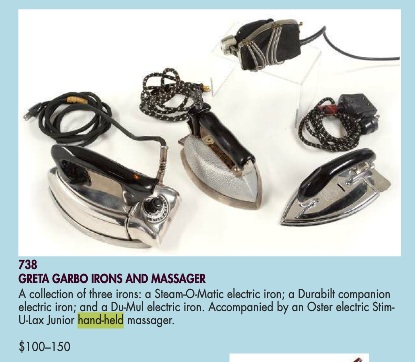
Of course, the art is in the selection. I looked up the actual 302 page catalogue, and the poem got even funnier. You can almost hear Kate Lilley saying, like Anna Russell, ‘I’m not making this up!’ The weirdness of starting each item with ‘Greta Garbo’ is not her invention. I didn’t check that everything in the poem is genuinely from the catalogue, but I did search for the line that most aroused my suspicions

Greta Garbo Stim-U-Lax Jnr Hand-Held

and there it was, hidden in plain sight:
ggm

Some liberty taken as befits a poet, but an honest steal.

Neither of these books appealed to me much on first contact, but when I came to write about them, even so spottily, I warmed to them both. My own fiddling with sonnets has taught me that there’s a lot of mechanics in poetic form, and it’s interesting to put the mechanism front and centre and see what you get. And listing found verbal objects without comment or interpretation can create interestingly comic or disturbing effects.

The Vagabond Press facebook page predicts another five titles by the end of the year, by Emma Lew, Bella Li, Emma Jones, Ania Walwicz and Jennifer Maiden. To be launched in Melbourne.

David Marr and The Prince

David Marr, The Prince: Faith, Abuse and George Pell (Quarterly Essay N° 51)

QE51

This is David Marr’s third extended portrait in the Quarterly Essay series. After tackling Kevin Rudd and Tony Abbott he’s moved on to Sydney’s Cardinal George Pell, with a focus on his response to accusations and proven cases of child sexual abuse by Catholic clergy and religious brothers. Though it’s written with Marr’s characteristic pungency, wit and compassion, it’s not an easy read: so much human suffering, so much denial and disconnection.

The essay tracks Pell’s career – priest, bishop, archbishop, cardinal – in parallel with the unfolding revelations of abuse and the institutional church’s responses. Its narrative backbone comes from Pell’s four-hour interview in May this year with the Victorian Parliamentary Inquiry into the Handling of Child Abuse by Religious and Other Organisations. Its heart is a double quest: on the one hand to hold to account the most institutionally powerful Catholic in Australia, and on the other to try to understand what is going on behind his unrevealing public persona (unsurprisingly, given Marr’s previous writing about him, Pell did not agree to be interviewed for the essay). No doubt the first quest, carefully documented and full of chilling detail, will stir defensive controversy: there may well be an equivalent of That Wall Punch, such a useful distraction from the gist of Marr’s essay on Tony Abbott. The second quest, as befits an essay, asks interesting questions and proposes answers that raise even more interesting questions – the final paragraphs, reflecting on the meaning of priestly celibacy, offer an equivalent to Marr’s conclusion in QE 38 that anger is the juice in Kevin Rudd’s machine …

Avoiding spoilers, I note that Marr isn’t a Catholic. Unlike, say, Bishop Geoffrey Robinson’s lucid writing, which explores problems with papal infallibility and the moral theology of sex as contributing of the problem of abuse, this essay isn’t particularly interested in the deep questions of how the church got into this state, or of what can be done at the level of culture (beyond relinquishing any sense of being above the law of the land, and acting with justice and compassion rather than defensiveness and financial shrewdness): prayer and forgiveness are correctly dismissed as worse than useless strategies for child protection; there’s little tolerance for celibacy or the seal of the confessional, and even ‘smells and bells’ (Marr’s phrase) come in for a bit of mockery.

Marr tells the story of a man who, abused as a nine-year-old altar boy, met with Pell in 1997. As reported in the Age and quoted here, the man asked how Pell could persuade him to return to the Catholic faith, to which Pell replied, ‘Do you say the Hail Mary?’ While Marr leaves that hanging as one of many examples of Pell’s amazing interpersonal incompetence, a Catholic writer might have stayed with the moment, teased it out a bit. Why the Hail Mary? The words of the prayer don’t offer much help:

Hail Mary, full of grace,
the Lord is with thee.
Blessed art thou among women,
and blessed is the fruit of thy womb, Jesus.
Holy Mary, Mother of God,
pray for us sinners,
now and at the hour of our death. Amen.

Is Pell insensitive to other people’s suffering, or is he suggesting that this form of words might revive some deep, healing connection to childhood piety? Does his question expose the poverty of his personal spirituality, or suggest a profoundly simple approach to faith? If in a similar situation a Buddhist or Hindu sage offered the questioner a mantra, would it seem less bizarrely disconnected? I’m genuinely puzzled.

One reassuring aspect of the essay is that George Pell’s rigid, defensive, authority-centred version of Catholicism is not widely shared by other Australian bishops, let alone the clergy or laity in general. And now, even more grounds for hope, the pope himself seems to be from a very different Catholic tradition.
—-
And up the back, as always, there is discussion of the previous Quarterly Essay. Seasoned feminist activists Sara Dowse, Sylvia Lawson and Rachel Nolan add interesting and necessary perspectives to Unfinished Business, Anna Goldsworthy’s essay on sexism in public life.

In a departure from Quarterly Essay‘s usual practice, and fair enough because a right of reply is involved, a member of the Australian‘s commentariat puts in an appearance, about which perhaps the most interesting thing is that the cheapest of her snarky shots (and there are quite a few) is reproduced almost verbatim by a cooler-than-thou self-styled left-wing cultural columnist. Angela Shanahan: ‘On the other hand, Anna Goldsworthy is an excellent pianist.’ Helen Razer: ‘Anna Goldsworthy, by contrast, is a wonderful pianist.’ A kinder editor might have deleted both these sentences, and left both writers with a little more dignity intact.
—–
Addition: Andrew Hamilton, consulting editor of Jesuit publication Eureka Street, reviews David Marr’s essay here.

‘The death rattle of the fossil fuel industry is likely to become extremely nasty.’

It seems that Australia’s new Prime Minister really meant it when he said he’d dismantle even the moderate steps taken by previous governments to meet the challenge of climate change.

Luckily, however, the future isn’t completely determined by Tony Abbott, the Murdoch media and those whose interests they serve. Among myriad initiatives taken by non-government, non-Murdoch people, 350 Australia recently launched a divestment campaign, Go Fossil Free Australia. From their web site:

As members, beneficiaries, and customers of super funds, banks, educational and religious institutions, and governments, each of us can play a powerful role in divesting Australia’s economy from fossil fuels.

As part of their project of building public dialogue and awareness of fossil fuel divestment and alternative investments, 350 Australia is hosting public forums around the country in September and October 2013, with the intention of presenting a variety of perspectives, both for and against divestment.

Just in case you were hoping you could trust in the Murdoch–Abbott complacency, here’s a talk by Ian Dunlop at a recent forum, outlining just how grim things are.

http://vimeo.com/74364697

A 2 degree increase in temperature, which apparently is pretty inevitable, will be bad enough, but if we keep on as we are, we’ll have a 4 degree increase, and the planet then would only be able to  sustain 1 billion humans. I guess anyone reading this will all be dead anyhow before that load of disaster hits the fan, but Tony, how stupid do you have to be not to even try to stop it from happening?

Cassandra Golds’s Pureheart

Cassandra Golds, Pureheart (Penguin Australia 2013)

1pureheartI won’t write a proper blog post on this book because I’ve had the great privilege of reading more than one draft on the way to its final form, and don’t know if I can tell what’s actually on the page! It’s another brilliant tale of tortured female adolescence by the writer who gave us Clair de Lune, The Museum of Mary Child, and The Three Loves of Persimmon.

Cassandra Golds appeared on Books and Arts Daily recently, and gave an interview that all fans of her books should listen to.

Evanescent park art

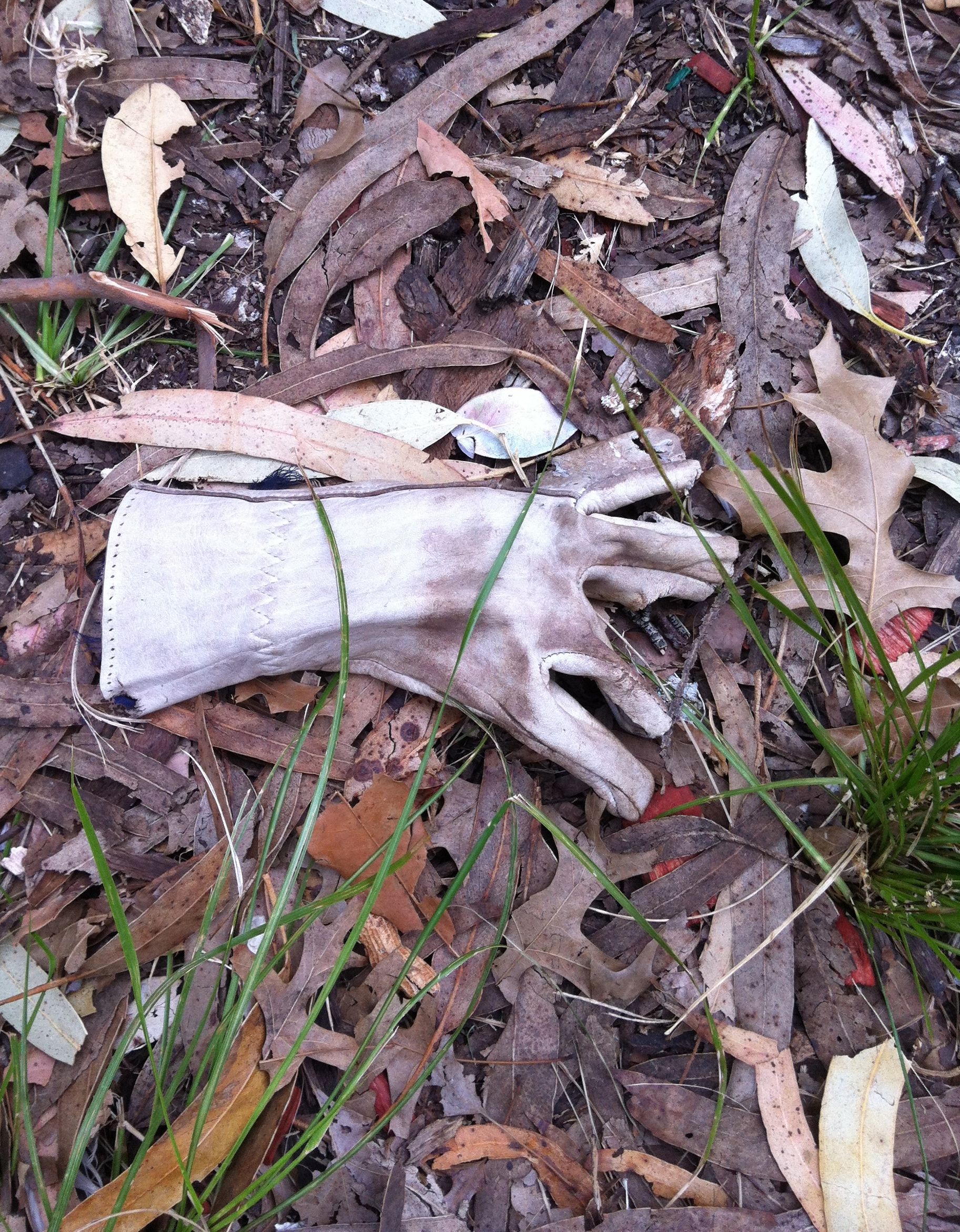
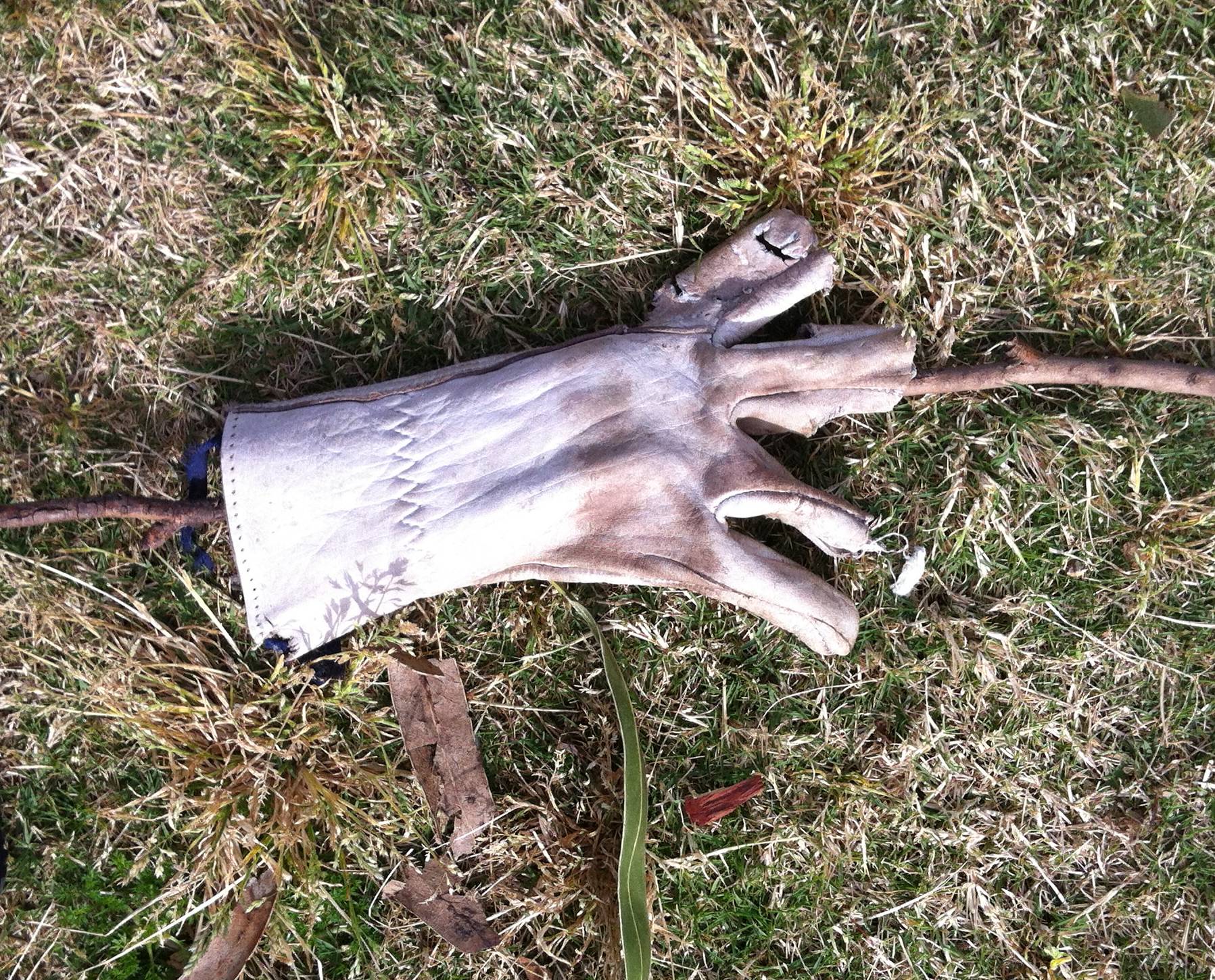
A while back I wrote a couple of posts about shoes abandoned or carefully posed in the streets near my place. Well, we’re moving on to other accessories.  Or rather, one accessory, which seems to be moving around Enmore Park when no one is watching. I’ve seen this glove a number of times, in a number of places, but only snapped it twice.

Here it is, pretending to be a leaf:

glove

And here, skewered:

glove2