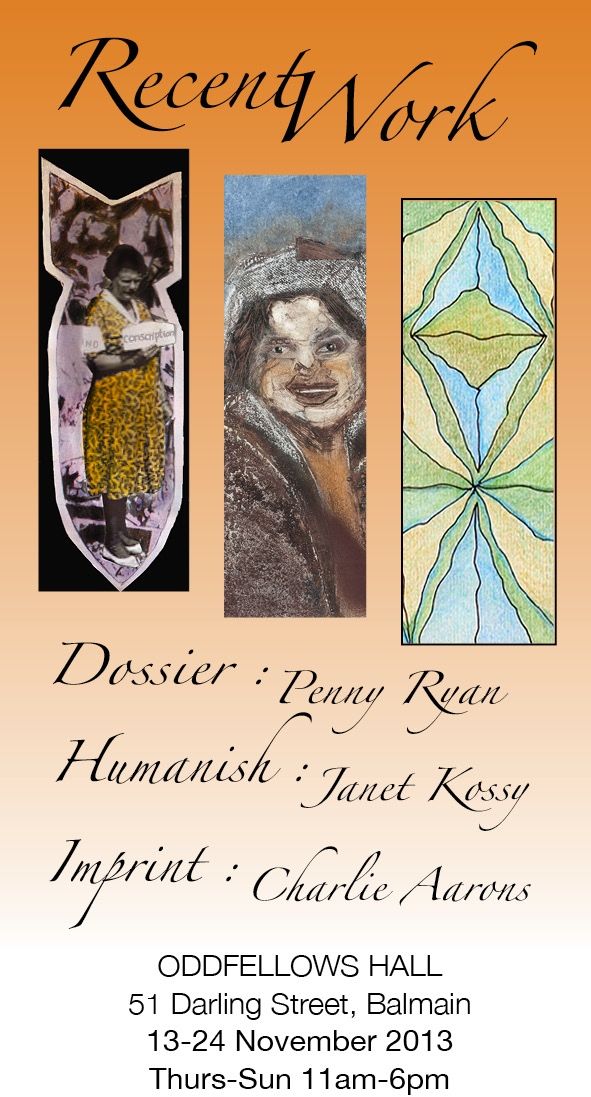
Come one, come all!

The Art Student has an event this Wednesday evening and you are warmly invited. I know, it’s not smart to invite the Internet to anything, but I keep a close watch on my stats, and in this case the part of the Internet living within visiting distance who will read this amounts to maybe 25 people. So come one, come all!

It’s a small exhibition of recent work by three friends. The Art Student is presenting a sequence of 14 small pieces inspired by her mother’s ASIO files. The opening is this Wednesday 13 November 6–8 pm at the Oddfellows Hall, 51 Darling Street, Balmain.

invite ARK


David Denholm’s Colonial Australians and 14 rhyming lines

David Denholm, The Colonial Australians (Penguin Books 1979)

ImageDavid Denholm (1924–1997) wrote fiction as David Forrest. One of the ‘living Australian authors’ profiled in John Hetherington’s 1962 collection, Forty-Two Faces, he is remembered mostly for two novels and a number of short stories. Under his own name, he had a second career as a historian, which, though productive in other ways, produced just this one book and a pamphlet on land use in New South Wales.

It’s a strange book, not – as the title might suggest – a survey of the population of the Australian colonies, but a series of enquiries into what Denholm describes as ‘odd trifles’ to see what general light they might shed on the those people. Many of the trifling questions are conveniently summarised in the Introduction:

How long would it have taken to reload a musket? What on earth possessed surveyors to divide up much of Australia with little regard for the shape of the land and its resources? Why does this brick wall not look like that brick wall? In a land of cheap horses, why did not everybody ride a horse? Why do some Presbyterian churches have steeples? Why is the Monaro in ‘Banjo’ Paterson’s ballads not the real Monaro? Why did some people stack their plates while others had them taken away one at a time?

He does indeed go on in great detail about how to load a musket, about three different bricklaying patterns, and about surveying practices, in each case using them as evidence for persuasive argument against received versions of our history. He also paints an idiosyncratic version of the kind of religion (ie, of Christianity) that dominated the first century and a half of settlement, what he calls determinism as opposed to free-will based orthodoxy – it’s idiosyncratic but rings true and has quite a bit of explanatory power when applied to the Pell and Jensen phenomena. He turns a bit of a blowtorch on romantic versions of ‘the bush’ and writes interestingly about what happened to the idea of a gentry – ‘an historically based manner in which power was projected upon society’ by a class of people possessed of wealth, education and leisure (hint: it was destroyed but lives on).

The chapter ‘Men Bearing Arms’ – about the ‘mutual impotence’ of Aboriginal Australians and their invaders, whose slow loading muskets were  far from making them invulnerable – is a revelation, especially in its discussion of the extent of ‘fraternisation and appeasement’ between the two populations, so that all too often brutal murders and massacres had an element of personal betrayal.

But it’s November, so I have to lapse into rhyme:

Sonnet 3: On reading David Denholm’s The Colonial Australians
How can we know what really happened
a week ago, two hundred years?
Vile things are misnamed on the map, and
victors’ tales besiege our ears.
Historians must play detective,
sniff ash trays, challenge the selective
versions, shift perspectives, ask
what hid behind the public mask.
We want to honour our ancestors:
with courage, ingenuity and toil
they named the land and turned the soil.
But there’s another truth that festers:
a brutal war of conquest here,
sword and musket, club and spear.

Sonnet 2: At the check-out

OK, I’m getting into the swing of 14 lines every couple of days. Here’s my second attempt for the month:

Sonnet 2: At the check-out
I know she has to smile and greet me.
I’ve seen the instructions on her till.
Still, rather that than have her beat me,
cheat me, treat me like a dill.
We meet each other almost daily,
greet each other almost gaily.
Who cares if warmth comes à la carte
from a Woolworths-managed heart?
I trailed along with Mummy shopping
in another world: ‘Hello,
Mr See Yick. How’s your toe?’
‘Oh Mrs Shaw, you’ve seen me hopping …’
Some days would not be nice, they knew,
but with some help they’d see them through.

Sonnet month again

It’s November, and once again, while all over the world people with stamina take on NaNoWriMo, I’m setting myself the modest goal of 14 sonnets in the month – LoSoRhyMo (Local Sonnet Rhyming Month). Actually, I’ve discovered that the 14-line form I’m enaoured of, the Onegin Stanza, isn’t a sonnet properly speaking, but I’ll keep the name for the project rather than opting for the even less euphonious LoSoOnStaMo. It’s my blog and words will mean whatever I want them to mean.

To kick off the month, here are some hasty lines about The Butler, Lee (‘Precious’) Daniels’ movie featuring Forest Whitaker (brilliant), Oprah Winfrey (also brilliant) and half a dozen big names in cameos (I especially liked Alan Rickman as Ronald Reagan):

Sonnet 1: A night at the movies
A tiny audience saw The Butler
screened at the Chauvel last night:
a history lesson – I’ve had subtler –
meant for us, as we are white.
Rape, murder, and a double lynching
in living memory, with no flinching
from those in power, and then the fights:
bombs, burning crosses – civil rights,
Panthers, afros, ‘Nam. The lazy
eye of Forest Whitaker, who serves
eight presidents deadpan, observes
with anguish. Though Miss Daisy
would have liked him, here’s the thing:
he wasn’t dissed by Doctor King.

Fry’s Falen’s Pushkin’s Onegin

Alexander Pushkin, Eugene Onegin (1833, translated by James E Falen 1990, narrated by Stephen Fry 2013, Digital October Publishing House)

1eoThis audio book is sheer delight. James E Falen’s verse is fluid, witty, full of charm. Stephen Fry’s reading is superb – unfolding the pleasures of the language with the same infectious relish he brings to his role of BBC game-show host.

Vladimir Nabokov said it was impossible to translate Eugene Onegin into verse that kept the rhyme scheme or the  ‘bloom’ of the original. I know about 3 words of Russian, so I’m in no position to argue, but I’m going to assume that Falen’s attempt approaches the impossible, and  that the poem I’ve just had read to me is essentially Pushkin’s. I now agree with the quasi-mother-in-law who told me in my 20s that reading Pushkin was one of life’s great joys.

I mainly listened to it while driving around the city, which means that for the first couple of hours of it I was negotiating traffic with a slack-jawed grin. Incredibly, the cheerful, witty urbanity of the first parts – where the death of a rich uncle, the ennui of endless Moscow balls, a dilettante’s reading habits, and the passion of a young man who today would be called an emerging poet are all subjects of light, ironic banter – gradually yields to a more serious tone. By the end, the sprightly ‘Onegin stanza’ – shorter lines than Shakespeare, lots of feminine rhymes – has proved suitable for telling of calamity, betrayal and despair. It’s a much smaller story than Anna Karenina, but I’ve got no doubt that Tolstoy knew it well and expected his readers to have read it, and I bet scholarly papers have been written about the relationship between the two works.

I’ve done a tiny bit of research about the translation: Stephen Saperstein Frug’s blog, Eugene Onegin in English Translation, quotes 10 versions of the first stanza, including the one from Charles H. Johnston’s 1977 translation, which inspired Vikram Seth to write The Golden Gate. I’m very glad to have met Onegin in James E Falen’s version, but I recommend Frug’s site if you’re planning to read the poem and shopping around among Englishings. (Nabokov’s version of the first stanza, which ostentatiously avoids trying to sound like verse, manages not to read like English either.)

What Maisie and the Book Group Knew

What Maisie Knew, Henry James (1897, this Kindle edition based on Echo Library Large Print Edition 2006)

1_wmkBefore the meeting: When I read Henry James at university (Portrait of a Lady in first year and What Maisie Knew some time later), quite a bit of it went right over my head. I loved the prose, but the worlds of his novels were a long way from the North Queensland pragmatism and Catholic piety that I had been brought up with. Perhaps now, more than forty years of secular urban life under my belt, I’d have more luck. After all, Scott McGehee and David Siegel’s movie adaptation just about tore my heart out a few weeks ago, and Kate Lilley’s poem ‘Maisily’ moved me simply by listing the adverbs from the book.

The Kindle edition gets right down to business – cover, title page, table of contents, and then, without so much as a chapter heading:

The litigation seemed interminable and had in fact been complicated; but by the decision on the appeal the judgement of the divorce-court was confirmed as to the assignment of the child. The father, who, though bespattered from head to foot, had made good his case, was, in pursuance of this triumph, appointed to keep her: it was not so much that the mother’s character had been more absolutely damaged as that the brilliancy of a lady’s complexion (and this lady’s, in court, was immensely remarked) might be more regarded as showing the spots.

We’re thrown right into the middle of a story, everything in plain sight, embedded in metaphor and sarcasm. This can’t be read fast, and once you know that by this stage of his life James dictated his novels, it can’t be read without the mental image of a portly gentleman pacing the room enjoying the sound of the sentences as they roll out from his mouth.

And it continues as it has begun: rich, sonorous, intricate sentences that tell a story of child neglect from the point of view of the child, but with no attempt to tell it as a child would: instead, we are asked to explore the great complexity of this little girl’s perceptions of the adult world and her strategies for dealing with it, in language that is at times as baffling to the reader as that world is to her.

I enjoyed the book, but I can’t pretend that I always understood what was going on in that adult world. Specifically, in the last movement Maisie – now well past the age of six that she remains in the movie – has to make a decision about her living arrangements in a context where the adults clearly share an understanding of the issues and believe incorrectly that Maisie does too. James seems to expect his readers to have the insider’s view as well. But times have changed, and the reference point of the culture have shifted so much that I at least could only follow the broadest outlines of what F R Leavis calls the ‘moral squalor’ of the adult world. The governess Mrs Wix, who is possibly meant to be a kind of moral centre of gravity (and who is not there in the movie) wins out in the end, and I think we’re meant to see this as a triumph of good over evil, but I completely couldn’t see why Maisie’s rejection of Mrs Beale, who has always defended and loved her, should be seen as a good thing (though who can tell when the air is so thick with irony?).

By telling the story from Maisie’s point of view, the novel throws into question the whole concept of moral squalor, if that refers primarily to sexual behaviour: what Maisie doesn’t get is all the sexual stuff, so being a kept man or a loose woman or a gold-digger or someone who pays for sex, as various characters appear to be, matters not at all, whereas loyalty, patience, kindness, generosity and their absence are what count.

F R Leavis thought very highly of this novel, which is probably why it was set for us to study at Sydney University in the 1970s. I don’t know that it’s a book I’ll be in a hurry to reread, though many of James’s sentences merit many re-readings.

After the meeting: Words like ‘loathing’ kept cropping in emails leading up to last night’s dinner. However, it was hard to feel loathing for anything much, as we sat outside eating barbecued chicken and sausages on a balmy, mosquito-free Sydney spring evening, as darkness brought an end to a day that had been predicted to be full of bushfire horror but had instead been one where the volunteer rural fire service could be justifiably proud of having averted disaster by strategic backburning the day before.

There were six of us. A couple had been travelling, and shared travellers’ tales. One had been living in Darwin and told spectacular yarns of Territory life. Some of us had been to the theatre and had stories to tell from there as well – one involving a smart phone that played Beatles tunes as background to the drama until an actor politely asked the blithely unaware owner of said phone to turn it off. It was a warm, convivial evening.

We did talk about the book, happily and with minimal rancour. Only one of us – me – had read the whole thing. Only one of the others said he planned to finish it. I may have been the only one who found the sentences fascinating rather than perversely complex. As we were going home, we clapped eyes on the paperback that one chap was holding, and several of us had difficulty reconciling the slimness of the paperback with the size of the book we felt we had read on our various electronic devices.

Ngurrumbang BIFF

The Brisbane International Film Festival unveiled its program today, and if you search for ‘Australian Shorts’ on the BIFF site you get a listing of all the movies shown in the two Australian Shorts sessions.  Ngurrumbang is in the second session, screening at 2 pm on Sunday 24 November.

biff

A bit of Baudelaire

As my November sonnet binge approaches, I apparently feel the need to limber up.

Among our dog Nessie’s amusing quirks is her terror of holes covered by grids. A couple of years ago, I was delighted when she sniffed warily at such a hole and had her terror justified when the darkness just beneath the grid turned out into a hissing cat. That gave rise to this:

She looks down
Wherever Nessie goes she takes her fear
of what might lie beneath the solid ground.
She doesn’t shrink from cliffs, she’ll gladly bound
down hillsides, but she comes all over queer
when asked to walk on grids that cover holes –
no matter if mere centimetres deep.
She turns to stone, responds to no controls
as one afraid of dreams recoils from sleep.

At times, off leash, ears pointing, she will dare,
tout pleine de vague horreur, and so so slow,
creep to the edge and, fascinated, stare
at unseen demons, the nothing-space below.

Today, green eyes stared back from an abyss,
and scared her silly with a black cat’s hiss.

A special prize if you noticed the references to Baudelaire’s poem Le Gouffre, itself referring back to Blaise Pascal’s existential terror. Now it’s not as if I’ve been abyss-obsessed myself, but I was thinking about Baudelaire’s poem recently and spent a couple of hours doing a version of it. My reading of the last line seems to be the opposite of everyone else’s, but maybe I’m the only one in step. Here it is:

The abyss
Pascal travelled with his own abyss.
Poor Blaise! all’s horror: deeds, desires, dreams,
and words! My nape too feels the screams
of bristles at the breath of Fear’s soft kiss.
Above, below, all round, on banks, in streams,
in silence, in great captivating space …
my night’s a wall for God’s hand to deface
with take-no-prisoners spray, where nightmare teems.

I fear my sleep, a door that opens wide
to formless horror on who knows what tide.
Infinity is every window’s view.

My heart, forever dizzy for a fall,
yearns for a void, for numbness over all.
Ah! Not to leave what’s solid, two plus two.

The sky today

Bushfires have been threatening, and worse than threatening, a number of rural communities in New South Wales. The sky over Sydney was grim, as the many photos posted on social media attested. Embers have been falling on the surf at Bondi and Narrabeen, and in our dog’s water bowl here in Marrickville. It’s only mid October.

If bush fires can start early, so can my sonnets.

Here in Sydney, mid October,
the sky is blanketed in smoke.
Springtime bush fires strike a sober
note – this climate change, no joke,
is promising a nasty summer.
It’s crap, says PM Abbott. Bummer!
Though left-wing Nature now attacks
he’ll still repeal the carbon tax.
A hundred homes and more are burning
but he has promises to keep
to Murdoch, Rinehart, Pell. The sleep
of Reason brings forth monsters. Turning
profits will decide our fate
unless … unless … it’s not too late

Re-reading Vikram Seth’s The Golden Gate

Vikram Seth, The Golden Gate (1986, Vintage International 1991)

I don’t do very much re-reading, at least not of whole books. This one was an ambush.

The copious notes in John Tranter’s Vagabond Press chapbook Ten Sonnets quote Wikipedia’s entry on the Onegin stanza, so called because Pushkin used it in his novel Eugene Onegin:

The work was mostly written in verses of iambic tetrameter with the rhyme scheme “aBaBccDDeFFeGG”, where the lowercase letters represent feminine endings (i.e., with an additional unstressed syllable) and the uppercase representing masculine ending (i.e. stressed on the final syllable).

That sent me looking for Vikram Seth’s novel in Onegin stanzas. Though it was this book that had launched my own excursion into sonnet land, and I had written and blogged quite a number of sonnets (for which, by the way, I don’t claim any great distinction) of what I thought was the Onegin variety, I had missed the crucial bit about the ‘feminine’ and ‘masculine’ endings (the quote marks are in deference to the Art Student’s objection to the gendered terminology). I went to see if Seth observed the aBaBccDD etc rhyme scheme, and indeed he did: each stanza has three feminine rhymes and four masculine, the feminine coming first in each of three configurations. That might sound awfully technical, but once you notice it you realise it accounts for the wonderful flow of the verse narrative – the feminine endings send the reader’s mind forward the way serifs in a typeface send the eye to the next letter, and the masculine endings have a kind of exclamatory effect, not necessarily stopping the flow but hitting a strong beat.

It’s a wonderfully seductive rhythm, and it had me in its grip again. I read whole slabs out loud to the Art Student as she was cooking dinner, and she who claims not to like poetry said, ‘It sounds as if he had a good time writing that.’

The narrative deals with relationships among a group of 20-somethings in San Francisco in 1980–81, with something of the feel of Armistead Maupin’s Tales of the City (written a decade earlier), but with significant differences. It’s the Reagan era: the threat of nuclear war forms a backdrop, which comes to the foreground in some heated arguments that threaten to destroy friendships, and at an anti-war rally where one of the speeches runs for close to 20 stanzas.  There’s a wonderful ill-tempered cat named Charlemagne, and some serio-comic conflict around religion and homosexuality (I don’t know how comic it was meant to be, but it made me laugh as well as rage). It’s not all froth and bubble by a long shot: there are birth and death, seasonal rhythms and harsh disruptions, silly spats and deeply wounding fights.

In one of the book’s few self-referential moments, Seth reflects on his chosen form, discusses both the use of feminine rhymes and the tetrameter (four beats to the line rather than the five beats used by Shakespeare). He then goes on:

Reader, enough of this apology;
But spare me if I think it best,
Before I tether my monology,
To take a stanza to suggest
You spend some unfilled day of leisure
By that original spring of pleasure:
Sweet-watered, fluent, clear, light, blithe
(This homage merely pays a tithe
Of what in joy and inspiration
It gave me once and does not cease
To give me) – Pushkin’s masterpiece
In Johnston’s luminous translation:
Eugene Onegin – like champagne
Its effervescence stirs my brain.

When I read The Golden Gate the first time I contemplated moving on to Les Murray’s verse novels, one of which is told in sonnets. I will read them one day, but they aren’t a natural successor to this novel. I have now downloaded an audio book of Eugene Onegin, in which Stephen Fry reads James E. Falen’s translation – not that of Sir Charles Johnston, which Vikram Seth so loved. It may be a while before I have ‘an unfilled day of leisure’ in which to listen to its 4 hours and 21 minutes, but I’m looking forward to it.