Sonnet 12: Australia, 27 November 2013

As we headed for bed, home form a social evening, I wailed that I had to get a sonnet written but the well was dry. The Art Student, never one to let someone just moan, told me to get in touch with my inner rage about recent news headlines. So I came up with this in fairly short order:

Sonnet 12: Australia, 27 November 2013
When they were in opposition
they said no, no, no, no. No
one expects the Inquisition,
Spanish or otherwise, and so
we didn’t dream that once empowered
they’d really drag us back to Howard
and beyond, ditch Gonski, try
to bluff and bully SBY,
sack scientists, be kind to rorters,
snub climate talks, give boats to thugs,
tweet racist tweets, treat us like mugs.
As trusting lambs are led to slaughters
we chose them. They appal, amaze
the world in barely eighty days.

Sonnet 11: How I got a new tool

If I remember correctly the French for ‘crash’ in the context of computers is naufrager, which is also the word used when a ship wrecks.

Sonnet 11: How I got a new toy tool
Some virtual reef sank my computer
as it steamed on through the night.
Its kernel panic wasn’t cute or
pretty, nor its owner’s fright.
But I’d backed up, so very little
work was lost – two jots, one tittle.
I took it to a man in red,
who said the audio card was dead.
A woman in red T-shirt, Uppy,
charming smile, discreet tattoos,
helped dissipate my first-world blues.
Though I’m too old to be a yuppy
my heart leapt up when I did hold
a shiny new Mac, bought and sold.

The computer that died has featured in this blog at least once before. It survived four years after the disaster that befell it shortly before this photo was taken, and was already of a certain age then, so I guess it’s had a good innings.

Sonnet 10: Suburban travelling companions

Perhaps a snippet of narrative, which is after all what this form of sonnet was invented for:

Sonnet 10: Suburban travelling companions
Corinda, Sherwood, Graceville, Chelmer:
Tattooed boys with half shaved heads
and desperado airs that tell more
than they know use seats as beds.
One sleeps. ‘I hope he bought three tickets,’
tuts a greybeard, ‘makes me sick.’ It’s
soon Taringa, then Toowong.
Two boys share buds. A chinkling song
confirms the greybeard’s irriration.
Unplugged, they chat about the dole
and meetings to observe parole.
The sleeper wakes for Central Station,
which comes like dawn to end his night.
There tattoos, beard, and I alight.

Sonnet 9: South Bank

Enough with trying to squeeze a thought into 14 lines of roughly 8 syllables each. Today, an impressionistic moment:

Sonnet 9: South Bank
Thursday morning in the city
at the Ice-Cream-Brand-Name Beach
and Other-Brand-Name Fountains, pretty
children with one adult each –
mothers, aunts, great aunts, grandmothers
a dad or two – and sundry others
deploy the sunny Brisbane day
to better ends than making hay.
A squad of teenage girls come jogging,
uniformed, with in-ear buds.
A skateboard ollies, grinds and scuds.
I sit and eavesdrop, rhyming, blogging:
‘Mummy, sunscreen!’ ‘Splash me!’ ‘What?’
‘Oh my god, how can you not?’

Sonnet 8: A prayer

I’m away from my computer and trying to catch up on my sonnet quota on the iPad far from home. The first eight lines of this got published prematurely some time yesterday. Here’s the whole thing, and the other six lines took less than 24 hours.

Sonnet 8: Prayer of a child of capitalism
Dear Absent Lord, Our Nobodaddy,
Dear Particle, or Gland, or Gene,
Who speak through prophet, saint and maddy
and have done since the Pleistocene,
accept my humble genuflection
in awe of natural selection.
Give us this day our daily bread
and roses, birdsong, sky’s vast spread.
Forgive – But I’ve no heart to ask it.
We’ve made a quarry of the Earth
and of its peoples. What’s it worth
when hell-bound in a plastic basket
to say we’re sorry? Don’t respond.
We’ve work to do. No magic wand.

Sonnet 8: A prayer

I’m away from my computer and trying to catch up on my sonnet quota on the iPad far from home. The first eight lines of this got published prematurely some time yesterday. Here’s the whole thing, and the other six lines took less than 24 hours.

Sonnet 8: Prayer of a child of capitalism
Dear Absent Lord, Our Nobodaddy,
Dear Particle, or Gland, or Gene,
Who speak through prophet, saint and maddy
and have done since the Pleistocene,
accept my humble genuflection
in awe of natural selection.
Give us this day our daily bread
and roses, birdsong, sky’s vast spread.
Forgive – But I’ve no heart to ask it.
We’ve made a quarry of the Earth
and of its peoples. What’s it worth
when hell-bound in a plastic basket
to say we’re sorry? Don’t respond.
We’ve work to do. No magic wand.

Sonnet 7: Demo

For those who didn’t receive any group emails, recorded phone messages, leaflets, facebook promptings or reminders from actual friends: yesterday was National Day of Climate Action.

Sonnet 7: Demo
Ten thousand had, today in Sydney,
enough sense to stand in the rain
and twirl umbrellas, not stay hid. We
rallied, one link in a chain
of rallies all around Australia
crying out against the failure
of governments who play the role
of sycophants to Old King Coal.
Ten thousand stood with rain god Hughie,
sixty thousand nationwide
who’ll vote, divest, protest, decide
to use renewables, get more cluey.
There’s climate change, heat’s on the rise.
It’s time to change, to organise.

Sonnet 6: Friday night TV

November is disappearing fast and the sonnets are coming slow, so a night on the couch in front of the box can’t go to waste.

Sonnet 6: Friday night on the box
… Auction Room with Scottish Gordon
Juanita tells of child porn bust
and crooked Christmas Island warden,
and Tony still expecting trust.
After Sinabung’s eruption
Quentin shouts about corruption.
Stephen and his boys play bright.
Jack and Phryne put things right.
Serangoon Road has been too clunky
so we watch week-old New Tricks
for Sandra’s swan song – what a fix!
Ten-thirty – I’m no TV junky.
iView Luther? Nah! Instead
it’s time to read a book in bed.

Sonnet 5: An exhibition

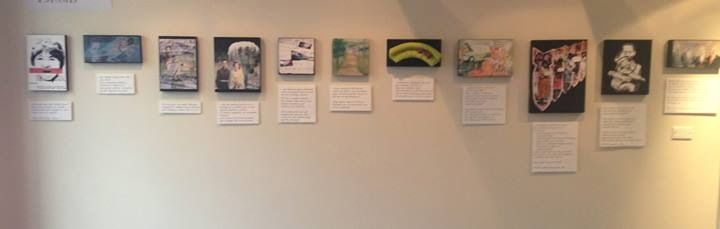
The opening on Wednesday night was fun, and the exhibition will be open for business at 51 Darling Street Balmain until 24 November, 11 to 6 Thursday to Sunday.

For those who came in late, the exhibition features work by three emerging older women artists: a narrative series by Penny Ryan about her mother and ASIO; exuberant work – mainly prints – by Janet Kossy that makes me think of Weimar art, only joyful; and delicate drawings by Charlie Aarons that reference Morandi‘s still lifes and traditional Kiribati designs.

Some men grow alarmingly sleazy moustaches in November. I do rhyme:

Sonnet 5: An exhibition
John Berger said, ‘Original paintings
are still and silent in a sense
that information [to explain things]
never is.’ Here’s my five cents:
that’s also true of prints and drawings,
whose lines are movement lashed to moorings.
Now frozen, mute, hung on the wall
of Darling Street’s Oddfellows Hall
are rage, desire, despair, compassion,
a mother’s joy, a daughter’s pain,
a moment freed from rat-race strain,
three days to hang, lifetimes to fashion.
We stroll around, we come, we go:
it’s just a little pop-up show.

IMG_0143

Photo by Penny Ryan

Sonnet 4: On Being Kept Awake by David Denholm

I’m falling behind on my sonnet quota – partly because I’ve had other things preoccupying me, but also because every time I sit down to write a paragraph from the David Denholm book comes into my head insisting that it be the subject. I’ll add the paragraph below, but first here is my Onegin stanza response to it (with a little input from Gitta Sereny’s The German Trauma, about which I expect to blog in good time.).

Sonnet 4: On being kept awake by David Denholm
Before we sang our soil as golden
before the settlers’ toil made wealth
long before the FJ Holden
this land was taken, not by stealth,
but violence and then watchful waiting,
armed and calm, anticipating,
one with musket, one with spear,
each the other’s direst fear.
We can’t claim Bach and not own Hitler,
a German lawyer said postwar:
we’re made of all that’s gone before.
The death toll here may have been littler
(I’ll write this, though my rhyme is weak)
If Anzac’s us, so’s Myall Creek.

From David Denholm, The Colonial Australians (Penguin 1979) page 40:

… the normal condition of inland life was an armed, watchful, wary, nervous calm. White and black spent months, even years simply watching one another, waiting for someone like Vincent James Dowling on the Paroo in Queensland in 1861 to drink at a lonely waterhole without first reconnoitring the vicinity, or like Paddy Finucane in 1853 to leave his musket in the hut while attending to a sick sheep, or like the Pinjarup in Western Australia in 1834 to camp the tribe down at night on a site familiar to white men. The victim had to deliver himself up. That is the whole point of the horror.