Jordie Albiston’s Book of Ethel

Jordie Albiston, The Book of Ethel (Puncher & Wattmann Poetry 2013)
1boI bought my secondhand copy of this small miracle of a book in Sappho’s, lovingly inscribed by the author to a couple of evidently ungrateful friends. Well, Jordie, it’s my copy now and I’m definitely keeping it.

The Ethel of the title was the poet’s great-grandmother. Born in Cornwall in the 1870s, she emigrated to Australia as a child, married a minister, raised six children, and died in the 1940s. That broad outline of her life emerges from these poems, though the story is not told in a straightforward narrative. This isn’t a verse novel. It’s a series of 60 short poems, each capturing a moment of the life, with little if any narrative flow from one to the next. A note up the back tells us who Ethel was, and leaves us to surmise that Albiston has drawn on archival sources – letters and diaries, perhaps, and a small book mentioned in passing, Parsonage Peeps. Google confirms that the book really existed, published in the 1930s, and I’d be astonished to learn that other writings by Ethel aren’t used, sometimes verbatim.

This found material is integrated into extraordinarily lively poetry, all in Ethel’s voice and held in a tight form. I didn’t pay a lot of attention to the form to start with. I just went along for the ride with Ethel, aware that the text isn’t generally structured according to ordinary prose conventions, and is peppered with eccentric exclamation marks, italics and spaces. I don’t mean that the poems are obscure or annoyingly mannered; on the contrary, while the precise meaning of a phrase may not always be obvious, the sense of a living, complex mind in action is strong and very attractive. But perhaps inevitably somewhere along the line I paused to figure out what’s going on.

Anyhow, here’s the first poem (the word in bold here is in italics in the original – I can’t make WordPress give me non-italics in a quote):

so Life!__we meet once more__you
& I__in concert__concord
happy agreement to do
until done__my act__your stage
make__lie in it__this! my bit-
part__play__World__with me aboard
a Speck!__then__gigantic

It’s a great opening that sets the reader’s mind racing in a number of directions at once. Who is speaking? What is the theatrical imagery doing? Is there an echo of ‘You’ve made your bed, now lie in it’ in line 5, and if so what does it mean? And how about that fabulous change of perspective in the last line?

But what is going on in the poem’s form? Are the line breaks arbitrary? Are those rhymes incidental? Is the punctuation just eccentric, or hip in some poetic way that’s obscure to unsavvy readers? Such questions multiply, and intensify, as you get further into the book.

(A word of warning: sensible readers of this blog might want to skip the next bit as it’s all poetry-geeky without being all that poetry-educated. It may be that the form here is quite common, not invented by Jordie Albiston as I imagine.)

It turns out that every poem in the book uses the same stanza form as the one quoted above, though the number of stanzas varies – most poems have just one, but there’s one with four and a number with two or three. Each stanza has 7 lines, of which the first and third lines rhyme, and the second and sixth – if you allow ‘rhyme’ to include such pairings as kindly/Queenie or Lizzie/tiny. More significantly, though, each line has 7 syllables, with none of the regular patterning based on emphasis that is usual in English verse. It’s what Wikipedia calls syllabic verse. There may be other rules – certainly there’s always a lot of internal rhyme, alliteration and so on. But the point is that every word in the book is held in a tight, mathematically dictated structure.

The form, the structuring principle, doesn’t give any indication of how the poem is to be spoken – yet from that opening exclamation this is verse that cries out to be heard as well as seen. So the whole book is animated by a tension between Ethel who is speaking to us and the tight restrictions of the form in which she is allowed to speak. It may be stretching it a bit, but it feels to me as an enactment of the way Ethel could flourish as a human being within the extraordinary limitations placed on her by the society of her time.

The result is just wonderful, and I am in total awe of Jordie Albiston’s ability to pull it off.

(End of nerdy bit.)

If you’re interested in reading a response to the book from someone much less ignorant than I am, I recommend the review by A J Carruthers in Rabbit No 10.

awwbadge_2013This is another title in my Australian Women Writers Challenge for 2013.
Our movie at Flickerfest

Flickerfest, the festival of short films that is one of Sydney’s cultural institutions, is on again at the Bondi Pavilion in the middle of next month. I confess to having appreciated it from afar until now, but this year I plan to be there. My elder son, Alex Ryan, sometimes known in these pages as the Filmmaker, has not one but two films screening.

FlickerClips, a program of music videos screening at 4.30 on Saturday 18 January, includes his video of the Cairos’ ‘Obsession‘. Given that the competition includes Nash Edgerton’s clip for Dylan’s ‘Duquesne Whistle’ we’re pretty chuffed.

The festival includes seven programs of Australian shorts. Ngurrumbang which Alex directed from a script written by him and me, is screening in Best of Australian 7 at 4.30 on Saturday 18 January.

You can buy tickets at the links.

Two Launches (with pic added later)

I’ve been sick with a cold since last Monday, and going stir crazy. Perhaps unwisely, I’ve struggled out of the house two nights this week to go to book launches.

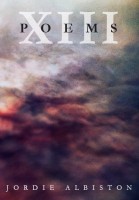
rabbit10The first, on Monday night, 1XIII-Poemswas a double launch at Gleebooks – of the tenth issue of Rabbit, a Melbourne-based ‘quarterly journal of non-fiction poetry’, and XIII Poems by Jordie Albiston, the first in a series of booklets to be published by the journal. Both books are beautiful to look at and to hold, and I’m looking forward to reading the copies I bought on the night. Among other tempting morsels, the Rabbit offers poems by Julie Chevalier, Jordie Albiston, B R Dionysus, Lachlan Brown (to name the poets whose work I know), photographs, an essay, an interview and reviews, including one by A J Carruthers of two books I’ve loved, Jordie Albiston’s Book of Ethel (blog post coming soon) and Pam Brown’s Home by Dark (blog post here). And I’m fast becoming a Jordie Albiston fan, so I’m looking forward to reading what she calls orphan poems.

There were 17 people in the upstairs room at Gleebooks for the launch, of whom 8 spoke or read, all interestingly, and one or two others were part of the team who had flown up from Melbourne for the occasion. Jessica Wilkinson, Rabbit‘s founding Editor-in-Chief, graciously described it as an intimate affair, and urged us to take some grapes or cheese home in our pockets since the modest catering was clearly far in excess to requirements.

Whatever the cause for the poor turn-out, the launch was convivial, with plenty of humour about poets becoming members of the Warren, etc, and much joy in language used with precision and passion. I was glad I’d struggled up from my sickbed to put a bum on a seat and at least half a mind into the room.

As a segue, I’ll mention that at least one of the speakers mentioned their students, and one poet explained that she wasn’t reading her poem from the Rabbit because it was too much a ‘page poem’.

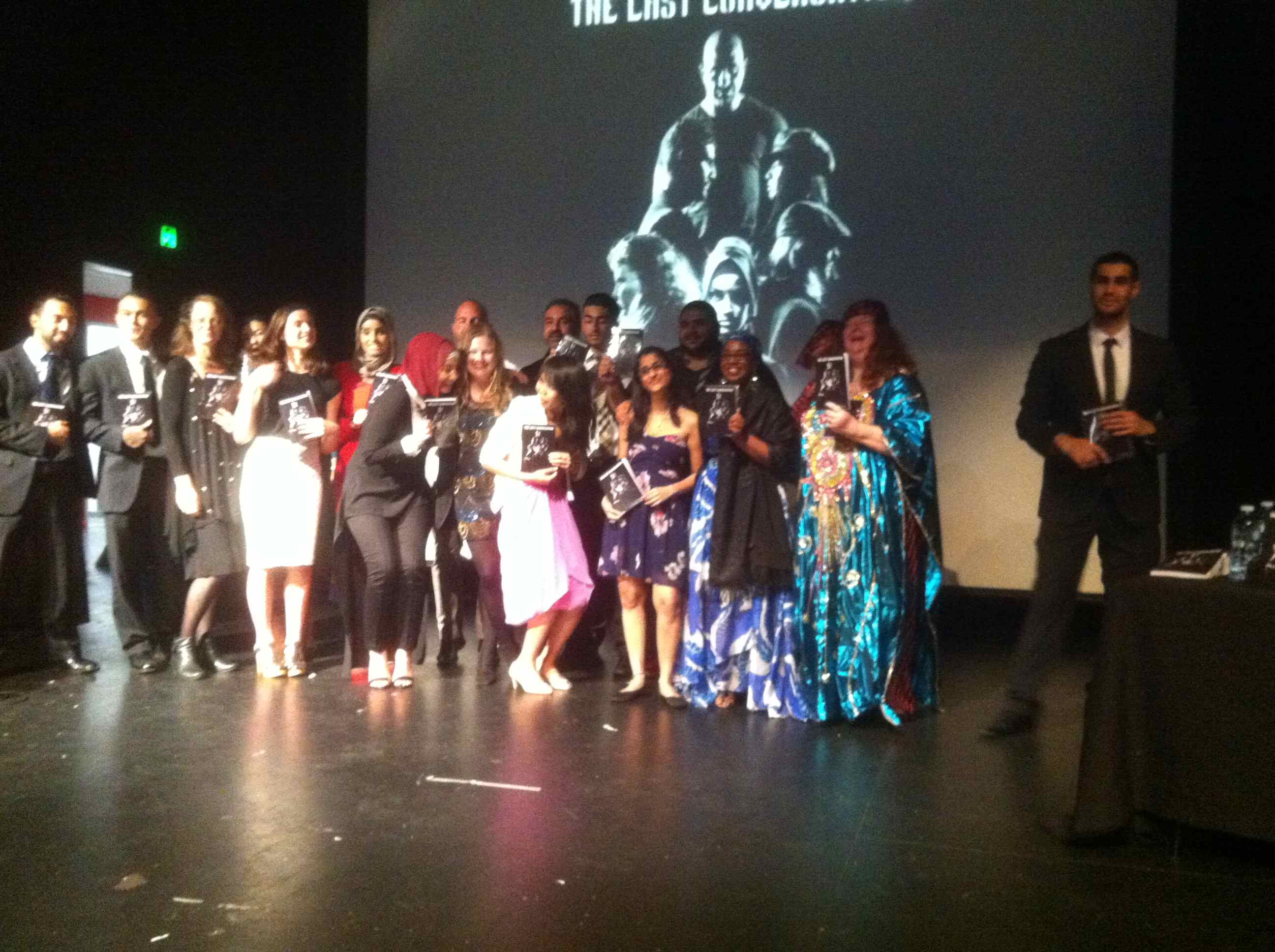
1lcThe next night’s launch was a completely different affair. The Last Conversation is an anthology of poems that have been read at the Bankstown Poetry Slam – that is, a collection of spoken word pieces attempting the transition to page poems under the guidance of slam co-founder and anthology editor Ahmad Al Rady.

The monthly Bankstown Poetry Slam has grown in the year of its existence into the biggest slam in Australia. I’ve never managed to get there, and if last night’s event is any indication of the nature of the experience, I’m missing out on something excellent. Ahmad Al Rady and his co-founder Sara Mansour were fabulous MCs – charming, witty, self deprecating and lavish in their appreciation of others. As many as 10 poets performed: a militant hymn to Gandhi and Mandela (timely, though obviously the poem was first performed when Mandela was still alive); cries from the heart from young men against violence against women; a disturbing piece about cutting into flesh after which the poet reassured us that she was not a serial killer or self-harmer but a surgeon; a passionate piece about the detention of asylum seekers; two sisters mining the rich field of sibling rivalry and sibling support.

The theatre at Bankstown Arts Centre was full to capacity,mainly with young people dressed in their best, as if for graduation. The audience whooped, cheered and (during the readings) clicked. It was a huge, enthusiastic celebration not just of the slam and each other, it seemed to me, but of what can happen when language is unleashed. At the start of the evening, Sara Mansour described how the Bankstown slam had started. It was laziness. She and Ahmad were tired of driving all the way into the city for poetry slams. Bankstown needs its own slam, they thought, and hunted around until Tim Carroll, the generous and welcoming CEO of BYDS (Bankstown Youth Development Services) gave them a home. At the end of their first year, she said, she realises they were wrong on two fronts: running a slam in Bankstown was a lot more work than driving into the city once a month; and Bankstown didn’t need a poetry slam – poetry needed Bankstown.

(By way of full disclosure: I played a small consultative role in the editing of the anthology.)

Added later: This snap I took with my phone at the end of the evening shows something of the mood. These are the poets who read plus some others who are in the book.

last conversation

Gitta Sereny’s German Trauma

Gitta Sereny, The German Trauma (Allen Lane 2000)

1gtGitta Sereny (1921–2012) was one of the great non-fiction writers of the 20th century. Holocaust denier David Irving described her as a shrivelled Nazi hunter, but though she may well have worn the insult as a badge of honour it wasn’t accurate. She said of herself: ‘I am interested above all in how individual human beings succumb to, or resist, evil.’ In Albert Speer: His Battle with Truth (1995), and Cries Unheard: The Story of Mary Bell (1998) she digs with empathy and rigour into the minds of one of Hitler’s closest henchmen and a child murderer respectively, and sheds light on very dark places.

This book, retitled optimistically for the US market as The Healing Wound, was her last. It’s a collection of essays and newspaper pieces spanning 30 years, revised and with new interstitial pieces so that something of a coherent narrative emerges, beginning with the Austrian-born Sereny’s childhood and adolescent experience of Nazism (she accidentally attended a Nuremberg rally as an 11 year old schoolgirl and was enraptured; at 15 she shouted at an SS officer who was humiliating some Jews in Vienna soon after the Anschluss), and tracing her engagement with the meaning and legacies of that time up to the turn of the century.

It’s not pretty. She takes us with her just after World War Two on the extraordinarily distressing task of tracking down East European children stolen from their parents years before, and abetting their being torn from home for a second time – she was in the employ of the UNRRA, the United Nations Relief and Rehabilitation Administration, where she might have rubbed shoulders with Edith Campbell Berry if the latter hadn’t been a figment of Frank Moorhouse’s imagination. We encounter Franz Stangl, who was commandant of the Treblinka extermination camp (I haven’t read Sereny’s 1974 book, Into That Darkness, which expanded the Daily Telegraph article included here, though I may one day have the stomach for it) and Albert Speer (in an essay that doesn’t add a lot to her magnificent book, but is well worth reading). We are introduced to children of Nazis who find strength in each other to face the horrors perpetrated by their parents. We follow Sereny’s dealings with a number of odd individuals who are dedicated collectors of Nazi documents and memorabilia. We gain some understanding of the US’s dubious dealings over decades with the question of justice for Nazi criminals. We meet an elderly woman who was one of Hitler’s secretaries, to whom he was always kind and thoughtful.

And through it all Gitta Sereny’s gaze doesn’t flinch. The book is saved from being a catalogue of horrors by the pervasive sense that she is driven by a need to understand. Perhaps the most impressive moment in the book is her response to David Irving’s book claiming that Hitler knew nothing of the ‘final solution’: rather than dismissing it out of hand as incompatible with her own understanding, she was intrigued, and began her fact-checking exercise, which was to turn into a devastatibg debunking, almost hoping Irving was right.

I learned a lot from this book. The Jewish Holocaust was a towering piece of evil, a calculated attempt to kill a whole people that succeeded in killing a full third of them – something way beyond genocide. But the Nazi murderousness wasn’t restricted to Jews. They killed something like 15 million people – homosexual men and women, political opponents, Romany people, eastern Europeans, people with disabilities – not as war crimes but as murders committed under the shadow of war, some with industrial efficiency in the extermination camps, some a bullet in the back of one head at a time, some with hideous callousness and mind-boggling disrespect for the dead. The US’s ‘denazification’ barely scratched the surface, leaving the German courts to prosecute Nazi crimes for at least 30 more years. While most Germans tried to forget and move on with their lives, Sereny says, a small elite made up of writers, artists and lawyers pursued the incredibly difficult task of coming to terms with what was generally known as ‘the recent past’ until well into the 1980s. Next time I hear an Australian shock jock or rabid columnist condemning ‘inner city elites’ or a combatant in our renewing history wars use. Dismissive phrase such as ‘black armband history’, I’ll remember Sereny and gird my loins for battle.

Linda Jaivin’s Found in Translation

Linda Jaivin, Found in Translation: In praise of a plural world (Quarterly Essay N° 52)

QE52Every now and then the Quarterly Essay series leaves aside the world of party politics and the headlines. The last time it did that was in N°41, David Malouf’s The Happy Life. In this one, Linda Jaivin, professional translator from Chinese to English, entertains, informs and advocates on a number of fronts, all to do with her profession, which is also clearly a major passion.

I’ve been interested to the point of fascination in reading about translation ever since Brother Gerard, my high school Latin teacher, explained that when he said my unseen exercise was a very good attempt he was offering high praise, because all one could ever do was attempt to translate, the thing itself being impossible. And I remember how thrilling it was in first year university when our lecturer spent a good ten minutes exploring the nuances of a single word (it was ‘serratum’) in a passage of Virgil. This essay feeds that fascination beautifully, with a wealth of personal anecdotes and snippets from the public record that range from hilarious to frankly chilling. It also has an urgent, cogent point to make about the importance of learning languages other than English as a significant and necessary counter to domination of politically weaker cultures by the stronger.

Having recently re-read Vikram Seth’s The Golden Gate and been sent back by it to a translation of Pushkin’s Eugene Onegin, and of course inspired to my own dabbling with the Onegin stanza, I loved reading about a chain of creations and translations involving the Seth novel:

Stirred by Seth’s brilliant homage, the Israeli writer Maya Arad read Pushkin in the original Russian and then wrote her own verse novel in Hebrew in 2003, translated into English by Adriana Jacobs as Another Place, Another City. … David Bellos marvels at how ‘the very diluted version of the Onegin stanza in Adriana Jacob’s translation of Maya Arad’s imitation of Vikram Seth’s imitation of Charles Johnson’s verse translation of Pushkin resurrects something of the lightness and joy of Onegin’s youth.’ Babel can never be recovered; it never existed. Yet translation allows the construction of great towers, in which each brick may be laid by someone speaking a different language but sharing a common vision.

And up the back is an excellent selection of correspondence on QE51, David Marr’s The Prince, which dealt with Cardinal George Pell’s response to clerical child abuse. I particularly appreciated the responses from four Catholics: Geraldine Doogue, Michael Cooney, Frank Bongiorno and Paul Collins.

awwbadge_2013This is another title in my Australian Women Writers Challenge for 2013.
Francis vs the Neocons

Just in case you haven’t seen it already, here are some fabulous bits from the new pope’s recent exhortation Evangelii Gaudium (full text here):

. . .  some people continue to defend trickle-down theories which assume  that economic growth, encouraged by a free market, will inevitably succeed in bringing about greater justice and inclusiveness in the world. This opinion, which has never been confirmed by the facts, expresses a crude and naïve trust in the goodness of those wielding economic power and in the sacralised workings of the prevailing economic system. Meanwhile, the excluded are still waiting. To sustain a lifestyle which excludes others, or to sustain enthusiasm for that selfish ideal, a globalization of indifference has developed. Almost without being aware of it, we end up being incapable of feeling compassion at the outcry of the poor, weeping for other people’s pain, and feeling a need to help them, as though all this were someone else’s responsibility and not our own. The culture of prosperity deadens us; we are thrilled if the market offers us something new to purchase. In the meantime all those lives stunted for lack of opportunity seem a mere spectacle; they fail to move us.

No to the new idolatry of money

One cause of this situation is found in our relationship with money,  since we calmly accept its dominion over ourselves and our societies. The current financial crisis can make us overlook the fact that it originated in a profound human crisis: the denial of the primacy of the human person! We have created new idols. The worship of the ancient golden calf (cf. Exodus 32:1-35) has returned in a new and ruthless guise in the idolatry of money and the dictatorship of an impersonal economy lacking a truly human purpose. The worldwide crisis affecting finance and the economy lays bare their imbalances and, above all, their lack of real concern for human beings; man is reduced to one of his needs alone: consumption.

While the earnings of a minority are growing exponentially, so too is  the gap separating the majority from the prosperity enjoyed by those happy few. This imbalance is the result of ideologies which defend the absolute autonomy of the marketplace and financial speculation. Consequently, they reject the right of states, charged with vigilance for the common  good, to exercise any form of control. A new tyranny is thus born, invisible and often virtual, which unilaterally and relentlessly imposes its own laws and rules. Debt and the accumulation of interest also make it difficult for countries to realize the potential of their  own economies and keep citizens from enjoying their real purchasing power. To all this we can add widespread corruption and self-serving  tax evasion, which have taken on worldwide dimensions. The thirst for power and possessions knows no limits. In this system, which tends to devour everything which stands in the way of increased profits, whatever is fragile, like the environment, is defenceless before the interests of a deified market, which become  the only rule.

No to a financial system which rules rather than serves.

Does this man worship the same God as our Prime Minister who with each passing day reveals that he has steeled his heart against yet another sector of humanity, and the environment, ‘defenceless before the interests of a deified market’.

Will Coles

Will Coles’s works are probably seen and enjoyed by more people on a daily basis than those of any other sculptor. It’s not that crowds line up to see them, although he has been exhibited in galleries, but you might happen to look down while waiting for traffic lights or standing at a bus stop, and there will be a donut baring its teeth at you, or a squashed softdrink can inscribed with the word ‘Eternity’ in Arthur Stace script, or a mobile phone labelled ‘Hate’.

If you’re not familiar with his work, have a look at Mr Will on Flickr, and/or visit his web site. What I’ve been noticing is the way his work has been defaced – in Marrickville, Enmore, Newtown and as far afield as Surry Hills. In the video interview from Virtual Press Office below, he talks about this as part of the game, but sometimes it creates interesting new effects. The main damage to his work seems to come from would-be collectors and other street artists (or would-be artists). Could this be saying something more general about art in this society?

IMG_0819

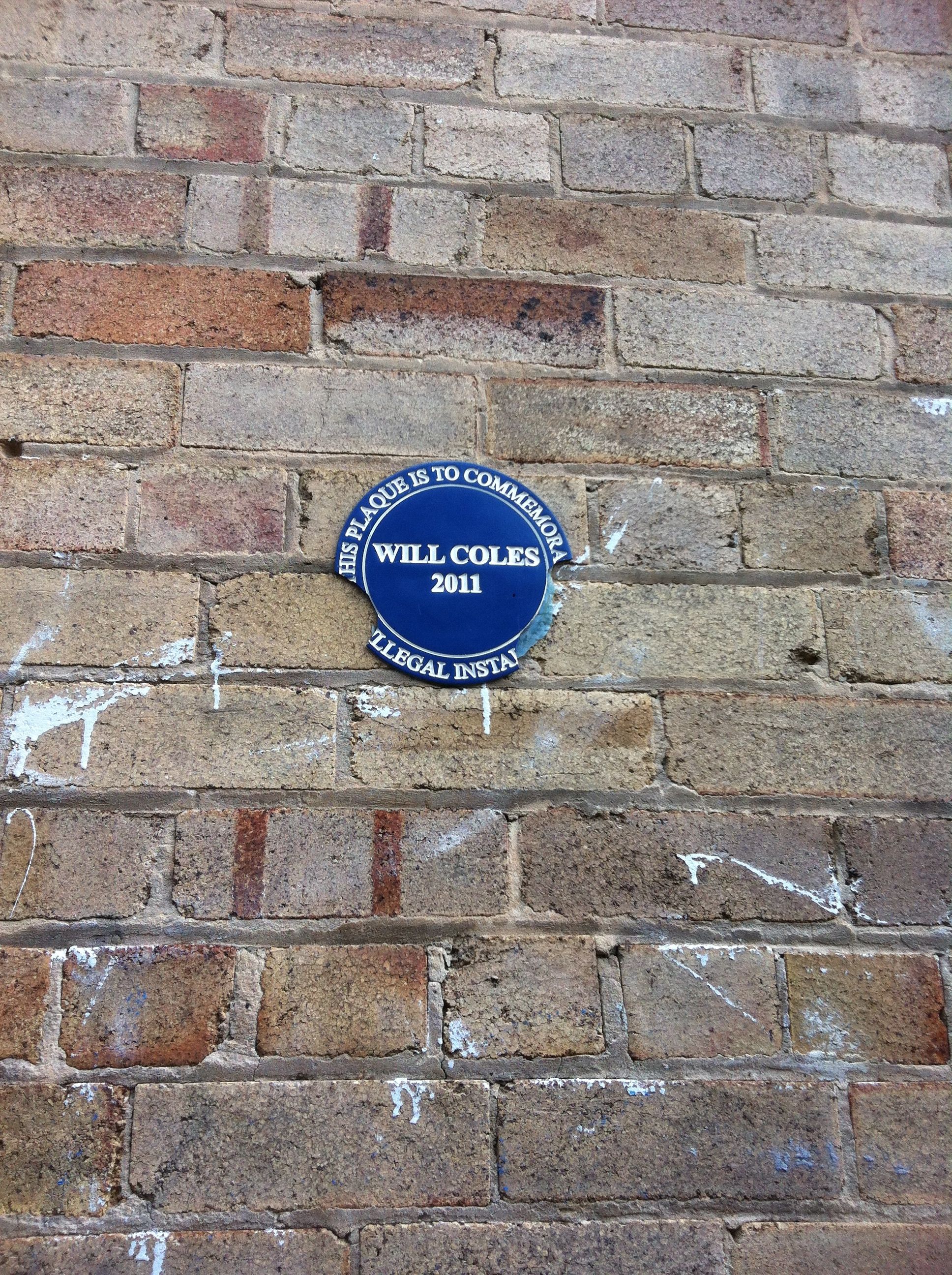
Street Plaque near the Brett Whiteley Studio in Surry Hills. An image of the intact work is here.

IMG_0823

An undefaced Sweet Tooth in the back streets of Marrickville.

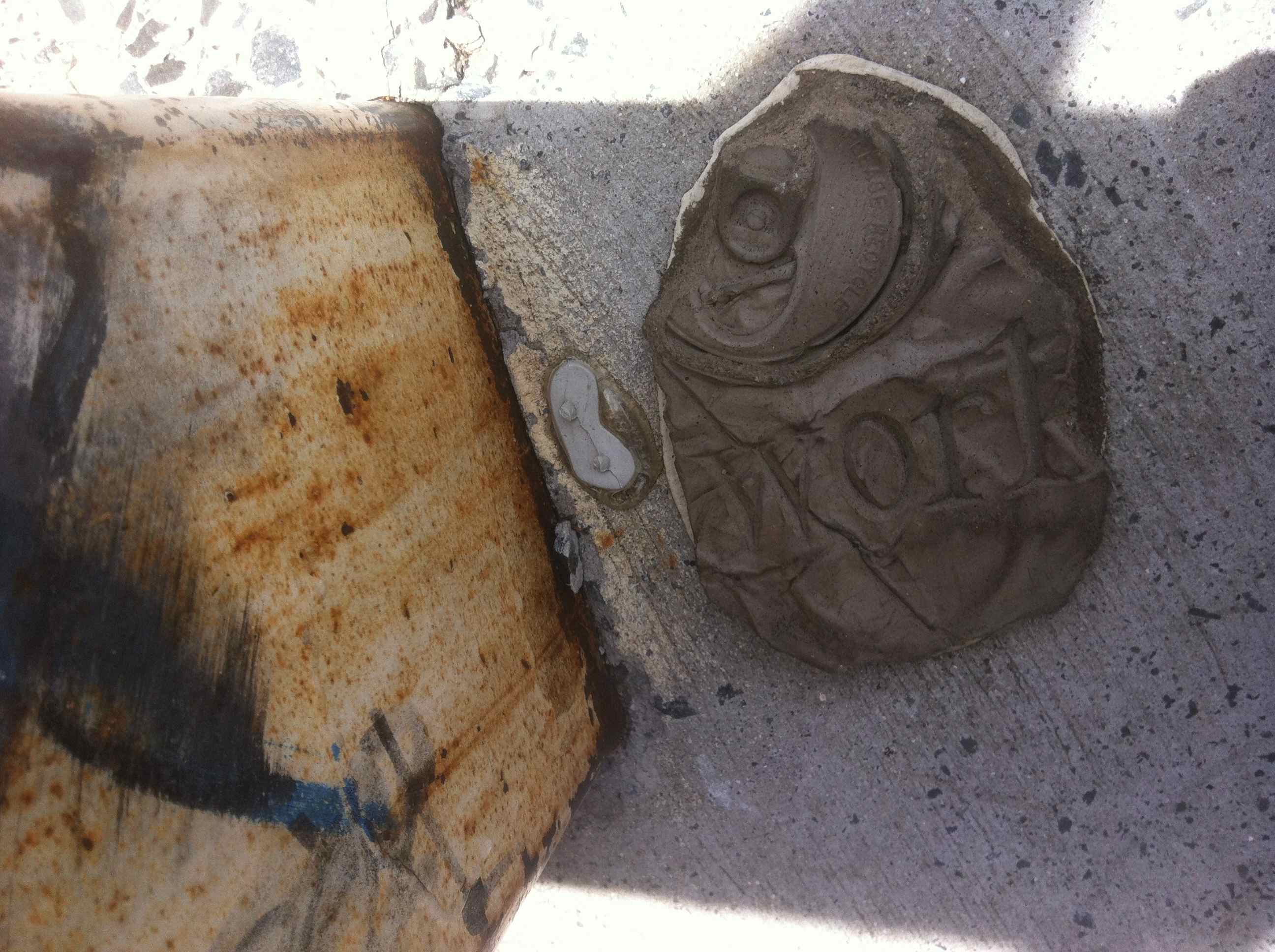
IMG_0846 - Version 2

Man-Made at a bus stop in Enmore Road. A would-be collector was defeated by the glue and left us with a relic. There’s a photo of an unmutilated piece here.

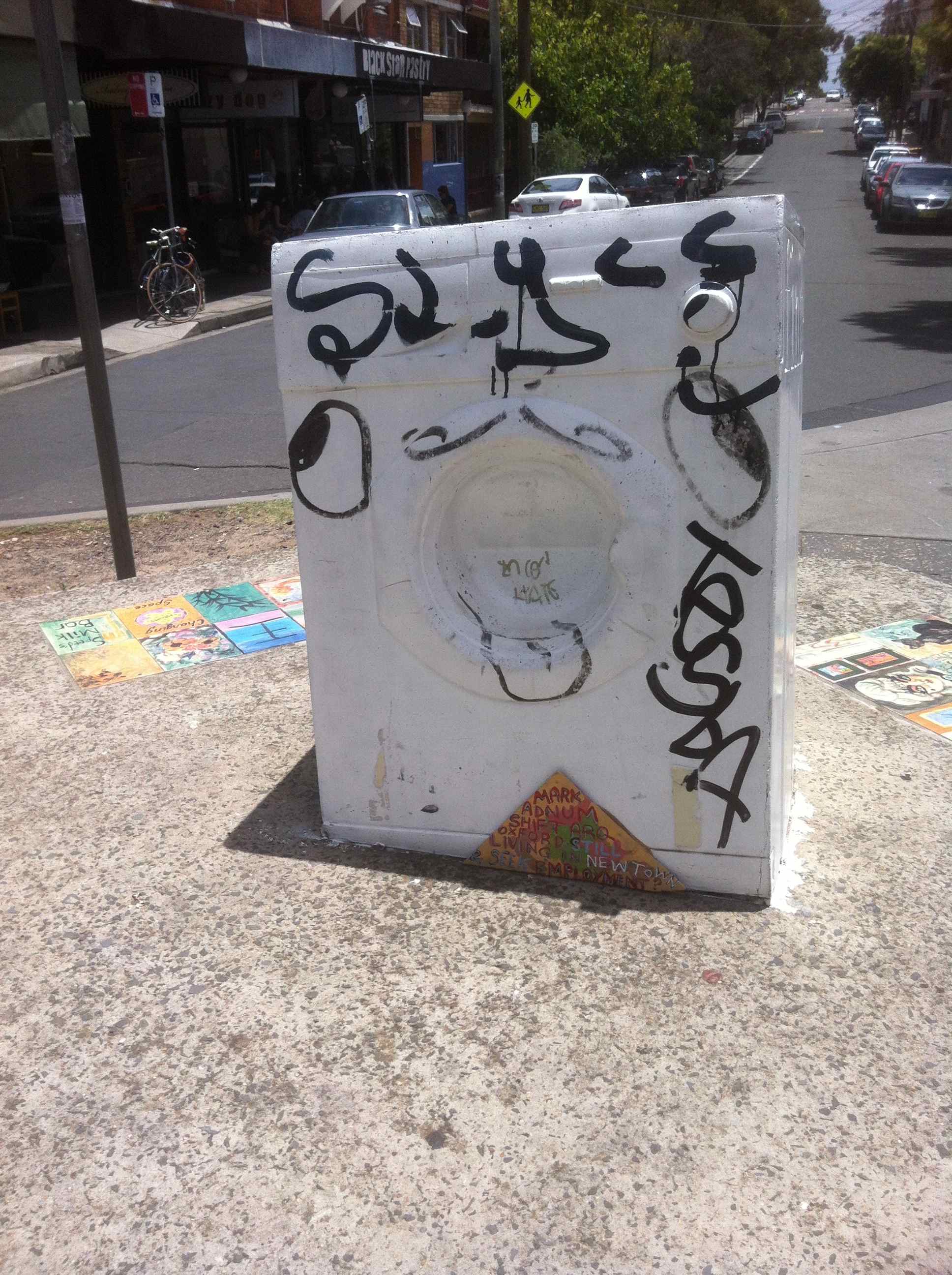
Finite1

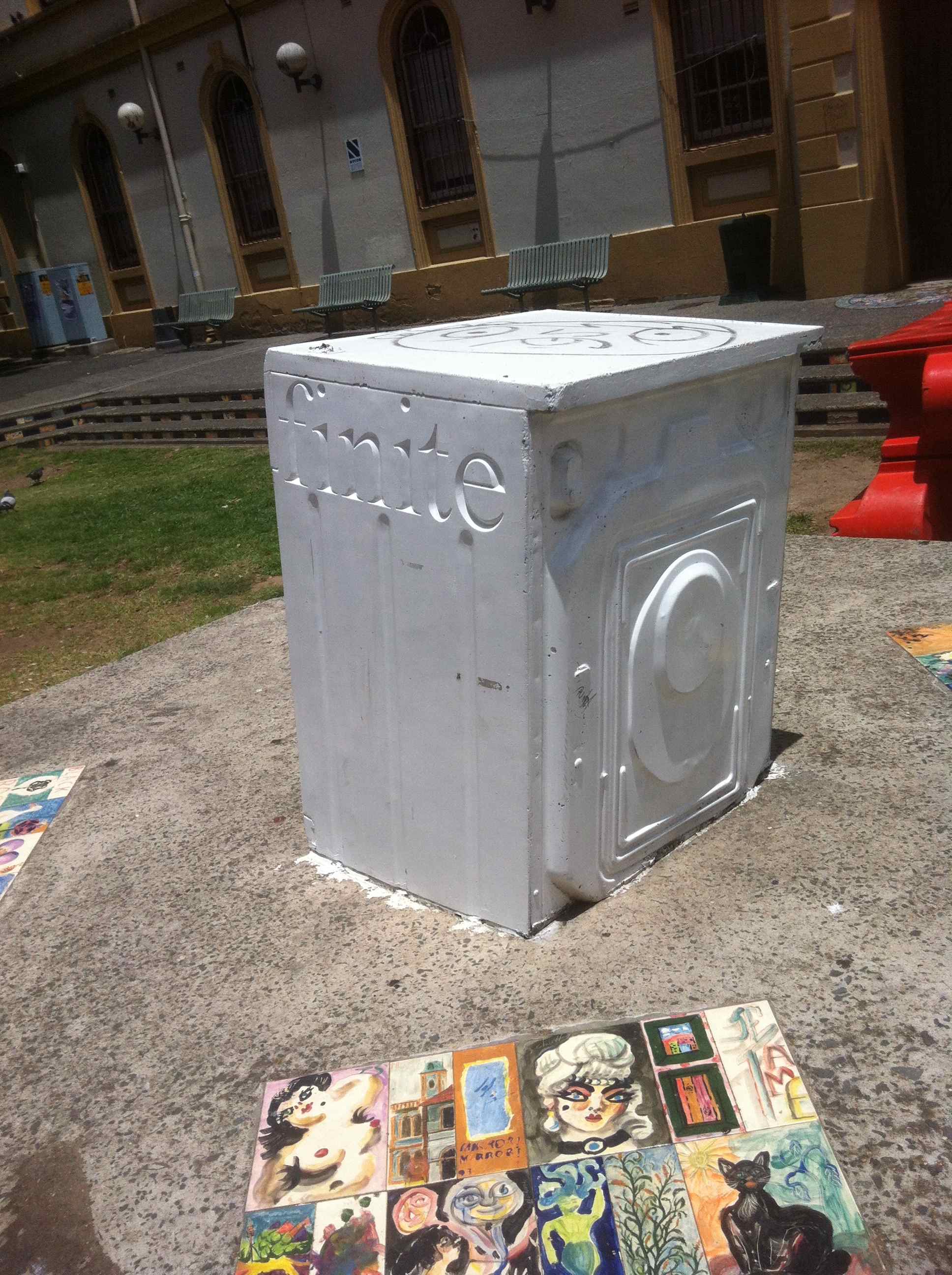
Finite, outside the Newtown police station. From this angle it looks pretty much untouched, except of course for the tags on its top.

Finite2

But here it is from the other side. Not just the graffitists, but another street artist with a distinctive lettering style have used the sculpture as their canvas. Not so bad really: it just changes the image from white-goods consumerism to tacky laundromat.

Work

Someone tried to acquire this Work, also near the Newtown police station, but the glue defeated them.

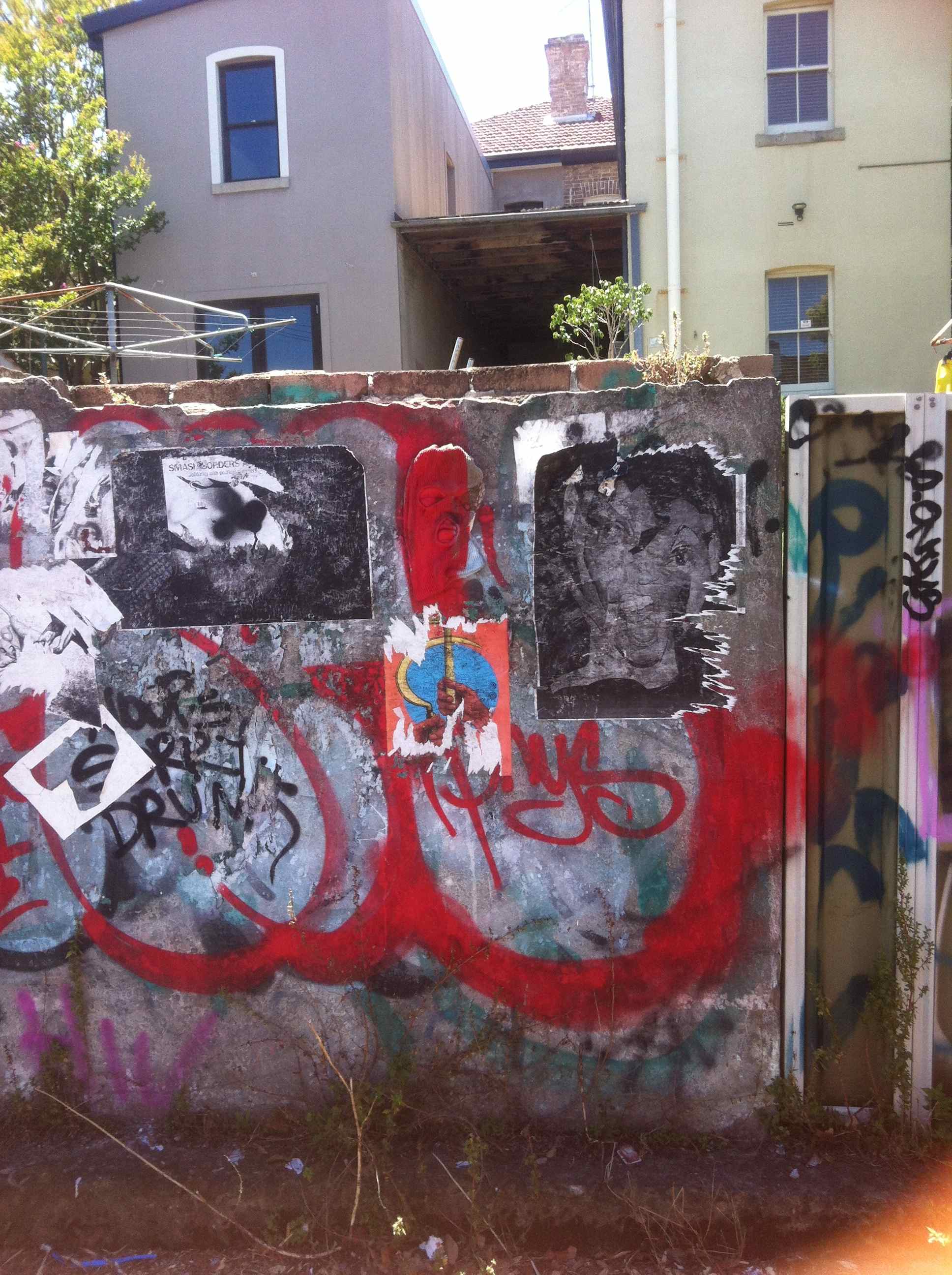
laissez faire in situ

Here’s a patch of wall just off Enmore Road that’s been liberally covered with posters and graffiti. Hidden beneath the layers is a Will Coles sculpture.

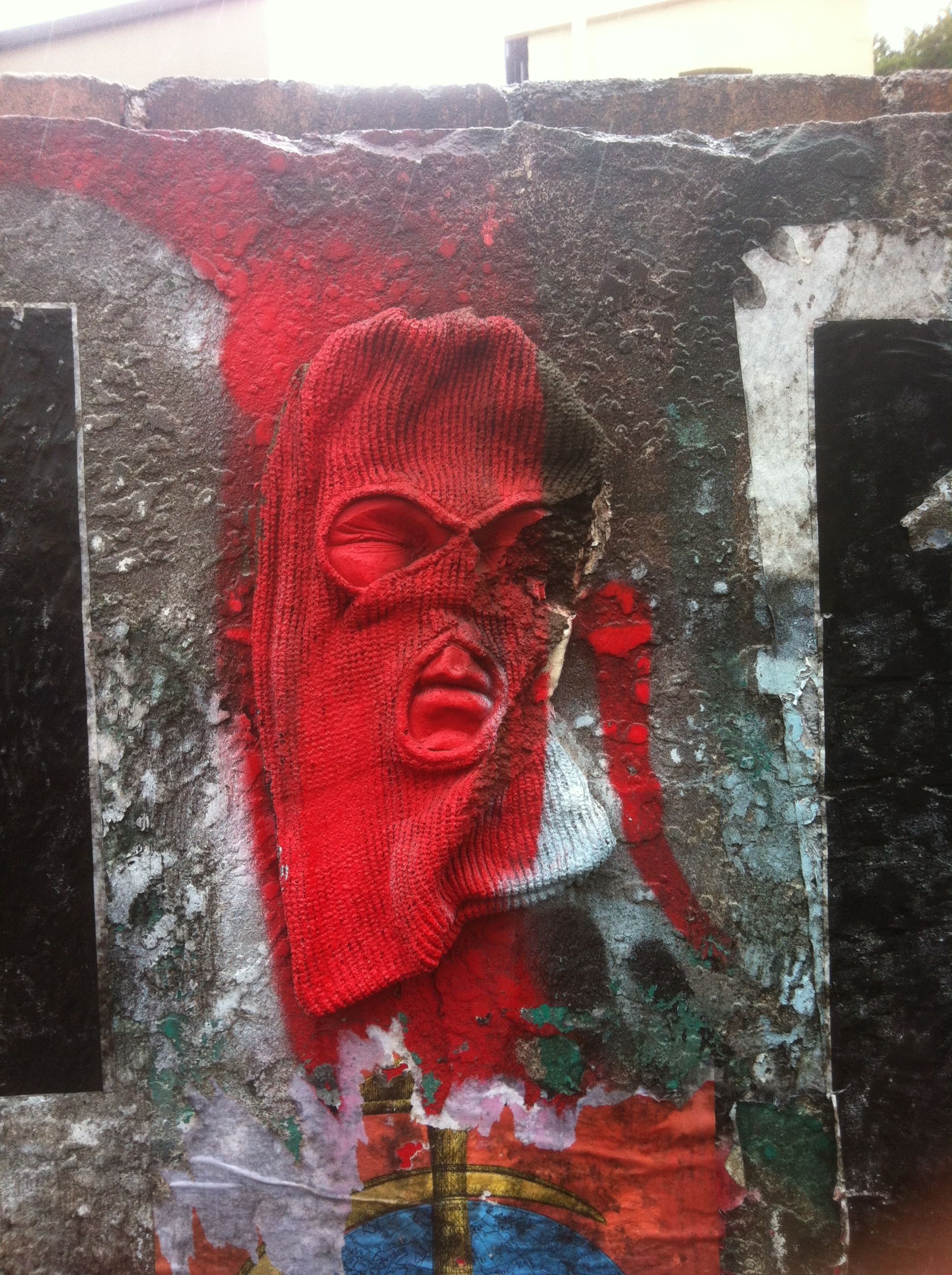
IMG_0835

Voilà! The piece is entitled Laissez Faire, but its comment on larcenous capitalism is a bit lost when it has been chipped at and buried in red paint.

IMG_0849
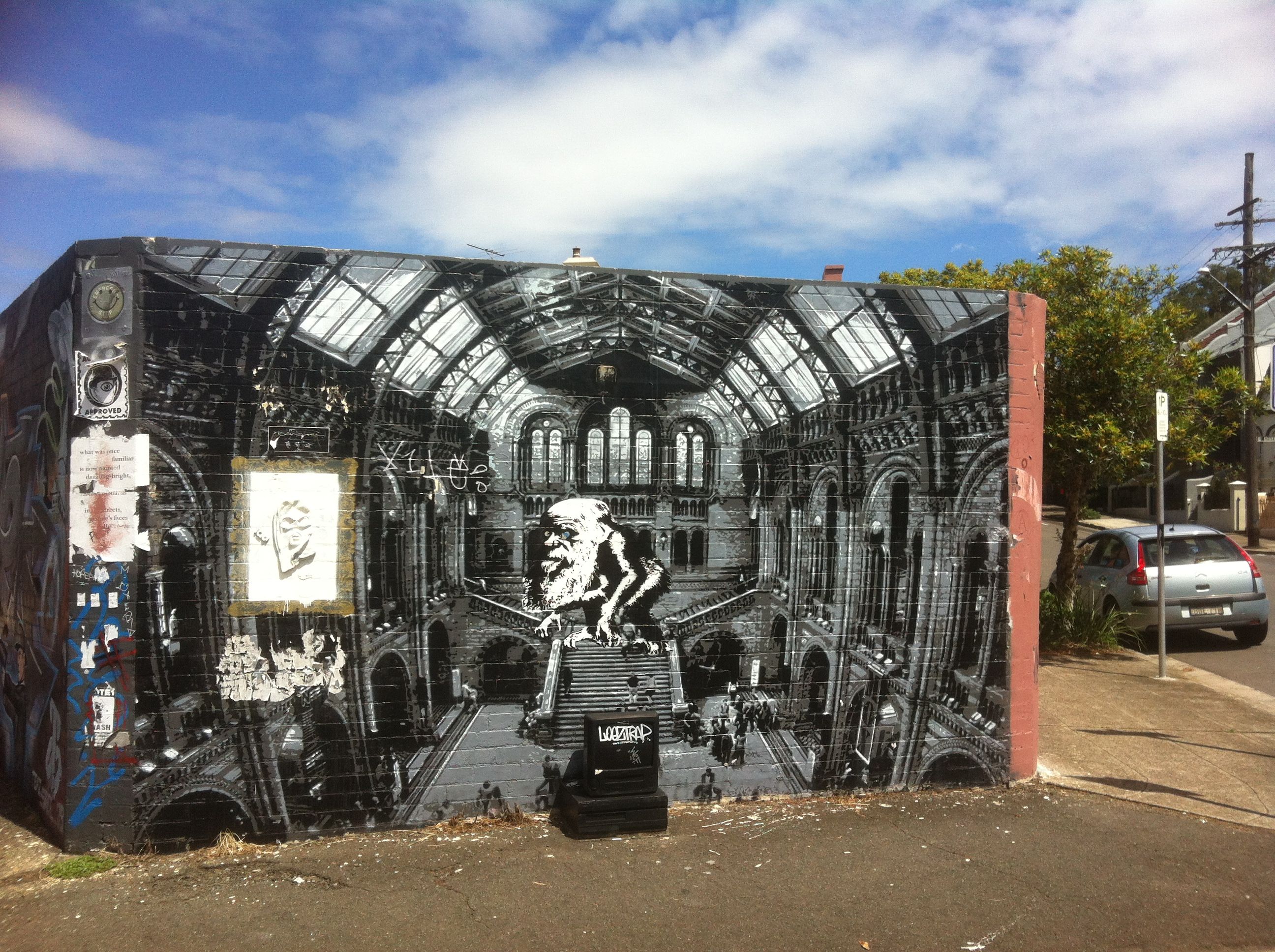
The spectacular mural on the corner of Phillip and Gladstone Streets, Enmore. The owner of the wall welcomes street artists, asking them only to avoid the entrance to his place of business. These artists have impressively given due deference to the Will Coles work that was there before them.
IMG_0848

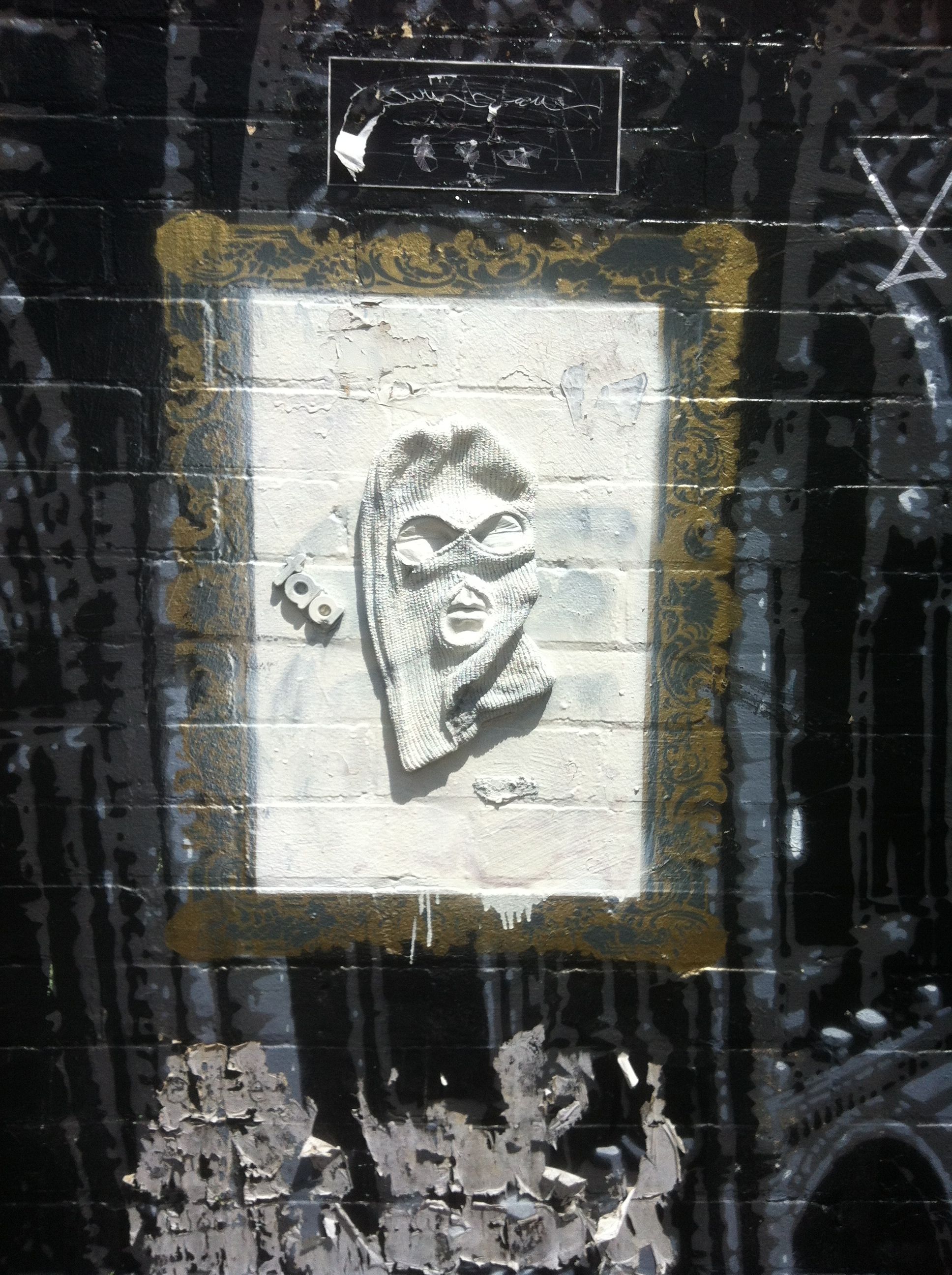
A detail from the mural showing Laissez Faire, and also the damaged smaller Coles work, Tag, to its left.

Here’s the video from Virtual Press Office:

Jennifer Maiden: A Rare Object

Jennifer Maiden, The Violence of Waiting (Vagabond Press Rare Objects Series No 95, 2013)

1vwAs Vagabond Press’s beautifully crafted Rare Objects series of chapbooks approaches its hundredth and final title, Jennifer Maiden makes her debut at Nº 95. There are just six poems in the book, mostly in modes established in Maiden’s recent books:

  • Nº 15 of the George Jeffreys series, which finds George and Clare Collins in a purgatorial Western Suburbs Poker Machine Palace
  • Nº 10 of the Hillary Clinton and Eleanor Roosevelt dialogues – this time with a little Lady Diana thrown in
  • A Lady Diana–Mother Teresa dialogue – this may be the second time they’ve appeared together in a Jennifer Maiden poem, the first time being shortly after they both died
  • a ‘Uses of’ diary poem, about cosiness and Sylvia Plath among other things
  • A Kevin Rudd–Dietrich Bonhoeffer dialogue
  • ‘Maps in the Mind’, a lyric that invokes successive Australian governments’ treatment of asylum seekers a little in the manner of ‘My Heart Has an Embassy’, which referred to Julian Assange

As I was starting this blog post, my Feedly reader presented me with ‘The poetic spirit of Rare Objects’, an excellent review by Jessica L Wilkinson of the four Rare Objects launched in Melbourne last weekend. Having read that review, which originated on the Overland site, I find it hard to think of anything else I want to say, so I recommend that you click on the link. For those who don’t click, here’s her final sentence, which captures the mood of the book beautifully:

This collection is quietly yet resolutely political, and leaves us considering our own strengths and vulnerabilities, and who we may imagine clinging to for guidance through tough decisions.

awwbadge_2013I nearly forgot and perhaps I should have as it’s such a small book, but this is another title in my Australian Women Writers Challenge for 2013.

Sonnet 14: November ends

For a while there it looked as if I wasn’t going to make my sonnet quota this year, but here’s the last one, just ahead of deadline. I was tossing up whether to write about my increasing deafness, or Yoko Ono’s exhibition at the MCA, or the way Eleanor Caron’s Booker prize-winning novel The Luminaries is getting so little promotion in the end-of-year lists in newspapers and bookshop reading guides. I settled for this:

Sonnet 14: November ends
I shopped, I read, I went to movies,
played with children, watched TV,
rode a train with weary juvies,
helped add a show to P’s CV,
stood in rain for climate action,
faced computer death distraction,
ruminated on the news,
tried to formulate some views:
all grist for my November rhyming
fourteen lines in Pushkin’s ways,
fourteen times in thirty days.
An hour to spare – precision timing –
I’ve got them done. Perhaps next year
the form of Petrarch, or Shakespeare.

Colleen Z Burke’s Splicing Air (and Sonnet 13)

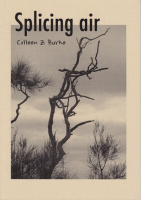
Colleen Z Burke, Splicing Air (Feakle Press, 2013)

1sa

More than 20 years ago in a pub in Glebe I heard Colleen Burke (I don’t think the Z had yet become part of her working title) read poems from which I still remember lines that move me, from what she presented as straightforward records of conversations with her children.

Many of the poems in Splicing Air capture moments with her grandchildren, and the conversations still smuggle killer lines into the poetry. Many others, in what I think of as her signature style, are short, impressionistic pieces about landscape or, especially, skyscape in and over Newtown and surrounds, or bushland. There are a number of pieces observing the social life of Newtown, past and present, and a handful of longer pieces. And some snapshots from New Zealand

Four of the longer pieces draw on the history of discovery and settlement of New South Wales: an narrative-essay on James and Elizabeth Cook, journal entries by the surgeon and an officer from the First Fleet, a biographical sketch of the early Australian poet Frank Macnamara. They lack obvious poetic embellishment, but in each of them the effect is unsettling and revelatory. There are straightforward accounts of the lives of two nineteenth-century women – ‘The publican’s daughter’ being the poet’s great grandmother, and ‘The fossil hunter – Mary Anning’ (which accounts for roughly a fifth of the book) an extraordinary Dorset woman who might easily have been lost to history because of her class and gender.

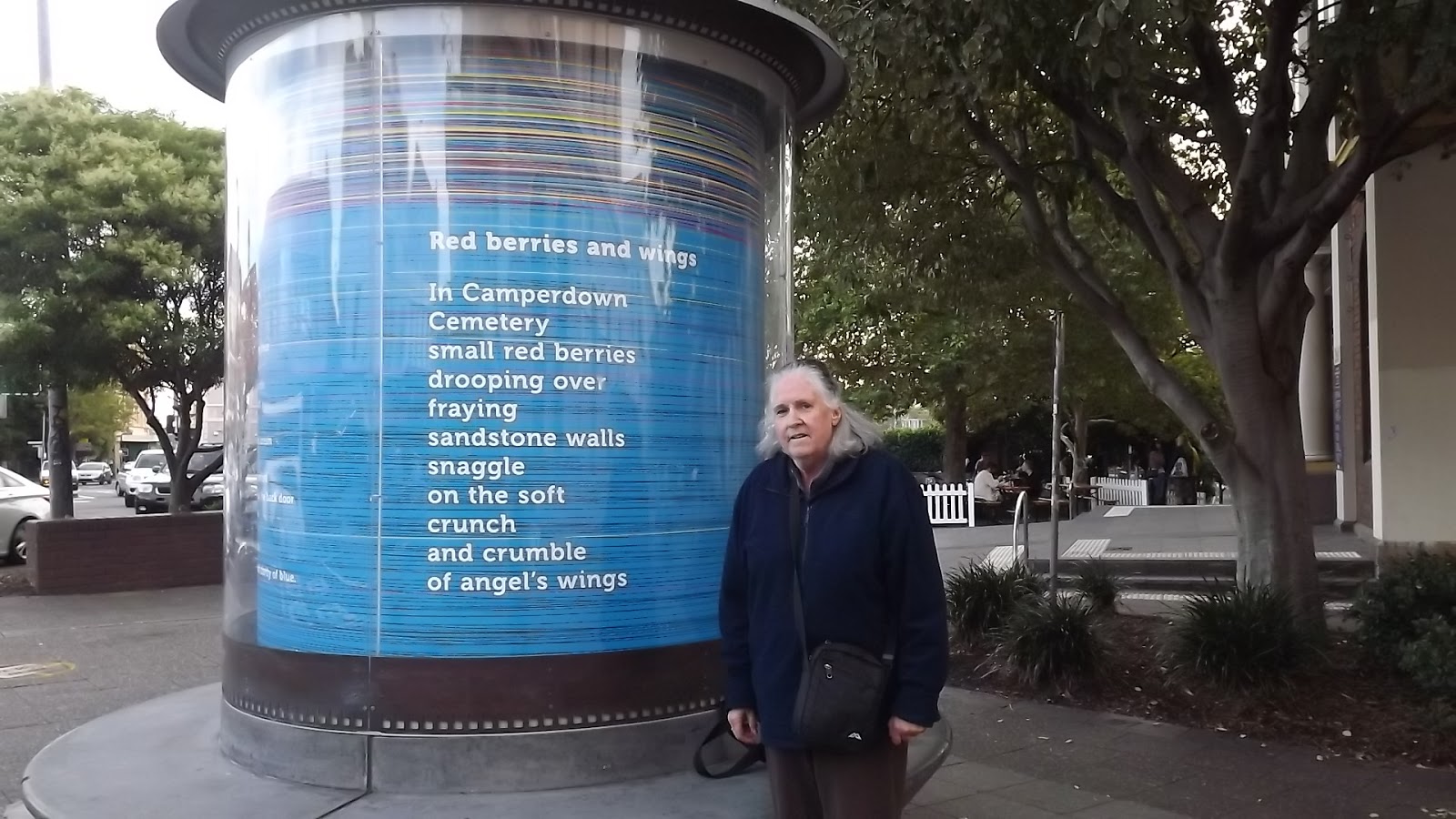
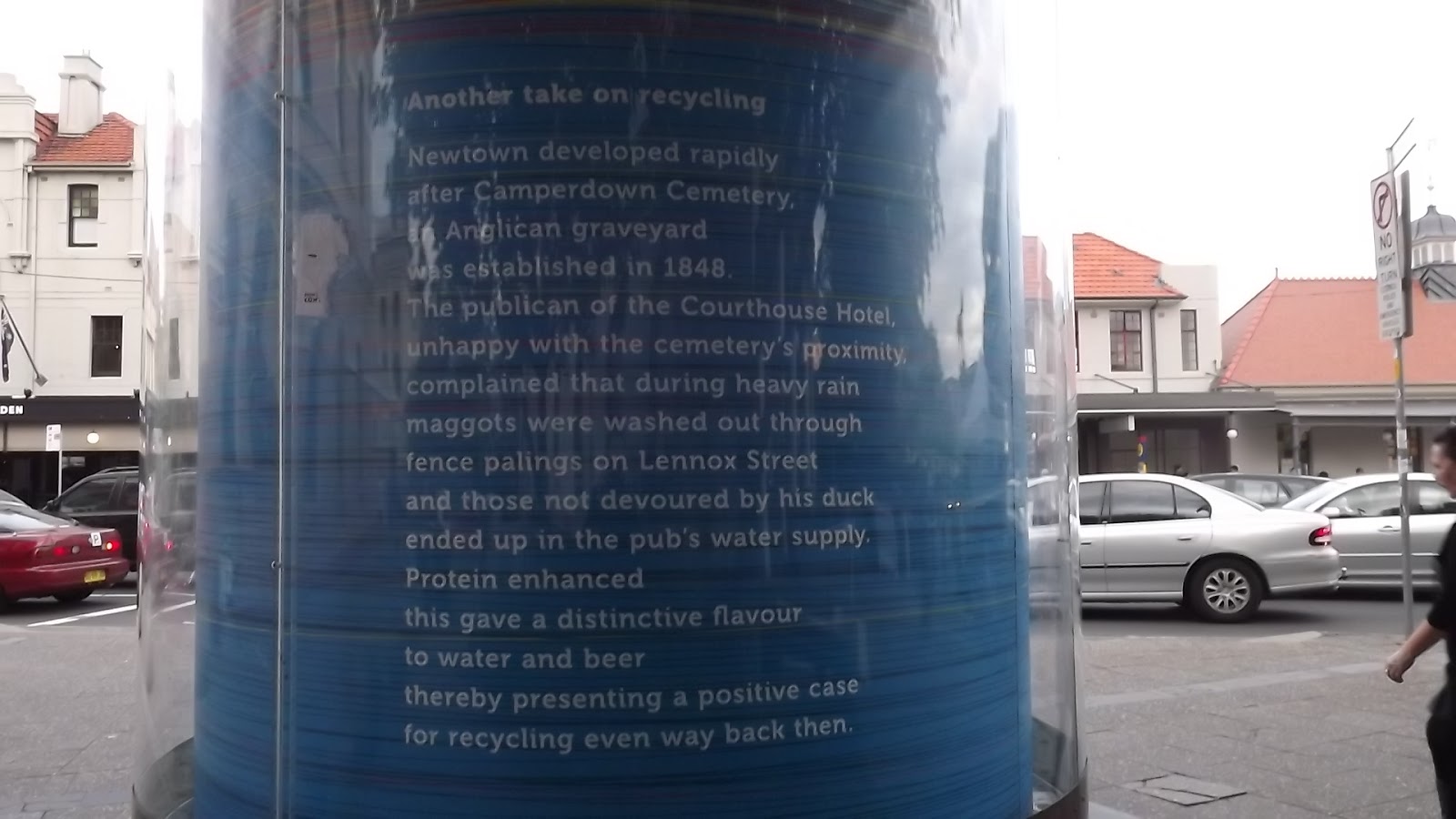
The sense of place is strong here as in all Colleen Z Burke’s work: I think of her as the poet of Newtown. Earlier books have included a number of pieces set in Camperdown Cemetery, and this book has two beauties set there too: ‘Kangaroo grasslands and my 20 month old grandson’ and the wicked ‘Another take on recycling’.

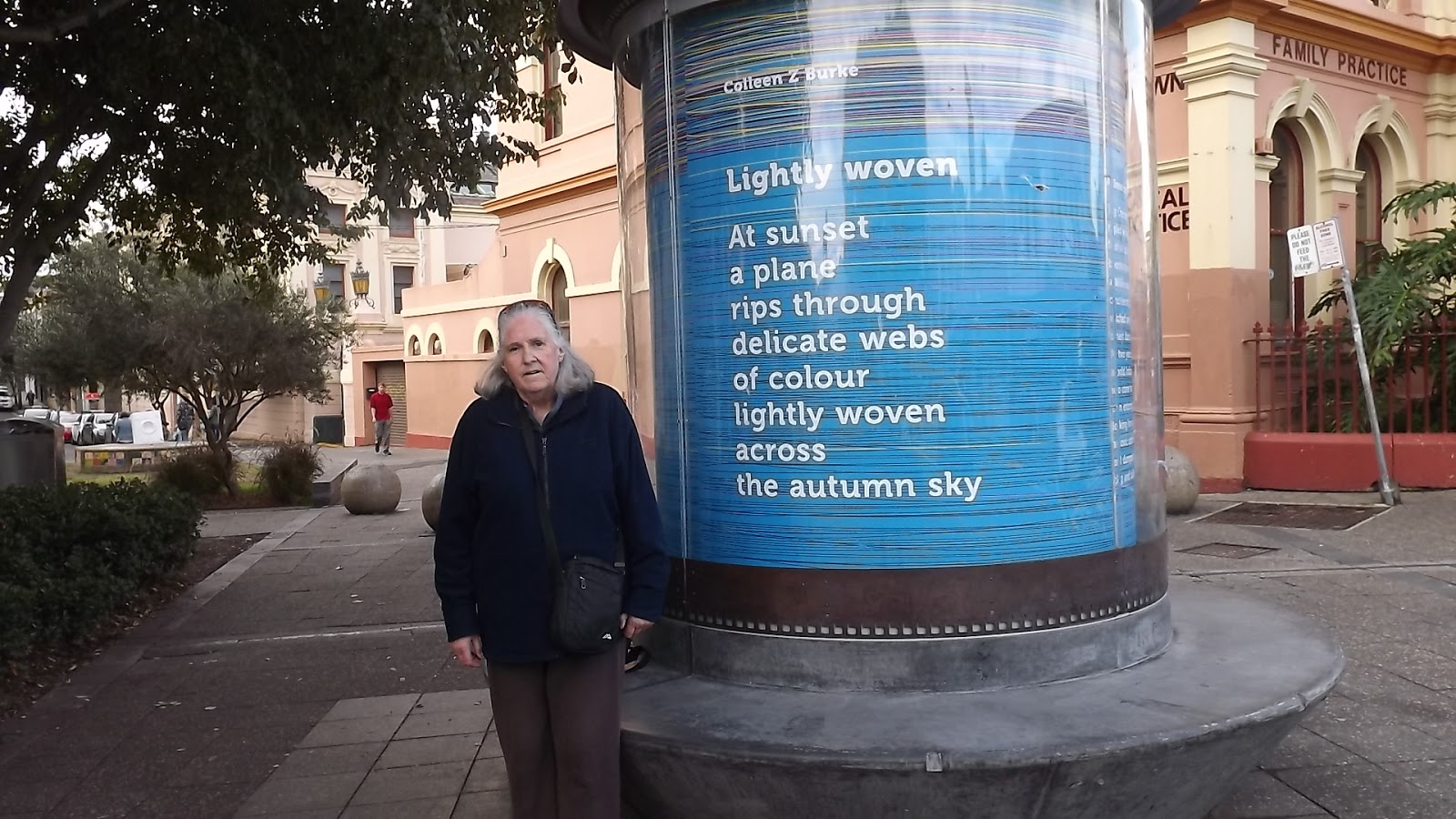
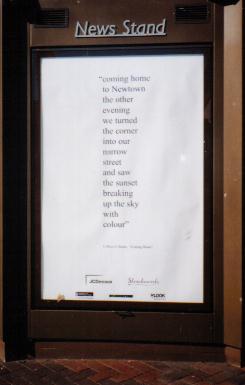
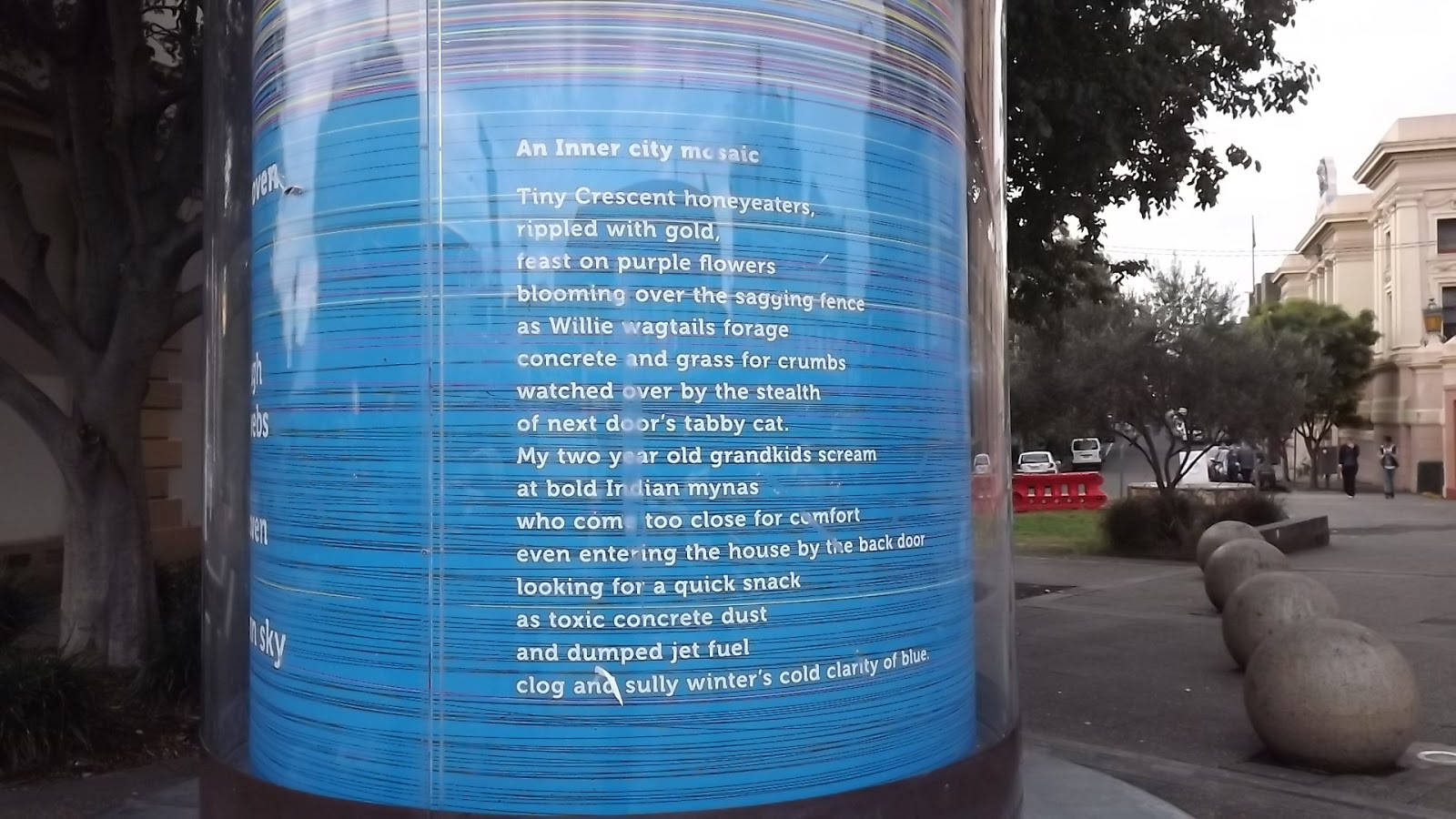
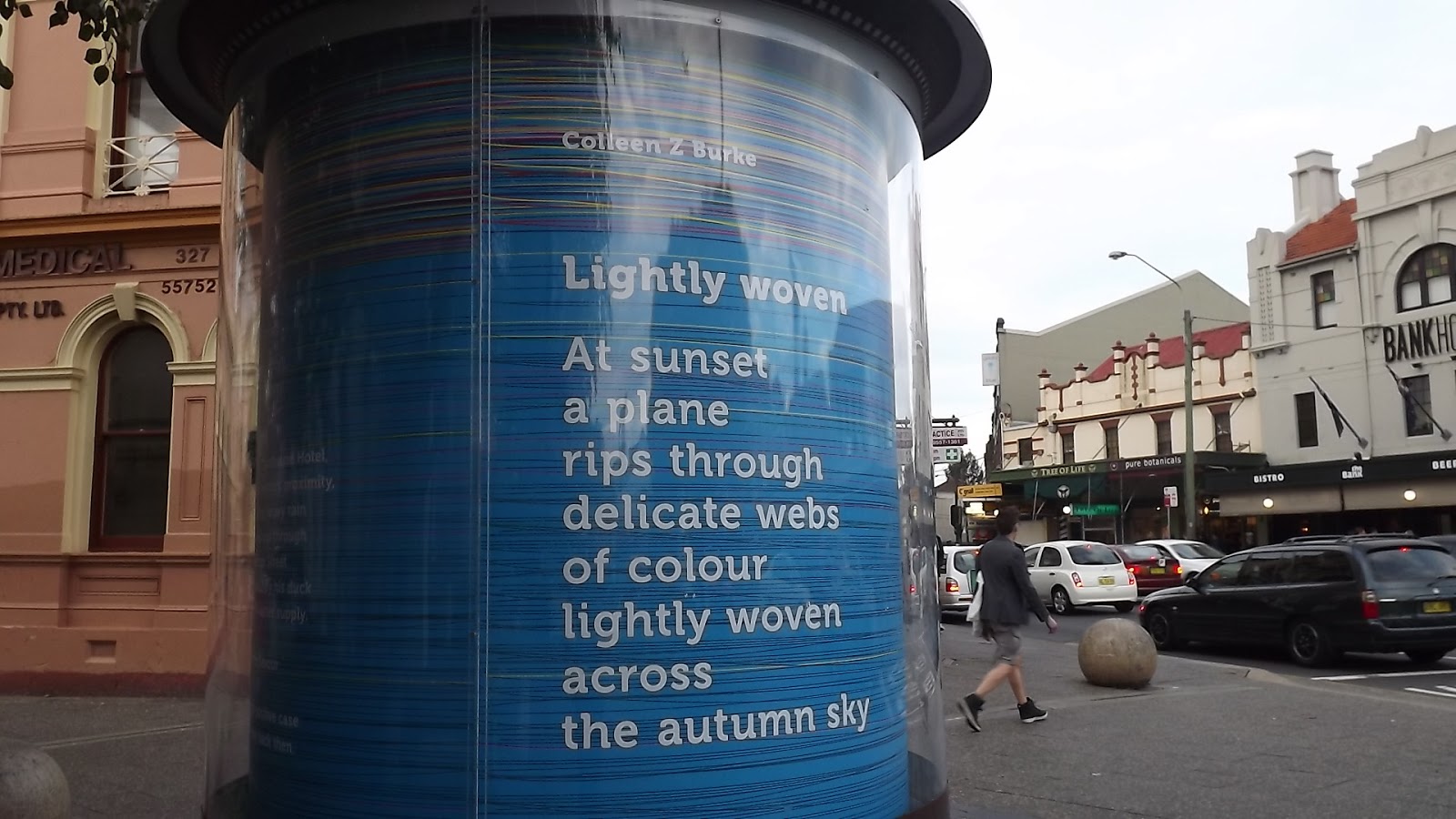
It’s November, so a sonnet is obligatory. This one draws on the last couple of times I laid eyes on the poet, and occasions when her work has featured large in the urban landscape, as illuminated posters that were part of the Sydney Festival some years ago, and more recently on the Newtown Art Seat. (there are six different links there, all to this site)

Sonnet 13: Colleen Z Burke
She reads to us beside a Whiteley –
her landscapes quiet, his lewd and loud.
I’ve seen her sunset words shine nightly,
tall amid a milling crowd.
Her tiny poems tread light, illumine;
‘the details of decay are human’
as she bids a friend farewell.
Human too what she can tell
of autumn air and Maralinga,
clouds, trees, coprolites, cats, birds,
muskets, trinkets, children’s words.
This poetry’s a pointing finger,
self-effacing, yet with grace
it helps to root us in this place.

Full disclosure: I published one or two of these poems in The School Magazine in my past life, and may have rejected one or two others A significant event in my mother-in-law’s pre-dementia life was a creative writing class taught by Colleen Burke.

awwbadge_2013

I think this is the 11th book I’ve read as part of the Australian Women Writers Challenge 2013.