Enter the Duck

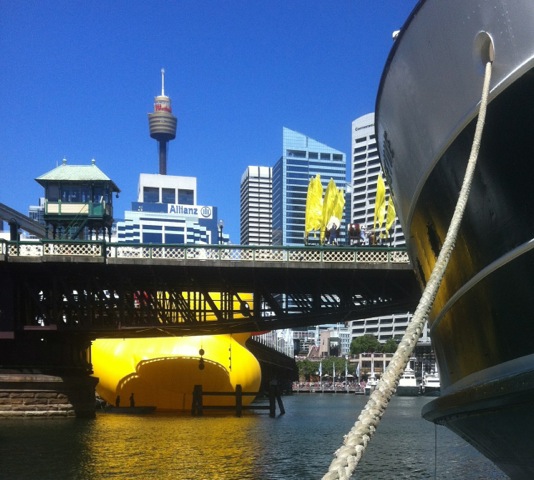
Whatever the ghost of Rembrandt might think about the state of Dutch art in the early 21st century the arrival of Florentijn Hofman’s magnum opus in Darling Harbour today was a hit, even after the seeming endless and mostly lame concert and tumbling act that preceded it. The figures beneath the yellow banners up on the Pyrmont Bridge are taiko drummers. They were splendid.

ducky

And so the 2013 Festival of Sydney begins. No first night celebration in which the city becomes a giant concert venue, but a giant rubber ducky isn’t too poor a substitute.

Blowing my own trumpet …

… or really my own tin whistle.

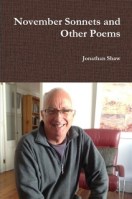
november_sonnetsIn December, I played around on lulu.com to publish a very slim book of verse from this blog. I’ve postponed mentioning it because I gave copies to a number of people as glorified Christmas cards or end-of-year gifts, and didn’t want them rushing to buy when there was already a book on its way to them in the mail.

But now, here it is, available direct from lulu.com. It’s also listed at Amazon (though don’t be misled, the hardcover edition advertised there is a different book by a different, long-dead, unrelated Shaw). You can see inside the book at both those links.

Not only that, it’s been reviewed in extraordinarily generous terms by my friend, blogger, and sometime commenter on these pages, Will Owen.

From Jennifer Maiden’s backlist

Jennifer Maiden, Tactics (UQP 1974)
Selected Poems of Jennifer Maiden (Penguin 1990)
Jennifer Maiden, Play with Knives (Allen & Unwin 1990)

Friends of mine who met and married in their 40s discovered during their courtship that twenty years earlier they had moved in the same circles, shared similar enthusiasms, gone to the same demonstrations, once even posed in the same group photo, but never actually met. They speculate that if they had met back then, they might never have fallen in love, might not even have liked each other.

It can be like that with readers and writers. I may have heard Jennifer Maiden read in the early 1970s, and almost certainly read some of her poems in magazines and anthologies, but I didn’t engage with her poetry until her 1999 collection, Mines, and – as dedicated readers of this blog will have noticed – I now can’t get enough of her new work. In the last little while I’ve journeyed back in time to read three of her early books: her first poetry collection, a selection she got together after eight books, and a novel. I’ve enjoyed all three (though ‘enjoyed’ may not be quite the right word for some of the more gruesome bits), but I’m not sure I would have embraced the work of that 20- and 30-something writer when I was a 20- and 30-something reader.

IMG_0682It’s clear from Maiden’s first book, Tactics, why she was included in significant 70s anthologies like Kate Jennings’s Mother I’m Rooted (1975) and John Tranter’s The New Australian Poetry (1979), in which she was one of only two women. This early poetry is more compressed and elliptical, and in that way much more difficult, than more recent work, but it’s recognisably the same mind: grappling with issues of violence, holding a public event or abstract concept up against an intensely private perception or intimate moment, refusing easy answers. From the perspective of 2012, it’s interesting to read in the cover blurb, ‘She is interested in the Labor party, and married,’ two subjects that don’t get an obvious look-in in the poetry in 1974, but are addressed head-on by the more relaxed older woman in poem after poem (that is, if the notion of being married can be taken to include being a mother).

Reading the book at about the same time as Nigel Robert’s In Casablanca for the Waters, which hails from the same era, led to some interesting juxtapositions. Take Roberts’s ‘As Brian Bell said‘ and Maiden’s ‘Isolde and the Censor’. Both poems are about works of art that assert female sexuality, the former using what these days would be called explicit language about a Modigliano nude (the link saves me from risking my PG rating, though I should advise you there’s a typo – it should be ‘crap’ not ‘crab’), the latter describing a censor, ‘complacent Arbiter’, obliviously applauding a Wagnerian soprano who ‘carols the meltwater of her “heart”‘. Both poems, I realised, were written in the context of a struggle against repressive censorship: Maiden’s narrative celebrates euphemism as an evasive tactic, Roberts’s refusal of euphemism is a direct challenge to the censorious. I don’t think I would have understood the political seriousness of either poem if I hadn’t read them more or less together.

1spjmThe 1990 Selected Poems includes ‘The Problem of Evil’, alluded to in ‘Sphinx on Legs’ in this year’s Liquid Nitrogen. It’s a narrative but, possibly typically of its time, is not at pains to make itself understood. (I thought of Dr Jim Tulip’s saying that a certain poet’s work was like the pre–Vatican II Catholic Mass, where the priest kept his back to the audience and mumbled the ritual inaudibly in a foreign language.) It’s still worth reading even if, like me, you decide not to make the mental effort required to disentangle it. As the book progresses through the six books published between Tactics and 1990, there’s a lovely sense of the poetic voice relaxing, becoming more open.

There’s a lot to enjoy. One thing that struck me was the continuing exploration of evil, which reaches something of a climax in The Trust, a long poem in which a story-teller addresses a character in a story she is making up, a story that involves violent death and a suggestion of necrophilia (and incidentally makes it clear that the valuing of euphemism in ‘Isolde and the Censor’ doesn’t imply a rejection of blunt language). It’s not so much violence and evil that is being explored, as our fascination with it. Certainly there’s a lot in these poems that enriches my reading of more recent work: in them, violence is not only something out there, in other people, but something to be worried at in one’s own heart as well. Take these lines from ‘The Mother-in-Law of the Marquis de Sade’ (from Birthstones, 1978):

To sit people on gas-stove jets,
to plug them into light-sockets,
to prod with sparklers, stand
them barefoot in buckets of dry ice:
_____I remember I devised
all these things in the bored
South Africa of childhood,
________the shrill
Brazil that still entrances
the clean children next door

The Soweto uprising was recent when the poem was written, and Brazil was a brutal military dictatorship. The invocation of these regimes in the context of children’s cruel imagining could be read as trivialising them, but I think the poem works the other way, against the trivialising of childhood: the big public violence that fills the news and the private unspoken and unacted violent imagining are part of the same phenomenon. ‘Tiananmen Square’, one of the seven previously uncollected poems at the end of the book, prefigures the way recent poems respond sharply and personally to what Martin Duwell calls ‘media-experienced public events’: it begins, ‘I’m forty now.’ Two of these seven poems, ‘Aptly’ and ‘Chakola’, mark the debut appearance of a major character in the Maiden oeuvre, identified in the latter poem as ‘my three year daughter’.

1pkI wanted to read Play with Knives because its two main characters, George Jeffreys and Clare Collins, have reappeared many times in the last three books. Jennifer Maiden said in her recent fabulous interview with Magdalena Ball on Blog Talk Radio that it’s part of the conceit of the George Jeffreys poems that the reader knows these characters from previously, but it doesn’t really matter if she/he actually does know them. All the same, when I saw the book listed on the internet for a reasonable price I decided to buy and read.

If you avoid stories where terrible things are done to women, then stay away from this one. It’s a pretend genre piece involving a serial killer in Western Sydney, which reaches a truly nasty and unexpected climax. I say ‘pretend genre piece’ because the serial killer scenario is secondary to the story of a gossipy, slightly sleazy group of public servants and professionals involved in the release and return to civilian life of teenager Clare Forster/Collins who had killed and mutilated her three younger siblings when she was nine years old. At the heart of this story is Clare’s relationship with the narrator, probation officer George Jeffreys.

As I read the conversations between these characters, first as George is determining whether he will recommend Clare’s release, and then as he is her mentor while on parole, I was reminded of Gitta Sereny’s Cries Unheard, in which Sereny tries to get inside the mind of child murderer Mary Bell, through long and exhausting conversations with her as an adult. The Sereny book was published nine years after this one, so it’s not a source, and the books have very different angles on the subject of child murderers: Sereny asks how a child could have come to commit such an act; Maiden is interested in what life is like for the perpetrator afterwards – and what it means to be fascinated by such a person.

The broad outline of the George–Clare back-story is given in a note in Friendly Fire, and it’s true that even that much information might not be necessary for an understanding of the poems. But it’s clear to me that, having read the book with all its ethical creepiness, outright horror and high romance, I can read the poems better. It’s not as necessary as Shakespeare is to Eliot’s The Wasteland, but it helps.

Nigel Roberts in Casablanca for the Waters

Nigel Roberts, In Casablanca for the Waters (Wild and Woolley 1977)

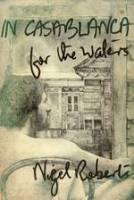
2015498179I’ve been vaguely on the look-out for this book for decades. Nigel Roberts was a regular reader at the Balmain Poetry Readings of the late 1960s and early 1970s, and something of a mover and shaker in the volatile poetry scene of those days. He was canonised as one of the generation of 68 in John Tranter’s New Australian Poetry; he turns up in Robert Adamson’s Inside Out as ‘a robust individual with a generous mind, passionate in his belief that poetry should reach more people at a street level’; he helped found a number of poetry magazines with names like Free Poetry; and he worked as an art teacher in the Department of Education, including at the school of one of my sons. He has stayed in my mind because of one half-remembered poem. I was very happy recently to find the book, and the poem, on the shelves of Berkelouw’s secondhand and antiquarian bookshop.

The poem is ‘Flavour of the Month’, in which the male speaker inveighs against flavoured vaginal douches in a romantic, anti-corporate celebration of the female body. It struck a chord with me 40 years ago: in spite of its ‘sexually explicit language’ it reminded me – perhaps by way of Blake’s proverb, ‘The nakedness of woman is the glory of God’ – of Gerard Manly Hopkins’s ‘God’s Grandeur‘: ‘all is seared with trade … nor can foot feel, being shod.’ Rereading ‘Flavour of the Month’ now, I still like it, but it does feel dated: what was fashionably transgressive 40 years now just seems crude.

As it happens, much of this collection is dated. There’s quite a lot of writing about sex, particularly oral sex, that may have been liberatory once but is now deadeningly familiar. There’s some smirking about marijuana, some right-on sentiments about the US-Vietnam War, quite a lot of ephemeral poetry-wars rhetoric and gossip, unaltered phrases from Bob Dylan’s songs, and satiric barbs whose targets have died or moved on. The introductory note, by no less a star than US poet Robert Duncan, reads now as a puerile collection of penis jokes – not a preface but ‘A Prepucal Face’.

The datedness is probably an inevitable by-product of the poems’ strengths – their spontaneity, their aim to ‘reach more people … at street level’. And perhaps it’s a matter of point of view. The poems offer a fascinating glimpse of an epoch that involved group houses, an odd explicitness about sex and sexism, marijuana as a symbol of subversion, and knockabout creativity.

A handful of poems stand out. For me at least there’s still ‘Flavour of the Month’. ‘The Quote from Auden’ is almost a parody of Dylan’s ‘The Gates of Eden’. With ‘In the Family Album’, the poetry comes into its own. I haven’t mentioned the use of illustrations. The photographs that punctuate the poems are mostly comic or ‘satirical’ in effect, as in the advertisement for Raspberry Douche that accompanies ‘Flavour of the Month’. Those incorporated into ‘In the Family Album’ are of a different order: they show the poet’s grandfather as a young man in a boater, at 75 at an Anzac Day March, waiting with Kitchener for a devastating Dervish attack in the Boer War, and their presence enriches the poem’s quiet contemplation of the relationship between the poet and that grandfather – so that when it ends with an anti-US-Vietnam-war chant and an anti-war slogan, the smart-aleckery and bravado that is characteristic of most of the book is just not there.

End of year lists 2012

As if it isn’t enough to be shopping and wrapping and cooking and unwrapping and eating and searching for lost dogs and blocking our ears to keep out the piped carols, it’s the season for drawing up Best-Of lists.

The Art Student’s best five movies (with links to the movies’ IMDb pages):

A Separation (Asghar Farhadi 2011): ‘Definitely the best movie this year. We got to see how complex it all is for secular Muslims in Iran.’

Lore (Cate Shortland 2012): ‘Up there with A Separation. You don’t believe you can watch yet another film about Jews and Nazis, yet here it was, original and fresh. I hope it wins an Oscar. I liked Somersault too.’

The Skin I Live In (Pedro Almodóvar 2011): ‘Creepy,’ she said, ‘but good.’

This Must Be the Place (Paolo Sorrentino 2011): ‘I loved the great humour, the art, the spectacular musical event.”

The Sessions (Ben Lewin 2012): ‘I liked having nudity and sex without it being voyeuristic.’

My best five movies, chosen fairly arbitrarily (with arbitrary reason given) from a short list of 19 that included all five of the Art Student’s picks:

Liberal Arts (Josh Radnor 2012) features a main character who walks around the city reading. I identified. It also reminded me of the pleasures of Eric Rohmer movies.

Sing Me the Songs that Say I Love You: A Concert for Kate McGarrigle (Lian Lunson 2012) pips The Sapphires (Wayne Blair 2012) at the post for my musical of the year. It’s a concert movie that invites us into extraordinary intimacy with a brilliantly musical family. Martha Wainwright sings ‘First Born’, which her mother wrote for her brother, and which we played a lot when our firstborn son was being ‘the first to crawl’.

Le Havre (Aki Kaurismäki 2011) made me feel irrationally pleased with myself or recognizing the oddly deadpan directorial style from Drifting Clouds, which I saw and loved decades ago.

The Artist (Michel Hazanavicius 2011) was a moderately enjoyable film until the final moment, which resolved a plot point I had been half-awarely worrying over, and vastly expanded the movie’s meaning.

Weekend (Andrew Haigh 2011): In spite of the phenomenal consumption of alcohol and other drugs, which would normally be enough to put me right off, I loved the unsentimental, unprurient portrayal of two characters who are completely taken with each other, including sexually.

The worst movie: We both picked Sophie Lellouche’s bland, self-indulgent Paris–Manhattan. But don’t take this as a solid judgement on the film as it might have miraculously picked up after the first hour, which is all we could bear. If we had to name a movie we stayed the course for, the Art Student would pick Skyfall, which she just plain hated, and I might have to pick Bernie, because Jack Black’s creepiness and the creepiness of the subject matter were from different universes.

The Art Student’s best books (she wouldn’t be limited to five), listed here in no particular order, with links to my blog entries or the book’s LibraryThing page:
1bmMartin Gayford, A Bigger Message: Conversations with David Hockney (2011): ‘Full of surprises and delights, about the way an artist sees the world.’
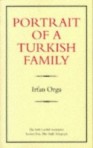
090787181XIrfan Orga, Portrait of a Turkish Family (©1950, Eland & Galeri Kayseri 2004): ‘Compellingly tells of the transition from a feudal society to modernity as a result of war. Also wonderful was the insider child’s view of life under the veil.’
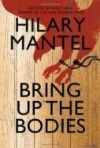
20120704-175516.jpgHilary Mantel, Bring Up the Bodies (2012): ‘I’m glad it won the Booker. I’m completely hooked on the story, and looking forward to the third book, although having fallen in love with Cromwell I’m not looking forward to his death.’
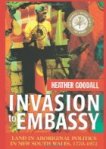
1920898581Heather Goodall, From Invasion to Embassy (1996): ‘A must-read for all Australians, especially those who think the dispossession of Aboriginal people all happened in the distant past.’
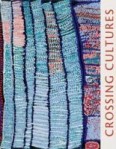
1ccStephen Gilchrist, editor, Crossing Cultures: The Owen and Wagner Collection of Contemporary Aboriginal Australian Art at the Hood Museum of Art (2012): ‘I’m only half way through this but it’s a great, accessible introduction to the complexity of Australian Indigenous art.’
Edwina Shaw, Thrill Seekers (2012): ‘I read this in one sitting. I couldn’t put it down even though a lot was uncomfortable.’
0007149530Richard Holmes, The Age of Wonder (2008): ‘Fascinating portraits of scientists in the late 18th century, when science and romanticism were closely joined. Particularly good on Banks and the Herschels.’
0670033804Sebastian Barry, The Long Way Home (2005) and On Canaan’s Side (2011): ‘Two completely absorbing novels. The first is probably the best novel of the First World War I’ve read, and the second extends the story to Irish immigration to the USA, and the past catching up with you, written convincingly in the voice of an 80 year old woman.’

My best books, which I’ve kept down to just five by declaring the AS’s list off limits:
20120224-180529Fàbio Moon & Gabriel Bà, Daytripper (2011): A gem of a comic book by twin brothers from Brazil, this is a string of connected short stories that celebrates a human life as a miracle of survival.
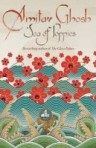
Amitav Ghosh, Sea of Poppies (2008): A story of colonial India that manages to be a gripping romance at the same time as blasting any romantic nostalgia for the Raj to oblivion.
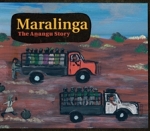
Yalata and Oak Valley Communities with Christobel Mattingley, Maralinga, the Anangu Story (2009): it was a toss-up between this and Tohby Riddle’s miraculous Unforgotten for my picture book of the year. This is a different kind of miracle from Tohby’s – it opens a space for a multitude of voices to speak about the lethal indifference to Indigenous Australians on the part of he British atomic test at Maralinga, and about the resilience of the Anangu people.
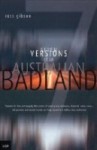
Ross Gibson, Seven Versions of an Australian Badland (2002): I choose this over Gibson’s brilliant 26 Views of the Starburst World, which was published this year, because the earlier book made me understand something of the colonisation of my North Queensland home that I had read about previously but managed not to grasp.
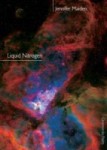
Jennifer Maiden, Liquid Nitrogen (2012): I read quite a bit of poetry this year. Possibly the major revelation was Byron’s Don Juan, but I haven’t finished reading that, and I might have chosen Liquid Nitrogen anyway, as I feel that Jennifer Maiden’s stories, meditations and dialogues help me to live in the modern world.

A note on the gender balance front: I would have thought my reading was fairly every spread between male and female writers, but numbers don’t cater to wishful thinking. According to my blog statistics, I read 34 books by men and 22 by women.

Colm Tóibín’s Mary’s Testament

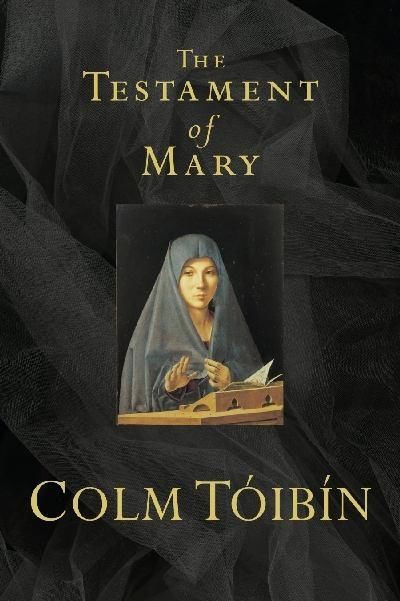
Colm Tóibín, The Testament of Mary (Picador 2012)

1tm Last Christmas I read The Book of Rachael, Leslie Cannold’s debut novel about an imagined sister of Jesus. This year veteran novelist Colm Tóibín speaks in the voice of Jesus’ mother.

The Book of Rachael wasn’t completely satisfying as a novel, but it painted a convincing picture of what it may have been like to be poor or outcast or female in Jesus’ times, and entered convincingly into a world view where tales of miracles could be true without being true as we understand the word.

The Testament of Mary has different fish to fry – my trouble is I can’t tell what those fish are. There are passages that are pretty well straight retellings of incidents from the Gospel of John: the raising of Lazarus and the ecce homo. Other familiar scenes – the crucifixion, the miracle at Cana – are recast in ways that in effect claim that the Gospel is lying. For most of the book I felt I was reading notes towards a novel, something that would be fleshed out once a bit more research could be done, and a few crucial decisions made: is Mary’s son a charlatan followed by desperate misfits, and if so how does that fit with his bringing a corpse back to life? why are the Romans and ‘the Elders’ intent on killing him and all his followers, and in that context why does the head Roman try to save him? why have Mary flee the scene of the crucifixion before the actual death – might there be a less crude way of saying that the Gospel of John isn’t historically accurate?

I suspect that the heart of the piece is in something Mary says to the unnamed man who explains to her that Jesus died to save the world: ‘when you say that he redeemed the world, I will say that it was not worth it. It was not worth it.’ I read this as an emphatic repudiation of a 1950s Irish Catholic world view, and I go, like, ‘Whatever!’

It’s not a novel. It’s not an informed engagement with the gospels – it seems to assume, for example, that John’s gospel claimed to be a historical rather than a theological document. It’s not effective as polemic, because the thing it opposes is presented as arbitrary and fanatical. I don’t know what it is. Maybe Colm Toíbín felt that it was important to show his colours in the current struggle between fundamentalism and science, etc. OK, it does that – but I’m surprised the commissioning editor didn’t return the manuscript with a note: ‘Needs more work.’

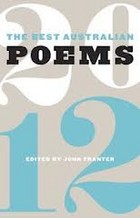
Tranter’s Choice

John Tranter (editor), The Best Australian Poems 2012 (Black Inc 2012)

bp2112My note on this book in the little blog where I keep a note of my reading provoked an anonymous comment full of rage and despair. (I’m linking to it, because it seems a pity that such passion should go almost unheard.) It may be that the commenter didn’t actually have this book in mind, since the poem s/he singled out for particular spleen is actually in last year’s Best Australian Poems, but it’s probably inevitable that any anthology claiming to be the best of something will annoy someone, especially if they’ve got a dog in the fight themselves.

Although I’d secretly love someone to decide that my November Sonnets were works of genius, I didn’t actually  have a dog in this fight. So I wasn’t annoyed. I can’t say that I was swept away either. I’d read and enjoyed about half a dozen of the poems, and was delighted to see them included. And there are fine poems by many writers whose work I know, and by many I don’t. John Tranter’s own contribution, at the conclusion of his introduction, is a kind of cento – an assemblage of lines and images from the chosen poems, but with Tranteresque impersonality they don’t form a coherent whole but are ‘chosen more or less at random’.

Some previously unpublished poems were submitted directly to this anthology. But most appeared previously in a wide range of publications, including books, literary journals and newspapers. Both Quadrant and Overland get a guernsey, likewise both Fairfax and Murdoch – a touch of poetry making the whole world kin? But why, I ask querulously, is there nothing from the paper I subscribe to, the Sydney Morning Herald? And I answer even more querulously because poems turn up in the Sydney Morning Herald only slightly more often than teeth in hens. SMH, Susan Wyndham, literary editor of the SMH.

Added a couple of hours later: I know this post isn’t a review. As it happens, Ali Alizadeh’s excellent discussion of the book went up on the Cordite Poetry Review site not long after I posted my little piece. I recommend it.

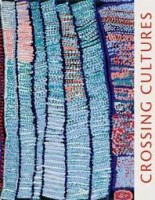
Crossing Cultures with Owen and Wagner

Stephen Gilchrist (editor), Crossing Cultures: The Owen and Wagner Collection of Contemporary Aboriginal Australian Art at the Hood Museum of Art (Hood Museum of Art, Dartmouth College 2012)

Until now I’ve assumed that exhibition catalogues were basically illustrated lists, of little or no interest to anyone who hasn’t been to the event they relate to. The Crossing Cultures catalogue has made me think again. My rethink was given a serendipitous boost by Mary Beard‘s contribution to TLS Books of the Year lists. She wrote:

Let me put in a plea (not for the first time) that we don’t forget the great contribution of exhibition catalogues, which often goes far beyond a simple record of the show concerned.

Like the esoteric-sounding catalogue she had in mind, Crossing Cultures ‘includes some wonderful essays and entries’. The bulk of the book is devoted to ten substantial essays, while the illustrated list – the ‘exhibition checklist’ – takes up less than a quarter of its pages. Since very few of my readers are likely to visit the exhibition (it’s in New Hampshire) or see the catalogue, I’ll give you a quick guided tour. The Art Student’s words when she first flipped through the book echo my own response and serve very well as a TLDR: At last, something that might help me understand some basics about Aboriginal art.

Will Owen kicks things off with an account of how he and Harvey Wagner created the collection of Aboriginal Art which they are now donating to the Hood Museum at Dartmouth College, and which constitutes the exhibition. People often bemoan the influence of collectors as a key part of the commodification of art and the art scene under capitalism. Will’s essay gives a different perspective. It describes how the urge to collect grew from being captivated by the art, and led him and Harvey to build relationships with dealers and artists, and to a deep engagement with ‘the complex social and cultural elements that informed [the art’s] creation’. Will’s blog demonstrates the intelligence, erudition, and passion he has brought to that engagement. (Will and I met online when I blogged about an exhibition of work from Aurukun, at which he and Harvey bought a sculpture over the internet. I think of him as a friend – and our copy of this catalogue is a generous gift.)

Then comes a trio of general articles:

Howard Morphy’s ‘Aboriginal Australian Art in America’ explores the role that US exhibitions and collectors have played in the process by which the non-Aboriginal art world has come to recognise ‘the value and aesthetic power’ of Aboriginal art, beginning with an image from the New York Times in 1941 that juxtaposed a bark painting from western Arnhem Land with paintings by Dali and Miro: decades before anyone would have thought of doing it in Australia, a US exhibition was suggesting an equivalence between Aboriginal and non-Aboriginal art. An observation that’s relevant to this exhibition:

The building of collections of Aboriginal art with a historical depth has … happened outside art museums, through the activities of private collectors and ethnographic museums.

In ‘In the Eye of the Storm: Issues Facing Contemporary Indigenous Art in Australia’s Remote Communities’ Brian Kennedy, former director of the NGA, summarises the social and political environment of Aboriginal art in recent decades – he doesn’t name John Howard or Mal Brough, but their dark presences are very much there. The general principle:

Each and every non-Indigenous person who hangs a work of Aboriginal or Torres Strait Islander art on the wall of his or her home or office thereby publicises Indigenous culture and sooner or later should contemplate the circumstances in which these works are made.

‘Painting the Law: Understanding the Law Stories in Aboriginal Art’ is an overview by N Bruce Duthu of the notion of the Dreaming and the importance of country in Aboriginal cultures. Duthu, a Professor of Native American Studies, quotes tellingly from a number of Aboriginal people, including this exchange between Aboriginal legal scholar Christine Black and David Mowaljarlai, senior law man from the Ngarinyin people of the Kimberley:

‘What about the areas where there are no Aboriginal people surviving, or at least living traditionally there any longer?’

‘You’re wrong there thinking like that. The land remained, you can’t get away from that. It acts for the people and their imprint is still there. If the land sinks into the ocean, the symbols will still be there. Only if the whole continent is blown to pieces and nothing is left of it, then it will be finished.’

Each of the remaining six essays focuses more narrowly

In ‘Daguerreotypes, Stereotypes, and Prototypes: Reframing Indigeneity’ Stephen Gilchrist, curator of the exhibition and editor of the catalogue, discusses photography. Six contemporary photographers are represented in the exhibition: Christian Thompson, Darren Siwes, Destiny Deacon, Bindi Cole, Ricky Maynard and Michael Riley. The essay takes us from a time when photography was a means for colonisers and anthropologists to define Indigeneity to the present when Aboriginal photographers

manage to push through the burdensome expectations of making racially explicit work and instead speak up against the persistent climate of ideological repression.

As the title suggests, Françoise Dussart’s ‘Mediating Art: Painters of Acrylics at Yuendumu (1983–2011)’ focuses on the work of Warlpiri artists in the Central Desert, particularly Yuendemu. After reprising the history of the beginnings of acrylic dot paintings at nearby Papunya, she draws of decades of conversations with Warlpiri artists, she explores the relationship between the acrylic art and the Dreaming stories it reflects, and pushes at the edge of how non-Indigenous people can read and understand the art:

Rooted in colonial and evolutionist views of exchange 
with indigenous peoples, practices of collecting have relied 
and continue to rely too often on sampling, on finding the
 ‘iconic’, on serial individualizing (concentrating on the career of a single artist), and on ‘preserving’. It may be time 
to instead embrace the truly panoramic representation of 
paintings from a specific time and place. Understanding 
the practices of indexicality articulated by Aboriginal painters will likewise force collectors and museums to think beyond sampling practices and the kinds of power relations
 that such practices generally structure.

Jennifer Deger’s ‘Art + Emergence’ focuses on northeast Arnhem Land. Her concern is to take her readers past looking at Yolngu barks and canvases as ‘elaborate messages in need of decoding’, to find ways to ‘sensually encounter’ the works – which means more than just finding them pretty. At the same time she writes very interestingly about the issue of who has the right to tell the stories that are contained in some paintings.

Sally Butler, Senior Lecturer in Art History at the University of Queensland, ranges from Cape York to Brisbane in ‘The “Presence” of Queensland Indigenous Art’. Queensland is huge, and the range surveyed in this essay is huge – from traditional Aurukun sculpture to the text-based protest art of Gordon Bennett and the extraordinary variety of Vernon Ah Kee’s work. Sally Butler, like most other contributors, quote artists of more traditional work in ways that indicate political / diplomatic intentions. An old man from Aurukun declared about Kugu Law Poles, ‘ I know your laws: now you can know mine.’

Among other things, Henry F Skerritt’s ‘Strange Relatives: Negotiating the Borderlines in East Kimberley Painting’ tells the story of Rover Thomas, and places his art in the context of Keith Windschuttle’s reactionary revisionism, which prompts me to reflect that if you were looking for a beautifully illustrated introduction to Aboriginal culture, history and politics, including the impact of dispossession, massacre and colonisation generally, as well as the integrity, courage and sheer brilliance of the ongoing struggles of Aboriginal people, you could do a lot worse than this book.

In the final essay, ‘Rethinking Western Desert Abstraction’, anthropologist and curator John Carty argues that in the process of claiming Aboriginal art as fine art rather than ethnographic artefact, ‘we have somehow neglected the basic disciplines of formal and art historical analysis’. Western Desert artists have moved on in their use of traditional forms, becoming increasingly abstracted, but art criticism has not kept pace – he traces the process in the works of ‘the incomparable Emily Kam Kngwarray’:

Her artistic trajectory resonated with the broader history of Western abstraction in ‘impossible’ ways, and yet it also expressed what some have come to interpret a a kind of Indigenous modernism. But the effusive proclamations of Kngwarray’s ‘genius’ have tended to obscure the fact that her dissolution of the structural and iconographic aspects of the aesthetic system was part of a broader creative process in much desert art of recent decades. Kngwarray has become the iconic embodiment of that process, yet singular as she was, her work encompassed developments in the abstractions of desert painting that both preceded and followed her own individual career.

He then gets down to cases, and has a fascinating discussion of concentricity, of dots and their relationship to meaning.

So, it’s not Contemporary Aboriginal Art for Dummies by any means. Each of the contributors speaks from deep knowledge, and many Aboriginal voices are quoted. But, speaking as a dummy, I find it hard to imagine how a single book could do a better job of informing me on the subject. Plus, of course, the images are plentiful, and brilliant.

Jennifer Maiden’s Liquid Nitrogen

Jennifer Maiden, Liquid Nitrogen (Giramondo 2012)

In ‘The Year of the Ox’, the long poem that opens this collection, Jennifer Maiden identifies herself as an ox (her daughter, who has been appearing in her poems for at least 20 years, is a tiger):

==================I plough my furrow
heavily and fruitfully and my seldom rage
is that of the earth like an earthquake, sudden
and efficiently gutting. She is full of lovely
litheness and protection. Next year I
will still plough slowly, heavily.

She invites us to see her poems as ploughed fields, produced by steady work, but work performed with power, deliberation and passion, no hint of Vachel Lindsay’s ‘ox-like, limp and leaden-eyed‘. I wonder if it’s deliberate, though, that the poem doesn’t mention that oxen are ruminants – because while Jennifer Maiden’s poetry goes in for emeralds and sapphires and turquoise rather than lead, she certainly ruminates: in the ‘diary poems’ (there are three in this book – the term is ironical, taken from an essay by Martin Duwell [actually a review by Andrew Sant – see Katharine Margot Toohey’s comment]), and in the imaginary dialogues which often begin with one of the participants waking up (which I think of as being like the relevant synapses of the poet’s brain turning on).

A main preoccupation of these ruminations is political power. Many of Jennifer Maiden’s books have taken their titles from the jargon of warfare – Tactics (1974), The Occupying Forces (1975), The Border Loss (1979), Acoustic Shadow (1993), Mines (1999), Friendly Fire (2005). Liquid Nitrogen isn’t obviously in this tradition. The substance liquid nitrogen first appears here (in ‘George Jeffreys 11: George Jeffreys Woke Up in Langley’) as a cooling agent used to keep the CIA computers from overheating – not a weapon of war as such, but part of the machinery of repressive state power. It does turn up again in later poems and its metaphoric meaning transforms – ‘Liquid / nitrogen does not shred, it facilitates, / should not be exclusive to Satan, to Langley, is / too good’ (‘Diary Poem: The Uses of Liquid Nitrogen’). Like liquid nitrogen, Maiden’s poems provide an environment in which data can be preserved and experiments can be conducted.

So Hillary Clinton and Eleanor Roosevelt have challenging but affectionate conversations (two poems in this book); former parole officer George Jeffreys and former child murderer Clare Collins, characters from Maiden’s 1990 novel Play with Knives, continue their fictional adventures in trouble spots all over the world (four poems). Julia Gillard (in three poems) is scrutinised by the newly awakened Aneurin Bevan, for whom the actual Julia Gillard has expressed admiration. There’s also Kevin Rudd with Dietrich Bonhoeffer (one and a half poems) and Bob Carr with US Senator Robert Byrd (one poem). These poems may involve ox-like ploughing and rumination, they may be thought-experiments conducted in metaphorical liquid nitrogen. Unlike working oxen, though, they are often playful; and unlike liquid nitrogen they are suffused with warmth, and sometimes heat. I could quote lots, but here’s Dietrich Bonhoeffer on Kevin Rudd (in ‘Deep River’):

=========== He thought that he had never
actually seen anyone purse their lips as much
as Rudd did, even Germans, but the jokes
Rudd made were flirtily Teutonic, his slang
as strangely stylised as an Eden from a culture
he knew had never been, as if to say,
==========''Okay:
so we're all self-constructed out of trauma.
==========Standing here,
I defy you to file me away.'

I love the way this moves from deft observation of mannerisms to much-mocked peculiarities of speech to a completely unexpected flash of compassionate insight. That’s characteristic of these poems – ‘Diary Poem: The Uses of Powerlessness’ which rails angrily against Julia Gillard, begins with a cheerfully resigned address to the ‘Good Spirit of the Universe’ which has given Gillard as a subject, and develops as a meditation on the nature of a certain kind of political power, and in the end the scathing criticism has not been dulled, but it has been infused by a sense of Gillard as dreadfully deprived.

The book isn’t just a collection of disparate poems. Themes are developed from one poem to another. The development of the liquid nitrogen image is just one example. Relationships between the characters in the dialogue poems unfold in an almost novelistic way. In one poem, the poet writes of a weird little dog she and her daughter have seen on the TV news that she had considered giving it to George Jeffreys, then 25 pages later George and Clare adopt it in Cairo.

I should mention that Giramondo sent me a free copy, presumably because I’m a declared Jennifer Maiden fan. I’m grateful for the gift.

Acquisitions

Three artworks have come into our household recently, all three of them beautiful and all three worth telling the circumstances of their arrival.

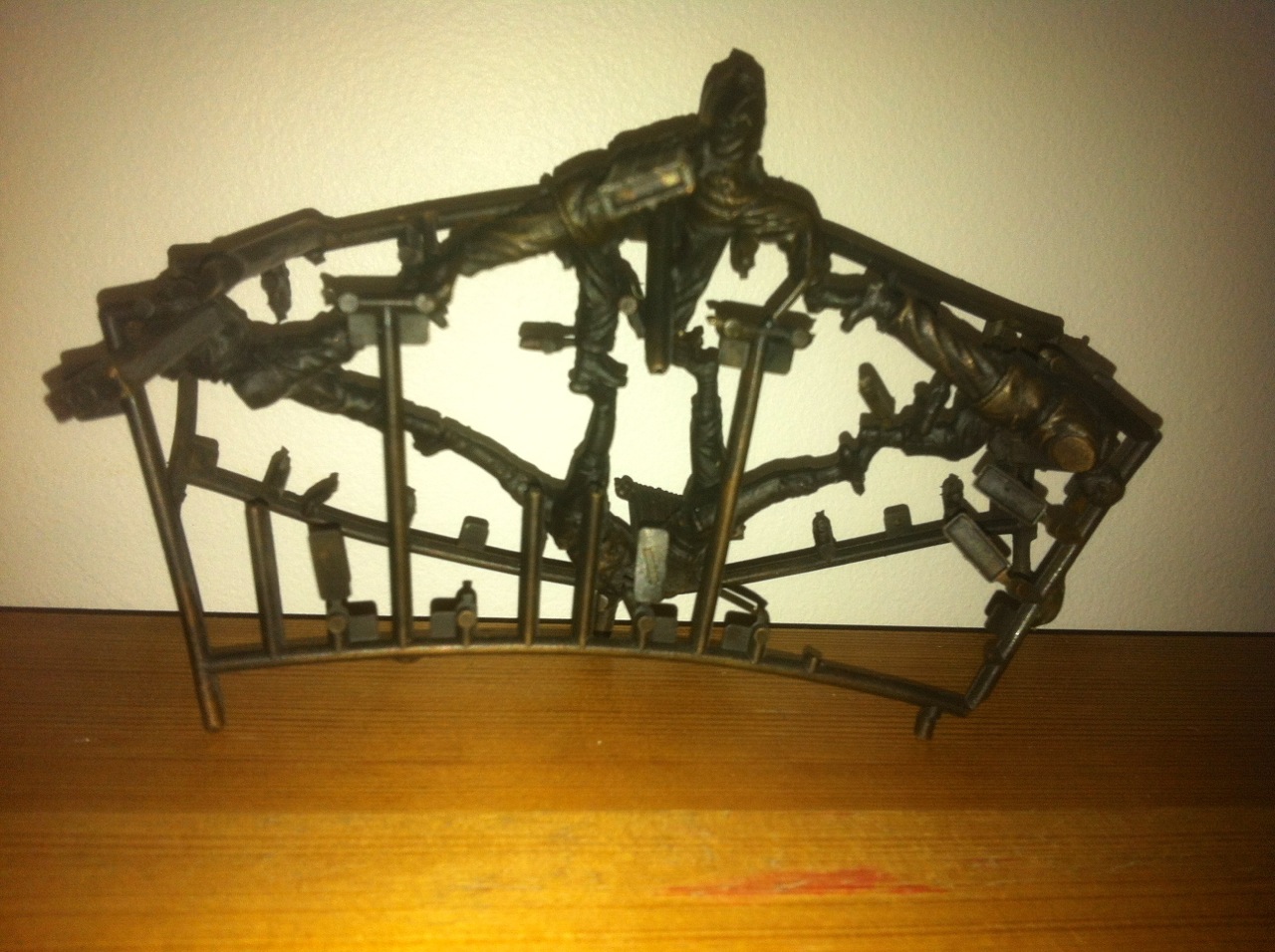
The first, a couple of weeks ago, is an intricate little sculpture by Sam Valenz, a bronze version of one of those plastic frames that toy solders come in, with the soldiers in various stages of removal from the frame, and various stages of mutilation. Here’s front and back:

IMG_0680 IMG_0681

This was a gift from the artist to the Art Student – he was her sculpture teacher, and the gift was to acknowledge the work she has done organising in a number of ways to defend and extend The Gallery School at Meadowbank TAFE.

Then, yesterday was the AGM of FAIM (Fine Arts Meadowbank, Inc.) which the Art Student got up and running over the last 12 months to promote art in the Ryde Municipality and in so doing raise the profile and the survival chances of The Gallery School. She resigned as president, and then was completely bowled over when Rew Hanks, her printing teacher and a printer of international renown (click for a review of his most recent exhibition), presented her with an artist’s proof of his ‘The Hunter and Collector’, a huge image of Joseph Banks, for which all the teachers had chipped in for the frame:

Rew_Hanks_The_Hunter_and_Collector_1342506472

Well, she has been running herself ragged, but this was an amazingly generous gift.

Then today, a more conventional acquisition. We went to the Damien Minton Gallery this afternoon where there is an exhibition of Aboriginal art to commemorate the 20th anniversary of Paul Keating’s Redfern Speech. Gail Mabo, daughter of Eddie Mabo, spoke , and recited part of the speech:

We took the traditional lands and smashed the traditional way of life.
We brought the diseases. The alcohol.
We committed the murders.
We took the children from their mothers.
We practised discrimination and exclusion.
It was our ignorance and our prejudice.

As the Damien Minton Gallery is just down the street from Redfern Park, where the speech was made, there was a tremendous sense of place and occasion. But before the speeches – which also included a marvellous ‘Welcome to No Country’ by artist Adam Hill, who sang a welcome in four different languages, four very different singing styles – the Art Student had already fallen in love with and bought one of the works in the exhibition, Beyula Napanangka’s ‘Kalinykalinypa Tjukurrpa‘. That link is to an image on Damien Minton’s webite, but it doesn’t capture the subtlety of the actual image, and nor does this from the Art Student’s phone, but you get some idea:

IMG_0499

We bought this painting, partly to honour the occasion, partly because we’re both reading Crossing Cultures, the catalogue of an exhibition in the USA of Indigenous Australian art, the gift of Harvey Wagner and Will Owen to the Hood Museum in Dartmouth, New Hampshire – of which I will blog, at least briefly, soon. As we were driving to Redfern this afternoon we were talking about how one of the essays brought home to both of us something of what it means to say that Aboriginal culture has a special connection to country: our minds were well and truly prepared to be enthralled by that Napanangka’s painting.