[Because the older version of this blog has become unreachable, I am retrieving at least occasional posts from it that I see people trying to click on. This is one from October 2008.]
As promised, here’s an update on the corner shop. It’s something like 21 months since it began its painfullyslow rise from the dead. Like the June deadline before it, the September deadline has come and gone.
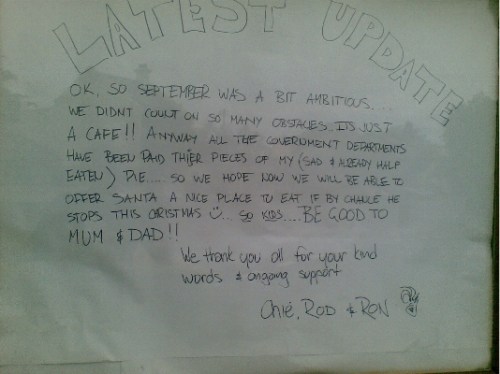
A new bulletin has appeared in the window:
I don’t know if it’s significant, but Chie has moved to the front of the list of signatories, and she and Rod have been joined by Ron. I’ve not yet met Chie, and Ron is probably the older man I’ve seen about the place fairly regularly, though given the amount of time that’s passed, it’s quite possible that our prospective storekeepers have a baby or even two. Oddly à propos, Penny and I were talking to an old friend last night who has transformed from a leftist university student into a property developer, and he evoked for us the agonies caused by paperwork sitting for weeks, even months on a desk somewhere in a bureaucracy waiting for someone to pass it on for gazetting. It sounds as if our ever closer but never quite here corner shop may have had its share of such experiences
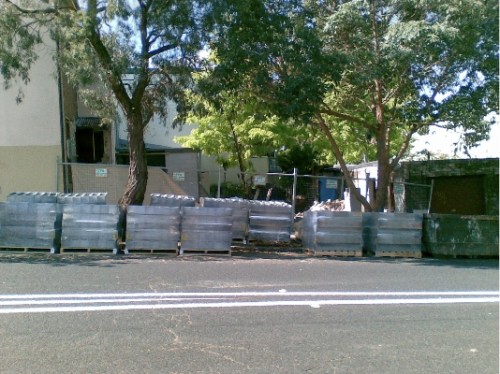
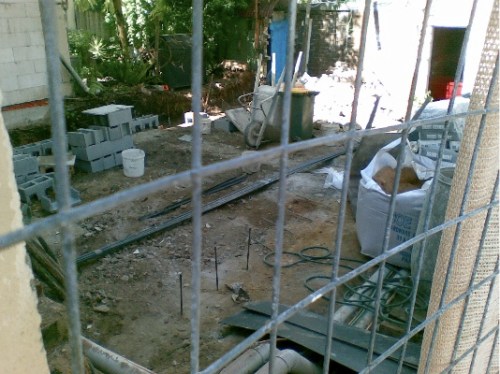
The back yard has been opened up and is in the process of being paved, or perhaps built on.
And here’s a bonus photo, found in my phone, of a plastic omelette as seen at Narita Airport. Mmmmm!
[Because the older version of this blog has become unreachable, I am retrieving at least occasional posts from it that I see people trying to click on. This is one from September 2008.]
We’re home from nearly four excellent weeks in Japan. As assiduous readers of this blog will realise, my blogging software (iBlog) sits on my laptop, which spent the last weeks on our kitchen table at home. Hence my blog silence except an occasional comment posted from Internet cafes. Now I’m back to a slightly changed world: the ornamental plum tree on our nature strip is in bloom, my elder son has appeared in a small speaking role in a show on national television (he speaks in series 2, episode 4, at about 6 minutes and 30 seconds), a pile of mail has accumulated, the dog is fat and healthy, the corner shop has still not re-opened for business, and the state Labor Party is in deep trouble. And I’ve told you almost nothing of my holiday.
But I don’t intend to leave the trip totally unblogged, partly because I’m an addicted blogger, and partly because I am now convinced that people need to know how fabulous Japan is to visit (unless you’re allergic to seafood, of course). Inspired by franzy’s current-sentence-a day-project, I plan to put up a post a day, reporting on the day exactly a month before — as we left on 15 August, my first travel blog entry will go up on 15 September. I’m setting a time limit for myself, so I don’t get intimidated by the task. And in the couple of days between now and the 15th I’ll post about the books I read, of which there were many, since as it turned out we hardly went out at night at all. Um, so if you were hoping for graphic tales of the famous risqué nightlife, abandon that hope now. Tomorrow: Japan books # 1.
I had credit to spend at Sappho’s bookshop, and this book leapt to my attention. It cost more than my $8 note, but I recognised Shane McCauley’s name from the ancient days when I was editor of The School Magazine. (Note: I’m not the editor any more. I refer you to the magazine’s helpful tips for manuscript submission.) There’s one beautiful poem in particular, ‘Clouds’, illustrated by Tohby Riddle (in Orbit, November 2003) with a small figure of a child, in the centre of a page filled with dark grass, looking straight up at the viewer, who is positioned as one of the eponymous clouds. I’d never read any of his poems for grown-ups (I hate that word, but adult has been co-opted), and here was a chance. The poems really are for grown-ups: to enjoy them, you need to be either alarmingly well-read or unintimidated by encountering someone who is much better read than you. I’m in the latter category. The range of reference is huge: from an aged Samurai arranging flowers to an Islamic executioner, from Ancient Greece and Rome to Chuang-tzu, from Western Australian landmarks to scientific and mythopoeic cosmology. And I trusted his references: when he attributed thoughts to La Perouse in the long ‘La Perouse to Eleanore’, I believed he had immersed himself in La Perouse’s writing enough to have got it right. I intend reading this again.
During my time at The School Magazine, we published Stephen Whiteside’s poems regularly. And that’s probably the only thing his poetry has in common with Shane McCauley’s. This is his second self-published book, and probably because its back cover includes a quote from this blog, he kindly sent me a copy. Most of the pieces date from the early 1980s when Stephen did a lot of performing (Aha! Another similarity: according to the flap of The Butterfly Man, Shane McCauley was a founding member of a performance poetry group on Perth. However, I doubt if he ever put on a funny hat as Stephen did.) These aren’t poems intended primarily for children, and if I’ve read any of them before it was to reject them (sorry!). They are mostly good rollicking fun with some history, some genial satire, a little bush-philosphising and a touch of melancholy. Many of them latter-day bush ballads, and as an added grace there’s a short, often affectionately deprecatory introduction to each one. You can buy a copy from www.bookstore.bookpod.com.au or, I assume, at Stephen’s readings. (One last note: I suppose I should be glad of it, but I find myself lamenting that in the featured poem about the horribly cold town Omeo, he did not stoop to ‘Omeo, Omeo, wherefore art thou, Omeo?’)
The New Yorker of 21 July features an article by Jill Lepore about ancient literary battles in the USA.
Anne Carroll Moore (1871–1961), first superintendent of the New York Public Library’s Department of Work with Children, wielded enormous power in children’s literature in the USA during the first half of the twentieth century: ‘Her verdict, not any editor’s, not any bookseller’s, sealed a book’s fate,’ Lepore writes. ‘She kept a rubber stamp at her desk that she used, liberally, while paging through publishers’ catalogues: “Not recommended for purchase by expert.” The end.’
The article tells how E B White’s first book for children, Stuart Little, brought an end to her influence. She hated the book, reportedly writing to White that it was ‘written by a sick mind’, and recommended against it. In 1945, an amazing first print run of 50 000 hit the bookshops, and though ACM’s hostility initially slowed sales down, she was helpless against the tide of its popularity. Behind these events lay a great shift in what was understood to be excellent in children’s literature. Anne Carroll Moore ‘loved what was precious, innocent, and sentimental. White [both EB and his critic–librarian wife, Katharine] found the same stuff mawkish, prudish, and daffy.’
I don’t know if the history of Australian children’s literature boasts any personalities of the magnitude of Anne Carroll Moore or E B White, but I’m feeling impelled to blog a little about some rough equivalents. The School Magazine, subtitled ‘A Magazine of Literature for our Boys and Girls’, was coming into existence at about the same time as Anne Carroll Moore was setting up the Children’s Room behind the lions at the New York Public Library and winning the right for children not only to enter the library but even to borrow books. But who remembers the name of the magazine’s first editor, Inspector Stephen Smith? Since Mr Smith kept fairly busy earning his place in history as an educational mover and shaker, setting up correspondence schools and the like, it probably makes sense to think of Doris Chadwick (1899–1979), generally acknowledged as occupying the chair from 1920 to 1960, as the real first editor.
As far as I know, no one has written much about Doris Chadwick. Yet she did wield significant influence over children’s literature in Australia during the period of Anne Carroll Moore’s dominance in the US. She decided what poems, short stories, songs would be encountered by generations of primary school students in New South Wales. She may not have made or broken careers, but she almost certainly gave thousands of people their first taste of C J Dennis, May Gibbs, Henry Lawson, Mary Gilmore, Wordsworth, Blake, Tolkien, Aesop, as well as stories with titles like ‘Fairy Twee Wee’s Adventure’ (by ‘Neelia’, 1916), which Katharine White may well have found mawkish, or ‘Two Days at a Shearing-Shed’ (W M Corrigan, 1920).
I know two artists who illustrated for Miss Chadwick’s magazine in the 1950s. By that time she was deaf, and very aware of her dignity. When the young Noela Young was ushered into her presence she was asked to wear gloves and instructed to curtsey, which she did to the best of her ability. ‘Ah, yes, I remember you,’ said Doris when introduced to a promising art student, Astra Lãcis. ‘I didn’t recognise you without your hat.’ Astra never wore hats, and this was their first meeting. By that time, without the benefit of a battle in the New York manner, the power was passing to a new generation: Noreen Shelley, assistant editor, was soon to be in charge. She published an excerpt from Stuart Little in 1961.
In the last week and a bit I’ve been to a workshop in the US, which involved large slabs of time in planes and airports and close to 24 hours in a Golf Country Club in Taiwan, the latter because my Taipei–Sydney flight had vanished from the schedule. I’ve had lots of bloggable adventures, but for now, here is What I Read:
Sydney–Taipei: I first met When the Sergeant Came Marching Home years ago in the form of four short stories submitted to The School Magazine. We published them with the series title, ‘Scenes from a Canadian Childhood’, and reprinted them more than once. Now, in hard covers and with an overall narrative arc, they’re still a joy: two boys come to terms with their father’s return from killing Nazis and almost immediately uprooting them and their mother from their suburban lives to take on the life of a struggling farmer. For the book, someone has decided to transplant the farm from rural Canada to US-book-buyer-friendly Montana, but other than that the stories are as fresh, their ironic comedy as laugh-out-loud as ever. (The mother is called ‘Mum’ once, and it’s a rare case of a proofing error – if it is one – that gave me pleasure, providing as it does an archaeological trace of the family’s past life as Canadians.)
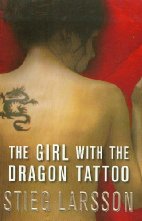
Taipei–Los Angeles, Los Angeles–Boston:The Girl with the Dragon Tattoo was recommended to me as ideal plane reading. It’s a Closed Island Murder Mystery that morphs on its way to a predicable surprise ending into a Hunt for a Serial Killer. The original Swedish title translates literally as something like ‘Men Who Hate Women’, which as you might expect reveals a good bit of the plot. The English title has the virtue of focusing the reader’s attention on the novel’s most interesting character; sadly, the alluringly feminine Quercus paperback cover gives a radically false impression of her. But spiky hair, piercings, and a hint of the sociopath probably wouldn’t have sold as many books. It’s the first of three books, will almost certainly be made into a movie, and was in fact perfect plane fare, and the right length for this trip. I finished it soon after arriving in Boston.
Boston, then Boston–Salt Lake City, Salt Lake City– Los Angeles: I also packed two slim vols of poetry, which also turned out to be perfect travel fare: taking up hardly any room, they provided satisfyingly complete short reads before sleeping the sleep of the sleep-deprived and jetlagged; they were excellent for quelling panic when I turned out to have been booked on a non-existent flight with nothing to do but wait for my name to be called on the hastily found alternative; and when on this flight and in Taiwan I found myself bookless, they bore rereading.
So I consider myself in Jacob G. Rosenberg and joanne burns’s debt, even though many of the former’s poems, despite giving the initial impression that they are a sonnet sequence, read like fairly prosaic notes on the way to his wonderful memoirs East of Time and Sunrise West(as if the gruelling subject matter made attention to anything much more than bald narration seem pernickety), and I read a number of the latter’s offerings with bemused incomprehension. Inspired by Jeanette Winterson on The Book Show, however, I spent a good bit of this leg of my travels memorising poems, and they richly repaid the effort. For the record, I can recite number xii of jb’s ‘diversions’ (beginning ‘The wall longs to be rubble’) and her lovely elegaic ‘ecce’. From JGR’s book, I have taken possession of ‘My Sister Pola’, one of the Holocaust poems.
Los Angeles–Taipei: I don’t suppose Los Angeles Airport is anyone’s favourite place in the whole world, but it’s just moved down a peg or two in my affections. After queuing for maybe a total of an hour to check in, to have my check-in baggage x-rayed, to pass through immigration and to submit to a shoeless personal security check, I discovered that if I wanted a book to read over the next 25 or possibly (and as it happened, factually) 49 hours, I had a grand total of 16 books to choose from. The spanking new collection of David Sedaris essays was the only one that beckoned to me, and it proved to be a diverting read. Sedaris’s charming self deprecation and irony sometimes makes it hard to hear his more serious voice, but it is there, and the book offers meditations on death and lyrical celebrations of his beloved partner Hugh without becoming unreadably earnest. The long section on giving up smoking while holidaying/vacationing in Tokyo is full of delights. I decided two things, however: if possible, I’ll take any future Sedaris aurally, because he’s much funnier and more moving that way; and I’ll read some essays by Montaigne, originator and master of the form.
Taipei: The search for something to read continued in my enforced 24 hour layover: nothing but golf magazines and a 14 year old tourist booklet in the Miramar Golf Country Club, which was also miles from the nearest shop of any kind, let alone English-language bookshop. An anguished email home (thank heavens there was an Internet nook) gave rise to much merriment.
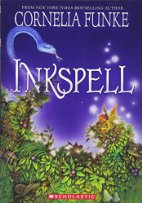
Taipei–Sydney: It was a relief on arriving at Taipei International Airport to discover there was a bookshop, even though it had only a couple more English-language books than LAX: the choice boiled down to The Kite Runner for 530 new Taiwan dollars or Inkspellfor 350. I opted for the children’s book, sequel to the marvellous Inkheart. I’ll write about it when I’ve read more than 50 pages (because, yes, I slept, and even watched a movie).
[I originally posted this on 10 June 2008. I’m making it public now as it’s relevant to a piece I’m writing about the Voice Referendum. 31 August 2023]
OK, I’ve seen the light. Instead of a marathon post at the end of each month about the books I’ve been reading, the plan is now to post entries much more frequently – which reflects more accurately the way those longer posts (20 of them by my count) were composed. I don’t know whether I’ll do a post for every book I read, or a weekly post, or something more idiosyncratic, but the posts will be shorter and more frequent. They won’t be reviews, though if I I feel the urge to write a review I won’t necessarily resist it. My aim, as with the longer posts, is to keep some kind of record of my reading. If I was commenting on paintings visited, I hope I would be doing something less like an art gallery audio-guide and more like the Dear Art Please Touch Me project I heard described on Radio National’s Artworks recently. That project, created by two young artists, Danielle Freakley and Elizabeth McGechie, is an audio tour of the National Gallery of Victoria in which you hear a soundscape of ordinary people giving their idiosyncratic responses to the art. In my case, I do hope you’ll add your own comments, idiosyncratic or otherwise.
I’m kicking off the new regime with Kay Anderson’s Race and the Crisis of Humanism (Routledge 2007), winner of the 2008 Gleebooks Prize, one of the NSW Premier’s Literary Awards. I wouldn’t have noticed the book if I hadn’t been pointed at it by the awards. I wouldn’t have bought it and started reading it if I hadn’t been so taken with Raewyn Connell’s Southern Theory earlier this year, and consequently been interested in the impact of early European–Aboriginal encounter on European theorising, which is pretty much the concern of this book. And I wouldn’t have persisted with its dense academic prose, which fairly bristles with learned referencesand also with the proofreading oversights and chaotic use of commas that seem to be inevitable in such publications, if there wasn’t a promise of fresh insight into the nature of racism.
I’m glad I read it, because it introduced me to apparently vast scholarly conversations about race and racism, and about the history of people’s understanding of what a human being is, among other things. Its central argument is something like: let’s agree that the concept of innate differences between people of different ‘races’ was developed over the last couple of hundred years, and had the function of rationalising the genocidal brutality of nineteenth century colonialism; but describing its function isn’t a full explanation of where it came from; European thinkers took their own specific society to be a universal human condition, and as they encountered different-looking and differently organised peoples their understanding of what it means to be human was challenged; rather than change that understanding they found a series of ‘scientific’ ways to define the new people as lesser versions of human. Something like that – but a lot more carefully argued, and more interesting. Kay Anderson brings a coldly analytic eye to some fairly monstrous pieces of writing, all the more monstrous because I recognise in a lot of them a kind of full-blown, explicit version of ideas that still float around today, some that were presented as simple fact in my childhood education.
At some points in the book, I felt an almost physical pain at the absence of Aboriginal voices. As the European scholars – few of whom had ever visited Australia – argued back and forth about the status of ‘the Tasmanians’ and ‘the Australians’, collecting their skulls and measuring them obsessively, it was almost impossible not to think of the deep satisfaction of a man and woman in a recent Awaye program describing sleeping in the same room as ancestral remains reclaimed from a European museum before loading them onto a homeward-bound plane. As the scholars pontificated about the inevitable ‘extinction’ of the Tasmanian Aboriginals, I recalled James Boyce’s account in Van Diemen’s Land of the machinations, negotiations, lies and evasions of the British Governors who oversaw the massacres. As they rabbited on about the ‘unimproveability’ of the Australians, I was glad to have read Inga Clendinnen’s meticulous attempts to retrieve from the colonisers’ own records an account of the first years of contact in New South Wales from the point of view of the invaded. And once or twice, when something felt personal about someone I know, I almost shouted out loud, ‘Shut up! Just shut up!’ Kay Anderson has a much stronger stomach that I do: she actually goes in and tries to understand where the vile stuff comes from.
[Because the older version of this blog has become unreachable, I am retrieving at least occasional posts from it that I see people trying to click on. This is one from October 2008.]
>It’s been a while since I’ve posted anything about our block’s long, slow journey towards once again having a functioning corner store. There have been signs of progress lately. The windows have been replaced, or at least had their woodwork scraped back and varnished, and noises and lights have been reported at odd times of the day and night, mostly on weekends. Sadly, before I could have a stickybeak and maybe take a photo of developments, all the windows had white paper sticky-taped to their insides, so developments have been shrouded in mystery … until today, when a news bulletin appeared on one of the papered windows:
I don’t know that I’d thought of the corner shop as an icon, but it certainly has been a treasured institution, and I’m sure I’m not alone in thinking: ‘Come, September!’
[I posted about this in my old blog in 2008, and am retrieving it to this one because it mentions Somewhere Towards the End by Diana Athill, who died in January, and whose more recent book of essays, Alive, Alive Oh! I plan to blog about soon – JS, 31 March 2019]
As I mentioned last month, I started reading Schulz and Peanuts to check its suitability for a young fan. I’m happy to report that in general it passes with flying colours. A young woman has a termination, and the break-up of ‘Sparky’s’ first marriage is gruelling, but these are both handled with a good bit more tact than you’d find in many YA novels.
Every week, for just months short of 50 years, Charles M Schulz sat at his drawing board to produce six daily strips and a longer Sunday piece. He inked every line himself, and penned in every letter until his final stroke meant that the speech balloons in the very last frames were filled by computer-generated lettering. Peanuts was the most important thing in his life; he hated being away from home, and died the day his last cartoon was published.
This isn’t a tale of heroic physical exploits or grand public gestures, but David Michaelis seems to have interviewed every living soul who had a meaningful connection with his subject, from the psychology student who gave him an impromptu – and effective – counselling session on his agoraphobia at a tennis tournament and never had another conversation with him, to Joyce nee Halvorsen, the main model for Lucy, his first wife and the mother of his many children (one of the best bits of the book could have been titled The First Wife’s Story).
The result is a fascinating, many-faceted portrait of an artist and of a man. Peanuts strips are scattered through the pages, not as decoration but as integral elements of the narrative. Cartooning was not only Schulz’s life work, the fulfilment of a central ambition; it was also, dare I say, a spiritual discipline by which he found perspectives on the difficulties and dilemmas of his life (and the lives around him) that allowed the release of laughter. While Michaelis is very bold (and repetitive) in some of his psychologising, I found his thesis persuasive: that what we common or garden readers received as Schulz’s comic reflections on life in the abstract were often if not always born out of particular moments of pain or joy. Schulz seems to have been an excellent exemplar for Neil Gaiman’s advice on how to deal with trouble: Make good art.
Michaelis places Schulz interestingly in the history of comics – though he barely mentions comic books as opposed to strips, and surely the moral panic in the 1950s epitomised by Fredric Wertham’s Seduction of the Innocent (which led to a nun confiscating a Phantom comic from me in Grade Three, and to our teachers’ recommending that we read the boring Catholic comic Topix) had something to do with the runaway success of Schulz’s wholesome creation. It’s surely not entirely coincidence that for a time in the 1940s, before he got his big break, Schulz did lettering for Topix.
[I passed the book on to my young friend, whose mother reports that after dipping into it he said, ‘It’s not all that interesting to me, even if it is to Jonathan. But he reads everything.’ Then, softening the blow, ‘Some of it is pretty good.’]
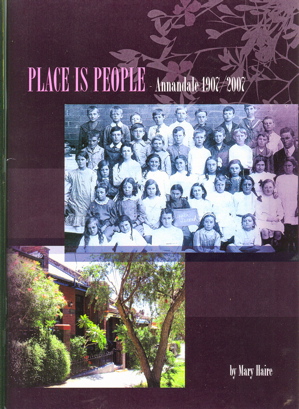
Place is People is a strange little book, neither an attractive collection of photographs to introduce the suburb to visitors nor a quick historical overview. It’s got elements of both those, but is something more personal and less orderly than either; if it was even more personal, it might have been an extended prose poem, but it isn’t quite that either.
Mary Haire leads walking tours, and the book has something of the serendipitous feel of such tours: here’s a little girl walking to school; let me tell you about a boy that age who went to the same school a hundred years ago. I know more about my suburb’s history having read it; some errors have been corrected, and some tantalising trails laid in my mind: Cardinal Freeman was born here, for instance, and the young woman at the florist’s is a single mother. How can I put those two snippets in the same sentence, you ask? I plead that the book sets a precedent with its gloriously unconcerned potpourri approach to its subject.
Talking at Gleebooks recently, Helen Garner paid tribute to Elmore Leonard’s essay, ‘Ten Rules of Writing‘: she has his sentence, ‘If it sounds like writing, I rewrite it,’ on the wall above her desk. In The Spare Room, she has given us a feminine Elmore Leonard story: it’s about the emotional tangles between two women, or at least those tangles provide the language for its telling, but it has the clean lines, the sure forward movement, the lack of hooptedoodle, that give such pleasure in Leonard’s tough-guy narratives from The Tall T to, say, Pagan Babies.
It’s a very quick read, and an intense one. There’s plenty of complexity, some of which I’ve found making itself known to me weeks after finishing the book. For instance, ‘Helen’ the character, who is manifestly a version of Helen the writer, claimed my allegiance and assent to her judgements while I was reading, but has since come to seem much less reliable, much too caught up in her own emotional reactions to be able to give us the full picture (some of which the book gives us in spite of her). It’s a magnificent achievement.
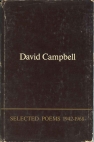
I doubt if David Campbell (1915–1979) is still studied in Eng Lit courses at many Australian unis, but I hope he is fondly remembered and occasionally reread by more than just me. He and Martin Johnston share a posthumous moment in John Forbes’s elegiac ‘Lassù in Cielo’; he cropped up in a footnote in the John Manifold collection I read last month; a recent Poetica featured his correspondence with Douglas Stewart; lines and images from his poems arrive in my mind unbidden from time to time.
Most of the poems in this selection are a strange mixture of the bucolic and the erudite (and just in case I’ve misused those words, I mean rustic and scholarly), and there’s a pleasant music to them. When I read the sequence of twelve twelve-line rhyming poems of ‘Cocky’s Calendar’, I found myself wondering how he managed to pick up his pen again after writing something so wonderful. Back in the early 1970s, in an Aust Lit seminar on this sequence, a student from North America totally didn’t get them: while the rest of us were being drawn into the poetry’s intensely personal relationship with the landscape, he lost patience altogether and said the whole thing read like verse you’d find on a Norman Rockwell calendar. I thought then that he was missing something, and I find I still do. This is the ninth poem, for September:
Under Wattles
Now, here and there, against the cold,
The hillsides smoulder into gold
And the stockman riding by
Lifts to the trees a yellow eye.

It's here the couples from the farms
Play in one another's arms
At yes and no – you'd think the trees
Sprang from their felicities.

So may our children grow up strong,
Got while the thrush drew out his song,
And love like you and I when we
Lie beneath the wattle tree.
How about that present tense ‘lie’, eh?
I think the sequence as a whole speaks to me so strongly because of my father. At a family gathering once, another farmer, of a younger generation, said something about the boredom of spending a whole day driving around a paddock in a tractor (this was before the days of air-conditioned tractor cabins and iPods). When my father said mildly that he didn’t get bored, one of my female cousins asked him what he did with his mind when he was out there all day. As he drew breath to answer, my mother came to the rescue by changing the subject (‘Oh Jenny, you know you’ve been asking me about tatting, I have a pattern here I can show you’). Probably to his relief, my father didn’t get to answer the question. I like to think that David Campbell’s contemplative poems, even though his is a sheep property while my father grew sugar cane, provide some version of what my father might have wanted to say back then over tea and scones.
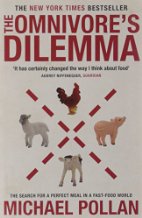
With The Omnivore’s Dilemma I was back to farming, in three categories: industrial, of which I read with a mixture of horror and curiosity; pastoral, which is not synonymous with ‘organic’, but tends to have the virtues claimed for it; and personal, in which the author creates a meal from things he has personally grown, hunted and killed, or foraged. I don’t know that anyone could read this tremendously engaging book without changing the way they think about food. It’s very heartening that it was a New York Times best seller. If you want a quick look at the central part of the book, which deals with ‘intensively managed grazing’ or clever grass farming, here’s a video from Michael Pollan’s recent TED talk:
The book integrates into its narrative any number of lively essays: on the ethics of meat-eating (in which Pollan engages with Peter Singer), the joys of hunting (ditto Ortega y Gasset), attempts at humane design in modern abattoirs (Temple Grandin), the US domestic and international politics of corn (in which he doesn’t discuss the so-called Free Trade Agreements that leave the US free to subsidise its grossly inefficient corn agribusinesses while preventing other nations from continuing with similar protections, but he makes their absurd brutality abundantly clear), on just about anything you can think of that’s related to his central question, ‘What should we have for dinner?’ Some of it is very funny. Some is inspiring. Some horrendous. All of it is engrossing.
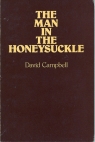
I hadn’t read David Campbell’s The Man in the Honeysuckle before. As with Selected Poems, I’m fairly indifferent to the learned bits, mainly translations and imitations from the Russian, but some of the lyrics, especially the Aust Pastoral pieces, are extraordinary. The book was published posthumously, and it’s hard not to read a number of the poems as being poignantly suffused with a sense of death as imminent. ‘Crab’, ‘The Broken Mask’ and the whole ‘With a Blue Dog’ section stand out for me in this first encounter. How’s this:
Wind in Casuarinas

Camped under the she-oaks
With a dog and swag

The woman a white sapling
A straight flame
Blown all ways
And the children off
On their several roads

Lives rounding like river stones
Or washing out in wheel ruts

A high sky over tree and hill
And the clouds taking fire
I am spread out I burn
Yellow and rose – blessing and blest
A still flame in the arms of the she-oaks

Life butting into the world
With five wants and a howl
And shambles out with a blue dog.
I want to put ‘five wants and a howl’ right up there with ‘helpless, naked, piping loud’.
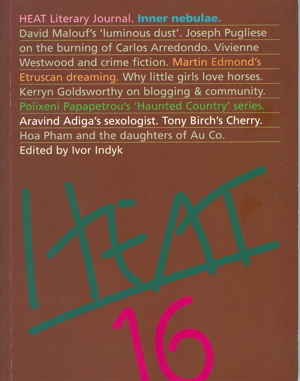
I don’t imagine Elmore Leonard would care much for this Heat. There’s hoptedoodle galore … though generally very high quality hoptedoodle. Ironically, the one article that seem to me to be 90 percent hoptedoodle is by a crime writer whose point seems to be that crime fiction has advantages from being bound to an absence of hoptedoodle (but maybe I was just irritated because her essay on the relationship between genre fiction and literary fiction totally ignores the existence of children’s literature and science fiction).
There’s a terrific piece on blogging by Kerryn Goldsworthy, not a hopt or a doodle in sight; a lovely pairing of a story by Eva Sallis (‘Abattoir’) and an essay by Elizabeth Campbell (called ‘Why Little Girls Love Horses’ on the contents page but ‘Envy Worship and Passion’ on its own title page); chiming mentions of the catacombs of Paris, of which I’d never heard, first in one of Jennifer Maiden’s still-intriguing George Jeffreys–Clare Collins poems and then in an engrossing essay by Sarah Knox about researching historical novels, her own and Hilary Mantel’s; and a number of memorable pieces on aspects of migration: Elisabeth Holdsworth’s memoir ‘New Holland’, a short story by Hoa Pham, poems by Ali Alizadeh (on his unborn baby) and Peter Skrzynecki (on his late father). There’s lots more. I’m a happy subscriber.
I understand that it must be a nightmare to copy edit a magazine like this: so many words, so many different voices, so little time. But there are enough lapses to present a significant obstacle to the reader, at least to this one. At one point, havoc is ‘wrecked’; as something wreaks havoc just a few pages later in the same article, it seems likely that the error resulted from an editor’s dependence on a spellchecker rather than ignorance. In the sentence, “The memoir becomes a book about illness to many reviewers; a ‘survivors’ tale; a plumbing of the issue of women’s health, and the continuing masculinist paternalism of the public health system” it looks very much as if the apostrophe after survivors was misunderstood by someone who inserted another before it to make it function as a quote mark; and the comma after health almost derails the sense. I don’t want to go hunting for similar moments, but the erratic comma and absent apostrophe in ‘reconstruction, so redolent of the historian’s duty, and the re-enactors fancy’ just leapt up at me from further down the same page (p 172). This might be just the irritated snitchiness of an underemployed pedant, but in this context it becomes hard to tell if the truly eccentric punctuation in a number of the poems is what the poet intended or the product of editorial inattention.</curmudgeonly grumble>
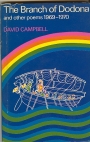
How could I resist reopening The Branch of Dodona, my only other David Campbell book? This one had pride of place in the bathroom for a week, to allow for contemplative reading in short bursts. Again, it’s his farming poems – in this volume, the ‘Works and Days’ sequence, with its love–hate relationship to sheep – that speak most strongly to me. Even his ‘My Lai’, which I remember him reading at Vietnam Moratorium Readings in another age, works so powerfully because of the farmer-to-peasant solidarity it embodies:
I was milking the cow when a row of tall bamboo
 Was mowed by rifle fire
 With my wife and child in the one harvest,
 And the blue milk spilt and ruined
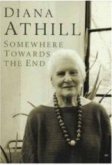
I’m not sure what the friend had in mind who gave me Diane Athill’s reflections on old age, Somewhere Towards the End, as a present for my 61st birthday. As Ms Athill is almost exactly 30 years older than me and still going strong, I’ll assume she wasn’t hinting it’s time I hang up my spurs.
In terms of my current reading, the book’s matter-of-factness, its almost belligerent steadiness of gaze play as a sober counterpoint to the rage and evasion of The Spare Room: both books generate what Athill calls an ‘addictive excitement of the mind’, and they speak to each other. Ms Athill’s brief reference to Hilary Mantel’s A Place of Greater Safety endorses Sarah Knox’s praise of it in her essay in Heat. The book has in spades a (to me) miraculous quality that I think of as Protestant integrity, a quality also displayed, ineffably, in the manner of my friend J’s leavetaking. I wouldn’t mind having a mind like Diana Athill’s when I’m 90. She manages to be remarkably cheerful about things usually discussed, if at all, in gloomy mode. One chapter begins, for example (the emphasis is mine):
When you begin discussing old age you come up against reluctance to depress either others or yourself, so you tend to focus on the more agreeable aspects of it: coming to terms with death, the continuing presence of young people, the discovery of new pursuits and so on. But I have to say that a considerable part of my own old time is taken up by doing things or (worse) failing to do things for people older, or if not older, less resistant to age, than myself.
Can’t you just see that paragraph, followed by the word ‘Discuss’, as an exam question on The Spare Room?
[Because the older version of this blog has become unreachable, I am retrieving at least occasional posts from it that I see people trying to click on. This is one from February 2008.]
As promised a little over a year ago, I’ve been posting about developments at our corner shop. Things seem to be coming to a head, although the only obvious sign of progress at the moment is a lot of texta on the door. Still, though we’ve lost our corner rubbish bin, arguably because of the threat of terror (though more likely because it interfered with the Indian-theme Amex ad shoot in the middle of last year), the politics of hope is alive and well in this part of the world: here’s a sample of the hopes and dreams of people of Our Block. Who knows what the blacked out request was? What will become of the mermaid — will democracy decide? Would Newtownfolk approve of being identified as lentilburger munchers? Where will the sourdough come from? Fajitas? Alcohol? These questions and more may be answered in June.


 I had credit to spend at Sappho’s bookshop, and this book leapt to my attention. It cost more than my $8 note, but I recognised Shane McCauley’s name from the ancient days when I was editor of The School Magazine. (Note: I’m not the editor any more. I refer you to the magazine’s helpful




 It’s been a while since I’ve posted anything about our block’s long, slow journey towards once again having a functioning corner store. There have been signs of progress lately. The windows have been replaced, or at least had their woodwork scraped back and varnished, and noises and lights have been reported at odd times of the day and night, mostly on weekends. Sadly, before I could have a stickybeak and maybe take a photo of developments, all the windows had white paper sticky-taped to their insides, so developments have been shrouded in mystery … until today, when a news bulletin appeared on one of the papered windows: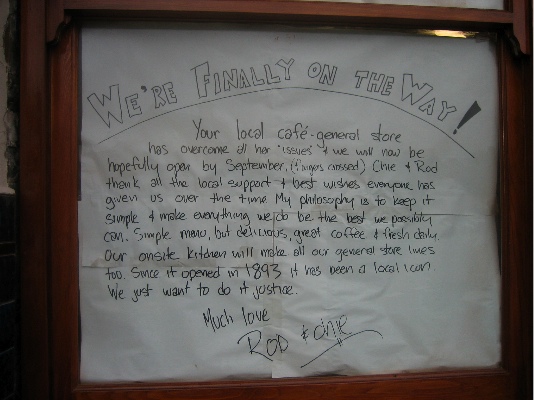



 Me fail? I fly!