One of the persistent joys of grandfatherhood is the chance to read aloud, and reread, some excellent books. This post continues my notes on this pleasure.
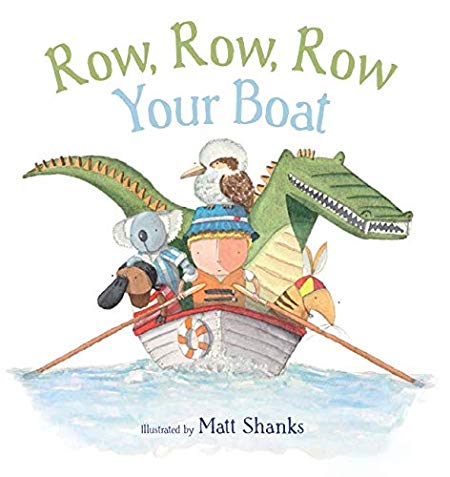
What a joy for Ruby to discover this book. It combines three of her major sources of delight: a kookaburra, a crocodile and the song ‘Row row row your boat’. The uncredited author has added verses to the song that introduce a koala, a platypus, a bandicoot and a kookaburra as well as the crocodile that was already there (‘If you see a crocodile don’t forget to scream’).
I don’t care terribly for the illustrations, but they do a great job with the target audience.
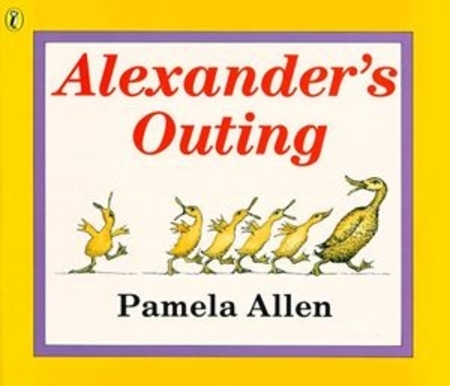
We bought this from the shop at Sydney’s Royal Botanic Gardens, which is the setting for its story of a family of ducks. A song that Ruby requests interminably is ‘Five little ducks went out one day’. The Emerging Artist, in this context known as Nana, does some wonderfully dramatic quacks in that song, and this is a book that offers great scope for more – plus there’s a silly story about a little creature lost and then recovered, thanks to kindness and cooperation. Pamela Allen is fabulous.
This was read to us at Rhyme Time at the library – a total classic that takes us through a range of colours, each attached to an animal. It’s fascinating to read this after I Went Walking (Julie Vivas and Sue Williams 1996), which follows its format closely but does something quite different with the images and has a child observing the animals and in the end having what my mother would have called a love-up with them.
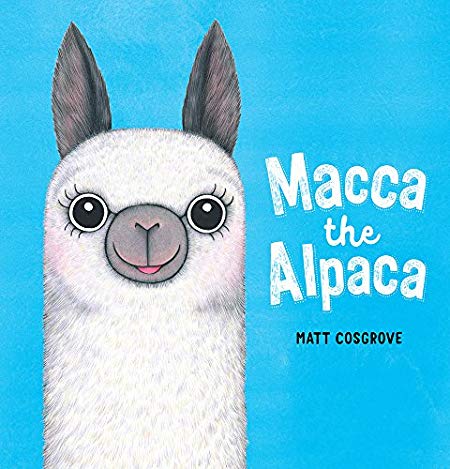
Macca is a sweet, kind, cute creature who meets a big, tough, bullying llama named Harmer, a very different creature from llama-llama-red-pyjama llama who all the same claims the affection, or at least the fascinated attention of our young reader. The bully gets his come-uppance, the skills of the smaller, more agile creature are established, and there is an implausibly sweet reconciliation at the end. As with ‘Row Row Row Your Boat’, Ruby likes this a lot more than I do.
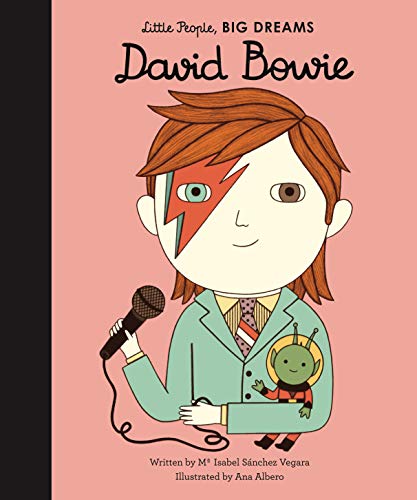
Not really a Ruby Read, this one. The EA and I recently spent an interesting evening with a five-year-old boy while his mother was out. We listened to ‘Old Town Road‘ at least ten times and then on the way to sleep I read to him – his choice – an encyclopaedia entry about volcanoes, and this book. It’s the story of David Bowie’s life as a fable about a boy who felt he didn’t belong becoming very successful and widely loved through, in part, embracing his difference. (Also, I didn’t know what happened to his eye.) The round-faced images are slightly jarring, but it’s a lovely framing of Bowie’s story.
Alexander’s Outing is the thirty-third book I’ve read for the 2019 Australian Women Writers Challenge. (Pamela Allen now lives in New Zealand, where she was born, but she lived and created books in Australia for many years. For a time she illustrated for that most Australian of institutions, the New South Wales Department of Education’s School Magazine.)
For nine years now, Toby Davidson has been organising an annual celebration of Francis Webb’s poetry. Toby edited Webb’s Collected Poems (1911) – my blog post here. Though I’ve been enamoured of Webb’s poetry for 50 years now, this is the first time I’ve managed to attend the event (or the second, if the reading at the 2011 Sydney Writers’ Festival counts – my blog post here).
We met in a large room – the ‘Creator Room’ – at Chatswood Library, in the region where Webb spent his childhood. The library has inherited Webb’s collection of paintings – all or most of them bought with funds Webb received as a government grant, funds spent of art rather than, say, food – and his library of books. The paintings and some of his books were on display, along with other fascinating realia, including a photocopy of the handwritten draft of his final poem.
Toby Davidson was an unabashedly enthusiastic MC for an audience that was an interesting mixture of ancient fans (like me), current students (including some from Davidson’s classes) and satisfyingly motley others. The readers:
Robert Adamson, poet (blogged about by me here and here among other places): told us of his awe-struck meeting with Webb in Callan Park Psychiatric Hospital, and read three poems – ‘End of the Picnic’ (an imagining of the arrival of Cook’s ship in 1770 as a spiritual disaster), ‘Morgan’s Country’ and ‘Wild Honey’ (probably my favourite Webb poem, read in a way that had tears on my cheeks). A hard act to follow, but followed it was.
Michael Griffith (author of God’s Fool, his 1991 biography of Webb): quoted Shakespeare’s Sonnet 65 ‘How with this rage shall beauty hold a plea / Whose action is no stronger than a flower?’ as emblematic of key themes in Webb (and his own life), and read us two poems with props – the first part of ‘In Memoriam Antony Sandys, 1806–1883’ with the painting that the poem describes on an easel beside him; and ‘On first Hearing a Cuckoo’ preceded by part of Delius’ ‘On Hearing the First Cuckoo in Spring’.
Judith Crispin, poet and photographer, whose work, according to her web site, ‘includes themes of displacement and identity loss, a reflection of [her] own lost Aboriginal ancestry’: read the dingo’s second speech from ‘The Ghost of the Cock’, and commentred on the extraordinary way it embodied what webb could not have known, the polarity of moon and dingo in an Arnhem Land foundation story; and two other poems, ‘Episode’ and ‘Toward the Land of the Composer’.
Gareth Jenkins, poet, spoke among other things of the sonic, rhythmic quality of Webb’s work, his mastery of long lines, and read, beautifully, ‘The Yellowhammer’.
Richard Miller, self-described as a long-time Webb fan and former musician in, I think, the Sydney Symphony Orchestra, in a complete change of mood, delivered a brilliantly theatrical, over the top rendition of ‘Introduction in a Waxworks’ from ‘Leichhardt Pantomime’.
Two school students whose names I didn’t catch, one from each of the nearby schools that Webb attended: one read the eminently accessible ‘Australian Night’, which Toby Davidson told us Webb wrote between ages of 7 and 10; the other read ‘Compliments of the Audience’, a sardonic take on a poetry reading, thereby concluding the reading part os the afternoon.
Before we broke for an afternoon snack, we were treated to Oliver Miller’s short film Electric, based on Webb’s radio play of the same name about the first use of ECG on a human subject.
I had a great time. Some of the poems I could just about mouth the words as they were read. Others came from the bits of the work that I have pretty much skimmed. Every reader showed some new aspect of the poetry – and of themselves. Michael Griffiths told us that he had been discouraged from writing his PhD thesis on Webb because, the then Professor of Australian Literature at Sydney University said, ‘He’s mad’. And he’s been dismissed by more than one cultural arbiter. But it was a joy to be in a room full of people who are touched, challenged and invigorated by his poetry.
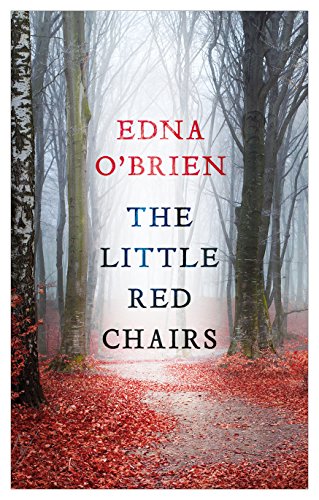
This book’s title, supplemented by a note explaining it before the title page, warns us what to expect. In 2012, the note says, an installation of 11,541 red chairs was set up in Sarajevo to commemorate the twentieth anniversary of the start of the siege of that city by Bosnian Serb forces: one empty chair for every Sarajevan killed during the siege, and of them 643 little red chairs to represent children. Somehow, we are being warned, the horrors of that siege will feature in what we are about to read.
Yet the novel starts out in a tiny community in the west of Ireland that could almost be Ballykissangel revisited – or an Irish version of Doc Martin‘s Port Wenn or Hamish Macbeth’s Lochdubh, with a pub, a policeman, a nun, a refurbished castle. A tall stranger in a long dark coat comes to town, bringing with him a whiff of the exotic, some intrigue, some sexiness. He’s a practitioner of alternative medicines. All set for a cosy comedy except, even if you’re smart enough to have avoided the terrible spoiler on the back cover, you’ve been warned.
The stranger gives a new lease of life to Sister Bonaventure, and his healing hands and herbs do wonders for many of the villagers, especially the women. Fidelma O’Brien, whose older husband can’t give her children, and whose shop selling imported finery has gone bust because a new expressway has meant most of her customers can go to the nearest city, decides she wants to get pregnant by him.
Not unexpectedly, things go terribly wrong. Then, at about the midpoint of the book, when Fidelma is pregnant, the stranger’s past has caught up with him, and the reader is wondering where on earth the story can go now, there is a moment of extreme sexual violence which I for one didn’t see coming even one paragraph before it happened, followed by a deeply distressing, and equally unexpected by me, moment of moral violence. Suddenly, it is a completely different kind of book. It becomes, in effect, Edna O’Brien’s equivalent of a red chairs installation.
The novel moves away from the tiny village, to return only briefly towards the end, and its narrative through line almost disappears in a harrowing series of tales of abuse, dislocation, and refuge. It’s as if the small story of the first half was split open and the whole suffering world was allowed to flow in through the cracks. Edna O’brien is a masterful writer, and she takes the reader with her to some very dark places, to reach a resolution that is a long way from restoring the comfort of the beginning.
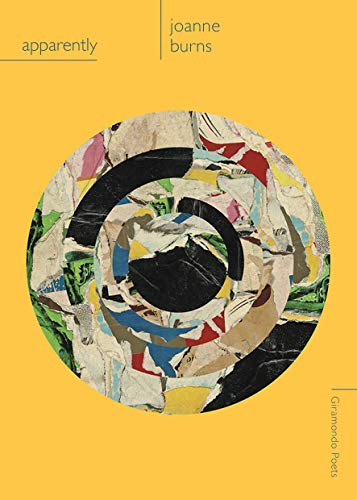
apparently is the sixteenth book of poetry by joanne burns (who prefers her name and work to be written without capitalisation). It’s in four sections: ‘planchettes’, ‘apparently’. ‘dial’ and ‘the random couch’. I enjoyed all four very different parts, perhaps especially ‘dial’, which plays merrily and nastily with contemporary social and political language. But in this blog post I want to say a bit about ‘planchettes’ – partly because I think of my regular readers as wary of contemporary poetry, and my ruminations may cast some light on parts of that forbidding terrain.
People who are perplexed by contemporary poetry sometimes complain that they don’t like poems that are like cryptic crosswords. ‘planchettes’ might have been written in response to that complaint. According to a helpful note on the book’s back cover, the section’s ten poems ‘spring-board from the clues and solutions to crossword puzzles’. I’m not exactly an expert on contemporary poetry (sometimes I approach it with the fearful fascination of a toddler offering a long-stemmed leaf to a beautiful but sharp-pecking rooster). However, I’m a cryptic crossword aficionado, and that helped me to enjoy these poems. I’ll try to communicate something of that joy in three parts.
First: about cryptic crosswords. A recent Guardian cryptic crossword included this clue: ‘Person catching extremists in Ferrari with tank. (9)’ (See it in context here.) The successful solver pays scant attention to its literal meaning, and instead deconstructs it, after any number of false starts, as follows: F and I are the extremes of ‘Ferrari’; sherman is a kind of tank; put F+I with Sherman and you have a 9-letter word meaning ‘person catching’ – FIsherman. Perform similar processes 20 or 30 times and the grid is filled. Only subliminally does one notice the often surreal or absurd images or micro-fictions conjured up by a clue’s surface. In this case: Who are the extremists, and why a Ferrari? who is the person in the tank, and is a weirdly asymmetrical chase scene implied, with an unlikely outcome? Is it a case of wealthy terrorists versus the power of the state? and so on. A solver may only notice the surfaces subliminally, but they are what make some crosswords richly pleasurable, while others offer only the dubious pleasure of pitting one’s wits against the setter (DA of the Sydney Morning Herald, I’m looking at you).
Second: about some poems. There’s a whole kind of poem – academics may have a word for it – that takes language from a particular, perhaps technical context, and puts it on display stripped of context. I was once at a poetry reading where someone read, at length and apparently without any alteration, an editor–proofreader’s marginal comments on a draft engineering manual. As an editor, I was bored by that experience, but I understood (or thought I did) that the poem was a verbal equivalent of a piece of readymade art – as in the urinal displayed as Fountain byBaroness Elsa von Freytag-Loringhoven (and claimed by Marcel Duchamp, but that’s another story). That’s not exactly what joanne burns is doing in ‘plaanchettes’ (and has done in the past with language from the world of finance), though it’s related. She hasn’t just typed out a string of crossword clues. As I understand it, she uses the clues and answers as a kind of restraint. Which brings me to my third part.
Third: restraint. This is a useful concept when talking about poetry in general. (Remember, I’m not an academic, and this is mainly stuff I’ve figured out myself or picked up along the way, and I could be wide of the mark.) Rhyme and metre are familiar forms of restraint: if you want to make up a limerick about Scott Morrison you have to find words that rhyme with one or other part of his name, or maybe his self-chosen nickname, and then see what you can do with them.* Limiting a poem to language found in crossword clues is a more drastic restraint than rhyme or metric form, but the underling principle is the same. Closer to these poems is the cento, where every line of your poem must come from another poem; or erasure, created by erasing most of a text, the poem being what’s left. In these forms, perhaps in all poetry, the result can be as surprising to the poet as to the reader. If you know exactly what you want to say at the start, better write the dullest kind of prose.
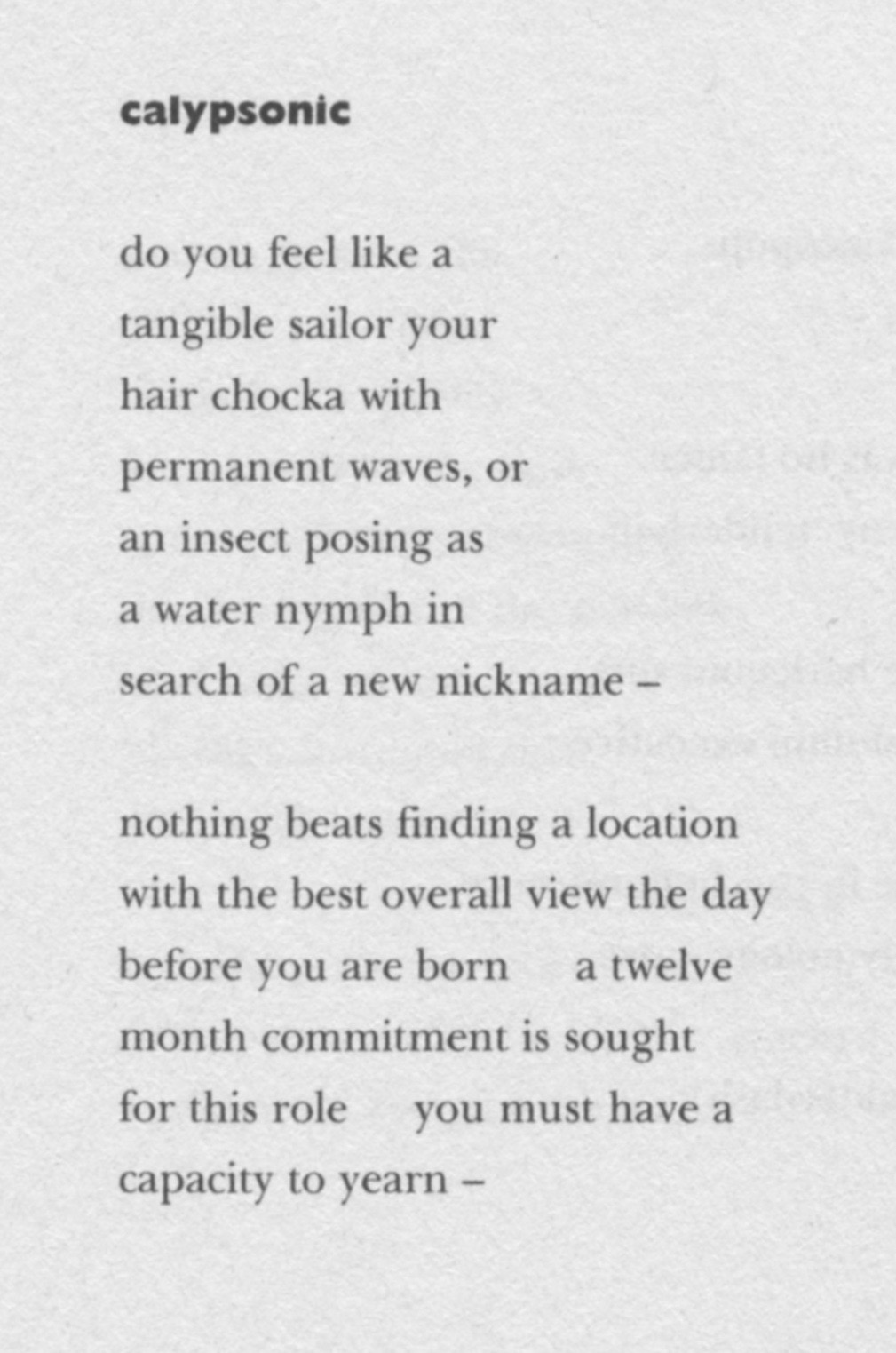
Now on to ‘planchettes’. A planchette, as you probably know and I had to look up, is that little piece of wood on wheels used in séances to spell out messages from who knows where – the spirit world or the jumble and chaos of the combined unconscious minds of the people wielding the wood. I don’t know anything about joanne burns’s process, but the title suggests that the crossword clues and answers are like the letters on a ouija board, and the poet’s mind moves over them, randomly at first and then with closer focus until something emerges that’s coherent, or somehow resolved. The weirdness of crossword clues remains, but not their solvability. Here’s an example, ‘Calypsonic’ from page 5:
I suppose one could scour the world of crosswords looking for the clues and answers that this poem has mined (starting, I imagine with calypsonic as an answer), but to what end? The words on the page are what we have. If you imagine them as having emerged from something like a spiritualist’s trance, not asking them to speak directly, but allowing meanings to swim before our eyes, you have to swim with them for a while and let something emerge – as I imagine they emerged for the poet.
‘Calypsonic’ isn’t in the dictionaries I have easy access to, but I read it as a variant of ‘calypsonian’, meaning ‘to do with the nymph Calypso’. At the start of the Odyssey, Odysseus has been a prisoner in Calypso’s cave for seven years. She offers him immortality if he will stay with her, but he wants to be on the move, to return to his wife, Penelope, and so the story begins, and so does Western literature.
The first seven lines ask ‘you’ if you ‘feel like’ an Odysseus or a Calypso – choose your archetype. A lot of wordplay swirls around that central question, perhaps clinging to it like detritus from the source material, but also complicating it – the ‘permanent waves’ pun suggests that the sailor’s voyaging will never end, at the same time as evoking the landlocked world of a presumed reader, who may very well have visited a hairdresser; Calypso is a nymph, but nymph also signifies a stage in an insect’s life cycle.
In the Calypso–Odysseus scene, she is at home and he wants to move on. Here, though, the word ‘permanent’ is attached to the Odysseus side of the equation, and ‘chocka’ also suggests fulness. Even ‘tangible’ suggests solidity. Here the sailor is paradoxical an archetype of stability. It’s the Calypso figure who is unstable – the nymph is an immature insect, still growing, and it’s casting about for a new identity (‘in / search of a new nickname’).
In the second part, the struggle between a settled existence and restlessness comes to the fore. The reference to the view reminds me that this is a Sydney poem, at the same time keeping the ancient story in mind. (I probably picked this poem to blog about because I recently visited what is reputed to be Calypso’s cave on the island of Gozo. It has a brilliant view of the Mediterranean.) But no sooner is the location found than ‘before you were born’ suggests that major change is about to happen. Then there’s ‘a twelve / month commitment’ versus ‘a / capacity to yearn’. And the final punctuation, not a full stop but a dash, leaves the whole thing up in the air, undecided.
The question arises: who is ‘you’ in this poem? It could be the poet as well as any reader who steps into the frame. After all, the person wielding the planchette is receiving a message rather than creating it.
Reading the poem – and any of these poems – isn’t a labour of explication as those paragraphs might suggest. Some joanne burns poems remain partly or completely opaque to me, which I guess is inevitable with poems that involve so much compression and indirection, but others, like this one, hit a spark. I can’t account for it, but quite apart from everything else I’ve said about it, it made me laugh.
apparently is the thirty-second book I’ve read for the 2019 Australian Women Writers Challenge. I gratefully acknowledge that I received a complimentary copy from Giramondo Publishing.
* Having raise the possibility, I had to have a go:
Our smiling prime minister Morrison
let cameras film him at orison.
His 'How good's Australia'
snatched victory from failure
and now we're the ones he piles horrors on.
Before the meeting: This month’s Book Selector happened to be at a dinner party with Kate Evans of the ABC’s Bookshelf when he was casting about for a book for us to read. She recommended Disappearing Earth, and I’m grateful, both to our name-dropping Book Selector and to Kate Evans. I loved the book.
The book is set in Kamchatka, a peninsula in the far east of Russia, that juts down into the Pacific Ocean north-east of Japan. The author’s acknowledgements mention that she visited Kamchatka twice while researching and writing the book. I would have been astonished to learn otherwise, because the locality is beautifully realised, from the southern city of Petropavlovsk-Kamchatsky with its majority ethnic-Russian population to the tiny villages in the north and their Indigenous peoples.
The story is told in thirteen chapters, one for each month of the year from August to July, with a short one in the middle for New Year’s. In August two little girls are abducted from the seaside of the city. We follow them until we know that they are being taken north, and then, with the end of the chapter, we lose sight of them. In the following chapters, the abduction is mentioned, sometimes as a barely remembered newspaper story, always as an unsolved mystery that creates unease, especially in women and the parents of young children. There is no way off the peninsula except by sea, and in spite of the evidence of a woman who witnessed the abduction (who has a chapter of her own), the investigating police pretty much decide that the girls drowned and the case is closed. What the reader knows, and most of the civilian characters fear, that the girls have been abducted and have probably been murdered, hangs over the many fragments of narrative like stormclouds.
As the book progresses, each chapter focuses on a new situation, so that it’s not even clear if there is a through narrative line. Perhaps we are reading a loosely linked collection of short stories, forming a over-arching portrait of a place, its seasonal changes, the tensions between Russians and ethnic minorities (another girl, a teenager from an Indigenous family in the north, disappeared some time earlier and the authorities and press have paid very little attention, as compared to the fuss over these two Russian girls). There’s also a kaleidoscope of women’s relationships, beginning with the two little girls at the start – the older one resents having to look after her little sister, but when trouble strikes she is completely committed to protecting her – and going on to motherhood/daughterhood, childhood friendships, widowhood and a range of unrealised sexual desire. At the two-thirds point I realised I didn’t know what kind of book I was reading: a mystery to be solved, a portrait of a community, or a collection of short stories about women’s lives.
This is not a complaint. I still wanted the mystery to be solved, but if that was not to be I was prepared to accept it in the name of realism. I knew who had done the abducting by about the three-quarter mark, but didn’t know if the characters would ever find out. Even at the climactic moment when the two mothers – the distraught Russian journalist and the bitterly resigned woman who runs an Indigenous cultural centre – meet in the north during a traditional festival to bring back the summer, I still didn’t know, and solving the mystery seemed almost beside the point. At the same time, the suspense was huge.
Usually, the emails organising food etc for the group include some rumblings about the book. Not this time. The most we got was an apology from our host for not having a sauna we could meet in – thus proving that he had read at least as far as New Year’s Eve.
After the meeting: Well, not everyone was as keen on the book as I was. Given that much of the joy in it for me was not knowing what kind of book it was or how it was going to be resolved, there’s some difficulty in describing our differences. But here goes:
I thought the ending was completely unambiguous. At least one chap had a diametrically opposite reading from mine: one reading is filled with horror, the other of sweetness and light.
One man said he felt it as a book written by a young woman for young women readers. He read it all the way through but came away feeling there was nothing in it for him. (See my comments above about women’s relationships.)
Another who reads most books twice because of an occupational hazard – as a former Second Director for television, he compulsively reads the first time with an eye out for locations; he has to read a second time to get the story and characters – couldn’t be bothered reading this one a second time. Contrary to the cover blurb from Publishers Weekly which speaks of masterful landscape descriptions, he could never tell where he was. While I agree that the blurb is weirdly wrong – there’s hardly any description as such – I love the sense of place. Paradoxically, at least two of us felt compelled to go back and reread some sections.
One man enjoyed the mosaic of relationships and then was disappointed when elements of what he saw as formulaic genre fiction came to the fore; another wanted it to be a policier and found the mosaic of relationships irritatingly beside the point.
We had barely laid out our range of initial responses when someone, perhaps bored with talking about books in general or just this one, asked, ‘What do we all think about Andrew Hastie’s intervention then?’, and we were embroiled in an animated conversation about China, Australia’s foreign policy, the politics of transgender, the vast unexplored terrain of what it means to be a man, and on to solve the problems of the world like twenty-somethings. Some grandfather talk was had, a house sale was announced, travel plans were tabled, the dressing on a removed melanoma was displayed, an excellent cauliflower and potato soup with fresh grated truffle was demolished.
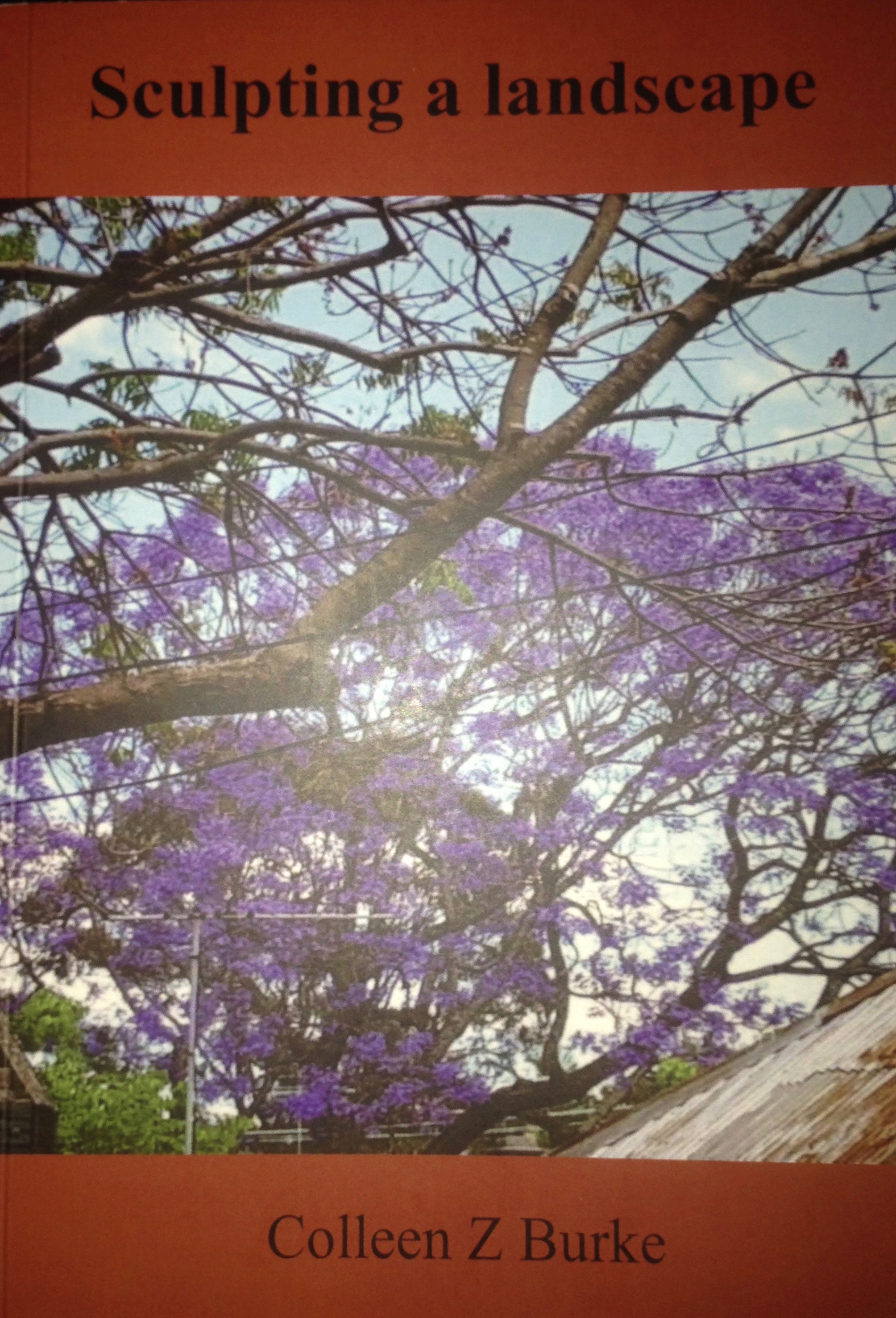
This is Colleen Z Burke’s twelfth poetry collection, published like many of the others by her own Feakle Press. When I blogged about her 2013 collection, Splicing Air (blog post here), I wrote:
Many of the poems in Splicing Air capture moments with her grandchildren … Many others, in what I think of as her signature style, are short, impressionistic pieces about landscape or, especially, skyscape in and over Newtown and surrounds, or bushland.
The same is true of Sculpting a Landscape. Many of its short poems are like verbal snapshots of a moment observed around the inner city, or of a moment of insight, or something learned in travels or seen on the news, or something one of the grandchildren said. These poems create an impression of artlessness, as if they were jotted down in the moment.
That impression isn’t necessarily accurate – there’s often a subtle play of imagery, an unexpected word or a stinging implication. The title poem is a good example:
Sculpting a Landscape

In a small clearing
amidst a huddle
of skeletal
gumtrees
a rusted
burnt out ute
fuses into the
eroded earth
sculpting a
definitive
Aussie landscape.
At first this looks like a slightly sentimental, familiar image of rural Australia. I’m typing this beside a Carol Ruff painting of a red desert landscape that has a rusted vehicle as a detail among stunted vegetation and scattered rocks: the land has outlived and assimilated the incursion of settler technology. By contrast, if you sit with this poem for a little while, you realise that something different is happening here. It’s a small clearing, so the vehicle is a larger presence. The trees huddle, and are skeletal: to my mind, but the only gumtrees that look skeletal are dead ones. And the earth is eroded. This is not a cosy picture: ‘Aussie’, the affectionate diminutive for Australian settler culture, is definitively attached to an image of death and destruction.
Most of the ‘snapshot’ poems aren’t as harshly unsettling as this, but there is often something just a little off kilter: an ibis is seen ‘meandering’ across an empty street, ‘gum / trees lilt air’, coastal limestone is ‘spliced with / slivers of pink / and white’, mountain skies are tetchy, ‘raindrops / savour summer’s intensity’, trees ‘pierce / luminous / clouds’.
The conversations with grandchildren are less compelling than in previous books. Perhaps this is because the children are older. (I recently heard David Malouf say that three-year-olds are the most interesting people he knows, and Colleen Burke’s four grandsons, beautifully photographed by the poet at the front of the book, are substantially older than that.) But the opening to ‘Running free’ is irresistible:
I want to go to the cemetery
and dance on graves, said Emmett,
my eight year old grandson.
There are speeches put into the mouths of women in harsh situations: ‘My Country’s Embrace’ in memory of Palestinian poet Fadwa Tugan (1917–2003), ‘Agnes’s story, Malawi’, ‘One less mouth’, about a young woman in an unnamed third world country. There are poems about mistreatment of animals – the slow loris, the pangolin, a kangaroo in a Chinese zoo. Re-reading my earlier posts about Colleen Z Burke’s poetry, I see recurring descriptions like ‘straightforward’, ‘unadorned’, ‘No traditional forms, no high rhetoric, no decorative figures’. So yes, this is plain-speaking poetry, filled with a sense of place, that place being just up the road from where I live, and with a concern for the underprivileged.
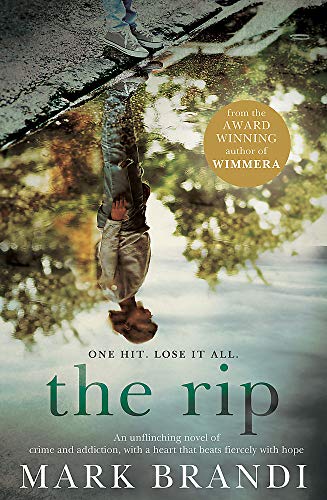
I’m on holiday, and this was a birthday present. I knew from the start that it wasn’t my cup of tea. The cover is clever. Jock Serong’s back cover blurb makes me ashamed. He says:
What held me close in this novel was not the idea of a hidden population of drifters and addicts, but the writer’s reassurance that dignity and small kindnesses have a place in that world.
It makes me ashamed because I just didn’t believe in the drifters and addicts, and found the dignity and small acts of kindness as unconvincing as the rest. The narrator is a homeless young woman addict who has grown up in foster homes, at least some of them sites of sexual abuse. She has a good friend and protector in an older man, who doesn’t exploit her sexually and tries to find ways for her to avoid turning tricks for cash. They fall in with a very unpleasant character and it goes seriously downhill for both of them. There are no surprises in the plot,and the characterisation is minimal.
The narrator is not stupid, though she is extraordinarily obtuse at key moments, but she’s uneducated and very limited in her experiences. And very often in the writing, one has a sense of the writer pushing against her ignorance and limitations to say something that’s beyond her. Sometimes she quotes her friend (using the word ‘osmosis’, for example) and says she doesn’t understand what it means. Other times, it just feels as if she has become pretty much a ventriloquist’s doll for the author. Here’s a taste, from a passage early on where she’s describing what it’s like to use heroin:
I don’t want to make it sound romantic. Except it is romantic. And it’s just about the most wonderful thing there is. I love it. And it’s something I’ll always love, probably as long as I live. I suppose it’s a bit like smokers – maybe that’s a good way for people to think about it. Smokers might quit smoking because of all the other shit that goes with it, but the actual smoking part is something they enjoy – something they might always love. But they just make a rational decision, I suppose, that the downside isn’t worth it.
But for me, the downside is worth it. Because downside is pretty much all I’ve ever known. Getting high is my only glimpse of the upside, if that makes sense.
(Page 16)
To be fair, the unadorned narrative has an occasional meta touch that works well, if the reader is feeling forgiving): the main pair occasionally sneak into movies, and their tastes run to art-house features like Dogville and Pan’s Labyrinth. The narrator pours scorn on Hollywood’s need for happy endings, and there’s some discussion of whether the ending of Pan’s Labyrinth is meant to be real or just the girl’s fantasy. So when we come to the book’s ending (not to be too spoilerish), there’s a big doubt cast over what is actually happening. And in a clever postmodern way, the opening pages only make sense if read after the ending.
That said, it may be that it was a mistake to read The Rip so soon after two superb books: Trent Dalton’s Boy Swallows Universe, which treats the world of ‘drifters and addicts’ with so much passion and complexity, and Elie Wiesel’s Twilight, which never tells the reader what to think and is never predictable. Whatever, it didn’t really touch the sides for me.
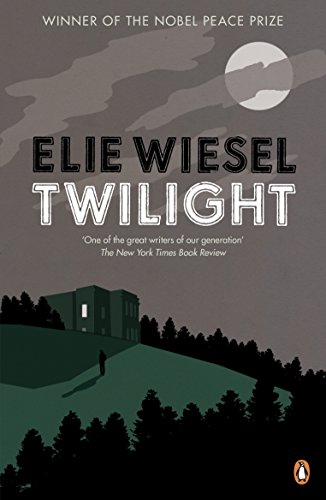
Elie Wiesel, Twilight (1987, translated from the French Le Crépuscule, au loin by Marion Wiesel 1988;)
I was given this book as a birthday gift some years ago. I was finally spurred to read it by a moment in Russell Shorto’s Amsterdam when he says that Holocaust survivor Frieda Menco became an international activist ‘after hearing fellow Auschwitz survivor Elie Wiesel discuss his experiences’.
Elie Wiesel was awarded the Nobel Peace Prize in 1986. The Nobel Committee described him as ‘one of the most important spiritual leaders and guides in an age when violence, repression, and racism continue to characterise the world’, and his Wikipedia entry offers ample justification for that description. His writing of memoir and fiction about the Holocaust is just part of his extraordinary activism; it’s the part I’m interested in here.
His first book, published in 1956, was a memoir in Yiddish of his Holocaust experiences, And the World Remained Silent. Night (published in French in 1958, then in English translation in 1960) was a shorter version, focusing on his relationship with his father in the camps. According to Wikipedia, Night ‘now ranks as one of the bedrocks of Holocaust literature’. In the next years, he wrote the novels Dawn (published in French in 1960, and in English translation in 1961) and Day (1961/1962), making a trilogy that marked (again I’m quoting Wikipedia) ‘Wiesel’s transition during and after the Holocaust from darkness to light, according to the Jewish tradition of beginning a new day at nightfall’.
It’s reasonable to suppose that Twilight (especially in its original French title, which translates as ‘Twilight, at a distance’) is meant to be read as a footnote to that trilogy, an extra phase of the diurnal sequence. Not having read those earlier books, then, I’ve come to this one at a disadvantage: I suspect it picks up lines of argument from the trilogy, either amplifying them or refuting them. So bear in mind, if you read on, that I’m writing as someone who came in late. (Imagine reading only Harry Potter and the Deathly Hallows and none of the first six HP novels.)
Raphael Lipkin was a young Jew in Poland during the Second World War. His entire family was wiped out, mostly by the Nazis but some by the Soviets, but he survived thanks to the intervention of a character known only as the madman with veiled eyes, and Pedro, a heroic member of Briha, the underground organisation that helped Holocaust survivors escape Europe. The novel tells the story of his traditional Jewish family as the reality of the Nazi threat becomes clearer and eventually overtakes them. Intertwined with this narrative is the story, some decades later, of Raphael’s time spent in a New York psychiatric hospital where all the patients believe they are characters from ancient history. He goes to the hospital on the pretext of learning from the patients in his academic field of Jewish mysticism, but he is actually trying to find out what happened to Pedro.
The Holocaust narratives here are mostly stories of richly diverse Jewish life – there are Judaic scholars, historians, young people in love, Communists, Zionists. The focus is on the rich culture and community life that was being destroyed rather than on the horror of the process (though there are moments of horror). In the modern story, Raphael speaks constantly to the absent Pedro, whose name he seeks to clear, but though Raphael’s main motivation is to do with Pedro, that story becomes secondary to his engagement with the hospital inmates. He has substantial conversations with Adam, Cain, a prophet, a dead man, the ‘Messiah of mad people’, and finally God himself. As I read it, in all these conversations, Wiesel is addressing the question of how the Judaic religious tradition can deal with the fact of the Holocaust – is it possible to still believe that God exists, that life has meaning. I suspect that as a confirmed atheist, and from a Christian tradition to boot, I missed a lot of the nuance, and if a conclusion is reached it passed me by (though there is a revelation in the final pages that may amount to Wiesel’s theological conclusion, and that revelation is foreshadowed in the epigraph from Maimonides, ‘The world couldn’t exist without madmen’).
The passion and intelligence of the writing held me captive the whole time. As a for-instance, here’s part of a monologue from the mad Adam, early in the book, which states an extreme despairing response to the horrors of the 20th century:
Listen, God. What I am about to tell you is for your own good. Stop! Yes, God: Stop this senseless project. Believe me, even you who are omnipotent cannot succeed in this. You thought man would be your glory, the jewel of your crown. You make me laugh. Man is your failure. Face it. Give up your illusions. Wake up. Be considerate. Close the book before you turn the first page. Does it shame you to admit that I’m right? Then forget it’s my idea. Let it be my gift to you. Legally, philosophically, you will have fathered it. And you know what? Theologically too. All you have to say is: I tried, I was wrong. And, luckily for the world, I realised it in time. Thus, even if your dream will have lasted but one day, one lifetime, you will be applauded. By your angels and seraphim. By the countless souls who will escape the curse of being born only to die. By the trees that will not be felled by man. By the animals that will not be slaughtered. By the earth that will not be despoiled. And all of Creation, pure and resplendent, will say: Look how great is God, how admirable His honesty. He does not shrink from admitting His error. And yes, He can manage perfectly well without man …
(page 28-29)
As you see, this isn’t a book that offers easy answers. It’s not a comfortable read. But (and remember, I’m a man who said last week that I need a novel to be fun) it’s kind of exhilarating.
The Emerging Artist and I have fled the winter in Sydney (which some people are beginning to call Eora, but I’ll wait to see on whose say-so before doing that myself) to spend two weeks on Yunbenun (aka Magnetic Island) in the tropics.
In the taxi to the ferry, the EA asked our friendly driver if he’d lived in Townsville long. ‘I’ve lived here all my life,’ he said. ‘It’s my land.’ He is a Wulgurukaba man. Let me start this blog post by acknowledging the Wulgurukaba and Bindal peoples, both with substantial claims to be traditional owners of the land where I have been holidaying, and made welcome.
We’ve been here a little over a week now, with a little less than a week to go. We’ve both been laid low with viral infections, the kind that come with grandparenting territory. We’re less sick now than when we arrived, but still coughing and spluttering quite a bit. Still, we’ve managed to go on some reasonably demanding walks – classified as moderate, but entailing fairly prolonged uphill climbs and including some spectacular views of the Coral Sea. We’ve been entertained by legion kookaburras, curlews, koels and currawongs, and admired the cuteness of rock wallabies. Koalas are yet to make themselves visible to us, but we’re confident that will happen. Our Air BnB host is friendly and very interesting – a marine scientist who is a rich source of information about the sea around us. He was able to reassure me that I needn’t have scrambled for the shore when a stingray came swimming straight for me when I ventured into the water.
Our usual experience is to arrive at a holiday destination and discover that a really interesting festival or event has just finished. This time is an exception. Quite without planning, our visit coincided with the North Australian Festival of Arts, and we spent the weekend on the mainland to participate. We were too crook on Saturday night to use our tickets to Tom Gleeson’s show in the May Wirth (a tent in the Queen’s Garden, named for one of Australia’s outstanding circus performers), but we walked the length of the Strand a number of times, taking in Strand Ephemera 2019, billed as North Queensland’s sculpture festival.
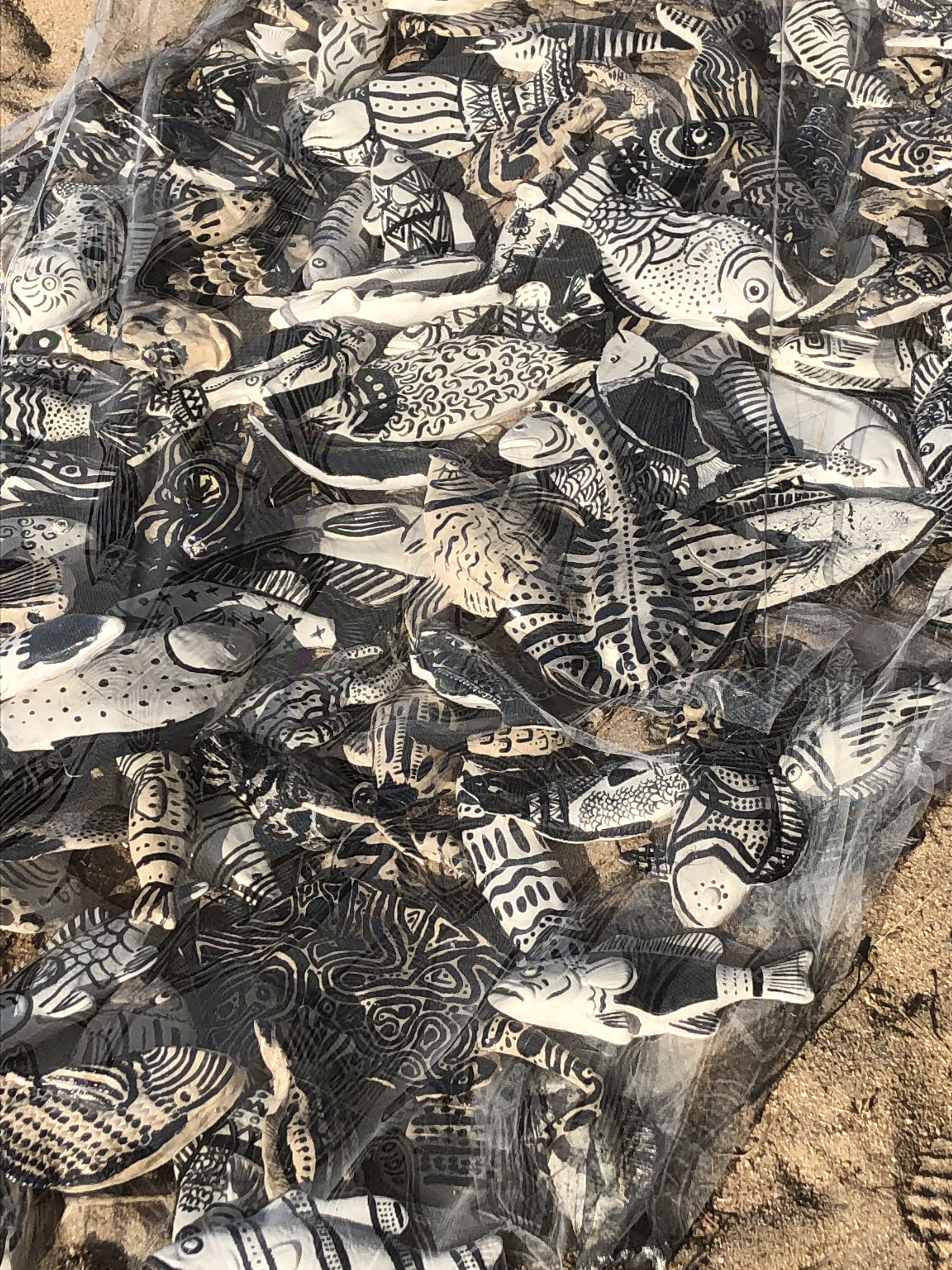
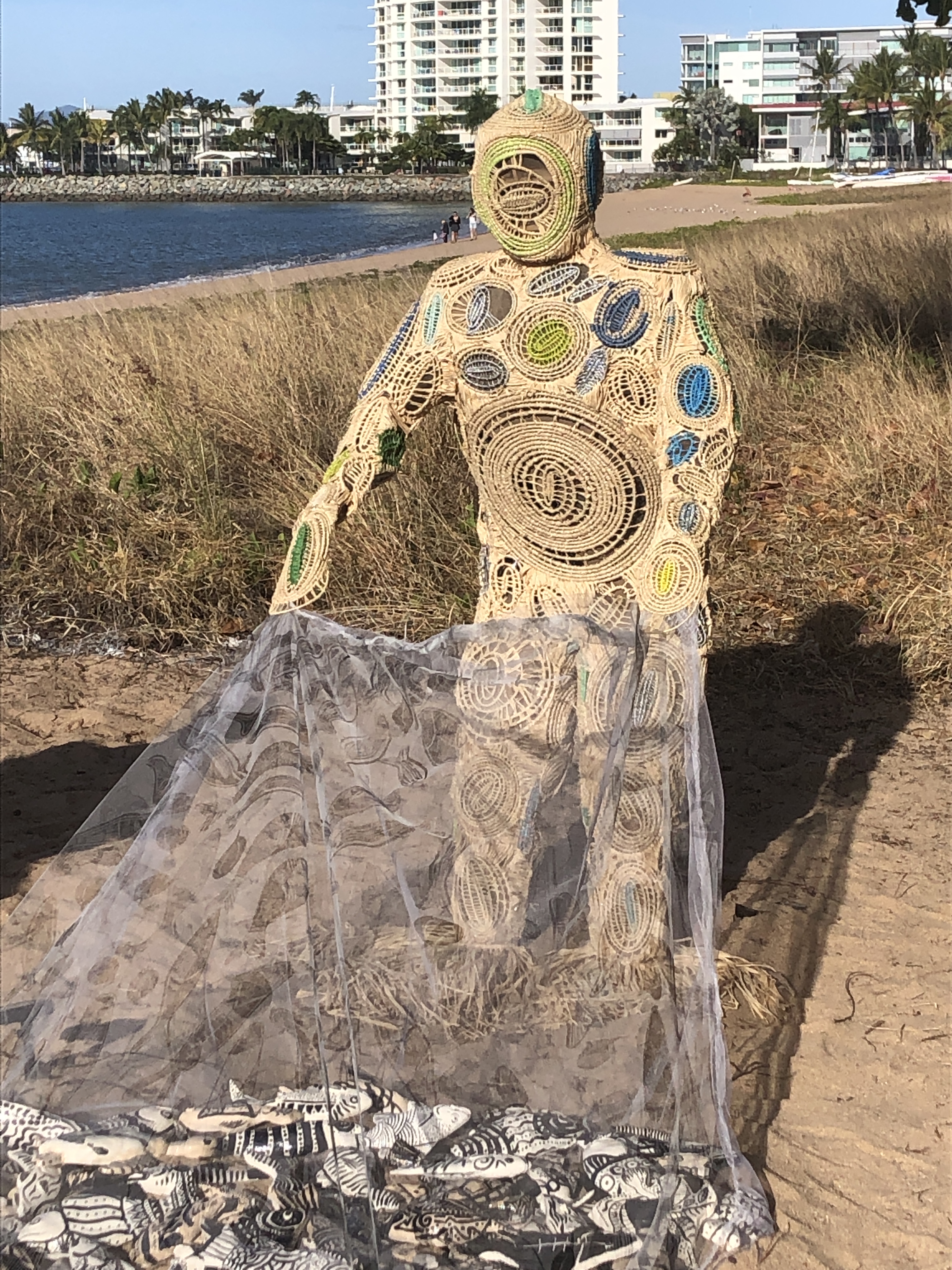
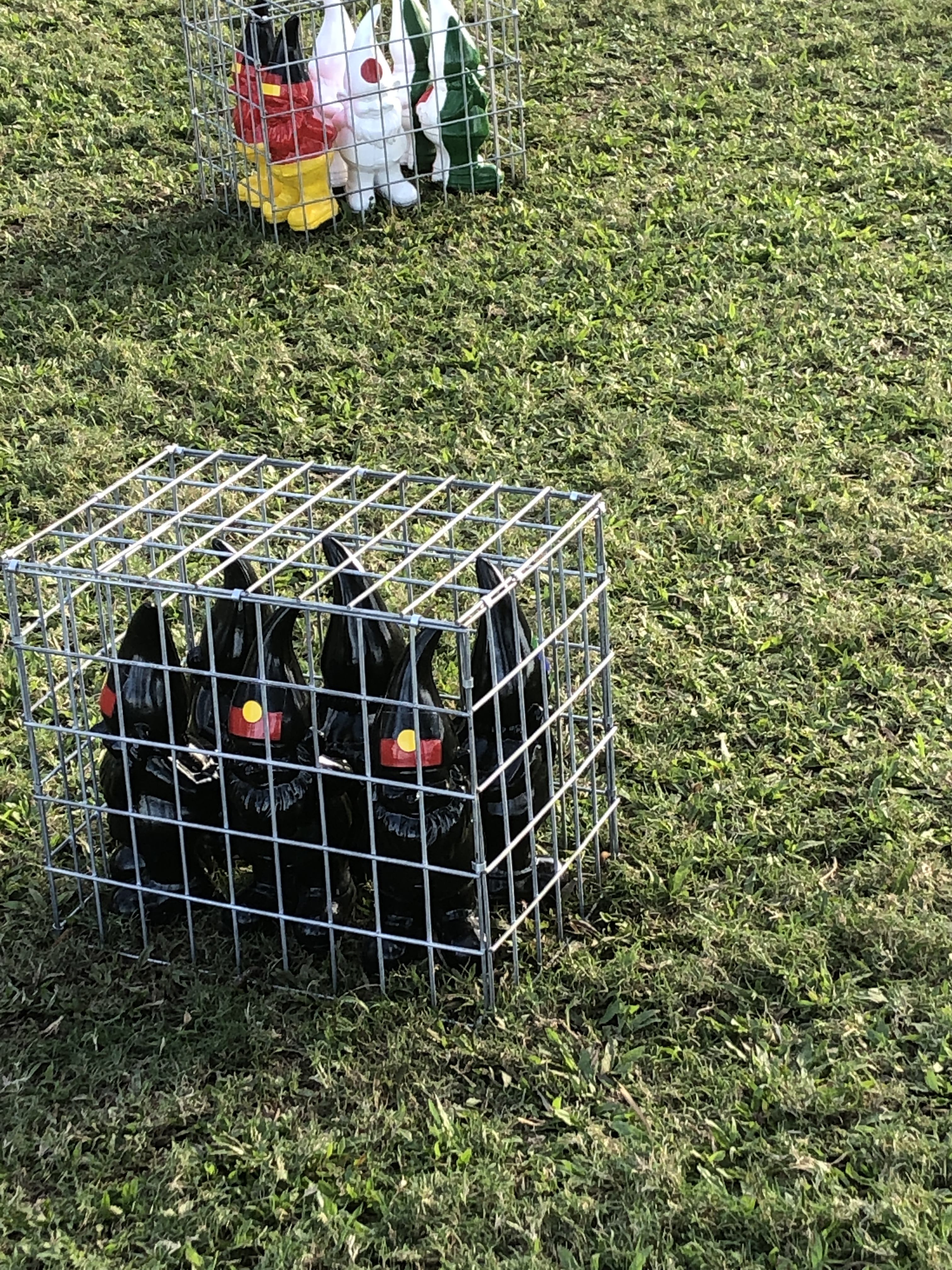
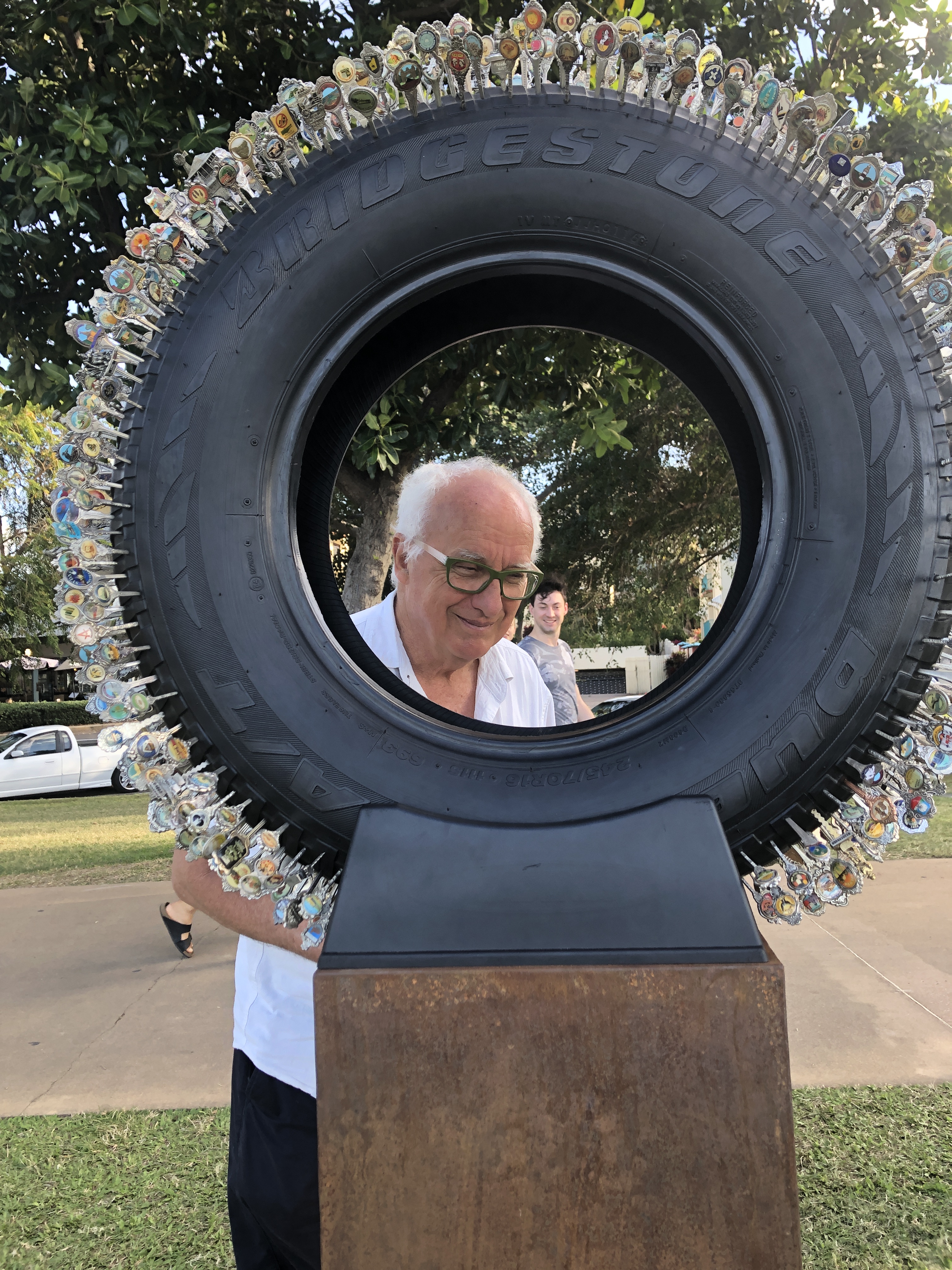
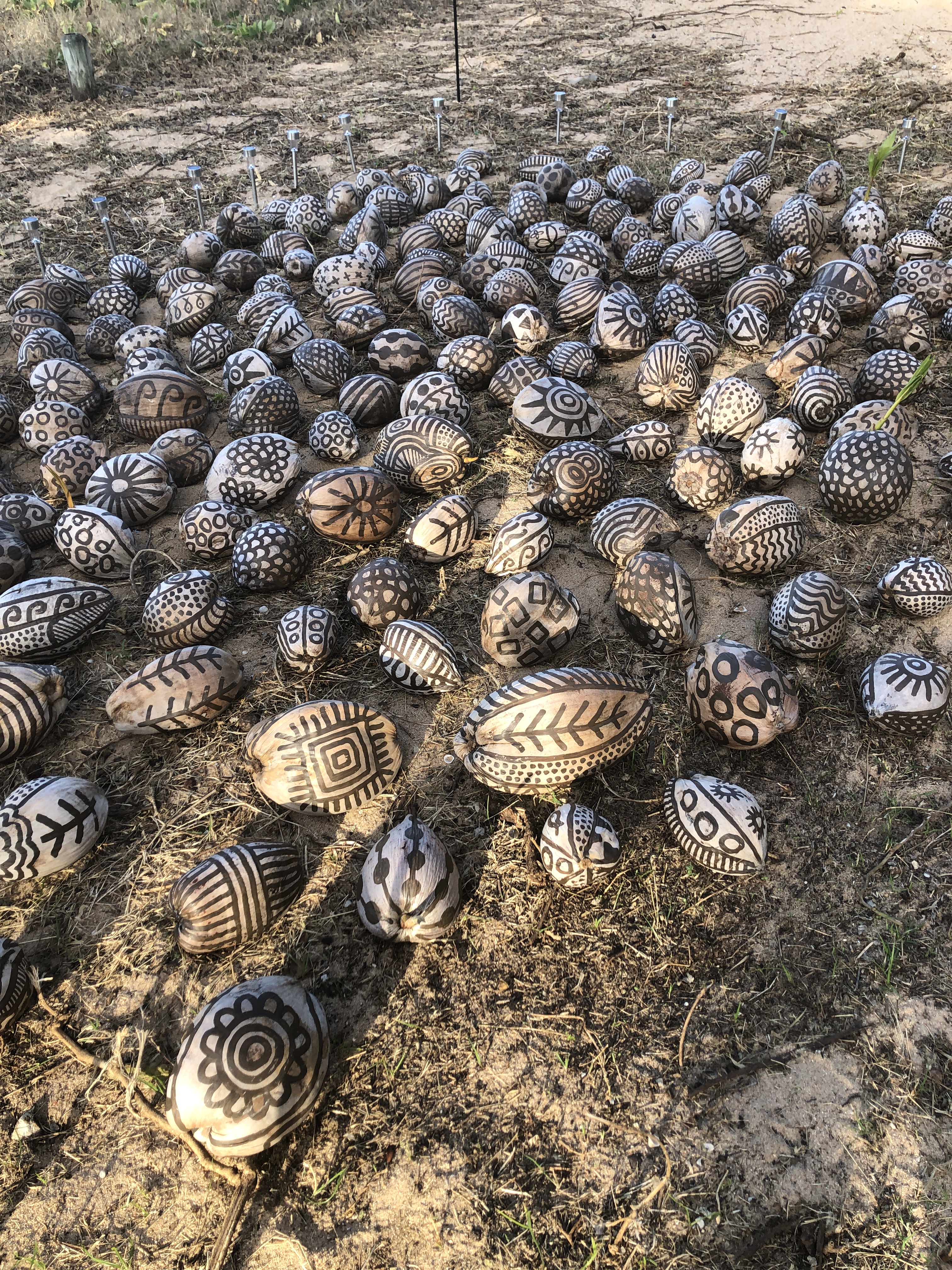
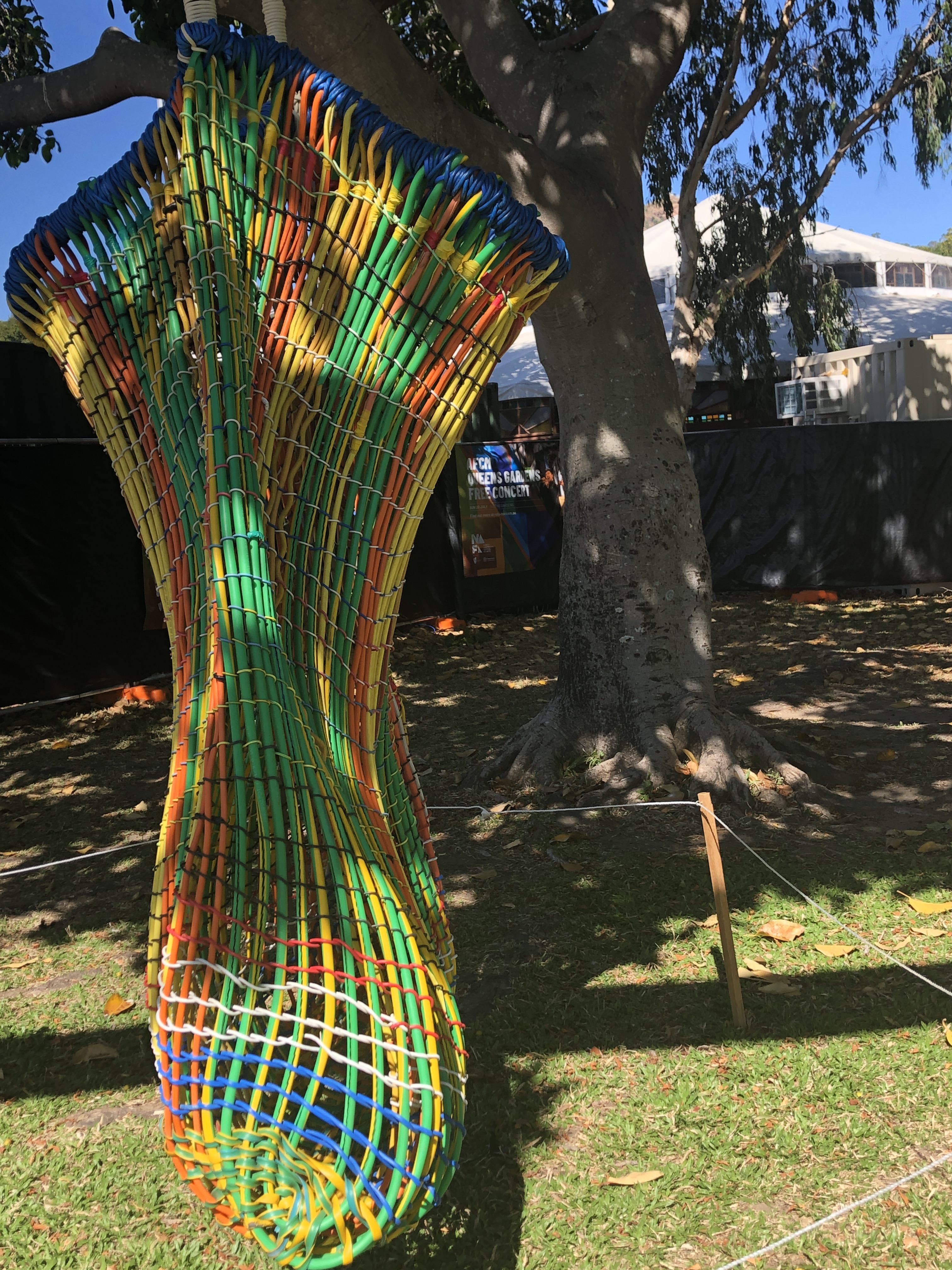
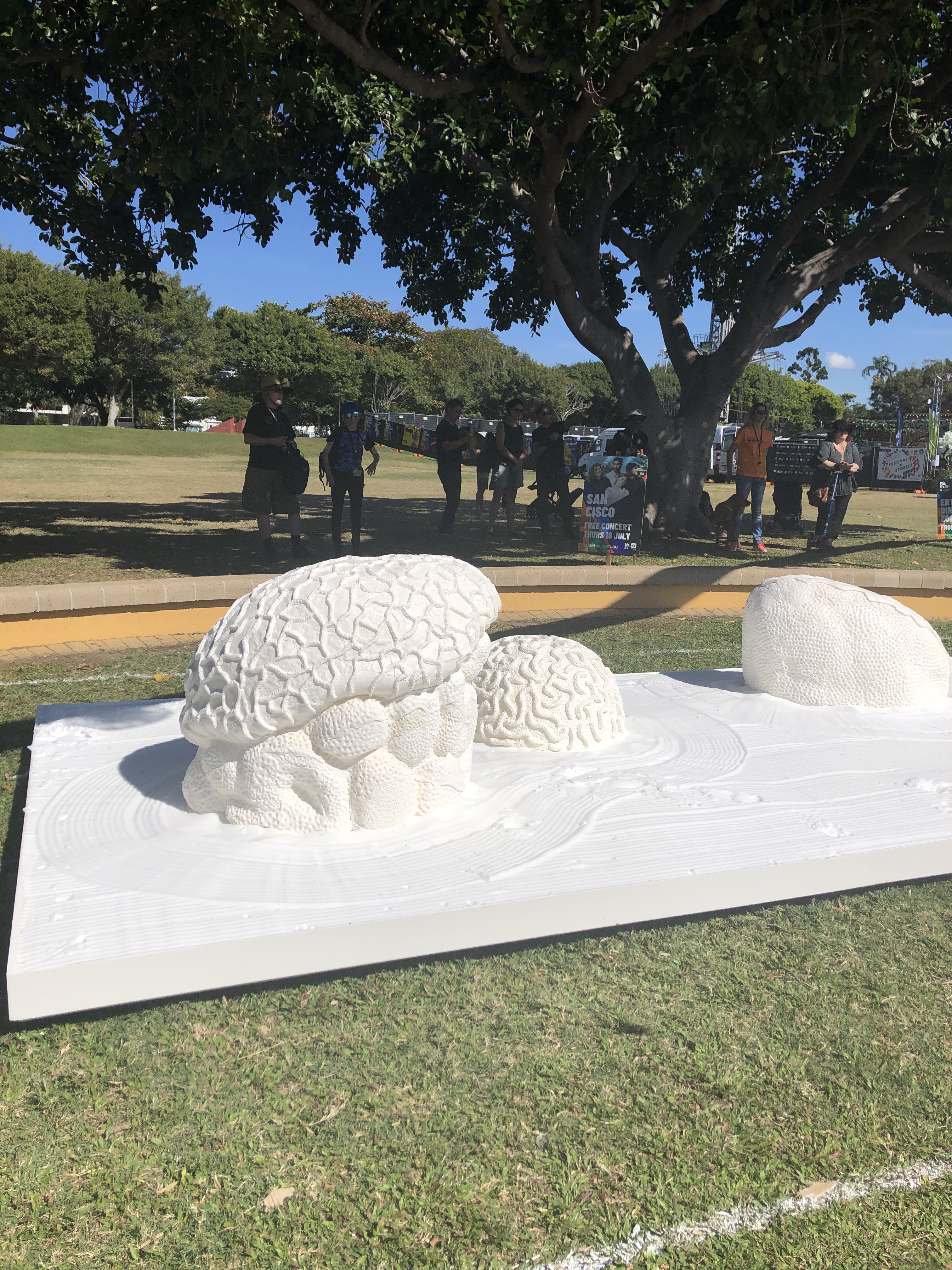
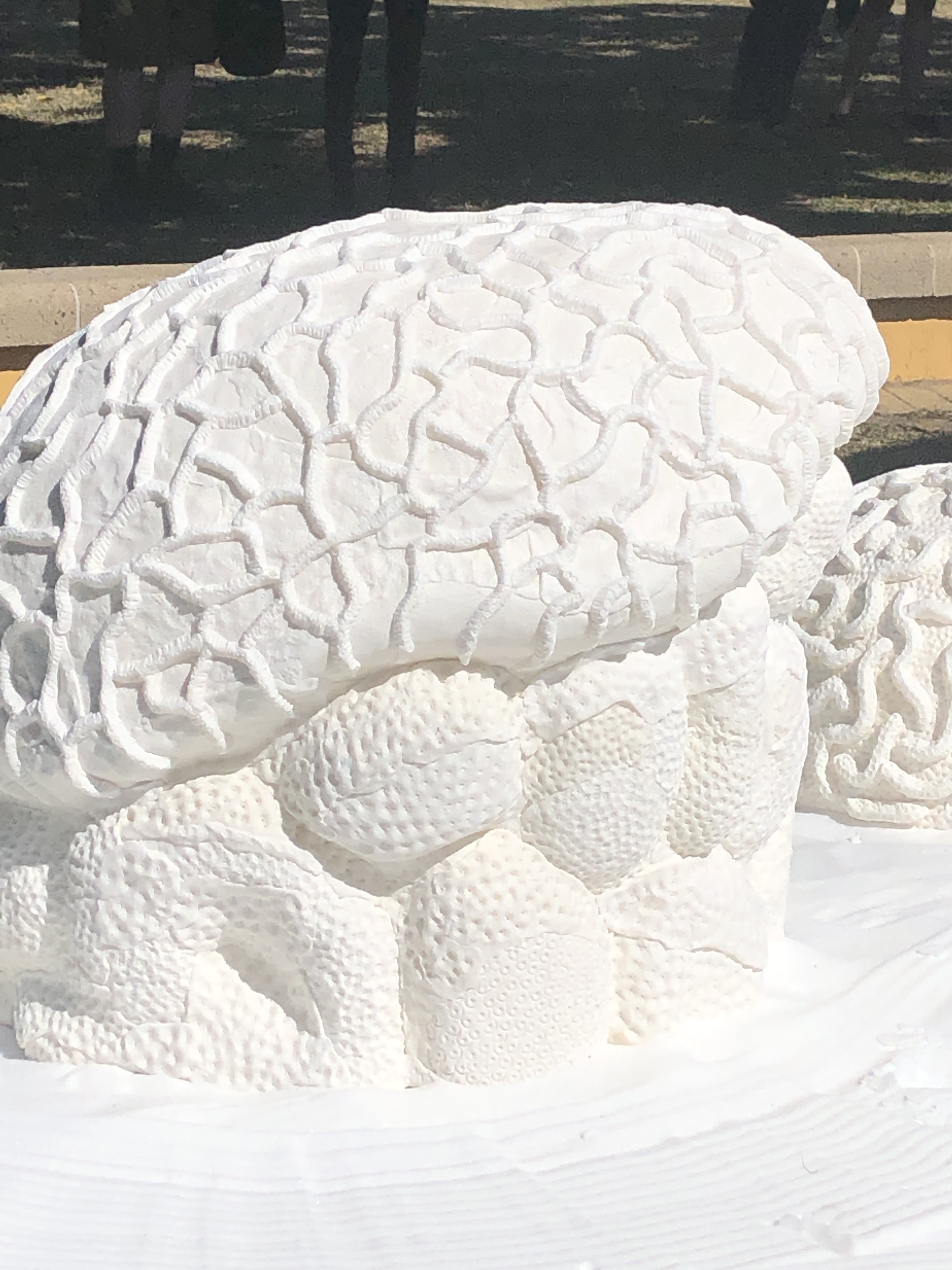
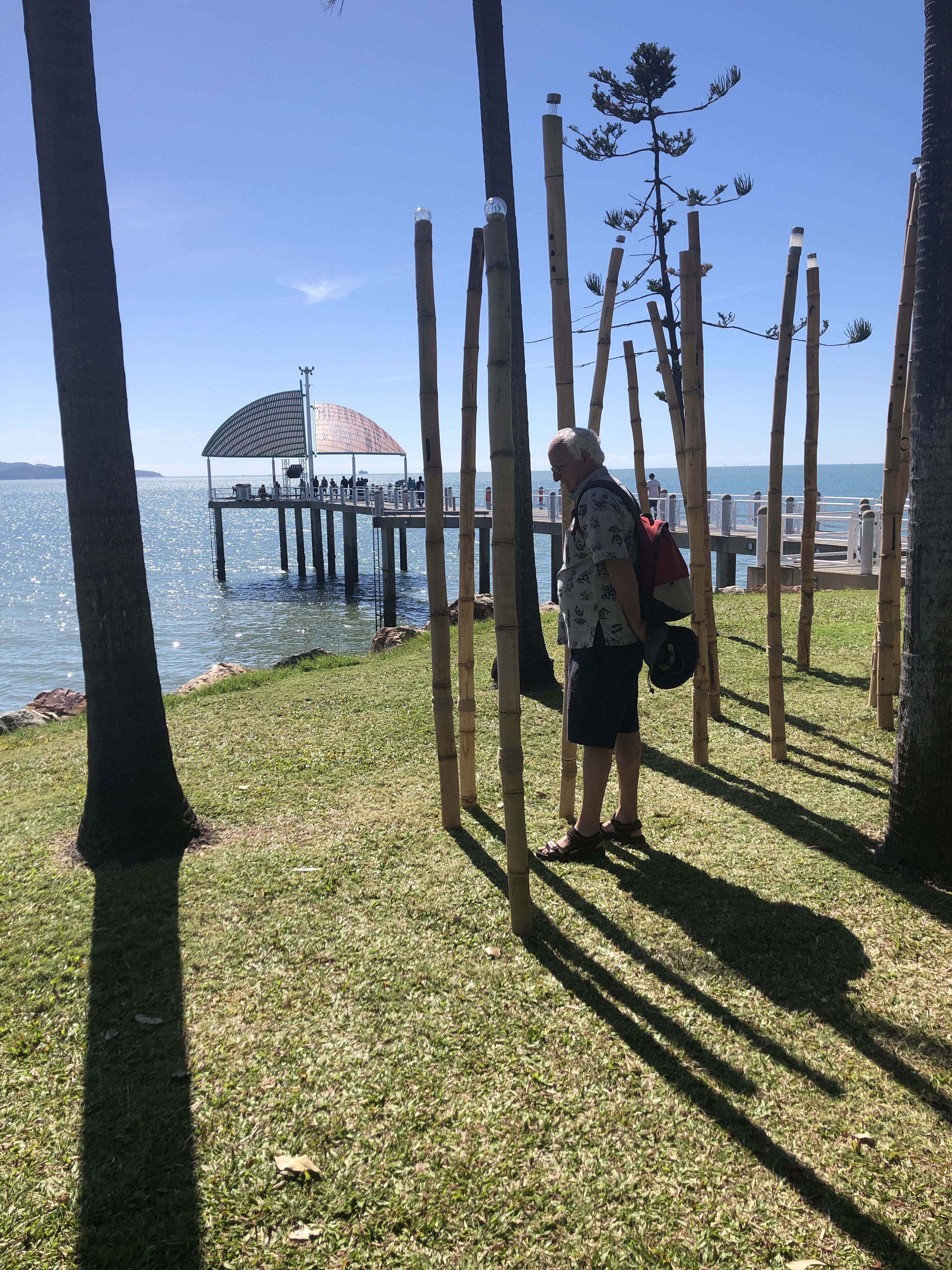
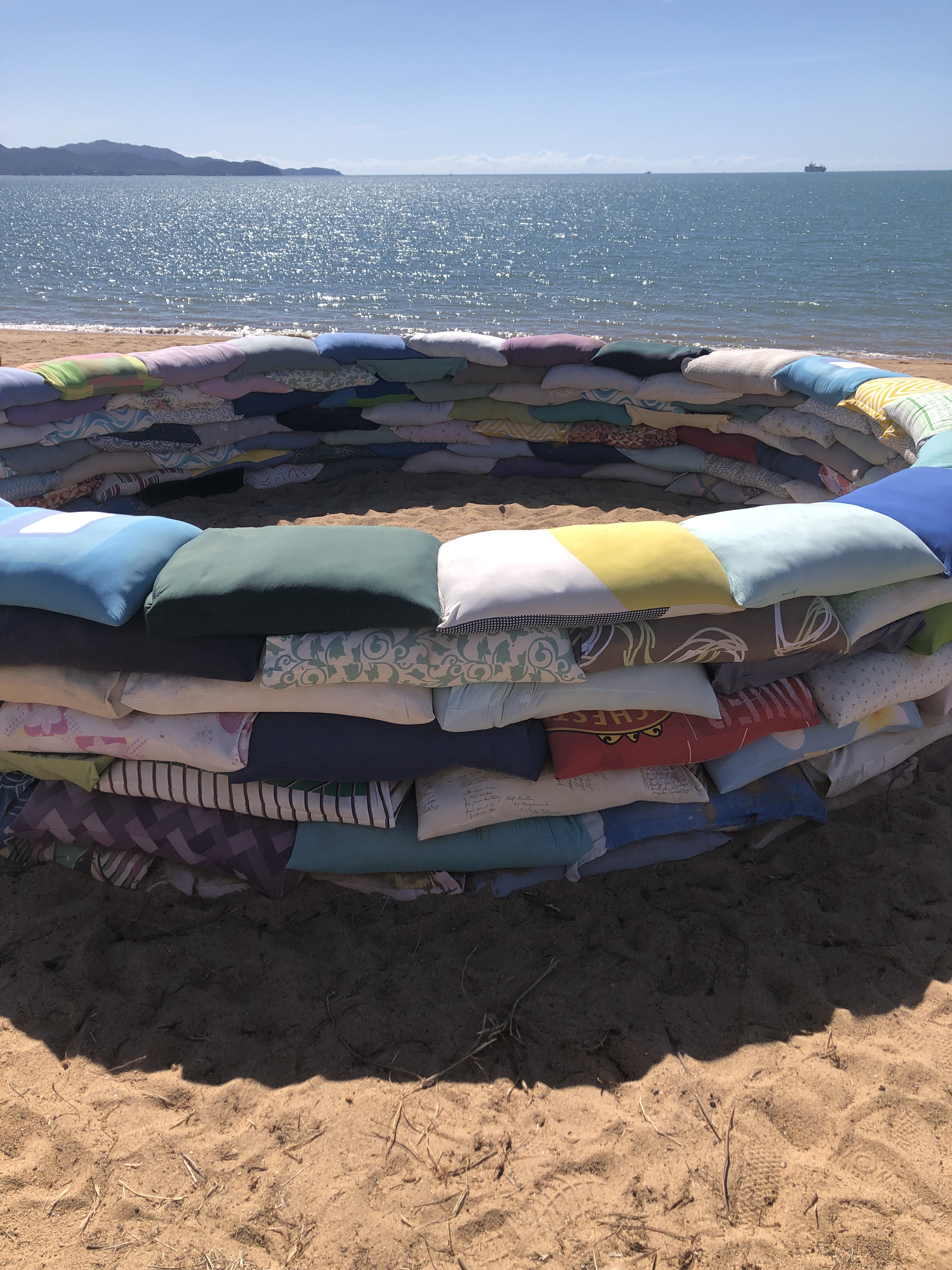
As in Sydney’s Sculpture by the Sea, the sculptures are displayed in a stunning natural environment, and have tremendous appeal for whole families. Here are some photos taken by the Emerging Artist: a weaving and ceramics tableau by the students at St Patrick’s College for girls (a video of the making of it here); an archipelago of caged gnomes painted variously in Aboriginal & Torres Strait Islander colours, LGBTQI symbols, etc; a car tyre pierced by the handles of hundreds of souvenir teaspoons; 200 coconuts, some of them sprouting, painted with Pacific designs; a string bag representative of the traditional people of Western Cape York, but huge and made from industrial materials; coral sculpted in sugar, beautiful and also emblematic of environmental disaster; bamboo pipes played gently by the wind; what one boy called a pillow fort and I thought of as a defended place to dream. And much more that we didn’t photograph.
St Patrick’s College, Plenty More (detail)
St Patrick’s College, Plenty More (detail)
Jan Hynes, Incarcerate! (detail)
Karl de Waal, I’ve been everywhere Man
Toni Rogers, The Language, the Wind and the Tides (detail)
Ngethn O’thawvl Wedlvn, Thawvl
Ken and Julia Yonetani, Sweet Barrier Reef (detail)
Ken and Julia Yonetani, Sweet Barrier Reef (detail)
Graeme Buckley, Lynn Scott-Cumming and Rhonda Stevens, Aeolian Messenger
Dominique and Samuel Chen, Dream Palisade
And this afternoon, at the Mary Who? Bookshop, David Malouf read to an audience of abut 50 people. It’s hard to imagine that the Tom Gleeson show that we’d missed could have given as much joy as this. David is a brilliant reader of his own poetry, and framed his selection beautifully today. He spoke of three stages: the experience that a poem draws on; the writing of the poem, which often happens many years after the experience; and, if the poet lives long enough, reading the poems many years after it was written. He began with The Year of the Foxes, a poem about a childhood memory written in 1965, and ended with Seven Last Words of the Emperor Hadrian, which has to be one of the most cheerful death-anticipating poems ever written (which made wet stuff run down my cheeks anyhow). When the Emerging Artist and I arrived, we commented that the age of the people gathered in the shop was generally well over 60: it was sweet, therefore, that David Malouf several times felt he had to explain a reference because most of his audience wouldn’t be old enough to recognise it. (He’s 85!)
Now for another week of health-restoring warmth, about which I may or may not blog.