After 14 years, Heat is to appear no more in book form. In this final issue Ivor Indyk, the editor and publisher, departs from his usual practice and speaks to us, explaining the reasons for his decision and sketching some possibilities for an electronic afterlife. (He spoke again to Ramona Koval on the Book Show.) The sad economic reality is that as a 240 page book, Heat is a monster to produce several times a year and then to distribute and warehouse. The community of people who are glad of its existence is much larger than the journal’s market – the people who buy it, and so contribute to its viability. As I’ve subscribed for ten years and written blog entries (I don’t really think of them as reviews), I have a twinge of smug virtue mixed with my sorrow: like, ‘It’s not my fault!’ I don’t know that I’ve ever felt part of a Heat community – too middlebrow, too whitebread, too shy – but it hasn’t been a purely economic relationship. I’ll miss this regular dose of austere high culture, and emergent/experimental/cosmopolitan writing.
Some of the culture in this final issue is incontestably high. Adrian Martin’s article, ‘Devastation’, after a wonderful anecdote about a working class man’s response to Terence Davies’ Distant Voices, Still Lives, goes on to discuss the films of Maurice Pialat. I’m a keen and frequent filmgoer, but I had to check with Google to be sure the article wasn’t a spoof and Pialat a comic invention – an archetypally grim French auteur whom Martin praises for daring to have sitting and standing characters in the same shot, and compares to a number of other auteurs I hadn’t heard of. It’s not a spoof: it’s the kind of article that sheds enough light on its subject to reveal the dark vastness of its reader’s ignorance. By way of contrast, Andrew Riemer’s brilliantly erudite ‘Four Glimpses of the Zeitgeist’ takes one gently by the hand and illuminates a web of connections joining Freud, Mahler, Riemer’s ancestors, conductor Bruno Walter, His Master’s Voice records, Hitler, playwright Thomas Bernhard and others, all converging in a Viennese theatre in 2010. Jeffrey Poacher’s reflection on the poetry of Peter Porter , who died last year, is likewise kind to general readers without, I hope, boring those who know Porter’s poetry well.
Cosmopolitanism is alive and well, particularly n Andreas Campomar’s ‘Uruguay Made Me’, a discussion of Eduardo Galeano in the context of his native Uruguay that makes me want – need – to read Galeano.
There’s plenty of emerging/experimental work too, mainly in the poetry. I was happy to see two typographically adventurous poems by Patrick Jones, who commented critically on this blog a while back.
But I don’t want to get hung up on classification. There’s a terrific poem by Adam Aitken dedicated to Susan Schultz – both Adam and Susan have graced my comments section recently. Ali Alizadeh and Jennifer Maiden are in fine form. Alan Wearne does some Gilbertian editorialising on the current move to form an Australian peak industry body for poetry. Amanda Simons interviews Antigone Kefala on her writing practice: Kefala says that, for her, writing and speaking are two completely different forms, and it’s delightful to encounter the conversational Antigone here alongside two characteristically non-conversational poems (there’s that austere high culture again).
I was struck by two examples of things a book you hold in your hand can do that a boundless (the word is from Ivor Indyk’s editorial) electronic creation can’t. In Nicolas José’s ‘What Love Tells Me’ a recently widowed man and his young son attend a performance of Mahler’s Third Symphony where the ‘blasting and pummelling and smashing’ music opens them up to emotional resolution and communication. The story is moving in its own right, but it gains an extra fizz from the fact that 150 pages earlier Andrew Riemer has been telling us something of what Mahler’s music (though not this precise symphony) meant at the time it was written. In my mind at least, that mental connection is made possible by the weight of the book in my hand
The other moment is a theatrical coup in Gillian Mears’ ‘Fairy Death’. This memoir begins with a title page: a right-hand page that’s blank except for the title and a brief note on the author. When you turn over, expecting the story to begin on the verso, you find instead a striking image of what seems to be a dress-shop mannequin with a crack or join around its middle, arranged on a bed and photographed from above. The figure’s face makes you realise that it’s actually a live, extraordinarily thin woman, that what looked like a join is a string tied around her waist and attached to what you now recognise as a red balloon in the photo’s foreground. The photo, taken by Vincent Lord Long, is of the author, and her mannequin-like thinness is the result of advanced multiple sclerosis. The article is in part an account of how it came to be taken. Though the memoir is astonishingly powerful, addressing (with what in another context would be Way Too Much Information) the effects of MS on the author’s sexuality, the act of turning the first page onto that image creates extraordinary poignancy – which I don’t believe could happen in an electronic form.
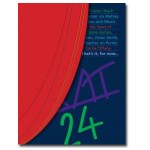
One perhaps minor advantage of ceasing to exist as a physical object is that proofreading and even copy editing can continue after publication. Heat 24 is far from egregious in that department – apart from a miniscule (which is a special case as the Microsoft spellchecker ignorantly allows it), I was plunged into confusion and irritation by only one editing error, which I won’t bore you with. It looks as if the presumably underpaid copy editor had enough time and/or other resource to do an excellent job on this issue, so he can go out with his head held high.
Just to be half clever, here’s the last stanza of John Shaw Neilson’s ‘The Poor Poor Country’, slightly altered:
The New Year came with Heat and thirst and the little lakes were low,
The blue cranes were my nearest friends and I mourned to see them go;
I watched their wings so long until I only saw the sky,
Down in that poor country no pauper was I.
Update 1 March 2011:
Over at Adam in (), Adam Aitken was kind enough to link to this page, and he asked me a question. I tried three times to respond in his comments section but for some reason my comments wouldn’t stick, so I’ll have go here.
Adam:
Jonathan, I don’t know why you see yourself as “whitebread”. Are HEAT writers “brownbread”? I won’t miss the so-called austerity of HEAT, as I feel on the contrary that HEAT would sometimes verge on the too rich, too dense side of things (by virtue of each issue being such a fat book).
Well, Adam, I’m not sure where I picked up the term ‘whitebread’, but my (now former) suburb, Annandale, got described that way by some of my more hip friends. They meant that the people of the suburb were the kind who ate only white, preferably sliced and packaged bread, remaining ignorant of or uninterested in the existence of pumpernickel, sourdough, ciabatta and challah, let alone pita, roti and naan. So my implication was Heat writers (and anyone else who belongs to its community) can come from anywhere in that vast world of different breads (quite a few of which are actually white, come to think of it). I have never read an issue of Heat without having my horizons extended, and I was amusing myself by saying that in a self-deprecatory way.
I agree with you on the richness and density of Heat. It’s been admirably austere in the sense that it would never have given us a review of the latest Oprah recommendation or blockbuster movie, and in a different way I’ve thought of Ivor Indyk’s editorial silence as austere. In this final issue he speaks to us, but presents it as asking our indulgence. I for one would have happily indulged him in this way many times over.
The ‘dead white male’ critique of Western Civ […] did not lead, as many of us had hoped, to a new internationalism, but rather to a new form of nationalism that emphasised hyphenated Americans. Chinese-Americans and Chicanos were now part of the intellectual universe, which was fine as far as it went, but Chinese and Mexicans were still excluded. Multiculturalism was, and is, not very multicultural at all.
(Eliot Weinberger, ‘The Post-National Writer’ in Oranges and Peanuts for Sale)
I’ve just read three literary journals whose roots lie respectively in a rejection of Australian xenophobia, in Communism with its commitment to internationalism and in a mission to publish Asian writing in English. Although we don’t do hyphens in quite the same way as the US, it seems reasonable to see how these journals stack up against Weinberger’s complaint.
***
This issue of Heat is atypical in not including any work in translation. Multicultural themes are addressed, but very little attention is paid to the world beyond our shores. There’s not even any travel writing, unless you count Vanessa Berry’s ‘Dark Tourism: Three Graveyard Tales’, in which the author visits two graves and strolls in a London cemetery (in a piece that might have been more accurately titled ‘Mildly Crepuscular Travels with my Mum’).
Turkish born, ethnically Greek Melburnian Dmetri Kakmi’s ‘Salam Cafe and the Great Burqa Debate’ might seem to fit Weinberger’s description of Clayton’s multiculturalism pretty well – a non-Muslim man joins the argument about what Muslim women should or shouldn’t be allowed or made to wear. But he puts the lie to that pigeonholing by acting as a conduit for Muslim points of view, drawing on his childhood memories of Turkey and his time as a student in Istanbul, and discussing burqa-related artworks by Muslims Shadi Ghadirian (a woman) and Kader Attia (a man, whose ‘Kasbah’ was shown in this year’s Sydney Biennale).
Weinberger’s aspersions might also seem to apply to Michael Mohammed Ahmad’s story, ‘The Hat Dance’, the piece that comes closest to the kind of hyphenation he dislikes. But this account of a dust-up in an extended family living in Western Sydney is so gloriously exuberant only some kind of Diversity Bean-counter could fail to relish it.
Of course, Heat doesn’t claim to fill a hypothetical Diversity Quota in every issue, and there’s no reason it should. Its characteristic approach to fostering diversity is by presenting crosscultural encounters, an approach I’m fairly sure Weinberger would approve of. Kakmi’s piece is an example of that approach. So is Michael Atherton’s portrait of Harry (christened Charalambos) Vatiliotis, who lives in the Sydney suburb of Croydon and makes classical violins in the manner of Stradivere, each one a unique work of art. Cassi Plate quotes from letters of Costas Tachtis, Greek novelist who lived for some years in Australia, and his friend Carl Plate, an Australian artist: ‘The letters,’ she writes, ‘take us into a cosmopolitan world within the heart of what is often assumed to be parochial 1950s Sydney.’ Maybe cosmopolitanism is a better word than diversity for the thing that Heat does so well.
Cosmopolitanism can incorporate voices from elsewhere, and also bring a sharp eye to bear on the local, as Peter Doyle’s fascinating ‘Bashful City: Sydney’s Covert Criminality‘ does to photographs from the archives of Sydney’s Justice and Police Museum. It can also include intensely place-specific writing like Mark Tredinnick’s review of Judith Beveridge’s most recent book of poetry, in which, incidentally, he compares her to a shark and a Philip Marlowe thug, and convincingly means both as compliments.
I do worry about Heat‘s copy editing and proof reading. There’s curiousity, practicing (though correct Australian usage practises elsewhere), an umbilical chord. Someone is heard cluttering in his garage. In Robert Adamson’s delicately poised ‘The Coriander Fields of Long Bay Penitentiary’, a with is repeated over a line break – I know it’s poetry, but that’s just a mistake. One article has this near the beginning: ‘It is one of the great dividers between the civilised among us: those of impeccable taste.’ I wasn’t interested enough in the article’s subject – taxidermy – to endure whatever came after that.
****
The first issues of Overland, published in 1954,carried the slogan ‘Temper democratic; Bias, Australian’, hardly a promise of cultural diversity or cosmopolitanism. But as a project of the mainly Communist Realist Writers’ Group, the journal had a commitment to internationalism. Surprisingly, there’s not a lot of that in this anniversary issue, unless you count a deference to Europe and the US. Not that there’s necessarily anything wrong with that: for instance, Alison Croggon’s ‘How Australian Is It?‘ talks with her characteristic clarity and generosity about the way much of our theatre has opened out to the world, freed from constricting preoccupations with national identity but distinctively Australian all the same. On the other hand, when Clive Hamilton characterises the Australian as an agent of ‘the Republicans’ war on climate science’, he implies – perhaps intentionally – that in this matter Australia is humiliatingly no more than an arena in which US battles are being fought. There’s a fair whack of ‘theory’**, enough to create a gnawing sense of Australia as a site for the application of theory developed elsewhere – no sign of Raewyn Connell’s Southern Theory here. (The most theory-rich piece, Alwyn Crawford’s ‘Permanent Daylight‘, which deals with the intimate connection between capitalism and anorexia, is nevertheless compelling reading because of a ballast of passionate personal testimony.) Christos Tsiolkas is the Literary Big Gun of this issue, with a short story about the market in European art, but I found it unreadable (that is to say, I couldn’t tell what the story was trying to do, whether it was a spoof or something else very dull). There’s no non-European voice, and little interest in non-European culture: one piece, by a non-Muslim, quoting no Muslim voices, uses the Western burqa debate as a springboard for theoretical reflections on the visibility or otherwise of women in the West; Jacinda Woodhead gives us an attractive profile of Melbourne rapper-comedians Fear of a Brown Planet (there’s a wonderful YouTube clip of one of them here); Kabul is mentioned in one article, but it’s in a quote from an organisation aimed at creating a market for US cosmetics there.
So Weinberger’s kind of internationalism isn’t overwhelmingly evident in Overland. The three outstanding pieces, in fact, aren’t even particularly multicultural. Chris Graham does a demolition job on Noel Pearson in ‘Telling whites what they want to hear‘. Graphic novelist Bruce Mutard re-tells a story from Overland 1: the story is ‘Nine O’clock Finish’ by John Morrison, a marvellous socialist realist writer, and the resulting 8-page comic is to weep. Janette Turner Hospital’s short story ‘Weird People’ is a tour de force centred on the captain of a tourist boat that takes mainly US tourists out to look at humpback whales off the coast of New South Wales – I suppose it could be read as a protest against our cultural client-state identity.
In Overland, though less so than in Heat, proofreading is a worry: ‘haute bourgeois’, the Communications Minster, and at least one article written in an academic style that apparently defeated all attempts to wrangle it into English.
* In a classic example of Mruphy’s law, when I first put this up, I misspelled Mr Sparrow’s first name – immediately after whingeing about someone else’s poor copy editing. I’ve fixed it now
** Writers referred to include Ariel Levy (North American liberal feminist), Nina Power (British philosopher and feminist), Mark Fisher (British cultural theorist), Guy Debord (French theorist), Sheila Rowbotham (British feminist historian), Edward Said (the exception that tests the rule and finds that it holds up), Naomi Baron (US linguistics professor).
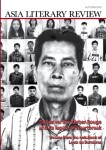
It’s a telling confirmation of Weinberger’s generalisation that the ALR’s web page header reads ‘Asia Literary Review – Asian American writing’, apparently promising US-ers that they can read it without danger of encountering anything genuinely foreign. Happily, it’s a false promise.
From the beginning, there’s no doubt that we’ve left the leisurely contemplation of anti-grand abstractions far behind. US-expat journalist Robbie Corey Boulet kicks off with a report on the first case tried – in 2009! – by the tribunal set up to deal with ‘those most responsible’ for the crimes of the Pol Pot regime. Itself a fine combination of court-reporting, historical background and interviews with people still looking for answers about their murdered relatives, it is followed a few items later by a suite of poems by Peauladd Huy whose parents were murdered by that regime and who now lives in the USA. And it finds a grim echo at the end of the journal, in an excerpt from Frank Dikötter’s Mao’s Great Famine, which draws on archival sources to explore the terror and violence of the Great Leap Forward (‘at least 45 million people worked, starved or beaten to death’). There are other pairings, including a story and a photo essay about floods in the Philippines. A good bit of the ALR probably amounts to armchair dark tourism – much stronger medicine than the piece wearing that label in Heat. The one actual piece of travel writing – about Mount Merapi, a Javan volcano – has enough disastrous loss of life for the darkest tourist sensibilities.
There aren’t many laughs, but there’s plenty of wit and imagination: ‘Youth-in-Asia‘, a story set in Korea by Canadian Ron Schafrick, delivers on its punning title; Priya Basil’s ‘Losing Their Religion‘ is a quietly entertaining memoir of religious conversion and un-conversion that spans three continents; GB Prabhat’s ‘The Silencer‘ gives us a clever inversion of celebrity stalking.
There is no Australian presence, apart from two full-page ads, for the Melbourne Writers Festival (featuring a Hokusai wave) and Heat (‘Australia’s only international literary journal’) respectively. Insert your own ironic comment.
One sentence leaps out to meet my eye. Jonathan Watts, an English journalist, moved from Korea to Beijing in 2003. His interviewer James Kidd tells us:
The signs of conspicuous pollution made an immediate impression: a keen runner, Watts found himself wheezing after a short jog; a father, he was alarmed when his two daughters were not allowed outside during breaks at their Beijing school. It was China that taught him to fear for the future of the planet.
I’m not sure I can afford to keep up my subscriptions to all three of these journals. I was thinking of letting my subscription to Asia Literary Review lapse – but it’s teaching me to think in terms of the whole planet
My yesterday was entirely devoted to the Sydney Writers Festival, and I had a great time, starting out at Walsh Bay, where my choices seemed to keep me away from the monster queues.
10 : 00 Poetry on the Harbour: Adam Aitken, Judith Beveridge and Kim Cheng Boey, with Ivor (‘I know they’re good poets because I published them’) Indyk in the chair.
In general I prefer to hear poets read their own work over having actors deliver sonorous, deeply felt renditions, because actors’ performances tend to narrow the range of possible readings. I also prefer poets’ readings that avoid the incantatory (though I’m delighted by the over the top bits of Yeats and Tennyson I’ve heard). All the same, all three of these poets read their work with such modesty and introspection that I longed for just a touch of the rock star, just a hint that they might be able to hold us in the palm of their hands and wring our withers.
It was an excellent reading nonetheless. Adam Aitken read his ‘Pol Pot in Paris’, and a poem taken from his father’s letters (introduced with, ‘I love my father, but he had colonial attitudes’) got actual laughs. Judith Beveridge began with an anecdote from Robert Creeley: at a school reading a child asked him, ‘Mr Creeley, was that a real poem or did you just make it up yourself?’ Among the poems that JB had made up herself was a lovely piece about a man washing himself at the railway station tap just outside Delhi. Of the extraordinarily cosmopolitan Kim Cheng Boey’s poems, I particularly liked ‘Stamps’, in which the poet converses with his little daughter.
11 : 30 First Nation Stories: Richard Van Camp and Boori Monty Pryor herded ‘like cats’ by Anita Heiss.
In introducing his poets, Ivor Indyk mentioned university positions and awards. In this session, Anita Heiss talked about which Indigenous Nations/mobs people came from, including herself. Both Richard and Boori perform and tell stories in schools. Richard gave us what I took to be one of his school performances; Boori talked about his. Both men were very funny, and Boori gets the Me Fail I Fly nomination for the most charming man on the planet. Yet with all the humour and charm he managed to put some hard truths. ‘This is the only country in the world,’ he said, ‘that mines a culture and sells it off to the world but doesn’t want to know about the people who produce it.’ He told of a group of preschool teachers who asked him for advice on how to tell Aboriginal stories to their charges. ‘Do you know about the 1967 Referendum? The Gurindji campaign? The reserves?’ he asked (though he probably named different specifics). ‘You won’t be able to tell the stories until you know about the fight to keep them alive.’
13 : 00 The Politics of Storytelling: Mike Daisey and William Yang, chaired by Annette Shum Wah.
I’m told Mike Daisy’s story was shattering, but I went to sleep during the loud, bombastic opening section of his monologue, which I guess was meant to be the warm-up (a baby cried, presumably at the sheer loudness, and was incorporated into the rant, to the delight of the fans in front of me but adding to my need to absent myself). William Yang showed a number of slides, and it was reassuring to see that his style worked just as well when taken out of the tightly controlled environment of his shows. The discussion was interesting – Annette asked about their provocativeness (William’s photos can be a bit rude, and Mike uses four-letter words, hardly confronting in Sydney I would have thought, but he did mention a show where a big bloc of the audience stood up and walked out – it’s on YouTube and his response is wonderful). William said that when he first did his shows he was part of an angry community. Now he might put in an occasional naughty photo out of impishness. These were such different men, yet their mutual appreciation was lovely to behold.
16 : 00 David Wessel, Meet Paul Keating with George Megalogenis
Note to anyone doing this kind of gig: it really really helps if you read up on the person you’re appearing with and can refer approvingly to his work. Both these men did that and it was a great leavening to what could have been a dry conversation about economics. David Wessell (economic editor of the Wall Street Journal, was able to drop a number of Keating’s famous phrases into his presentation (‘The recession we had to have’, ‘A shiver looking for a spine to run up’, etc). Wessell explained the causes of the GFC memorably as resulting from two false assumptions in the US: that house prices would never fall, and that extraordinary financial innovations spread risk in such a way as to diminish it to the point of negligibility. Keating, equally memorably described Chinese reserves as a great cloud full of water and electricity floating over the world, and Alan Greenspan building a copper pipe up into the sky to draw down the water. He also talked about Spain, Portugal, Ireland and Greece as having a big one-off party made possible by converting to the Euro and suddenly enjoying German interest rates. Right now we’re seeing the morning-after crash. Questions were probably intelligent, but were well above my head.
18 : 00 Have We All Been Conned?: An Emergency Town Meeting: Bill McKibben, Ross Garnaut and Clive Hamilton, with Tim Flannery as participating Chair, discussing the politics and science of climate change.
A case of false labelling. Of course, we all knew it was a Writers’ Festival event and not a political rally, so it was no surprise that it was, as my son described them, four bald men in glasses talking to an appreciative audience about the current state of affairs. No one was really concerned to plug his own book – it was, as Tim Flannery, said, a bit of a dream team.
Was Copenhagen a success or failure? Too soon to tell, but it has meant that developing countries are now taking on climate change rather than waiting for the developing countries to do their bit first.
How come Australia is the biggest laggard in climate change action, yet it has the most to lose? Ross Garnaut spoke with transparent obliqueness of lack of political leadership. Bill McKibben, I think it was, first mentioned Kevin Rudd by name. Clive Hamilton sunk the boot: Kevin Rudd thinks science is a lobby group, and he’s a manager not a leader.
What about the Greens’ rejection of the CPRS? A lamentable strategic error, seemed to be the consensus, rather than a grievous failure of principle as we have seen from federal Labor. Bill McKibben said wise words here. Coming from afar, he said, he had the luxury of responding without knowing or needing to know the details, but what we have to remember is that any victory, however small, is to be celebrated, and any victory, however large, is only a step forward. This is a struggle that will continue for our lifetimes and beyond.
Perhaps the grimmest note of the evening was the statement from, I think, Bill McKibben, that our challenge now is no longer to prevent climate change but to take action to deal with the new world we now live in.
In question time we reaped the consequences of the false advertising. Person after person took the microphone to tell us what they thought about the subject. One woman, from an outfit called A Hundred Percent Renewable, had even brought a banner, which she trailed after her disconsolately as she left the microphone, having failed to get a taker to hold up its other end.
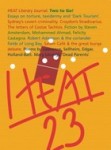
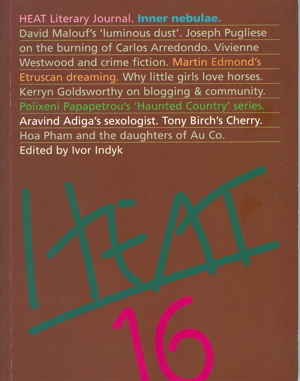
This issue of Heat has much that is wonderful. The title, following tradition, is a phrase chosen apparently at random from the contents, in this case from πO’s exuberant nonsense poem ‘Rabbit Proof Fence’:
The average person blinksoooo22 rabbits a minute.
Burke & Wills went into the desertoooowith a dozen rabbits
Obsession isooooa persistent rabbit.
The causes of a rabbitooooaren't clear.
Perhaps Ivor Indyk, the editor, is quietly suggesting that the seemingly miraculous persistence of Heat owes not a little to obsession.
I understand Heat to be about diversity, about presenting a version of literary Australia that is open to the whole planet. It often includes, for instance, travel writing, translated pieces, news from abroad, and fiction, essays or images that grow from places where cultures intersect. In this issue there are examples of each of these – respectively, Barbara Brooks’s self-styled fictional memoir ‘Lost in the House’ (which powerfully combines tales of travel, dementia, memory and intergenerational relationships); Stuart Cooke’s ‘Two Mapuche Poets’ (the Mapuche people are indigenous to parts of Chile and Argentina); Priya Basil’s ‘My Home is Our Castle’ (about a communal housing project that won a major architecture prize in Berlin last year); Michelle Moo’s colonial historical fiction, ‘New Gold Mountain’ (white women and Chinese men on the Australian goldfields); Barry Hill’s ‘Ezra Pound: The tragic orientalist’; and the centre section of art by Guan Wei, ‘Longevity for Beginners’. (The last three provide a nice example of the kind of counterpoint that Edward Said recommended.)
Apart from Barbara Brooks’s memoir three pieces stood out for me.
Brendan Ryan (whose book of poetry, Why I Am Not a Farmer, I am now actively seeking) has a gripping personal essay on the 1983 Ash Wednesday fires in western Victoria, which is enough by itself to justify the price of the journal. Sadly, not even part of it is up on the Heat website.
Lee Kofman’s essay, ‘Revisiting the Geography of My Body’, just as gripping and as intensely personal, includes incidental elements of a migration story, but is mainly about scars, particularly scars on a woman’s body, and their almost complete absence from literature and visual arts: wounds, scars as something to be healed, scars on men (she doesn’t have to mention Coriolanus), but scars as such, particularly on a woman’s body, reside ‘outside the linguistic and public realm’. By sheer chance, I happened to walk past this piece of graffiti in Newtown just as I finished reading the essay. I hope Ms Kofman would enjoy it:
I said I wouldn’t whinge any more about proofing errors in this Heat, but there is one good old-fashioned belly laugh in this essay. The pursuit of bodily perfection, it tells us, ‘can be traced back to Pluto’s ideal of human beauty as the “natural”, unmarked body’. Roman myth, presumably, rather than Disney.
Of the poetry, Kate Middleton’s poems on a Hansel and Gretel theme stand out for me. They are billed as excerpts from Where Dingoes Tread. I look forward to seeing the whole thing:
Remember when hunger
 was simple?
 ooooooooooooThere was nothing
 and we ate nothing. Then plenty returned
 and I turned
 to austerity.
One of my highlights from last year’s Sydney Writers Festival was a staged reading in Bankstown Town Hall by members of the Westside Writers Group. Naturally, we trekked west in the rain to see what they were putting on this year.
A big room in Bankstown Youth Development Headquarters had been set up with a couple of sofas, cushions, a standard lamp and a coffee table for the group and seats for the audience in the rest of the room. They proceeded to have a meeting like the ones they’ve been having every fortnight for years: each member of the group read a piece she or he had been working on – some brand new, some reworkings or extensions of things the group had heard before.
It was a risky idea, and could have failed in any number of ways. But it was great. All the writers have been trained in reading to an audience, and as their mode of working is to read to each other rather than circulating printed copies of their work, they have all become skilled listeners. So we were treated to a lovely range of readings, and then some tender but forthright exploration of what made each one tick and where it could be improved. Luke Carman and Michael Mohammad Ahmad were the stand-outs for me, the former with another of his strangely surreal monologues/stories, the latter with a vignette (a word evidently much discussed by the group) of life in a small ethnic community in the western suburbs. Nothing was dull: sestinas by Lachlan Brown, other poems by Fiona Wright, Lina Jabbir and Rebecca Landon, stories by Susie Ahmad, Sam Hogg, Felicity Castagna and Peter Polites (the dark-haired man on the couch in the pic, shaven headed and unrecognisable on the night), and video in the making from Bilal Reda. All this with the delicate, respectful probing and prompting of Ivor Indyk, resident literary guru.
And you know, from where I was sitting none of these young writers seemed at all fazed by having an audience of roughly fifty people watching and listening from the shadows as they exposed the fruits of their imagination to one another’s critical gaze.
Later addition: I can’t believe I forgot to mention that Alexis Wright was there as a special guest, putting her two cents worth into the discussion and reading what may end up as the start of her next book. When she’d finished her reading – an unsettling piece involving a personification of drought, a young woman carrying a not-quite dead swan in her arms – Ivor Indyk challenged the group: ‘Anyone want to take on a Miles Franklin winner?’
John Freeman, of Granta magazine, had an excellent piece in TheAustralian in July (pretty much the same article as published in the Independent a month earlier, with a little Australian – and Australian – content inserted). The primary function of literary journals, he said:
is to […] promote gross miscegenation, messiness, conflict and disorder; to subvert the market; and to place writers in unexpected places, where they can create an unlikely community of readers. …
It is presumptuous of any literary journal to claim that it has discovered any writers – novelists and poets are hardly nickel deposits, after all – yet a good journal can make it far easier for readers to discover a new writer’s work. It can take a piece of writing, regardless of where it comes from and what unusual shape its story takes, and ask readers to smash into it. For these reasons the ideal reader of a literary journal is one who yearns for the lash of the new, the way a boxer needs to be hit.
I can’t say that I yearn to be lashed by anything, really, but Heat does offer the kind of discomfort John Freeman describes, and I suppose I read it as a kind of homage to the gods of literature. Every issue contains things by writers who are completely new to me. Admittedly some of them are also, to me, almost completely unreadable; but others are sublime. In this issue Jennifer Maiden’s ‘Diary Poem: Uses of Privacy’ is in the sublime category, though I’m not new to her poetry. And there are a number of pieces that range from completely engrossing to callow, self-indulgent or academic-exercise-ish. I enjoyed and was instructed by Elizabeth Bryer’s ‘Peru’s Heartbeat’, an essay on a Peruvian drum. I was glad to learn about Aileen Palmer, daughter of Vance and Netty, and Rosa Cappiello who wrote novels in Italian during her years as an immigrant in Sydney (though I’m deterred from reading the latter’s Oh Lucky Country by the fact that her translator’s article here includes more than one sentence as awkward as this: ‘The Italian original is written in a language that is precise and explicit and yet metaphorically complex, and which sometimes reflects the influence of Neapolitan syntax and lexemes, popular Italian and some elements of the Australian variety of Italian.’)
It’s two translations from the Chinese, though, that got me closest to a lashing and mashing experience, both of them being unsettlingly odd: ‘An Inexperienced World‘ by Sheng Keyi, in which an older woman/writer lusts after a younger man she meets on a train; and ‘1989: My Confession‘ by Ah Jian, which seems to be excerpts from a longer, gossipy account of events among Beijing intellectuals in and around Tian’anmen Square in that year.
Part of each issue these days seems to be devoted the literary equivalent of “The Making Of” pieces: this time Evelyn Juers writes fascinatingly about her recent Giramondo title House of Exile: The life and times of Heinrich Mann and Nelly Kroeger-Mann, blending diverse elements including subtle self-disclosure, intriguing historical snippets, and tourist impressionism.
I share Pavlov Cat’s view that Ivor Indyk is a living national treasure, but the copy-editing of Heat often gives me pause. This issue is no exception: a supercede and at least one faux-gentility (‘a literary prize that enabled my partner and I to…’) have snuck past the editorial defences. Everyone makes mistakes. But there is one genuine puzzlement. In Ah Jian’s piece we read that the writer’s friend Zhao Yueshen wrote ‘about the ancient Greek [sic] poet Virgil’s Georgics‘. That ‘[sic]’ is not mine. It’s in the magazine. So someone – most likely the (uncredited) translator – made a note of Ah Jian’s slip (Virgil was actually Roman), and someone – most likely an editor or a series of editors and proofreaders – decided to leave it there so the readers would see it as well. It looks as if the editors, being primarily academics, treated the text as if it were something they were quoting in a scholarly paper, distancing themselves from the error but taking care to quote it accurately. But such meticulous respect for the text ends up looking like derision of the author. For the record, I want editors, quietly and without fuss, to correct my stupid mistakes.
[I posted about this in my old blog in 2008, and am retrieving it to this one because it mentions Somewhere Towards the End by Diana Athill, who died in January, and whose more recent book of essays, Alive, Alive Oh! I plan to blog about soon – JS, 31 March 2019]
As I mentioned last month, I started reading Schulz and Peanuts to check its suitability for a young fan. I’m happy to report that in general it passes with flying colours. A young woman has a termination, and the break-up of ‘Sparky’s’ first marriage is gruelling, but these are both handled with a good bit more tact than you’d find in many YA novels.
Every week, for just months short of 50 years, Charles M Schulz sat at his drawing board to produce six daily strips and a longer Sunday piece. He inked every line himself, and penned in every letter until his final stroke meant that the speech balloons in the very last frames were filled by computer-generated lettering. Peanuts was the most important thing in his life; he hated being away from home, and died the day his last cartoon was published.
This isn’t a tale of heroic physical exploits or grand public gestures, but David Michaelis seems to have interviewed every living soul who had a meaningful connection with his subject, from the psychology student who gave him an impromptu – and effective – counselling session on his agoraphobia at a tennis tournament and never had another conversation with him, to Joyce nee Halvorsen, the main model for Lucy, his first wife and the mother of his many children (one of the best bits of the book could have been titled The First Wife’s Story).
The result is a fascinating, many-faceted portrait of an artist and of a man. Peanuts strips are scattered through the pages, not as decoration but as integral elements of the narrative. Cartooning was not only Schulz’s life work, the fulfilment of a central ambition; it was also, dare I say, a spiritual discipline by which he found perspectives on the difficulties and dilemmas of his life (and the lives around him) that allowed the release of laughter. While Michaelis is very bold (and repetitive) in some of his psychologising, I found his thesis persuasive: that what we common or garden readers received as Schulz’s comic reflections on life in the abstract were often if not always born out of particular moments of pain or joy. Schulz seems to have been an excellent exemplar for Neil Gaiman’s advice on how to deal with trouble: Make good art.
Michaelis places Schulz interestingly in the history of comics – though he barely mentions comic books as opposed to strips, and surely the moral panic in the 1950s epitomised by Fredric Wertham’s Seduction of the Innocent (which led to a nun confiscating a Phantom comic from me in Grade Three, and to our teachers’ recommending that we read the boring Catholic comic Topix) had something to do with the runaway success of Schulz’s wholesome creation. It’s surely not entirely coincidence that for a time in the 1940s, before he got his big break, Schulz did lettering for Topix.
[I passed the book on to my young friend, whose mother reports that after dipping into it he said, ‘It’s not all that interesting to me, even if it is to Jonathan. But he reads everything.’ Then, softening the blow, ‘Some of it is pretty good.’]
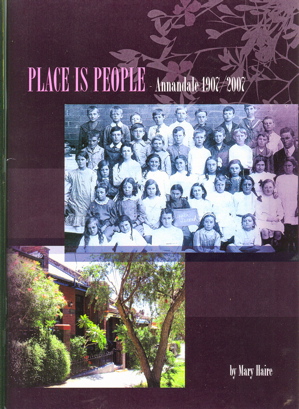
Place is People is a strange little book, neither an attractive collection of photographs to introduce the suburb to visitors nor a quick historical overview. It’s got elements of both those, but is something more personal and less orderly than either; if it was even more personal, it might have been an extended prose poem, but it isn’t quite that either.
Mary Haire leads walking tours, and the book has something of the serendipitous feel of such tours: here’s a little girl walking to school; let me tell you about a boy that age who went to the same school a hundred years ago. I know more about my suburb’s history having read it; some errors have been corrected, and some tantalising trails laid in my mind: Cardinal Freeman was born here, for instance, and the young woman at the florist’s is a single mother. How can I put those two snippets in the same sentence, you ask? I plead that the book sets a precedent with its gloriously unconcerned potpourri approach to its subject.
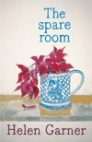
Talking at Gleebooks recently, Helen Garner paid tribute to Elmore Leonard’s essay, ‘Ten Rules of Writing‘: she has his sentence, ‘If it sounds like writing, I rewrite it,’ on the wall above her desk. In The Spare Room, she has given us a feminine Elmore Leonard story: it’s about the emotional tangles between two women, or at least those tangles provide the language for its telling, but it has the clean lines, the sure forward movement, the lack of hooptedoodle, that give such pleasure in Leonard’s tough-guy narratives from The Tall T to, say, Pagan Babies.
It’s a very quick read, and an intense one. There’s plenty of complexity, some of which I’ve found making itself known to me weeks after finishing the book. For instance, ‘Helen’ the character, who is manifestly a version of Helen the writer, claimed my allegiance and assent to her judgements while I was reading, but has since come to seem much less reliable, much too caught up in her own emotional reactions to be able to give us the full picture (some of which the book gives us in spite of her). It’s a magnificent achievement.
I doubt if David Campbell (1915–1979) is still studied in Eng Lit courses at many Australian unis, but I hope he is fondly remembered and occasionally reread by more than just me. He and Martin Johnston share a posthumous moment in John Forbes’s elegiac ‘Lassù in Cielo’; he cropped up in a footnote in the John Manifold collection I read last month; a recent Poetica featured his correspondence with Douglas Stewart; lines and images from his poems arrive in my mind unbidden from time to time.
Most of the poems in this selection are a strange mixture of the bucolic and the erudite (and just in case I’ve misused those words, I mean rustic and scholarly), and there’s a pleasant music to them. When I read the sequence of twelve twelve-line rhyming poems of ‘Cocky’s Calendar’, I found myself wondering how he managed to pick up his pen again after writing something so wonderful. Back in the early 1970s, in an Aust Lit seminar on this sequence, a student from North America totally didn’t get them: while the rest of us were being drawn into the poetry’s intensely personal relationship with the landscape, he lost patience altogether and said the whole thing read like verse you’d find on a Norman Rockwell calendar. I thought then that he was missing something, and I find I still do. This is the ninth poem, for September:
Under Wattles
Now, here and there, against the cold,
The hillsides smoulder into gold
And the stockman riding by
Lifts to the trees a yellow eye.

It's here the couples from the farms
Play in one another's arms
At yes and no – you'd think the trees
Sprang from their felicities.

So may our children grow up strong,
Got while the thrush drew out his song,
And love like you and I when we
Lie beneath the wattle tree.
How about that present tense ‘lie’, eh?
I think the sequence as a whole speaks to me so strongly because of my father. At a family gathering once, another farmer, of a younger generation, said something about the boredom of spending a whole day driving around a paddock in a tractor (this was before the days of air-conditioned tractor cabins and iPods). When my father said mildly that he didn’t get bored, one of my female cousins asked him what he did with his mind when he was out there all day. As he drew breath to answer, my mother came to the rescue by changing the subject (‘Oh Jenny, you know you’ve been asking me about tatting, I have a pattern here I can show you’). Probably to his relief, my father didn’t get to answer the question. I like to think that David Campbell’s contemplative poems, even though his is a sheep property while my father grew sugar cane, provide some version of what my father might have wanted to say back then over tea and scones.
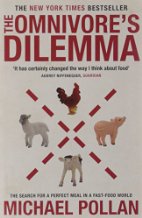
With The Omnivore’s Dilemma I was back to farming, in three categories: industrial, of which I read with a mixture of horror and curiosity; pastoral, which is not synonymous with ‘organic’, but tends to have the virtues claimed for it; and personal, in which the author creates a meal from things he has personally grown, hunted and killed, or foraged. I don’t know that anyone could read this tremendously engaging book without changing the way they think about food. It’s very heartening that it was a New York Times best seller. If you want a quick look at the central part of the book, which deals with ‘intensively managed grazing’ or clever grass farming, here’s a video from Michael Pollan’s recent TED talk:
The book integrates into its narrative any number of lively essays: on the ethics of meat-eating (in which Pollan engages with Peter Singer), the joys of hunting (ditto Ortega y Gasset), attempts at humane design in modern abattoirs (Temple Grandin), the US domestic and international politics of corn (in which he doesn’t discuss the so-called Free Trade Agreements that leave the US free to subsidise its grossly inefficient corn agribusinesses while preventing other nations from continuing with similar protections, but he makes their absurd brutality abundantly clear), on just about anything you can think of that’s related to his central question, ‘What should we have for dinner?’ Some of it is very funny. Some is inspiring. Some horrendous. All of it is engrossing.
I hadn’t read David Campbell’s The Man in the Honeysuckle before. As with Selected Poems, I’m fairly indifferent to the learned bits, mainly translations and imitations from the Russian, but some of the lyrics, especially the Aust Pastoral pieces, are extraordinary. The book was published posthumously, and it’s hard not to read a number of the poems as being poignantly suffused with a sense of death as imminent. ‘Crab’, ‘The Broken Mask’ and the whole ‘With a Blue Dog’ section stand out for me in this first encounter. How’s this:
Wind in Casuarinas

Camped under the she-oaks
With a dog and swag

The woman a white sapling
A straight flame
Blown all ways
And the children off
On their several roads

Lives rounding like river stones
Or washing out in wheel ruts

A high sky over tree and hill
And the clouds taking fire
I am spread out I burn
Yellow and rose – blessing and blest
A still flame in the arms of the she-oaks

Life butting into the world
With five wants and a howl
And shambles out with a blue dog.
I want to put ‘five wants and a howl’ right up there with ‘helpless, naked, piping loud’.
I don’t imagine Elmore Leonard would care much for this Heat. There’s hoptedoodle galore … though generally very high quality hoptedoodle. Ironically, the one article that seem to me to be 90 percent hoptedoodle is by a crime writer whose point seems to be that crime fiction has advantages from being bound to an absence of hoptedoodle (but maybe I was just irritated because her essay on the relationship between genre fiction and literary fiction totally ignores the existence of children’s literature and science fiction).
There’s a terrific piece on blogging by Kerryn Goldsworthy, not a hopt or a doodle in sight; a lovely pairing of a story by Eva Sallis (‘Abattoir’) and an essay by Elizabeth Campbell (called ‘Why Little Girls Love Horses’ on the contents page but ‘Envy Worship and Passion’ on its own title page); chiming mentions of the catacombs of Paris, of which I’d never heard, first in one of Jennifer Maiden’s still-intriguing George Jeffreys–Clare Collins poems and then in an engrossing essay by Sarah Knox about researching historical novels, her own and Hilary Mantel’s; and a number of memorable pieces on aspects of migration: Elisabeth Holdsworth’s memoir ‘New Holland’, a short story by Hoa Pham, poems by Ali Alizadeh (on his unborn baby) and Peter Skrzynecki (on his late father). There’s lots more. I’m a happy subscriber.
I understand that it must be a nightmare to copy edit a magazine like this: so many words, so many different voices, so little time. But there are enough lapses to present a significant obstacle to the reader, at least to this one. At one point, havoc is ‘wrecked’; as something wreaks havoc just a few pages later in the same article, it seems likely that the error resulted from an editor’s dependence on a spellchecker rather than ignorance. In the sentence, “The memoir becomes a book about illness to many reviewers; a ‘survivors’ tale; a plumbing of the issue of women’s health, and the continuing masculinist paternalism of the public health system” it looks very much as if the apostrophe after survivors was misunderstood by someone who inserted another before it to make it function as a quote mark; and the comma after health almost derails the sense. I don’t want to go hunting for similar moments, but the erratic comma and absent apostrophe in ‘reconstruction, so redolent of the historian’s duty, and the re-enactors fancy’ just leapt up at me from further down the same page (p 172). This might be just the irritated snitchiness of an underemployed pedant, but in this context it becomes hard to tell if the truly eccentric punctuation in a number of the poems is what the poet intended or the product of editorial inattention.</curmudgeonly grumble>
How could I resist reopening The Branch of Dodona, my only other David Campbell book? This one had pride of place in the bathroom for a week, to allow for contemplative reading in short bursts. Again, it’s his farming poems – in this volume, the ‘Works and Days’ sequence, with its love–hate relationship to sheep – that speak most strongly to me. Even his ‘My Lai’, which I remember him reading at Vietnam Moratorium Readings in another age, works so powerfully because of the farmer-to-peasant solidarity it embodies:
I was milking the cow when a row of tall bamboo
 Was mowed by rifle fire
 With my wife and child in the one harvest,
 And the blue milk spilt and ruined
I’m not sure what the friend had in mind who gave me Diane Athill’s reflections on old age, Somewhere Towards the End, as a present for my 61st birthday. As Ms Athill is almost exactly 30 years older than me and still going strong, I’ll assume she wasn’t hinting it’s time I hang up my spurs.
In terms of my current reading, the book’s matter-of-factness, its almost belligerent steadiness of gaze play as a sober counterpoint to the rage and evasion of The Spare Room: both books generate what Athill calls an ‘addictive excitement of the mind’, and they speak to each other. Ms Athill’s brief reference to Hilary Mantel’s A Place of Greater Safety endorses Sarah Knox’s praise of it in her essay in Heat. The book has in spades a (to me) miraculous quality that I think of as Protestant integrity, a quality also displayed, ineffably, in the manner of my friend J’s leavetaking. I wouldn’t mind having a mind like Diana Athill’s when I’m 90. She manages to be remarkably cheerful about things usually discussed, if at all, in gloomy mode. One chapter begins, for example (the emphasis is mine):
When you begin discussing old age you come up against reluctance to depress either others or yourself, so you tend to focus on the more agreeable aspects of it: coming to terms with death, the continuing presence of young people, the discovery of new pursuits and so on. But I have to say that a considerable part of my own old time is taken up by doing things or (worse) failing to do things for people older, or if not older, less resistant to age, than myself.
Can’t you just see that paragraph, followed by the word ‘Discuss’, as an exam question on The Spare Room?
[Originally published in May 2007 in my now defunct earlier blog, Family Life. I’ve retrieved it because a friend was looking for information on Jeff Sparrow’s book.]
Heat was, as always, a solid read. And as always it’s a bit of a puzzle how the title was arrived at: in this case it’s a phrase from one of the stories, with no obvious overarching thematic relevance. But it doesn’t matter. Even if there is no theme that makes the book hang together, the pieces in this issue, as in others, are free to resonate with, echo and comment on one another, so that the whole is pleasingly more than the accretion of its parts — and I did read and enjoy this issue cover to cover.
Beverley Farmer visits her former husband’s village in Greece in ‘The House on Rebirth Street’ (dropping a few too many untranslated Greek words for my comfort); Greece brings some respite to the heroine of Stephen Edgar‘s pseudo ghost story in verse, ‘The Deppites’. There are a number of nostalgic visits to family homes, and frequent references to migration.
Nostalgia for religious belief bubbles to the surface in a number of pieces. Gillian Mears is visited by the rumtitum rhythms of Edward Lear’s ‘Pelican Chorus‘ as she’s wheeled in, near death, to the operating theatre; Felicity Plunkett‘s wonderful sequence of poems ‘The Negative Cutter: An Introduction to Editing’, also deals with surgery, playing with a cinematic metaphor; Mark Rappaport, documentary film maker, has fun riffing on his connections to Catherine Deneuve, as fan and appalling collaborator. I love all this.
When I edited a literary magazine not so very long ago, it was regularly proposed to us that each issue should be organised around a Theme. Just as regularly, I resisted the proposal, as it seemed to me that it was based in a misunderstanding of what kind of creature a literary magazine is. My pleasure in Heat confirms me in my belief. Instead of corseting, regimentation, control, there is a sense of organic relationship, of many minds independently but harmoniously making story, or seeking truth, or singing, or doing whatever it is that literature does.
In his introduction to Communism: A Love Story, Jeff Sparrow writes:
Communism provided an alternative. It was, in many ways, the alternative, the most important indicator that society could be remade. Between 1917 and 1989, its star shone bright and its star shone dim, but its continuing sparkle in the political firmament allowed millions to believe in a world beyond the free market. Even those who despised communism felt that while it existed, change – whether they wanted it or not – was a possibility.
Today, that feeling is gone.
The book is a biography of Guido Baracchi, a well-heeled, literate bohemian and committed Marxist/Communist who lived from 1887 to 1975, described by Stuart Macintyre as ‘the knight errant of Australian communism’. He’s a terrific subject for biography: he worked for the cause in Weimar Germany and the 1930s Soviet Union; he had intense relationships with a number of poets and playwrights (Lesbia Harford, Katharine Susannah Prichard, Betty Roland), each of whose accounts this biography has drawn on; he was widely read and wrote a lot himself, also supplying a wealth of material to his biographer.
I was telling some friends about the book, and one woman was prompted to talk of her youthful romance with a son of a leading Communist family: when they were about to go out on a date, he would say, ‘Let’s stay home tonight – the old coms are coming around and there’ll be lots of tales.’ I suspect Jeff Sparrow had a background something like that, because while this book meticulously cites its written sources (discreetly, up the back, not interfering with the flow of the narrative), and doesn’t hang back from quoting T S Eliot and James Joyce to good effect, it’s also bursting at the seams with ‘tales’, with the lore of Australian Communism: clever ploys, bastardry, romance, betrayal, nobility (like Guido’s wife Neura’s principled reaction to the news that he had taken up with another woman, from which she seems never to have wavered), tragedy (which is too pallid a word for what Stalin and Stalinism did to the hopes of the world). You can almost hear the stories being told with suitable embellishment at a smoke-wreathed kitchen table far into the night.
As the story unfolds, what today is called the mainstream media is relegated to commenting from the sidelines: for example, during the travails of the tiny Australian Marxist movement of the early 20s, bitterly divided within itself, devoting most of its energies to self-education, and discouraged at the prospect of ever being effective, we learn that Prime Minister Bruce gets headlines by accusing the Labor Party of pandering to Bolshevism, and succeeds at a stroke ‘in elevating communism into a public issue in a way that the communists themselves found impossible’. Sadly, the MSM version has become received wisdom, and a whole dimension of our history has been largely forgotten. Those who deplore ‘black-armband history’ would no doubt equally deplore this, perhaps as ‘red-tie history’. I can’t recommend it enough – for that worthy reason, but also because it is a ripping good read, another example of history written with the verve and imaginative force that some think is the exclusive domain of the novel.
An extra pleasure of the book for me was encountering a number of people I have actually met: Betty Roland, the Currency Methuen edition of whose play The Touch of Silk I edited in 1974; Eric Aarons, ‘the young branch secretary’ who banned Guido from lecturing in 1939, whom I met as a gentle old man, a sculptor and caretaker of a workshop site (and whose own memoir What’s Left sits on my bookshelf unread); Nick Origlass, Trotskyist, who seems to have used the long boring speech as a weapon just as consistently in youth as in age; Bob Gould, shambolic bookshop proprietor, who appears here as a fiery youth; a friend’s mother gets a guernsey as one of two students who defied pressure to reject Guido’s teaching in 1939. And a final personal note: one of my dearest friends and teachers, a US communist in the 30s and 40s, still preserved his hatred for Trotskyism intact 40 years after leaving the party; I wonder what he would make of Jeff Sparrow’s implied contention that it was the Trotskyists who kept the flame of communism burning clearest during Stalin’s era.
Rotters and Squatters is the third in the Fair Dinkum Histories series, and takes the story of the Australian colonies from 1820 to 1850. I’ve already raved about this series. Consider it raved about again. They’re children’s books, but only a bizarre age-based separatist mentality would prevent an adult from enjoying them. Maybe you need an appreciation of juvenile humour to enjoy the deliberately appalling puns in some of Peter Sheehan’s cartoon illustrations, but this book communicates without condescension or chalk-dust or scatology, and strikes a wholly attractive balance between the general and the particular, the comic and the very serious, the personal and the (discreet cough) political.
Like the previous books in the series, it doesn’t attempt sanitised ‘balance’: no doubt it will irk the haters of black-armband or red-tie history. I reckon the series, and this book as part of it, makes a significant contribution to historical writing about Australia, not least by being a quick read with an occasional laugh-out-loud moment. One of several idiosyncratic reasons for my enjoying it is that its short Recommended Reading list includes just one book by an explorer: Edward John Eyre’s Journals of Expeditions of Discovery, the subject of my aborted MA thesis in the 1970s, which in my opinion richly deserves its recommendation here. (If my thesis supervisor – you know who you are! – is still alive and reads this, I’d like my copy back, please).
After a break, I went back to the Frank O’Hara. I still don’t think it’s my cup of tea, but I decided to read the poems as play – instead of puzzling over what he means by an obscurity, I’ll just take it that it’s there because it’s what popped into his head and sounded cool – or in some way captured the emotion of the moment. And I decided not to worry about his name-dropping and hi-falutin’ allusions. In other words, I stopped trying to understand what was going on and just let it flow. No doubt I missed a lot – because of his hurling words at the page like Jackson Pollock creating a painting, and because of the references and allusions that went past me – but I also enjoyed a lot. There are some outright reader-friendly bits like this piece of New-York patriotism from ‘Meditations in an Emergency’:
I can’t even enjoy a blade of grass unless I know there’s a subway handy, or a record store or some other sign that people do not totally regret life.
I gather he’s as hip as ever: people even use phrases from his poems as novel titles.
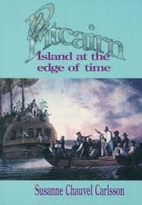
I read the Pitcairn book in preparation for an editing job (which seems, alas, to have fallen by the wayside – in Pitkern, it es ay los’ bawl). Susanne Chauvel Carlsson is the daughter of Charles and Elsa Chauvel. Her interest in Pitcairn Island grew from her parents’ relationship with the island, beginning with their 1932 visit to film parts of In the Wake of the Bounty. The book is a mix of fascinating potted history, family lore, personal reminiscence and observation, and travel log.
People who read the newspapers more carefully than I do, and that’s probably most people, may already know a lot of the Pitcairn story, but even if I’m coming in late, I’m compelled to say the story is riveting. Pitcairn was settled in 1790 by a party of Bounty mutineers led by Fletcher Christian and accompanied by a number of Polynesians: nine mutineers, six Tahitian men, nine Polynesian women (all but one of them from Tahiti) and one baby girl. The first decade was rough, with quite a bit of drunken rioting and mayhem (ears bitten off and so on), murder, a suspicious suicide. After a failed escape attempt, some of the women murdered the remaining Tahitian men. By 1800 the population comprised one man, the mutineer Aleck Smith (who later changed his name to John Adams); ten women (I don’t know where the extra one came from – the book is plagued with such inconsistencies ); and about 23 children. It was another eight years before the Pitcairners had any contact with the outside world, and isolation has been a major factor in the Island’s cultural, economic, linguistic and political development ever since.
It’s a story that reads like a lost-in-space fiction: the language developed as a mixture of rough English and Tahitian; the religion grew from the one semi-literate man’s determination to read and then communicate to the women and children what he found in the Bounty‘s bible. Susanne Carlsson makes no bones about having fallen in love with the place and the people – it’s one of those unfathomable complexities that the object of her affection has also been the site of a history of sexual assault and of sanctioned sexual practices that in most other places would be condemned as paedophilia.
All that news was bad enough already. It becomes much worse when you’ve read accounts of these people playing a cheerfully innovative version of cricket (you have to innovate when your total population is about 50), sharing out Christmas presents in the town square, praying in their Seventh-day Adventist chapel, rowing longboats out to meet the still infrequent visiting ship. I imagine we’ll never know whether the evidently widespread sexual abuse has been there from the beginning or whether it is a symptom of the recent breakdown of the stern religious glue that held the community together.
Oh, and this book had an excellent addition to the Little Known Facts file: in 1838, when the Pitcairners persuaded a visiting Royal Navy ship’s captain ‘to draw up a constitution and code of laws suitable to their needs’, Pitcairn became the first place where women had the right to vote, 46 years ahead of South Australia.
Baby Boomer Reminiscence Alert. Skip to the end if BBRs drive you nuts.
(OK, they’ve gone, but I’ll assume I’m not talking only to myself.) Back in the early 70s there were a lot of poetry readings in Sydney: there were Moratorium readings, Balmain readings, Sydney University Great Hall readings; at the 1972 Aquarius Festival in Canberra, the year before the much more famous Nimbin Aquarius Festival, there were a number of serious group poetry readings. I was a keen poetry-goer in those days. There were dramatic moments: Roland Robinson once shouted something like ‘This is muck!’ during a Chris Wallace Crabbe poem that began ‘To f**k is to move through grooves of time’. The dignified cadences of A D Hope shared the stage with the precision of Dave Malouf, the raffishness of Bob Adamson, the heady intellectualism of Martin Johnston, the drugged waifishness of Michael Dransfield, the hypnotic incantations of Les A. Murray … and so on. If I remember correctly, John Tranter was a regular at these events, but for some reason I’ve never really got his poems: back then, and on my occasional attempts to read him since, I found them intriguing but it felt as if they existed in a thicket of references and allusions and associations that were outside my experience. I thought of him as a poet’s poet.
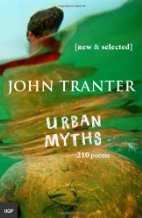
Afflicted as I am with an indefensible, irrational and unfillable greed to know and read everything, I used one of my 60th birthday vouchers to buy Urban Myths, which includes selections from his previous books dating back to 2000. I’m now about a third of the way through it. Those early poems are still intriguing but almost completely opaque. It’s not just the allusiveness; in some way that’s hard to articulate, I can’t hear a human voice in the poems, even one I don’t understand. I’m pleased to report that we’re getting on much better by page 80: I’ve laughed, I’ve been close to tears, I’ve reread some poems a number of times until I feel I understand them, because they promised to repay the effort. The book won the NSW Premiers Literary Award for poetry a couple of nights ago. John read the poem that opens the book, ‘After Hölderlin’, and I couldn’t remember what my problem was. That poem is dated 2002 in Urban Myths, so I’m expecting the best as I read on.
Years ago, when he was in his teens, Alex explained why he wouldn’t read Terry Pratchett: ‘If I’m going to make the effort to read a book, it needs to be about something important.’ He made sense, but I’ve never felt that way myself, not in the slightest – until I picked up a detective story at the start of this month and couldn’t see the point. After books on climate change, Arab-Israeli politics, the nature of history, etcetera, I wanted something that was either very meaty or no effort at all.
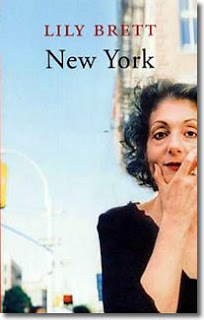
I found this Lily Brett book on my friend Judy’s shelves – a collection of short pieces, each one exactly three pages long, and staying resolutely at the level of observation and wry, reflexive commentary. (Unsurprisingly, mentioned nowhere in the book itself but prominent in its description on Lily Brett’s web site, the 52 pieces were commissioned as weekly columns for a newspaper, Die Zeit – a provenance which also explains the frequent German references.) Perfect, elegantly insubstantial bedtime reading, which morphed into perfect read-aloud in the car on the drive from Melbourne to Sydney when my reading of Shlomo Ben-Ami’s syntactically challenging sentences threatened to send driver my to sleep by the time we’d reached 1967 (roughly a third of the way through). We arrived home safely and in buoyant spirits ten minutes after the end of Lily’s last piece.
Once home, I didn’t immediately pick up Scars of War as a solitary read. I took a break, and knocked over Simon Leys’ book on the Batavia in a couple of days. He starts out saying he had planned to write on the subject for a long time, but given up when he read Mike Dash’s Batavia’s Graveyard, a book he recommends. I don’t think I’m up to the long book, and might not have read this one had I not received it as a freebie when I re-subscribed to the excellent The Monthly. But it’s a fascinating subject: a hideous reign of terror on a coral atoll off the coast of New Holland in the mid 17th century. I was impressed to find that the murderous teenage boy who was part of the events comes across as just as horrifying in this brief account as he does in Gary Crew’s young-adult novel, Strange Objects. The impression created by the novel that it is based in something real is borne out by this book. Simon Leys’ Batavia isn’t really book-length, and the volume is filled out with another essay, this time an account of the author’s tuna-fishing trip on a sailing boat in 1958.
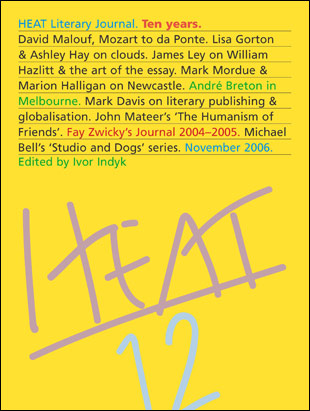
After that bracing dip into two very different seas, I was about to return to the dryness of war and peace in Israel, when Heat 12 arrived in the post. It turned out to be right on theme – I’ve written a separate post.
Then I got back to Shlomo Ben-Ami‘s book. The author is a self-described Zionist of the Left, a one-time member of the Knesset and chief negotiator in Israeli–Palestinian negotiations, an activist for peace, and clearly a passionate historian. The book is a superb history of the diplomatic, political and military tactics and strategies, coups and blunders in the Middle East. Its emphasis is on the negotiations, ‘the peace process’; wars and violence feature only as they impact on the politics. The Munich Olympics, for instance, don’t rate a mention, and one searches in vain for a detailed account of any of the many violent episodes. As a know-next-to-nothing reader, I would have loved an easy-reference timeline up the back, and perhaps a glossary giving key dates, events and outcomes for each salient episode. In the absence of such kindnesses, I felt my ignorance acutely at times, but if that minor discomfort was the price of admission, the show was well worth it.
There are wonderfully sharp portraits of the main players, David Ben-Gurion, Golda Meir, Moshe Dayan, Yitzak Rabin, Yasser Arafat – not the kind that seizes on colourful details but rather evokes the characters as complex human beings and political operators: no mention at all of Dayan’s eye patch, but a brusque sketch of him as a man who inspired many people but was completely incapable of being close to anyone, a fierce Zionist who despised Judaism and had a kind of pagan belief system. The pages on Arafat are devastatingly brilliant (I wouldn’t have a clue if they’re accurate, but they explain a lot).
The early chapters delineate the complex interplay of imperial aggression and Zionist aspiration that led to the first Jewish settlements, are unflinching in their account of the dispossession and abandonment of the Palestinians, and anatomise the complexities of the politics in the region, including the roles and objectives of the superpowers. As the book comes closer to the present, and the author’s own direct observations and even interventions become part of the story, it might easily have lost its way in the detail of personalities and politicking; instead it becomes absolutely engrossing. Little bits of gossip enliven the narrative – Arafat had such difficulty renouncing terrorism that he also had difficulty pronouncing it: at the Camp David peace talks he three times promised to renounce ‘tourism’.
The book’s real strength is that this is an insider’s view, and the whole story is presented on a human scale – not that the narrative reduces the stakes and complexities to the level of personality; more that it explores the huge dimensions of the persons involved: the myths that sustain them and undermine them, their capacity for generosity and humiliation, their relationships as political leaders with their constituencies, their skills as negotiators …
No doubt this book has its detractors, and it may well have got it wrong on any number of counts. But reading it has put me within cooee of understanding why the Middle East goes on defying attempt after attempt at peace. It has also given me tantalising glimpses of Advanced Negotiation (it’s salted with gems like, ‘The weakness of your rival is a reason to reach an agreement with him, not the trigger to humiliate him further’) and of Leadership With or Without Megalomania. Although its subtitle, ‘The Israeli-Arab Tragedy’, is thoroughly justified by the amount of death and destruction contained in this narrative, by the hubris of some players (mostly Israeli) and the opportunities culpably missed (spectacularly, but not at all exclusively, by Yasser Arafat), it manages all the same to end on a note of cautious but plausible optimism:
The time has finally arrived to assume that the complete satisfaction of the parties’ respective dreams or presumed rights will only lead them both to perdition. Here it is incumbent upon each to devise realistic ways that would heal without opening new wounds, that would dignify their existence as free peoples without putting into jeopardy the selective security and the particular identity of the other. The moment has come for the creative energies of the parties to this most protracted of conflicts to be put, at long last, to work in the service of a durable peace.









 Me fail? I fly!