
Junichirō Tanizaki, In Praise of Shadows (1933, translated by Thomas J. Harper & Edward G. Seidensticker 1976)
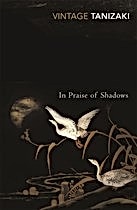
The Midcareer Artist and I recently visited a practitioner of kintsugi, the Japanese art of repair. When the MA said that I was a poet, our host thrust a copy of this book into my hands, saying it was her guiding light.
According to Wikipedia, Jun’ichirō Tanizaki (1886–1965) is considered one of the most prominent figures in modern Japanese literature. This short essay on aesthetics was written before he reached peak fame, but when he was already established as a novelist. He had got over an earlier fascination with western culture, and in this essay he proclaims the virtue of traditional Japanese aesthetic, even while seeming to acknowledge that it is disappearing with the coming of modernity.
It’s a delightful essay, pretty much beginning with half-ironic praise of Japanese toilets – not the spectacular creations celebrated in Wim Wenders’ 2023 movie Perfect Days, but dimly lit places of contemplation:
The toilet is the perfect place to listen to the chirping of insects or the song of the birds, to view the moon, or to enjoy any of those poignant moments that mark the change of the seasons. Here, I suspect, is where haiku poets over the ages have come by a great many of their ideas.
The essay doesn’t stay lavatorial. There’s an interesting discussion of the use of gold and other decoration – what looks garish in full sunlight or the bright illumination that comes with westernisation is richly beautiful in the shadows of a traditional Japanese temple, reflecting fleeting rays of light in ways that delight the eye.
A phosphorescent jewel gives off its glow and colour in the dark and loses its beauty in the light of day. Were it not for shadows, there would be no beauty.
There are some unsettling elements, including accounts of womanly beauty that present a Japanese version of the male gaze. And there’s a pretty shocking discussion of skin colour.
But on to page 47*. It asks the question Why? and sums up the differences between Japan and the West:
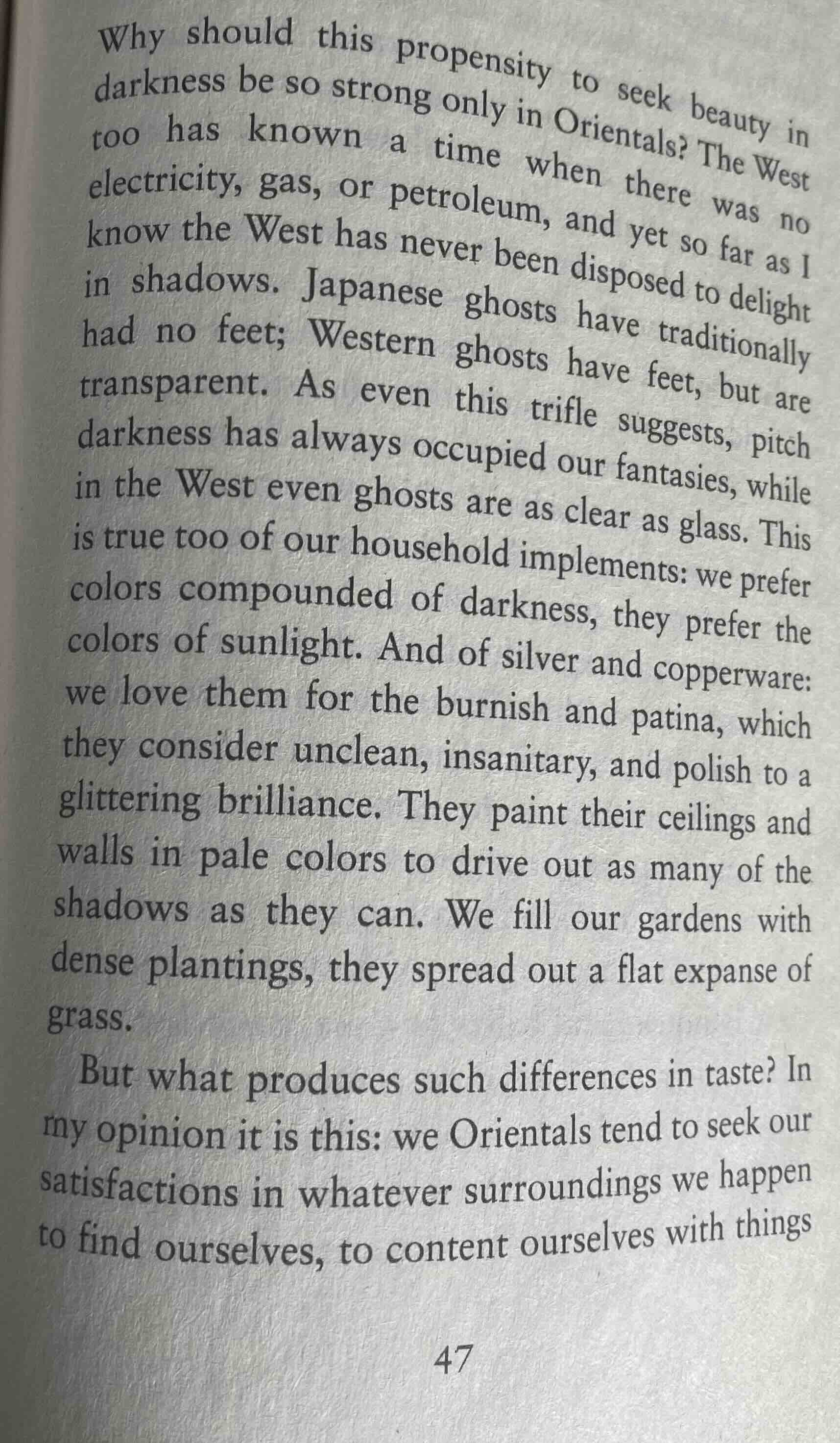
Why should this propensity to seek beauty in darkness be so strong only in Orientals?
I wish I had access to a new translation of the essay by Michael P. Cronin published this year, to see what he does with the word ‘Orientals’. But I don’t, so I’ll proceed without further comment.
The West too has known a time when there was no electricity, gas, or petroleum, and yet so far as 1 know the West has never been disposed to delight in shadows. Japanese ghosts have traditionally had no feet; Western ghosts have feet, but are transparent. As even this trifle suggests, pitch darkness has always occupied our fantasies, while in the West even ghosts are as clear as glass. This is true too of our household implements: we prefer colours compounded of darkness, they prefer the colours of sunlight. And of silver and copperware: we love them for the burnish and patina, which they consider unclean, insanitary, and polish to a glittering brilliance. They paint their ceilings and walls in pale colours to drive out as many of the shadows as they can. We fill our gardens with dense plantings, they spread out a flat expanse of grass.
That gives you a sense of the relaxed, meandering manner of the essay – ghosts, kitchenware, wall paint, garden plants all marshalled in one short paragraph to make his point.
I can’t leave you with just the question, so I’ll give a bit from over the page where he begins his answer to the question:
But what produces such differences in taste? In my opinion it is this: we Orientals tend to seek our satisfactions in whatever surroundings we happen to find ourselves, to content ourselves with things as they are; and so darkness causes us no discontent, we resign ourselves to it as inevitable. If light is scarce then light is scarce; we will immerse ourselves in the darkness and there discover its own particular beauty. But the progressive Westerner is determined always to better his lot. From candle to oil lamp, oil lamp to gaslight, gaslight to electric light – his quest for a brighter light never ceases, he spares no pains to eradicate even the minutest shadow.
You see what I mean about unsettling? Isn’t this exactly the kind of thing that Edward Said said the happens in Western accounts of Asian cultures – a kind of essentialising as Other?
I went duck-duck-go-ing: ‘Tanizaki orientalism’. Sure enough, I found ‘Performance of East-West Discourses in Tanizaki’s In Praise of Shadows‘, a very helpful article by Ryan Morrison on the Japonisme website, which actually quotes that same paragraph. Morrison pretty much nails my response to the essay when he says that its readers
are not sure whether to take the work as a parody of Orientalism/Occidentalism or as an Orientalist aesthetic treatise; and it is this resulting confusion that attests to Tanizaki’s ability to transcend ideology. For on the one hand, it is hard to say that Tanizaki is entirely insincere … On the other hand, it would be equally difficult to argue that In Praise of Shadows should not be read, at least in part, as a satire on the essentialist claims of Orientalism and its mirror, Occidentalism.
In the end, Tanizaki leaves his readers in a state of aporia – irresolvable paradox – which is perhaps the ultimate aim of art.
In praising shadows, Tanizaki has created a shadowy work of his own!
I am a man of settler heritage living on Gadigal Wangal country, beneath a deep blue sky and with a cool breeze in the branches outside my window. I acknowledge Elders past, present and emerging for their continuing custodianship of this land, and welcome any First Nations readers.
* My blogging practice is to focus on the page that coincides with my age, currently 79. When a book has fewer than 79 pages, as this one does, I look at page 47, the year of my birth minus 1900.


