
Magdalena Ball, High Wire Step (Flying Island 2018)
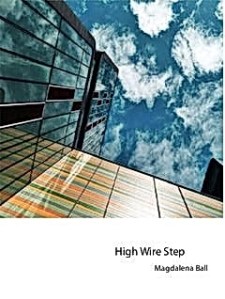
This is the third book by Magadalena Ball I’ve read. The others were Density of Compact Bone (2021) and Bobish (2023). Links are to my blog posts. I enjoyed those very different books a lot, so when High Wire Step arrived as one of the past publications included in my 2026 subscription from Flying Island, I was happy.
I still am happy. But I find myself unable to make any easy generalisation about the book. Each of its 40 poems stands alone and expects a reader to take time to savour it.
For instance, ‘Giantess’ is a monologue by the character who let Jack into her husband’s kitchen when he arrived from the beanstalk – beginning ‘I took a chance / opening the door’. There are a number of elegiac poems, and some enigmatic poems that seem to be childhood memories. There’s a longer poem, ‘Art of the Deal’, which begins:
While I grew up in lower Manhattan's
housing project
the pre-dawn cusp of gentrification
there was a shadow rising
and goes on to be a poem in which Donal Trump walks as he probably couldn’t in these Trump-saturated days. There’s a poem about the designer card game mille bornes, which begins ‘This is not a game.’
You get an idea of the diversity.
‘Trickle-down’, on page 78–79*, is a nice sample. It springs from a brief encounter – or even non-encounter – of a kind that happens often in city life. The poem’s main speaker passes a young woman begging in the street:
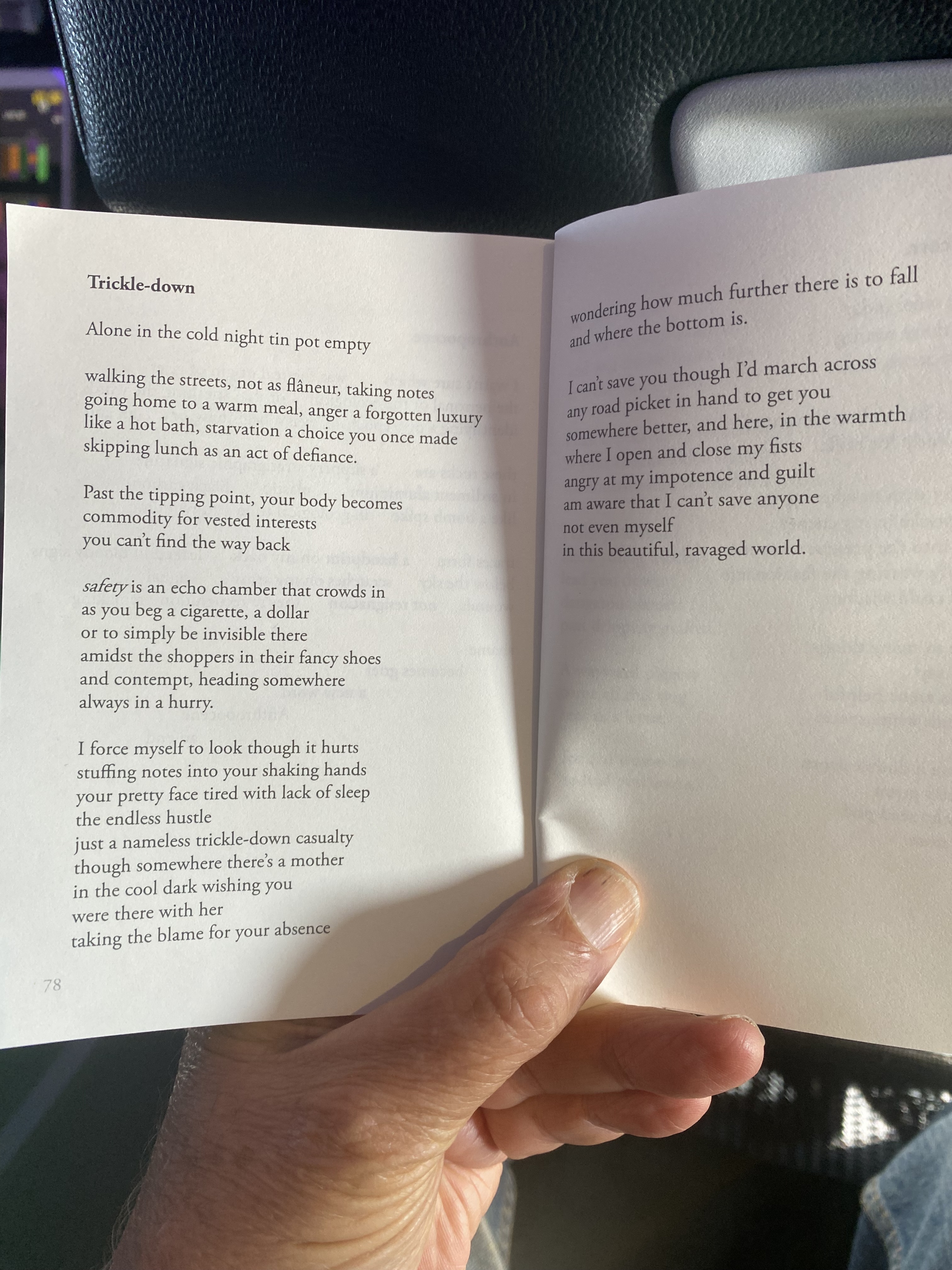
Trickle-down
The title suggests that the poem relates to the term ‘trickle-down economics’, government policy that favours the wealthy with the professed belief that the benefits will trickle down to those less wealthy.
What follows is not exactly a dialogue, but the poem has two characters. The first is evoked in the short opening line:
Alone in the cold night tin pot empty
The second, the poem’s main speaker, takes four lines to be introduced:
walking the streets, not as flâneur, taking notes
going home to a warm meal, anger a forgotten luxury
like a hot bath, starvation a choice you once made
skipping lunch as an act of defiance.
It’s not a glib contrast between someone begging and someone well-off and smug, or even someone idly observing ‘as flâneur, taking notes’. She’s on her way home from work, and there are elliptical bits of backstory, perhaps flashes of memory prompted by the sight of the begging woman. Once she was angry and defiant, but never experienced deprivation except by choice. The paradox of anger as a luxury suggests a life with dulled emotions, where the person is ground down by life’s demands
It’s interesting that the phrase ‘a choice you once made’ is the first time a personal pronoun appears. Until then the two characters have been implied in the naming of objects (the tin pot, the warm meal, the hot bath), emotions (anger) or actions (walking, defiance, skipping lunch). The poem takes its time to focus on the people.
Once there was anger, choice, defiance. The implication is that these are no longer there. There must have been a point where that changed. Acknowledging this, the poem completes the introduction of the passerby:
Past the tipping point, your body becomes
commodity for vested interests
you can't find the way back
She is caught up in the urban rat race. I like the fine touch of ‘your body becomes / commodity’. It’s not even an individualised commodity, just part of a general substance.
In the next stanza, there is a different you, who sees the world from where she sits at the edge of the footpath:
safety is an echo chamber that crowds in
as you beg a cigarette, a dollar
or to simply be invisible there
amidst the shoppers in their fancy shoes
and contempt, heading somewhere
always in a hurry.
Now there’s an I for the first time. The passerby snaps out of her numb state and becomes the speaker of the poem. She wasn’t taking notes, but now she forces herself to look, to notice details about the other woman, to reflect briefly on the way the economic system creates such poverty, to imagine something of the other woman’s life at least in general terms. This mental act of compassionate witness is as important as giving money:
I force myself to look though it hurts
stuffing notes into your shaking hands
your pretty face tired with lack of sleep
the endless hustle
just a nameless trickle-down casualty
though somewhere there's a mother
in the cool dark wishing you were there with her
taking the blame for your absence
wondering how much further there is to fall
and where the bottom is.
The final stanza brings together words and images from earlier. She is warm, angry (is it still a luxury?), would march (as oppose to shopping in fancy shoes or being always in a hurry), guilty (like the begging woman’s mother). She forms fists, whereas the other woman hands were shaking. And the opening words of the stanza echoes ‘safety‘ from earlier:
I can't save you though I'd march across
any road picket in hand to get you
somewhere better, and here, in the warmth
where I open and close my fists
angry at my impotence and guilt
am aware that I can't save anyone
not even myself
in this beautiful, ravaged world.
The last line is a final harking back: the begging woman’s pretty, sleep-deprived face becomes in retrospect a metaphor (or do I mean a synecdoche) for the state of the world.
I think it would be a mistake to read this as a manifesto of despair. I think it’s more a waking from numbness: by allowing (forcing?) herself to feel for this individual, the speaker has opened the possibility of acknowledging what she sees happening in the big picture. Certainly, that last line feels like a door swinging open to a vast panorama: anger is no longer a forgotten luxury.
You can find out more about the marvellous Magdalena Ball at her website, at this link.
And that’s my last post for Poetry Month 2026. I managed to post about nine books (not all of them read this month), and go to two live events – the Red Room’s National Poetry Month Gala and the penultimate Annual Francis Webb Reading. Poetry lives!
I am an Australian man of settler heritage. I read High Wire Step on Wulgurukaba land, on beautiful Yunbenun (aka Magnetic Island), and have written this blog post on Gadigal and Wangal country, which is just as beautiful but not as warm. I acknowledge Elders past and present of all those Nations, and I welcome any First Nations readers and commenters.
* My blogging practice is to focus on the page that coincides with my age, currently 79.


Who is “Magda,=lena Ball”? Interesting name, I must say.
LikeLiked by 2 people
The typos always happen in the most obvious place! Thank you for the proofreading!
LikeLike
Sorry, that was a bit rude. I’m a retired book editor so I’m afraid I can’t help it!
LikeLiked by 1 person
Not rude at all. I’m similar.
LikeLike
Pingback: New review of High Wire Step | Magdalena Ball
‘anger a forgotten luxury’. So striking. Thanks!
LikeLiked by 1 person
Yes, it’s a terrific phrase – whichever character it applies to!
LikeLiked by 1 person