Category Archives: Page 47

Joëlle Gergis’ Highway to Hell

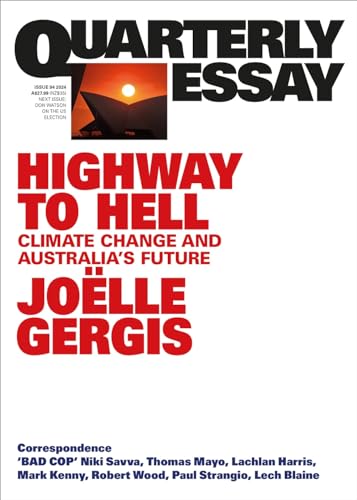
Joëlle Gergis, Highway to Hell: Climate Change and Australia’s Future (Quarterly Essay 94, 2024) – plus correspondence in Quarterly Essay 95
I’ve worn a Peter Dutton mask with devil horns in street theatre outside Anthony Albanese’s office. I’ve asked awkward questions at the AGMs of fossil fuel companies, scripted by Market Forces. I’ve participated with gusto in Move Beyond Coal‘s campaign targeting banks that provide financial backing to new coal mines. I joined the People’s Blockade of the coal port of Newcastle last November and plan to join again this year. Do I need to read ONE MORE BOOK on climate change?

Well, yes, I do. I had pushed out of my mind the terrible events of Summer 2021–2022. I even wrote about Judith Beveridge’s poem ‘Choirwood’ as if it offered some kind of hope after those fires (at this link). After reading Joëlle Gergis’s essay, the poem is still brilliant, but it feels like so much whistling in the dark.

Joëlle Gergis is one of the 234 lead authors of the most recent IPCC Report. She is a climate scientist who, she tells us in this essay, has become so frustrated at the way the reality of climate change is downplayed or ignored by those in power that she quit her job as an academic scientist to become a public advocate. I’d say she has become a Cassandra warning of the dangers, except that Cassandra was doomed to be ignored, a fate I hope will not befall Joëlle, for all our sakes.

After noting the relief of seeing the end of the denialist Morrison Government (remember ‘Labor’s war on the weekend’, and ‘Don’t be afraid, this is carbon’?), the essay tackles the current situation – better, but a long way from hopeful. Here’s a key paragraph, on page 7:

The scientific reality is that, regardless of political spin used to justify the continued exploitation of fossil fuel reserves, the laws of physics will keep warming the planet until we stop pumping carbon into the atmosphere and begin cleaning up the mess. The situation is too far gone for renewable energy alone to save us. Pinning our hopes on carbon capture technology to justify the continued burning of fossil fuels is a disastrous gamble the world can’t afford to take. So, as this fateful moment approaches, we need to take an honest look at the government’s climate policy and realistically assess the situation we are in. Are the climate wars really over, or has a new era of greenwashing just begun?

As she goes on to say what the laws of physics are up to and to outline a range of future scenarios, she begs us: ‘Please, don’t look away. Thee isn’t a moment to waste.’

I won’t try to summarise the science, but if you’re looking for a solid, accessible presentation, I doubt if you’ll find a better one anywhere. It’s a gruelling read, from which my main takeaway is that I need to grieve for the corals of the Great Barrier Reef that thrilled me as a child, for the thousands of cattle and millions of wild animals that have died and are yet inevitably to die as the planet heats up, for the vast tracts of forest, including rainforest, that have already been devastated. I need to grieve and I need to treasure what remains – and be prepared to fight for it.

After a blistering account of carbon offsets and carbon capture and sequestration (CCS) in a chapter headed ‘Chasing Unicorns’, she asserts that we know what needs to be done, but such is the power of the fossil fuel lobby that Australian governments won’t do it. True, there has been significant movement in State governments, and outside of government. But it’s pretty grim, when the main message to the reader about what can be done is to stress the importance of voting in the next federal election.

Almost any paragraph from this essay is worth quoting and pondering. On page 47*, there’s this:

To its credit, the Albanese government has tried to support Australia’s emergence as a renewable energy superpower. [She lists an impressive number of initiatives taken since the ALP’s election win in May 2022.] While these are all steps in the right direction, the challenge is not to undo all of this good work by allowing the interests of the fossil fuel industry to co-opt the process and weaken real progress towards reducing global emissions.

Rather than ‘net zero’, the goal must be to achieve ‘real zero’, which can only happen once we stop burning fossil fuels. In fact, the science tells us that around 60 per cent of oil and gas reserves and 90 per cent of coal must remain unextracted if warming is to be limited to 1.5°C. There is no way around having to eventually face this scientific reality.

But instead of facing facts, in December 2023, the federal government caved in to lobbying from the oil and gas company Santos.


The correspondents in Quarterly Essay 95 mostly agree with and amplify the arguments of the essay. There’s an excellent piece by David Pocock, who is probably the parliamentarian that Gergis meets with early in the essay. He describes his shock as a senator now for a little over two years to see how ‘policy is consistently shaped by political considerations ahead of evidence and research’. Often he says, politicians ‘are not looking for genuine, long-term solutions, but for the next opportunity to back their opponents into a corner’.

A stand-out exception to the generally supportive tone is a grim piece by Clive Hamilton. He’s not the only correspondent to describe Joëlle Gergis as operating on an ‘information deficit’ model: if only people, including those in power, had correct information they would do the right thing. Scientists have been trained to look for solid, verifiable facts and to base their actions on what they find. But it’s a mistake to assume that that’s how people in general function. Hamilton dismisses the essay’s hope as wishful thinking, argues that nothing Australian governments do can have much impact on climate change, and generally sees the outlook as bleak:

After two decades of research into the psychological, social and political complexities of persuading people to recognise and act on the science of climate change, it’s wearying when another scientist comes along convinced that it’s only a problem of someone with authority communicating the facts. I’d be more energised if Gergis, as an IPCC lead author, had written an essay arguing that it’s time for a campaign of industrial sabotage.

I would love to know how Joëlle Gergis responds to Clive Hamilton. Sadly, no response from her is included in QE 95. Maybe in Nº 96? Or maybe she’s already out there like the main character in the movie Woman at War.


I wrote this blog post in Gadigal Wangal country, where it is my great joy to live. I acknowledge Elders past and present for their continuing custodianship of this land.


* My usual blogging practice is to focus on the page that coincides with my age, currently 77. But as this Quarterly Essay runs to just 72 pages including notes, I’m looking at page 47, the year of my birth minus 1900.  
Ivy Ireland’s Tide

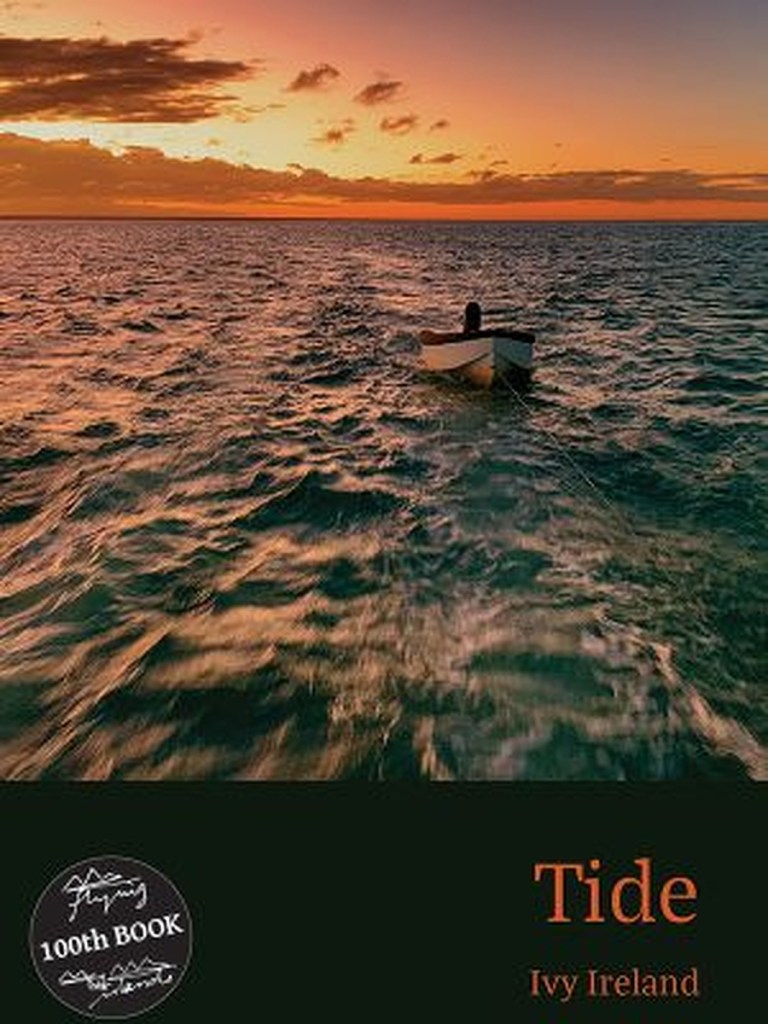
Ivy Ireland, Tide (Flying Island Books 2024)

Tide may seem like a quietly generic title for a book, especially one that has a number of poems about the sea, but a laconic note on sources suggests a dark subtext:

The title of this book, Tide, and the title of the poem, ‘A Shallow Boat’, are both taken from Alfred, Lord Tennyson’s poem ‘The Lady of Shalott’ (1832) with the necessary reverence.

I decided to read the Tennyson poem. I’m pretty sure I hadn’t read it before, but many of its lines (‘the mirror cracked from side to side’, ‘The curse is come upon me’) were familiar, probably from young Dorothy Hewett’s romanticism as recorded in her autobiography, Wild Card. Certainly Ivy Ireland’s compressed, science-related poems, with close observations of the real world, are not at all like Tennyson’s flowery, relentlessly rhyming lines. The word ‘tide’ occurs only once:

For ere she reach'd upon the tide
The first house by the water-side,
Singing in her song she died,
The Lady of Shalott.

The note on sources, then, leads one to expect something death-related: the tide is metaphorical, bearing us inexorably away. The book only partly meets that expectation. There’s a lot of life here, and not much death.

The book is divided into four sections of unequal length named for tidal phases: ‘Ebb’, ‘Low’, ‘Flood’, and ‘High’. If I had to pick favourites, I’d say I enjoyed the poems in ‘Low’ most: in ‘Lake Poet’, in the context of the climate emergency (not explicitly named, but definitely there in my mind) the lake is less a thing of sublime beauty than a place that will hold the poet to account, as opposed to the city, where ‘nobody has to answer for anything; in ‘Cane Toad’, the poet and her young daughter encounter some teenagers on Valentine’s Day:

She asks me,
of all people,
if they are going to marry,
those beatified ones,
out decking each other in posies
in the quiet toilet paper aisle.

‘Killing Plovers’ is a yarn about family life that takes on a fable-like quality about humans’ relations to other animals; ‘The Birth of the Universe’ is a wonderful poem about a) the Big Bang and b) giving birth.

The section ‘Flood’ comprises six prose poems, including ‘I Am John Is Dead’, long enough to be called a short story, about a young woman’s encounter with a New Age guru in the outback, which accurately describes itself as ‘like a Jim Jarmusch film’.

Page 47* is the title page for the book’s final section, ‘High’. The section includes just one poem, ‘A Shallow Boat’, in which the narrator with one other person goes sailing off the Queensland coast. Since the note on sources mentions this poem, I looked at the Tennyson poem again, and found:

In the stormy east-wind straining,
The pale yellow woods were waning,
The broad stream in his banks complaining,
Heavily the low sky raining
Over tower'd Camelot;
Outside the isle a shallow boat
Beneath a willow lay afloat,
Below the carven stern she wrote,
The Lady of Shalott.

This is the boat on which the Lady of Shalott floated to her doom.

Happily, the speaker of Ivy Ireland’s sailing excursion survives, having had a very nice time, even if it is sometimes scary and perhaps humiliating as she feels her incompetence.

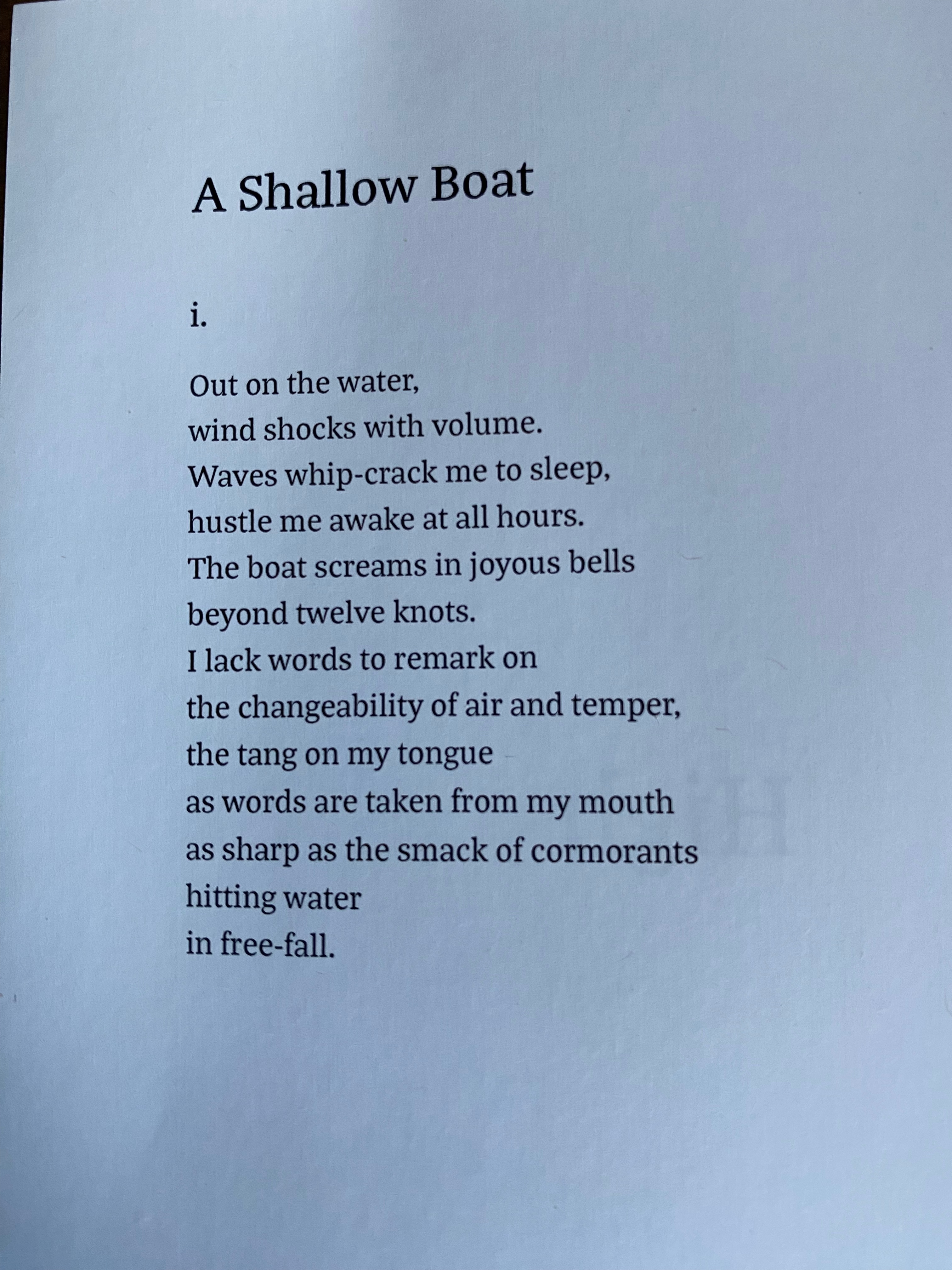
Here’s the first of the poem’s 12 parts, from page 48:

A Shallow Boat

1.

Out on the water,
wind shocks with volume.
Waves whip-crack me to sleep,
hustle me awake at all hours.
The boat screams in joyous bells
beyond twelve knots.
I lack words to remark on
the changeability of air and temper,
the tang on my tongue
as words are taken from my mouth
as sharp as the smack of cormorants
hitting water
in free-fall.

All I really want to say about this is that I love it. I have no desire to go sailing. I breathe a guilty sigh of relief when I realise that the Emerging Artist gets seasick very easily, so is unlikely to be urging me to do it. But I love it as evoked in this poem.

The poem is almost a sonnet. The first six lines describe the wind, the waves, the sounds of the boat. Then there’s a turn, and in the next five lines the poet tries and fails to articulate a response. Then there’s a three-line equivalent to a sonnet’s final couplet – rather than a witty encapsulation of what has gone before, here it’s the cormorants, ostensibly a metaphor for the poet’s speechlessness but actually just there, smacking the water.

Every verb, every adjective, every noun is carrying its share of the meaning-load, and the sound design is wonderful. The echoing Ws bind the lines together, with a little respite for Ts (‘temper’, ‘tang’, ‘tongue’, ‘taken’, and then ‘cormorants’) in lines 8 to 11. Back to W and then the Fs in the last line introduce a new, final sound.

The Tennysonian hints of doom may be realised in later parts of the poem, as in these chillingly succinct lines from part viii:

There's a point 
where climate emergency,
once witnessed,
ticks over from
possible to inevitable;
anything else is inconceivable.

But that’s context rather than substance. The joy in this poem, as in the whole book, is in celebrating engagement with the natural world, vulnerable, dangerous, fragile, awesome, beautiful, breathtaking (sometimes literally). From section ix:

Orange shifts over the horizon, and here we are: 
alive, while countless others are not.
Who am I to deserve daybreak. This happening here,
sea eagle fishing beside the boat,
sea turtle snorting to the surface. What's it for,
to be so honoured.

I wrote this blog post on land of the Gadigal and Wangal clans of the Eora Nation. I’m posting it on a day that has shifted from bright blue sky to heavy downpour within hours. From my window I can see wet gum leaves reflecting the afternoon sunlight as they have been witnessed by First nations peoples here for tens of thousands of years.


* My blogging practice for some time has been to focus arbitrarily on the page of a book that coincides with my age. A focus on just one page seems to me to be almost necessary with books of poetry, where the parts are so often greater than the whole. As Tide has fewer than 77 pages, so I’m focusing instead on my birth year, ’47.

Jennifer Maiden’s China Shelf, page 47

Jennifer Maiden, The China Shelf: New Poems (Quemar Press 2024)

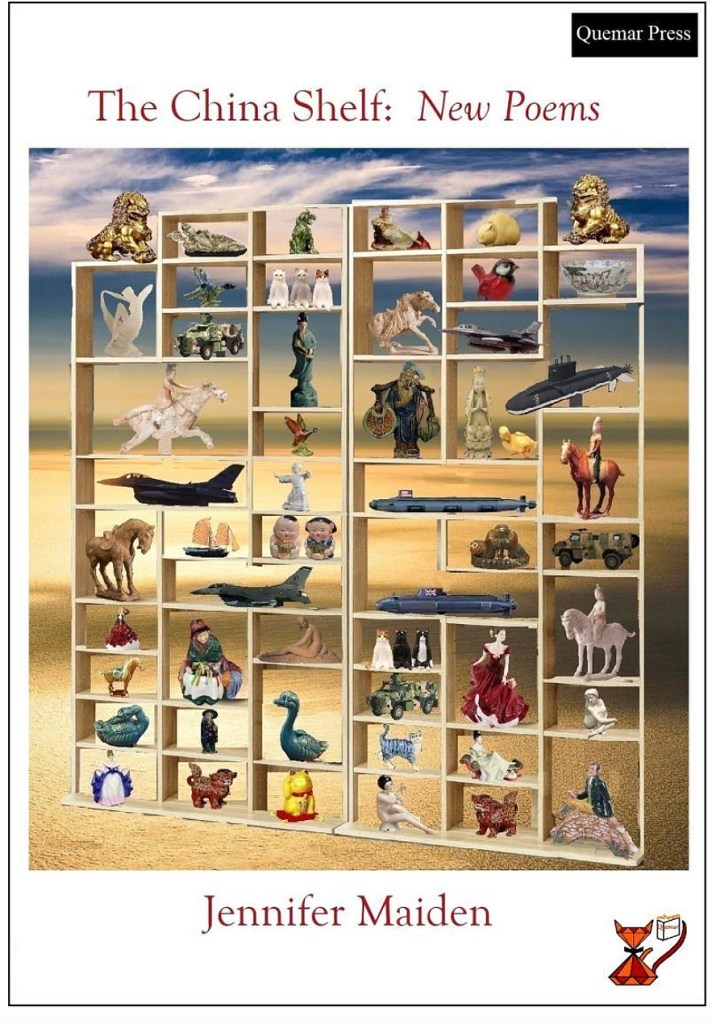
Jennifer Maiden and her daughter Katharine Margot Toohey, publisher of Quemar Press, have been doing a literary highwire act for years: a cover image of a future book and its general theme are announced early in the year, sample poems uploaded as they are written, and then the book appears at the beginning of January the next year. They did it again in 2023.

Beginning early last year, Quemar Press uploaded an image of the cover of The China Shelf and 11 ‘sample poems’. Each of the poems was freshly written when uploaded, and very much of its moment: July’s poem referred to talk of Julian Assange at an Ausmin Conference (press report here, poem here); August’s to the US’s alleged demand that Imran Khan be removed as PM of Pakistan (press report here, poem here); and so on. We were seeing the project being created in real time – its contents determined by world events, and the collection as a whole relating thematically to Jennifer Maiden’s china shelf with its figurines that range from cute ceramic cats to model nuclear submarines. Now we have the book itself.

The poems in The China Shelf continue in the mode Jennifer Maiden has made her own: conversational, with unobtrusively musical half-rhymes; featuring fictional or historical characters freshly woken up (most of them familiar from earlier Maiden collections); taking issue with political leaders, mostly from the Labor or Democratic Party side of politics; taking controversial stands on many issues, including sympathy for Putin in his invasion of Ukraine (though there’s not so much that in this collection); making surprising connections between people and events; reflecting on her creative process and arguing with critics and publishers; sometimes gossipy, with flashes of glorious lyricism. You can read the samples at this link.

There’s no page 76 (the page I usually blog about, because it’s my age). My fallback position is page 47 (my birth year). Because the poem that begins there is three pages long, I’m bending my rule to talk about pages 47–49. I apologise in advance if the discussion is a bit laboured – the poem is not.

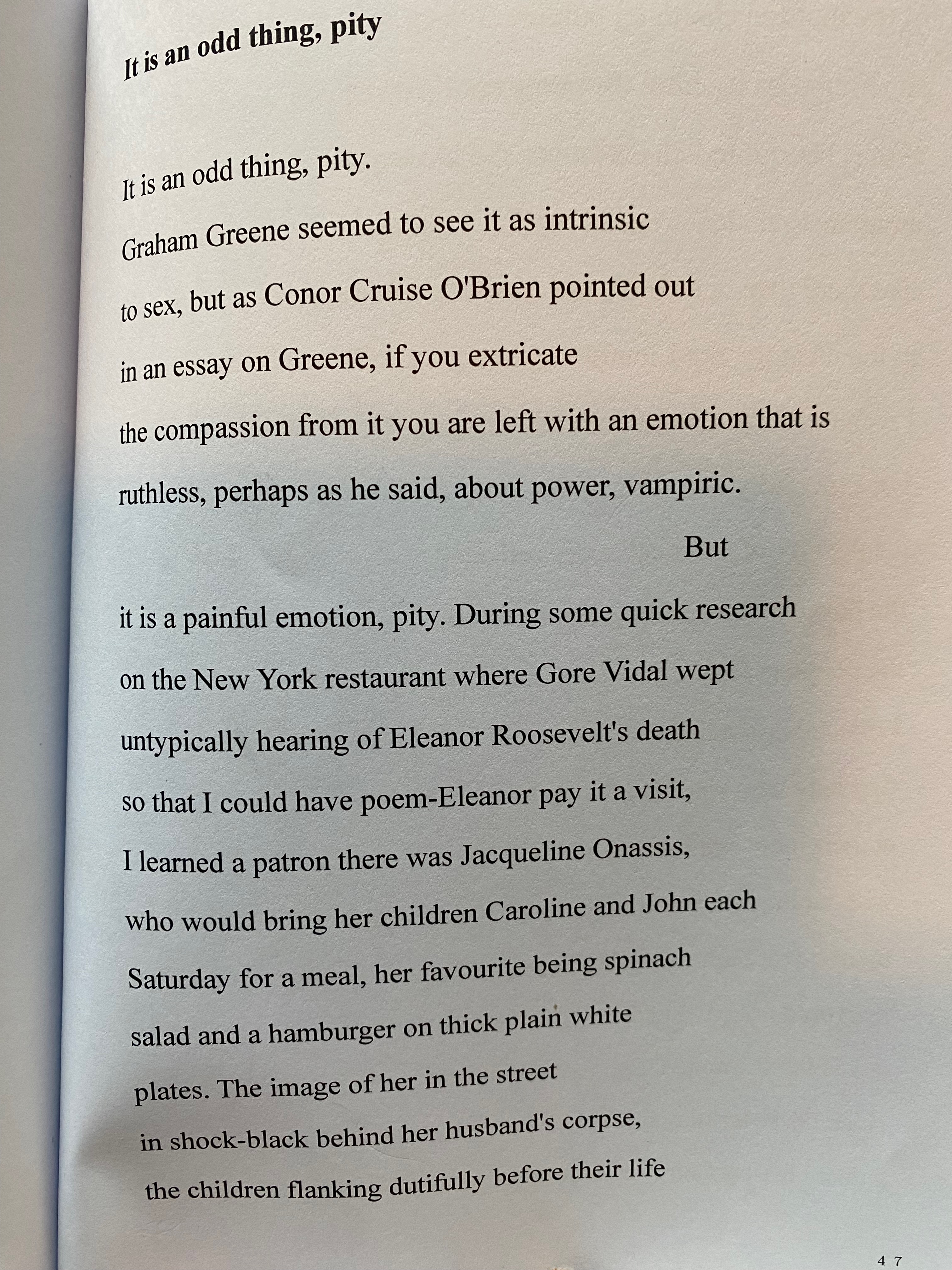
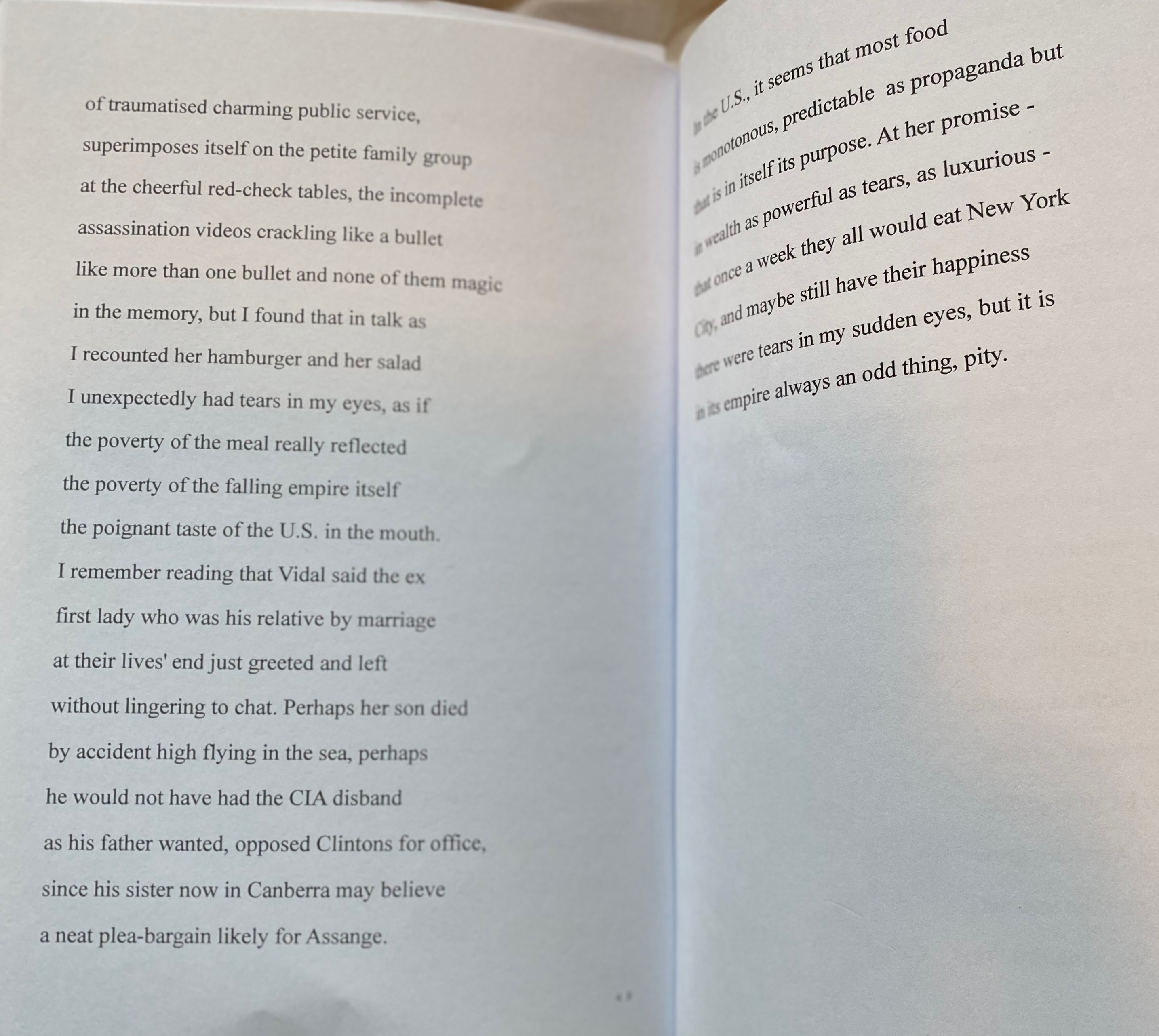
First, here are phone photos, which with any luck will look OK on your device. Click to enlarge.

I probably wouldn’t have chosen ‘It is an odd thing, pity’ to discuss – it doesn’t feature the china shelf, or begin with a character waking up, or reflect on the Australian poetry scene – but it turns out that serendipity is a wonderful thing, and the poem rewards a closer look.

A Study Notes synopsis might go something like this: The poet, while researching a restaurant that is the setting for another poem, discovers that Jackie Onassis took her two children there regularly for hamburgers and salad. She surprises herself by shedding a tear when telling someone about these modest family meals. The poem probes the meaning of those tears.

If you wanted a straightforward enactment of the Study Notes synopsis, you’d be annoyed by the amount of extra clutter in the poem. But (of course) that clutter is what makes the poem interesting.

It starts with a move characteristic of Maiden, an invocation of another writer, in this case Graham Greene, and Conor Cruise O’Brien commenting on him:

It is an odd thing, pity

It is an odd thing, pity.
Graham Greene seemed to see it as intrinsic
to sex, but as Conor Cruise O'Brien pointed out
in an essay on Greene, if you extricate
the compassion from it you are left with an emotion that is
ruthless, perhaps as he said, about power, vampiric.

It’s a long time since I’ve read any Graham Greene, and I have only a vague idea who Conor Cruise O’Brien is. (Change the names, and I could write that sentence about many Maiden poems – not a criticism of her, but an acknowledgement of my own ignorance.) I did a quick internet search, mainly hoping to read a less cryptic version of what Greene and O’Brien said. The search was fruitless, so I’m left where I might have been content to be anyway, finding my own way with the poem.

it turns out that the poem doesn’t need a reader to grasp the paradox of pity as a ruthless emotion, understand the distinction between compassion and pity, or know anything specific about Graham Greene and sex. Greene and O’Brien now depart and are heard no more. The poem has invoked them as a way of announcing that pity is seen as problematic more widely than in this poem. The lines are a kind of paradoxical preface that one expects the rest of the poem to elucidate, or perhaps bounce off.

And bounce it does, with the word ‘But’ on the extreme right on the next line:

______________ __________________________But
it is a painful emotion, pity.

Echoing the opening line, this takes control back from Greene and O’Brien, not so much disagreeing with their thesis as adding another dimension. Pity is not just an objective ‘thing’ to be discussed, but an ’emotion’ to be felt. It might be odd from a philosophical distance, but as lived experience, it’s painful.

Now the narrative proper begins:

it is a painful emotion, pity. During some quick research
on the New York restaurant where Gore Vidal wept
untypically hearing of Eleanor Roosevelt's death
so that I could have poem-Eleanor pay it a visit,
I learned a patron there was Jacqueline Onassis,
who would bring her children Caroline and John each
Saturday for a meal, her favourite being spinach
salad and a hamburger on thick plain white
plates.

That’s all one sentence. There’s no rhyme scheme in this poem, but it’s interesting to notice the music in these lines, helped among other things by the recurring ch sound at the end of lines: ‘research’, ‘each’, ‘spinach’.

The poem has arrived at its central image: Jacqueline Onassis and her children eating a modest meal. As I imagine you know, Jacqueline Onassis, wife of business magnate Aristotle Onassis, was formerly Jackie Kennedy, wife of President John F. Kennedy, who was assassinated in 1963.

The restaurant, as you probably don’t know, is Mortimer’s, a fashionable burger joint (the subject of a memoir, Mortimer’s: Moments in Time by Robin Baker Leacock (2022)). The poem referred to, ‘Eleanor Roosevelt Woke Up in a New York Burger Bar’, appears earlier in the book and is included in the Quemar Press sampler. Gore Vidal makes regular appearances in Maiden’s poems, mainly because Julian Assange was carrying a book by him when forcibly removed from the Ecuadorian embassy in 2019. Maiden’s poems often refer to each other in this way, and the detail of Gore Vidal weeping ‘untypically’ may be a product of another feature of her poetry: the recurring characters (poem-Eleanor is one, poem-Gore is another) tend to take on a life of their own, and here Gore Vidal insists on being more than a passing name-drop. His tears are the first of three lots in the poem.

Picturing Jacqueline Onassis with her children, Maiden’s mind goes to the assassination and the famous footage of Kennedy’s funeral:

plates. The image of her in the street 
in shock-black behind her husband's corpse,
the children flanking dutifully before their life
of traumatised charming public service,
superimposes itself on the petite family group
at the cheerful red-check tables, the incomplete
assassination videos crackling like a bullet
like more than one bullet and none of them magic
in the memory,

‘Shock-black’ demonstrates just how much work a single adjective can do, conjuring up the mood of that famous footage. But it’s now 60 years after the event, and the passage of time adds further superimpositions. The children’s futures are summed up elegantly as lives ‘of traumatised charming public service’. The controversy and conspiracy theories surrounding the assassination (was there more than one shooter? was it a CIA plot?) are thriftily evoked: the videos are incomplete and there may be more than one bullet. (There’s no magic bullet to cure the ills of that moment.)

Now comes another ‘but’, which pulls attention back to the immediate emotional impact, not of the funeral scene, but of the image of the meal:

in the memory, but I found that in talk as 
I recounted her hamburger and her salad
I unexpectedly had tears in my eyes,

Earlier, Gore Vidal wept ‘untypically’. Now the poet’s speaker does so ‘unexpectedly’. Gore, waspish observer of the social scene and sharp political commentator, has a moment of straightforward grief. Maiden, intent on creating complex poem-versions of public figures alive, dead and fictional, has a simple emotional response. You or I might have left it at that – it may be unexpected, but surely it’s not weird to be moved by the image of a recent widow and her orphaned children having a quiet meal: ‘It is a painful emotion, pity.’ But things are rarely simple in a Jennifer Maiden poem, and this one twists off in an unexpected direction:

I unexpectedly had tears in my eyes, as if 
the poverty of the meal really reflected
the poverty of the falling empire itself
the poignant taste of the U.S. in the mouth.

Rather than reflecting, as a lesser poet might have done, that even in the midst of international political events the suffering of a small family can evoke our empathy, Maiden takes a different tack: even a simple empathetic response can be understood in terms of major political movements. The humble meal, it suggests, reflects something about the humbling of US imperialism.

Not everyone will grasp how US imperialism can be seen as ‘falling’. If anything some would say it’s on the verge of exploding and bringing the rest of us down with it, terrifying rather than poignant. But for the poem ‘the poverty of the falling empire’ is a given, not a point of view to be argued for or needing the reader’s agreement.

We now move on to what lay in the future for that ‘petite family’. Gore Vidal is back, this time as a witness:

I remember reading that Vidal said the ex 
first lady who was his relative by marriage
at their lives' end just greeted and left
without lingering to chat. Perhaps her son died
by accident high flying in the sea, perhaps
he would not have had the CIA disband
as his father wanted, opposed Clintons for office,
since his sister now in Canberra may believe
a neat plea-bargain likely for Assange.

The mother became unsociable. The son died in an air crash – with two perhapses reminding us that conspiracy theories also hovered around his death. The daughter is now the US ambassador to Australia. Julian Assange has appeared in many Jennifer Maiden poems, and Caroline’s probable support for ‘a neat plea-bargain’ makes her one of the good guys in Maiden-land.

I don’t understand the ‘since’ in the second-last line there. Again, it feels as if a more detailed argument is being gestured at, but not something to be gone into here – this poem has other fish to fry.

The final lines return to the burger joint:

In the U.S., it seems that most food
is monotonous, predictable as propaganda but
that is in itself its purpose.

In real life, food is probably no more monotonous in the U.S. than anywhere else, but we’re talking about a burger joint – specifically, comfort food in a high-profile burger joint. A crude paraphrase of these lines might be: Propaganda is the McDonalds of the soul. The purpose of monotonous, predictable food is the same as that of comforting, reassuring propaganda: to dull the senses, lower expectations, create a compliant population.

that is in itself its purpose. At her promise – 
in wealth as powerful as tears, as luxurious –
that once a week they all would eat New York
City, and maybe still have their happiness
there were tears in my sudden eyes, but it is
in its empire always an odd thing, pity

Without the ‘clutter’ (that is, without the things that make the poem interesting), this could be paraphrased: ‘It was her promise of this weekly routine meal together, which might enable the three of them to be happy in spite of Kennedy’s death, that brought tears to my eyes.’ That is, the poem’s speaker, aware of the terrible ordeal that this family has gone through and of so much that is yet to come, sees this attempt at reassurance as pitiable.

The line that gives me pause is ‘in wealth as powerful as tears, as luxurious’. The line’s music works beautifully, ‘luxurious’ rhyming with ‘purpose’ and promise’ in the previous line, ‘powerful’ also resonating with ‘promise’, and ‘tears’ and luxurious’ resounding with a kind of end alliteration. Its meaning is not immediately clear. On the one hand, perhaps Onassis’ wealth, power and luxury are enough to outweigh her pain. On the other hand, her promise is made from a position of privilege that makes any tears she sheds a luxury. (I don’t want to make too much of ‘eat New York / City’ as suggesting that the Kennedy’s, specifically these three, were great devourers, as it is may be a typo – though even as a typo it would be a kind of Freudian slip.) In the poem, however, the person who sheds tears isn’t Onassis, but the poem’s speaker, demonstrating that whatever you/she might think about people of power, wealth and privilege, you can surprise yourself by the feeling a straightforward sympathy for them.

The final line brings us back to the start. Yes, pity is complex, but unless I’ve completely missed the point, this particular example is not sexy, ruthless of vampiric. We may even surprise ourselves by weeping tears of pity for those whom we might see as possessing those qualities. I love the phrase ‘in its empire’: pity, which I take to be the way we as humans spontaneous care about each other, has its own empire, which does not bow to any ideology.

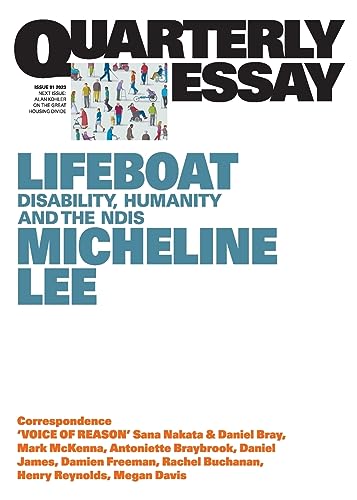
Micheline Lee’s Lifeboat

Micheline Lee, Lifeboat: Disability, Humanity and the NDIS (Quarterly Essay 91, 2023) – plus correspondence in Quarterly Essay 92

Micheline Lee is a novelist. In this Quarterly Essay and in her reply to correspondents in the following one, she demonstrates that she is a master of the killer last line. The essay ends with a personal story. When she was eighteen, anxious at the prospect of becoming increasingly disabled, she went travelling in Europe and Africa alone, without any support:

I remember Kamanja, a man I met in Kenya. He was one of many people who came my way and helped me through, who pushed me in my wheelchair and carried me when I was at a low ebb and battered. I started to thank him. He held out his hand for me to stop. ‘I help you because you need help,’ he said.

(Page 59)

Her reply to correspondents ends with a reference to Ann Marie Smith, who died in Adelaide in 2020 after years of extreme neglect while on a full time care plan with the NDIS:

If Ann Marie Smith had had one friend in the world, the abuse she suffered over three years that finally took her life would not have happened.

(Quarterly Essay 92: The Great Divide by Alan Kohler, page 122)

The essay lays out the origins of the National Disability Insurance Scheme, its underlying principles and goals, and the massive faults in its implementation, but it also offers sharp insights into lived experiences of disability – and the overwhelming importance of meaningful human connection.

The medical, or individual, model of disability defines disability as individual deficit or tragedy. The social model ‘demonstrates that the problems people with disabilities face are the result of exclusion and social and environmental barriers’. The activists whose lobbying led to the creation of the NDIS were proponents of the social model. The NDIS was intended to serve the needs of people who otherwise could not participate in society, and was to be one part of a whole ecosystem of support for people with disabilities.

The scheme was legislated in the last days of the Gillard Labor government, but it’s implementation took place under successive Coalition governments. Micheline Lee refrains from pointing the finger of blame, but she describes the way the rest of the ecosystem failed to materialise, much of the support that previously existed dried up as the NDIS was seen to be the only game in town, a narrowly market-based system was established that meant the ‘participants’ in the scheme have to negotiate complex application processes and regular reassessments of their disabilities. The individual model of disability reasserted itself in an economic rationalist environment.

My blog practice is to have a closer look at a single page. Usually it’s page 76 (my age). As there is no page 76 in this essay, I’ll talk about page 47 (I was born in 1947). As it happens, it’s a brilliant example of the feature of the essay that makes it not just informative but engrossing. Along with the trenchant analysis of the system, its potential transformative value and its actual flaws, the essay contains many startling glimpses of the realities of life with a disability, always in the service of the argument.

Page 47 is part of the longest of these glimpses. Micheline is travelling by plane to a writers’ festival. She decides to travel without a support worker because it would cost the NDIS 14 hours of the worker’s time, and she would have to pay their return air fare. Her preferred airline refuses to take her without a carer. The more expensive airline that will take her does so on a much longer flight, but she calculates that even with an hour’s delay she can hold off going to the toilet, which would raise impossible logistic difficulties. She arrives at security at Melbourne airport, and asks the officer if he could help lift her bag off the back of her wheelchair onto the screening table:

‘Where’s your carer?’ he asked. I told him I was travelling alone.
‘You should have a carer to help you with that,’ he said. I was taken aback; in the past, airport staff had always helped. The woman behind me in the queue muttered, ‘Unbelievable,’ and lifted my bag onto the belt. I could have kissed her.
Next, I met the wheelchair assistance officer at the boarding gate, and he asked me where my carer was. And similarly, on the plane, the fight attendant asked, ‘Who’s assisting you?’

The story continues:

I arrive at Sydney airport only to find that the connecting flight has been cancelled and the next one is four hours later. My heart starts pumping faster. I ask the airline assistant who is pushing me in an aircraft wheelchair if he can bring my electric wheelchair to me. He makes a call, then tells me that all the luggage needs to stay on the plane.
‘My wheelchair is not luggage,’ I cry out. ‘I can’t move without my wheelchair.’ The chair I am strapped into is what the airline uses to fit between the aisles in the aeroplane. It’s a thin wedge of a chair that is hard for me to balance on and you can’t push it yourself. He parks me on a square of carpet with a wheelchair symbol on it some distance from the service desk and the customer seating area. He tells me he’ll let them know at the service desk that I want my wheelchair. ‘Can you take me over so I can speak with them myself?’ I ask, but he has already walked off.

An hour later:

It’s a new person at the service desk now and I call out to get her attention. She is busy with customers and doesn’t hear. I call out to passengers passing by but they don’t look my way.

Reflecting on the episode o the next page, Micheline acknowledges that it wasn’t just the expense that made her decide to travel solo:

It has more to do with protest. I don’t want the NDIS to take the focus off the need for society to be more inclusive.

It’s not a tragic story, like that of Ann Marie Smith who was confined to the same woven chair for over a year, but in this one the readers are implicated. Would I be one of those passengers passing by, or would I be the woman who mutters, ‘Unbelievable’?

The essay, in the end, isn’t an account of another bureaucratic stuff-up like Robodebt that we can shake our outraged heads over. It’s a passionate, articulate appeal to our common humanity.


The correspondents in QE 92 include the current Minister for the NDIS, a commissioner of the recently concluded Royal Commission into Violence, Abuse, Neglect and Exploitation of People with Disabilities, and a number of disability activists. Often the Quarterly Essay correspondence includes argumentation, or correction, or defensiveness. Not here. These writers reinforce the essay’s account of things, coming from a range of perspectives and a range of lived experience. Taken together with the essay and Micheline Lee’s ‘Response to Correspondence’ they make a compelling case for change.

Mick Herron’s Standing by the Wall

Mick Herron, Standing by the Wall: A Slough House Interlude (Baskerville 2022)

This is one of those tiny books designed for display at the check-out of a books-and-mortar bookshop, to be bought on impulse as a small gift for, say, Mother’s Day, or for someone you know to be a fan of Mick Herron’s Slough House novels.

It probably found its way into our house as such a gift. I haven’t read any of the novels, but I love the TV series based on them (and I’m glad to learn that a third season is due to drop in December). For me, this book was a chance to get a taste of how it all works on the page. All the main characters are there: irascible and malodorous Lamb, obnoxious IT wiz Roddy, our hero River, salt-of-the-earth dry drunk Catherine and mistress of the archives Molly. Not much happens: River drops in on the station after extended leave to recover from being poisoned; Lamb has Roddy alter a photograph from the archives; Catherine has a moment of almost human conversation with Lamb, in which he says ‘I don’t do memories’; and most of the reject spies who work at Slough House go out for Christmas drinks. That’s it.

‘Ho!’

The name wasn’t so much dropped as thrown from the top of Slough House, and like a snowball finding its target struck Roddy Ho, two floors down, on the back of his neck. He looked up from his screen, senses quivering. He was needed.

The opening is horrendously over-written, and it goes on in that vein for a couple of pages. I was about to lay the book aside, giving quiet thanks for the wit and nuance of the TV series, when I realised that the over-writing was deliberate, allowing us a taste of Roddy Ho’s self-heroising perception of the world. The irony became clear, the prose settled down, and I was amused and gripped.

Page 47 (I can’t talk about page 76 because this is a very small book) features another piece of mock-heroics:

There was no one to flinch when, with surprising suddenness, Lamb swung his shoeless feet to the floor and went barrelling out of the room, entering Catherine’s office like a Viking on manoeuvres. Flakes of plaster fell from the ceiling when the door slammed against the wall; more drifted free as he pillaged desk drawers with the kind of controlled fury that this room alone, of all Slough House, generally provided sanctuary from. Most of what he found he dropped to the floor – reels of sticky labels, cellophane folders, account books, boxes of Biros, treasury tags; all this junk from another era, as if he were trashing a museum installation – littering the carpet with a mess of ancient stationery.

It comes as no surprise that all this furious pillaging turns out to be just Lamb looking for an envelope. Mick Herron is having a good time, and so is the reader.

The book is a fun chance to see the characters in action on the page. It may be laying the grounds for big events later in the series, or harking back in a way that will delight long-term readers, but whether or not it’s either of those things, it’s an enjoyable confection that entertained me on a train trip from Central to Parramatta and back.

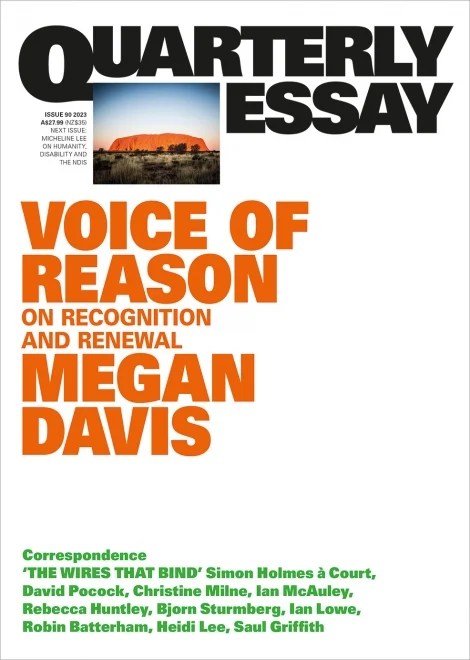
Megan Davis’s Voice of Reason

Megan Davis, Voice of Reason: On Recognition and Renewal (Quarterly Essay 90, 2023)
– plus correspondence in Quarterly Essay 91

As we approach voting day on the Indigenous Voice to Parliament, bad-faith arguments multiply and I don’t intend to add to the clamour. But I can recommend this Quarterly Essay by Megan Davis, one of the architects of the consultation process that led to the Uluṟu Statement from the Heart.

It’s short – just 66 pages. It’s personal – Ms Davis gives enough of her story that we know who she is. It’s instructive – she tells how the proposal for the Voice evolved through several official processes under several Prime Ministers. It’s respectful – it understands why some First Nations people might vote against the proposal, and argues the case with them. It has heroes and villains – John w Howard and Tony Abbott feature as wreckers; Yunupingu as a leader. It’s not into blame and rage. It has hope. And it’s utterly convincing.

If the referendum fails, as current polls suggest, this essay will bear re-reading for decades to come, though it will have to be read through tears.

You don’t have to buy a copy. At least for now you can read it on the Quarterly Essay website, beginning at this link.

My blog practice is to look a little closely at a single page. Usually it’s page 76 (my age). As there is no page 76 in this essay, here’s a little about page 47 (I was born in 1947).

In 2015, there was apparently bipartisan parliamentary support for constitutional change acknowledging that Australia was first occupied by Aboriginal and Torres Strait Islander peoples, recognising their continuing relationship to the lands and waters, and expressing respect for their ‘cultures, language and heritage’. That is to say, it looked like all systems go for symbolic recognition: nothing about non-discrimination, and no structural change. A group of 40 First Nations leaders met with Prime Minister Tony Abbott and Opposition leader Bill Shorten, and explained that such a change ‘would not be acceptable to Aboriginal and Torres Strait Islander peoples’ (the quote is from the Kirribilli statement). This meeting led to the consultation process that produced the Uluṟu Statement from the Heart and the proposal for an Indigenous Voice to Parliament. (It also proposed a Makaratta / Treaty and a truth telling process, but those aren’t on the table just yet.)

On page 47, Megan Davis hits the pause button in her recount of the history:

The thing I could not shake from my head was watching the prime minister and Opposition leader sit at the head of the table while forty people from forty communities spoke about the structural problems their communities faced. What is it like to be the leader of a nation and encounter a polity that is profoundly unhappy?
At this time, as one of the main Indigenous lawyers working on constitutional reform, I found it difficult to understand why politicians failed to hear what First Nations leaders and community members were saying. I had a textbook idea about how political and law reform work, but none of it applied to our people.
There were two challenges I saw. One is that politicians meet with Aboriginal leaders on a myriad of issues, but often First Nations do not feel heard and politicians and advisers do not listen.
The second is the impact of telling your story over and over again and not being heard – what effect does this have on health and wellbeing?

Which comes close to being the heart of the argument for a constitutionally enshrined Indigenous Voice: it’s not that First Nations people haven’t been speaking, it’s that the necessary people haven’t been listening – because, as Megan Davis argues elsewhere in the essay, they don’t have to.

That’s just a tiny part of the essay. The whole thing is worth reading.


The correspondence in QE 91 includes some big names, in particular historians Mark McKenna and Henry Reynolds, and some brilliant fleshing out of the issues by First Nations and other writers. Megan Davis acknowledges them all as ‘worthy and inclusive commentary on the essay and on this historic moment that we are barrelling towards’. She singles out the joint contribution from Sana Naka and Daniel Bray, a Torres Strait Islander woman and a man of European heritage who write about the way their family is constantly negotiating intercultural complexity. She gives them the last word in her response. Following her lead, I’ll end the blog post with the same quote from them:

Structural injustice exists because that is how our political system is structured. We are getting exactly what the system was designed to deliver. A Voice to Parliament alone cannot specifically redress every injustice, but it will connect people to power in a way that currently does not happen. Democracy demands nothing less.

Winter reads 7: Two bilingual poetry books

This is my seventh post on books I took with me on my escape from Sydney’s winter, focusing as usual on page 76 (or page 47 when there is no 76): two very different bilingual books from Flying Island.

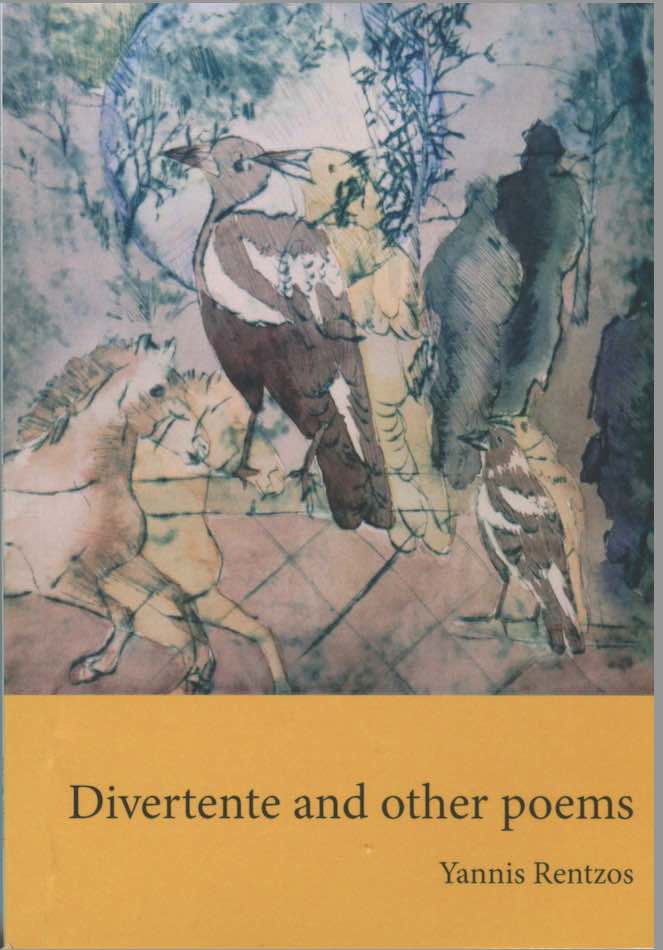
Yannis Rentzos, Divertente and other poems, translated by Anna Couani (Flying Island Books 2023)

Yannis Rentzos was born in Crete and has been living in Australia since 2006. His poems bear witness to his European roots as well as his antipodean present. The poetry is elliptical. I kept feeling that if I had been able to read the original Greek I would understand them better – not necessarily the evasive meaning, but perhaps something in the sound that is inevitably lost in translation.

For example, I particularly liked the poem ‘I know you are coming’, which seems to be about the death of a man, perhaps the poet’s father, whom he has ambivalent feelings about. Here are a couple of lines that suggest with wonderful economy that the man has spent time in prison, hint at violence, but remain opaque – in this way they are typical of much of the poetry:

In your first years on the outside
a plate, a glass

A suit hung unworn.
The cops knew, they turned a blind eye

Were the plate and glass smashed, as suggested by mentions of violence in surrounding stanzas? Why was the suit unworn? Did the cops turn a blind eye to the broken stuff, or to the unworn suit? If the latter, does that mean the suit was stolen? So many unanswered questions. But the plate, the glass, the suit are there in the poem and in the man’s past, radiating meaning – it’s just that we readers don’t know what that meaning is.

The final third or so of the book is devoted to a single sequence titled ‘Walk in Waverley’. Instead of Greek text on each right-hand page, there is a photo. In effect it’s a poetic-photo-essay on Sydney’s wonderful Waverley Cemetery.

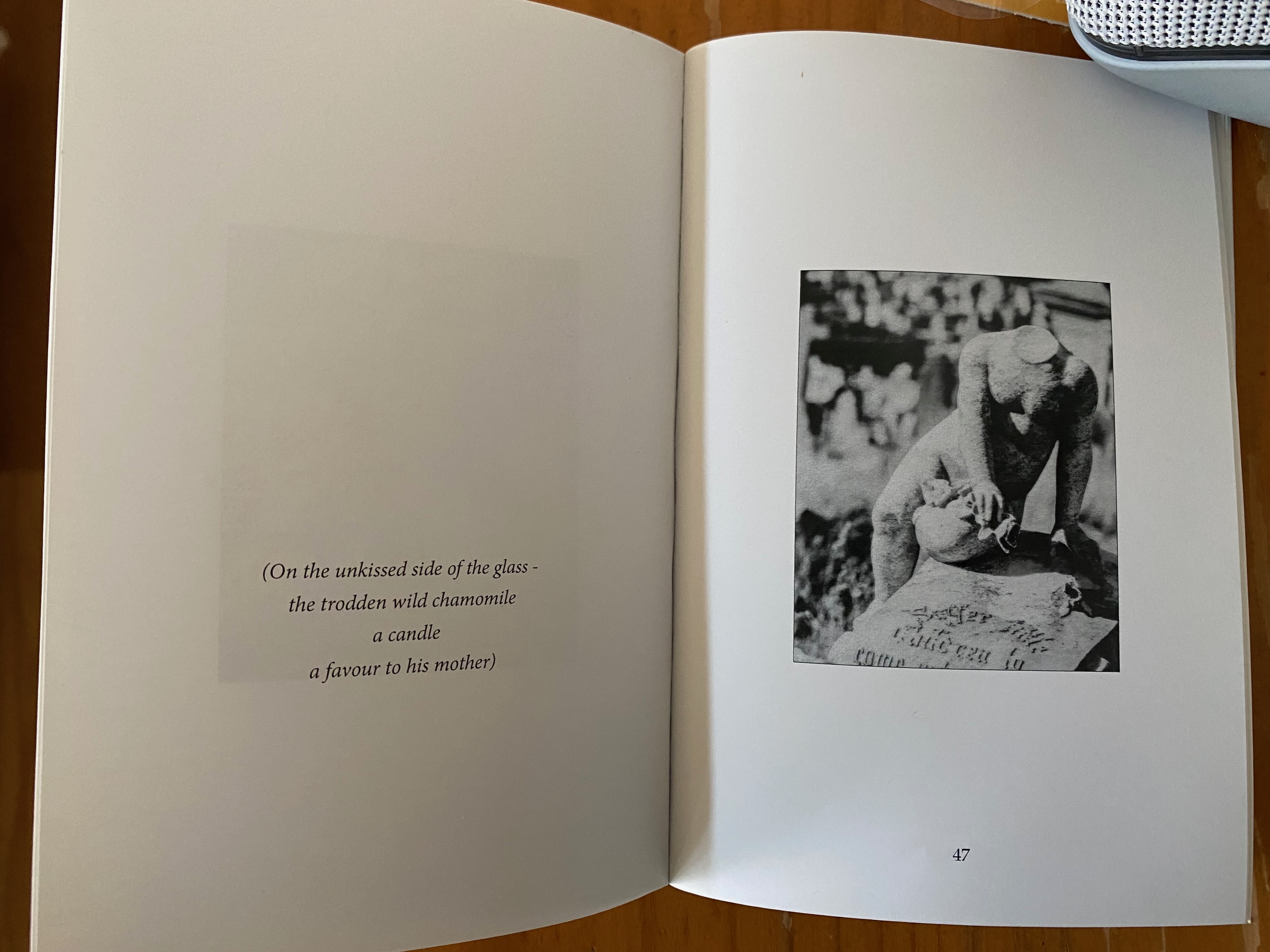
Page 47 is on the second spread of the sequence, the first that includes text:

This gives you some idea of the way text and image relate to each other throughout. They don’t illustrate each other explicitly, but as the text – mostly a single line per page after this – evokes thoughts of death and transience, the images suggest a walk among the graves, disturbing the crows that live there. On this page, the text –

(On the unkissed side of the glass - 
the trodden wild chamomile 
a candle
a favour to his mother)

– is a preamble to the walk that takes up the next ten spreads. It suggests a different style of grave from the one pictured – one with a glass-enclosed shrine. The man referred to in the fourth line maybe the person taking the walk through among the graves, starting at his mother’s grave. Perhaps these lines are a kind of dedication: ‘favour’ here meaning not so much as kindness as a token of affection or remembrance. You’ll notice that I say ‘perhaps’: nothing in this books is absolutely explicit.


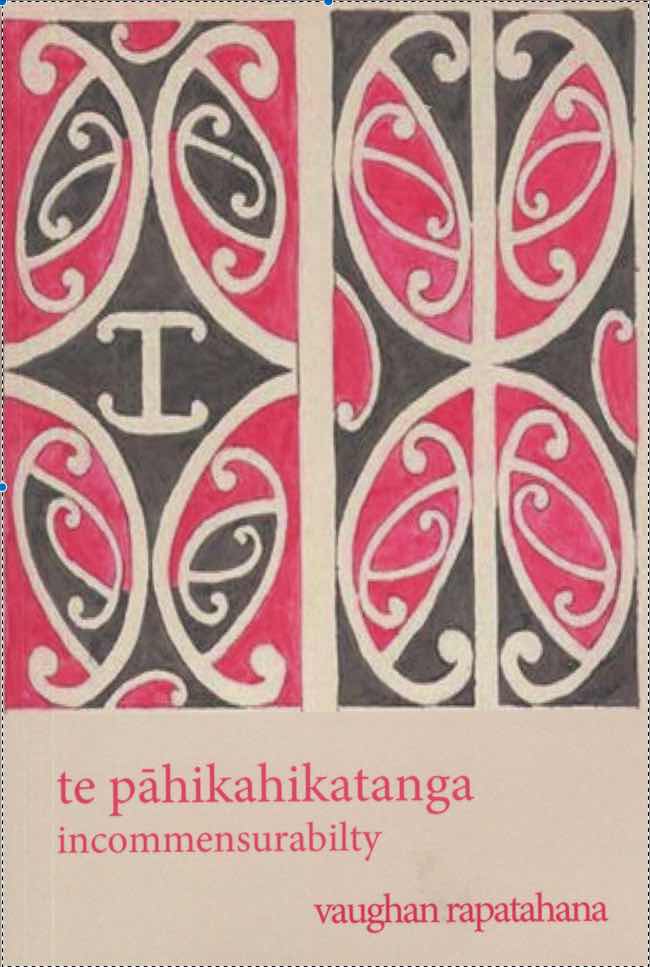
Vaughan Rapatahana, te pāhikahikatanga/ incommensurabilty (Flying Island Books 2023)

According to his author’s biog, Vaughan Rapatahana is one of the few World authors who consistently write in and are published in te reo Māori (the Māori language).

As well as a rich collection of poems rooted in Māori experience, this book includes a powerful essay on how important it is for Māori and other colonised peoples to learn and use their mother tongues.

The English language is one that historically and contemporaneously is all-too-often a deleterious influence on the languages of other cultures, in that its agents superimpose English with its inherent ‘cultural baggage’, on them. … The solution? To write in one’s indigenous language as much as practicable and to hope, to expect, that readers and listeners aspire to learn it too.

(Page 124–125)

Elsewhere:

I now write in my first language, the Māori language. Why? Because I want to fully express everything in my mind, in my heart, in my soul.
I cannot express myself fully in another language. For example, the English language is crammed full of the subject matter and cultural customs of the lands of Britain. The words of that tongue are inappropriate.

(Page 9)

The book is not just a bilingual book of poetry; it’s also a book about bilingualism. The incommensurability of its title refers to the impossibility of a ‘perfect’ translation. Anyone for whom the issues of translation matter will be interested. Likewise anyone interested in the long work of undoing the damage done by colonisation – to colonisers as well as colonised.

As a native speaker of the colonising language (with Irish and Scots Gaelic lost several generations ago), I’m reluctant to quote a whole poem, but here are a couple of lines from the English of ‘it is time for a big change’ on page 76:

there are many youths suiciding,
________________________-__ too many Māori youths
there are many women as victims of domestic violence
___________________________ too many Māori women
there is the ongoing issue of racism also,
__________________________ remember Christchurch.

And the original te reo Māori:

ko nui ngā rangatahi e mate whakamomori;
___________ he nui rawa atu ngā rangatahi Mãori
ko nui ngā wāhine ki ngā patunga o te whakarekereke ā-whare;
___________ he nui rawa atu ngā wāhine Māori
ko te take moroki o aukati iwi hoki;
___________  e mahara Õtautahi.

You don’t have to know much Māori language to immediately see some things lost in translation: in Māori, the lines mostly rhyme; in Māori, the second and fourth lines can end with the word ‘Māori’, whereas in English, the word is in a less emphatic position; and where the English translation has ‘Christchurch’, the Māori original has ‘Õtautahi’. The first and second of these differences are about the music of the poem. The third is a small illustration of the principles I quoted earlier: the English name inevitably carries connotations of England, of the Englsh Christian tradition; the Māori name makes it that much easier to remember that the victims of that mass shooting were Muslim.


I’m grateful to Flying Islands Books for my copies of Divertente and other poems and te pāhikahikatanga/ incommensurabilty.