Category Archives: Books

GDS launch at PPR in Newtown

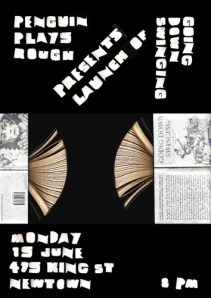
GDS28SydneyEflyer

Last night I went to the Sydney launch of Going Down Swinging No 28. As I may have mentioned, I have not one but two poems in this excellent publication, and I’d missed the Melbourne launch last Wednesday. So of course I made my way to Penguin Plays Rough headquarters in Newtown for last night’s event.

I’d left my PDA at home, so we had a little trouble finding the place. I remembered the address as 475 King Street. That turned out to be a convenience store, which didn’t seem right. My companion wanted to phone home for instructions, but my dim recollection of the Google Street Image made me expect to find a door down the side street. And sure enough there was one.

‘But look, through the windows, you can see that it’s someone’s home,’ said Madam Circumspect.

‘Remember the New American Vaudeville,’ I said.

‘That was fifteen years ago,’ she muttered, but the little New York adventure I was referring to had taken us to a door just as unlikely as this one in the Bowery, and it had opened onto a strangely enjoyable evening of fire-eating, Groucho Marx impersonations and bad folk music. So we climbed the stairs last night, to an evening that was at least as enjoyable, with its own kind of strangeness.

It turns out that we had been seeing someone’s home through the windows. The story as I gleaned it in the course of the evening is that two young women moved into the flat above the convenience store, and when they took a good look at the high-ceilinged, crumbly front room, they decided it was too big to waste as a bedroom or even as a shared living room, and should be put to work as ‘a space’. And so Penguin Plays Rough was born: at 8 o’clock on the third Sunday of every month five programmed writers and five wild cards sit in a red velvet wing chair and read from their work to a paying audience (a wild card is someone who puts their name on the blackboard at the door on arrival).

Last night the room was comfortably full of mostly young people drinking beer and what I thought at first was soup but was actually mulled wine. An assortment of chairs – wooden from the kitchen, wrought iron from the garden, upholstered and plastic – lined two walls, but most people sat in comfortable, picnic-style circles on the floor. My companion’s prediction that we would be the oldest people in the room proved correct by a good ten years, and we were possibly as much as 30 years above the mean. Klare Lanson and Lisa Greenaway, editors of GDS, were there. I knew a couple of people, including Mark Tredinnick, poet, essayist and creative writing teacher, who was there to give moral support to one of his students who was reading. But mostly I had a sense that this was a thriving group of people who enjoyed each other’s work, had fun writing and reading and providing an audience for each other. We were treated, among other things, to the final instalment of a Philip Marlowe spoof serial drama with a zombie and cheerful gay male incest. My favourite PPR part of proceedings was a nasty homophobic encounter on Windsor Railway Station told in the language of Shakespeare (‘Ho, varlet, what music doth enter thine ear through yon iPod buds?’ ‘This be Anthony and the Johnsons’), and incorporating a giant green tentacled alien.

A charming young man introduced simply as Shag (who Google tells me is a Radio FBi personality) did the launching. He hadn’t actually seen a copy of GDS until he arrived at the venue, but that didn’t stop him from doing a nice job: he had written a piece of ‘Creative Writing’ entitled ‘What I Imagine It will be Like to Launch Going Down Swinging’ which managed to be funny, self-deprecating and devoid of actual reference to the subject of the launch. Nonetheless there was a sweet mood of celebration. Klare Lanson had a few moments in the chair, and managed to slip us a couple of factoids (Peter Carey and Brian Castro appeared in early issues, and in spite of the implied pessimism of the title, it’s now been going down and swinging for 30 years). A couple of contributors read their poems and stories from the GDS,

Literary culture is alive and well and having a good time in a room above a convenience store in Newtown.

Mark Tredinnick mentioned in a break that his book The Blue Plateau is to be launched tonight at Macquarie University. ‘Do you imagine it will be like this?’ I asked. ‘Absolutely not,’ he said.
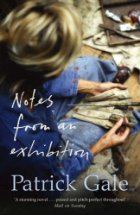
Notes from an Exhibition

Patrick Gale, Notes from an Exhibition (2007, Harper Perennial 2008)

Consensus at the Book Club was that this is excellent. Penny brought it home as part of her swag and urged me to read it. Since she also sounded as if the book made her yearn to become a Quaker, and went to the Glebe Library to borrow every Patrick Gale novel she could find to take away on our current holiday, I understood her to be strongly recommending the book. Resistance was useless. I agree – it’s a wonderful read.

Far too many novels, even very good ones, have me at least occasionally counting how many pages I am from the end. Not this one. It reminded me of the two-laughs-a-page rule that a comic novelist friend of mine swears by – any fewer than that you’re losing the reader, he says. Notes from an Exhibition isn’t a comic novel, but it manages at least two flashes of something a page. If the descriptions of Quaker practice and ethos don’t hold you, there’s the engrossing web of relationships of a family whose mother is diagnosied as bipolar. If that’s not enough, there are engrossing accounts of an abstract painter’s creative process. There’s a steady progress towards the heart of a mystery, and a sense from early on that we’ll get the detail of a family tragedy before the last page. The narrative shifts among at least half a dozen convincing points of view and back and forth in time, so that the story emerges with four-dimensional solidity. There are sharply visualised minor characters, some of them trailing hints of complex, heart-wrenching narratives of their own. I wish I’d got to the final chapter before my other Book Group’s evening on erotica, because it includes a lovely account of a teenage boy’s first sexual encounter: a straightforward narrative, with the emotional meanings front and centre.

As you can probably tell, I’ve joined the consensus.

Patrick Gale was on Radio National’s Book Show in February, and among other things it was heartening to hear him defend his main character against Ramona Koval’s charge of being a terrible mother.

Picture book for grown ups

Jenny Joseph and Pythia Ashton-Jewell (illustrator),  Warning : When I am an old woman I shall wear purple (poem © 1962, this edition Souvenir Press 1997)

0285634119I was mooching a book from someone in England, and they wanted me to take more than one book to make it worth their while. They had this illustrated Warning on their inventory. It’s a poem I’ve seen on feminist fridges for more than 30 years, so I added it to my list. I had it in mind to give to someone as a gift, but by the time it arrived – by surface mail – yesterday I’d forgotten who. So I gave it to the self-described poetry loather I live with.

She read it, said it had more in it than she remembered, and read it to me. Helped by the layout – one or occasionally two lines a page – she read it beautifully, slowly, thoughtfully. I vaguely remember reading somewhere that Jenny Joseph has said she wishes she’d never written the bl*dy thing. Certainly she’s famous for issuing take-down notices when her many fans put it up on their sites without thinking to ask. But it’s a good poem.

There’s a lot to be said for publishing poems with illustration. This is something I had used to agonise over when publishing a children’s magazine. By presenting poems with illustration were we straitening the readers’ responses, telling them how to read the poem rather than giving the words free play? It made the page more inviting, but at what expense?

I’ve had a couple of experiences recently that make me think there should be much more of it.

When Carol Ann Duffy was recently appointed Poet Laureate, I came across an animation of  one of her poems, and though I found the animation not at all to my taste, or a fair reflection of the poem, it slowed my reading down, and let the poem sink in – it’s a good poem. I’ve just found it on YouTube.

A couple of years ago, I was very taken with the Poetry Foundation’s sadly brief series Poem as Comic Strip, which similarly slowed the brain down to receptive speed. I particularly liked the Emily Dickinson–Gabrielle Bell page (this link is to a 580k PDF). See what you think.

Erotica: the morning after

Having done a “before” post, I now feel obliged to do an “after”.

As it turned out we were all white, middle-aged, heterosexual and in long-term relationships. No one had much interest in discussing Anaïs Nin – most hadn’t been interested enough in Delta of Venus to read the whole thing, though one chap had read a second, similar collection of her dollar-a-page pieces, and another had read some of her diaries. Someone went to the trouble of saying he found some of it offensive. We decided she belonged to another era, and moved on. (Is there something of hers that you, dear reader, would recommend?)

It turned out that if I am timidly vanilla in my taste for erotica I was in a room of similarly minded souls. I did read the Kathryn Lomer poem, and people liked it. One of our number had assiduously ransacked his memory, the web (by googling “erotic poetry”) and the bookshelves at an auction down the road, and shared some gems he’s found. He read us a steamy encounter between Elizabeth Bennett and Darcy in Pride and Promiscuity : The Lost Sex Scenes of Jane Austen – we agreed that that’s probably a perfect read-aloud book for consenting adults. He played recordings of two marvellous poems, one from ancient Egypt and another incorporating a Native American story about a winged penis. He read, with some apologies, Charles Bukowski’s “Like a Flower in the Rain” (warning, that link includes anatomically correct four-letter words), in which one can only marvel at how one word can transform a poem. Someone mentioned the bath scene in The Reader. We talked a little about the early scenes in Silk.

We kept asking each other what makes something erotic rather than pornographic. Clearly our collective taste veered to the non-pornographic end of erotica. We agreed we like our erotica with a bit of wit, a lack of emphasis on the plumbing (though no aversion to it being named), a context, and a sense of minds being engaged.

Next meeting, Anna Karenina.

Erotica

Anaïs Nin, A Spy in the House of Love (©1954, Penguin 2001)
—-, Delta of Venus (©1969, Penguin 1978)
Alessandro Baricco, Silk (translated by Guido Waldman, The Harvill Press 1997)

Tonight at my book group (this is the all male one) we turn our collective attention to erotica. (Welcome everyone who found this entry via a google search.) A number of us had heard of Anaïs Nin, so we decided to go with a couple of her books, though there was an invitation to bring along a passage to read aloud from anywhere else. I’m posting this before the meeting.

810Of A Spy in the House of Love, the less said by me the better: not so much erotica as neurotica. The long, ecstatic paragraph near the start that ended ‘but only that one ritual, a joyous, joyous, joyous impaling of woman on a man’s sensual mast’ had me thinking that if that was erotica I’d happily do without it. Thankfully there were no recurrences.

Maybe I’m showing my age, but I can’t say I warmed to Delta of Venus, either, 0140184708which had lots of impaling. The most interesting thing about the book is probably the introductory pages, excerpts from Anaïs Nin’s 1940 diaries describing the way she and a swathe of her literary friends churned out erotica for a mysterious ‘Collector’ for a dollar a page.

Back in 1970 or so, there was a lot of anti-censorship activity in Sydney, including the publication of pornographic editions of student newspapers and “Porn Fests”, at which distinguished academics and undistinguished enthusiasts read rude bits from Henry Miller, Sam Shepard, John Wilmot second earl of Rochester, the Marquis de Sade and so on to crowded lecture theatres. It was all in a good cause – blows struck in the struggle for free speech – and some of it was funny, but overall it was squirm-making. Delta of Venus seems to me to belong in that context: it does contain some characters and narrative, but the ‘dirty bits’ are its raison d’être. Already dated in 1976 when Anaïs Nin decided to publish it, it reads as totally quaint now, quaint and vicious in its playing with paedophilia, incest, rape and so on. However, I did read it from cover to cover, so it clearly has titillation value. What I’ve realised is that if writing is to work as erotica for me, it needs to arise from a complex, recognisably human reality. Maybe we should have agreed to read Anaïs Nin’s diaries, where presumably she talks about more than who is doing what to whom with what.

1860462588I went to the theatre on Sunday with another group member, who was similarly unenthused by the Anaïs Nin books. Someone had recommended Silk to him, and he lent it to me with his recommendation. It’s a very short book, something of a fable about love and passion. Most of it is taken up with a slow-building sexual charge. Then there are a couple of explicit, erotic pages – which work because they’ve had 80 pages of build-up. Then the tale ends with a bitter-sweet twist that makes one want to re-read the erotic pages again …

At the moment I’m tossing up what read-aloud to take tonight: A D Hope’s ‘The Countess of Pembroke’s Dream’ perhaps, or Kathryn Lomer’s ‘Tentative love poem’, which begins:

Snow comes late; only the air
between our mouths is warm,
a microclimate in which whispered words
are storms building. Our skins catch

what little light is cast – mine reflects,
yours absorbs.

MCMLXN

L K Holt, man wolf man (John Leonard Press 2007)

551c

man wolf man won the Kenneth Slessor Award this year. Whatever may be wrong with literary awards (promoting the view that art is a competition, for example), they do extend some readers’ range, mine included. How would I have picked this up if it hadn’t been singled out by the judging panel?  I’m glad I did pick it up.

Luke Davies is quoted on the publisher’s website as saying, ‘Holt’s is one of those voices that blast from the sky now and again, like a lightning bolt.’ To which I reply, ‘Fair enough.’ The writing in this book is sharp and playful and versatile and makes wonderful music. There are two long pieces, series of long sonnets (that is, sonnets with 18 lines – I don’t know if this is something L K Holt invented). One of them, ‘Unfinished Confession’,  starts out with almost A-D-Hopish gravitas, talking about an ancient pioneer of anatomical knowledge, then in the last lines of the first sonnet lurches into crude, impatient vernacular and reveals its totally contemporary subject, still serious, still – like much of A D Hope – rich in scientific reference and allusions to works of art, and preoccupied with sex, but very much its own thing. (I’m trying not to be spoilerish, and also keep my PG rating.) In the book as a whole, there are many delights in the patterning of language, many memorable lines.

The very first poem, ‘Man is Wolf to Man’, begins with a grim commonplace:

Until the consummation of things
man, wolf, man.

and goes on, elegantly, with a catalogue of horrors, ending:

Sometimes the enemy knocks before
entering. A baby is hidden in the drawer.

It seems to be saying that humans, or perhaps just men, are incorrigibly vicious to each other and that the best we can hope for is sometimes to protect something precious. I find this view of things repugnant, its pessimism in some way too easy (not the attribution of lupine viciousness, but the notion that it will be with us forever, that it cannot be effectively resisted). It’s a gauge of how good the book is that I intend to keep it, and reread it, and will seek out more of L K Holt’s work.

(An unsatisfactory explanation of the title of this post can be found in a post on my superseded blog, Family Life.)

Hard copy

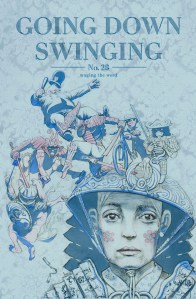
I was in Gleebooks this morning buying yet another copy of A Case of Exploding Mangoes, this one for a friend who has just gone into hospital for a longish stay, when I saw a stack of the new issue of Going Down Swinging:

GDS-FrontCover

Not only is it very beautiful, its contents include two poems by me. I didn’t buy a copy because I’ve pre-ordered six which I’ll pick up at a launch. But don’t let such considerations prevent you from splurging. There are a couple of hundred pages and a CD that feature stuff not by me, and my first quick impression is that it’s fabulous.

Bookblog #68: The joys of non-fiction

[This is reposted from my earlier blog because I want to link to it from a 2020 post. It first appeared on 19 May 2009 – JS]

Bernhard Schlink, Guilt about the Past (UQP 2009)
Theodore Seifert, Snow White: Life Almost Lost (©1983, translation into English, Chiron Publications Illinois 1986)

Pasted Graphic 2

It’s a truism that as men get older we prefer non-fiction to fiction. I hesitate to say that that’s true me in particular, but this collection of lectures by Bernhard Schlink thrills me much more than The Reader did some years ago. The Reader was a bloody good, thought-provoking read. Guilt about the Past strikes sparks from my brain with just about every paragraph.

These essays/lectures deal with the question of collective guilt: is it a legitimate concept, and if so what is to be done about it? Who has the right to forgive? How can a valid reconciliation be achieved between those who inherit a shared history of monstrous deeds in which their forebears were perpetrators and objects respectively? Bernhard Schlink has recent German history in mind and refrains from talking about his subject in universal terms, but what he manages to articulate is powerfully relevant to all manner of situations. He talks in terms of law, and morality where it’s not covered by law. I won’t try to write a proper review here, but recommend that you read the book. It’s short, clear, and lively. Every time I picked it up, as I flicked through the pages looking for my place, sentences would leap out at me. At random:

The notion that the past could be brought into form and order is foreign to the law.

… simply stated, everyone whose relationships have been damaged can reconcile. While forgiveness lifts the burden of guilt from the guilty parties, reconciliation merely makes it a bit lighter.

… understanding does not have only positive connotations.

… my mother was right. If a person does not believe in a forgiving God, then they have to live with their guilt when they can no longer obtain forgiveness from the person they injured.

The book is very readable, but I’ll need to re-read it and meditate on it.

sw021

Snow White: Life Almost Lost, on the other hand, does the meditating for you. It’s a discussion of the fairy story from the point of view of a Jungian therapist. Much wisdom is dispensed about the challenges of the inner life, and the Grimm Brothers’ 1859 version of the tale provides a mostly plausible springboard for it, but Herr Seifert surely sets a record of some kind by taking 32 pages of discussion to get us through the first 45 words of the story – and that’s without any attention to ‘Once upon a time’! The words themselves, in case you need reminding:

Once upon a time in the middle of winter, snowflakes were falling like feathers from heaven; a queen was sitting at a window that had a frame of black ebony, and she was sewing. As she sewed and looked up at the snow, she pricked her finger with the needle.

You’ll have to read the book to discover what profundities about life and death, hope and despair, belief, imagination, love, law and deprivation those words contain – assuming that like me you can’t see these profundities unaided.

My favourite couple of sentences, from much later in the book (remember there is no married couple in the story, until the wedding in its last paragraph):

Even after many years of marriage, going to bed at different times is still a problem for many couples. Every evening they suffer the same irritation: The one has to go now, the other can’t go yet. Each always experiences this as a form of a seeming demand; and without exception the mate is accused. We talk only of what the other did to us; we do not talk of our own lack of readiness to risk corresponding conflict and stand up for our own wishes. Ultimately all these poisoned thoughts suffocate our soul, just as the bodice laces suffocated Snow White.

Leaving aside the incomprehensible phrases, which can probably be laid at the translator’s door, this measures up fabulously against some of the most ingenious of mediaeval biblical hermeneutics. And for all that, and for all the preoccupation with marriage as the one road to a fully human life, I have come away from the book with a much deeper appreciation of the Snow White story.

Posted: Tue – May 19, 2009 at 11:57 AM

NSWPLA Dinner [2009]

[Retrieved from 18 May 2009]

Tonight writers, translators, illustrators, publishers, agents and fans put on their glad rags and turned up for a glittering evening in the Art Gallery. The occasion was the annual NSW Premier’s Literary Awards dinner. This year’s dinner cost $15 more than last year’s.

In previous years the dinner has been organised by staff of the Ministry of Arts. This year it was in the hands of the Department of Arts, Sport and Recreation. The transition was seamless, though there was a slightly awkward moment when the Department’s Director General, who was our MC, said we were doing very well for an arts event and only running half an hour late. There was no hiss of indrawn breath, but I did think it indicated she was much more familiar with sporting events than with arty ones, where my experience has been there is an obsession with punctuality. And at times, as she urged us to resume our seats after a break, her tone was reminiscent of what one would hear over the loudspeaker at, say, a netball tournament. But these were amusing foibles that in no way took away from the pleasure of the evening.

Nathan Rees, more famous for his stint as a garbo and for having inherited a train wreck of a government than for his Eng Lit Hons degree and likeability, gave the impression that he was much happier here than in the bearpit of politics. In his welcome (which followed Aunty Sylvia Scott’s Welcome to Country, in which she said, ‘Your books let me travel’), he spoke of his own passion for books, and told us that some left him cold, surely a mark of a genuine book lover. And he said, interestingly, ‘The examined life is only ever the turn of a page away.’

This was the thirtieth year of the awards, and there was slightly more reminiscence than usual. Neville Wran, the first Premier of the Literary Awards, was there and gave a brief talk on their genesis. Success has many parents, he reminded us, but failure is always an orphan. Of the many people who have claimed m/paternity of these awards, he assured us in his ruined voice, the one who could truly claim parenthood was his wife Jill, who insisted that Sydney should have a writers’ festival distinguished by literary awards. He mentioned the legendary Night of the Bread Rolls in 1985 when the guest speaker Morris West was pelted with bakery products. I’d heard that it was because he droned on. One of my dinner companions was there on that night, and he assured us that it was because the literary types were envious of Morris West’s best-seller status.

Marieke Hardy, of Reasons You Will Hate Me, gave the Address, with a tattoo on each shoulder and a large red flower behind one ear. She spoke of Twitter and quoted Stephen Fry to good effect. In the past, I’ve referred to these dinners as the Oscars of the introverted. Marieke went several steps better and, referring to booklovers out and proud, called it ‘our Mardi Gras’.

As in past years, it’s my pleasure to list the winners with random observations:

The UTS Prize for new writing: Nam Le, The Boat
There’s no short list for this prize, so the announcement was a bit of a surprise. It’s a wonderful book. The award was accepted by Nam Le’s publisher, who read out a short speech Nam had sent him from Italy.

The Gleebooks Prize for an outstanding book of critical writing: David Love, Unfinished Business: Paul Keating’s interrupted revolution
Nathan ‘s script described this as an accessible account of important economic matters. I’m afraid I didn’t understand a word of the brief acceptance speech after the initial ‘This is one for the true believers!’

The Community Relations Commission Award : Eric Richards, Destination Australia: migration to Australia since 1901
Eric Richards spoke of how Australia’s immigration program has been an outstanding success, yet has been and is still a cause of widespread anxiety. He was expecting the book to provoke ‘historical warfare’, but so far there has been none.

The Translation Prize and PEN Trophy: David Colmer
He seems to be a nice man – he translates from Dutch.

The Play Award: Daniel Keene, The Serpent’s Teeth
I saw the STC production of these plays, and was less than impressed by the production, though the plays as written seemed to be marvellous. I approve.

The Script Writing Award: Louis Nowra and Rachel Perkins and Beck Cole, First Australians
In announcing this prize the Premier said, quite rightly, that it was hard to go past this show, but then he went and spoiled the moment by feminising Mr Nowra’s first name. When Rachel Perkins took the mike she pointed out the error. Our Nathan looked suitably abashed, and Louis clearly couldn’t help himself: ‘How long do you plan to stay in government?’ he asked, trying to make it sound good-natured. Ow!

The Kenneth Slessor Prize for a book of poems or for a single poem of substantial length published in book form: LK Holt, Man Wolf Man
Possibly intimidated by the compere’s reminders of the importance of being brief, LK Holt simply thanked her publisher and took her prize. She did stand at the microphone long enough to enable those of us close enough to read the enigmatic tattoo on her left shoulder: ‘MCMLXN’.

The Ethel Turner Prize for a work written for young people of secondary school level: Michelle Cooper, A Brief History of Montmaray
At this stage I began to feel very under-read.

The Patricia Wrightson Prize for a work for children up to secondary school level: Ursula Dubosarsky & Tohby Riddle, The Word Spy
And then I started to feel like an insider again. Tohby and Ursula have both worked at The School Magazine. I read this book in its first incarnations as a series of columns in the magazine, and I was sitting at the same table as both of them – along with two other generations of Ursula’s family and Tohby’s wife Sally. This is the fifth gong Ursula has collected from NSW Premiers. Though it’s no longer a gong.: to mark the 30th anniversary, a new trophy has been created, by Dinosaur Designs: a hefty, transparent, book-shaped objet.

The Douglas Stewart Prize for a prose work other than a work of fiction: Chloe Hooper, The Tall Man: Death and Life on Palm Island
I’ve read this too, and think it deserves any prize anyone chooses to give it.

The Christina Stead Prize for a book of fiction: Joan London,The Good Parents
I haven’t read this, but it’s been very well reviewed in my house. Joan London gave a sweet speech, acknowledging , among other things, her debt to her children.

The People’s Choice Award: Steve Toltz, A Fraction of the Whole
I hadn’t voted, because I’d only read two of the books, and this wasn’t one of the ones I’d read. The same man who had accepted Nam Le’s award accepted this one, but Steve Toltz, who couldn’t be there, hadn’t tweeted him anything to say, so he just looked pleased.

Book of the Year: Nam Le, The Boat
Then the poor guy had to get up for the third time, and gave us the second half of Nam Le’s emailed acceptance speech, in which he thanked his readers, ‘both professional and normal’. As one who used to be a professional reader who is striving for normality, I loved this.

The Special Award: Katharine Brisbane
Katharine was my first employer, when she was Managing Editor at Currency Press, and I couldn’t be more pleased at her receiving this recognition. She adlibbed an elegant speech about the importance of recognising achievement in the arts. She has received a number of awards in her time, she said, but this is the first one to come with money attached. She closed by saying that she too had been there in 1985. ‘We pelted Morris West with bread rolls because he warned us that we had to be prepared for bad things. The Baader Meinhofs were in the news, and he was warning us against terrorism. We thought he was ridiculous, but he was right.’

And then it was all over bar the networking …

… and the journey home. As I was walking back towards the city from the Art Gallery, I drew alongside a rough looking man going in the same direction. He said hello and asked how the evening had gone. ‘We’re homeless, you see, we sleep just beside the porch there.’ We chatted for a couple of minutes. He told me who had won the People’s Choice at the Archibald. I tried to tell him about the Literary Awards, but I think he still thought I’d been at something to do with paintings. As we parted, he said, in an eerie echo of Nathan Rees’s comment about the examined life: ‘People don’t realise it, but you’re always just one step away from the gutter,’ and we wished each other good night and good luck.

No corner shop in time for the ascension

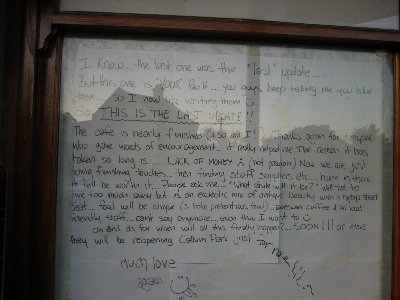
I ran into Rod the corner shop reviver the other day and asked him if Revolver would be open for Ascension Day. ‘When’s that?’ he asked. When I told him it was forty days after Easter, he replied in the emphatic negative. Shortly after that conversation, this notice appeared in the window:

IMG_3324.jpg

In case you can’t read it because of the lovely suburban sunset glare, it says:

I know, the last one was the “last” update …

But this one is YOUR fault … you guys keep telling me you like
them .. so I now like writing them

So … THIS IS THE LAST UPDATE!!

The cafe is nearly finished (so am I!). Thanks again for everyone
who gave words of encouragement … it really helped me. The reason it has
taken so long is … LACK OF MONEY (not passion). Now we are just
doing finishing touches … then finding staff, suppliers, etc … Hang in there
it will be worth it … People ask me, ‘What style will it be?’ Well not to
give too much away but it’s an eclectiv mix of antique beauty with a hiphop street
beat … Food will be simple (I hate pretentious food) … awesum coffee and all local
friendly staff … can’t say any more …even tho I want to.

Oh and as for when will al this finally happen? … SOON!!! Or else they will be reopening Callan Park just for me!!!

Much love again

Rod

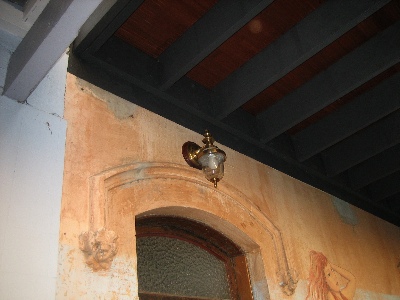
Cute little lights have appeared at the front of the shop:

IMG_3323.jpg

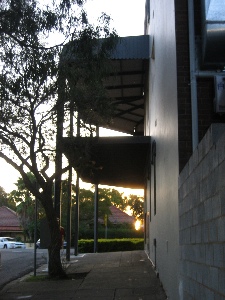
The balcony is built, complete with bullnose awning. Iron lace and railing are
stacked on the veranda, not visible here:


IMG_3327.jpg

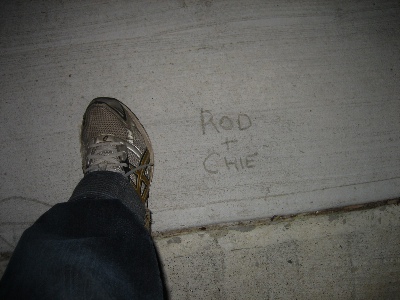
Rod and Chie, the owners, have made their mark in the footpath outside the converted
butcher shop next door:

IMG_3329.jpg

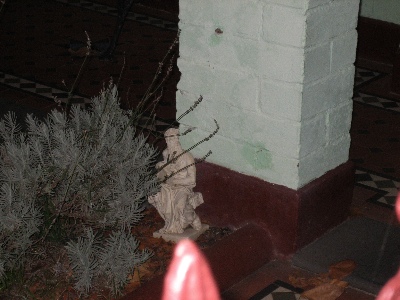
And just because it’s there, here’s a tiny replica of Michelangelo’s Moses that passes for a garden gnome in this part of the world.
IMG_3328.jpg