
Clive James(editor), The Fire of Joy: Roughly 80 Poems to Get by Heart and Say Aloud ()
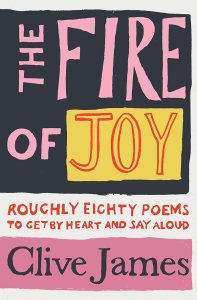
There’s a Japanese tradition of writing death poems. These aren’t just poems about death but poems when the poet knows death is imminent. The tradition has its own Wikipedia page.
This is Clive James’s death anthology, compiled when he knew death wasn’t far off and published after he died. His wife and daughters helped in the writing, as he was effectively blind when he began and increasingly sick as the work progressed. His elder daughter Claerwen, he says on his acknowledgements was the book’s ideal editorial curator:
There were times when I could generate individual passages of a note, but its higher architecture was beyond me. She became adept at assembling coherent prose from a heap of bits and pieces.
So this is an idiosyncratic collection of poems, many of which James says he has by heart and can say aloud, or could before his powers began to fail him. It begins with ‘Western Wind’, just four likes written before Chaucer started ‘the fashion for poets having names’, and ends with ‘The Red Sea’ by Stephen Edgar, who was ‘soon to bear the burden of being known as Sydney Technical High School’s most prominent poetic alumnus’.
There’s an introductory note offering rules for reading poetry aloud. Each of the poems included is followed by a note, and the notes range from observations on technique and form to purely personal associations. It doesn’t claim to be a Best Poems. There are more war poems than you might expect, and a number of poems that few readers will have heard of. Christina Rossetti makes the cut but William Blake doesn’t. He comments scathingly on Robert Lowell and, apart from the postscript, ‘Growing up poetical in Australia’, he includes ony three Australians.
Page 79* is devotes to Edward Fitzgerald – six stanzas from his’The Rubaiyat of Omar Khayyam”. I know that this is an excellent poem ‘to get by heart and say aloud’ because I once walked with an older friend who recited the whole thing to me as a way of calming down after a stressful encounter. One of the stanzas he includes happens to be the first one I came across. Actually I met it in a parody, a quote from Alfred E Newman on the title page of a Mad magazine. That version was, ‘A jug of wine, a loaf of bread and thou, and pretty soon I’m drunk, fat and in trouble.’ Fitzgerald’s actual stanza XII is:
A Book of Verses underneath the Bough,
A Jug of Wine, a Loaf of Bread, and Thou
Beside me singing in the Wilderness –
Oh, Wilderness were Paradise enow!
In his commentary, James doesn’t pay any attention to the problematic relationship of Fitzgerald’s poem to an original Persian poem. Instead, he reminds us that it was ‘a standard recital piece in every genteel English household’ which he first heard read by his mother. He throws in some witty insults to Robert Graves and ends with a line from satirist S. J. Perelman, ‘And thou, beside me, yacketing in the wilderness.’
It’s a farewell note, filled with gossip, memoir, and an occasional gag, from a deeply unfashionable poet, for whom poetry was a great, abiding love.
I am an Australian man of settler heritage.
* My blogging practice is to focus on the page that coincides with my age, currently 79.


