
Amitav Ghosh, Ghost-Eye (John Murray Publishers 2026)
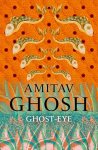
Before the meetings: I loved Amitav Ghosh’s Ibis trilogy – Sea of Poppies, River of Smoke and Flood of Fire (links are to my blog posts) for their exuberant language, their array of brilliant characters and their remorseless portrayal of British colonialism.
Ghost-Eye is a very different animal. It’s set in the recent past and present. Its characters live mainly in urban India and Brooklyn, with excursions to a remote village in the Sundarbans in the Ganges Delta. The main action involves westernised characters coming to terms with a case of reincarnation that is gradually revealed to be something even more challenging to Western ways of thought. The academics who take the incursions from the ‘other reality’ seriously are described as being ‘woowoo’, but the book – in my reading at least – asks us to take them seriously as an alternative to the western culture’s extractive, reductive, and now catastrophic dealings with the natural world.
I found the book didactic, plodding, and often incoherent. I was unconvinced by the characters. Where in previous books Ghosh’s play with language has thrilled me, the one distinctive use of language in this book is an irritating attempt at a hip young person’s dialogue.
It turns out that page 79* is a good place from which to launch a description of the book as a whole:
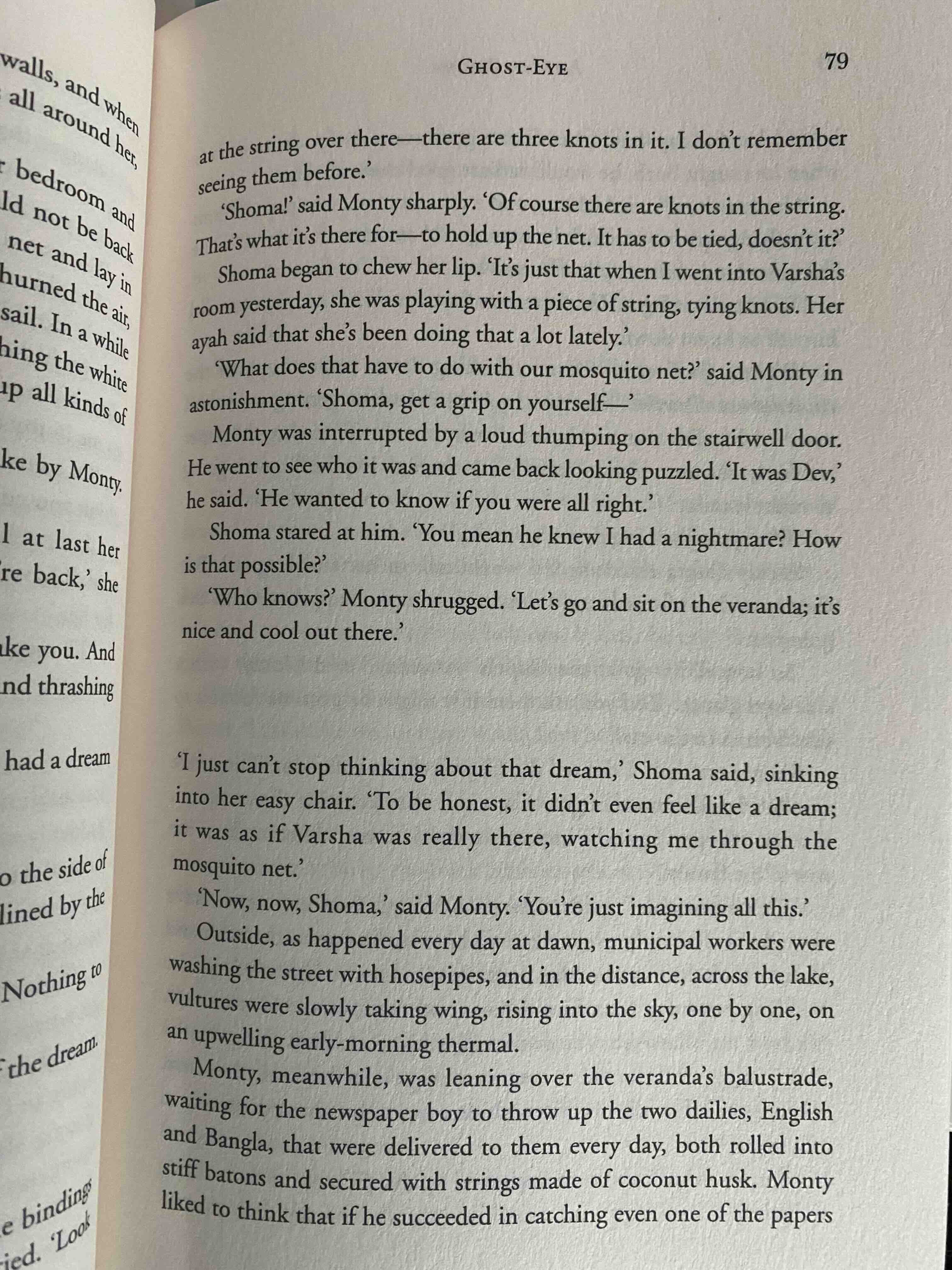
Four of the book’s main characters appear here.
Varsha, the subject of conversation, is the book’s central phenomenon. The book begins in 1969, when she is a three-year-old living in an extravagantly wealthy, strictly vegetarian family in Calcutta. One day, to her parents’ consternation, she asks for fish and refuses to eat anything else. Fish has never been in their house, and none of the servants would ever dare to break the rigid prohibition. A doctor is called in, and after spending time with Varsha, decides that this is a job for his wife, a psychologist who has dealt with ‘several cases of this type’ – that is, he explains, children who remember past lives. End chapter one.
Back to page 79: Monty is that doctor. In spite of being the one who first broached the subject of past lives, he is the book’s main voice of ineffectual scepticism. Shoma is his wife. She has done a lot of research into ‘cases of the reincarnation type’ in collaboration with a professor from the University of Virginia, and she has conducted tests with Varsha that convince her she really does remember a past life.
The other character named on this page is Dev, a refugee from Burma who is a servant in the household.
After a long session with Varsha, Shoma has had a vivid dream in which the little girl came to her bedroom and stared at her through the mosquito net. When she wakes up there are three knots in the string binding the net to the bedpost:
‘Shoma!’ said Monty sharply. ‘Of course there are knots in the string. That’s what it’s there for – to hold up the net. It has to be tied, doesn’t it?’
Shoma began to chew her lip. ‘It’s just that when I went into Varsha’s room yesterday, she was playing with a piece of string, tying knots. Her ayah said that she’s been doing that a lot lately.’
‘What does that have to do with our mosquito net?’ said Monty in astonishment. ‘Shoma, get a grip on yourself –’
You can hear the Twilight Zone music playing. Not only can this little girl remember a past life as a fish-eater, but is she also capable of out-of-the-body travel? And wait, there’s more:
Monty was interrupted by a loud thumping on the stairwell door.
He went to see who it was and came back looking puzzled. ‘It was Dev,’ he said. ‘He wanted to know if you were all right.’
Shoma stared at him. ‘You mean he knew I had a nightmare? How is that possible?’
‘Who knows?’ Monty shrugged. ‘Let’s go and sit on the veranda; it’s nice and cool out there.’
Ooooh, here’s something psychic about Dev too!
Out on the veranda, Shoma and Monty labour the point:
‘I just can’t stop thinking about that dream,’ Shoma said, sinking into her easy chair. ‘To be honest, it didn’t even feel like a dream; it was as if Varsha was really there, watching me through the mosquito net.’
‘Now, now, Shoma,’ said Monty. ‘You’re just imagining all this.’
Your mileage may vary, but that reads us pure clunk to me. It comes as no surprise that Varsha does indeed turn out to have amazing supernatural powers, and so does Dev. Towards the end of the book there is a twist in which even more people recover memories of past lives and discover that reality is much richer, more mysterious and full of possibility than their limited western mindset has allowed them to understand. And in this discovery lies the possibility of averting the climate crisis. To which I say, Bollocks!
There’s a lot of power in the proposition that Indigenous knowledge and ways of understanding the world will be crucial in dealing with climate change. But to conflate Indigenous knowledge with acceptance of the literal reality of reincarnation, mind-reading, astral travel and a string of other paranormal phenomena, as this book does, is a travesty. It may be that the book and I just got off on the wrong foot and I couldn’t recover. Maybe it’s meant to be just a bit of fun and I’ve misread its tone completely. It’s being read by both my groups – the BookGroup and the Book Club – so I hope to hear from people it worked for.
Back to page 79:
Outside, as happened every day at dawn, municipal workers were washing the street with hosepipes, and in the distance, across the lake, vultures were slowly taking wing, rising into the sky, one by one, on an upwelling early-morning thermal.
Monty, meanwhile, was leaning over the veranda’s balustrade, waiting for the newspaper boy to throw up the two dailies, English and Bangla, that were delivered to them every day, both rolled into stiff batons and secured with strings made of coconut husk. Monty liked to think that if he succeeded in catching even one of the papers in mid-air, the day would be off to a good start. As for the occasions when he caught both, he would radiate good cheer all day.
This paragraph reminds me that the book has its pleasures, including a vivid evocation of places, but especially the Indian ones. This is middle-class Calcutta in the 1960s, where vultures catch thermals and newspapers are delivered daily. You have to love the detail of that coconut-husk string. And neither Monty nor I feel any need to reconcile his moment of idiosyncratic superstition with a hard, logical view of the world.
The Book Club meeting: I was the only one who had trouble with the book’s preternatural elements. Everyone else enjoyed the yarn, some as pure fantasy, at least one as playfully challenging reductive materialism. I’m left with the odd sense that I’ve misread the book, but can’t undo that reading.
Ghost-Eye was one of three books discussed at the Book Club. It will also be discussed at the Book Group‘s next meeting, which I will not be able to attend. If I glean any further insights from reports of that meeting, I’ll add a note here.
The Book Club’s five members are all of settler heritage. We met on Gadigal land, and I have written this blog post on Gadigal and Wangal land. I gratefully acknowledge the Elders past and present who have cared for this beautiful country for millennia, and welcome any First Nations readers of this blog.
* My blogging practice is to focus on the page that coincides with my age, currently 79.


 Me fail? I fly!