Category Archives: Page 75

Summer reads 2: The Gleaner Song Lin

Song Lin, The Gleaner Song, translated by Dong Li (Giramondo 2021)
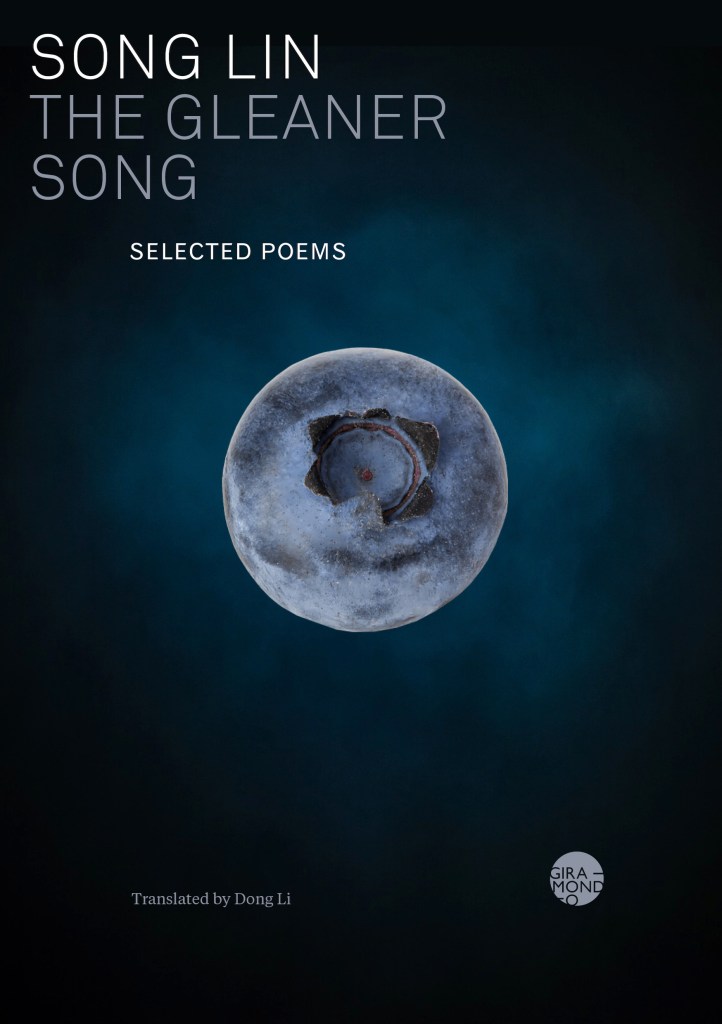
Song Lin (宋琳) was a campus poet in Beijing in the 1980s, and was active in the 1989 protests in Tiananmen Square, for which he was imprisoned for a year. On his release he married a French woman, and in 1991 went to live in Paris. After spending time in France, Singapore and Argentina, he returned to China in 2003, and now lives in Yunnan province. He has published many books of poetry and prose, including two bilingual French-Chinese volumes, and currently edits the poetry journal Jintian (Today), which ran for nine issues in the late 1970s before being censored, and was revived in 1999.

The Gleaner Song had its beginnings when Song Lin was on a long walk in the countryside of upstate New York with the young Chinese-born poet-translator Dong Li. Describing that walk in his introduction, Dong Li writes:

I saw his eyes light up as a deer leapt from the wild into a wide-open field. As the evening hues shifted farther into the forest, his line of sight followed the deer until it vanished into the night. We talked about the deer, and later he asked me to translate a poem that he had written to record the occasion.

That translation was to become the final poem in this book. It’s preceded by poems spanning four decades and as many continents, incorporating classic Chinese forms and elements of western modernism. Mostly I found it a difficult book, but in interesting ways.

To talk about the difficulty, and why it’s worth dealing with, I want to have a closer look at one poem, ‘Notes from South Xinjiang’. You can read the whole poem, without my commentary, on the Cordite Poetry Review website, where it was published in February 2022.

The rest of this blog post gets a bit detailed. A short version: the poem is a number of brief observations and reflections during a visit to South Xinjiang, the southern part of the Xinjiang Uyghur Autonomous Region in northwest China, much of which is taken up by the Taklamakan Desert, and most of whose population are Uyghur. It is a prose poem made up of 23 short numbered paragraphs. On a first reading, probably in bed at night, I enjoyed the sense of a mind at play in a new place, but I knew there was a lot I hadn’t understood. Here is what I found when I reread the poem with the internet open beside me:

Notes from South Xinjiang

1. The reckless god reads the braille of the desert.

The poem announces at the start that its subject is a desert. The gist of this first paragraph is clear enough: the shapes made by the wind on desert sands can look like braille, but it would be reckless to read a meaning into them – which by implication is what the poet, godlike, may be about to attempt. But is ‘the reckless god’ someone from ancient Chinese tradition, and would I read the poem differently if I knew? That question remains unanswered.

2. One night in Kupa, I received a telegram from Mars: there were traces of water.

I looked up ‘Kupa’ and found a river in Croatia. But there is a town called Kuqa (or Kuche) on the edge of the Taklamakan Desert, so I’m pretty sure that’s where the poet was. Wikipedia gives a long list of variants but ‘Kupa’ is not one of them. Who can blame a copy editor for not picking up what is almost certainly a transcription error, but mistakes like this add a layer of difficulty for the uninformed reader. So the poet is on the edge of the desert which he imagines as Mars-like. There may even be a suggestion that Mars has water where this desert does not. Certainly in photographs it looks vast and dry.

3. Dead rivers look like twisted mummies in the gallery of the sky.

I parse this to mean the dead rivers as seen from the sky – that is, in the gallery of images held in the sky rather than a gallery of images of the sky, which was my first reading. A map of the region shows a network of rivers, with a note to say they are ‘usually’ dry.

Why mummies? It’s not an obvious visual likeness, but it turns out that 4000-year-old mummies have been found in this area. This is the poem’s first oblique reference to the region’s ancient history

4. Language, dust of dust, flies on the long, long road.

I don’t know if the ambiguity of ‘flies’ – is language as insignificant as insects or does it fly away? – is something that happened in the translation, but either way it works well: human activity, especially language, is dwarfed by the desert. This paragraph introduces human activity more explicitly, and specifically the idea of the road, which is taken up the next five paragraphs.

5. An oar stands before the boat-shaped coffin. Sailors of the desert sea, tell me, what kind of sail do you dream of?
6. Business caravans head east, and west. The sun bakes eyebrows, beards, and crusty flatbreads.
7. Go. Once you lie down, you run the risk of being air-dried.
8. From one invisible border to another, I count those disappeared countries.
9. A silkworm once dreamed of Rome; or rather, Rome once dreamed of a silkworm.

These six paragraphs reflect on past human travel in the desert. Paragraph 5: the mummies from 4000 years ago had boat-shaped coffins. Paragraphs 6 and 7 refer to conditions endured by caravans of any era. Paragraph 8: perhaps the poet knows what those disappeared countries are, where those borders were – I don’t, but neither of us needs to know that for the line to work. Paragraph 9 is a lovely evocation of the history of the Silk Roads which passed through this region, skirting the desert (according to this map).

10. Breeze in the dense forest, homonym of silk and porcelain.

This paragraph is an example of what must be a nightmare for translators. It makes no sense as a stand-alone sentence in English. Really, all one can take from it is that some words in a Chinese language sound the same as others. Maybe in the original it’s an elegant pun, or a cute but inconsequential observation. As I can’t read or speak Chinese, I have no way of knowing, and I can’t see how a translator could do other than what Dong Li has done here: translation is impossible. (In other poems, Dong Li explains linguistic play in a footnote, but that’s a bit like explaining the mechanics of a joke – it still doesn’t make you laugh.)

From here on the poem bristles with specific historical and cultural references. It’s as if the poet is wandering abut the region, making random, elegant notes about things he sees. He also, incidentally, challenges the ignorant reader to do a bit of work. Or from another perspective, he points to a number of doors that open on vistas of new knowledge.

11. The Han princess Liu Xijun – Sappho of Wusun country – was married to a vast and endless homesickness.

Song Lin gives his western readers a small hand by comparing Liu Xijun to Sappho, the earliest woman poet in the western tradition. Liu Xijun wrote one of the earliest poems in Chinese written by a woman. Wusun country, as far as I can tell, was a little to the north of South Xinjiang, but near enough. Liu Xijun’s poem includes the lines, ‘Living here, I long for my land, and my heart aches / Wishing I could be a yellow swan, and return to my old home.’

Having paid homage to traditional Han culture, the poem now moves on to religion:

12. Under the statue of Kumarajiva, I thought: perhaps his intelligible translation saved Buddhism.
13. On their pilgrimage to Chang'an, the three Buddhist masters walked in the opposite direction to the three wise men.

Kumarajiva’s statue is in Kuqa. He was a Buddhist monk of the 4th and 5th centuries of the current era, who translated many Buddhist texts from Sanskrit to Chinese. His translations are still in use today.

Chang’an is the ancient name for Xi’an: I don’t know the story of the three Buddhist masters who – I’m guessing – travelled through South Xinjiang. The reference to the three wise men is another example of Song Lin’s cross-cultural awareness. I read him as suggesting an equivalence between the foundation of Christianity and the bringing of Buddhism to China.

14. If Emperor Wu of the Han dynasty knew that the Ferghana horse was a horse with a disease, would the history of Ferghana be re-written?

At about 100 CE, China imported huge numbers of horses from Ferghana in central Asia, roughly contemporary Uzbekistan, coerced by an army sent there by Emperor Wu. The horses remained popular for the next thousand years. They were said to sweat blood, which – according to Wikipedia – modern authorities believe was caused by the activity of parasites.

15. The donors depicted on the murals have thin eyebrows.
16. Stupa - navigation system of the desert.
17. What a pity! Gan Ying saw the sea but did not know which one he saw.

Paragraphs 15 and 16 are mercifully straightforward, though I don’t know if thin eyebrows have particular meaning in Chinese iconography.

Gan Yin was a diplomat who travelled west in 97 CE in search of Rome, but only got as far the ‘the western sea’, which – according to Wikipedia – could have been the Mediterranean Sea, the Black Sea or the Persian Gulf.

18. Petals of the mandala – one five-baht coin after another.
19. The auricle of the crescent rises on the ruins where Xuanzang preached.

Paragraph 18 doesn’t need any extra research.

Xuanzang was a key Buddhist teacher of the 7th century CE. The ancient novel that was the basis of television’s Monkey Magic was a fictionalised version of his journeys. He visited Kuche (now Kuqa) in 630 CE. The crescent of Islam, compared here to an ear, has risen where once actual ears heard him preach.

20. In the dark labyrinth of the karez, flowing water looks for bright vineyards.

This is a beautifully concise evocation of the Turfan Karez System, which consists of 5000 kilometres of wells and underwater channels around Turpan, on the edge of the Taklamakan desert. It’s tentatively listed as a World Heritage site.

21. Migration – from Sanskrit to Charian, Uighur to Chinese; over battlefields and millennia of forgetting, Maitrisimit flies into my vision like a phoenix.

Oh dear, I couldn’t find ‘Charian’ online, but Tocharian languages were spoken in South Xinjiang from 400 to 1200 CE. The paragraph should begin ‘Migration – from Sanskrrit to Tocharian’. (Does this mean no one actually managed to read the poem thoroughly when the book was in production?) So the migration described follows the flow of languages that have succeeded each other over the millennia.

According to Wikipedia, ‘Maitrisimit’, full name ‘Maitrisimit nom bitig’ is an Old Uyghur translation of the Tocharian text of a Buddhist drama, which itself (departing from Wikipedia here) is probably from a Sanskrit original. The way the text survives the extinction of language after language is captured in the image of the phoenix (not necessarily a reference to western mythologies, as China too has a phoenix).

This is the poem’s first mention of the Uyghurs, and possibly suggests – ‘Uighur to Chinese’ – that their culture is in the process of being wiped out. Given the necessarily oblique way Chinese poetry has addressed political matters over the last half century, it’s perhaps not too much of a stretch to see this as a disguised protest.

22. Another Uighur muqam: alas the musailaisi wine, the ice-cold beauty, come quickly and rub out my burning desire for you!

The poet has visited the statue of Kumarajiva, some murals, a statue of a Ferghana horse, and so on. Now he relaxes at a musical performance, a Uyghur muqam, drinking musailaisi, traditional Uyghur wine. I’m pretty sure his address to the wine echoes centuries of conventional drinking songs and poems. If there is a protest at the treatment of the Uyghurs, it is thoroughly disguised, but still visible to reader who want to see it.

23. In Kashgar, Shen Wei said to me: there are people wherever poplars grow.

As you’d expect, Kashgar is another city in South Xinjiang. Shin Wei is a poet, younger than Song Lin, who lives in South Xinjiang. So the poem ends on a note of collegiality among poets (an almost Jennifer-Maidenish note). I have no idea what Shen Wei’s remark means. In English the sound play between ‘people’ and ‘poplars’ creates a kind of resonance, and the original Chinese may have a similar play, but that’s a guess.

In the end, I have to resign myself to the reality that not everything in a poem can be translated, and be grateful for as much as does make it across the barriers of language and culture.


I am grateful to the Giiramondo Publishing Company for my copy of The Gleaner Song.

Jessica Au’s cold enough for snow

Jessica Au, Cold Enough for Snow (Giramondo 2022)

Cold Enough for Snow won the inaugural Novel Prize in 2020. It’s very short, hardly more than a novella. In it, the narrator, a young woman I guess to be in her late 20s, takes her mother on a holiday to Japan. The two women have lived in different cities for some time and this is a kind of reunion. The recount of their holiday is interspersed with the young woman’s memories of family stories, her transformative university experience, an episode from her sister’s life, and a little about a former boyfriend and her husband. No big stormy scenes, no tears or even really any laughter. The biggest drama of the holiday occurs when the mother believes she has lost her passport then finds it in a zipped compartment of her bag.

Yet it’s hard to put the book down.

What is not said looms large. The narrator tells us early in the book that she invited her mother to come on the trip ‘for reasons [she] could not yet name’. She never does name them, but the question has been raised for the reader.

For most of the book the narrator is insufferably patronising to her mother, making all the decisions, telling her what to do, giving her brief lectures about the art they see, generally explaining the world to her, and – on the occasions when her mother does speak – barely managing to be respectful.

We come to understand that this is a migrant story – the mother came to Australia from Hong Kong and she and her husband made great sacrifices so their daughters could have every advantage. In their turn, the daughters grow up in a different culture, unable to speak their parents’ language, relating to them in mutual incomprehension. In my reading, the narrator is lost between two worlds, having been overwhelmed by the attractions of western culture but not quite at home there. Her mother becomes an enigmatic emblem of the culture she has lost: mostly silent, patient, largely unreadable.

None of this is spelled out. It’s conveyed by something unsettling going on beneath the flat, unemotional surface of the writing. There’s no direct speech. Most characters and most places are unnamed. We are often given details but not the general picture or the way the details connect: it’s as if the narrator is a visitor to the world, interested but largely uncomprehending. It’s a book that cries out for some close reading.

Page 75 is a good example of what I mean. The narrator is remembering a visit to the father of her husband, Laurie (Laurie is one of the few named characters):

Laurie had taken a photo of me standing next to the bright yellow car in a field of green sugarcane. As we drove he pointed out his old high school, the house of a childhood friend, the beaten track where he’d trained and competed as a kid. We stopped at a large lake, which seemed to be an almost perfect circle. Laurie explained that the lake had been formed by a crater, and that no one knew how deep it really was. He’d swum across it many times as a teenager, and once, he and his first girlfriend had borrowed a friend’s canoe and taken a tent and camped at the other side.

(Page 75)

This seems straightforward, but there’s a hint of the uncanny valley about it. As the first sentence focuses on the colours of the photograph (a product, perhaps of the narrator’s studies of visual art), you hardly notice that it places the car in a canefield – the reader almost automatically adjusts the image to place the car on the roadside next to the canefield, but the discrepancy has a subliminal effect. Then there’s the lack of names or sense of place. An Australian reader will know they are in North Queensland, probably driving from Cairns airport through sugarcane country, then up the steep climb to the Atherton Tableland, and stopping at Lake Barrine (or possibly Lake Eacham). Stripping out the names could be a matter of avoiding the colonisers’ language, an oblique acknowledgement of Indigenous ownership. In the immediate context, though, it seems to stem from the narrator’s lack of engagement with the world beyond her immediate relationship. She sees only what Laurie draws to her attention.

Once arrived at their destination, there’s this:

Even though he had not lived there for many years, Laurie moved around with a deep sense of familiarity, the kind that could only come from childhood. He went freely from room to room, picking up objects like he owned them, knowing all the paintings on the walls and where everything was kept. In the spare room, he found a shoebox full of old photos, and showed me one of his fifth birthday party, all the boys dressed up as pirates, hanging off a wooden ship his father had built for them, and that had stayed in the garden for many years.

There is very little description of the rooms or the objects that Laurie picks up. It’s as if the narrator isn’t at home enough in the world to name them, or even perhaps see them. By contrast, Laurie has a place, a piece of country, a house, that are full of memories. Even though he now lives in the unnamed city that has a university and trams, he still has this deeply familiar childhood place, a rootedness – exactly what the narrator lacks. Even after years away from his father, there’s a sense of continuity in the relationship. On the following pages it turns out that the father is an artist and can talk to the narrator about art in a way that her mother simply cannot (though once again we are told nothing of the conversation’s content.

This passage appears toward the end of the book. I chose it because of my arbitrary policy of picking page 75 for a little close reading when I blog about books, but also because I’m a North Queenslander. What’s true of the descriptions here is also true of places in Japan, and in Glebe in Sydney (I think). Jessica Au has given us a tremendously subtle portrait of a second-generation immigrant trying to find her bearings, and perhaps – depending how you read the book’s final moment, which I won’t spoil here – succeeding.


I am grateful to Giramondo Publishing for my copy of Cold Enough for Snow.

Michael Galvin’s Ben Book

Michael Galvin, The Ben Book: A Father’s Memoir (Ginninderra Press 2020)

Michael Galvin is a self-described ageing baby boomer, a former academic whose son Benjamin, born in 1984, lived with the disease known as Duchenne muscular dystrophy, from which he died when he was 22 years old.

The Ben Book tells their story. A brief introduction says the book was written in the first years after Ben’s death, and some of it was clearly written when grief was raw, but it took more than ten years ‘to be able to face up to its publication’. It is an intensely personal memoir about a relationship, about being a carer as well as a father and a friend, even a best friend. According to the introduction, the book is published with at least two types of reader in mind, those who are ‘involved in the muscular dystrophy community’ and those who have no involvement with the world of disability. I belong in the latter group, so have no comment on the book’s possible reception in the former, except to say I hope people new to that group will find validation and some kind of reassurance in its pages.

For me as an outsider to the world of disability, the book is full of revelations. It doesn’t dwell on the physiology of Ben’s condition, but gives a strikingly dynamic portrait of Ben himself and how he dealt with the progressive weakening and breakdown of his muscles – from a physically active boy, to a teenager who needed a wheelchair to get around but still played wheelchair sports, to a young man who could do almost nothing physical without assistance. There are gruellingly detailed descriptions of the kinds of intimate assistance he needed, exhilarating moments of joy, encounters with able-ism ranging from the irritating to the devastating, and a tactfully vague account of the toll taken on the parents’ marriage and on Ben’s younger, non-disabled sister. At its heart is a loving portrait of a resilient, thoughtful young person, who was discovering new things about the world until the end. The book must have been unbelievably difficult to write. It’s a heroic book about a heroic young man and the heroic family he was born into.

To give you a sense of the writing, I’ll talk about page 75. Ben was 22 years old. He and Michael had been going to a counsellor for some ‘mutually beneficial anger management’. On this day Michael had been ‘overwhelmed with all the sadness [he] felt about Ben’s condition’. He wept and spoke from his heart about how much he loved him and how devastated he would be to lose him. Michael the narrator describes his words as ‘dramatic, self-centred statements’. That’s evidently not how Ben heard them – Galvin tells us that he replied calmly, over and over, ‘I know, Dad.’ When they left the counsellor’s office a significant milestone had been passed – there was to be no more avoiding the imminence of Ben’s death:

We walked aimlessly for an hour or so in the Parklands, saying little, grateful to be alive, and to be together (I speak for myself; I think I speak for him too). I think we noticed every bird that chirruped, on that particular afternoon.

A toilet stop was needed, and there’s a glancing reference to the probability that the toilet is a gay beat – nothing is made of this except the mild comedy of the ‘strange and confusing sight’ that a stranger would have encountered. Then the narrative rests a while on what happened in the counselling session, beginning with a quote from Cormac McCarthy’s All the Pretty Horses:

Because the question for me was always whether that shape we see in our lives was there from the beginning or whether these random events are only called a pattern after the fact.

Galvin often reaches out to literature as a sustaining reference point. As well as this and other quotes from Cormac McCarthy, there are Les Murray’s ‘A Perfectly Ordinary Rainbow’, Victor Frankel’s From Death Camp to Existentialism, Pat Barker’s Regeneration trilogy, Ingmar Bergman’s The Seventh Seal, Joan Didion, Isabel Allende, and more. There is a brief section about the importance of religion, particularly the religion of one’s childhood, but it’s secular literature that’s woven into the texture of the telling to provide perspective and emotional resource. I read this particular quote as a caveat, warning the reader that Galvin may be an unreliable narrator. (Someone once said, and as an Eng Lit academic Galvin knows, all memoir is unreliable.)

Referring to the counselling session, in one of the few moments where he writes about his life before parenthood, Galvin writes:

Ben reacted better than I did when the same things happened to me when I was young. I was a callow fifteen-year-old, about to go to boarding school. For fifteen years, I had been very close to my granddad, a stern man, an unemotional man. The night before I was to leave, I was with him when he burst into tears, and told me how lonely he was going to be when I went away. Until that moment, I don’t think I had given his feelings a moment’s thought. Now I was that old man … When his turn came, Ben showed more empathy and guts than I ever did.

The book is subtitled A father’s memoir. It’s as much Michael’s story as it is Ben’s. This small passage, possibly more than any other, shows us the depth of the father’s admiration for the son, rooted in a sense of his own limitations. It’s a strength of the book that it refrains from generalisiing about courage and disability. Ben isn’t brave and empathetic because of his disability, but he has risen to its challenges with courage and empathy. (I’m reminded that when I briefly had Bell’s palsy some decades ago, the only two people who responded to it with unembarrassed empathy were a small boy who had endured much surgeries because of how his body was at birth, and an older woman with post-polio syndrome.)

On a personal note: I met Michael Galvin when he arrived at that boarding school as a fifteen year old. I was the year ahead of him, a significant difference at that time of life, but we were friends until we both graduated in English at Sydney University. We lost touch soon after that, for nearly 50 years, and only recently renewed contact by email. When he told me about his son and this book, I immediately ordered a copy from Ginninderra Press. I don’t recognise the man in the photo on the cover, and reading the memoir was an uncanny experience: I knew they were the words of a man I knew when we were both young, but they were in the unrecognisable voice of someone who has been through the mill. I’ll give him the last word here:

Writing this account has been driven as much by need as desire. The desperation of a man, getting close to retirement himself, struggling to survive emotionally, his nerves as worn out as old shock absorbers, wanting to make sense of the biggest things in his life … I somehow cling to the crazy idea that, if I can keep Ben alive in words, I might keep him alive, or at least not dead, in other ways.

Well, it turns out that was the second last word. I get the actual last word: The book does keep Ben alive in words, and as a result he lives ‘in other ways’, in the minds of readers, including me.

Aly and Stephens, Uncivil Wars

Waleed Aly & Scott Stephens, Uncivil Wars: How Contempt is Corroding Democracy (Quarterly Essay 87, 2022)
– plus correspondence in Quarterly Essay 88

Waleed Aly and Scott Stephens are co-hosts of the ABC radio show and podcast The Minefield, on which they set out to negotiate the moral and ethical dilemmas of modern life. Their unscripted chats don’t shy away from big words like ‘epistemic’ or ‘teleological’ and refer frequently to philosophers ancient and modern, with occasional insights from the Islamic tradition. There’s usually a guest who has expertise in the topic of the week. There’s banter, an occasional malapropism, and usually – the main source of pleasure for me as a listener – a sense that no one knows quite where the conversation will go. One of the recurring motifs is the importance of thoughtful, deliberative communication, of which the show is a fine example.

Of necessity, in this Quarterly Essay Aly and Stephens speak with one voice – no mutual demurs, no pricking of pomposities, no license to meander. It’s not as much fun as the podcast but, especially when read along with the correspondence in QE88, it’s a stimulating and challenging essay.

The essay begins with a description of much current public conversation:

It is now entirely common for each of the opposing sides of a vociferous debate to consider themselves shamed and silenced, unable to speak without being branded in some malevolent way.

(Page 1)

Their diagnosis is that people on all sides of hot-button topics see the others as acting in bad faith, as tools of oppression, or perhaps as deluded fools – and the debate descends into mutual contempt. It’s not the readiness to be outraged or the short fuse to anger, but contempt that puts an end to any useful dialogue.

The essay then falls into four sections. First, some moral philosophy, which proposes some definitions of contempt and describes recent defences of it as a moral virtue. Second, some history: contempt as the air we breathe as fostered when the great US press barons of the 19th century realised that their profits would grow if their newspapers stirred up emotions, of which contempt was a real winner. Capitalist commodification of emotion reached an extreme with social media, particularly with Twitter’s retweet button and Facebook’s like button, both of which make it possible to broadcast an opinion to the world without any mental effort. Third: how this plays out in politics. The essay distinguishes between ‘thin’ democracy – in which people get to vote and that’s pretty much it – and ‘thick’ democracy, ‘which imagines society as a more dynamic organism where people can have their preferences and interests changed by interactions with others’. This is familiar ground to The Minefield‘s listeners. The final section, titled ‘Democracy as Marriage’, is a call for us to be more attentive to each other, including those with whom we disagree, and perhaps especially those with whom we disagree passionately.

As well as drawing on a wonderfully broad range of cultural touchstones – from Godard’s movie Contempt to George Floyd’s brother Philonise, with Simone Weil and James Baldwin featuring prominently – the essay draws heavily on recent events in the USA, because of its global cultural dominance and because it has gone further down the contempt road and so shows what can happen.

This Quarterly Essay featured in a special edition of the podcast, which originated as a session at the 2022 Festival of Dangerous Ideas in Sydney. You can listen to it here.

I can’t have a closer look at page 75* as there are only 64 pages to the essay. On page 47 (chosen because I was born in 1947 – is that arbitrary enough for you?) the essay is engaging with the argument in favour of ‘upward’ contempt as a way of doing politics. Quoting US philosopher Amy Chua, it argues that ‘to aggregate and compare … the average earning capacity of white and non-white families’ and similar statistics may be useful but it overlooks differences among white people, particularly class:

Many working-class whites clearly felt alienated from the culture and institutions that surrounded them. Few people with any mainstream cultural or political power seemed to take that alienation seriously. It’s easy to imagine that working-class whites felt themselves to be objects of contempt. And in an environment where such emotion can be commodified and turned into profit, someone like Donald Trump was always liable to come along.

The politics of contempt is what enabled the rise of Donald Trump and Trumpism. This leads into the beginning of the most interesting section of the essay, four pages in which James Baldwin is invoked. His body of work, the essay asserts, ‘stands as a monument to the refusal of contempt. It is shot through with sensitivity to its danger and warnings of its self-sabotage.’

So that’s page 47.

Leaping ahead to the correspondence in QE 88: it kicks off with a long essay by African-Australian Nyadol Nyuon, which argues with lawyerly precision that Aly and Stephens have missed the main point by apparently assuming an unreal symmetry between social groups struggling against oppression and those who are enforcing it (those are my terms: she is much more specific than that). In particular, she challenges their reading of James Baldwin. It’s a powerful piece of writing, and anyone who reads the original essay ought to read it. And not only it but the seven other thoughtful and not entirely supportive correspondents. And Aly and Stephens’s final reply.

Taken together, this is an inspiring example of serious conversation about real things. People misconstrue each other, but its generally in good faith. There’s an occasional sarcastic gibe, perhaps some defensiveness (if Nyadol Nyuon went after me I’d be a lot more defensive than thee authors, who hold their ground but remain genuinely respectful), some interesting anecdotes that are tangential to the topic, maybe a little self-promotion. But it’s a conversation, rich, thoughtful and mutually attentive.


* Currently when blogging about books I take a closer look, arbitrarily, at page 75 – moving on to page 76 at my next birthday if the idea works well enough.

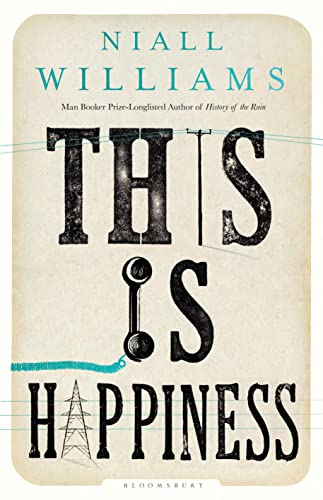
This is Happiness, Niall Williams and the Book Group

Niall Williams, This Is Happiness (Bloomsbury 2019)

Before the meeting: When we discussed Niall Williams’s History of the Rain in October, a number of people had also read his next book, This Is Happiness. December’s chooser, impressed by their enthusiasm, decided we should all read it.

The book’s first sentence, ‘It had stopped raining’, which sits on a page by itself, is pretty much identical with the final sentence of the earlier book, and the tiny, backward village of Faha in West Ireland is again the setting, but the bulk of the narrative takes place in an earlier period, and there is no obvious reference to the characters or events of History of the Rain. It’s the story of the coming of electricity to the village; a coming of age story of young Noe, who has taken leave of the seminary and is telling the story as an old man in the USA; and a big romantic story of love lost and found by Christy, an older man who befriend Noe.

Page 75* must be one of the book’s few pages that doesn’t mention the absence of rain. It happens in the thick of one of the book’s comic set pieces. It’s not the set piece when the lights go down and the cinema comes alive with amorous grapplings, or the one where Noe goes to the communion rail at Sunday Mass in order to get a good look at the woman Christy left at the altar, or the spectacular one where he is knocked unconscious by a falling electricity pole. On page 75 Noe and Christy are on the first of a number of epic pub crawls.

These pub crawls are as much about music as about alcohol, music performed by men who are shy and nondescript until they start playing, and then are brilliant conduits of a great folk tradition. On this first adventure, when the evening is well under way, Christy startles Noe and everyone else in Craven’s pub by starting to sing:

Not only was Christy singing, he was singing with screwed-up eyes and fists by his side a ballad about love. He was singing it full-throated and full-hearted and before he had reached the second verse it was clear even to Roo the dog that a passionate truth was present in that place. It wasn’t only that this didn’t happen in Craven’s, it was that there was something raw in it, something deeply felt, that was, even to those who had descended blinking into the umbrae and penumbrae of numberless bottles of stout, immediately apparent and made those who first looked now look away.

(page 73)

Christy has come to Faha as a worker in the great electricity project. This episode is our first inkling of his profoundly romantic reason for signing up for the work. Not so obviously, it prepares us for the major role music is to play in Noe’s story. Page 75 itself is a beautiful piece of misdirection. After Christy has sung, Noe writes:

I did the only thing I could do. I went to the counter and got two bottles of stout.

Those bottles are followed by another two, and then another. Greavy the guard arrives and declares that it’s Closing Time (as Noe says, this is one more way in which Faha lags behind the times), but the two of them are incapable of moving. Alcohol-based humour usually leaves me cold, but Niall Williams’s version made me laugh out loud. I suppose the whole book could be read as an extended Irish joke: the villagers have an almost superstitious awe of the one telephone in town, and the coming of electricity has almost cosmic significance for them. If you read the whole book like that, the stereotypical Irish drunkenness in this passage is representative (including the sly invocation of Waiting for Godot):

Getting up proved aspirational. There was the idea of it, quite clear. Unmistakably clear now. There were hands placed on knees for push-off. There was a Right now. There was another when that failed to produce action. A Right so following. And still nothing. Between thought and verb a vacancy, not intended, but not grievous, just gently perplexed, and in that perplex the realisation that Craven’s was not in fact such a bad place at all, was downright comfortable in fact, in fact there were few places on this earth as agreeable. True? Too true. A person could stay here, could stay right here and be quite happy now, quite, for a very long time. What’s your rush? There’s no rush. All the problems of the world could be settled right here.
Right.
Will we go so?

I don’t want to minimise the book’s humour. Far from it. But there’s a seriousness to it that page 75 gives no clue of. Christy’s romance is genuinely touching. The villagers’ resistance to the coming of electricity is more than comic: and these villagers are described as custodians of their land, defending an ancient culture under siege by capitalism – without being at all heavy handed, the narrative reminds us that the Irish were the first people to be colonised by the English. The dramatic decline in the Catholic Church’s power since the 1950s is deftly evoked both in Noe’s commentary and in his own story: his turning away from his priestly vocation is a tiny reflection of the ending of Church-domination in Ireland at large.

After the meeting: There were seven of us. Covid–19 and other coronaviruses kept some away, while one or two had better things to do – and one sent video of spectacular drone art over Sydney Harbour.

This was our end-of-year meeting so we had other business besides the book, but it generated quite a bit of discussion. The discussion was unusual in that quite a few of us read out favourite passages. Indeed, two of the absentees sent lists of quotes – it’s that kind of book. One interesting insight was that the narrative as we receive it is created by an old man looking back on a key moment in his youth, making a story out of it, and casting a benevolent glow over the community in which that moment happened.

Other business, besides of course the plentiful food including a splendid pavlova, included a Kris–Kringle book exchange with the usual mixture of cautious delight and polite almost-hidden dismay, and a poetry reading. We were each supposed to bring a poem, and most did, even one of the absentees.

Poems were a nonsense poem by CJ Dennis (‘Triantiwontigongolope’), a poem about climate change (that was me – Kit Kelen’s ‘Parable’), a Thomas Hardy (‘Heredity’), a Robert Frost (‘A Time to Talk’), a poem from Claudia Rankine’s Just Us (‘sound and fury’), and two poems of Australian patriotism that couldn’t have been more different (Sara Mansour’s ‘My Australia‘ – link to her performing it on YouTube – and a poem whose name and creator I don’t remember celebrating the lump in the throat brought on by, for example, Anzac Day). This little reading, including by two people who said they felt awkward reading poetry aloud, left us reeling.

And that was a wrap for the Book Group for 2022.

* Currently when blogging about books I take a closer look, arbitrarily, at page 75 – moving on to page 76 at my next birthday if the idea works well enough.

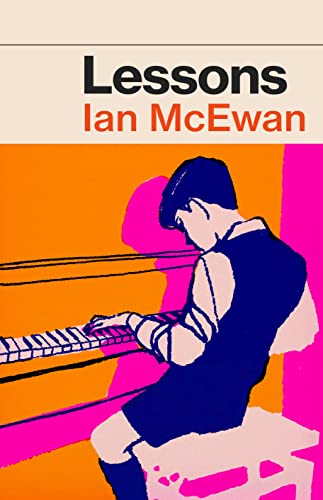
Ian McEwan’s Lessons: page 75

Ian McEwan, Lessons (Jonathan Cape 2022)

This is a tentative experiment in a different way (for me) of blogging about books: take page 75 and write whatever comes to mind about it. After my next birthday, if I keep this up, I’ll take page 76.

Page 75 of Lessons would probably have a red line drawn through it by someone writing a film script. It’s mainly a minor character’s backstory.

By this stage of the novel, the main character, Roland Baines, has been abandoned by his wife, Alissa, with no warning and no real word of explanation, leaving him to care for their infant son. He has received a couple of postcards from European addresses, the most recent saying she is about to visit her parents in Germany. Page 75 begins with his wondering why she is visiting her parents and imagining that if she tells them what she has done, ‘the row would be like no other’. McEwan delivers on this tease later when Roland hears the mother’s account of that row, which is quite different from what he imagines. Later still, that account is confirmed by Alissa herself.

The rest of the page begins the back story of Alissa’s mother, Jane: born in 1920, educated in a grammar school, and by the end of the page nursing literary ambitions working as a part-time typist at Cyril Connolly’s prestigious literary magazine Horizon (a real magazine):

She later told her son-in-law that she was seated in an invisible corner and given the dullest correspondence. She wasn’t beautiful or well connected and socially adroit like many of the young women who passed through the office. Reasonably enough, Connolly barely noticed her but occasionally she was in the presence of literary gods. She saw, or thought she saw, George Orwell, Aldous Huxley and a woman who may well have been Virginia Woolf. But, as Roland knew, Woolf had been dead for two years and Huxley was living in California.

There are many passages like this in the book: passages that fill us in on someone’s background, or summarise a novel or (in one case) a children’s picture book. As here, the writing keeps the main narrative in sight: we’re getting Jane’s story, but it’s as told to Roland, and commented on by him. There are plenty of dramatic scenes in the novel – Roland visits Berlin as the wall is coming down; he has a weird physical struggle with a conservative politician in the wilds of Scotland; in his 70s, he confronts a woman who sexually abused him as a 14 year old – but even in undramatic passages like this, there’s plenty of complexity to hold a reader’s interest. There’s also a version of one of the novel’s recurring motifs: a life lived in the shadow of fame.

The novel tells the story of Roland’s life, from early childhood in Libya, his time at boarding school where he has a deeply troubling sexual experience with his piano teacher, through years of drifting, his shortlived marriage to Alissa, single parenthood, some years of happiness in a new relationship, to old age. His early promise as a pianist is blighted by the early quasi-consensual sexual abuse: that and his abandonment by Alissa are the two intimate experiences that shape his life. The Suez crisis, the Cuban crisis, the building and fall of the Berlin wall, Brexit and Covid 19: each of these also has a direct impact. The novel is immensely satisfying as the story of an ordinary life that covers, as it happens, almost exactly the same period as my own. I feel as if I know Roland.

Rereading page 75 makes me realise that his story also functions as a conduit for other stories, mostly stories of women: his mother, the piano teacher, Alissa, Alissa’s mother Jane, Daphne who is a good friend and confidante in the early chapters and later become much more, and finally, briefly, his granddaughter Stefanie. Each of these stories can be seen as holding lessons for Roland, and for us, or at least they can be seen as posing questions: about adults’ responsibility to young people in their care, about complex issues of consent, about how to face death, about the competing demands of art and personal relationships, about ways to assess success and failure. Not that it’s didactic. When Roland reads Tomi Ungerer’s Flix to his granddaughter, he tries to make it a teaching moment by asking her if the story ‘is trying to tell us something about people’:

She looked at him blankly. ‘Don’t be silly, Opa. It’s about cats and dogs.’
He saw her point. A shame to ruin a good tale by turning it into a lesson. That could be for later.

(Page 481-482)

Lessons is a good tale, or a whole entwined mass of good tales. One of them is the tale of a man who is offered many lessons and learns some of them. If there is one overarching lesson, it’s that the more you know about someone’s life, the less easy it is to make a sharp moral judgement.