Category Archives: Page 77

Anne Enright, The Wren, the Wren, the book club, page 77

Anne Enright, The Wren, the Wren (Jonathan Cape 2023)
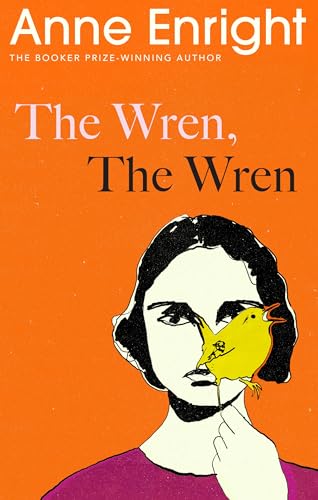
Before the meeting: Carmel and Nell are mother and daughter. They have a complex relationship with each other, and terrible relationships with men: Carmel’s father Phil, a middlingly successful, womanising poet; Nell’s coercive, rapey on-and-off boyfriend Felim; an endlessly boring man who comes into Carmel’s life for a time; and so on. It seems that Phil’s long shadow is responsible for their misery. Tess writes online copy for an influencer.

The first couple of pages of The Wren, the Wren had me enthralled as the narrator describes a psychological experiment conducted by Russell T Hurlburt, a real person (here’s a link). The experiment deals with the fact that we can never know what is happening in another person’s mind. Sadly, I hadn’t read much further when I realised I had no idea what was in Anne Enright’s mind when she wrote the book. I couldn’t tell what mattered to her about the story, and it gave me no reason to keep reading.

I did read on, motivated pretty much entirely by the need to avoid being scolded at Book Club like the people who hadn’t read Killing for Country at our last meeting.

Nell and Carmel have alternating chapters, except for one chapter narrated by Phil. As far as I could tell, Phil’s chapter is there for the purpose of including some hideous animal cruelty that neither of the women could have witnessed. The book is punctuated by his (in my opinion) tedious poems.

Anne Enright’s style is smooth and there are moments that give joy: Nell’s state of mind after the first time she has sex with Felim (the only time she enjoys it); some nice reflections on the naming of birds in Australia; conversations between Nell and Carmel that capture a fine balance between love and irritated mutual incomprehension. But as a whole, this is one of the least engaging books I’ve read. It may be that this is my internalised patriarchal attitudes taking over my reading mind. If so, please put me right in the comments.

Meanwhile:
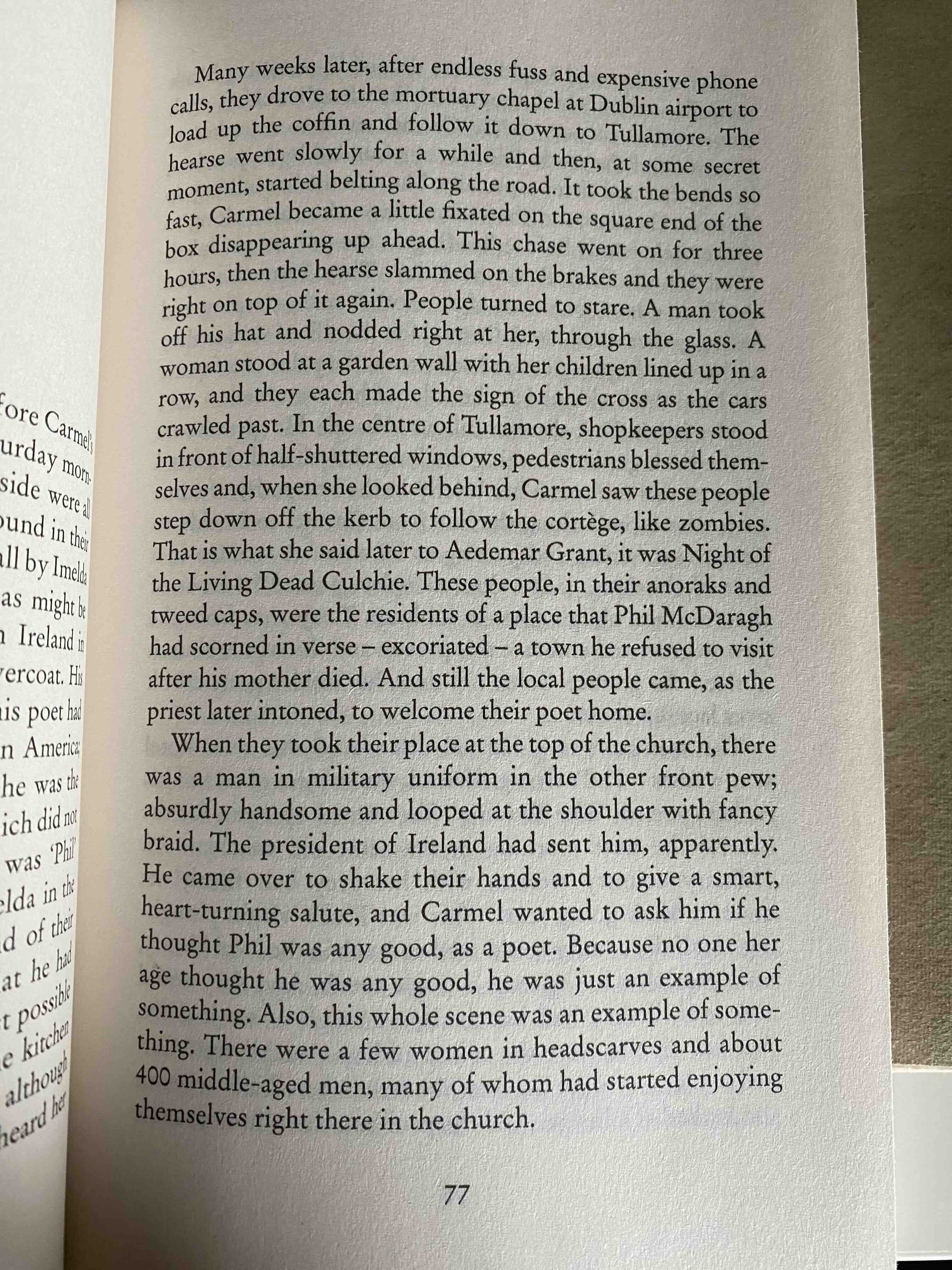
Page 77 is part of the description of Phil’s funeral. Though he was accustomed to slagging off his native town in USA talk shows, he had expressed a sentimental desire to be buried there. I suppose this page is darkly funny if you’re not as jaded with the book as I was. To me it just reads as cliché.

First there’s a bit of gratuitous dangerous-driving humour as Carmel is in a car following the hearse from Dublin airport where the body has been received:

The hearse went slowly for a while and then, at some secret moment, started belting along the road. It took the bends so fast, Carmel became a little fixated on the square end of the box disappearing up ahead. This chase went on for three hours, then the hearse slammed on the brakes and they were right on top of it again.

Then a bit of yokel humour. Or it may be a moment of pathos that segues into yokel humour. It’s a choose-your-own-tone paragraph:

People turned to stare. A man took off his hat and nodded right at her, through the glass. A woman stood at a garden wall with her children lined up in a row, and they each made the sign of the cross as the cars crawled past. In the centre of Tullamore, shopkeepers stood in front of half-shuttered windows, pedestrians blessed themselves and, when she looked behind, Carmel saw these people step down off the kerb to follow the cortège, like zombies.
That is what she said later to Aedemar Grant, it was Night of the Living Dead Culchie.

Then some joyless satire about the hypocrisy of public mourning ceremonies:

When they took their place at the top of the church, there was a man in military uniform in the other front pew; absurdly handsome and looped at the shoulder with fancy braid. The president of Ireland had sent him, apparently.
He came over to shake their hands and to give a smart, heart-turning salute, and Carmel wanted to ask him if he thought Phil was any good, as a poet. Because no one her age thought he was any good, he was just an example of something. Also, this whole scene was an example of something. There were a few women in headscarves and about 400 middle-aged men, many of whom had started enjoying themselves right there in the church.

That final sentence is probably a ‘comic’ invocation of the idea that the rural Irish are a mob of drunks.

I haven’t read anything else by Anne Enright*. On the strength of this book I’m unlikely to.

The meeting: In this Book Club, we discuss two books, possibly because if we just choose one it could turn out to be a dud. The Wren, the Wren was paired with My Friends by Hisham Matar. Both books start out with the notion that it’s impossible to know what’s going on in another person’s head. Both have a lot to do with fathers, and – as someone pointed out at the club meeting – both have protagonists who are lost.

No one told me I was completely wrong about The Wren, The Wren. There was general agreement that Carmel was more interesting than Nell, and no one cared for the book as a whole. We were all bemused by the praise heap[ed on it elsewhere, including its being included on the long list for the Booker. Two people had heard Anne Enright talk at the Adelaide Festival Writers’ Week. Evidently she was delightful, speaking a lot about the importance of poets and family in Irish society and not that much about the book. A friend of one of us had said it was a wonderful book: we surmised that this was because of its portrayal of coercive control – which I at least thought was as ordinary as Phil’s poetry.

My Friends is a much more interesting book and generated much more interesting conversation. I’ll write about it separately.


* Or so I thought. A couple of hours after pressing ‘Publish’, I discovered that I read The Green Road only a year ago, and to judge by my blog post (here) I loved it.

Sebastian Barrry’s Old God’s Time at the book group, page 77

Sebastian Barry, Old God’s Time (Faber and Faber 2023)

Before the meeting: Tom Kettle is a nine-months retired Irish policeman, living quietly suicidal in an annexe of a castle in Dalkey, on the coast outside Dublin. Two young coppers from his old unit come knocking on his door with a request that he read the file of an old case he is particularly suited to help with. The conversation is oblique, but we understand that the case has to do with child sexual abuse by Catholic priests.

It’s the set-up for a Cincinnatus story: the hero is summoned out of retirement to do battle with the forces of evil. The reader settles down for a yarn whose shape is familiar, and whose subject is also, horribly, familiar: the terrible history of sexual abuse of children by Irish clergy.

From the beginning, however, Sebastian Barry is in no great hurry to get that story under way. Tom gives the young coppers shelter from a storm overnight, but barely looks at their file. He is still grieving the death of his wife some years earlier, and is missing his two adult children. The visit from the young men and then a couple of days later from their boss, his own former boss, stirs up memories of his terrible childhood in an institution, and the sexual abuse inflicted on his wife by a priest when she was a child in another institution. This is no longer a straightforward police procedural featuring a heroic retired copper. It becomes something much more elusive than that: part ghost story, part psychological thriller, part fictional misery memoir, part dramatisation of the long tail of child abuse, part revenge tragedy. And part, perhaps, a portrait of a mind in the early stages of dementia.

Bit by bit a tale of horror emerges. At times it seems that only Sebastian Barry’s brilliantly musical prose and the presence of the land, sea and town are all that stand between us and the abyss. At the same time, it is a deeply humane book that features a gallery of odd characters (odd in the sense of interesting and surprising), and wonderfully memorable dialogue.

There are so many twists that I’m reluctant to say more about the plot. I was gripped, and I trusted the truthfulness of the story, though (no spoilers) I was not completely convinced by the main event of the final act: too much hinges on ‘an expression of pure depravity‘, italics in the original.

The emotional spine of the novel is Tom’s love for his wife, June. They gave each other the possibility of decent lives after the desolation of their childhoods. On page 77, he is remembering their early days together.

Here’s the paragraph that fills the page –’those things’ in the first sentence is the June’s childhood spent in an orphanage (no details), and the only other things that may need explaining are that June is working as a waitress in a Wimpy bar, and that she has been fostered by a prim and moralistic woman, Mrs Carr:

For so long she was quiet and never spoke about those things. They’d been going out for a whole month, him fairly killing himself to get out on the bus or the train to her, from his lousy digs in Glasnevin, or his work in Harcourt Street. He tried to see her every day. If only the old train station there had still been open, oh bejesus, but he had to gallop all the way across Dublin, through the Green, down Grafton Street, skirt the college, stampede up Abbey Street and onto Talbot, and go like the clappers to Connolly station for the 5.30 to Bray. He was younger then and fit but it was summer all the same and he was obliged to change into a spare shirt in the tiny jacks as noisy as a drumkit, and wash the sweat off his chest and arms into the bargain. After a month of this he might have qualified for the Irish team at the Olympics. A whole month, a fortune in train fares. Couples might be expected to talk through their life stories the first night – not June. She liked to tell him all that had happened that day at the café, maybe in just a little too much detail, but he could bear it. He liked her in the aftermath of her work, weary but not bone-weary, her feet aching. She’d have thrown on her jeans and grabbed a jacket. Her lovely denim jacket, the very height of hippy fashion. The jeans she had worn into the bath as instructed by the label, and let shrink on her legs, skin-tight. She would never meet him in her digs, of course, because it was some kind of religious gaff for the protection of Catholic girls – Mrs goddamn Carr lived in Stillorgan, far away from the Wimpy. Not that he even knew about Mrs Carr then. He knew nothing. She loved to natter on but she never talked. He supposed that was it, that was how she was. In a way he was relieved she didn’t go serious on him, because he was the guardian of his own silences, had been all his life.

It’s so alive, carrying the reader along with sheer vitality – the vivid evocation of first love remembered in old age, and details like the tiny jacks (that’s a toilet to non-Irish speakers, not the only one in the book), the word-map of Dublin. Then, after a little joke about the Olympics and a wry complaint about the expense, the paragraph turns to June: her work, her fashionable clothes, her chattiness, her home, and, crucially, her silence about her past. Then the key sentence, so deftly placed that you might almost miss it, ‘She loved to natter on but she never talked,’ and his version of himself as ‘the guardian of his own silences.’

Is it a particularly Irish thing, this ability to ‘natter on’ without talking? It certainly feels familiar to me from my own Irish-heritage background. Almost all the conversations in this novel are elliptical, from the first visit of the young gardaí to the climactic revelations about June’s death – we can mostly guess at what isn’t being said, but we have to work at it.

After the meeting:
There were seven of us, excellent food, a friendly dog under the table who one suspected was more interested in the food than in us, glass walls open to a garden on a gorgeous early-autumn Sydney night. Once we had sat down to eat, and a number of book-group-relevant announcements had been made – the long aftermath of an injury sustained at a much earlier meeting, the imminent sale of the ouse where we were meeting, my own modest act of self-publication – the evening took an unaccustomed turn. One man decided to take on a smilingly stern facilitator role and proposed that we each take an initial turn of two minutes to give a quick first response to the book, and then stomped cheerfully on anyone who attempted to speak out of turn. This is probably standard practice in other book groups, and if so I can see why. That first round was rich. Here are some highlights (as they survive in my poor memory):

  • L– loved the Irishness of it: the way the dead were still present, the oddities of the community, the evocation of the country
  • G– was keen on the book but felt that the final movement piled things on too much
  • I– said it was a beautifully written Irish novel, but he wasn’t sure the world needed any more beautifully written irish novels. He thought it wasn’t as good as the other Sebastian Barry book we’ve read, A Long Long Way (link to my blog post)
  • D– found the prose irritating, and didn’t enjoy the experience of being inside the meandering mind of an old man – he got quite enough of that already, thanks very much (someone pointed out, later when allowed by the facilitator, that Tom is 66, a good bit younger than D– and most of the rest of us)
  • J– (that is, me) said something passable, and mentioned the, um, glibness of that ‘expression of depravity‘
  • S– said he loved and hated the book. When he started he thought, ‘Not another novel abut child sex abuse, and not another novel about the Catholic Church,’ but he read on and was often delighted and moved. He understood something very early that others of us took half the book to realise (I’m carefully avoiding spoilers).
  • N– thought that the oddities of Tom’s memory weren’t so much about cognitive decline as the way traumatic experiences can be remembered as if they happened to someone else. He reminded us of the pivotal moment when Tom, having been unsure whether some of the stories in his head were June’s experiences or his own, realises with a shock that something he had remembered as something he witnessed had actually happened to him.

Others shared my reaction to the word ‘depravity’ and the way it suggests a lack of imaginative commitment to the big events near the end. But, as often happens, we disagreed about the very ending, which I don’t think is ambiguous at all. What I hadn’t realised until the meeting is how that ending – however you interpret it – echoes key elements of the opening pages. It would be far too spoilerish to say more.

The consensus was that this was an excellent book, but something a little more cheerful might be called for next time.