Category Archives: Page 77

Percival Everett, James and the book group

Percival Everett, James (Pan Macmillan Australia 2024)

Before the meeting: Mark Twain’s Adventures of Huckleberry Finn is one of those books that, even if you haven’t actually read it, you probably feel as if you have. Though it’s set in the south of the USA during the time of slavery, it was published in 1884, two decades after slavery was abolished. It’s an adventure story. A prefatory note warns the reader not to look for a motive, a moral or a plot. But the warning is obviously ironic. Huck, a white boy, teams up with Jim, a man escaping from slavery, on a raft trip down the Mississippi and, though the book is much praised for other elements such as its portrayal of the great Mississippi River and its breakthrough use of US vernacular English, it’s Huck’s moral growth, his coming to recognise Jim’s humanness and the evils of slavery that account for the book’s status as a Great American Novel.

But …

As African-American voices – voices of people whose lives are still deeply affected by the legacy of slavery – have made themselves heard, the book has met with controversy. I first met the negative case in Julius Lester’s Falling Pieces of the Broken Sky, in which one essay begins, ‘I am grateful that among the indignities inflicted on me in childhood I escaped Adventures of Huckleberry Finn.’ Inspired by Lisa Hill in the comments section on my post about that book (yes, there are places where it’s safe to read the comments!), I searched for the article to refresh my memory and found a version at this link. Lester is scathing, describing the book’s world as the ‘all-too-familiar one of white fantasy in which blacks have all the humanity of Cabbage Patch dolls’. There’s a lot more if you’re interested.

Percival Everett’s James tackles Huck Finn in a different way, less scathing but even more radical in its project of restoring humanity to the character Jim. It’s a novel in its own right, which I imagine you could read without reference to Twain’s. But you’d miss a lot of the pleasure and insight it has to offer.

James tells the story from Jim’s point of view, including a number of episodes where Jim and Huck are separated. It keeps much of the adventure and the humour of the original, but it opens out to the visceral horrors of slavery. In particular Twain’s final section in which Huck and Tom Sawyer hatch a plot to free Jim is replaced by darker, and also more joyful and just as improbable actions in which Jim takes things into his own hands.

But just as important as the changes in the story are the changes in tone. Beginning with the book’s title, dignity is restored to Jim. He is still called by the diminutive in most of the narrative, but we know that’s not all of him. In a key device, whenever enslaved characters talk to each other out of earshot of whites, they speak a form of standard English, returning to ‘slave talk’ – Sho nuff, Massah, etc – if they think they’ll be overheard. It’s not realistic: there’s no way enslaved people in the American South in the mid 19th century spoke standard 21st century English, but it’s an inspired bit of comedy that works to undo the othering of the enslaved.

As it happens, page 77* is a nice example of how James writes back to Huckleberry Finn.

In Mark Twain’s narrative, Huck and Jim have been separated by a near disaster. When Huck regains the relative safety of the raft he finds Jim in an exhausted sleep, and decides to play a trick on him. He tells Jim nothing untoward has happened, that it has all been a dream. Jim believes him, and sets about interpreting the dream – only to have Huck point to some damage on the raft that proves the incident really happened. Huck, who is the narrator, asks teasingly what these things stand for:

He looked at me steady without ever smiling, and says:
‘What do dey stan’ for? I’se gwyne to tell you. When I got all wore out wid work, en wid de callin’ for you, en went to sleep, my heart wuz mos’ broke bekase you wuz los’, en I didn’ k’yer no’ mo’ what become er me en de raf’. En when I wake up en fine you back agin, all safe en soun’, de tears come, en I could a got down on my knees en kiss yo’ foot, I’s so thankful. En all you wuz thinkin’ ’bout wuz how you could make a fool uv ole Jim wid a lie. Dat truck dah is trash; en trash is what people is dat puts dirt on de head er dey fren’s en makes ’em ashamed.’
Then he got up slow and walked to the wigwam, and went in there without saying anything but that. But that was enough. It made me feel so mean I could almost kissed his foot to get him to take it back.
It was fifteen minutes before I could work myself up to go and humble myself to a nigger; but I done it, and I warn’t ever sorry for it afterwards, neither.

It’s a milestone in Huck’s journey to realising that Jim is fully human, and is often quoted as one of the most moving passages in the book.

Here’s the equivalent in James, beginning with Jim playing along with Huck’s childish trick:

‘Lawdy, Lawd, Lawd,’ I said. ‘Sho was a scary dream.’
Huck started laughing. He pointed at me and laughed harder.
‘You mean you was pullin’ on my leg?’ I said. He was enjoying himself and that was all right with me. It always made life easier when white folks could laugh at a poor slave now and again.
‘I had you goin’,’ Huck said.
I acted like he’d hurt my feelings. White people love feeling guilty.
‘I’m sorry, Jim. I just thought it was funny,’ he said.
‘Yeah, it be funny, Huck, sho nuff funny.’ I pushed out my lower lip a bit, an expression I displayed only for white people.
‘I din’t mean to hurt you none.’
It could have been my turn to experience a bit of guilt, having toyed with the boy’s feelings, and he being too young to actually understand the problem with his behaviour, but I chose not to. When you are a slave, you claim choice where you can.

So much is happening here. Jim is no longer a gullible fool. He’s an adult, adept at playing the role assigned to him by slavery while holding firm to his own reality. Huck’s great moral turning point is just another example of the psychology of members of the oppressor group who want to see themselves as virtuous: ‘White people love feeling guilty.’ But as an adult he is acutely aware that Huck is a child. When he chooses not to ‘experience a bit of guilt’ he’s departing from his usual protective attitude. Despite what he says, he clearly does feel guilty – and needs to justify his behaviour. Like a true adult, though, he doesn’t argue that he was just giving as good as he’d got, tit for tat, ‘He started it’. He acknowledges that he was acting within their other opprsssor–oppressed relationship. ‘When you are a slave, you claim choice where you can.’ It’s a complex moment, that foreshadows the way we come to see Jim and Huck not so much as slave and slaver as adult and child.

Jim, soon to call himself James, gets to dispense some rough justice in the course of the book, but his relationship with Huck develops in benign and interesting ways, with a twist that is signalled early, guessable, and very satisfying.

After the meeting: We had a fabulous meal, over which discussion ranged from the recent State of Origin match to the question of whether as a man of a certain age one should step off the footpath when an oncoming group of young people acts as if you’re invisible.

I was probably the most familiar with Huckleberry Finn, and no one else was all that interested in the relationship between the two books. My impression is that reading with that relationship in mind meant that I enjoyed it more – I didn’t just forgive what others saw as the faults of the book but saw them as features. For example, a number of chaps commented that there was a series of incidents and events rather than a character-driven plot. That’s definitely an issue for James as a stand-alone novel, but I just accepted it as integral to the basic project of writing back to Huck Finn. Similarly, the number of coincidences that allow Jim and Huck to get back together after their separations is irksome, or possibly laughable, unless you take them in your stride as echoing nineteenth century conventions. Most interestingly, the ‘twist’ (sorry, I won’t be spoileristically specific) feels implausible. Sure, but it’s profoundly satisfying as a symbolic statement.

But it wasn’t a disagreement. We reminded each other of ‘good bits’: the time Jim spends with a minstrel group, as a Black man pretending to be a white man pretending to be a Black man; a horrific scene when a man who is being savagely flogged mouths the word ‘Run!’ to someone he sees to be at risk Mostly, we enjoyed the book as a good yarn – down the river then a u-turn back up, as someone said.


I wrote this blog post on the unceded land of the Gadigal and Wangal clans of the Eora Nation, not far from where what we now call the Cooks River has been cared for by Elders for millennia. As I finished it, the shortest day of the year was nearly here, and the ground was sodden from abundant rain.


* My blogging practice is to focus arbitrarily on the page of a book that coincides with my age, currently 77.
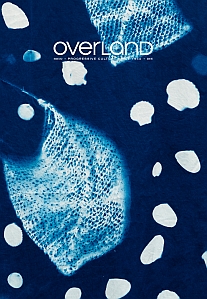
Journal Catch-up 23

Two more journals in my endless attempt to keep up to date!


Evelyn Araluen and Jonathan Dunk (editors), Overland 252 (Spring 2023)
(Some of the content is online at the Overland website – I’ve included links)

This Overland‘s editorial describes itself as a ‘second run’. The first run had reflected on the Voice referendum, but as publication came closer – in October last year – ‘the temptation to linger on the politics of symbolic recognition and constitutional reform seems a luxury in the face of escalating violence against Palestinians in Gaza and the West Bank’. With feet and throats sore from a solidarity march, the editors draw attention to an essay by Palestinian-Australian writer and historian Micaela Sahhar, ‘which reminds [them] of Overland‘s historic role in indexing Palestine’s survival and resistance’.

Quite apart from its serendipitous relevance, the essay, ‘An idiosyncratic archive: Overland 169 & the Wolstonecroft years‘, is a joy to read, as Sahhar revisits two copies of Overland she acquired in 2002 and 2004. She compares her reading of them then and now, talks of her relationships to people who appeared in them, and generally takes us on a journey into her mind. I love this passage – and so, I assume, do the editors:

As a journal at odds with the mainstream, Overland offered a younger version of me an intellectual place where radical thinking could reside, and a dawning awareness of a community I could take a place in. In this sense, Overland was the tangible expression of a counter to the indifference and invisibility of a young Palestinian woman, the significance of whose identity was rewritten just as she came of age at the time of a catastrophic intellectual nadir represented in 9/11; and a place of refusal against socio-political disengagement and apathy which have been the horsemen of these neo-liberal times.

The other stand-out essay is ‘The Disappearance of a.k.a. Victor Mature‘ by Vivian Blaxell, which ranges far and wide, high and low, into memoir and poetry appreciation, circling the subject of beauty. It’s a great read, from which I can’t resist quoting what may be the silliest paragraph, but one that made me laugh:

Australian English is wanton with beautiful. Beauty pops up in not the usual beautiful places there, thereby revealing the radical contingency of beauty itself, probably unintentionally: beautiful, Australians might say of a pork sausage, which seems a surprise at first until you realise that beauty does not exist before we say it exists, for beauty relies entirely on disclosure for its existence. That lucky sausage.

Other essays are a discussion by Peter D Mathews of Sophie Cunningham’s 2004 novel Geography and an idiosyncratic but fascinating essay by πO on concrete poetry in Australia and related matters.

There are five pieces of fiction and nine poems.

Of the poetry, ‘Balloch’ by Eileen Chong stands out for me. An apparently simple poem about a visit to a Scottish loch, it leaves an uncanny aftertaste that only gets richer with further readings.

The fiction covers a wide range, from a celebration of Rotuman culture (I had to look it up) by Dorell Ben to a fantasy of a catastrophic world post climate emergency by Jodie How, with a little social realism by Chloe Hillary and other pieces in between.


Alexandra Christie (editor), Heat Series 3 Nº 12 (Giramondo 2023)

This may be my last issue of Heat before my subscription expires. Despite having a selection of poems from Nam Le’s 36 Ways of Writing a Vietnamese Poem, a book I’m looking forward to, the journal is a bit of a fizzer for me, though the dominating US presence I’ve complained of in earlier issues is absent, and only one member of Heat‘s editorial advisory board gets a guernsey.

  • You can read Paddy O’Reilly’s ‘Redundant‘ on the Heat website. It’s an experimental prose piece in which the experiment seems to consist of not finishing sentences. See what you think.
  • Jordi Infeld’s ‘Poet’s Pocket’ would and indeed does pass for a short essay on sewing and related matters – just a footnote identifying one of its otherwise unremarkable phrases as a quote from Gertrude Stein’s Tender Buttons suggests deeper undercurrents.
  • ‘The Phoenix Apartment’ by Bella Li feels to me like notes towards a larger project.

Items from beyond the Anglosphere are ‘We Shall Be Monsters’, a meditation on Mary Shelley’s Frankenstein by Argentinian writer Esther Cross, translated by Alice Whitmore, and six terrific short poems by Iranian Maryam Nazarian, translated by Malaysia-based Arash Kohshsafa. Here’s the first and shortest of the poems, which does wonderful things with an echo of William Carlos Williams’s poem about the plums:

One
I've set the breakfast, the kisses, and the keys on the table.
Please, forgive me
if I find freedom more pleasant than your love.

The most interesting piece is Stephanie Radok’s ‘Inventory 2020’, an impressionistic chronicle of a working artist’s life, made up of mostly very short entries. It reminded me of the late Antigone Kefala’s journals in the way it combined observations of the passing moment with considered reflections and descriptions of the artist’s process. As 2020 was a year when the even tenor of our lives was disrupted by Covid, a narrative emerges. Here’s the entry for 23 February, on page 77*:

23. What you thought was passing/casual was your life. And a particular red purple near a blue hillside that seemed to reflect you.

As for Nam Le’s poems, they seem to be part of a larger whole. I’ll wait for the book.


* My blogging practice for some time has been to focus arbitrarily on the page of a book or journal that coincides with my age.

William Gibson’s Peripheral

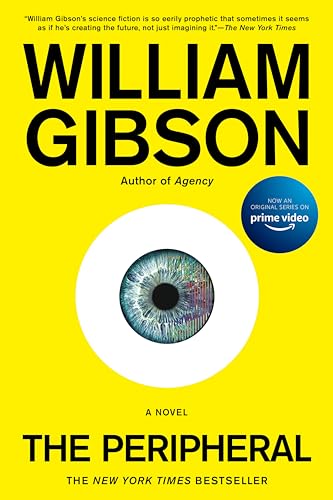
William Gibson, The Peripheral (Berkly 2014)

I picked up The Peripheral in a street library soon after I finished reading and blogging about its sequel, Agency, nearly four years ago. Since then, it has been my TBR shelf as a treat for a rainy day. Its time has now come.

There’s a peculiar challenge in writing about it. Possibly the main thing I enjoyed about it is that a lot of the time the reader has no idea what’s actually happening. You’re not even sure what some words mean, or what the characters are not saying. Explanations do come, eventually, but there’s a delicious disorientation as AI devices and other technical marvels multiply, we only half-see crucial incidents, cultural events are described from the point of view of someone who knows a lot more about the background than the reader does. The action takes place in two unspecified future time periods that interpenetrate in often unclear ways. However serious the issues may be – and there’s a plausible version of how the global emergency will develop – there’s a pervasive sense of play. If I summarise the plot, or even the set-up, I’ll be depriving you of that experience.

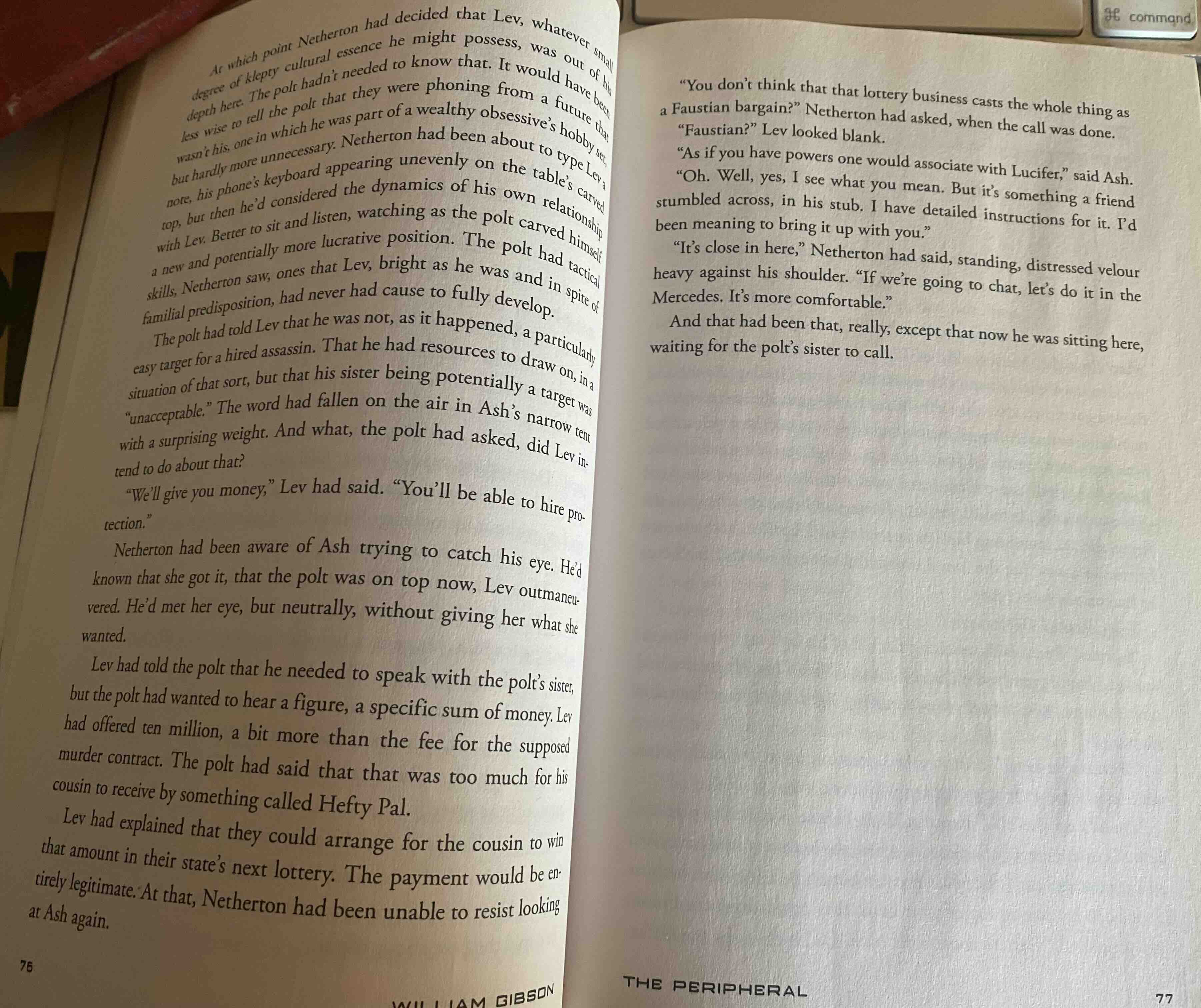
My first idea was to write about first two short chapters – all the chapters are short – but then I thought, oh what the heck, I’ll skip straight to page 77* to give you a taste, and let the spoilers fall where they will.

Lev had told the polt that he needed to speak with the polt’s sister, but the polt had wanted to hear a figure, a specific sum of money. Lev had offered ten million, a bit more than the fee for the supposed murder contract. The polt had said that that was too much for his cousin to receive by something called Hefty Pal.
Lev had explained that they could arrange for the cousin to win that amount in their state’s next lottery. The payment would be entirely legitimate.

Gibson has a gift for coining terms. ‘Cyberspace’ is his invention. Of The Peripheral‘s many coinages, three appear in this short passage: ‘polt’, ‘Hefty Pal’ and ‘stub’. They each have the virtue of suggesting their origins if not their precise meanings. A polt, derived from poltergeist, is a person who is bodily in one place and/or time, but is somehow seeing and acting in another time. (A peripheral is a human-looking artefact, that can be the host to a polt.) Hefty is a mega corporation of which Hefty Pal, as in PayPal, is a subsidiary. A ‘stub’, known more formally as a ‘continuum’, is a key invention of the book, something that readers and half the characters come to understand only gradually. All I’ll say here is that it is something that results from people going back to an earlier time and changing that time’s future.

There are three characters in this scene: Lev, the son of a fabulously wealthy Russian gangster capitalist, whose hobby involves mucking about with the past (stubs/continua are his playthings); Ash, a tech wiz who makes it happen for him (among other distinguishing features, she has tattoos of animals that move around on her skin, often glimpsed running for cover when someone tries to look at them); and Wilf Netterton, put-upon publicist, from whose point of view the story is told in alternate chapters. Page 77 is at the end of a Wilf chapter.

Three more characters are referred to. ‘The polt’ is Burton, a battered veteran in Netterton’s past / our future (though that way of describing things isn’t quite accurate). ‘The polt’s sister’ is Flynne, a gamer in a small US town who is the focus of the non-Wilf chapters. Burton and – on one fateful occasion – Flynne have been employed as polts by Lev under the impression they were testing a computer game. The main narrative is set in motion by Flynne’s witnessing what may be a murder. ‘The cousin’ is Leon, one of their tribe of loyal family members.

At that, Netherton had been unable to resist looking at Ash again.
‘You don’t think that that lottery business casts the whole thing as a Faustian bargain?’ Netherton had asked, when the call was done.
‘Faustian?’ Lev looked blank.
‘As if you have powers one would associate with Lucifer,’ said Ash.
‘Oh. Well, yes, I see what you mean. But it’s something a friend stumbled across, in his stub. I have detailed instructions for it. I’d been meaning to bring it up with you.’

Tiny moments like this give the book its rich texture. There’s the complicity between WIlf and Ash, two underlings who have cultural memories, unlike their rich and powerful employer. (Similarly in the earlier paragraph, it’s fun that Hefty Pal is something in the reader’s future and Flynne’s present that has been forgotten in Wilf’s time.) Like the implied reference to poltergeists, the mention of Faust reminds us that even though the narrative is presented as a tale of high tech, AI and nanotechnology, it often has the feel of demonic possession and fairytale magic. (If you’ve read Gibson’s Sprawl trilogy – Neuromancer (1984), Count Zero (1986) and Mona Lisa Overdrive (1988) – you’ll remember the prominence there of the legba of Voodoo.)

And that had been that, really, except that now he was sitting there, waiting for the polt’s sister to call

That’s the first hint of the almost-romance that is to almost-blossom between these characters who can only spend time together by means of weird time travel mediated by a peripheral in one direction and an odd little children’s toy in the other.

Now I’m tempted to reread Agency. I remember that it was also gleefully inventive and similarly had two interrelating times. I’m pretty sure that some of the distant future characters are in both books, but my memory is dim. William Gibson is anything but dim.


I wrote this blog post on the unceded land of the Gadigal and Wangal clans of the Eora Nation, not far from where what we now call the Cooks River has been cared for by Elders for many millennia. The weather has just turned cold, but spider webs are still proliferating.


* My blogging practice is to focus arbitrarily on the page of a book that coincides with my age, currently page 77. For The Peripheral, I’ve included a little from page 76 as well.

The Book Group & Richard Flanagan’s Question 7, page 77

Richard Flanagan, Question 7 (Knopf 2023)

Before the meeting: Richard Flanagan is a giant of Australian literature. His non-fiction work has been transformative. He has won the Booker Prize and many other awards.

Before this year, I had read one and a half of his novels and had no desire to read any more. My blog posts on The Unknown Terrorist and Wanting speak for themselves.

So, bidden by the Book Group, I came to Question 7 bristling with prejudice.

I was not encouraged by this passage on the second page:

Sometimes I wonder why we keep returning to beginnings – why we seek the single thread we might pull to unravel the tapestry we call our life in the hope that behind it we will find the truth of why.
But there is no truth. There is only why. And when we look closer we see that behind that why is just another tapestry.
And behind it another, and another, until we arrive at oblivion.

Oh really? Other opinions are available, but this struck me as the kind of thing Les Murray meant when he described another of Richard Flanagan’s books as ‘superficial, showy and pretentious’ (link here)?

But what the Book Group wants, the Book Group gets … I read on.

I found a lot to dislike. The whole Question 7 schtick struck me as ‘superficial, showy and pretentious’ (more about that later). There are a couple of pages that could have been written by a self-righteous teenager, denouncing Oxford holus bolus as misogynist, racist and imperialist; a sneer often hovers at the edge of Flanagan’s descriptions of other writers; there’s a muddled insistence that all time is now – a kind of mix-up of Kurt Vonnegut in The Sirens of Titan and co-opted Indigenous notions. Regularly, out of the blue, there will be a bit of ‘philosophising’ about the uselessness of words, or a portentous one-line paragraph: Chekhov’s non-sequitur, ‘Who loves longest?’ or the sub-Vonnegut refrain, ‘That’s life.’

It could have been an engrossing book. There are powerful portraits of his grandmother, his mother and his father, and a gruelling, operatic account of near-death as a young adult. Above all, there’s the way Flanagan sets out to explore his own origins in the context of world history.

His father was a prisoner of the Japanese in 1945 and would have died in the camp if not for the nuclear bombs dropped on Hiroshima and Nagasaki – Flanagan owes his existence to that massively destructive act.

The book comes at that painful paradox from a number of angles: his father’s reminiscences of the camp; his own visit to its site, including an encounter with a former guard; stories about H. G. Wells, who coined the phrase ‘atom bomb’; the life of Leo Szilard, the scientist who first conceived of a chain reaction and after 1945 became a tireless campaigner for nuclear disarmament. It’s a fascinating tapestry of interlacing lives, thoughts and actions.

Flanagan is a Tasmanian, so he also owes his existence to the genocidal dispossession of the First Nations of luwitja. (In one of the recurrences that the book delights in, H. G. Wells’s novel The War of the Worlds was inspired that history.) There are powerful passages about colonisation, which (to my mind) he undermines by describing the term settler colonial society as lazy thinking because it hides the inequalities on which what he calls ‘the new Martian world’ was built. His point is that many of the first non-Indigenous arrivals were convicts, suffering terribly under the British system – and among them he counts his forebears. IMHO, settler colonial society is a fine term: patriarchy doesn’t hide inequalities among men; capitalist society doesn’t hide inequalities in our current world. The fact that you suffer doesn’t change the fact that you play an oppressive role. Not that Flanagan denies that, but he want to make it clear that his people were primarily victims rather than perpetrators.

But I’m getting irritated again.

Page 77* does not show the book in its best light. It falls in the midst of an excursion into historical fiction involving H. G. Wells.

The much younger Rebecca West has come into Wells’s life, and they are mutually entranced. After a first passionate kiss, he withdraws – not so much because he already has a wife and a mistress as because, according to Flanagan, she is too much his equal.

All that is evidently true to the known facts. West and Wells’s relationship was to endure. She had a son with him and they remained friends until his death. But at page 77 that’s all in the future, and she is struggling with his rejection of her:

Rebecca West, though, was not for defeat. For her, love and victory were synonyms. And she was not one for losing. She coupled audacity and ambition with an idea of stability she would forever after mistake older men as offering. She held herself to a high standard. She had written only a few months earlier how unrequited love was pathetic and undignified, adding as proof her contention that Christianity lacked dignity – and by implication was pathetic – not because Christ was crucified, but because his love for the world was unrequited. ‘A passion that fails to inspire passion,’ she wrote, ‘is defeated in the main object of its being.’

Having dispensed with God, she wrote to Wells that she was going to kill herself after being rejected by him, that all she could do was love. She had tried to hack the overwhelming love she felt for him back to the little thing he seemed to want. But even that, she realised, was too much for him.

Does that feel to you like a real person? Is it respectful of the historical Rebecca West? Does it use its sources fairly or even accurately? On the latter point, I looked up the essay it quotes (in The Freewoman, July 2012). It’s a brilliantly witty takedown of a book of literary history, in which the reference to Christ is cheeky, but not dismissive and not meant to prove anything. Flanagan is being snide, and not pretending otherwise. His Rebecca West is basically a comic character.

But what is she doing in this book at all? Maybe she’s there to establish that Wells was a truly complex, flawed human being (‘flawed’, to be specific, means physically ugly and using high-sounding ideals of free love to justify his promiscuity). It also serves the purpose of having a strong female presence in the historical part of the novel, which is otherwise full of men. This particular passage may owe something to her reference to Jesus echoing a repeated line in Flanagan’s The Unknown Terrorist: ‘the innocent heart of Jesus could never have enough of human love.’

The West–Wells story also, confusingly I think, seems to relate to the book’s title. That title is a riff on an early Chekhov short story, ‘Questions Posed by a Mad Mathematician’, an absurd parody of a mathematics quiz. The seventh quiz item starts with trains leaving stations at various times and ends with the non-sequitur question, ‘Who loves longer, a man or a woman?’ Because it’s posed as a question about gender, the Wells–West story (the only romance in the book) seems to hark back to it, but I think now probably not, as the version of the question that pops like a refrain, is simply, ‘Who loves longer?’ (Incidentally, the only version of Chekhov’s story I could find online, at this link, translates the question as, ‘Who is capable of loving?’ I’d be interested to know if the gendered version of the question is more a product of the gendered nature of the Russian language than of Chekhov’s intention.)

In the rest of the page, we follow the West-resistant Wells to Switzerland:

Wells arrived at his mistress’s magnificent Swiss retreat with his two sons and half a suitcase of scientific reprints concerning the recent discoveries about radium – discoveries that, he told Little e, as he called the diminutive Elizabeth, pleasantly took his mind as far away as laudanum once had Samuel Taylor Coleridge’s and which would form the basis of the novel he would write – the story of man summoning a power equivalent to the sun.

Wells runs from West to write the novel that is his reason for being in this book. It’s The World Set Free, in which he will coin the term ‘atom bomb’ and imagine with amazing accuracy the devastation such a bomb was to create. (I’m depending on Flanagan’s description. The novel is available at Project Gutenberg for the truly dedicated.)

Presumably the real-life Wells is being cited here, but what sense does it make to say that his lifelong interest in science was like a drug? In the immediate context, the implication seems to be that his interest in radioactivity is a distraction from the emotional turmoil associated with with Rebecca West. Am I wrong to read this as a sneer?

So, I look forward to having the virtues of the book made clear to me by people who have not been blinded by their own grumpiness.

After the meeting: After a wonderfully eclectic dinner over which we had exchanged important information about dumplings and life in general, we had one of the most interesting and spirited Book Group discussions ever.

Evidently it’s a love-it-or-hate-it book, and we were fairly evenly divided.

One man had hated the Wells-West thread so much that he re-read the book leaving it out, only to discover that he still hated the book, and spent days trying to figure out why. As I understand it, he realised that he regularly came up against a closing off of possibilities – just as Flanagan proclaimed he was opening up to complexity he would shut things down with a piece of certainty.

Another, on the contrary, read the book as an anti-narrative. Those shutting-down moments were a way of frustrating our quest for simple answers in an impossibly complex world. It’s important that Question 7 is about love, because all through the book there’s a dreadful intertwining of love and brutality.

Where some felt Flanagan was arrogant and withheld, others read him as exposing his own vulnerability. One loved the Rebecca West story; another loathed it. One read out a passage he particularly loved eliciting sympathetic nods from some and groans from others. Some felt that the book spoke directly to their own experience as colonial settlers, others not so much. I had to admit that I had got fixated on the things that annoyed me, and disregarded things that otherwise would have fed my soul.

None of us had previously heard of Leo Szilard. One of us said he now has Family Matters, by Flanagan’s brother Martin, on his to-be-read list, as a supplement to Richard’s account of his parents.

It was amazing! I don’t think anyone left feeling bruised. For myself, I intend to reread the book. But not for a while.


* My blogging practice for some time has been to focus arbitrarily on the page of a book that coincides with my age. Surprisingly, this page often reveals interesting things about the book as a whole.

Alan Kohler’s Great Divide

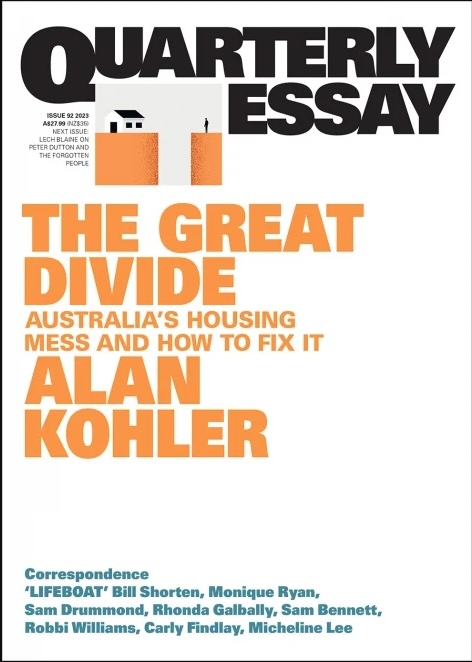
Alan Kohler, The Great Divide: Australia’s Housing Mess and How to Fix It (Quarterly Essay 92, 2023) – plus correspondence in Quarterly Essay 93

Alan Kohler appears regularly on the ABC News, the genial presenter of largely incomprehensible finance updates. He usually flashes up a chart or two, giving the impression he’s doing it for his own amusement as much as our enlightenment, and then signs off, ‘And that’s finance.’

This Quarterly Essay has some of that trademark geniality, and it has graphs, but it’s a long way from incomprehensible. As someone who is near-illiterate about economics, I found it wonderfully instructive about the background and causes of the current housing crisis, and while his proposed solutions seem unlikely to be implemented I could follow their logic.

The key issue is probably obvious, but it’s a joy to see it named so clearly:

The houses we live in the places we call home and bring up our families in, have been turned into speculative investment assets by fifty years of government policy failure. (Page 3)

The notion of a home as investment goes back further than 50 years, as the essay describes, but as with so many of the ills of contemporary Australia, it got a big boost under the prime ministership of John Howard. Then, around the turn of the century, three main things pushed up demand for housing and consequently the price:

A sharp life in immigration that increased the number of people needing a place to live; capital ganis tax breaks and negative gearing, which represent a $96 billion per year subsidy for buying houses;and federal first home buyer grants, which represent a $1.5 billion direct addition to house prices each year. (Page 7)

Add into the mix the conflicting concerns of the three different levels of government, particularly the stalemate that results when state governments push for medium density housing in areas where local governments insist on restrictive zoning regulations.

On the reluctance of politicians to do something about the cost of housing, Alan Kohler quotes John Howard’s bon mot (or mauvais mot if you like): ‘No one came up to me to complain about the increase in the value of their home.’ A sizeable portion of the electorate – home owners and many aspiring home owners – have a vested interest in having prices continue to increase.

Kohler expands lucidly on all these matters, and goes on to propose solutions: of course, to increase the supply of housing, for which he makes a number of suggesrtions; ‘a big investment in trains designed to at least double, preferably triple, the commutable distance from the capital cities and industrial inner suburbs where people work’; ‘reducing demand by restricting negative gearing and increasing capital gains tax’, which ‘should happen, but probably won’t; ‘increasing the supply of medium density in existing suburbs through better zoning and planning’ (which is ‘still more talk than action’); and more abstractly, for government to set an ‘affordability target’, to reduce the ratio of house prices to wages.

On page 77*, Kohler expands on that last proposal:

House prices need to stay put for a while and allow incomes to catch up. Average weekly earnings are currently rising at about 4 per cent a year. For the national median house price [at time of writing the essay] of $740,668 to be 3.5 times income, the average wage would have to be $210,000, more than double what it is now. At 4 per cent growth in incomes per year, that would take about eighteen years.
The only time house prices remained unchanged for that long was from 1930 to 1949 – that is, during the Great Depression and the period of price controls in the war. Even after the recessions of 1982 and 1991, it took less than half that long for prices to start rising again.
So fifteen to twenty years of static house prices would be unprecedented, but that sort of time frame might also get Australians out of the habit of thinking that house prices always rise and that housing is the best way to build wealth. And if housing affordability is to be properly dealt with, we have to change that mindset, because house prices won’t stop rising at twice the rate of incomes unless we stop expecting them to.


Alan Kohler’s 86-page essay generated more than 50 pages of correspondence in the next Quarterly Essay (Lech Blaine’s Bad Cop: Peter Dutton’s Strongman Politics). The correspondents range from qualified approval, such as Joseph Walker’s description of the essay as ‘sober, necessary and broadly correct in its conclusions’ to this scathing ‘stay-in-your-lane’ dismissal by Peter Tulip, chief economist at the Liberal-Party aligned Centre for Independent Studies:

Public discussion of housing policy suffers from undisciplined eclecticism. Too many commentators provide long, unstructured lists of multiple causes or conclude that the truth lies between competing explanations. This muddle reflects an inability or an unwillingness to distinguish the important from the unimportant. Alan Kohler’s Great Divide and the accompanying media coverage are examples.

There’s a lot of robust discussion, which (did I mention that I’m ignorant about economics) I can only watch in dismay. Everyone agrees that there is a problem – that, as Kohler says in the essay, ‘the high price of housing is undermining social cohesion and the proper functioning of the economy and the nation.’ And it’s heartening to see so many people who have invested so much thinking and action in the issue. I’ll give Alan Kohler the last word (it is the last paragraph of his gracious Response to Correspondence):

The process of researching this subject and then engaging with responses to my essay has confirmed that this is a subject about which a lot of people have been thinking deeply and expertly for a long time, and Australia is well served by them. It’s just a pity they are not listened to more. We are less well served by the politicians and bureaucrats whose job it is to do something about it.


* My fairly arbitrary blogging practice is to focus on the page of a book that coincides with my age. This page often reveals interesting things about the book as a whole.

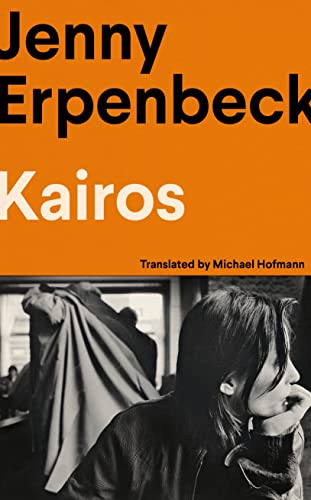
Jenny Erpenbeck’s Kairos and the Book Club

Jenny Erpenbeck, Kairos (translated by Michael Hofmann, Granta 2023)

Before the meeting: The Emerging Artist read this book before I did. She hated it, couldn’t finish it, and threatened to divorce me if I ended up liking it. Though I wouldn’t say I absolutely loved the first 166 pages, by page 167 (of 292) I was pretty sure our relationship was safe.

In a prologue, the book’s narrator, Katharine, learns that a former lover has died. She is unable to attend his funeral as she has promised, but soon after the funeral two boxes of material are delivered to her door by a weeping woman. Here’s how she describes the project that becomes this book:

Kairos, the god of fortunate moments, is supposed to have a lock of hair on his forehead, which is the only way of grasping hold of him. Because once the god has slipped past on his winged feet, the back of his head is sleek and hairless, nowhere to grab hold of. Was it a fortunate moment, then, when she, just nineteen, first met Hans? One day in early November, she sits down on the floor and prepares herself to sift – sheet by sheet, folder by folder – through the contents of the first box, then the second.

What follows, based on the contents of those boxes plus a suitcase of Katharina’s own memorabilia, is the story of her relationship with Hans, a married man who is ten years older than her father, 51 to her 19. Two things inclined my expectations against the Emerging Artist’s distaste. First, the set-up linked nicely to other recent reading – mainly Annie Ernaux’s The Young Man (link is to my blog post), a memoir of a relationship between the author and a much younger man. Second, it’s set in East Germany in the 1980s in the prelude and aftermath of the fall of the Berlin Wall, so I thought (correctly) that the book would capture something of the flavour of that time and place.

The book starts with a cute meet in a downpour in Berlin in 1985. There’s a period of mutual bliss, which blossoms all too quickly into a physically and psychologically abusive nightmare, to which Katharina is inexplicably committed, so that by page 167 without any explanation she has evidently consented to being tied up and beaten with a belt, and later with a riding crop. Until that point, the historical context was enough to keep me afloat as a reader. The hideous mind games move up a notch as Hans convinces Katharina that she is cold, selfish and deceitful and sends her a series of cassettes detailing how terribly she has made him suffer. Instead of pulling the plug, she listens to the tapes, takes careful notes (hence the narrator’s ability to recall them even though he destroys each hour-long diatribe by taping the next one over it), and writes a self- abasing reply, thereby provoking another cassette.

The hideous gaslighting continues for many pages. Several times the reader breathes a sigh of relief as it seems the relationship is finished, and then it’s on again with occasional moments of joy and endless rounds of blame and accusation on his part and wretched self-abasement on hers. Maybe its an allegory about East Germany, as Neel Mukherjee says on the back cover, but I can’t see it.

I’m glad I persisted, because a) the worm does finally turn, if ever so slowly and slightly, and more importantly b) there are several wonderful pages about how the reunification of Germany was experienced by the Easties. Maybe for German readers the relationship between the central relationship and the historical moments would be clearer, but I couldn’t see it as more than a gruelling account of a vulnerable young woman being exploited by a self-obsessed and cruel much older man, with the broad sweep of history barely impinging on their lives until massive change happens all around them.

Page 204: I usually blog about page 77. It would have been interesting to linger on that page in Kairos, where Katharina first visits the West, foreshadowing the final movement. But this time I want to give you a bit of page 204, which is the moment when I first began to hope for something other than abuse and submission, and catch a glimmer of the book’s intention to capture what it was like to have lived through first the Nazi and then East German Communist regimes. It’s the closest Hans comes to introspection:

The abolition of a pitiless world through pitilessness. But when does the phase after begin? When is the moment to stop the killing? … To be arrested or to carry out arrests and believe in the cause, to be beaten or to beat and believe in the cause, to be betrayed or to betray and believe in the cause. What cause would ever again be great enough to unite victims and murderers in one heartbeat? That it would make victims out of murderers and murderers out of victims, until no one could tell any more which he was? Arrest and be arrested, beat and be beaten, betray and be betrayed, till hope, selflessness, sorrow, shame, guilt, and fear all make one indissoluble whole … And if beauty can only be bought with ugliness, and free existence with fear? Probably, Hans thinks, turning aside, and hearing Katharina mutter something incomprehensible in her sleep, that’s probably what it took to produce the deeper experience that you can see here in every woman, every man, every child even.

After the meeting: After a pleasant meal of mussels and pasta, we dutifully turned to a discussion of the books (Paul Murray’s The Bee Sting was also on our agenda, blog post to follow). Only two of the five of us had finished the book. There was some discussion about whether Book Clunb members had an obligation to read the books. I think the position that ended up being accepted was that yes, they do, except if a book offends their value system intolerably. Kairos was such a case for at least one of last night’s non-completers.

Generally we agreed that it was an awful read. I tried to argue that the final section, in which the Wall comes down, made the whole book worth reading, but I didn’t even convince myself. I also argued that the eerie lack of internality in the characters was not a bug but a feature: the narrator is reconstructing a painful episode from her youth, which she no longer understands or perhaps can’t bear to imagine herself back into. So she meticulously recreates a narrative from the documents, including details of places, times, food eaten, drinks drunk, transport caught, the content of cassette tapes and letters, and leaves it to the reader to imagine the emotional content beyond the broad outlines of ‘love’. I pretty much convinced myself that this was an accurate reading, but no one else bought it.

We didn’t talk about the translation at all. I couldn’t help thinking, though, that the book would almost certainly speak more forcefully to German readers, not so much because of the language as because of their connection to the history.

In short, not a recommended read.


I wrote this post on Gadigal-Wangal land, not far from the Cooks River, in a place that was once wetland teeming with birdlife. I finished it after a long walk through Gadigal land to the waters of Sydney Harbour/Warrane on a beautiful autumn day. I want to acknowledge the people who have looked after this place for tens of thousands of years, their Elders past present and emerging.

Chris Mansell’s Foxline

Chris Mansell, Foxline (Flying Island 2021)

Chris Mansell is an Australian poet with an impressive list of books and awards to her name. She has also played a significant role in fostering and publishing other poets. Here’s a link to her website. Foxline is part of Flying Island’s Pocket Poets Series, small enough to fit into a shirt pocket, but offering a substantial reading experience.

The book’s last page has a note describing its genesis:

I came across a fenceline of foxes scalped and strung by their hind legs on the boundary fence of a farm. There were about two hundred dead and even dead they were beautiful. … I imagined the farmer, perhaps less articulate than the fox. I imagined him walking the paddocks in stolid opposition to the creatures that were taking his sheep.
It is real and it is also traditional. It is in his blood as it is in the blood of the fox to hunt and feed their young.

Each of the book’s 30 poems is spoken by the farmer or a fox. In most of the fox poems the speaker is a female fox; occasionally we hear from a young male, and even once or twice a flying fox. Both Fox and Man (they are capitalised in the marginal notes) are interested in more than each other, but mainly the poems deal with their relationship: their antagonism, their attempts to understand each other, and their recognition of what they have in common. They even manage to learn from each other.

In one poem (‘Dark Solo’) a young male fox becomes the fox in Ted Hughes’s poem ‘The Thought-Fox’. But the literary work I was most strongly reminded of is Roald Dahl’s The Marvellous Mister Fox. In some ways Mansell’s book could be read as an adult response to Dahl’s. Here there is no easy resolution to the conflict between Man and Fox and, contrary to what you might expect from Mansell’s account of the book’s origins, both characters elicit our sympathy.

Before I talk about page 77*, I want to name my favourite stanza in the book. It’s the beginning of ‘Surprise’, one of the Man’s poems, and is a haiku-like stanza (or more accurately senryu-like, as haiku aren’t supposed to mention people):

we are always surprised
here every winter
we are amazed it's cold

The poem goes on to arrive, elegantly, at how we are ‘astounded / by death especially’. I love the way the poem makes poetry from an often-heard New-South-Wales joke, then takes it somewhere unexpected but completely right.

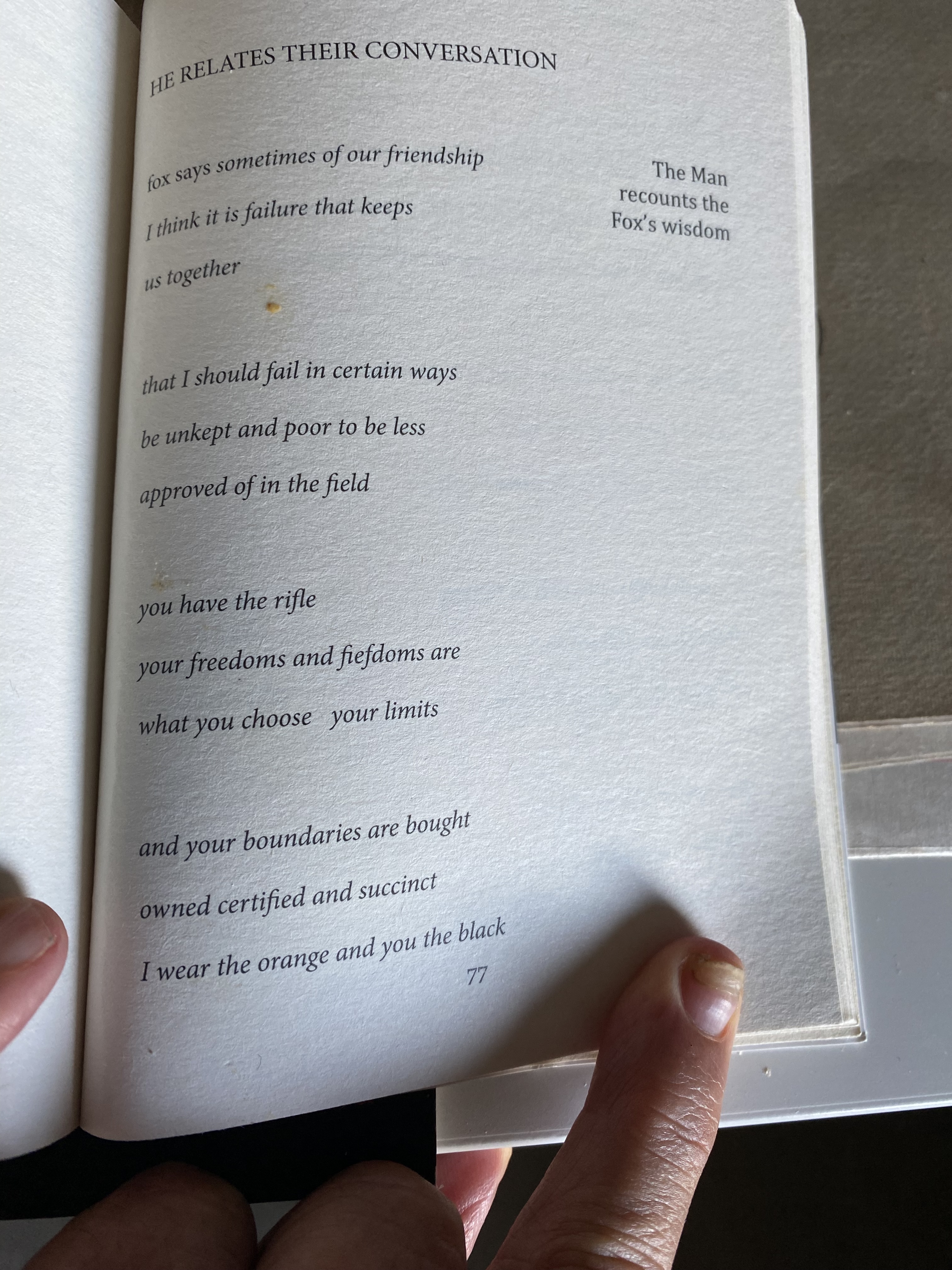
Page 77 is the beginning of the poem, ‘He relates their conversation’.

HE RELATES THEIR CONVERSATION

Like every poem in the book, this one has a note in the margin telling us who is speaking and offering a brief summary, the way some 18th century novels do, as if acknowledging that the semi-articulate protagonists don’t always make themselves clear:

The Man 
recounts the 
Fox's wisdom

The italics on this page signify that though the Man is speaking, he is relating the Fox’s words. The Fox’s ‘wisdom’ is paradoxical:

fox says sometimes of our friendship
I think it is failure that keeps
us together

In what way are they together? And whose failure does she mean? An obvious meaning is that ‘together’ really means ‘both alive in the same locality’, and the failure is that of the Man – he has failed in his quest to kill the fox. But the word ‘friendship’ in the first line suggests that something else is going on. Its cryptic possibilities provide the impetus to read on.

that I should fail in certain ways 
be unkept and poor to be less
approved of in the field

Before she gets to ‘friendship’, the Fox expands on what she means by ‘failure’. She is the one who must fail. To understand ‘in certain ways’ we don’t need to think beyond the Fox’s activity as sheep-killer. If she succeeds in killing or even damaging the Man’s livestock that’s the end of any fellow-feeling. ‘Unkept’ is an example of the way the Fox’s language is interestingly off-kilter throughout the book. It’s not quite ‘unkempt’ though it possibly includes that. It suggests the opposite of ‘well-kept’ as in well-fed. The fox needs to be bad at her job – ‘less / approved of’ in the field’ by other foxes, perhaps.

you have the rifle 
your freedoms and fiefdoms are
what you choose_ your limits

and your boundaries are bought 
owned certified and succinct

(The double space in the third line here acts as a break in the meaning – a full stop.) But yes, the Man must also fail in his quest to eliminate the fox. He has the means, but he can choose to act freely or according to an imposed order. ‘Freedoms and fiefdoms’ is a wonderfully evocative phrase: is this farmer a free operative or is he pretty much a serf in the current economic order? It’s his choice. the limits and boundaries are those of the farm, but they are also limitations and constrictions on himself that he has bought into.

I wear the orange and you the black

On first reading, I had no idea what this meant. Now that I’ve pondered the previous lines, its meaning leaps out at me. The Fox is making an analogy to sporting teams – Australian cricketers wear the baggy greens, Indians the bleed blues. The Fox and the Man belong on different teams.

I won’t go on in detail about the remaining page and a bit. In short, the man now speaks in his own voice, expressing a wish to become the Fox, and they recognise the similarity between the rifle and the fox’s ‘whitesharp teeth’. According to an explanatory side note:

They know 
they have a
tense
commonality

‘Tense commonality’ is an excellent human-prose translation of the Fox’s term ‘friendship’.


* My blogging practice is to focus arbitrarily on the page of a book that coincides with my age. This page often reveals interesting things about the book as a whole.

Robbie Coburn’s Ghost Poetry

Robbie Coburn, Ghost Poetry (Upswell Press 2024)

Ghost Poetry‘s back cover blurb includes a discreet trigger warning:

Always vulnerable, and often confronting and harrowing, Ghost Poetry is a beautifully crafted and important work that will scar the reader.

I agree that these poems are beautifully crafted and confronting, but I wouldn’t say I was actually scarred by them. They do deal with tough subjects – self harm, addiction, the mental health system, suicidal ideation, miscarriage, abortion, rape and more. But there are also horses, a love-poetry thread, and always the sense that the poetry is doing much more than giving vent to pain and suffering, and not at all playing for shocks.

Some of the poems are presented as accounts of dreams, of nightmares really, and many others have a dreamlike quality. Perhaps more accurately, in many of the poems the border between waking and dreaming is blurred so that the emotional intensity and weird logic of nightmare suffuses the daylight world. Sometimes the speaker seems to be a ghost.

A partial list of the titles in ‘Blood Ritual’, the first of the book’s three sections, gives an idea of what I mean: ‘Dream of Human Sacrifice’, ‘Oblivion’, ‘Dream of Scarification’, ‘Cutter’, ‘Dream of Suicide’, ‘Bloodletting’, ‘Dream of Abortion’, ‘I Dreamed I Saw You on a Bridge’, ‘Asylum’. I’m not being entirely flippant when I say it was a relief to read the opening lines of ‘Poetry’, the final poem in the section:

I am tired of these poems;

you can only write your own death
so many times before
you begin to plan for its arrival.

The second section, ‘Wreck’, is filled with horses, and love poems. Again, there is a lot of pain, but also moments of delight as in ‘Foals’, where the poem’s speaker addresses a loved one. You don’t need to have been around newborn foals or calves to be moved by the poem’s final lines, though you may need to have been in love:

as I followed you
your gumboots making a space
for our feet in the wet grass

like two newborn foals
teaching one another
how to walk.

If I had to name a single subject (always a bit of a mug’s game) of the third section, ‘Straw Horses’, I’d say it was love for someone in pain:

I want to touch your tortured bones 
as if my hands were gauze.

But my practice of looking at page 77 demonstrates that it’s not just the loved one who is in pain. ‘Love Poem to a Razorblade’ is not the only one that deals with flesh being cut, in other poems mostly by knives, in dreams, and the flesh not necessarily that of the speaker. Here the subject is definitely self-harm:

It’s a hard poem to write about. As I was drafting this blog post, an article by Rose Cartwright in the Guardian Online threw me a lifeline. It included this:

‘What happened here?’ a colleague asked innocently on set, pointing to the scars on my arm.
‘I used to cut myself,’ I said. I didn’t tell her how recently.
She glanced around. No one nearby to rescue us. ‘Really?’
‘Really,’ I said with a reassuring smile.
There was an awkward silence, which I didn’t fill, since the explanation I would have once filled it with – ‘I was mentally ill’ – no longer felt right.

I was the poster girl for OCD, Guardian 13 April 2024

This poem sets out to bridge that awkward silence. You will read it differently depending on the experience you bring to it. For myself, I’ve never had a compulsion to self-harm, at least not of the cutting kind, and my relevant experience is limited to conversations with parents of young ‘cutters’. One of the main things I’ve gleaned is that communication is problematic: the young person can’t talk about what’s happening and/or the person wanting to help can’t bear to hear what they’re trying to say. That difficulty is at the heart of this poem.

I don’t know if Robbie Coburn is writing from his own lived experience, or as an extraordinary act of empathetic imagination. Either way, the poem calls on the reader to attend to a voice that is rarely heard.

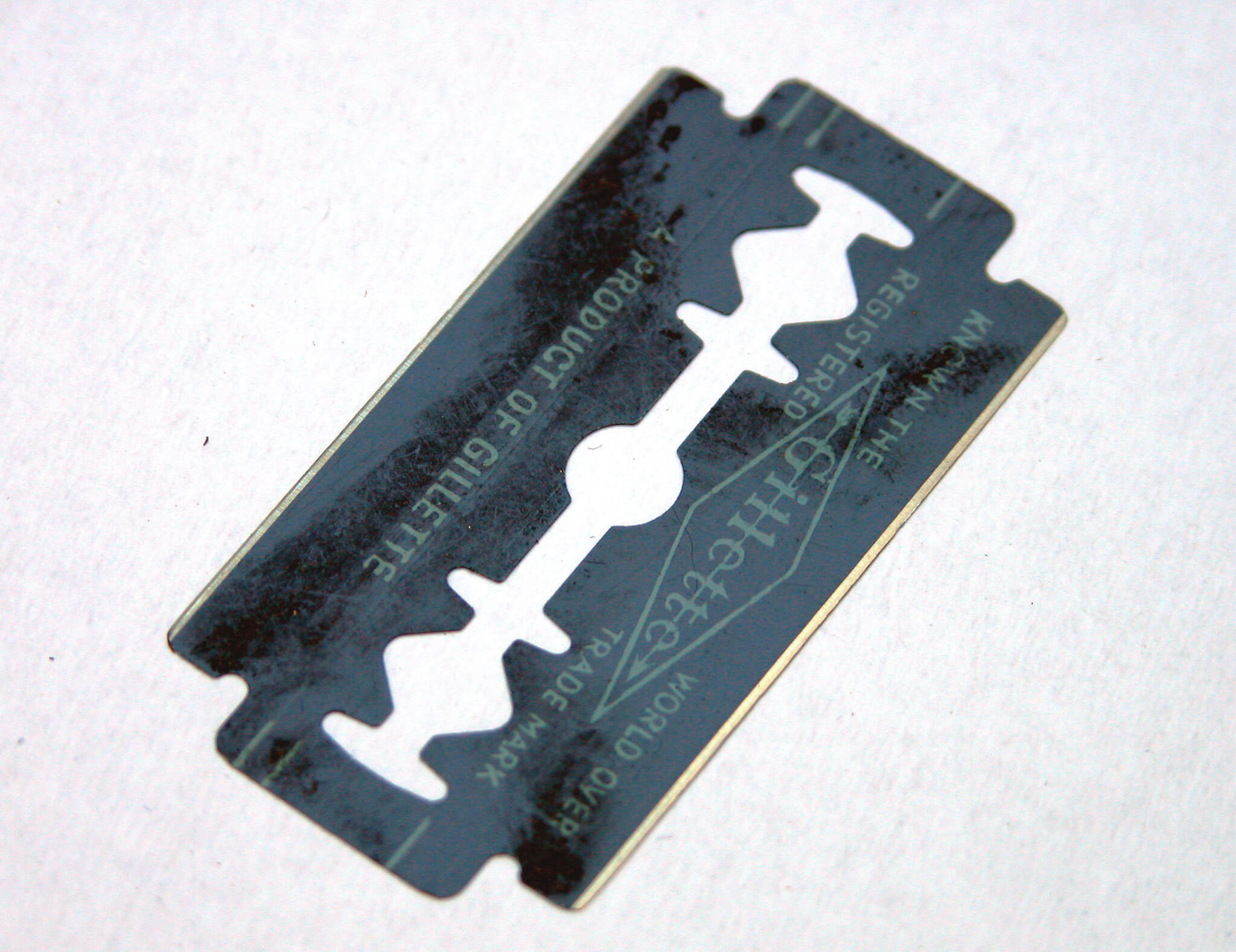
Love Poem to a Razorblade

Anyone who has ever been addicted to anything harmful – cigarettes, ultra-processed foods, chocolate – recognises the paradox. If, as a person with high blood pressure, I were to write ‘Love Poem to a Fried Dim Sim’, the tone would be different: despite the best efforts of nutritionists, a fried dim sim habit is only mildly stigmatised, certainly not seen as ‘mental illness’. But the paradox is similar. The behaviour is doing me no good, but I am drawn to it. It’s not too much of a stretch to call that love.

The first lines are full of possibilities:

As a child I knew
I could keep you hidden.

I turned away from the past
and saw your mouth open
and cover me.

First there’s secretiveness. This isn’t about guilt. It’s not ‘should’, but ‘could’ – there’s a kind of power there. But the question hovers: ‘Hidden from whom?’ From someone who would punish or shame the young one, probably. The next line provokes an allied question, ‘What happened in the past that I had to turn away from it?’ As I read it, the speaker had an (unspecified) unbearable experience as a child and, unable to turn to a human for comfort, somehow turned to the razor blade, to self harm.

I struggle to visualise a contemporary razor blade with an open mouth, but those from my childhood, and I’m guessing from the much younger Robbie Coburn’s, could be flexed so that the opening along the middle would open out. All the same, it’s impossible to visualise this ‘mouth’ covering someone. The lines are after an emotional truth rather than a visual image – the possibilities of the blade enclosed the young person in a protective cover against whatever he was turning away from.

you told me love wasn't a word 
to be spoken
but a scar cut into the surface
of the body.

anybody you love in this world
will mark you.

A human comforter would have said something (‘It’s all right, ‘You’re OK,’ ‘This will pass’ …). The razor blade’s ‘mouth’ had no words, its message is conveyed, recorded, imprinted, by action.

But there’s more to these lines than that. They don’t dwell on the act of cutting – the welling blood, the pain, etc – which happens in the moment, like a word. The message is in the aftermath, the enduring scar, in the surface of the body but also in the mind, an expectation that love will involve damage. But not necessarily damage! In another context that last couplet could have a completely benign meaning: isn’t it true, and interesting, that if you love somebody they have an effect on you, leave a mark on you? Here, though, ‘mark’ carries a strong negative meaning.

I believed you;
each promise immovable,
every moment between us
carved into permanence.

The message from the razor blade is that those effects and marks are solid, scarlike, immovable, permanent. If there’s grief or humiliation in a relationship, you will remain grief-stricken or humiliated forever. As it was in the beginning is now and ever shall be. It’s not just self-harm that lodges such messages in the mind, of course. Don’t we all have moments in our childhood that have created templates for how we expect the world to always be?

even when you were taken 
you have never left me –

It’s childhood experience that has been described so far. ‘When you were taken’ implies an intervention that stopped the self-harm, possibly at an early age. But the effect of those moments persists.

the blood was ours, 
every night we were alone,
silently holding you in secret.

In this last triplet, having reflected on the long term effects of cutting, the speaker can at last look at the moment itself. Only now, can he name the blood, and evoke the (creepy) romance of the moment. I think of the song from Calamity Jane, ‘Once I had a secret love‘, and though I can’t articulate it I know that I’ve been taken somewhere.

While writing this, I have had to walk away from the computer every now and then and breathe for a while. You can feel the poet’s steely will as he holds his mind to this subject, honouring its complexity.

It’s a gruelling book, but rewarding.


I am grateful to Robbie Coburn for my copy of Ghost Poetry.

Romaine Moreton, Post Me to the Prime Minister, page 77

Romaine Moreton, Post Me to the Prime Minister (jukurrpa books, 2004)

Romaine Moreton is Goenpul Yagera of Minjerribah (aka Stradbroke Island) and Bundjulung of northern New South Wales. She is a poet, spoken word performer, philosopher and filmmaker. A brief showreel from the transmedia work One Billion Beats (2016), which she co-wrote and co-directed with Alanna Valentine, gives a powerful glimpse of her stage and screen presence, as well as her incisive writing (link here). Also on Vimeo is a profound lecture she gave about that work (link here), which discusses the colonial gaze and dissects colonial cinematic representations of Indigenous people.

Post Me to the Prime Minister, a collection of poems published in 2004, 12 years before that formidable work, also deals with issues faced by First Nations people. As I was reading it, I kept wishing I could see Romaine Moreton perform them. I’ve just been told that she opened for Sweet Honey in the Rock at the Sydney Opera House on one of their visits to Australia, which makes complete sense. The short film she made with Erica Glynn, A Walk with Words: The Poetry of Romaine Moreton (2024), ends with her performing the book’s final poem, ‘I will surprise you by my will’ (you can rent or purchase the whole film at this link). The poem is in the film’s trailer:

we are here and we are many,
and we shall surprise you by our will,
we wll rise from this place where you expect
to keep us down,
and we shall surprise you by our will.

There are so many riches in this collection, but I’ll stick to my arbitrary practice of singling out page 77. It’s the second page of a long poem, ‘Once upon a patriarchy’. Here’s a pic of pages 76 and 77:

The book’s title comes from the poem’s opening lines:

truth be known,
you would very much prefer it
if I were male

oh yes you would wrap me in glad tidings
and post me to the prime minister and say
how proud we are

___ our son

Things have moved a long way since the moment in the 1972 movie Ningla A-Na when Indigenous women argued vehemently that sexism was a white women’s issue, that Indigenous women needed to support Indigenous men and not challenge their sexist behaviour. More than 30 years later, this poem’s speaker doesn’t have to be defensive about the ‘colonial gaze’; it’s not written with a non-Indigenous reader foremost in mind. The strength of First Nations communities no longer depends on papering over the cracks of lateral oppression.

It’s not easy to tell who ‘you’ is in this poem. At first it may be the speaker’s parents, or perhaps a part of the First Nations population that has a parent-like relationship to her. But it shifts, and by the start of page 77 it is a First Nations man, ‘our son‘, who is being addressed. He’s a man who wishes ‘to walk as the colonial / hallowed one’. I don’t think it’s too fanciful to see him as similar to the would-be assimilationist Tomahawk in Alexis Wright’s great novel Praiseworthy (2023), or perhaps as a member of Chelsea Watego’s ’emerging tribe’ of self-appointed leaders (see the essay ‘ambiguously Indigenous’ in Another Day in the Colony, also published in 2023).

for while you vie 
for the passenger seat
the cattle truck is loaded for market
you have left me golden hallowed son

dragging
in
the never-never

This is beautifully complicated. There’s sibling rivalry – ‘golden hallowed son’ is a variant on ‘golden-haired boy’, the favoured sibling, favoured partly because he’s male. But it’s not just that. He has decided to be part of the action, be up front in the cattle truck, join in the extractive farming of the land. He’s not in the driver’s seat, not in charge of his own destiny, but has attached himself to the power. To reinforce the farm metaphor, the poem brings in the Australian colonial ‘classic’, Mrs Aeneas (Jeannie) Gunn’s We of the Never Never (1908). I haven’t read that book, but I’m pretty sure its account of Mangarayi and Yungman who were displaced by the Elsey cattle station, and worked on it, fits the tone of these lines – a place to be left dragging.

The next lines continue to reproach, and to remind the ‘son’ of the loyalty shown by Black women. (See the scene in Ningla A-Na mentioned above.)

and while I never ever forget you 
you gladly allow me – the black female
to rot

like the wife of Lot
though I have never
turned
I captured you to my breast 
always remembered
what is best

for my people
for my people

Whatever else is going on with the ‘son’ his maleness is key, as is the speaker’s femaleness. The reference to Lot’s wife (who looked back at the destruction of Sodom and Gomorrah in Genesis 19 and was turned into a pillar of salt as punishment) broadens the picture: women have always been punished. In this case, though, there’s not even the pretext of he having done something wrong.

If you weren’t noticing the music of the poem previously, you can’t help but hear it here. These lines, with the rhyming of ‘rot’ and ‘Lot’, introduce a new rhythm that builds, with the rhyme of ‘breast’ and rest’, to the lovely repetition of ‘for my people’. When performing some of her poems, Romaine Moreton moves from spoken word to song. These lines cry out for that treatment.

One of my favourite words in poetry is ‘but’. And here it comes:

but you
golden hallowed blackened son
more despised there is none

The ‘son’ is not just ‘golden hallowed’, but ‘golden hallowed blackened’: sitting in the passenger’s seat doesn’t make him immune from racism. ‘Blackened’ is an interesting word here: it signifies First Nations identity, but also colonial attitudes. He may think of himself as the golden son, but his Black identity will be imposed on him and he will be seen accordingly through a colonial lens: ‘none more despised’. That’s something that the man on the receiving end of racism would readily agree to. And then the killer lines:

except one

which is me

That’s not the end of the poem, it does move on interestingly, but it’s all I’m looking at here.

Hisham Matar, My Friends, the book club, page 77

Hisham Matar, My Friends (Viking 2024)

Before the meeting: Hisham Matar was a guest at the 2017 Sydney Writers’ Festival. On a panel titled ‘Resist!’ which was mainly concerned with the recent election of Donald Trump as President of the USA, he enriched the conversation by referring back to his own childhood in Qaddafi’s Libya, where he wondered who was more sculpted by the regime, those who actively served its interests or those who dedicated themselves to resisting it. He argued powerfully for the importance of complexity, of remaining true to one’s own authentic self. (My blog post here.)

In My Friends, when the narrator, Khaled, is a teenager in Benghazi, he and his family hear a short story read over the BBC. It’s a kind Kafkaesque version of Melville’s ‘Bartleby the Scrivener’, in which the word ‘no’ has tremendous power. Nobody spells it out, but we understand that it’s a heavily coded advocacy for non-compliance with the Qaddafi regime. (By the end of the book, we understand it could equally refer to refusal to take up arms.) The young narrator, partly inspired by the story, leaves Libya to study at Edinburgh University.

In 1984, he and his friend Mustafa evade the surveillance of their fellow Libyan students and travel to London to join a demonstration outside the Libyan embassy. When the crowd is fired on from inside the embassy (this really happened), they are seriously injured. Unknown to them, the writer of the short story – Hosam – is also at the demonstration, but walks away uninjured. All three of them are now exiles.

The novel traces the way the lives of these three men intertwine, how their friendships grow, how each of them deals with the pain of separation from family and country, and how each responds to the changing political news from home. The Arab Spring of 2010 brings things to a head: the question is now whether to return to join the revolt against Qaddafi, or to continue with the lives they have built away from home, however insubstantial.

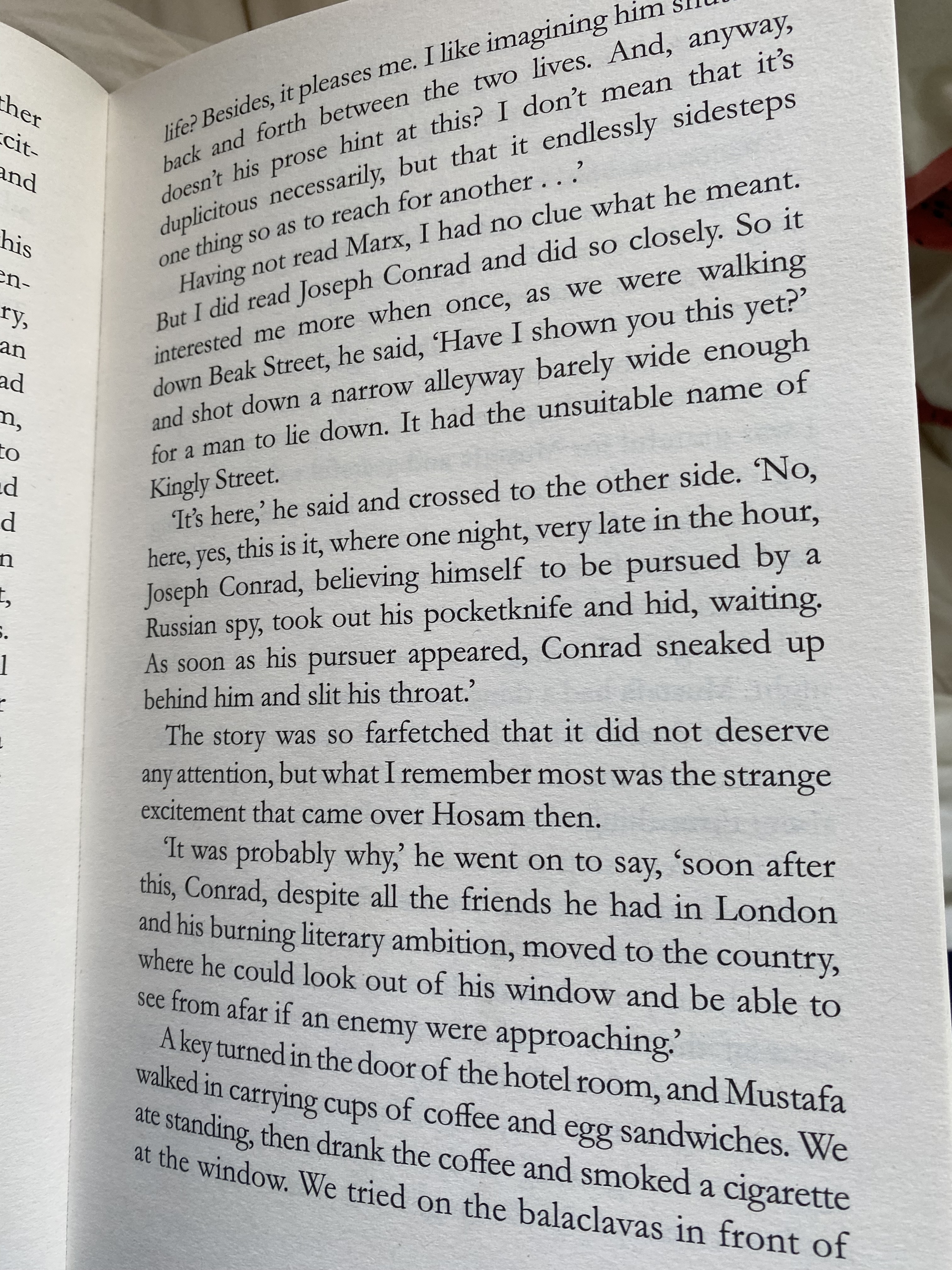
On page 77, Khaled is walking the streets of London, remembering when he and Mustafa first came there for the demonstration which would radically alter the course of their lives. His memories leap forward to the period years later when he and Hosam were walking those same streets, with Hosam enthusing about literary history attached to those places. Both the anecdotes on this page touch on major themes of the book.

At the start of the page Hosam has just relayed gossip that when Karl Marx is said to have been ‘sweating it out’ in the British Library, he was actually visiting his mistress in Soho:

‘I like imagining him shuttling back and forth between the two lives. And, anyway, doesn’t his prose hint at this? I don’t mean that it’s duplicitous necessarily, but that it endlessly sidesteps one thing so as to reach for another … ?’

Regarding characters, this is Hosam, six years older than Khaled, showing off his sophistication. Thematically, his description of Marx’s prose could equally be describing Khaled’s approach to life: it never quite commits himself to a clear position. Even in these early pages when he describes his participation in the demonstration, he oscillates between saying he waas led there by Mustafa and taking responsibility for his own decision.

It strikes me that I could draw up a list of all the writers and works mentioned in the early pages of this book and have a reading schedule for a year. There’s not just Marx, and further on this page Conrad, and much of the western canon (including Montaigne, my current early-morning read), but a whole world of Arabic writing including, for example, the Sudanese poet Nizar Qabbani, the Lebanese novelist Salim el Lozi, and Khaled’s father’s favourite poet Abu al-Ala al-Ma’arri. Conrad, who wrote in English away from his native Poland, crops up a lot.

As we were walking down Beak Street, he said, ‘Have I shown you this yet?’ and shot down a narrow alleyway barely wide enough for a man to lie down. It had the unsuitable name of Kingly Street.
‘It’s here,’ he said and crossed to the other side. ‘No, here, yes, this is it, where one night, very late in the hour, Joseph Conrad, believing himself to be pursued by a Russian spy, took out his pocketknife and hid, waiting. As soon as his pursuer appeared, Conrad sneaked up behind him and slit his throat.’
The story was so farfetched that it did not deserve any attention, but what I remember most was the strange excitement that came over Hosam then.
‘It was probably why,’ he went on to say, ‘soon after this, Conrad, despite all the friends he had in London and his burning literary ambition, moved to the country, where he could look out of his window and be able to see from afar if an enemy were approaching.’

I’ve got no idea if this anecdote is Hisham Matar’s invention – a web search found nothing – but Hosam’s excitement in telling it signals a parallel with his own trajectory. By the time he tells it, he has abandoned his writing career, and like all three of the friends, he is intensely aware that he has enemies in Qaddafi’s regime.

Hosam never explains in so many words why he no longer writes, and is unmoved by his friends’ urgings. It’s through moments like this remembered anecdote that we are able to glean what is going on: Conrad’s withdrawal after killing the suspected agent is parallel to Hosam’s fear of detection and shame at his own silence after the 1984 demo.

The book’s opening words point to a feature of the narrative that this passage exemplifies:

It is, of course, impossible to be certain of what is contained in anyone’s chest, least of all one’s own or those we know well, perhaps especially those we know best

I don’t think we ever know what is going on in Khaled’s heart. For instance, when Qaddafi is being overthrown, he sits up all night listening to news and reading text messages from back home, but at work the next day he mumbles that he doesn’t pay much attention to the news. He is more forthcoming with the reader, but a stubborn silence remains.

There’s a lot more to say, but I’m out of time. There’s one wonderful scene I must mention. When after many years his family come to London to visit him, Khaled finally tells his father the real reason that he hasn’t come home, his participation in the 1984 demonstration and the wound he sustained. What happens next between father and son is profound. Here’s how it starts, as Khaled indicates the location of the scar:

‘Here,’ I said and pointed to my chest.
His manic fingers were all over me, trying to unbutton my shirt and pull it off at the same time. I gave him my back and did it myself. He took hold of my vest, and the child I once had been surrendered his arms. What happened next broke a crack through me.
My father, the tallest man I know, bowed and began to trace his fingers along my scar, reading it, turning around me as he followed its line, tears streaming down his face.
‘My boy, my boy,’ he whispered to himself.

(page 242)

Now I really am out of time.

After the meeting: The five of us discussed this book along with Anne Enright’s The Wren, The Wren (blog post here). This one generated much more interesting conversation. Among other things, two of us had been to Libya when Qaddafi was still in power – for them, the descriptions of life in Benghazi stirred rich memories.

Most if not all of us had read at least one other book by Hisham Matar, The Return (my blog post here), Others had read either In the Country of Men (which I read with my other Book Group, blog post here) or A Month in Siena.

The one who had read A Month in Siena had been irritated by it because ‘nothing happened’. She had a similar complaint abut My Friends. Having enjoyed it up to the point of the demonstration, she was frustrated that instead of telling a story about Libyan politics, the narrative stalled and Khaled in particular settled for a boring uneventful life for most of the book. For others of us, that was the point – it’s a story of exile, and Khaled is stuck, caught between the yearning for home and the impossibility of going there. Yet another challenged the assertion that Khaled was stuck: he had a job teaching English literature, which was the great love of his life – what’s wrong with that? And as the narrator of this book, he is the one who gets to see the whole picture.

Speaking vaguely so as to avoid spoilers, there was some disagreement on how successfully the narrative placed its characters at key events in Libyan history. I thought it was audacious; others thought it was a weakness, a clumsy welding act.

We didn’t come to blows. Even the least enthusiastic among us enjoyed the book, and I think it’s true to say that we all learned a lot about, or were at least reminded of, recent Libyan history.

Also, we had a pleasant meal and heard epic tales of bathroom renovation.