Category Archives: Books

2011 in review

The WordPress.com stats helper monkeys prepared a 2011 annual report for this blog. They certainly give value for money, especially given that it’s a free service

Here’s an excerpt:

The concert hall at the Sydney Opera House holds 2700 people. This blog was viewed about 21 000 times in 2011. If it were a concert at Sydney Opera House, it would take about 8 sold-out performances for that many people to see it.

Click here to see the complete report.

Stevie Smith

Stevie Smith, Selected Poems (edited by James MacGibbon 1975, Penguin 1978)

My first boss, who had met Stevie Smith in his youth and been enchanted by her, once delighted his staff, all three of us, with an expressive recitation of the final of pages of her Novel on Yellow Paper, beginning something like, ‘I will now tell the story of the death of the lion Aunt.’ On another occasion he treated us to her best known poem, ‘Not Waving but Drowning‘, and her lines about death being the only god who comes when he is called. I’ve been a kind of fan by proxy ever since.

But I don’t seem to have actually read much of her poetry. At least just now this book felt like a fresh encounter rather than a revisiting. I had a mental image of Stevie Smith as English-eccentric with a quirky take on the world, witty, whimsical and self-deprecatingly wise. This impression had been helped along by two poems we published in the School Magazine when I was editor, ‘My Tortoise’, which verges on baby talk, and sublimely silly ‘The Galloping Cat‘. But though there are a number of whimsical poems about animals toward the end of the book, the dominant tone is much, much darker than I expected. Death and a longing for death are pervasive; there’s quite a bit that’s moralistic, snobbish and outright misanthropic; and she wrestles resolutely with her Anglican heritage. Even the cat that ‘likes to / gallop about doing good’ seems unsettlingly satirical. Yet I enjoyed the book a lot, and had to restrain myself from reading much of it aloud.

It’s hard to say quite what it is that I find so enjoyable. These lines from ‘A Soldier Dear to Us’ help:

But you taught me a secret you did not perhaps mean to impart,
That one must speak lightly, and use fair names like the ladies
They used to call
The Eumenides.

Stevie Smith seems to have been an excellent student of that old soldier. She certainly speaks lightly of serious things, in satirical squibs, in a verse essay on Christianity that ends with a warning of religiously rationalised mass murder, in a denunciation of cruelty to animals, in cryptic narratives of love denied or lost or twisted out of shape, in many lyrics that echo the ‘Come, Death’ sentiment, and so on. Casting about for words to describe her characteristic tone I come up with ‘chirpy’. It’s more complex and interesting than merely cheerful, suggesting something like courage and humility in adversity, not denying anything but refusing to be overwhelmed or melodramatic.

‘The Lads of the Village’ is a poem that struck a chord with me strongly enough that I memorised it, which turned out to be a rewarding process (see earlier post about memorising verse). Here it is:

The lads of the village, we read in the lay,
By medalled commanders are muddled away,
But the picture that the poet makes is not very gay.

Poet, let the red blood flow that makes the pattern better,
And let the tears flow, too, and grief stand that is their begetter,
And let man have his self-forged chain and hug every fetter.

For without the juxtaposition of muddles, medals and clay,
Would the song be so very much more gay,
Would it not be a frivolous dance upon a summer day?

Oh sing no more: Away with the folly of commanders.
This will not make a better song upon the field of Flanders,
Or upon any field of experience where pain makes patterns the poet slanders.

If I had read that aloud to the Art Student I expect she would roll her eyes, but let me try to explain how it gets to me, and some of what I found as I did my learning by heart.

The first two lines promise us a poem in strict meter, like one of the lays they refer to, and then in the third line the rhythm breaks up to become much more conversational, while the rhyme scheme stays intact. The metric shape is increasingly disrupted, so that the rest of the poem is of playful struggle between natural speech – perhaps chatty, perhaps angrily ranting – and songlike formality. It’s almost as if the poem’s sense has been shoe-horned into its shape: the unexpected ‘slanders’ at the end of the long final almost McGonagallesque line could be a desperate ploy to end the poem with a full rhyme. The alliteration in the second line and elsewhere has a similar effect – at first blush it feels as if ‘muddled’ is there purely because it echoes ‘medalled’. I think this apparent arbitrariness is what creates the feeling of lightness.

And yet, and yet, just how arbitrary is it really? When you come to think about it, ‘muddled’ is satirically precise, and ‘slanders’ arrives with tremendous denunciatory force, like a stone hurled from a sling. And the sling isn’t such a bad simile: in this poem tiny Stevie-David takes on the Goliath tradition of poetry that celebrates war and delivers a killer blow. Blood flows, grief stands, generals are foolish, the lads go into clay, and the poet exploits the whole cruel mess for aesthetic purposes. ‘Slander’ justifies its status as the last word, and the disruption of the form enacts in a way the repudiation of the kind of song that is deemed suitable for memorial ceremonies at Flanders.

There are other felicities that I didn’t notice till I did the memorising: the repetition of ‘upon … field’ in the final stanza, the reappearance of the ‘ay’ rhyme in the middle of the third last line, the patterning of the p words ‘poet’, ‘picture’, ‘pattern’ and ‘pain’, and more. But that’s all I’m writing here.

Wilson

Daniel Clowes, Wilson (2009, Drawn and Quarterly 2010)

20111226-124107.jpgOne of my joys at Christmas these days is that my family give me comics. This year I received a grand total of six hefty hardbacks, all by people I haven’t read anything by. Wilson is the least daunting, appearing at first glance to be made up of 80 or so single-page strips about the unkempt, misanthropic Wilson. In one strip he asks a woman to help him out by estimating the weight of a small parcel he plans to post, and then tells her it’s full of fresh dog poop. In another he tries to start up a conversation in a cafe with a man who politely indicates that he’s working on a laptop, and eventually delivers the punchline, ‘Hey asshole, I’m talking to you!’

That sort of thing is amusing in its own depressive way, and then the apparently unrelated strips come together into a coherent story arc. There’s a satisfying payoff to both the dog poop and the laptop man, and in the end it’s a kind of love story.

End of year lists 2011

Here are the Art Student’s best five movies for the year, in no particular order. That’s five out of roughly 43 movies we went to. (If you don’t know a movie the title links to  its IMDb page.)

Inside Job: A documentary about the Global Financial Crisis. The most memorable thing is that at the end Obama kept in something like 20 key positions the same people whose advice had led to the policies that brought about the collapse.

Of Gods and Men: The AS knew this was on my list and wouldn’t give me a comment.

Win Win: She liked this for its moral complexity and understatedness.

The Guard: This made her laugh. She liked being seduced by someone who did bad things.

Bill Cunningham New York: She was exhilarated by this and loved it as a model of a kind of integrity that may well be disappearing from the western world.

And mine:
Bill Cunningham New York: See the Art Student’s comment above

Of Gods and Men: Interestingly enough, this is also a study in integrity, and though it’s fiction, it ends with a profound letter written by the actual man it’s based on.

Source Code: An SF Groundhog Day that I found completely delightful.

If a Tree Falls: A Story of the Earth Liberation Front: There seems to be a theme emerging: what I loved about this was that its main character had done bad things with good intentions and took responsibility for his actions. It also cast yet more unflattering light on the US authorities’ response to ‘terrorism’.

Toomelah: I saw this at the Sydney Film Festival, introduced by Ivan Sen in the company of two young actors. Perhaps that’s why I saw it as an ultimately hopeful, though unsparing, look at life in a crushed, neglected and dysfunctional Aboriginal community.

About books, the Art Student claims not to be able to remember back past the last book she read, but she’s happy to have Edmund de Waal’s The Hare with Amber Eyes in her top five books for the year. This year, following the shocking VIDA statistics on gender bias in literary journals, I decided to keep track of whether books I read were by men or women, and a quick count shows, astonishingly that I read 25 books by men and 23 by women. Compulsive honesty has me acknowledge that many of the books by women were very short. the most dubious inclusion being a YouTube video of Harvard Professors reading Margaret Wise Brown’s Goodnight Moon.  My top five, a list that might look quite different if I did it on another day:

Christina Stead, The Man Who Loved Children. What a painful pleasure to re read this! I can’t think of a character I’ve hated more, while being fascinated, than Sam Pollitt.

Francis Webb, Collected Poems and a number of ancillary books.

Charles Dickens, Bleak House. I’m that much less likely to win a game of Humiliation now that I’ve read this. I completely understand why Claire Tomalin read this twice when researching her biography of Dickens – she wasn’t prompted by duty but by pleasure.

Kim Scott’s That Deadman Dance. Phew! We’re into the 21st century. After the necessarily careful correctness of, say, Kate Grenville’s novels about early contact in Sydney, this exuberant, multi-faceted, generous, funny, heartbreaking novel is like a blast of clean air.

Robert Whitaker’s Anatomy of an Epidemic: Magic Bullets, Psychiatric Drugs, and the Astonishing Rise of Mental Illness in America. Whenever I’m asked what my favourite book is I’m tempted to name the one I’m currently reading, but this really is a wonderful book, all the more shocking for the care with which it marshals its evidence and argument. I want to push it into the hands of everyone I know.

Please quarrel with these lists, add your recommendations, etc.

Memorising poetry with Dan Beachy-Quick

The Poetry Off the Shelf podcast for 13 December is a lovely interview with US poet Dan Beachy-Quick about memorising poetry, ‘Inscribe the poem on yourself’. I listened to it when I had just finished my first stab at memorising Stevie Smith’s ‘The Lads of the Village’ (of which more in a later post), and a lot of what was said on the podcast rang very true for me. Here are a couple of hastily transcribed highlights:

Something about the act of memorisation puts the poem inside me in such a way that I feel like when I do need to know what exactly it is in the poem that draws me so much it will be there as a kind of constant resource that I can call upon whenever I want to or when I need to.

And this on memorising poems using traditional forms:

When you go through the work of memorising a poem the metre of it or the rhyme of it or the formal pattern that it’s in ceases to just be a technology of the poem and you begin to see the real necessity that might underlie the choice of writing in a sonnet or the power of taking as a genuine concern the need to find a perfect rhyme or a slant rhyme, because those things too, metre and rhyme, are so absolutely bodily and part of the meaning. One feels a rhythm. Rhyme is felt as much as heard. It’s almost as if the ear is learning to feel when it hears a great rhyme. So I think in a way memorising such poems helps one learn to read and take seriously traditional poetic values that in a postmodernist framework might be easily dismissed.

If you have 12 minutes and 19 seconds to spare, you could do better with that small slab of time than listen to the whole thing.

Incidentally, as I was fiddling around trying to get you that link, I found that the Poetry Foundation’s Poem of the Day has featured a swathe of Australians, including most recently Michael Sharkey reading his ‘Eating Sin‘.

You wouldn’t read about it

On Friday night my book club had its end of year meeting. That’s the book club where we swap books and keep discussion to a minimum. I missed the end of year meeting of the book group, where the rest of the chaps discussed a book of essays by David Foster Wallace which I hadn’t managed to read, so I didn’t miss anything but conviviality and shame (unless of course something happened that they’re being secretive about). The book club met at Anong in Kings Cross for the best Thai food I remember ever eating, and we had a wonderful night, helped by two of our number being on first name terms with the restaurant owners and several having had recent travel adventures.

Rather than the usual complex swapping, this meeting each year is the occasion of a bit of simple giving. Each of us brings a gift-wrapped book, and each goes home with one. Two years ago three of the six books turned out to be The Slap, which has become even more ubiquitous since then, if that’s possible. This year, despite all the double guessing and byway exploration that goes into the choice of books, there was another hat trick: Jeanette Winterson’s Why Be Happy When You Could Be Normal?

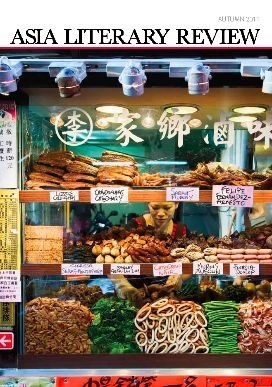
Asia Literary Review 21

Stephen McCarty (editor), Asia Literary Review No 21 ([Northern] Autumn 2011)

[Note added in 2021: All the links in this blog post are broken except the ones in the journal title above and in the image to the left. The whole journal is still available online to subscribers.]

Under Stephen McCarty’s editorship, the Asia Literary Review tends to have themed issues. The last three focused on China, Burma and Japan respectively. This one moves to a subject that transcends political and geographic boundaries: food.

Where a focus on a single country can lead to a journal as diverse – and as integrated – as anyone could wish, other kinds of themes, even one as vast as food, risk crossing the line between relatedness and sameness. This issue comes close to that line a couple of times, but it manages to stay on the right side. Notably, Felipe Fernández-Armesto kicks things off with ‘History à la Carte‘, a short essay on food as an ‘instructive historical document’, particularly about the ‘relative input of different cultures to a globalising world’ over the centuries – and the pages that follow provide a number exemplars of the kind of thing he means: Fuchsia Dunlop, an Englishwoman who has trained as a chef in Sichuan, writes of her childhood love for sweet and sour pork, and explores its origins as a dish invented for despised foreigners (or was it?); Bernard Cohen’s story about a disintegrating marriage, ‘The Chinese Meal, Uneaten‘ can be read as a meditation on the cheap Chinese restaurants of a bygone Australia; in Erin Swan’s ‘Tomatoes‘, a couple of western tourists in the Himalayas get some humility about their privileged status thanks to a box of tomatoes; Jennifer 8. Lee’s ‘Making Pasta Sauce: My Independence’ tells of a Chinese New Yorker’s discovery in Italian cuisine (this little memoir-recipe, sadly not available online to non-subscribers, has had a significant impact on the cooking in this house); in Wena Poon’s story ‘Fideuà’, a woman who was a ‘China baby’ adopted by a Spanish couple finds in seafood noodles a deep emotional connection between her birth home and her adoptive one (a Chinese matriarch watches the protagonist cook Spanish fideuà in a paella pan and says, a little scornfully, a little proudly, ‘This pan is like our wok. This noodle, come from China. Seafood, same. All same. We call it hoi seen meen. We use same ingredients.’). Perhaps because a jungle of self-sown vines is producing abundantly in our tiny back yard, I particularly enjoyed the way tomatoes kept appearing: here we learn they are known in some parts of China as barbarian aubergines, there that Europeans thought they were poisonous for hundred of years after they were brought over from the Americas, in a third place that they have delicacy status in Himalayan villages.

I should mention Lizzie Collingham’s fascinating piece of history, ‘Japan and the Battle for Rice’, which makes the case for thinking of Japan’s participation in World War Two as in part a war about food, of which we may be about to see many more. Chandran Nair stops short of making that prediction in his chilling article, ‘The World Food Crisis – An Asian Perspective’, which echoes the Annie Leonard video I posted yesterday by calling on Asian governments to ‘reject the consumption-led growth model and adopt instead an approach that makes resources conservation the heart of all policymaking’. Good luck to us all with that!

Oh, and there’s ‘Table d’Hôte’ by Murong Xuecu, translated by Martin Merz and Jane Weizhen Pan. It’s the journal’s only prose piece translated from an Asian language and easily its most powerful fiction, with something of the feel of that contemporary Chinese art that plays around with death and mutilation.

And there’s plenty else. I’ve linked to the stories that are accessible online. If you want to read the others you have to subscribe.

Harpur on the sonnet by way of Middlemiss

Perry Middlemiss often blogs Australian newspaper articles from decades past on literary subjects. He recently treated us to a  essay on the sonnet by Charles Harpur, originally published in the Sydney Morning Herald in 1866, which I found fascinating for reasons that might be obvious. Here’s a sample:

the untransgressible limits of the sonnet often tend to induce that closeness of expression, and that sublimation of imagery which are proper to the highest kind of enduring poetry, namely, that kind which is suggestive rather than descriptive, or which by a few select images, intensified in the putting, suggests infinitely more than could be circumstantially described, or otherwise than wearisomely; and which, therefore, while it amply recompenses the imagination of the reader, exercises it as well, and thereby quickens and strengthens it for direct conception upon its own account, or as an individual and self-sustained faculty. And, having, as I think, this tendency, of course these exact limits prevent in an equal degree that verbal delusion of the sense which is the besetting weakness of most modern writers, both in a verse and prose.

Correspondence on Manne (no sonnet)

Quarterly Essay No 44 is just out. It may be a while before I get to read the essay itself, Andrew Charlton’s Man-Made World: Choosing between progress and planet, but I went straight to the pages up the back with correspondence about last quarter’s essay, Robert Manne’s critique of the Australian. In the past I have been glad that QE doesn’t include correspondence from the name-calling, straw-dog destroying, science-denying voices that dominate some other forums. This time it would have been odd not to have a contribution by someone from Rupert Murdoch’s empire – and indeed the discussion is kicked off by Nick Cater, editor of the Weekend Australian. He comes out fighting:

For thirty years or more, Manne has distinguished himself through his rare determination to exercise his intellect in the town square. There is no sign that he intends to relinquish his position as a public intellectual, but with this essay he has retreated further into the cloisters. He has become ever more abstract, aloof and contemptuous of his interlocutors. I mean no disrespect by suggesting that Manne needs to get out more.

Clearly he does mean disrespect. And so when the other correspondents make what might seem to be outrageous assertions and implications about the ethos of the Australian – that it is not a newspaper so much as an organ for political propaganda whose employees are in a state of denial that results in their responding like cornered beasts to any criticism, for example, or that it would be a good idea if they tried to represent accurately the arguments of people they disagreed with – there is a living, breathing example of the kind of thing they are talking about just a few pages earlier. Manne’s contribution or the correspondence is to thank the other correspondents and then attempt to extract the actual arguments from Cater’s piece, ignoring the abundant ad hominem elements, and counter them methodically. It’s a good read, though one is left with an uneasy sensation that Cater and Manne have widely divergent assumptions about what constitutes an argument.

It’s a pity that the correspondence doesn’t include anything from the left, putting the kind of position that Tad Tietze did on the Overland blog a while back. While appreciating the great service Robert Manne’s article has done us, among other things he laments Manne’s lack of analytical tools in relation o the media, gives a brief account of the Propaganda Model of the private media, and concludes:

Manne seems to believe that we’d have a better country if The Australian was somehow reined in, but this gets things the wrong way around. It is because things have gotten worse, and because elite hegemony has been unravelling, that we have been blessed with The Australian we have today. Better to stop obsessing about Murdoch’s apparent omnipotence and figure out how our side can more effectively prepare for the battles ahead.

Michael Dransfield revisited & LoSoRhyMo #12

Michael Dransfield, Streets of the Long Voyage (UQP, Paperback Poets 1970) and The Inspector of Tides (UQP Paperback Poets 1972)

Around 1970, when Sydney poetry readings drew relatively large audiences, a young Michael Dansfield, roughly my own age as it happens, created something of a stir. With unruly shoulder length curls, he looked every inch the romantic. He was evidently much loved by the community of poets and his death of an overdose inspired a number of moving elegies. I bought his books and applauded his readings, but it was my guilty secret that I found his persona and his poetry vaguely irritating.

Recently a friend who was culling her bookshelves gave these two books to me rather than tossing them or lugging them to a secondhand shop (where the Internet suggests they might have been worth a bob or two, if not for a small child’s large writing in the margins of ‘Still Life with Syringe’ and elsewhere). I’d long since disposed of my own copies, and was glad of a chance to revisit the poetry after some 40 years.

Half way into Streets of the Long Voyage I realised I was looking for irritants, and finding them: the self pitying romanticisation of drug addiction (‘a needle spelling XANADU / in pinprick visions down your arm / what of nostalgia when/ the era that you grew in dies’), the hi-falutin’ name-dropping (no John Forbesian Ramones for this lad, just Chopin, Scriabin, Taktakishvili all the way), the crude social commentary, the weird nostalgia for a fictional(?) decaying family home; and a pervasive self-absorption. The self-absorption came into focus for me in these lines from ‘goliard’:

The driver wonders what I’m writing
but with the superb manners of an Australian
merely asks, ‘Got enough light there, mate?’

Anyone who understood the idiom would realise, as the speaker evidently doesn’t, that ‘the driver’ was indirectly – and yes, politely – asking what his passenger was writing. One imagines that the driver’s account of that moment would not include the phrase ‘superb manners’; nor for that matter would it include the essentialising ‘Australian’.

The Inspector of Tides was more of the same: more ‘this world is going to the dogs so I’m leaving it on a needle’; more ‘ah, my ancestral home now in ruins’; more social commentary that seems quite untouched by the upsurge of optimistic activism that was happening at the time. There’s even a unicorn. ‘Endsight’ got up my nose with its reference to

00000000000000000000000the Official Poets, whose genteel
iambics chide industrialists
for making life extinct.

Since the poem is dedicated to A D Hope among others, this is a reasonably transparent jibe at Hope. I couldn’t lay hands on anything by Hope about environmental issues, but perhaps Dransfield was thinking of something like ‘Inscription for Any War’:

Linger not, stranger, shed no tear;
Go back to those who sent us here.
We are the young they drafted out
To wars their follies brought about.
Go tell those old men, safe in bed,
We took their orders and are dead.

Iambics, yes, but genteel chiding? I don’t think so. It would still take guts to read that at a military funeral, or even a parliamentary debate on Afghanistan.

There are plenty of things to enjoy in both these books – especially when the poetry relaxes, as in ‘Ryokan’:

at the window
rain

the sparrow
feathers puffed out

sings brightly but alone

my hand makes
black marks on white

the sparrow
pink marks on grey

But this is a blog entry not a review. Dransfield is a much better poet than, for example, I will ever be. He just brings out the irrits in me.

And since it’s November and I’m behind on my quota of sonnets, a quick question in rhyme:

Sonnet 12: Re-reading
Oh you who love to read again
the books you loved, who tell us how
the love you had for Austen when
you were fourteen is burning now
with brighter and more subtle fire,
how Dostoevsky, then so dire
a challenge to your questing brain
now sparks your neural paths again,
you haven’t said, do you re-read
the books that stirred you not at all,
or those, perhaps, that made you fall
asleep mid sentence, ‘Meh!’ indeed?
If it annoyed in sixty-seven
what hope for it in twenty eleven?