Laura Tingle’s Political Amnesia

Laura Tingle, Political Amnesia: How we forgot how to govern (Quarterly Essay Nº 60, Black Ink 2015)

qe60.jpgAs always with the Quarterly Essay I turned to the back section of this issue for the correspondence on the previous one. The responses to David Marr’s profile of Bill Shorten aren’t argumentative – they mostly praise, summarise, amplify and contextualise. My favourite paragraph is from Michael Bachelard:

The dilemma is that, though fascinating to insiders, the grindings of Labor’s factional machine – at once impenetrable, distasteful and apparently crucial – are to outside observers dull to the point of stupor. But without understanding and accounting for the networks of influence and patronage that bind the union bosses, the branches (more accurately, the branch-stackers), the ethnic warlords and the parliamentarians, there is no explaining the Labor Party and how it identifies and promotes talent.

Marr’s ‘Response to Correspondence’ doesn’t actually respond, but reflects on the timing of the essay’s publication. Its portrait of Bill Shorten as the man who might beat Tony Abbott for the Prime Ministership lost a lot of topicality when Malcolm Turnbull did the job on the eve of publication – but, Marr says, ‘Anything can happen between now and the uncertain date at which Australia will go to an election.’

Political Amnesia asks us to turn aside for a moment from politics as soap opera or contest of personalities, and look instead for structural changes underlying our current political malaise. She argues, convincingly, that there is a growing loss of institutional memory in Australian public life. ‘Without memory,’ she argues

there is no context or continuity for the making of new decisions. We have little choice but to take these decisions at face value, as the inevitable outcome of current circumstance. The perils of this are manifest. Decisions are taken not as informed by knowledge of what has worked, or not worked, in the past, or even by a conscious analysis of what might have changed since the issue was last considered. … Rational debate about the pros and cons of an issue becomes too hard for both advocates and audience. We slip into the habit of conducting our debates in the present tense.

Or worse, three word slogans. The rot has been a long time coming, she argues, and has had complex causes, including the advent of the 24-hour news cycle, where the media beast must always be fed something new (am I the only one who finds it unnerving that even on the ABC news bulletins often tell us about announcements that will be made the next day?), the politicisation of the public service (beginning in a big way when John w Howard sacked department heads he considered politically unacceptable), the blurring of the roles of political advisers and policy advisers (perhaps beginning as early as the Whitlam government, but reaching the heights with Peta Credlin’s role in the Abbott government). She sums up the extent of the problem:

[The] institutions which have made Australia’s political system so vibrant and successful have been changing profoundly over the past few decades. These changes include the rise of unstable executive government (because it has lost the capacity to build institutional memory) at the cost of the parliament (which has also lost its memory as it struggles for relevance); the decline in the influence of the public sector (as a result of a range of forces which have robbed it of much of its institutional memory); the relative rise of the national security establishment (which retains its influence and its memory); and the transformation of the media into a channel for present-tense information, rather than a reliable repository of the historical record. In the background there has also been a nibbling away at our civil rights, as relentless incremental change has left many of us unaware how far the law has moved in the last couple of decades.

The essay has a refreshing focus on systems and structures rather than personality. It ends on a tentative note of hope, and some general suggestions for how the erosion of memory could be slowed or even reversed. Though she can’t be much more than 50, it’s clear that Laura Tingle is one of the precious vessels of memory, a journalist auntie. Much of what she describes if familiar to anyone who has worked in the public service, or really to anyone who has been paying attention. We can hope that this essay contributes towards a change for the better.

AWW2016.jpgPolitical Amnesia is the first of hopefully ten books by Australian women that I will read this year as part of the Australian Women Writers 2016 Challenge.

If not for the challenge, I might not have noticed an element of the essay that would have been unlikely to been there if the essay had been written by a man. The essay pretty much begins with a quote from the ancient Roman historian Tacitus, which describes the Roman people as seduced by Augustus Caesar into preferring ‘the safety of the present to the dangerous past’. That could easily have been done by a man, but Tingle frames the quote in a story about helping her daughter study for an Ancient History exam: so the quote slips into the reader’s mind as something that anyone’s teenage child might know, with none of the elitist baggage that quotes from the ancients – and by extension arguments about institutional memory – might otherwise carry.
Overland 221

Jacinda Woodhead (editor), Overland 221 (Spring 2015)

As usual, this Overland is well worth reading. Two articles stand out for me:

  • Transgender justice by Eliora Avraham. Noting that the mainstream media’s fascination with transgender didn’t start with Caitlin Jenner (I remember being fascinated by an article on Christine Jorgensen while my mother was under a dryer in a hairdressing salon in the mid 1950s), the essay moves on to a discussion of economic discrimination against trans people, and makes an interesting contribution to the debate about whether calling an event for women, say, ‘Pussy Power’ is oppressive to those trans women who have penises. The essay makes an excellent companion to the recent episode of the Jill Soloway’s TV series Transparent where the Jeffrey Tambor character is shattered to discover that only ‘women who were born women’ are welcome at the Wimmin’s Music Festival. Apart from occasional moments such as the bald characterisation of some disagreers as purveyors of hate speech, the case is argued carefully and respectfully all round.
  • Are Australian universities creating good artists? by Lauren Carroll Harris,  an excellent general article on the state of art education under neoliberalism in Australian universities. The writer attended the institution now known as UNSW Art and Design, and perhaps it’s an interesting product of the rivalries and snobberies the permeate the art education scene that she  fails to mention the National Art School in Sydney as a surviving studio-based tertiary art education institution. Likewise, no mention of the recent evisceration of art education in TAFE NSW.

There’s a lot more besides. Sophie Cunningham has another study of urban USA in Gold Rush, about the politics of murals in San Francisco’s Mission District. Stephen Wright’s column On male fear does a nice turn on sexism as a key concept in addressing domestic violence. Alison Croggon’s reliably elegant column defends vulgar language as often less vile than perfectly polite words (an argument that has turned up in the newspapers recently in New South Wales as prosecution of profanity is coming under question). In The excellence criterion, Ben Eltham lays out the arguments against George Brandis’s recent proposed changes to arts funding – proposals not substantially changed by Brandis’s departure from the ministry. Facebook absolution by Laurie Penny makes me seriously consider quitting facebook before it’s too late.

There are the judges’ reports and winners of two short story prizes the Victoria University Short Story Prize and the Story Wine Prize, the winner of the latter, with an 800 word limit, soon to appear on a wine label. I enjoyed all the stories but none of them took me by storm.

There’s Peter Minter’s last selection as poetry editor, with joanne burns (‘fate curves like a recycled / frisbee in search of destiny’) and  John Kinsella (‘I hear no birds at night / through thick concrete /and the lack is critical’) heading the bill.

And there’s a very welcome three-page selection of drawings by Sam Wallman from time spent recently working to support people crossing europe’s borders.

One advantage of being late to write about this issue of Overland is that most if not all of its content is now available online, hence my links


Pat Barker’s Noonday

Pat Barker, Noonday (Hamish Hamilton 2015)

noonday.jpgJust a short post on this:

Pat Barker’s Regeneration  trilogy is a magnificent work about World War One. Noonday is the final book in a different trilogy – one which began, in Life Class, before that war, and which takes its characters, those who survive, into the London of the Blitz.

I read Life Class too long ago – all I remember is the life drawing class that it opens with, in which the woman protagonist is dumped on by the instructor, and my blog entry about it explains why I didn’t go chasing after the second volume, Toby’s Room.

Noonday is worth reading for its evocation of London during the blitz. These days when the slogan’Keep Calm and Carry on’ and its parodies adorn a million mugs and tea towels, and the movie of Dad’s Army approaches with its no doubt charming and hilarious ragtag segment of the land army (not that there’s anything wrong with either phenomenon), it’s good to have this vivid reminder that it was a time of great suffering and great heroism.

But the main characters, three artists with varying degrees of success, aren’t all that interesting. Two of them are married at the start and not at the end, and it’s never very clear what happened. There’s adultery, which seems to be a big deal, at least for one of them, but I kept thinking of Bogart’s line in Casablanca: ‘It doesn’t take much to see that the problems of three little people don’t amount to a hill of beans in this crazy world.’

Then there’s a weird subplot involving a grossly overweight woman who is both a charlatan claiming to give the bereaved messages from their dead loved ones, and a genuine psychic. I didn’t know what to make of that, and in the end didn’t care.

So, at the risk of sounding as if I’m ten years old, I’d say read it for the account of London during the Blitz, but skim the talky-talky lovey-dovey bits.

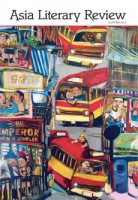
Asia Literary Review 28

Martin Alexander (editor) Asia Literary Review 28, [Northern] Summer 2015

This issue of Asia Literary Review was part of a collaboration with Australia’s Griffith Review. I subscribe to ALR (actually I have a complimentary sub, for which I am grateful) but have only read one or two issues of the GR, which I guess makes me an atypical Australian reader of this joint publication.

Because the ALR is an English-language journal, every issue engages with cultural complexities: inter-generational stories, post-colonial hybridity, expat and emigrant writing, and some translation. In this issue, Australia is the non-Asian pole of much of the interaction. As always, the Asian presence is nothing if not diverse, including writing from or about mainland China, Hong Kong, India, Indonesia, Japan, Kashmir, Malaysia, Myanmar, Nepal, North Korea (a defector), the Philippines, Singapore, Thailand, and Vietnam.

Among the Australian contributors, Omar Musa – rapper from Deniliquin, spoken-worder and author of Here Come the Dogs – strikes a different tone in ‘Supernova’, a sober, reflective story about an older emigrant who has returned to Malaysia and takes part in the political process there; Ellen van Neerven’s ‘Half a Butterfly’ reports on a visit to Goa as part of a cultural exchange between Aboriginal Australian writers and Dalit writers; and Jessie Cole’s ‘The Asian Invasion’ is, among other things, a memoir of her childhood in Hippie Nimbin that challenges the received version of that community as drug-fuelled, self-indulgent and delusional, offering instead a recollections of one that was diverse, open to new experiences and other cultures.

One or two articles seem to be written with Australian readers in mind: Keane Shum’s marvellous ‘Ripple from Hong Kong’ tells a history of that island from the perspective of a Hong-Konger whose people were there long before the Chinese ceded it to Britain; in ‘All for the People, without the People’, André Dao starts from his own experience of voting in Melbourne, complete with sausage sizzle, and goes on to consider what democracy and ‘human rights’ might mean in Vietnam, a familiar subject presented through a personal prism; Miguel Syjuco’s ‘Beating Dickheads’, an argument for mockery as a form of resistance to tyranny, invites Australian readers to consider their own practice of mocking those in power (‘Every nation has its unfair share of dickheads, douchebags, dingleberries and degenerates. But my country, the Philippines, bests most in democratic tomfoolery.’); when Prodita Sabarini’s ‘Let Bygones Be Bygones‘ discusses the great Indonesian silence about the 1965 massacres, her main non-Indonesian reference point is Joshua Oppenheimer’s movies The Act of Killing and The Look of Silence – Oppenheimer is a USer, but his films have made a big splash in festivals here, as, evidently, they have in parts of Indonesia.

I don’t want to give the impression that everything is geared towards Australian readers. Far from it. The pleasure of encountering the unfamiliar, of being an invited eavesdropper, is as strong here as in any other issue. A number of pieces, for instance, discuss the role of humour, which notoriously travels poorly. Apart from ‘Beating Dickheads’, there’s Murong Xuecun unpromisingly titled ‘Chinese Thinking the Age of the Internet’. ‘If President Xi Jinping is clearheaded,’ he writes, ‘he will understand that although he may be able to seal people’s mouths, he can never stop them sniggering.’ Fair enough, one thinks, but the essay becomes really interesting when it gives examples of the subversive humour that the Internet allows to spread:

New English words with Chinese characteristics are popping up: Chinese citizens become shitizens; Chinese democracy begat democrazy; secretaries with Chinese characteristics (especially the female secretaries of high officials) are sexcretaries. Political jokes are also spreading. Here’s one I encountered recently: Xi Jinping went into the Qingfeng Dumpling Shop and asked what the fillings were. The waitress answered, ‘This one is cabbage and pork; this one is pork and cabbage; this one is pork with added cabbage. Which do you want?’ Xi thought about it for a moment and said, ‘They’re all the same, there’s no choice.’ The waitress responded, ‘Aren’t you forgetting, that’s how we chose you?’

You have to love the people who make these jokes, even if you don’t laugh. And though the essay doesn’t mention Ai Wei Wei, it changes the way one sees what some critics describe as his self-promoting poseurdom (and incidentally, I recommend the Ai Wei Wei / Andy Warhol exhibition that’s currently at the National Art Gallery of Victoria).

I also recommend Asia Literary Review. This blog post has barely skimmed the riches of this issue.

Ed Brubaker’s Fade Out

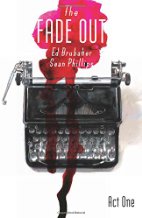
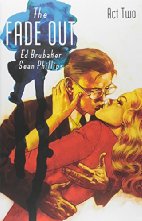
Ed Brubaker and Sean Phillips, with colours by Elizabeth Breitweiser, The Fade Out
– Act One
 (Image 2015)
– Act Two 
(Image 2015)

1632151715I’ve no sooner decided that superhero comics bore me than the universe, mediated through the generosity of my sons, sends me an apparently endless stream of comics in other genres: investigative journalism, space opera, fairytale epic, domestic comedy, and now Hollywood noir.

It’s 1948. Our narrator, Charlie Parrish, is a Hollywood writer. Traumatised by his experience in World War Two he can’t write a thing, but he keeps his job by secretly taking dictation from his friend Gil, who has been blacklisted by the House Unamerican Activities Committee and so can’t get any work in his own name.

1632154471A beautiful woman is murdered in the first couple of pages, and the crime scene is altered to make it look like suicide. Charlie sets out to investigate and uncovers as much corruption, secretiveness and deranged viciousness as Philip Marlowe or Sam Spade could ever have wished for. He also gets beaten up quite a bit and gets involved with the beautiful woman who has replaced the murder victim in the film they’re all makng. He and Gil have a difficult relationship, not helped by Gil’s alcohol intake and his tendency to want to speak truth to power without regard for the consequences. Some real characters appear: Clark Gable knows Charlie from his war days, and Dashiell (‘Sam’) Hammett gives advice on how to flush out a murderer.
The plot is still thickening at the end of Act Two. Trails have been laid that may lead to interesting places – for example, will we be given the details of Charlie’s war experiences? I can’t find any information about how many more Acts are to come. Act Three is due out next month, and then who knows?

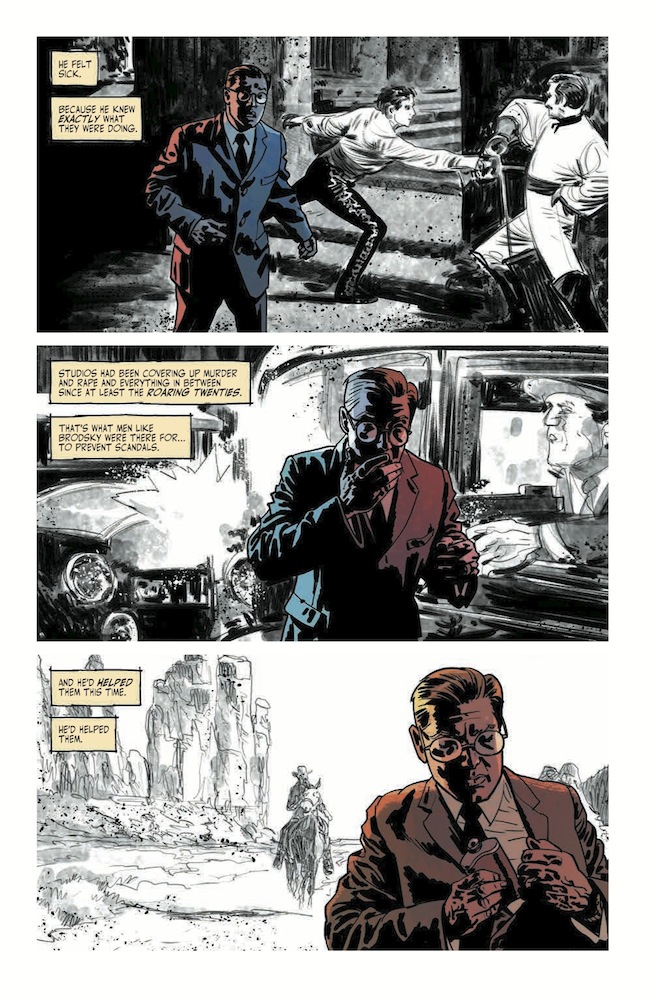
Brubaker and Phillips have been a team for more than 16 years, and the work feels seamless. Elizabeth Breitweiser’s colouring deserves a mention for its wonderfully evocative moodiness. The shadowy details of Hollywood behind the scenes may be a little hard for my ageing eyes to make out when I’m reading at night, but it’s worth the effort. Here’s a page I’ve lifted from the Image website:

FadeOut.jpg

The books, each a compilation of four original comics, are beautifully done. There’s none of the generational lossiness or iffy registration that bedevils comics from a couple of decades back, and the four original covers reproduced up the back of each book are stunning.

David Malouf’s First Place

David Malouf, A First Place (Knopf 2014)

dmfpThere isn’t just one Australian story. Even as a child I had my doubts about grand unifying versions of what it is to be Australian. Even though my family were white and English-speaking, and enjoyed meat pies and Vegemite as much as anyone, we lived in coastal north Queensland, where Dorothea Mackellar’s ‘land of sweeping plains’ might as well have been on another planet. The much talked-about monoculture of Australia before the 1950s may have been a reality in Sydney, but my grandfather, a magistrate in Queensland in the 30s and 40s, learned Italian in order to deal with the people who appeared before him and my sugar-farmer father played poker with a Greek and a Korean, and placed bets with a Chinese SP bookie.

David Malouf hails from Brisbane, which we in Innisfail referred to as ‘Down South’ or even ‘The Big Smoke’, but the essays and occasional writings collected in  A First Place provide eloquent solace to my inner tropical child. This is from ‘A First Place’, a lecture from 1984:

We have tended, when thinking as ‘Australians’, to turn away from difference, even to assume that difference does not exist, and fix our attention on what is common to us; to assume that some general quality of Australianness exists, a national identity that derives from our history in the place and from the place itself. But Australians have had different histories. The states have produces very different social forms, different political forms as well, and so far as landscape and climate are concerned, Australia is not one place

Following his own advice Malouf writes beautifully in that lecture and throughout the book about his home city of Brisbane, about Queensland architecture, both domestic and public, about his culturally diverse family (‘My Multicultural Life’, also written in 1984, and ‘As Happy as This’ written for a collection of family memoirs a decade later, are joys to read), about the Bicentenary, Anzac Day, the Republican movement. He is always urbane, humane, nuanced, always drawing on a deep and broad knowledge of Western art and literature.

In 1988 he wrote a piece on the Bicentenary for the Age, ‘Putting Ourselves on the Map’. Like many of us, he was uneasy at the fanfare and pomp, but he was able to get past bald political catch-cries, writing that

this celebration of a great event goes against the grain with me because it goes against the grain of our real experience as Australians. Anniversaries are not what this particular enterprise is about. The anniversaries of the real events that made us, the millions of small ones – axe blows, blows with the pick and crowbar, childbirths, first cries, the squeak of chalk across a blackboard – do not need celebrating, or are celebrated already, by repetition each day. This particular event [the arrival of the ‘First Fleet’] is too ambiguous – and its repetition in fancy dress is ridiculous. It is too blackened with sorrow for some of us … and with shame for the rest: too loaded with despair, courage, the slow triumph of surviving and creating, for its re-enactment to be any more than a tawdry farce.

The longest piece in the book at 110 pages is ‘A Spirit of Play’, which comprises Malouf’s 1998 Boyer Lectures, a masterly meditation on ‘The Making of Australian Consciousness’. In these essays Malouf brings a poet’s sensibility to a subject we’re used to hearing about from journalistsor politicians. He draws on deep knowledge of history, poetry, architecture, to tell a story that is at once his own and persuasively ours.

It’s interesting to think about who that ‘ours’ refers to: it shifts around, sometimes seeming to exclude, for example, Aboriginal people, or Communists, or committed homophobes, but these exclusions aren’t rigid. Roughly speaking, ‘we’ are people who participate in mainstream Australian culture. What Malouf has to say about an audience is relevant:

An audience comes together of its own volition, unlike a rally, for example, where there is always some element of compulsion, if only a moral one of commitment or duty. An audience simply appears, as the 700 000 or so people do who turn out each year for the gay Mardi Gras procession in Sydney. They have no reason for being there other than interest, curiosity, pleasure, and they are an audience, not simply a crowd; an audience that has been created and shaped by the society it draws from, and in which the faculty of watching, listening and judging has been to an extraordinary degree sharpened.

He has more to say about that particular audience, but I think it’s fair to say that his general notion of an audience relates in some way to the ‘us’ he talks about in these essays: ‘we’ are the people who of our own volition do our watching, listening and judging in this society, and also our creating, living and relating to one another. Both the people who wrapped themselves in the flag at Cronulla ten years ago (nearly a decade after these lectures were given) and the people attacked by them are part of ‘us’, though each might not be part of some accounts of who ‘we’ are. Malouf certainly doesn’t deny the existence of brutality and narrowness in our history: his account of the 1950s as on the one hand ‘comfortable, secure, cosy’ and on the other mean-spirited, defensive, embattled ‘against life itself’ is brilliant, and then followed up by his compassionate account of the series of blows that closed down the open-hearted confidence of the start of the century – which I will leave you to read. (It turns out the original lectures are still online at the ABC’s website. The description of the 50s is in the fifth lecture, ‘The Orphan in the Pacific‘.)

There’s a lot more. These essays were written over three decades for vastly different readers and audiences. They build on each other, occasionally almost contradict each other, rarely outright repeat each other. They don’t demand that the reader agree with them, but ask us to engage thoughtfully, and often to have another look at received ways of seeing the world. Taken together, they are a beautiful example of what Malouf calls ‘the real work of culture’:

This business of making accessible the richness of the world we are in, of bringing density to ordinary, day-to-day living in a place, is the real work of culture. It is a matter for the most part of enriching our consciousness – in both senses of that word: increasing our awareness of what exists around us, making it register on our senses in the most vivid way, but also of taking all that into our consciousness and of giving it a second life there so that we possess the world we inhabit imaginatively as well as in fact.

As a bookish child in north Queensland, I felt the absence of that work, perhaps not acutely but as a dragging background ache. Seeing  cane-cutters on stage in The Summer of the Seventeenth Doll when I was nine was a revelation, though even then the North was a long way from the real, felt action of the play. David Malouf’s essays are a wonderful gift to that child, who is still here, hoping to have density brought to his life in that place.

I read A First Place in August last year. I think I’ve delayed blogging about it because I didn’t want to be finished with it. It’s been sitting on my desk, like a talisman. It’s been good to go back to it to write this. I will go back to it again.

Self-promotion

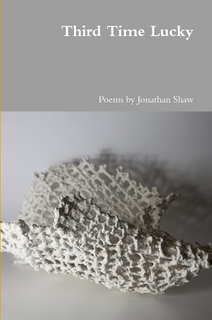
3tlIt’s all very well reading stuff online, but for my money you can’t beat the feel of a dead-tree book in your hand. Likewise, I enjoy putting my verses up on the blog, but it’s not the same as having them in an actual book. So in December last year, for the third time I collected verses written during the previous 12 months and got a book together thanks to lulu.com, again with a cover by the Emerging Artist, this time one of her fabulous ceramics. It’s now available from Lulu and Amazon.

Apart from pure vanity, my main motive for this and previous self-publishing ventures is to make a small gift to give friends the end of the year. If you’re a friend who hasn’t got a copy, then it’s an oversight on my part. Tell me in the comments or by email and I’ll send you one.


Bill Willingham’s Fables 6–10

Bill Willingham and many artists, mainly Mark Buckingham, and Todd Klein letterer, Fables:
– 6: Homelands (Vertigo 2005)
– 7: Arabian Nights (and Days) (Vertigo 2006)
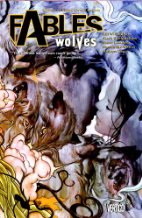
– 8: Wolves (Vertigo 2006)
– 9: Sons of Empire (Vertigo 2007)
– 10: The Good Prince (Vertigo 2008)

fables6.jpg I’ve written about earlier volumes of Fables here, here and here. If I say that these five volumes, borrowed from a son, give us more of the same, that is not a negative comment. The story, which unfolded as a series of monthly comics, came to an end last July with No 150. These five collections bring us up to No 69.

For synopses you can go to Wikipedia. I just want to reflect here that though Bill Willingham may, as he says, have decided to work with fairy tale characters because they are out of copyright, that’s not as simple as it sounds. Lots of characters that are out of copyright have completely disappeared from the cultural memory: fairytale characters come with histories.

fables7.jpg There’s wit in making snoopy little Goldilocks grow up to be an adventurous spy, for example. Likewise, Hansel makes sense as a fanatical witch-killer and Prince Charming as a feckless womaniser.

More broadly, the identity of the Adversary  – the powerful character who aims to dominate or destroy the all the Fables (as fairy tale characters are called here) – as revealed in Book 6 plays beautifully  with our inherited lore. Or when Sinbad the Sailor turns up in Book 7 as an emissary from fairytale Baghdad, we are well prepared for his vizier to turnout to be a bit on the wicked side, and we’re not surprised when the survival of the universe is threatened by an all-powerful d’jinn.

fables8.jpg The overall arc of these five volumes is something you don’t expect from the ‘fractured fairytale’ genre: an epic battle is brewing between the forces of good and evil. Bigby Wolf has more in common with Achilles or Arjuna than with the Grimms’ Big Bad Wolf. And it’s not too much of a stretch to see Jack (of candlestick and beanstalk fame) as a wily Odysseus. Not that epics and fairy tales have to be kept separate. Correct me if I’m wrong, but the Iliad and the Odyssey are built from a whole storehouse of received folk stories, the early books of the Bible have a strong folk content (the J and E strands, rather than the P and D), and the Mahabharata (as Cheryl D mentioned in a comment on this blog recently) has tremendous popular appeal now, and almost certainly did from its beginnings.

fables9.jpgThe intimacy / domesticity of fairy tales is still there: several romances are brewing as surely as the war. Bigby Wolf and Snow White marry at last, and Bigby resolves some big issues with his father and siblings in Book 8. There’s  a sweetly comic romance in Book 9 between a wooden soldier and his wooden woodcarver. They have heard about kissing:

‘Basically we open our mouths and touch them together.’

‘We can do that.’

‘How long do we stay like this?’

‘I’m not sure. At some point it’s supposed to feel good.’

‘Maybe I didn’t write down the instructions correctly.’

But sweet as this romance is, we don’t forget that its outcome has a strategic importance in the overall conflict.

fables10.jpg In Book 10 this combination of the domestic fairy tale and the epic is most clear. The Good Prince is a single narrative arc that takes up most of the book. It beautifully melds the story of a prince who was turned into a frog with harrowing of hell / raising of dead armies / return of the king stories. Its conclusion is a great point to take a rest in one’s progress through the massive work.

Fables is often compared, with some justice, to Neil Gaiman’s Sandman. It’s not as serious as the Gaiman work: Gaiman’s work features the Endless, eternal beings who are his own reinvented pantheon. Fables is not about gods but non-human beings at the fairy level (goblins, shapeshifters, giants, d’jinns, sentient animals) and humans who deal with them (witches, wizards, the enchanted). Even in the episodes of carnage, there is a fairy lightness to it, the stakes are less than cosmic. It’s consistently funny and exciting and inventive, it challenges us to think about the meanings of fairy tales, and I’m looking forward to the next10 or so volumes, but it makes no claim to explore the meaning of life.

I Stay

Our weekend was chockers with fabulous art. On Saturday we visited the Carriageworks for El-Anatsui exhibition with not only his breathtaking tapestries made from discarded wine bottle caps and wire, but also some older works: ceramics, wood carvings, drawings. Then into town for one part of the Destination Sydney exhibitions – Margaret Preston, Grace Cossington Smith and Cressida Campbell at the S H Erwin. Today we went in late morning to the MCA for the incredibly busy work of Grayson Perry, and then an excellent exhibition of work from Tiwi artists. And there were Lloyd Rees’s extraordinary landscape drawings from the 1930s at the Sydney Museum on the way home.

But the biggest thrill happened in the street. I’ve passed Jenny Holzer’s I Stay many times but never stopped to look at it. It consists of text rolling up a couple of slanting pillars outside an office block in the CBD. It turns out that the text is excerpts from a large number of Aboriginal source – historical documents, poems, essays, etc. Only a few words are visible at any one time and the sources aren’t identified (unless, as a plaque explains you go to Jenny Holzer’s website http://www.istaybyjennyholzer.com/). The big revelation today was that if you stand and read the text for a couple of minutes, not only do you absorb the content of the fragment that happens to pass along the column at that time (in our case it was some thing about the colour of water), but when you look away, the rest of the world looks shaky and insubstantial – the buildings around you, all the solid realities of post settlement Sydney –  seem to waver like mirages. The word that comes to mind is unsettling.

Mahabharata for young (and English-speaking western) readers

Upendrakishore Ray Chowdhury, Mahabharata for Young Readers translated from Bengali by Swapna Dutta (The Book Mine, Hachette India  2015)

9350099985.jpg I expect my readers are generally familiar with the notion of divine inspiration: God, or a god, breathes life into a mere human’s writing. Sometimes a writer even claims to literally take dictation from a spirit being. The great Indian epic the Mahabharata happened the other way around. It was written down by the elephant god Ganesh, taking four-handed dictation at speed from the more-or-less human Vyasadeva. Ganesh is traditionally shown with one broken tusk because when a nib of one of his pens broke Ganesh snapped off part of a tusk and  dipped it in ink to keep up with Vyasa’s stream of words.

Since that mythic event there have been many translations of the Mahabharata, some of them into English. It’s roughly a hundred years since Upendrakishore Ray Chowdury published his Chheleder Mahabharat, a version for Bengali children. Only now has this pint-sized version found its way into English, thanks to the labours of children’s writer and blogger Swapna Dutta. It would be a challenging read for most children in my part of the world – no illustrations and a lot of unfamiliar concepts – but those who rise to the challenge will be well rewarded, as I was by Kingsley’s Heroes.

The book tells of a longlasting feud between two noble families, the Pandavas and the Kauravas, which culminates in an epic battle that leaves millions of corpses piled on the ground. Within that framework is an extraordinarily rich compendium of tales – of magic, nobility, craftiness, romance and treachery, of words which, once uttered, bind the speaker in unexpected ways. Some of them are familiar to me from my time editing a children’s magazine. Others are so archetypal that I feel I ought to know them  (and am pleased that now I do!).  For example, when the five Pandava brothers return home from an adventure where one of them has won the hand of a beautiful woman, the bridegroom-to-be calls out to their mother, ‘Come and see the beautiful thing I have found.’ From inside the house, their mother replies, ‘Make sure you share it with your brothers.’ In the world of the Mahabharata these words are binding, and the brothers must find a way for all five of them to marry her. (They do, with happy results.)

Familiar names inhabit the pages, notably Arjuna,the great warrior, and Krishna, here Arjuna’s charioteer. There are many others, like the women Kunti and Draupadi (the bride of all five Pandavas), who ought to be better known.

Of course, this version is no substitute for the thing itself. Among the incidents considered not suitable for children, for example is the conversation between Krishna and Arjuna when the latter has misgivings about going into battle and slaying an awful lot of people. This conversation is passed over in a sentence here:

Krishna’s words were long enough to fill up an entire book that came to be known as the Bhagavad-Gita which you should read for yourself when you are older.

The Bhagavad-Gita is 700 verses long, and according to Wikipedia ‘presents a synthesis of the Brahmanical concept of Dharma, theistic bhakti, the yogic ideals of moksha through jnana, bhakti, karma, and Raja Yoga … and Samkhya philosophy’. And there are other bits where our narrator tells us that someone explained the meaning of life but doesn’t burden us with the content. I imagine that both my relief at not having to read the philosophy right then in the middle of the action, and my curiosity about what Krishna said are exactly what Upendrakishore Ray Chowdury hoped to rouse in his young readers.

Given that the lengthy philosophising is omitted, is there anything for the reader besides superhero murderousness and charming folktales?

Well, yes. There’s a lot here to grab the imagination and engage the moral intelligence, not to mention stirring curiosity about the possible historical events that lie behind the tale. Ii imagine every reader will find something different here. For me, possibly the most moving thing was the way, even though at the surface level there seems to be a massive celebration of violence, there is also a tremendous sense that the warriors are trapped, that many of them are fighting against their will, obliged by codes of honour and obligations of loyalty to fight and kill close relatives, whom they love dearly. The famous World War One episode of the Christmas Truce, where soldiers played and sang together for a day before going back to killing each other, could have come from these pages.

Don’t take my word for it. I was given my copy by Hachette India, but you can buy one for about $20 here.