2015 favourites

Each December we – that is, me and the Emerging Artist formerly known as the Art Student – compile a list of our favourite books and films of the year. We’ve been caught this year with minimal internet coverage (and maximal sun, sand, beach, bush and rain, especially rain) so we’re running a bit late.

Three movies made both our top five lists:
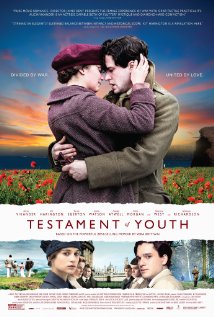
ToY

Testament of Youth (directed by James Kent), from Vera Brittain’s memoir, screenplay by Juliette Towhidi: A World War One film in the year when idealising  Gallipoli  was big in the headlines, it doesn’t focus on the battlefield but on the effects of the war on the combatants and their families and loved ones. It makes a powerful pacifist argument.
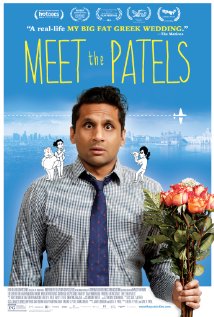
Meet the Patels (Geeta Pavel, Ravi Patel 2014): We saw this at the Sydney Film Festival. It’s unlikely to get a theatrical release, but it’s a very funny documentary about match-making among first generation Americans of Indian heritage. It’s really about intergenerational relationships. The EA says it’s a must-see for every parent.
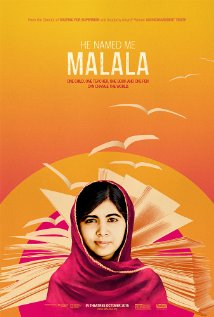
hnmm

He Named Me Malala (Davis Guggenheim 2015): Another documentary, this one could be seen as hagiographic, but Malala Yousafzai is a remarkable young woman. I loved the way she spoke with the absolutism of teenagehood from a position of influence to tell the president of Nigeria to do his job and ensure the safety of the girls abducted by Boko Haram.

The Emerging Artist’s other two:
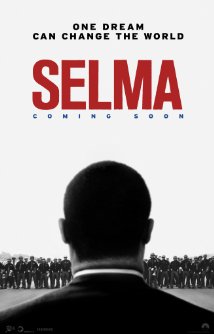
selma

Selma (Ava DuVernay 2015): A flawed movie, but it conveyed the experience of ordinary people taking part in Civil Rights marches. The leadership of the march across the bridge was particularly interesting: how to think strategically, resisting the push to be seen to take ‘decisive action’. The filmmakers weren’t given permission to use Martin Luther King Jr’s actual speeches, but the ones written for the film caught his style brilliantly.
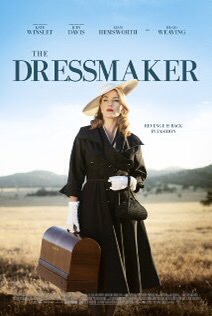
 The Dressmaker (Jocelyn Moorhouse 2015): The humour, the flamboyance, the over-the-topness of it. Kate Winslett was marvellous. So was Hugo Weaving. In fact, there were no weak performances.

My other two:
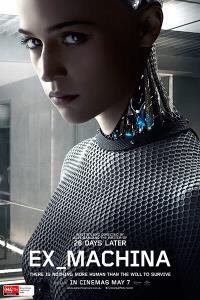
 Ex Machina (Alex Garland 2015): The thing that stays in my mind is the image of the artificially intelligent creations – a fabulous effect where we see the cogs and wheels whirring away inside what is otherwise a human head. The story worked very well too.
ffm

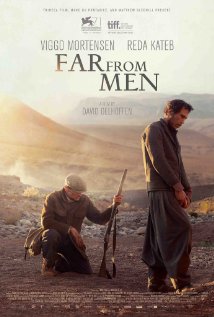
Far from Men (David Oelhoffen 2014): Apart from enjoying the easy irony that there were only men in most of the film (should it have been called Far from Other Men?), I was transfixed by this slow, beautiful film of a pied noir (Algeria-born white Frenchman) escorting an Arab prisoner through the austerely photogenic Atlas Mountains.

The EA’s top five books:

The EA’s reading year was bookended by titles that brought home the harshness of the oppression of gay men and lesbians, even in times and places where one might think it was comparatively mild. Damon Galgut’s Arctic Summer deals with novelist E M Forster’s agonising life in the closet, and the part of Magda Szubanski’s memoir, Reckoning, that tells the story of her coming out is genuinely harrowing.

But those books are in addition to her actual top five. Here are those, with her comments:
1846145066

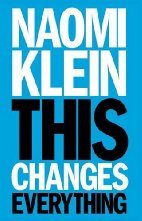
Naomi Klein, This Changes Everything: This is a bracing book that everyone needs to read. We all know about climate change in a general way, and we know that powerful vested interests fight attempts to respond effectively. Naomi Klein gives detail and challenges us not to look away.
ioc

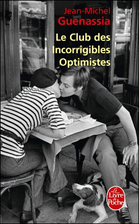
Jean Michel Guenassia,  The Incorrigible Optimists Club: A novel about Soviet bloc refugees in Paris at the time of the Algerian War of Independence, this includes a coming of age story.
1743319118

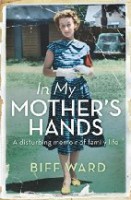
Biff Ward, In My Mother’s Hands: Excellent memoir of a 50s childhood. Buff Ward’s father was prominent left wing historian Russel Ward, so the domestic story includes elements of red-baiting. But the real power of the story is in her mother’s intensifying irrationality and the family’s attempts to deal with it.
1408703483

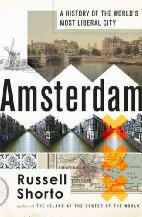
Russell Shorto, Amsterdam: A History of the World’s Most Liberal City: The birth of liberalism without the US-style individualism. This is not a travel book. It’s very accessible, thoroughly researched history that compelled at least one person to read big chunks aloud to her partner. The history of Europe looks different after reading this .

9781742232430

Vivien Johnson, Streets of Papunya: Vivien Johnson has been involved with the Western Desert artists for decades. An earlier book told the story of the great Papunya Tula artists. This book tells the story of Papunya itself, especially after many of those artists left. Art is still being made there, by a new generation, mostly women.

My top five books:

I read at least 12 books in 2015 that did what you always hope a book will do: delighted, excited or enlightened me, changed the way I felt and/or thought about the world. I whittled the list down to five by selecting only books that touched my life in explicit ways. Here they are i order of reading:
1781251088

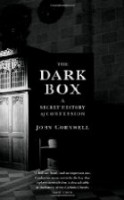
John Cornwell, The Dark Box (2014): A history of the rite of Confession in the Catholic Church. The confessional was a big part of my childhood. I’ve dined out on a story of going to confession with Brisbane’s Archbishop Duhig when I was about thirteen. He asked in a booming voice that I was sure could be heard by everyone in the cathedral outside, ‘Would these sins of impurity have been alone or with others?’ Cornwall’s book felt like a very personal unpicking of that moment and the whole cloth it was spun from.
1555976905

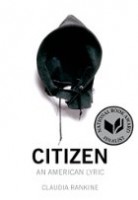
Claudia Rankine, Citizen: An American Lyric (2014). What can I say? I’m white. In laying out the way a word or phrase between friends or strangers can disrupt day-to-day life, so that the ugly history of racism makes itself painfully present, and linking those moments to the public humiliations of Serena Williams and the violent deaths of so many young African-American men, the book is a tremendously generous gift. It and Ta-Nehisi Coates’s Between the World and Me share this generosity of spirit.
dmfp

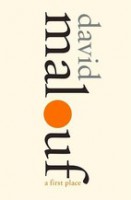
David Malouf, A First Place (2015): I haven’t blogged yet about this collection of David Malouf’s essays. It feels personal to me because David lectured me at university, but also because he is a Queenslander, and these essays explore what that means. Even though he is from what we in north Queensland used to call ‘Down South’, these essays fill a void I felt as a child – I was a big reader, but the world I read about in books only ever reflected the physical world I lived in as an exotic place.

talking-to-my-country

Stan Grant, Talking to My Country (2016): I was privileged to read this ahead of publication. Stan Grant is a distinguished Australian TV journalist. This book, part memoir, part essay, gives a vivid account of growing up Aboriginal. It includes the most powerful account of a ‘mental breakdown’ I have ever read, not as a medicalised episode of ‘depression’, but as the result of generations of pain inflicted by colonisation refusing to stay at bay.
The-Fox-Petition

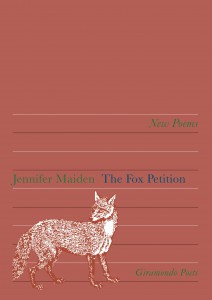
Jennifer Maiden, The Fox Petition (2015): I love this book in all sorts of ways. I love the way the image of the fox recurs – a literal fox, a fox as in Japanese folk lore, Whig politician Charles Fox. I love the chatty voice, and Jennifer Maiden’s trademark linebreaks after the first word of a sentence. I love the argumentativeness. I love the playful, almost silly, resuscitation of the distinguished dead to confront those who claim to be inspired by them. I love the way Jennifer Maiden makes poetry from the television news the way some poets do from flowers.

And now, on to 2016! I’m already about eight books behind in my blogging.

My AWW Year

This is my mandatory round-up post about the Australian Women Writers’ Challenge 2015. I think I undertook to read 10 books by Australian women writers. I read 21. It was not an ordeal.

• I read poetry, such poetry:

I read two stunning memoirs:

In My Mother’s Hands, Biff Ward

Reckoning, Magda Szubanski, as an audiobook read brilliantly by the author

• I read biography and recent history

Barbara Baynton: Between Two Worlds, Penne Hackforth-Jones

The Streets of Papunya, Vivien Johnson

• I read novels:

The Golden Age, Joan London

When the Night Comes, Favel Parrett

The Strays, Emily Bitto

The Soldier’s Wife, Pamela Hart

The Life of Houses, Lisa Gorton

Chasing Shadows, Leila Yusaf Chang

• I read a brilliant essay:

Quarterly Essay: Dear Life, Karen Hitchcock

• I read short works, including a book of short stories, components of Going Down Swinging‘s Long Box, and children’s books:

Go to Sleep Jessie, Libby Gleeson and Freya Blackwood

The Cleo Stories: The Necklace and the Present, Libby Gleeson and Freya Blackwood

Bush Studies, Barbara Baynton

Thirteen Story Horse, Bridget Lutherburrow

News from a Radiant Future, Katherine Kruimink

Protein, Libbie Chellew

Its not as if I read these books just because they were written by women, but I doubt if I would have read them all if not for the challenge. My life is definitely richer for it.

I intend to sign up for the 2016 challenge. Of course.

Jennifer Maiden’s Fox Petition

Jennifer Maiden, The Fox Petition (Giramondo 2015)

The-Fox-Petition Like all Jennifer Maiden’s books for several years now The Fox Petition has a huge cast of historical and fictional characters, as well as some living politicians and a couple of non-human entities.

Most of these appear in Maiden’s dialogue poems. Julie Bishop makes her debut, and so do father and son act Keith and Rupert Murdoch. Making return appearances are Kevin Rudd and Dietrich Bonhoeffer, who seem to be forever on an aeroplane; Tony Abbott and Queen Victoria, whose relationship is becoming even more tense; George Jeffreys and Clare Collins continuing their adventures, this time in the Greek financial crisis and with refugees from Syria; Hillary Clinton and Eleanor Roosevelt, still flirtatious and remonstrative in pretty equal measure.

I think the Hon. Carina Monckton, created by the inhabitants of the Carina Galaxy, has appeared in an earlier book, but I’m positive that the Harvard School of Business has not been seen before his chat here with Julie Bishop.

Then there are the Diary Poems, so called because they seem to ramble like diary jottings, though those appearances are hugely misleading. Many other characters get a guernsey in them, including Tanya Plibersek, Gillian Triggs, Penny Wong, Joan Baez, Labor politician Melissa Parke (Maiden’s ‘favourite politician / now’) and eighteenth century Whig Charles Fox (her ‘favourite politician / of all time’).

Heavily populated though the book is, it has an extraordinary coherence. The title refers to a recent protest against measures in New South Wales making it illegal to keep a ‘newly acquired fox’, even if neutered and vaccinated, and also to Charles Fox’s defence of habeas corpus during the Napoleonic Wars. What links the two, apart from the word play (of which there is a lot) is Maiden’s passionate dislike of the single-minded self-righteousness she has previously called ‘ethical security’, which here is represented literally and metaphorically by Biosecurity: the goal of being safe from germs, feral animals, refugees, and moral complexity of any kind.

As my regular readers know, I’m a fan. I love the voice of these poems. A Maiden poem characterically feels as accessible and even as interactive as a chat with a friend about the TV news, making you laugh and perhaps confirming your prejudices.Then extraordinary lines emerge, such as:

it is vital to be Australian, which
seems to mean rat poison and a flag.

Something else has been going on behind the chat. It is, after all, poetry made from the stuff of the nightly news, that pushes the reader to think and feel in new places. Did I also mention that it’s fun?

aww-badge-2015 The Fox Petition is the twenty-first and last book I read for the 2015 Australian Women Writers Challenge.

Adrian Tomine’s Scenes from an Impending Marriage

Adrian Tomine, Scenes from an Impending Marriage: A pre-nuptial memoir (Drawn and Quartered 2011)

0571277705.jpgI heard Adrian Tomine’s most recent book reviewed on the radio, and ever keen to expand my knowledge of fine comics I went off to Kinokuniya in search of the thing itself. But contrary to the rumours a lot of people listen to the ABC, and the last copy of Killing and Dying had sold that morning. The helpful young man in the comics section produces this as the only Adrian Tomine on the shelves. I was reluctant to leave empty handed, so he made a sale. (It being late December and me having gifts to buy, I also bought one or two other things, but perhaps more about them later.)
It’s an intimate book, consisting of a series of vignettes from the life of Tomine and his fiancée in the year leading up to their marriage: deciding on the guest list, the invitations, the venue, the entertainment, contemplating elopement etc. It’s witty, convincingly real, and benign, with absolutely no killing or dying of any sort, drawn  and framed in a style that’s much closer to Peanuts than to, oh, Sin City. I don’t think it’s giving too much away to say that in the final section, the bride-to-be proposes that each wedding guest be given a little book about the lead-up to the marriage, made by Tomine. This book would have filled that bill superlatively.

It’s odd to be introduced to a comic maker’s art through such an obviously tangential work. But I’m looking forward to seeing more of Tomine’s clean lines and quiet social observation.

Andrea Levy’s Small Island

Andrea Levy, Small Island (Review 2004)

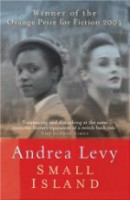
0755325656This is a completely wonderful book. The main action takes  place in London in 1948. The city is suffering the aftermath of war. Men are still returning from the conflict, and everyone is adjusting to new realities. In particular, men from the Caribbean who have volunteered to defend the ‘Mother Country’ now decide, some of them, to make new lives in England. The story centres on one of them, Gilbert, and his new wife, Hortense, as they come up against what in this book is clearly a shocking betrayal of the promises of the British Empire – white racism.

The other main characters are Queenie, a white woman who befriends Gilbert, and her husband Bernard, who is obnoxiously insular, pompous, racist and sexist. Each chapter is narrated by one of these characters, either in 1948 or ‘Before’: so we get childhood stories from Jamaica and rural England, and war experiences in many part of the globe, all told with a brilliant ear for different englishes. One of the many wonders of the book is that when, well past the half way point, Bernard finally has a series of chapters, we come to sympathise with him: not to like him, except possibly for one moment of unexpected generosity, but at least to feel for him.

Circumstances meant that I read most of Small Island in short bursts. This meant I could notice that while the story, or stories, did keep moving along, there was something to delight on every page. I was reminded of a piece of advice to young writers I read somewhere: Give the reader cool stuff now, and then more cool stuff later. That is to say, it’s no good having a fabulous surprise twist if everything leading up to it is dull. Well, nothing here is dull. Even dull Bernard’s story is gripping. A lot of it is very funny. The Jamaicans encounter racism but it does not define them. Brilliant humour made from the  differences between US and British brands of racism, and in the climactic moments Gilbert delivers a brilliant speech naming the idiocy of white supremacist attitudes.

The final pages are guaranteed to wrench any heart.

About the title: one of the Jamaicans refers disparagingly at one point to the West Indians who come from small islands. Then he realises that Jamaica itself is a small island. And I don’t know if it’s ever made explicit, but there’s a strong implication that Britain is also one, its people as insular in their ways, as resistant to change and outside influence as anyone from St Kitts or Martinique.

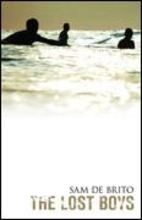
Sam de Brito’s Lost Boys and the Book Group

Sam de Brito, The Lost Boys (Picador 2008)

lost boysBefore the meeting: Sam de Brito, a Sydney newspaper columnist and blogger, died in October. I don’t know if any of us in the book group had read his columns or his blog, but we decided to read his only novel, The Lost Boys, to honour his passing. It turns out there’s not much honour in it.
It appears to be about a man who, having spent his teenage years drinking, smoking dope and preoccupied with sex and peer-group status, hasn’t changed much in his thirties and hates himself for it. Mysteriously, given the almost total lack of reflectiveness in any of the characters, he also seems to be a writer. For Sam’s sake, I devoutly hope this isn’t substantially autobiographical. I couldn’t bring myself to read the whole thing. I wanted to lay it aside after ten pages but persevered for 60, and seeing no sign of any change, threw in the towel.

Here’s a sample from the post-schoolboy era:

Andrea just watches as we pass the bong around.
– You don’t smoke, Andrea? I ask.
–Not really, not any more, she says. – When I used to live in Indonesia we smoked so much and the stuff you get there, it really had a kick, let me tell you, but the stuff you get here, it’s full of chemicals, it’s not like what we used to get when I lived in Indo.
Fuck, I guess she wants me to ask her about Indonesia, but I can’t be bothered. I’m pretty ripped, so all I can manage is  – Yeah?
– Oh yeah. Once we had this bag of heads, it was like this big.
She makes the shape of it with her hands. Big bag. I nod. She’s got a story to tell. We let her tell it.
– And we smoked joint after joint after joint. No one smokes cones in Indo. And we must have smoked like half of this bag and we were so off our faces we could barely talk.
She starts laughing at the memory. Chong smiles. I wonder if I’m missing something.
–And then we all had these incredible banana smoothies and the next thing we know its morning. All of us fell asleep, just like that. We were so off our faces.
She laughs again. I wait, then realise that’s the story.
Fuck me, chicks really need to go to storytelling school. The first thing they need to learn is it has to have a point of difference: a funny ending, some sort of killer twist. A joke or line. A piece of wisdom.

To be fair, I’m confident that the reader is meant to recognise the sexism there for what it is. To be equally fair, that doesn’t make it any less yukky (or, given the number of excellent books by women I’ve read recently, any less bitterly ironic). But the reason I quote this passage (from page 39) is that it signals that somewhere in the 360-odd pages ‘some sort of killer twist’, even a ‘piece of wisdom’, might emerge from the bleak hedonism of the narrative.

That signal wasn’t enough to keep me reading. Given that the friends who constitute the lost boys of the title are Christian Brothers old boys, perhaps there is an implied piece of wisdom: don’t send your children to Christian Brothers schools if you want them to have any moral compass or cultural ballast. (I spent two unhappy years in a Christian Brothers school myself, but I don’t endorse that message.)

At the meeting:
It was our last meeting for the year. We each brought a wrapped book from our shelves at home and each took one of them home. In addition to this, one chap, who turned 60 this year, brought a number of scrolled slips of paper on which he had printed short poems that, he said, represented the state of his soul this year. We each chose one and then read them out amidst some hilarity and some reflective chat.

We did discuss the book. Not many had finished it. One of the finishers said that he had started out reading it as thinly fictionalised memoir, but about half way through began to think of it as a moral tale: a warning of the dangers of too much drugs and alcohol. Another had been to the same school, drunk when under-age at the same pub, recognised some of the characters. Another said that the book captured for him the way men who have been friends in adolescent sometimes maintain the friendship even though some have gone on to have successful careers while others remain trapped in their adolescent anomie. From each of these I got a sense of the book as almost a tragic documentation of something that’s all too real, a poignant ‘There but for fortune’.

We met in a restaurant, and though we had booked a separate room, water damage from the recent storms meant there were a number of other tables nearby. This meant that any readings from the book had to be bowdlerised. One memorable passage involving a graphic description of coprophagy read by the professional actor kept its power even when bowdlerised, and made me think that perhaps this book would be better heard in company than read on the page: language which on the page is just revolting becomes when read aloud the verbal equivalent of a scene from a Hollywood gross-out comedy.

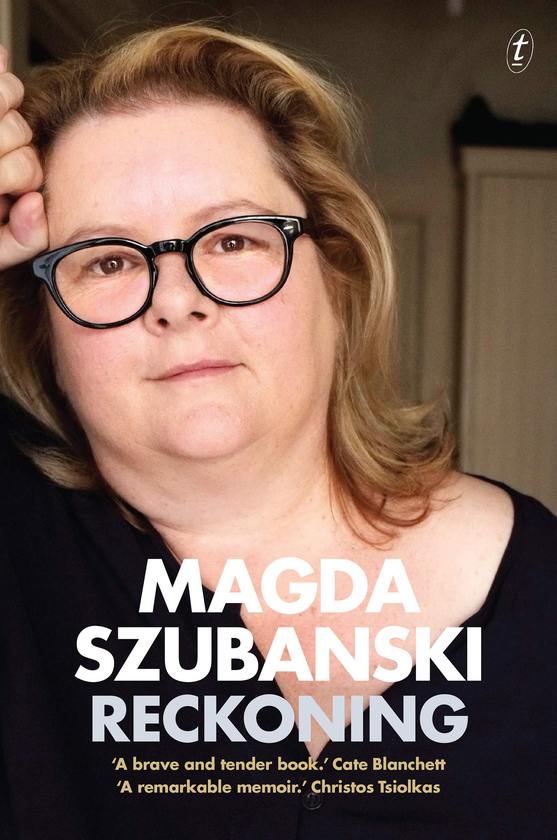
Magda Szubanski’s Reckoning & Tim Winton’s Island Home

Magda Szubanski, Reckoning: A Memoir (Text 2015; Bolinda audiobook read by Magda Szubanski)
Tim Winton, Island Home: A Landscape Memoir (Hamish Hamilton 2015; Bolinda audiobook read by David Tredinnick)

9781925240436.jpg We listened to Reckoning on a car trip fromSydney to Brisbane and then part of the way back. It’s hard to imagine a book better suited to such a trip.

Magda Szubanski, a superb comedian as the fat, unloved but ever optimistic Karen in Kath and Kim, and the bustling farmer’s wife in Babe, here comes out as a complex, thoughtful person with quite a lot to say and the ability to say it well. I particularly admire her way with similes. As you’d expect of a celebrity memoir, it gives us the background story on a number of her well-known and much-loved parts, as well as her more obscure commercial and critical failures. Unsurprisingly, it goes into her family history, but though there are elements of celebrity-misery-memoir in the story that emerges of a depressed mother and a rigid, disciplinarian father, the narrative transcends that category to become something much more interesting.

There are many strands. Possibly the most interesting is Magda’s quest to understand her father. She tells us at the start that he was a teenaged assassin, an ally to Jews who put his own life at risk, and a member of the Polish resistance during World War Two. A key element of her own life story is her gradual uncovering of the details and significance of that, and of its implications for how he related to his own children. There’s also her struggle with weight, and the agonising story of her coming to terms with her sexuality, of coming out to her family, and then to the world is a revelation. (That is to say, I vaguely remember that when she came out my response was something like, ‘That’s interesting – Oh look, something shiny!’ For her, it was a major decision: she had to face the possibility that her career and any number of important relationships would go down the drain, and she also had to face head-on the internalised version of the vicious oppression that comes at Lesbians and Gay men.)

Magda Szubanski reads this audio book, and I recommend this as a way of receiving it. Perhaps it would be funnier read on the page: there’s plenty of wit, but Szubanskidoesn’t play for laughs. She does, however, do the voices: her father’s Polish accent (‘Ach, Maggie’), mother’s soft Scottish burr, her own childhood pipe, and any number of show-biz types (her impression of Mark Trevorrow is uncanny).
—-

islandhome.jpgWhen we’d finished Magda’s book, we moved on to Tim Winton’s Island Home. Sadly, we lasted only about 40 minutes into it, and even that was a struggle. The book itself is interesting. Winton writes about the meaning of the land in Australian sensibilities: we have more geography than culture here, he says; the long Aboriginal custodianship of the land has had a very different impact from the ubiquitous naming and taming of Europe, and the last two centuries have not erased that.

The book is interesting, and I hope to read it some time. But my companion and I found David Tredinnick’s reading intolerable. He did that thing of not trusting the words to do the work, but injecting emotion and significant intonations. The effect was to constantly draw attention to the words rather than to what they were trying to say. You could tell that Winton was struggling to articulate something, but it was being read to us as pronouncements of wisdom from on high. I see from Bolinda’s site that David Tredinnick is a frequent reader for them. I hope this performance isn’t typical.

Added later:
aww-badge-2015Reckoning is the twentieth book I’ve read for the 2015 Australian Women Writers Challenge.

November rhyme # 14

Better late than never. At least the event that inspired this happened in November:

Rhyme #14: Dinner 
From canapes to mango cheesecake
conversation didn’t flag.
(Two teenage boys sat mute – like, please make
this weird food go. It makes me gag.)
A window shows the inner working
of lab mice. There’s no one smirking
that a boyfriend in North Bay
was hit by two cars. Who can stray
down George Street in a hypo stupor
or drop unconscious in a pool
while holding baby? The Art School
exhibition’s still on – super!
Records from ASIO. Oh my!
Too much man sex in London Spy.

And so ends my task of 14 rhymes for November for 2015. I told the emerging Artist (formerly the Art Student) that I was thinking of keeping the doggerel  up, if at a slower rate, as a regular thing in the blog. Tactfully, she said people really like my prose. So normal functioning will resume shortly.

November Rhyme #13

OK, this is a fridge door poem I made earlier, but since the object it describes is once again being exhibited I’m passing it off as done today

as+for+living+II+web

As for Living III, by Penny Ryan. Photo by Kate Scott

Rhyme # 13: Piece in an exhibition
A broken ribcage from some broken
evolutionary line?
But these  aren’t bones – too glibly spoken!
That’s no knotted ridge of spine.
This work displayed in art school stairway
is not by some apprentice Yahweh,
nor did the wondrous Burgess Shale
a woven life like this unveil.
And yet it speaks of some great sorrow,
something beautiful that’s lost,
A world bereft, left with a ghost.
Perhaps a warning for tomorrow
unless we act, lives we hold dear
will be as if they never were.

Rumi in Strathfield and November Rhyme #12

IMG_1447

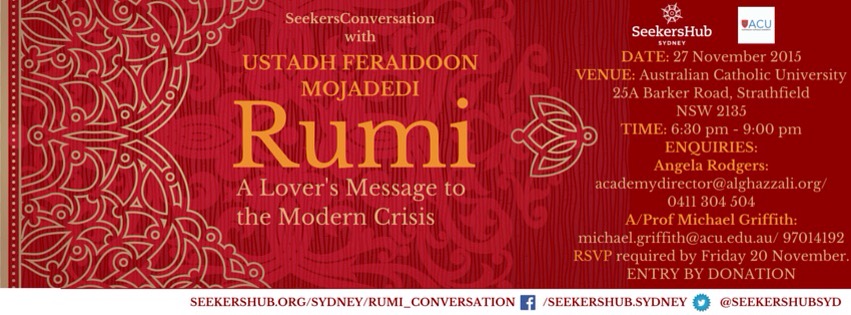
On Friday evening at the Australian Catholic University, two Muslim scholars sat with an audience and discussed the great 13th century Persian poet Mevlana Rumi.

Ustadh Feraidoon Mojadedi, an Afghani scholar who now lives in the USA, was in conversation with Imam Afroz Ali, of the Sydney Seekers’ Hub, a place of Islamic learning.

They spoke of Rumi as a great spiritual teacher, not just for Muslims, but for all humanity. Ustadh Feraidoon Mojadedi wears his enormous erudition lightly, and had us laughing even as he explained the complexity and depth of Rumi’s vision. He argued that what non-Persian readers need is more, better commentary rather than translation, because all translation is misleading. There’s much more to Rumi than you would gather from the quotes you see on Facebook.

I went along for a number of reasons, but mainly because a friend gave me a copy of The Essential Rumi decades ago which has remained, literally, a closed book. I’m also aware that my ignorance of Islam can’t be a good thing in the age of Corey Bernardi and Donald Trump.

Well, I know a tiny bit more about Rumi, and I’m planning to go to another event next week. But possibly more significant is how the evening altered my sense of Islam.

The relaxed, affectionate  relationship of the two scholars was in sharp contrast to images I have from movies.

In question time, it was women who asked all the questions – so much for the notion that women are silenced in Islam.

And most interestingly we were all invited to join the sunset prayer part way through the event. I’m not at all religious, but I’d joined in the Our Father at an Anglican ceremony the previous day. I checked with a number of people and joined the prayers. I did a lot wrong: I hadn’t arrived in an abluted state, I didn’t take my shoes off, I joined a line that turned out to be the women’s line, and I’m pretty sure I failed to follow all the standing and kneeling correctly (though my Catholic youth and childhood was some preparation for that). And of course I didn’t understand what was being said by the prayer leader. But there is something profound in joining a group of people who humbly bow repeatedly in the face of the mystery of the universe, and I returned to the lecture with an extraordinary sense of our shared humanity. Which was also the content of much of the talk.

So I went to the event expecting a literary evening, and found something quite different.

I’ve set myself a task of writing a 14-line rhyme with each blog entry in November (originally inspired by those people who write a whole novel in November – not sweating over quality, just getting the words out). Here goes for this one:

Rhyme #12: On joining sunset prayers
I bow, I kneel, I touch my forehead
to the grass. I have no God:
no disrespect, I take these borrowed
gestures (like my childhood’s nod
at Jesus’ name, or genuflection)
not to seek some Power’s protection,
but to say: The world is vast,
my time here comes and goes so fast.
Right now I humbly pay attention
to what is deepest in my heart:
my loves, my challenges, the part
I choose to take past good intention.
We bow, we stand, we’re flesh and bone
and mind. We’re none of us alone.