Ngurrumbang, directed by Alex Ryan from a script written by Alex and me, is on the list.
It’s eligible for the Live Fiction Award and the Rouben Mamoulian Award for Best Director, each bringing a cash prize of $5000, sponsored by Dendy Cinemas.
The competition looks stiff, which means the screenings will be worth attending. The winning film in the competition will be announced at the festival’s Closing Night on 16 June 2013. I plan to be there.
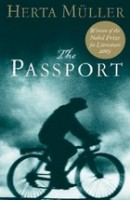
Herta Müller, The Passport (1986, translation by Martin Chalmers 1989, Serpent’s Tail 2009)
I got hold of this book via BookMooch soon after Herta Müller was awarded the Nobel Prize for Literature in 2009. Possibly because the press response wasn’t exactly encouraging (which of course it won’t be until a US writer wins), the book sat on my bedroom bookshelf for four years as a shining testament to pious intentions. I finally picked it up now because I’d read two books in translation, and decided to make it three of a kind.
It’s a very short book, just 92 pages, and it’s made up of short sentences. Here’s a random paragraph:
The skinner had given the stuffed animals to the town museum as a gift. He didn’t receive any money for them. Two men came. Their car stood in front of the skinner’s house for a whole day. It was white and closed like a room.
Sentence after sentence. Page after page. It proceeds in that staccato way. It doesn’t quite say what it’s saying. People do things, and say things, and see things. There are snippets of folklore, a bawdy song, symbolic objects, similes and metaphors as odd as the white room in that quote. You have to fill in the gaps, decode the descriptions. Only a handful of characters have names, the rest being known only by their professions or relationships. It took me until page 42 to realise I was in the middle of a narrative that I hadn’t been following. I started over. I’m glad I did.
It’s a terrible tale of the German-speaking minority in a village in Ceauçescu’s Romania. Uneducated, superstitious, despised by the Romanian majority, they live lives of quiet desperation and degradation. The village miller sets out to secure from the corrupt system a passport that will enable him, his wife and daughter to leave for West Germany.
I hated a lot of this as I was reading it: I just wanted to be told the story, to have a spade called a spade, rather than a headache being called a grain of sand moving around behind the forehead (at least, I assume that was a headache). But there is something mesmeric about it. I’m amazed that now I intend to immerse myself in that world again – not immediately, but when enough time has passed that I will be revisiting it rather than extending the current visit.
A couple of scrappy notes about the translation:
The English title draws attention to the plot, such as it is. The original German, taken from something the miller says at his lowest point, translates as ‘A man is nothing but a pheasant in the world’, and signals the sometimes enigmatic narrative mode.
There is a three-word glossary up the back. I could have done instead with a brief note at the start informing us that the original was written in German, that the action takes place in Romania (something that I’m guessing is obvious in the original but doesn’t become evident in the translation until we’re well under way), that most (all?) of the characters are German-speakers – in other words, filling us in on some things that are almost inevitably lost in translation.
There are one or two places where I completely didn’t know what was being described, and would love to know if it was because of the translation or the original. In particular, there’s a scene in which a woman is pleasuring herself or discovering she has some terrible disease – I’ll refrain from going into detail of the description here, but my confusion is genuine, and her husband’s comment, ‘So that’s how it is with your bladder, my lady,’ doesn’t make any sense either way. Perhaps this is the kind of thing that people mean when they say Herta Müller writes surrealism.
I suspect that this book is another that was a nightmare to translate, and it’s wonderful what a distinctive voice comes through in the telling.
PS: When I had uploaded all that I went to LibraryThing to post a version of it as a review there. And behold there was a very interesting post by Meisterpfriem, who had loved the book in German and been surprised at its lukewarm reception in Engish translation. I recommend it.
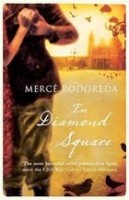
Mercè Rodoreda, In Diamond Square (1962, Translation by Peter Bush, Virago 2013)
Before the meeting: I came to this book with inaccurate expectations. Gabriel Garcia Marquez describes it on the cover as ‘the most beautiful novel published in Spain since the Civil War’, which I misread, lazily, as ‘about the Spanish Civil War’. True, the action of the novel spans the years of the Civil War, which is a major element in the story, but it would be quite a stretch to say the novel is about the war. The novel tells the story of Natalia, a naive, uneducated young woman from Gracia, then a poor area of Barcelona rather than what the internet now calls ‘one of the city’s hippest areas’. She marries a volatile young man whose entrepreneurial ambition fills their apartment, bizarrely and malodorously, with pigeons. The Civil War disrupts their family life when her husband and their male friends joins the militia – we see none of the combat, and none of the reasons for the war are discussed or explained, but we stay within Natalia’s narrow horizons, following her through wretchedness, deprivation, despair and unexpected happiness (though, to save spoilers, not necessarily in that order).
It’s a gripping story, with some brilliant images, but the thing that struck me most strongly was the language. Natalia is the narrator, and her voice is what makes the novel what it is. She begins:
Julie came to the cake-shop just to tell me they would be raffling coffee pots before they got to the lucky posy; she’d seen them and they were lovely, an orange split in two, showing its pips, painted on a white background. I didn’t feel like going to the dance or even going out, after I’d spent the whole day selling cakes and my fingertips ached from tying all those gilded raffia knots and handles. And because I knew Julie could manage on as little as three hours’ sleep and didn’t mind whether she slept or not.
She begins as she plans to go on, with leaps in logic (from the coffee-pot design to the question of whether she will go out or not, omitting to mention that Julie had come to take her there), syntax that doesn’t quite cohere (‘And because’ – huh?), attention to details that lead nowhere (‘an orange split in two’ etc), lack of orientation (who is Julie?), unexplained cultural references (are we supposed to know what ‘the posy’ is?), and so on. Then it took me a moment to figure out that the third they was a different they from the first two, that Julie is talking about the coffee pots, not the people who were raffling them, and because that tiny awkwardness feels like the kind of thing that happens in translation, I lost confidence as a reader , and as I read on I couldn’t tell how much of the narrative voice was Natalia’s and how much was the sound of Peter Bush wrangling the transition from Catalan into English. I wasn’t necessarily critical of the translation: perhaps this is one of those books that defies translation – as I imagine Malcolm Knox’s The Life to be. (A literal translation of DK’s ‘Well yeah … but no’ would probably leave Catalan readers floundering, but how else do you translate it?)
I read on, enjoying the book, but my unease about the translation persisted, and about a hundred pages from the end I turned to the Internet for help. I don’t know what I expected, but I found an excellent article from the British journal The Translator, ‘Language and Characterization in Mercè Rodoreda’s La Plaça del Diamant‘ by Helena Miguélez Carballeira, which discusses the language of the book in the context of two previous translations. According to Ms Carballeira, Natalia’s discourse is what the boffins call escriptura parlada – spoken writing. Mercè Rodoreda sets out to ‘trace the discursive peculiarities’ of the uneducated Catalan working-class. Her speech is also full of features that mark it as peculiar to Barcelona, and is full of the euphemism, attention to detail and diminutives that mark stereotypically feminine speech. More than that, Carballeira argues (and I’m persuaded) that
Natàlia is a woman who feels uneasy with the very act of speaking. … The characteristics of [her] conversational, unmediated speech as a discursive device in the novel are rather predictable: there is an extensive use of idioms and colloquialisms, interjections and onomatopoeias. This yields a constant, highly idiomatic, non-straightforward use of language.
That is to say, Natalia is at least as big a headache for a translator as Knox’s DK.
A gauge of the difficulty of the task is the differences between translations. Carballeira discusses a number of fascinating examples. Here’s just one, quoted in a discussion of Natalia’s use of euphemism:
The original Catalan (1962):
I mentre em dedicava a la gran revolució amb els coloms va venir el que va venir, com una cosa que havia de ser molt curta.
From Eda O’Shiel’s The Pigeon Girl (1967):
And while I devoted my energies to the grand revolt against the pigeons, there took place what had to take place, and it seemed as if it would be over quickly.
From David H Rosenthal’s The Time of the Doves (1986):
And while I was working on the great revolution with the doves the war started and everyone thought it was going to be over quickly.
From Peter Bush’s In Diamond Square (2013):
And while I was waging my big revolution against the pigeons, what was brewing came, that they said would be a two-day wonder.
Having read this article when I was struggling, part way through the book, I had a much better time with the rest. Some of Peter Bush’s decisions had confused me. For example, he names Natalia’s husband Joe, possibly as what Carballeira calls a domesticating strategy, but when I read that his name is Quimet in the original I realised that the discord between his English name and his Catalan context had niggled away at the edge of my mind, creating a sense of unreality like the one in some CGI movies, where figures don’t quite seem to touch the ground. And another example: Joe/Quimet refuses to call Natalia by her name but calls her Pidgie, without explanation of where the name comes from – to my ear that sounded a bit like Piggsy, and so vaguely insulting, and it was a long way into the story that I realised it was short for Pigeon, and that Joe/Quimet was obsessed with those birds; in the original he calls her Columeta, which my computer translates from the Catalan as, you guessed it, Pigeon. Maybe to a British ear ‘Pidgie’ sounds more affectionate than ‘Pigeon’, but ‘Pigeon’ would have worked fine for me.
This experience makes me suspect that if I’m going to read books in translation a little bit of research will make the whole experience go better. As it happens I’ve been to Barcelona, so quite a few of the local references – Tibidabo, Parc Güell, etc – made immediate sense to me. If I hadn’t been there, I doubt if I would have bothered to get out a map, but it wouldn’t have been a bad idea. (I do think I was right, though, not to read the author’s spoilerish 1982 ‘Prologue’ until after I’d read the book.)
The meeting: We were astonishingly unanimous in our responses to the book. We’d all enjoyed it; we’d all been at least mildly disconcerted by the language, though when someone read a short passage aloud, its ‘written speech’ qualities were obvious; we’d all engaged with Natalia and formed strong opinions about Joe/Quimet; and I think we’d all had our heartstrings / tear ducts activated. There was an attempt to get someone to read the last couple of pages, which are full of sweet, kind-of-sexual tenderness, but no one was up for the challenge. We enjoyed the book so much we contemplated staying with Catalonia for our next meeting, and reading The Sun Also Rises, Homage to Catalonia and perhaps something by Colm Toibín. (We decided against it, and will be heading off to Norway instead with Karl Ove Knausgaard.)
Your mileage will vary, but the article in this Overland that stands out for me is Beyond denial by Philip Mirowski, Jeremy Walker and Antoinette Abboud, which argues that ‘the phenomena of science denialism, emissions trading and geoengineering are not in fact unrelated or rival panaceas but rather constitute together the full neoliberal response to global warning’. The article makes a distinction between neoclassical economics and neoliberalism, describing the latter, in what I wish was a harsh caricature, as worshippers at the shrine of an all-wise market, who hold, for example, that ‘Science is not an independent mode of truth discovery: it is a boutique knowledge format only validated by “the marketplace of ideas”‘.
The neoliberal response to the climate change challenge is, if I understand the article correctly:
Deny the science so as to distract attention from the crisis and buy time for commercial interests to find a way to profit
Back emissions-trading schemes in order to divert political actors from using state power to curb emissions into setting up carbon markets, which won’t ever work, because the big polluters are already finding ways to go on polluting
Develop grand geoengineering schemes that will make huge profits for corporations but will not address the root problem of increasing carbon dioxide concentrations or stop ocean acidification.
The article doesn’t come up with an opposing plan, but it gives a salutary map of the terrain. I recommend the whole thing.
Elsewhere, this issue strikes a nice balance between giving pleasure and holding the reader’s feet to the fire.
First, the pleasures include:
interesting chat from regular columnists Alison Croggon and Rjurik Davidson about, respectively, Tolkien and Hollywood’s version of Second World War resistance movements
Francesca Rendle-Short writing about writing about her late father (as she has elsewhere), including poignant moments that will strike a chord with anyone who has a close relative with advancing dementia:
[H]is hands dance largo, float and rise and fall in a slow movement set to its own tune, an adagio. First, he clasps them in front of his chest as though in a praying gesture, a supplicant hold where the palms lie flat against one another. Then he pauses a moment to pray, to ask for God’s blessing before the fingers start to stir larghetto. They loop first this way so the fingers interlace each other; then right then left, before rising up elongated in a slow, seesaw action. A ritual dance.
The cartography of foxes, a deeply satisfying and unsettling short story by Theresa Layton that augurs well for Jennifer Mills’s tenure as Fiction Editor
Peter Minter’s report as judge of the 2012 Overland Judith Wright Poetry Prize for New and Emerging Poets, which is almost as enjoyable as the winning poems, particularly his description of how he read and re-read the submissions in the midst of domestic life
The winning poems, especially the winner, Augury? by Luke Fischer
An essay by Californian Aaron Bady that, after going on a bit about the Great American Novel, confirmed my decision not to give any cash to the makers of Zero Dark Thirty, with an argument that chimes with my experience of The Hurt Locker. The movie succeeds as propaganda, he writes,
because it never tries to glorify the protagonist’s obsession, never tries to rationalise it, defend it or even make it seem attractive … But it’s still the one we’re stuck with for two and a half hours … You have no choice but to identify with torturers whose motivations you understand, and with the victims of Muslim terrorists whose motives you are not allowed to be privy to.
Judy Horacek’s dark cartoons (I couldn’t find a link), especially one that should probably be in the ‘feet to the fire’ category, in which two people holding a ‘Save the Planet’ sign face a gang holding signs that read ‘Save our Profits’ – she manages to be funny about discouragement.
And then there’s what Overland does so well, argument and analysis of the harsh realities of our times from a progressive point of view. Some highlights:
Alyena Mohummadally on being same-sex attracted, Muslim, and organised in Australia
Panagiotis Sotiris offering an alternative view of the Greek economic situation. His repeated calls for ‘struggle and solidarity’ as the necessary response to the fascist Golden Dawn, is little more than sloganeering shorthand, but where else can you find a clear challenge to the mainstream narrative about Greek laxity finally being brought to heel by the benign forces of the EU, the IMF etc?
Martin Kovan on the alarming number of ethnic Tibetans who have set themselves on fire in recent years, mostly with fatal results. The article discusses how these burnings remain largely unnoticed in the West, ‘inside the narcissism of self-interested, racially conditioned and materially anaesthetised ethical immunity’, then focuses on the English Buddhist novice who self-immolated in southern France late last year. Kovan knew the monk, and his reflections are personally charged
Guy Rundle, self-described default Luddite, reporting on 29c3 – the twenty-ninth Chaos Communication Congress, at which hackers confronted the rise of the total-surveillance state. He reflects on the relationship between hacktivism and the Left, in particular on what their different histories mean they can learn from each other. In doing so, he manages to end the journal on a note of restrained optimism.
I’ve included links to everything except the cartoons. Overland make its entire content available on line. It also publishes background interviews on some articles in its Editors’ Blog, which is one place on the Internet where the comments don’t make you want to run screaming from the room.
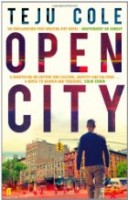
Julius, the narrator–protagonist of this novel, is a psychiatrist by trade, but as far as we’re concerned he is a flâneur: we don’t quite have a word in English for such a person, one who strolls (flâne) around a city, observing people and things with a detached, intelligent curiosity, and no other agenda. Julius strolls from street to street, from church to bar, gallery to movie theatre to concert hall. He visits an old friend who is dying, phones a former girlfriend, has a casual sexual encounter, chats with the man who checks the air-conditioning vents on the subway, is mugged, runs into the sister of a friend from his teenage years. Almost always, he is moved by whim rather than intention, and when he does set out on a quest at one point, the quest comes to absolutely nothing.
The city is New York, though Julius visits Brussels for a spell and continues his flâning ways there. I didn’t read the book with a street map open beside it, but I expect that if I had I’d have known to within a block or two where I was on almost every page. The same goes for time: he visits and responds to particular films, concerts and exhibitions, and I’m reasonably sure that the date he saw them on could be approximated by a quick check of past issues of New York newspapers.
In a way, just as Julius’ wanderings trace the shape of the city, his encounters (not all of them are conversations) build a picture of the less tangible social and political world, mostly from perspectives other than the dominant one, as most of the people he talks to are not white – he himself is the Nigerian-born son of a German mother and a Nigerian father.
But the book is not the meandering bore or disguised tract that description may conjure up. True, it doesn’t have a central quest or conflict needing resolution. Also true, there are reflections on the state of racism and internalised racism in the US, on ‘political correctness’, on Middle Eastern politics. But none of the reflections amounts to a didactic ‘line’, and there is a quiet and unobtrusive overall arc. We get to know Julius, and start to wonder about him. He has an ambivalent attitude to African-Americans in general – welcoming the sense of connection but shying away from the enforcement of identity. He loves his old English professor and knows he is dying, yet visits him only twice over many weeks, and when he discovers on his third visit that his old friend has died, he resumes his peripatetic ways without missing more than a beat. There is a striking lack of affect in his account of a sexual encounter with a Czech woman in Brussels. His quest to find his German grandmother is oddly half-hearted. His music references are incredibly erudite, and you might start to wonder if ‘incredible’ might be more precise than it at first seems – that he might be straining to project an image of himself as a man of high culture. It’s not that we’re being given a coded alternative version, but we realise that, perhaps inadvertently, he is telling us a lot about what it means to be a mixed-heritage, middle-class African immigrant to the US. Perhaps it’s a sop to the conventional reader that there is a surprise revelation towards the end, but I found it both disturbing and deeply satisfying that Julius lets the revelation sit on the page with only a broad introductory comment, as if he is as stunned by it as we are.
I’m not sure what the title means. An open city, in the usual wartime context of the term, has declared that it will not defend itself in case of attack. Perhaps Manhattan is wide open, ready to yield its secrets to anyone who wants to walk its streets and buildings with eyes and mind on the alert. Or perhaps Julius is the open city of the title – laying himself out there without defensiveness.
Open City was one of the books I took home from our last Book[-swapping] Club. It took me months to actually pick it up because I’m generally suspicious of books and movies that treat New York as a cosmos. This isn’t one of those.
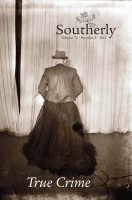
The Southerly of my youth, whatever its contents, always had the same staid, non-committal design: a single colour cover with a small blowing-wind logo the only decoration. (For non-NSW readers, the southerly is a cool and often rain-bearing wind from the south-east, famously welcome for its sudden arrival on stinking hot summer days.) Those days are long past, though the little wind is still there above the title. This issue’s cover, featuring an enigmatic photo from the NSW Police Forensic Photography Archive, is a perfect teaser for an issue built around true crime stories, more than one of them drawing on that same archive.
The archive, consisting of 130 000 photographs taken in the first half of last century, found without any accompanying documentation and now held at the Justice and Police Museum in Sydney, is an Aladdin’s cave for researchers into Sydney’s criminal history. Peter Doyle’s ‘Detective writing: mapping the Sydney pre-War underworld’ is a fascinating dip into it, complemented with an account of a couple of relatively long-lived publications, which he describes as ‘kind of ‘ trade papers for cops, full of vivid and sometimes lurid portraits and narratives from the criminal scene. In Southerly‘s online section, The Long Paddock, Ross Gibson’s ‘Collision Course‘ plays with the narrative possibilities of a selection of images – though none of them are as queerly suggestive as the one on the cover – and refers the reader to his ongoing project with Kate Richards, Life After Wartime. Marise Williams, in ‘Women’s Work’, explores the same milieu, though without drawing on that archive: the women of her title are Kate Leigh and Tilley Devine,who ran organised crime networks in Darlinghurst in the 1920s and 1930s. It’s not just the covers that have come a long way since the staid 1960s.
My favourite single prose piece in this issue is Cassandra Atherton’s ‘Raining Blood and Money’. Classified as fiction, it’s a graphic imagining of New York’s terrible 1911 Triangle Shirtwaist fire, in which 146 people, most of them women workers, died in 18 minutes. The fire was hugely significant in the history of women and labour in the USA, and in the century since it happened it has given rise to innumerable songs, stories, monographs, rallies, and organising activities, as the links on its Wikipedia page demonstrate. Some stories need to be told and retold, and Atherton’s telling feels as fresh and visceral as if it happened yesterday.
Of course, Southerly is still a scholarly journal, so: there’s a theoretical consideration of sensationalist 19th century crime writing; the formidable thinking of Deleuze and Guattari is brought to bear on Ned Kelly’s Jerilderie letter; a Black Saturday arsonist is considered in the light of the different understandings of the notion of ‘abjection’ in the writings of Julia Kristeva and Judith Butler; Schapelle Corby is the subject of abstruse reflections that include such highly technical language as: ‘To be where you are … requires a sense of affective difference, understood as either the Spinozan–Deleuzian mapping of co-ordinates of intensities or as the forms of projective identification required in nominating and refining the arbitrary and violent constitution of the nation-state.’ Lit crit has moved on since my day.
There’s forty pages of reviews, including Kate Middleton in elegiac mode about the late Peter Steele’s Braiding the Voices, and a swag of poetry, of which Adam Aitken’s ‘The plein-air effect (after John Clare)’, Michael Farrell’s ‘Disapproval’ and Hazel Smith’s ‘Experimentalism’ stand out for me.
A dip into the Long Paddock came up with not only Ross Gibson’s piece, but also Melissa Jane Hardie’s review of A Tragedy in Two Acts: Marcus Einfeld & Teresa Brennan by Fiona Harari. I met Teresa Brennan once, and am glad to see that this book makes more of her than a name in a false alibi: it doesn’t mention that she was at one time a writer for Barry Humphries/Edna Everage.
The 2012 NSW Premier’s Literary Awards Dinner seems like just last week, yet it was actually last week that this year’s short list was announced. The list is up on the web site of the State Library, which now administers the awards.
I’ve read one of the novels with my book group (less than enthusiastic blog post here) and liked the look of another one so much I gave it to someone twice – for Christmas and then for her birthday. I haven’t read any of the non-fiction, though I have bought a copy of one. I’ve read one of the poetry books (here) and enjoyed being read to by a number of the other listed poets. Regretfully I’ve read only one of the books for children or young people (which I loved, here). I’ve seen a production of one of the playscripts (here) and one of the TV scripts (here). I haven’t read any of the ‘multicultural’ titles.
Today I received an email invitation to the Awards Dinner. Should I buy a ticket? It costs as much as about 15 nights at the movies or two cheap seats at the Opera – nearly half as much as one of the flash seats for Carmen on the Harbour. Last year I had a horse in the race, if a book by a niece counts as a horse, and the cost was immaterial. This year …?
Jennifer Maiden’s Liquid Nitrogen has been shortlisted for the Griffin International Poetry Prize, described on the Griffin Trust website as ‘the world’s largest prize for a first edition single collection of poetry written in English’. The judges’ citation reads in part:
An extended meditation on the uses and abuses of power, the moral gravity of Liquid Nitrogen is buoyed throughout by Maiden’s self-effacing sense of humour and her tenderness towards her grown daughter, Katharine, who stands at the heart of this collection. Epic in its scope and utterly eccentric in its approach, Liquid Nitrogen is a work of rare passion and unprecedented poetic achievement from one of Australia’s most prominent living writers, ‘alert to the point of twitching’, like the ox to whom she likens herself on page one, who nevertheless ‘still tramples through the difficult’.
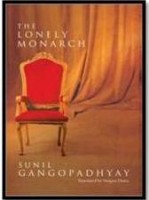
Sunil Gangopadhyay, The Lonely Monarch (2005, translated from Bengali by Swapna Dutta, Hachette India 2013)
My high school French and Latin teacher, Brother Gerard, taught us a healthy respect for the art of translation. When he wrote ‘Excellent attempt’ in the margin of one of my exercises, he explained that it was high praise, that all anyone could aspire to was an attempt at translation – the thing itself must remain forever elusive: if you stay too close to the original, your translation won’t sound like natural English, and if you produce something that feels natural in English you will have lost the feel of the original. Kumārajīva (343–430 CE), one of the sub-continent’s great translators of Buddhist texts from Sanskrit to Chinese, said that translation was like ‘chewing rice for others, which would not only lose its original taste, but also make people feel like vomiting’. (Translations of his statement differ.) So translators are heroic people who serve the common good, building bridges between cultures that might otherwise remain dangerously ignorant of each other, but they do so knowing that page after page, book after book, they must fail.
I don’t know any Bengali at all, so I can’t comment on the accuracy of Swapna Dutta’s translation of Sunil Gangopadhyay‘s Nihsanga Samrat. But it gave me that delicious sense of access to a place that would have remained closed to me without her labours. The eponymous lonely monarch is Sisirkumar Bhaduri (1889–1959), a pioneer of Bengali theatre, or at least a fictional stand-in for him, as this is a fictional rendition of the real Sisirkumar’s life. His theatrical project was to Bengal roughly what Louis Esson’s Pioneer Players were to Australia, not quite a national theatre but a profound influence on audiences’ tastes, though the comparison underplays the significance of Sisirkumar. The theatre as he found it was ruled by Western conventions, women actors were generally prostitutes, the emphasis was on spectacle. He and his colleagues reached for a theatre that incorporated traditional jatra forms; his partner Kankabati was an educated woman who became even more acclaimed as an actor than he was; his plays were often adaptations from serious novels.
Calcutta (as it is called here) had a thriving theatre scene in the 1920s and 30s, rich with artistic ambition, greed, brilliant collaboration, vicious competition, surprising acts of generosity, sweet loyalty, despair, alcoholism, romance … Sisir, as he was known to his friends, was at the heart of it as an actor–producer. In a postscript to her translator’s note, Swapna Dutta gives brief introductions to twenty characters who were important personalities of the time ‘whom people outside Bengal might not know’: poets, artists, playwrights, scholars, political figures. Without this help, the sense of a flourishing cultural scene would still have been vividly realised, but for foreign readers like me the names would have passed in a blur (actually, they still mostly did, but now I knew the nature of the blur!). Some names didn’t need a note: the great Rabindranath Tagore is partly a kind of tutelary deity whose approval is beyond price for the younger generation, and partly the esteemed elder whose mould they need to break; Sunil Gangopadhyay himself makes a brief appearance as a young man among Sisir’s admirers; and Satyajit Ray, Bengali director of many great films including Pather Panchali, has a moment towards the end of the book.
Sisirkumar takes a troupe of actors to New York in 1930. The trip has its disastrous moments, but it starts with a rapturous welcome. A young Indian man living in New York explains:
Ordinary Americans hardly ever come across Indians. Most of them are under the impression that Indian women are either kept under lock and key or burnt as a sati; that young children who enter the river are devoured by crocodiles; that the roads in India are packed with sadhus and yogis, tigers and snakes. They are clueless about our art, culture, literature or music.
Although there’s no whiff of an instructional intention in this book, I’m at least a little less clueless for having read and enjoyed it.
(Sisirkumar Bhaduri does have a Wikipedia entry, but it doesn’t say very much, and IMDb lists the eight films that he directed and acted in, which were very much a sideshow to his career in the live theatre.)
Full disclosure: Swapna Dutta is a friend of mine, though we’ve never met in person. She contributed a number of elegant stories to The School Magazine when I was editor, including retellings from Hindu and Buddhist classics as well as original stories, and we have stayed in touch by email since. Hachette India sent me a complimentary copy of this book.
I recently heard a distinguished novelist claim that she grew up believing New South Wales was mostly settled peacefully and that damage to the original inhabitants was largely unintended, caused by infectious diseases and the like. Despite having been correctly described by a commenter on my auxiliary blog as not knowing shit about Aboriginal matters, I was slightly better informed than that in my childhood: I knew there was a lot of frontier violence. But I think I’m like most non-Indigenous Australians in having assumed, complacently enough, that Aboriginal people, at least in this state, were irrevocably dispossessed and driven from their land in the early years of settlement. In other words, all the really bad things were done long long ago, probably by people who were just acting according to the morality of their times. Um, well, mea culpa.
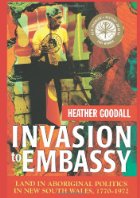
The dispossession of Aboriginal people in Australia has been a long, painful process. It has played out very differently in different states and territories and different regions within states, and been resisted at every phase by Aboriginal people and their allies, using means ranging from armed resistance to eloquent letters to the press. Invasion to Embassy tells the New South Wales history, and although the stories it tells are grim, often heartbreaking, I found it exhilarating: in these dying days of what W H Stanner called the ‘great Australian silence’ – the relegation of Aboriginal experience to footnotes in our history – books like this, where Aboriginal points of view are front and centre, are like doors opening onto the real world. I wish this one could be absorbed into the bloodstream of every non-Indigenous Australian.
Heather Goodall maintains that land has been a key issue in Aboriginal politics from the beginning. ‘There are strong grounds for arguing,’ she writes in the first chapter,
that for Aboriginal people in south-eastern Australia before the invasion, land was the physical and symbolic base for almost every aspect of life. Social relations were expressed, managed and negotiated through relations to land; political standing was legitimated and authority grounded in landholding. Knowledge was structured by its relation to place, and it was taught, held in memory and performed according to this organisational framework. New experiences were analysed by and incorporated into that oral tradition and so they too became organised within it by place.
In the first decades of the colony at Port Jackson and surrounds, then:
Land was seen by its Aboriginal owners as a central factor in their experience of colonialism. Their sense of invasion, of loss and deprivation of land was expressed clearly and unarguably. It was expressed to whites alongside Aboriginal pain at the deaths of their loved ones and offence at the transgression of their laws.
It’s a book that makes you want to read bits out loud to the nearest available listener, and maybe I should have done the blogging equivalent of that by uploading regular progress reports. But that’s an idea for another time, another book. Until you read the book, here’s a string of dot points, which might be familiar to you but were mostly news to me:
Before 1850, owners of the large pastoral properties described Aboriginal men as virtually useless as employees, but after that date, when almost all non-Indigenous workers headed for the Victorian goldfields, those same Aboriginal men, being now necessary, were suddenly transformed into brilliant horsemen, unsurpassed as shepherds and stockmen.
In the second half of the 19th century, reserves were established all over the state where Aboriginal people were promised security of tenure, and where many of them cleared land and worked small farms for decades, only to have their tenancies summarily revoked by the government, with no justification that would make sense in the absence of deeply racist, genocidal assumptions.
The legal doctrine that Australia was terra nullius, land owned by no one, when the first European settlers arrived, was not proclaimed in law until 1889. Goodall comments that such a judgement could not have been made in 1840 ‘when there was such wide acknowledgement of Aboriginal relations to land’.
154 Aboriginal men from New South Wales volunteered and fought overseas in the First World War. Although there were no discriminatory regulations or laws, it turned out in practice that the Soldier Settler scheme was only for white soldiers – just one Aboriginal man was given any land under the scheme.
This kind of thing happened during the Depression (page 185):
By 1933 there was a large camp of Aboriginal people just outside Cumeragunja, refused the dole in Victoria because they were New South Wales residents, but refused the dole in New South Wales because they were ‘too black’, and told they must go to the [Aborigines Protection Board] station for relief. But at Cumeragunja they were met by a manager clinging to the old APB rules, who told them that they were ‘too white’ to receive Aboriginal rations because they were not ‘predominantly of Aboriginal blood’.
The story of the first half of the 20th century is gruelling. When government agencies wanted to move Aboriginal communities from their land, the threat to remove the children was often used to force compliance. Aboriginal children were excluded from public schools in many places because white parents complained and the government gave them what they wanted – and families were again forced to move to places where some form of education, sometimes of a quality that beggars belief, was available. The ‘Dog Act’ – the 1936 amended version of the Aborigines Protection Act – created conditions in which Aboriginal people felt the government could pen them up and shift them around like animals: the reserves, which had been refuges and places where some vestige of traditional connection to land could be maintained, became virtual prisons. Even as benign a project as the creation of National Parks was the occasion of further dispossession and removal – I was shocked to reflect that to speak of wilderness in Australia is to give voice to a genocidal worldview, that is, it denies the existence of the people who lived in that part of the world for millennia.
Here are some more dot points, people and events that in any sane world would be as much part of general Australian lore as Ned Kelly, Phar Lap and the Eureka Stockade:
Pemulwye and Windradyne, the two most famous leaders of armed resistance to colonisation, around Port Jackson and Bathurst respectively
William Cooper – if you haven’t heard of him, and even if you have, read his Wikipedia entry. He was an extraordinary leader, who wrote to his local parliamentarian in his 20s, calling on the government to secure a ‘small portion of a vast territory which is ours by Divine Right’, and in his 70s organised the Day of Mourning on the sesquicentennial Australia Day. He is honoured in the Yad VaShem Holocaust Museum in Israel as the only person in the world to have organised a private protest in response to Kristallnacht. As Goodall says, he ‘had personally experienced the whole process of demanding land and winning it, farming it in relative independence, and then facing the bitter years of dispossession and violent repression on the station [of Cumeragunja]’
The Cumeragunja Walk-Off, in which 200 Aboriginal men, women and children crossed the Murray River into Victoria in protest against conditions at the New South Wales station. Among other things, this is the subject of Deborah Cheetham’s opera Pecan Summer
The Australian Aboriginal Progressive Association – the first Aboriginal political organisation to create formal links between different communities, whose chief spokesperson was Fred Maynard, a Hunter River Koori. It took shape in the early 1920s and found allies in the right-wing nationalists of the day.
The Australian Aboriginal League, formed in the 1930s with a close focus on Cumeragunja (can you tell the Cumeragunja story made a deep impression on me?), but also asserting broader Aboriginal unity: ‘We should nail our colours to the mast, … making our slogan “Full equality for the dark race with the white race, and no differentiation between the full-blood and those of mixed blood”‘
Political alliances between Aboriginal and other organisations – ranging from the Communist Party of Australia, which saw the unjust treatment of Aboriginal people as an extension of class struggle, to PR Stephenson’s right-wing nationalists, for whom Aboriginal issues were emblematic of White Australia’s need for independence from England and English cultural domination. When different Aboriginal groups accepted help from such disparate sources, it caused serious rifts.
I could go on. Read the book! You won’t regret it.
Invasion to Embassy was published in 1996, four years after the Mabo decision had laid to rest the legal fiction of terra nullius, and the same year as John w Howard said, disingenuously, ‘Injustices were done in Australia and no one should obscure or minimise them.’ The book would have to be an example of what Geoffrey Blainey and John Howard labelled black armband history. I’m sure Keith Windschuttle could find, perhaps has found, any number of errors. But those critics miss the point. Telling these stories doesn’t deny or diminish anyone else’s story. And it’s not about handwringing, collective guilt and shame – rage, perhaps, and a profound respect for those who held out for justice and dignity through it all.

 Ngurrumbang, directed by Alex Ryan from a script written by Alex and me, is on the list.