Tag Archives: Novel

Robbie Arnott, Limberlost and the Book Group

Robbie Arnott, Limberlost (Text Publishing 2023)
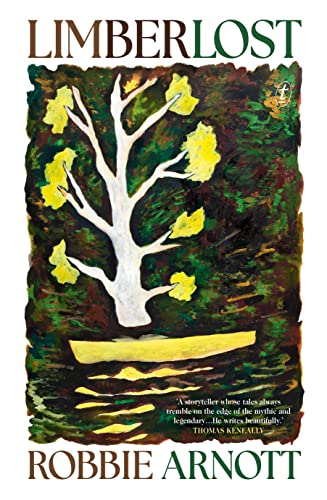
Before the meeting: To fully appreciate this book, you may need to have read Gene Stratton-Porter’s 1909 classic of USA children’s literature, A Girl of the Limberlost. I haven’t read it, but Sue at Whispering Gums has, and loved it. You can read her review of Limberlost at this link.

The novel’s main character is Ned, a young teenager living on an orchard in Tasmania towards the end of World War Two. His two older brothers are away at the war, leaving Ned and his older sister to help their gruff, widowed father on the struggling farm. Ned has a secret goal of buying a boat – he’ll raise the money over summer by shooting rabbits and selling their pelts. Rabbit fur is prized as material for making slouch hats for soldiers, and Ned hopes his father will believe his killing project is inspired by patriotism rather than self-interest.

The story unfolds as you’d expect, reaching forward to Ned’s later life as father of two adult daughters and back to an incident involving a whale. There’s more I could say about the book as a whole – the Tasmanian bush, Ned’s father, the boat, the whale and a wounded quoll – but this is a ‘Page 76’ blog.

Page 76 comes almost exactly at the novel’s one-third point. The local vet has given Ned’s project a boost by asking as payment for services rendered that he clear rabbits from her garden and the forest behind her place. (US readers note: in Australia a vet is a veterinarian surgeon, not a former soldier.)

Before rereading the page closely for this blog post, I would have said that it deals with the practicalities of trapping and shooting rabbits – a necessary bit of telling before we move on to the important bits of the story (the boat, the quoll, the father, the girl next door, etcetera). But slowing down to read it, I realise that it’s full of the stuff that makes the book engrossing.

Bending my rules a little, here’s part of the description of the vet’s patch of forest on page 75:

A place of dark-eyed wallabies and fat-faced possums and flickering wrens and eagle-sized ravens and swarms of rabbits beyond counting, beyond thought. A place so thoroughly non-paddock and non-river and non-orchard that, when he picked his way through its structures, Ned began to unmoor from the leafy dirt and drift away from the version of the world he knew. A wave of prickles needled through him. He felt a shifting beneath his flesh: all his pain and shame and anger and sorrow would peel off his nerves, steam from his bones and fry off his skin.

Only after bringing the place to our attention as so full of life and a kind of enchantment, the narrative moves on to Ned’s activities. The first full sentence on page 76 pulls us up short:

By the time the sun had fully risen, his hands were full of death.

What follows a brutal edge to it. First the traps:

Each morning he’d find at least two of their corpses in the teeth of his traps, sometimes three. He’d skin them at the edge of the garden and hurl the bodies far into the trees.

Then the shooting:

After he’d stashed the skins in his bag he’d move through the forest, towards the small clearings that lay within its interior. Here other rabbits inched over the grass, grazing at pace, their cheeks swelling in the low light. Ned stepped quietly, made sure he was obscured by the darkness of the ferns, waited. He’d raise the rifle and pick out the fattest animal, the cleanest fur. Missing was difficult, although occasionally he managed it.

It’s not that Ned has any particular feeling about the killing. Earlier, we’ve seen him working out the best way to place the traps, and he’s fascinated by skinning techniques. Here his focus is on moving quietly, picking the best victim. But Robbie Arnott’s prose insinuates a different perspective: the dead rabbits are ‘corpses’ and ‘bodies’; the living animals graze ‘at pace’. The comment that ‘missing was difficult’ comes from Ned’s pragmatic perspective, but it conjures up an image of innocent, vulnerable creatures. I’m reminded of the hunting scene in Renoir’s La règle du jeu, where the humans are cheerful and relaxed, but the camera shows rabbits first fleeing for their lives then dying in close-up, tails and ears twitching. The counterpoint there between the characters’ perspective and that of Renoir’s camera is similar to the tension between Ned’s view and Arnott’s prose.

The narrative doesn’t pass judgment. It leaves that to Ned’s daughters much later. This page offer a final harsh image (‘In the trees, ravens picked apart his kills.’), and something that has underlain much of the story so far comes into full view. As Ned makes his way back, ‘his bag heavy with pelts’, he feels ‘the unmooring, the needling, the shifting’ named on the previous page:

The burning away of his emotions, until he saw only the forest around him, and felt only the weight of his bag and gun, and the warmth of the morning.

Then this (moving on to page 78 – Maggie, Toby and Bill are his siblings):

Outside of those mornings in the forest he was exposed to an uncontrollable stinging in the folds of his mind … To counter this, he avoided thinking about anything that brought on the sting. The war. The school year that awaited him. The mare. The quoll. Maggie, ice hammered from metal ships, northern seas of endless chop. The rush of Toby’s smile, and how soon they might see each other. His father. How his father, after he’d read Toby’s letter, had asked Ned if anything had come from Bill. The blank fissure in the old man’s face when Ned had shaken his head.

The saga of the rabbits and the boat is something that Ned has dreamed up to distract himself from deeper issues: the questions of his relationship to the land that the captured quoll embodies, the ordinary angst of being a teenager, and over it all the cloud of war. Arnott doesn’t hit us over the head with this, but it’s always bubbling under the surface.

After the meeting:

As always it was a fun evening with far too much to eat. A couple of chps brought Tasmanian-themed food and drink. I had offered to host at short notice when our designated host came down with Covid (not as bad as the first time, he said, but still rotten). As a result I inherited substantial leftovers. We spent some time, quite unrelated to the book, as a bunch of old codgers trying to help each other understand the young people these days. We had minimal success, perhaps because the younger and wiser group members (overlapping categories) were detained elsewhere by work, family commitments and the aforementioned Covid.

The book struck a deep chord for a number of people. Two had read it twice. One said he resonated strongly because like Ned he had two older brothers and has two adult daughters, and Ned’s experience chimed with his own. The other had read Robbie Arnott’s first novel, Flames, then returned to Limberlost, enjoying the way it revisited similar concerns in a very different mode. One man’s partner had loved A Girl of the Limberlost with a passion, but otherwise we’d all read this book without illumination from that one.

I confessed to blogging about page 76. Someone promptly read a beautiful passage from page 77-78, in which Ned is haunted by images of violence among birds, in ancient and modern warfare, and in the sight of the girl next door carrying a rifle.

Some insights were shared about the quoll that Ned accidentally traps and then keeps until it has recovered from its wounds: it mirrors back to Ned the wildness and rage he can’t admit to feeling; it’s a beautiful thing that transcends humdrum daily life; it becomes an intimate shared experience between Ned and the girl next door; it provides one of a number of occasions when Ned’s father surprises him by being sympathetic.

There was a lot more. I came away from the meeting with a much deeper understanding of the book, and of the traditional rural masculinity it depicts.
Hilde Hinton’s Solitary Walk on the Moon

Last November I decided to experiment with blogging about books by taking a single page and writing whatever comes to mind about it. I picked page 75, my age at the time. Sadly, though I did focus on page 75 (or 47 or even 7 in shorter books), I didn’t really keep to the plan but felt obliged to go on about the books in general as well. Now that I’m 76, I’m renewing the experiment.

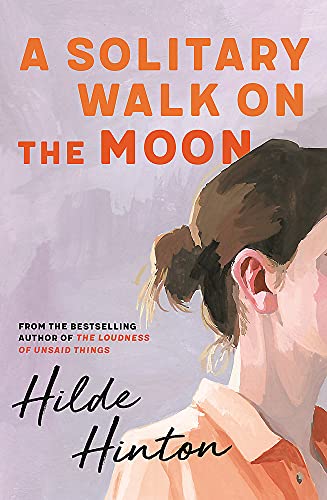
Hilde Hinton, A Solitary Walk on the Moon (Hachette Australia 2022)

You could describe A Solitary Walk on the Moon as a quirky comedy, but that suggests a particular kind of US movie – and Evelyn, the book’s laundromat-manager protagonist, is more John Wayne than Miranda July, or perhaps Miranda July in a John Wayne role. Like the hero of a classical Western movie, she’s a loner who brings her peculiar set of skills to the aid of the community who come to love her, but among whom she feels she has no abiding place.

Page 76, a little past the one-quarter mark, is relatively uneventful, but in it the characters develop, the plot moves forward and key images recur, all without breaking a sweat.

Evelyn is in the process of building what will turn out to be a patchwork family. Having overheard two young women, laundromat customers, talking about a friend who has disappeared, she has insinuated herself into their confidence, and enlisted the help of a befuddled old man, also a customer, who she has learned is a retired policeman. At the start of this page, she introduces the man to the young women with characteristic awkwardness and a touch of bravado that doesn’t quite work:

‘This is,’ Evelyn said, suddenly realising that she didn’t know his name, ‘our retired policeman.’ Her ta-da finish went unacknowledged.

We understand the lack of acknowledgement to be partly because the young women don’t quite trust Evelyn, and partly because the retired policeman is grubby and vague-looking. By this stage readers have come to understand that though Evelyn is deeply strange – perhaps non-neurotypical, perhaps from a non-mainstream culture, or perhaps dealing with childhood trauma – she is smart and well-intentioned. But we also understand other people’s hesitance around her.

The ex-policeman introduces himself as Phillip, and they head off to the police station. In a characteristic narrative move, they stop on the way for Phillip to play the love-me, love-me-not ritual with a daisy. He presents Evelyn with the stem, ‘topped by a clearly embarrassed pistil and a sad, solitary petal which flapped about in the evening breeze’. This moment reminds us that Phillip is probably in early stages of dementia, but it’s also a feature of the novel’s style: at any moment there’s likely to be a mild departure from a straightforward narrative. All the characters, it seems, are at least slightly odd, or at least wonderfully naive.

They arrive at the police station:

‘Don’t ring the bell,’ he said authoritatively when Evelyn went to ding the bell.
‘How will they know we’re here?’ she asked. The old man pointed at the mirror behind the counter and sat down on one of the plastic moulded chairs. They were all bolted together, and Evelyn wondered why. No one in their right mind would steal one. Phillip crossed his legs and clasped his hands behind his head. The two girls sat either side of him. Evelyn was not in the mood for sitting and wandered around the waiting room looking at the faded posters that looked like they’d been there for years. There was a chart of missing persons, and Evelyn vaguely remembered the tall cross-eyed man who had gone missing while bushwalking a few years back. They had never found him, as far as she knew.

This isn’t one of Evelyn’s most eccentric moments, but you can see her restless mind at work, wondering about the chairs, noticing the details of a missing man. We half expect her to go in search of him (she doesn’t). Hilde Hinton draws us into Evelyn’s world, so that we too come to notice the odd things that stand out for her, and find ourselves seeing the world with fresh eyes – not those of a child, but fresh all the same.

You can see the author’s mind playfully at work here too: is Phillip’s counter-intuitive advice about ringing the bell sensible, or are we being played with? Either way, it’s characteristic of this book that a man who when we first saw him was unable to find his own way home has practical wisdom to offer when he’s on his own turf.

There’s a faint hint here of Evelyn’s past. It’s the missing persons chart that she notices. The novel is full of such people: the young women’s missing friend, the mother of a little boy who calls on Evelyn as the only friendly adult in his life, potentially Evelyn herself. We gradually discover that she has had a number of previous lives. We learn almost no specifics, just enough of her childhood to know she was ill treated. We learn that she has walked out of her life a number of times and started over each time, so an undertow of suspense builds: this time, as she almost inadvertently builds a patchwork family around her, will she stay or will she go?

The search for this missing friend turns out to be a minor episode (they don’t actually find her, but the search is resolved). In terms of the longer arc, what is happening here is that Phillip is being drawn back into meaningful participation in society. He will go on to help solve the mystery and become part of Evelyn’s knocked-together community.

There are other great characters: Don, the man from the paint shop who is delighted by Evelyn; and the little boy and his drug-addicted mother. As the back-cover blurb says, Evelyn is going to make a difference in their lives, whether they like it or not. She’s a terrific character and this is an immensely enjoyable book. I’m grateful to the Struggling Artist, who picked it up more or less at random from the Marrickville Library shelves.

Middlemarch: Progress report 5

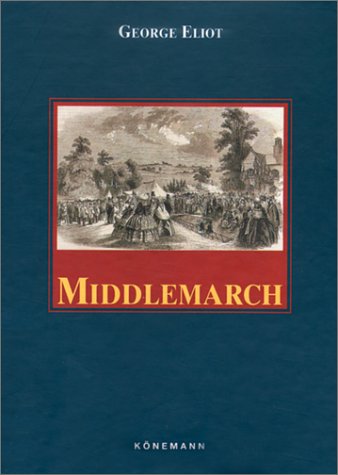
George Eliot, Middlemarch: A study of provincial life (George Eliot, 1871–1872; Könemann 1997), chapter 47 to beginning chapter 59

This month, as usual, Middlemarch made its presence felt elsewhere than in the five pages I read each morning. Researching her family history, the Struggling Artist learned that her paternal ancestor who came to Australia roughly a decade after the events related in Middlemarch was a health practitioner who started out as a doctor and became an apothecary because that’s where the money lay after medical doctors were no longer able to sell drugs. This change in the law plays a big role in the fortunes of Middlemarch‘s Lydgate. He is in favour of the changes and the established medical men of the town, believing they will be deprived of much of their livelihood, take against him.

In last month’s progress report, I described the moment when Dorothea feels pity for Casaubon, her dried-up stick of a husband. I thought it was a central turning point, a hinge. Little did I know (spoiler alert) that the real turning point would turn up in the next day’s reading! He died.

This month, among the older generation there’s much buying and selling, some blackmail, some generosity to the younger generation, a near riot as the railway comes to town, and some apparent endorsement by George Eliot of appalling class attitudes and behaviour.

Among the younger generation, which is where our interest really lies, Dorothea is taking up the management of her inherited estate, while a codicil to Casaubon’s will says she will be disinherited if she marries Will Ladislaw – which if it becomes known will create the impression that the two young people have been having a dalliance (nothing could be further from Dorothea’s mind or Will’s upright nature, though it’s what we want for them both). In the hope of winning Mary’s hand, Fred has given up any intention of becoming a clergyman, but he has discovered, and inadvertently alerted Mary to the fact, that the altogether decent, but older, Mr Farebrother has his hopes set on her too. Rosamond, who only last month revealed that she was pregnant, has had a miscarriage probably caused by going riding against her husband’s advice, and there’s a brilliant scene when Lydgate tells her about their financial crisis expecting her to see it as their shared problem, only to find that their understandings of the world, including in particular of their marriage, are separated by a huge gulf.

Today the narrative returns to the vexed issue of Dorothea and Will’s prospects. At least, that’s where I think we’re heading. Chapter 59 begins with this wonderful sentence, a nice example of Eliot’s way with similes, and of her wry understanding of how good intentions don’t guarantee good outcomes:

News is often dispersed as thoughtlessly and effectively as that pollen which the bees carry off (having no idea how powdery they are) when they are buzzing in search of their particular nectar.

While visiting the Farebrother household Fred learns about the codicil to Casaubon’s will. He, who ‘knew little and cared less about Ladislaw and the Casaubons’, wants to avoid being scolded tiresomely by his sister for having given up the Church, and passes the news on to distract her. Who knows what his sister, gorgeous and totally lacking in empathy, will do with the information? It’s not like her to keep any cat in any bag.

The suspense is massive.

Middlemarch: Progress report 4

George Eliot, Middlemarch: A study of provincial life (George Eliot, 1871–1872; Könemann 1997), end chapter 35 to end chapter 46.

Five pages of Middlemarch each morning has been my dependable daily joy for four months now.

This month, as usual, it turned up in other reading. Natasha May wrote in the Guardian that when she was young she found George Eliot’s sympathy for Dr Casaubon life-changing. She quoted this from Dorothea’s ‘honeymoon’ in Rome:

She was as blind to his inward troubles as he to hers: she had not yet learned those hidden conflicts in her husband which claim our pity. She had not yet listened patiently to his heartbeats, but only felt that her own was beating violently.

In my 20s, as far as I remember, I thought George Eliot’s sympathy for Casaubon was largely sarcastic. My current reading is closer to Natasha May’s. This month in particular, as he faces his mortality, I can tell that Eliot genuinely feels for him, and she paints his inner turmoil so vividly that when he offers Dorothea a word of attenuated kindness, we feel it as his moral victory, as well as recognising that Dorothea is no longer in his thrall:

‘Come, my dear, come. You are young, and must not to extend your life by watching.’
When the kind quiet melancholy of that speech fell on Dorothea’s ears, she felt something like the thankfulness that might well up in us if we had narrowly escaped hurting a lamed creature. She put her hand into her husband’s, and they went along the broad corridor together.

(Page 488)

That’s the end of Book Four, and of the first volume in the edition I’m reading, so pretty much the central hinge of the novel.

Since then, in the first pages of Volume 2, the narrative has been concerned with the politics of Middlemarch. Fifty years ago I read this as variously background and counterpoint to the main story of Dorothea’s romantic life. It’s not that I misread it then, but this time around I’m much more interested in Eliot’s satirical account of how an uneducated public responds to medical innovation, how professionals’ vested interests oppose that innovation, how media (in this case newspapers) function as tools of political agents, how political elites look after their own, and so on. It’s hard not to think of current conversations about the First Nations Voice to Parliament when I read a sentence like this one:

Oppositions have the illimitable range of objections at command, which need never stop short at the boundary of knowledge, but can draw for ever on the vasts of ignorance.

(Page 503)

This morning, I read a scene involving the two young men: Lydgate the reforming doctor (I can’t bear to call him Tertius), and Will (it seems unfriendly to call him Ladislaw) the reformed artistic gadabout who now edits a newspaper. Lydgate has married the beautiful Rosamond, which we know won’t end well; Will adores Dorothea, which we fear likewise. Lydgate has thrown his lot in with the religious ideologue Bulstrode because he supports Bulstrode’s hospital project. Will is allied with the scatter-brained Mr Brooke’s potential run for parliament because he sees it as a way of supporting the movement for political reform*. The young men – one of them lying on the rug in the other’s living room, while the latter’s wife, Rosamond, waits impatiently for the disagreeable conversation to finish – discuss the evergreen subject of how to form alliances with others who are less than perfect. Lydgate:

If one did not work with such men as are at hand, things must come to a dead-lock. Suppose the worst opinion in the town about Bulstrode were a true one, that would not make it less true that he has the sense and the resolution to do what I think ought to be done in the matters I know and care most about; but that is the only ground on which I go with him.

(Page 531)

Rosamond calls a halt to the conversation. When Will has gone she and Lydgate have a brief conversation and we find out in the last three lines of the chapter, almost as a throwaway that a) Lydgate’s household debts, unknown to Rosamond, are becoming more pressing and, b) Rosamond is pregnant. I thought of this novel as proceeding at a leisurely pace, but no five pages pass without significant plot developments.


* Mostly I can live with not understanding the specific political and cultural references in Middlemarch. I did look up Lord Grey’s Reform Act of 1832. Mr Brooke is a Tory, who in his typical muddled way thinks Grey (a Whig) has a lot going for him. Will hopes to help Brooke get elected, and to influence him to support Grey’s bill.

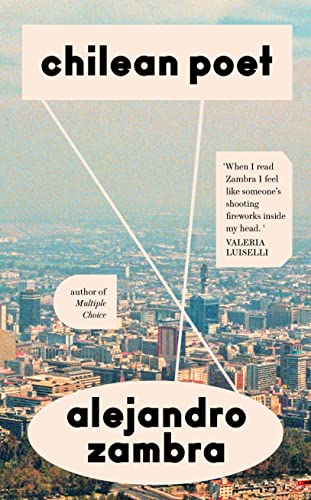
Alejandro Zambra’s Chilean Poet and the book group

Aalejandro Zandro, Chilean Poet: A novel, translated by Megan McDowell (Granta 2022)

Before the meeting: I enjoyed this novel enormously. I expect people who know Chile, and especially the Chilean poetry scene, would enjoy it even more.

In the freezing Chilean winter of 1991, teenagers Carla and Gonzalo curl up night after night under a magnificent red poncho watching television in her mother’s house and manage to do ‘everything except for the famous, the sacred, the much feared and longed-for penetration’. Just as the nights are beginning to warm up and remove the excuse for the poncho, they get an opportunity, but the famous etc event turns out to be less than absolutely pleasurable, at least for Carla.

The story goes on from there. In my innocence, I was surprised by the turns of events, so I won’t go into detail, except to say that Gonzalo as a teenager is an aspiring poet, and we get to read one of the atrocious sonnets he writes for Carla; and some years later Gonzalo becomes stepfather to Carla’s son Vicente.

The second half of the book begins with an echo of the opening of the first half. Vicente, now a teenage aspiring poet (probably more promising than Gonzalo), is in explicit sexual action with Pru, an older woman visiting Chile from the USA, using alarmingly explicit English he has picked up from porn.

It may be a spoiler, but I’ll risk it: the relationship between the two poets Gonzalo and Vicente is the heart of the book and its narrative spring. Carla and Pru, and Vicente’s natural father León, are vivid secondary characters. Chile, in particular Santiago, and most specifically the Chilean poetry community, provide the charming, engrossing, at times hilarious, always lively milieu.

Pru is visiting Santiago on her first major journalistic assignment. Her editor wants a ‘human interest’ story about stray dogs, but she persuades him to let her explore the poetry scene, and Alejandro Zambra has a lot of fun describing her interviews with poets.

I have no idea if poets and poetry have the prominent role in Chilean life that these poets claim. One of them says that for Chileans the Nobel Prize in Literature is as significant as the World Cup, and it’s a matter of huge pride that Chilean poets have won it twice: Gabriela Mistral (1945) and Pablo Neruda (1971). Not that any of the living poets care too much for Neruda or Mistral – the living are much more interesting and important, and their mutual competition, championing and denigration make Australia’s so-called poetry wars look … well, I was going to say tame, but really it makes them look normal.

I’ve read two other novels with poet protagonists recently: Edwina Preston’s Bad Art Mother and Niall Williams’s A History of the Rain. Unlike the former, we believe that the characters in Chilean Poet actually write poetry of varying quality; unlike the latter, these poets are part of a thriving scene rather than slightly deranged, isolated mystics. One of the joys of the book is the way their alertness to language features strongly in all their relationships. The account of Vicente’s wooing of Pru, for example, is full of the joys and perils of communicating across a language barrier.

There’s a terrific scene in the first part, when Gonzalo is a hands-on father to Vicente. He breaks one of Clara’s rules by allowing Vicente to sit in the front seat of the car – and accidentally reveals his crime to her. She explodes, using the word betrayal, which sets him off:

‘I’m so sorry for taking care of Vicente every single day,’ said Gonzalo.
‘It’s times like these it’s clear you’re not his father,’ retorted Carla.
Gonzalo looked at her with astonishment and contempt. He grabbed his hair with his left hand, and with his right he tore up an abundant clump of grass.
‘I’m a much better father than that lame-ass, ugly, mediocre motherfucking pusillanimous sack of balls who stuck his dick in you.’

(Page 75)

Rather than continue with the fight, the narrative stops there, and the poet-mind kicks in. Gonzalo spends two pages mentally critiquing his own sentence. It ‘felt a bit ungrammatical and was a pretty stupid outburst, but …’ He ponders the accuracy of ‘ugly’, acknowledges that pusillanimous doesn’t apply, and wonders if he used that word ‘for the mere pleasure of saying a word that León would have to look up in a dictionary’. He quite likes sack of balls because it’s not only hurtful but original. And before pouring himself a double whisky and stomping off to his writing-room he indulges in this final piece of poetic analysis:

The truly damning part was definitely that grand finale, who stuck his dick in you, which brought jealousy to the forefront and insinuated that Carla was some kind of whore. Still, the accusation held a trace of childishness, as if Gonzalo had only just found out how babies are made.

(Page 76)

Megan McDowell’s translation is terrific. At many moments, the narrative turns on the use of language, as in the passage I’ve just discussed. At a key moment, when Vicente is quite young, he and Gonzalo discuss the Spanish word for ‘stepfather’ – padrastro. Gonzalo is reluctant to take it on because astro at the end of a word has negative connotations. McDowell does a brilliant job of putting this into English as a completely plausible conversation for a poet to have with a young boy, and manages not to feel as if she is winking at English readers over the characters’ heads.

The meeting: After an hour of convivial catch-up and organising of food, we settled down to the book. Unusually, the Chooser explained how he had made his choice: he started out thinking of something by Annie Ernaux, in deference to the Nobel Prize committee, but as none of her books were easily available he sought advice at from his local bookseller, who suggested this – which turned out, he said, to be a perfect summer read. One chap who usually doesn’t say much, and usually speaks softly, immediately grabbed the floor and disagreed vehemently: not an ideal summer read at all; for that he’d recommend Richard Osman’s Thursday Murder Club series; this author was too intent on displaying his knowledge of poetry and poets to keep his narrative alive and engaging.

And it was on!

No one, it turned out, had done the work of checking which poets in the book are real and which imagined. A number of us, including a late-comer who had missed the opening salvo, just loved the bit where Pru interviews a range of poets and leaves the main narrative on hold. There’s a disorderly poet’s party that got a lot of love.

The bits that might have been irritating, where the author breaks the fourth wall to comment on his decisions, were pretty universally enjoyed. We were sorry to see the end of Pru, the gringa journalist over whose shoulder we get to know the poetry scene. One chap felt that Carla, Vicente’s mother, was a bit two-dimensional. No one contradicted him, but no one seemed to mind terribly. One man said he’d read the book very soon after last meeting and could barely remember it, which he took to mean it is pretty forgettable – though he did remember that it lacked any strong sense of place. Not everyone agreed – perhaps not the physical place, but we felt that there was a strong feel for the cultural milieu, and the food.

One man brought a bottle of pisco and made pisco sours (of which many are drunk in the book), plus a sour-without-pisco for the non-drinker. He also brought a selection of holiday photos from Santiago and Valparaiso, including one of Pablo Neruda’s home, now a museum.

Favourite passages about poetry were read and enjoyed all over again, including one in which a poet says he doesn’t know whether what he writes is any good, but he writes because of what it achieves for his own mind. (That definitely rang a bell for me and my own adventures in rhyme).

As usual, the conversation dissipated, though this time it stayed roughly on topic: there were anecdotes about meeting famous poets and other famous people (including two stories about David Malouf that cemented his status in my mind as a spectacularly kind person), ruminations on the comparative respect in which poets are held in Chile and Australia, an invitation for personal reflections about step-parent experiences that went unaccepted because none of us had been there, stories of young men getting excited when they realised they were talking to an older man who reads books, some excellent ribaldry. Unrelated: George Pell’s faulty theology, Lydia Thorpe’s stand in relation to the Voice, the complexity of some post-Holocaust Jewish family histories.

Towards the end of the evening, the man who had set the ball rolling with vehement negativity announced with equal vehemence that he realised he had actually enjoyed the book. We took this as vindication of the group as a way of taking the solitary act of reading into a shared experience.

After the meeting: Someone mentioned having seen a YouTube conversation with Alejandro Zambra and Megan McDowell. I dutifully watched it during my grandson’s afternoon sleep the next day. It’s full of good things about the translator–novelist relationship – if you watch it and are strapped for time, you could start at the 10 minute mark and skip all the charming introductory stuff. I particularly love their discussion (from 13’00” to 19’05”) of the Spanish word for ‘stepfather’, padrastro, including Zambra’s comment that as a poet Gonzalo is fighting with that word. Poets are always fighting with words, intensely, he says, ‘which is beautiful’.

Middlemarch: Progress report 3

George Eliot, Middlemarch: A study of provincial life (George Eliot, 1871–1872; Könemann 1997), chapter 28 to partway through chapter 35

Reading five pages of Middlemarch each morning, which I’ve now been doing it for two months, is a joy.

This month, as usual, it turned up in other reading. In Claire Potter’s book Acanthus there’s a short poem ‘Middlemarch in the Kitchen’. I don’t think the poem says anything about Middlemarch specifically – it just happens to be the book the poet is reading in the lighted kitchen: ‘instead of the grass and the trees, the objects I turn my back on are before me in the window’. But it’s a little sign that Middlemarch is everywhere. [Added on 16 March, just a little more than 2 months later: This morning, a passage in Chapter 61 of Middlemarch leapt out at me. The pious Mr Bulstrode’s past is catching up with him, so that ‘he felt the scenes of his earlier life coming between him and everything else, as obstinately as when we look through the window from a lighted room, the objects we turn our backs on are still before us, instead of the grass and the trees’.]

I have been away from home since the last week of December, and I didn’t bring my borrowed copy of Middlemarch away with me, as it would have risked damage to this beautiful object.

The parts I did read since my last progress report told mainly of the death of Peter Featherstone and the general disappointment generated by his will. In the younger generation, Lydgate has proposed to Rosamond, not without a degree of manipulation on her part; Fred has not benefited from his uncle’s death and so all hope of marriage to Mary seems lost; Dorothea is unhappily resigned to a life of misery with Mr Casaubon, but Will is back in town. Intrigue and hypocrisy continue to be the order of the day among their elders. George Eliot’s pleasure in her creations continues to shine in every sentence.

Here’s something from the last page I read before packing for Victoria. Mrs Bulstrode has raised the subject of her niece Rosamond’s betrothal to Lydgate – having a vague sense that this inappropriate match is partly due to her ostentatiously pious husband having given Lydgate a boost in the town’s social life:

‘I am sure we are bound to pray for that thoughtless girl – brought up as she has been,’ said Mrs Bulstrode, wishing to rouse her husband’s feelings.
‘Truly, my dear,’ said Mr Bulstrode, assentingly. ‘Those who are not of this world can do little else to arrest the errors of the obstinately worldly. That is what we must accustom ourselves to recognise with regard to your brother’s family. I could have wished that Mr Lydgate had not entered into such a union; but my relations with him are limited to that use of his gifts for God’s purposes which is taught us by the divine government under each dispensation.’
Mrs Bulstrode said no more, attributing some dissatisfaction which she felt to her own want of spirituality. She believed that her husband was one of those men whose memoirs should be written when they died.

(page 397)

‘Those who are not of this world,’ he says, meaning himself, who is of course one of the wealthiest men in town and much given to power games. And we know that ‘the use of his gifts for God’s purposes’ refers to Bulstrode’s having installed Lydgate as the only chaplain in the new hospital, thereby excluding any clergyman who might be critical of Bulstrode, The reader wants to give him a good shaking.

Maybe George Eliot’s irony is a little heavy, but I just love that ‘assentingly’: Bulstrode doesn’t have to disagree with his wife in order to reject outright her implied request for an intervention. Mrs Bulstrode’s backing off is one of GE’s myriad examples what we now call internalised sexism – but in case you’re inclined to think her belief, all evidence to the contrary, in her husband’s spiritual superiority is a mere comic invention, I remind you that just this morning former Australian Prime Minister was quoted as describing the recently deceased George Pell as ‘a saint of our time’.

Jessica Au’s cold enough for snow

Jessica Au, Cold Enough for Snow (Giramondo 2022)

Cold Enough for Snow won the inaugural Novel Prize in 2020. It’s very short, hardly more than a novella. In it, the narrator, a young woman I guess to be in her late 20s, takes her mother on a holiday to Japan. The two women have lived in different cities for some time and this is a kind of reunion. The recount of their holiday is interspersed with the young woman’s memories of family stories, her transformative university experience, an episode from her sister’s life, and a little about a former boyfriend and her husband. No big stormy scenes, no tears or even really any laughter. The biggest drama of the holiday occurs when the mother believes she has lost her passport then finds it in a zipped compartment of her bag.

Yet it’s hard to put the book down.

What is not said looms large. The narrator tells us early in the book that she invited her mother to come on the trip ‘for reasons [she] could not yet name’. She never does name them, but the question has been raised for the reader.

For most of the book the narrator is insufferably patronising to her mother, making all the decisions, telling her what to do, giving her brief lectures about the art they see, generally explaining the world to her, and – on the occasions when her mother does speak – barely managing to be respectful.

We come to understand that this is a migrant story – the mother came to Australia from Hong Kong and she and her husband made great sacrifices so their daughters could have every advantage. In their turn, the daughters grow up in a different culture, unable to speak their parents’ language, relating to them in mutual incomprehension. In my reading, the narrator is lost between two worlds, having been overwhelmed by the attractions of western culture but not quite at home there. Her mother becomes an enigmatic emblem of the culture she has lost: mostly silent, patient, largely unreadable.

None of this is spelled out. It’s conveyed by something unsettling going on beneath the flat, unemotional surface of the writing. There’s no direct speech. Most characters and most places are unnamed. We are often given details but not the general picture or the way the details connect: it’s as if the narrator is a visitor to the world, interested but largely uncomprehending. It’s a book that cries out for some close reading.

Page 75 is a good example of what I mean. The narrator is remembering a visit to the father of her husband, Laurie (Laurie is one of the few named characters):

Laurie had taken a photo of me standing next to the bright yellow car in a field of green sugarcane. As we drove he pointed out his old high school, the house of a childhood friend, the beaten track where he’d trained and competed as a kid. We stopped at a large lake, which seemed to be an almost perfect circle. Laurie explained that the lake had been formed by a crater, and that no one knew how deep it really was. He’d swum across it many times as a teenager, and once, he and his first girlfriend had borrowed a friend’s canoe and taken a tent and camped at the other side.

(Page 75)

This seems straightforward, but there’s a hint of the uncanny valley about it. As the first sentence focuses on the colours of the photograph (a product, perhaps of the narrator’s studies of visual art), you hardly notice that it places the car in a canefield – the reader almost automatically adjusts the image to place the car on the roadside next to the canefield, but the discrepancy has a subliminal effect. Then there’s the lack of names or sense of place. An Australian reader will know they are in North Queensland, probably driving from Cairns airport through sugarcane country, then up the steep climb to the Atherton Tableland, and stopping at Lake Barrine (or possibly Lake Eacham). Stripping out the names could be a matter of avoiding the colonisers’ language, an oblique acknowledgement of Indigenous ownership. In the immediate context, though, it seems to stem from the narrator’s lack of engagement with the world beyond her immediate relationship. She sees only what Laurie draws to her attention.

Once arrived at their destination, there’s this:

Even though he had not lived there for many years, Laurie moved around with a deep sense of familiarity, the kind that could only come from childhood. He went freely from room to room, picking up objects like he owned them, knowing all the paintings on the walls and where everything was kept. In the spare room, he found a shoebox full of old photos, and showed me one of his fifth birthday party, all the boys dressed up as pirates, hanging off a wooden ship his father had built for them, and that had stayed in the garden for many years.

There is very little description of the rooms or the objects that Laurie picks up. It’s as if the narrator isn’t at home enough in the world to name them, or even perhaps see them. By contrast, Laurie has a place, a piece of country, a house, that are full of memories. Even though he now lives in the unnamed city that has a university and trams, he still has this deeply familiar childhood place, a rootedness – exactly what the narrator lacks. Even after years away from his father, there’s a sense of continuity in the relationship. On the following pages it turns out that the father is an artist and can talk to the narrator about art in a way that her mother simply cannot (though once again we are told nothing of the conversation’s content.

This passage appears toward the end of the book. I chose it because of my arbitrary policy of picking page 75 for a little close reading when I blog about books, but also because I’m a North Queenslander. What’s true of the descriptions here is also true of places in Japan, and in Glebe in Sydney (I think). Jessica Au has given us a tremendously subtle portrait of a second-generation immigrant trying to find her bearings, and perhaps – depending how you read the book’s final moment, which I won’t spoil here – succeeding.


I am grateful to Giramondo Publishing for my copy of Cold Enough for Snow.

Middlemarch: Progress report 2

George Eliot, Middlemarch: A study of provincial life (George Eliot, 1871–1872; Könemann 1997), chapter 15 to most of chapter 28

Reading five pages of Middlemarch each morning, which I’ve now been doing it for two months, is a joy.

When reading Niall Williams’s This Is Happiness, I kept feeling a Middlemarchian tone: the narrators in both books tell of events that happened in a remote village in living memory but feel as if they are from a different era. Williams’s narrator has a name and a story of his own. We are left to imagine who George Eliot’s narrator might be, though there’s definitely a person there, who is full of opinions, occasionally mentions conversations with her friend, and – if we assume she is a mature woman as Eliot was known to be when the book appeared – has bitter experience of male domination. Both narrators identify themselves as sophisticated and modern, she in metropolitan England, and he in the USA.

This month the intrigues continue among the older and younger generations, the former to do with control of the town’s institutions and the latter to do with affairs of the heart. Dorothea is married to Casaubon but troublingly finds his young cousin Will Ladislaw a more interesting companion in Rome. Rosamond is closing in on Lydgate as a prospective husband. And Fred, the profligate young man, discovers that his failure to keep promises not only harms his reputation but also harms other people.

This morning, the Rosamond–Lydgate story is approaching a defining moment. They have been thrown together when Lydgate comes to attend Rosamond’s brother Fred who has been struck down by typhus. Actually, not quite thrown together: Rosamond has declined to take the recommended course of leaving their house until the danger of infection was past, ostensibly so that she can help her mother tend to Fred, but really so she can see more of Lydgate. After some vividly evoked moments when they become embarrassed at meeting each other’s eyes, they settle into openness and ease with each other. He begins to play at flirting with her, seeing no harm in such a little pleasure. She – admitting it to no one – has visions of marrying him and escaping the suffocating backwater of Middlemarch. After much intricate tracking of the mental processes of each of them, and a scene where Lydgate sees off a chinless young man who he doesn’t even realise is a rival for Rosamond’s affections, today’s read finished with this terrific paragraph, which sums up the state of play, foreshadows the outcome, and ends with a gloriously deflating image:

To Rosamond it seemed as if she and Lydgate were as good as engaged. That they were some time to be engaged had long been an idea in her mind, and ideas, we know, tend to a more solid kind of existence, the necessary materials being at hand. It is true, Lydgate had the counter-idea of remaining unengaged; but this was a mere negative, a shadow cast by other resolves which themselves were capable of shrinking. Circumstance was almost sure to be on the side of Rosamond’s idea, which had a shaping activity and looked through watchful blue eyes, whereas Lydgate’s lay blind and unconcerned as a jelly-fish which gets melted without knowing it.

(pages 312–313)

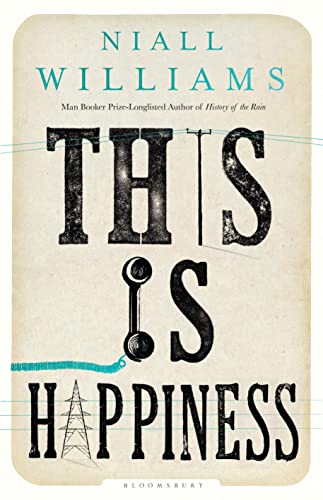
This is Happiness, Niall Williams and the Book Group

Niall Williams, This Is Happiness (Bloomsbury 2019)

Before the meeting: When we discussed Niall Williams’s History of the Rain in October, a number of people had also read his next book, This Is Happiness. December’s chooser, impressed by their enthusiasm, decided we should all read it.

The book’s first sentence, ‘It had stopped raining’, which sits on a page by itself, is pretty much identical with the final sentence of the earlier book, and the tiny, backward village of Faha in West Ireland is again the setting, but the bulk of the narrative takes place in an earlier period, and there is no obvious reference to the characters or events of History of the Rain. It’s the story of the coming of electricity to the village; a coming of age story of young Noe, who has taken leave of the seminary and is telling the story as an old man in the USA; and a big romantic story of love lost and found by Christy, an older man who befriend Noe.

Page 75* must be one of the book’s few pages that doesn’t mention the absence of rain. It happens in the thick of one of the book’s comic set pieces. It’s not the set piece when the lights go down and the cinema comes alive with amorous grapplings, or the one where Noe goes to the communion rail at Sunday Mass in order to get a good look at the woman Christy left at the altar, or the spectacular one where he is knocked unconscious by a falling electricity pole. On page 75 Noe and Christy are on the first of a number of epic pub crawls.

These pub crawls are as much about music as about alcohol, music performed by men who are shy and nondescript until they start playing, and then are brilliant conduits of a great folk tradition. On this first adventure, when the evening is well under way, Christy startles Noe and everyone else in Craven’s pub by starting to sing:

Not only was Christy singing, he was singing with screwed-up eyes and fists by his side a ballad about love. He was singing it full-throated and full-hearted and before he had reached the second verse it was clear even to Roo the dog that a passionate truth was present in that place. It wasn’t only that this didn’t happen in Craven’s, it was that there was something raw in it, something deeply felt, that was, even to those who had descended blinking into the umbrae and penumbrae of numberless bottles of stout, immediately apparent and made those who first looked now look away.

(page 73)

Christy has come to Faha as a worker in the great electricity project. This episode is our first inkling of his profoundly romantic reason for signing up for the work. Not so obviously, it prepares us for the major role music is to play in Noe’s story. Page 75 itself is a beautiful piece of misdirection. After Christy has sung, Noe writes:

I did the only thing I could do. I went to the counter and got two bottles of stout.

Those bottles are followed by another two, and then another. Greavy the guard arrives and declares that it’s Closing Time (as Noe says, this is one more way in which Faha lags behind the times), but the two of them are incapable of moving. Alcohol-based humour usually leaves me cold, but Niall Williams’s version made me laugh out loud. I suppose the whole book could be read as an extended Irish joke: the villagers have an almost superstitious awe of the one telephone in town, and the coming of electricity has almost cosmic significance for them. If you read the whole book like that, the stereotypical Irish drunkenness in this passage is representative (including the sly invocation of Waiting for Godot):

Getting up proved aspirational. There was the idea of it, quite clear. Unmistakably clear now. There were hands placed on knees for push-off. There was a Right now. There was another when that failed to produce action. A Right so following. And still nothing. Between thought and verb a vacancy, not intended, but not grievous, just gently perplexed, and in that perplex the realisation that Craven’s was not in fact such a bad place at all, was downright comfortable in fact, in fact there were few places on this earth as agreeable. True? Too true. A person could stay here, could stay right here and be quite happy now, quite, for a very long time. What’s your rush? There’s no rush. All the problems of the world could be settled right here.
Right.
Will we go so?

I don’t want to minimise the book’s humour. Far from it. But there’s a seriousness to it that page 75 gives no clue of. Christy’s romance is genuinely touching. The villagers’ resistance to the coming of electricity is more than comic: and these villagers are described as custodians of their land, defending an ancient culture under siege by capitalism – without being at all heavy handed, the narrative reminds us that the Irish were the first people to be colonised by the English. The dramatic decline in the Catholic Church’s power since the 1950s is deftly evoked both in Noe’s commentary and in his own story: his turning away from his priestly vocation is a tiny reflection of the ending of Church-domination in Ireland at large.

After the meeting: There were seven of us. Covid–19 and other coronaviruses kept some away, while one or two had better things to do – and one sent video of spectacular drone art over Sydney Harbour.

This was our end-of-year meeting so we had other business besides the book, but it generated quite a bit of discussion. The discussion was unusual in that quite a few of us read out favourite passages. Indeed, two of the absentees sent lists of quotes – it’s that kind of book. One interesting insight was that the narrative as we receive it is created by an old man looking back on a key moment in his youth, making a story out of it, and casting a benevolent glow over the community in which that moment happened.

Other business, besides of course the plentiful food including a splendid pavlova, included a Kris–Kringle book exchange with the usual mixture of cautious delight and polite almost-hidden dismay, and a poetry reading. We were each supposed to bring a poem, and most did, even one of the absentees.

Poems were a nonsense poem by CJ Dennis (‘Triantiwontigongolope’), a poem about climate change (that was me – Kit Kelen’s ‘Parable’), a Thomas Hardy (‘Heredity’), a Robert Frost (‘A Time to Talk’), a poem from Claudia Rankine’s Just Us (‘sound and fury’), and two poems of Australian patriotism that couldn’t have been more different (Sara Mansour’s ‘My Australia‘ – link to her performing it on YouTube – and a poem whose name and creator I don’t remember celebrating the lump in the throat brought on by, for example, Anzac Day). This little reading, including by two people who said they felt awkward reading poetry aloud, left us reeling.

And that was a wrap for the Book Group for 2022.

* Currently when blogging about books I take a closer look, arbitrarily, at page 75 – moving on to page 76 at my next birthday if the idea works well enough.

Middlemarch: Progress report 1

George Eliot, Middlemarch: A study of provincial life (George Eliot, 1871–1872; Könemann 1997), pages 1–162

I had read just eight pages of Middlemarch, two mornings’ worth, squinting through sleep bleared eyes, when a kind friend lent me her copy, a beautiful two-volume edition from a German publishing house that is set in type that will demand less effort than the on I picked up from Gould’s bookshop.

In other reading this month, when the protagonist of Ian McEwan’s Lessons reads the novel written by his estranged wife, he finds to his chagrin that it is brilliant, and includes ‘high-flying digressions offered up to the ghost of George Eliot’ (page 243).

So far, it’s not so much high-flying digressions as sharp authorial observations on the side that are delighting me. For instance, in the first scene where the gorgeous, privileged Rosamond Price and plain, less privileged Mary Garth have a scene together, there’s this brief excursion into the abstract:

Plainness has peculiar temptations and vices quite as much as beauty; it is apt either to feign amiability, or, not feigning it, to show all the repulsiveness of discontent: at any rate, to be called an ugly thing in contrast with that lovely creature your companion, is apt to produce some effect beyond a sense of fine veracity and fitness in the phrase.

(Page 130)

Part of the pleasure of this kind of thing is that it’s ironic. The narrator goes on to attribute to Mary the ‘vice’ of speaking with a satiric edge, a quality the narrator herself has in spades. There’s always a sense of the narrator as a character here, one who has a lot in common with George Eliot herself. In this example, it’s hard not to read the comment as springing in part from Eliot’s own experience of being seen as plain (‘horse-faced’, I dimly remember). The novel’s opening words, ‘To my dear husband’, affirm that George Eliot is a woman, and I guess she could assume that the English reading public knew who she was.

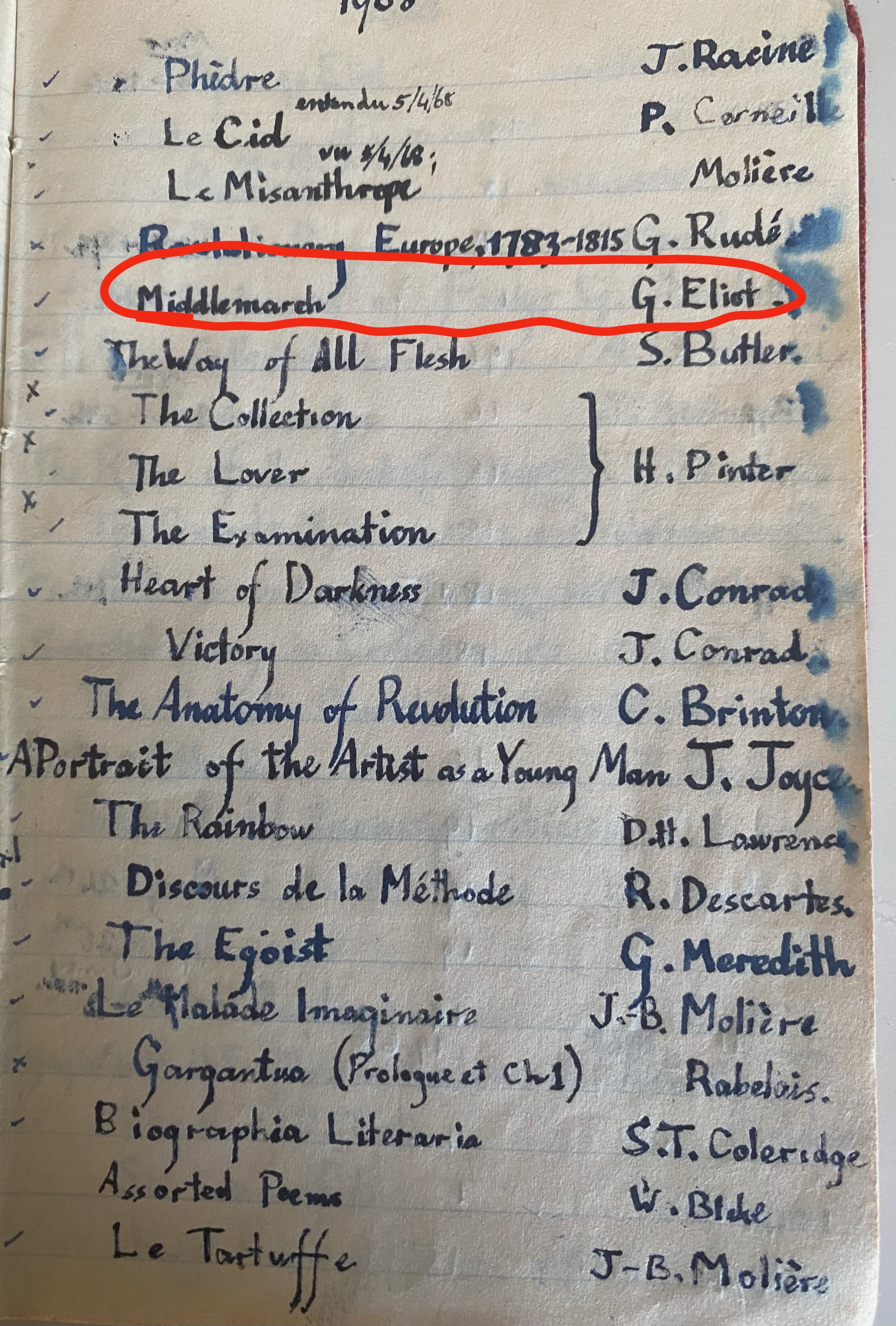
When I read Middlemarch in 1968, it was as part of an exhilarating immersion in literary classics. In the little notebook where I listed the books I read, it appears on the same page Racine’s Phèdre, Samuel Butler’s The Way of All Flesh, and books by Pinter, Conrad, Joyce, Lawrence, Descartes and Rabelais. So reading it now, with that tsunami well in the past and without my 20-year-old predisposition to awe, is like meeting it for the first time.

I’m pretty sure I picked up on the ironic tone back then, but I doubt if I understood that the affectionate mockery of the idealistic heroine Dorothea and her pragmatic sister Celia, of gorgeous Rosamond and her flibbertigibbet brother Fred, and of ‘plain’, sarcastic Mary all has to do with their youth. The narrator is in love with their lack of world-weariness, and I’m in love with them too, as I doubt I was the first time around, however much I loved the book.

Mind you, I’ve read to the Emerging Artist a couple of passages that gave me joy. She responded to the first with a noncommittal noise, and to the second, ‘Now I know I was right not to read past the first page.’ So it’s not a book for all tastes.

So far, Dorothea has committed herself to marry the dried up old stick, Mr Casaubon. Youngish Dr Lydgate has arrived in the area full of reforming zeal. Rosamond, whose beauty no man could resist, is determined to marry someone from outsides Middlemarch and Lydgate is a likely prospect. Fred is in love with Mary, who has been his friend since childhood. The older generation is rife with intrigue to do with religious intolerance, political ambition, greed, and owning-class pretensions. So far, it’s a frothy comedy of manners as told by an immensely erudite and morally serious narrator.

This morning, there was some dialogue worthy of Oscar Wilde. Mary is responding to Fred’s proposal of marriage, which we understand has been made many times before::

‘If l did love you, I would not marry you: I would certainly not promise ever to marry you.’
‘I think that is quite wicked, Mary. If you love me, you ought to promise to marry me.’
‘On the contrary, I think it would be wicked in me to marry you even if I did love you.’
‘You mean, just as I am, without any means of maintaining a wife. Of course: I am but three-and-twenty.’
‘In that last point you will alter. But I am not so sure of any other alteration. My father says an idle man ought not to exist, much less, be married.’
‘Then I am to blow my brains out?’
‘No; on the whole I should think you would do better to pass your examination.’

(Page 162)

I hope they end up living happily together, rich or poor. I know their love’s path will not be smooth, any more than that of any of the other potential love matches.